REVIEW 3 major objections 4 minor 1 cited by
Skyrmions of Frustrated Quantum Dimer Systems
T0 review · 3 major / 4 minor · reviewed 2026-08-06 · deepseek-v4-flash
Pith's one-line read Frustrated isotropic Heisenberg dimers can host CP^3 skyrmion crystals at zero temperature, with no Dzyaloshinskii-Moriya or easy-axis anisotropy needed.
desk verdict Clear and useful extension of skyrmion physics to CP^3 in frustrated spin-dimer systems, with a plausible frustration-induced easy-axis mechanism, but the numerical evidence for the headline phases rests on a single 5x5 commensurate cell and needs finite-size validation. read the letter →
The pith
A machine-rendered reading of the paper's core claim, the machinery that carries it, and where it could break.
The reading
What carries the argument
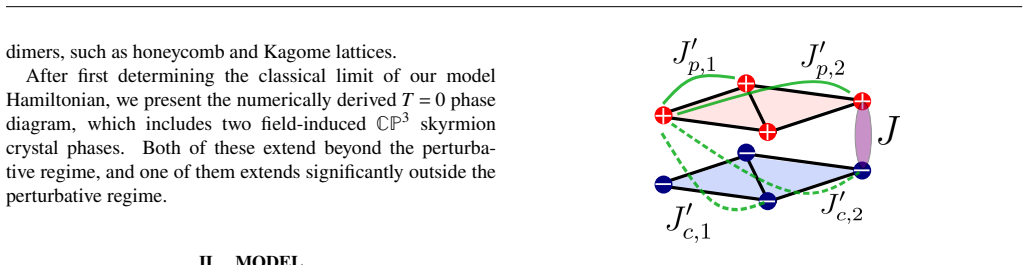
The machinery is the SU(4)-coherent-state classical limit of the dimer Hilbert space, in which the local state of each dimer is represented by a 15-component color field $n^\mu_j$ living on the manifold $\mathbb{CP}^3$, a complex projective space whose second homotopy group $\Pi_2(\mathbb{CP}^3)\cong\mathbb{Z}$ classifies skyrmion textures. The classical Hamiltonian is a generalized Landau-Lifshitz dynamics for the color field, and the skyrmion charge is computed as a sum of Berry phases around triangular plaquettes. The load-bearing identity is that the low-energy projected Hamiltonian becomes an XXZ pseudospin-$1/2$ model with effective exchange anisotropy $\Delta = J_+/2J_-$; $\Delta>1$ (easy-axis) selects six ordering wave vectors whose magnitude is set by the ratio $J_-^2/|J_-^1| = 2/(1+\sqrt5)$, making the ordering wave vector $Q=1/5$ commensurate with a $5\times 5$ magnetic unit cell.
What would settle it
Recompute the classical SU(4) energy minimization for the same Hamiltonian at, say, $\alpha=0.5$ and field just below saturation using magnetic unit cells of size $L=6$, $L=7$, or $L=8$; if a single-Q spiral, a multi-domain state, or a different triple-Q state is found to be lower in energy than the SkX-II skyrmion crystal for any larger cell, the claim that the phase persists beyond the perturbative regime is false. A complementary experimental falsifier would be inelastic neutron scattering on a candidate material showing elliptical, rather than circular, Goldstone cones at the six ordering wave vectors.
Extended reading notes
Core claim
The central claim is that the classical limit of a frustrated spin-dimer bilayer on a triangular lattice, with only SU(2)-invariant Heisenberg couplings, supports two thermodynamically stable zero-temperature $\mathbb{CP}^3$ skyrmion crystal phases in an applied field. The SkX-I phase consists of a triangular lattice of fully polarized cores in a singlet background, while the SkX-II phase inverts the texture, with singlet cores surrounded by a polarized background. The effective low-energy pseudospin model derived in the weak-coupling limit shows that the competition between parallel and crossed isotropic inter-dimer exchanges generates an easy-axis exchange anisotropy $\Delta>1$, which is the known criterion for stabilizing skyrmion crystals in centrosymmetric frustrated magnets. The numerical phase diagram shows the SkX-II phase persisting for inter-dimer exchange comparable to the intra-dimer exchange ($\alpha\lesssim 0.5$), well outside the perturbative regime. The paper also argues that the same mechanism should apply to other hexagonal dimer lattices such as honeycomb and kagome.
Load-bearing premise
The numerical phase diagram rests on a single magnetic unit cell of linear dimension $L=5$, chosen to match the ordering wave vector $Q=1/5$, with no finite-size scaling or larger-cell checks reported.
Editorial extensions
If this is right
- Skyrmion crystals at zero temperature no longer require Dzyaloshinskii-Moriya interactions or single-ion anisotropy; isotropic exchange frustration plus a field suffices.
- Because the target space is $\mathbb{CP}^3$ rather than $S^2$, skyrmion textures can interpolate between a singlet state and a polarized triplet state, so the cores or backgrounds of the textures can be locally paramagnetic.
- The SkX-II phase surviving to $\alpha\approx 0.5$ means the mechanism is not confined to weak inter-dimer couplings and could be realized in strongly coupled dimer materials.
- Triple-$Q$ skyrmion phases can be distinguished from multi-domain single-$Q$ spirals by inelastic neutron scattering: the Goldstone-mode cones are circular in the triple-$Q$ phases and elliptical in single-$Q$ phases.
- Stacked triangular-lattice dimer compounds with strong interlayer coupling are named as candidate platforms for realizing these $\mathbb{CP}^3$ skyrmions.
Reading between the lines
- The paper does not test this, but recomputing the phase diagram with magnetic unit cells of linear dimension $L=6$, $L=7$, and $L=8$ would show whether the SkX-II phase and the triple-$Q$ minima survive the $L=5$ commensuration, or whether they are an artifact of pinning $Q=1/5$.
- The same SU($N$)-coherent-state construction should, in principle, produce $\mathbb{CP}^{N-1}$ skyrmion crystals in any dimer or cluster system whose local Hilbert space has $N$ levels and whose effective low-energy model acquires easy-axis-like anisotropy; testing this on $N>4$ cases, such as systems with multiple singlet states, would generalize the result.
- Because the SkX phases carry finite scalar spin chirality on each layer, optical probes of magnetochiral or magneto-optical response might detect them even where neutron diffraction shows no dipolar long-range order; the paper suggests magnetic circular dichroism but does not compute the expected signal strength.
Editorial analysis
A structured set of objections, weighed in public.
Referee Report
Summary. The paper studies the classical limit of a frustrated spin-1/2 dimer bilayer on a triangular lattice, using SU(4) coherent states that retain intra-dimer entanglement. The authors derive an effective low-energy pseudospin model, compute a zero-temperature phase diagram by numerical minimization of the classical Hamiltonian, and identify two field-induced CP^3 skyrmion crystal phases (SkX-I and SkX-II) that emerge from isotropic Heisenberg exchange interactions alone. They argue that SkX-II remains stable up to inter-dimer exchange comparable to the intra-dimer exchange (alpha ~ 0.5), and they compute spin-wave spectra and neutron scattering signatures to guide experimental detection.
Significance. If the phase diagram is correct, this would be the first demonstration that zero-temperature skyrmion crystals can be stabilized by isotropic exchange frustration alone, with a CP^3 target space rather than the usual CP^1. The paper's analytical framework is a clear strength: the classical limit based on SU(4) coherent states, the derivation of the effective pseudospin model (Appendix B), the continuum Hamiltonian (Appendix D), and the topological charge formula (Eq. 17-18) are all presented carefully and connect to established results. The predicted inelastic neutron scattering distinctions between single-Q and triple-Q orders (Figs. 5 and 11) are concrete and falsifiable. However, the central numerical claim rests on a single commensurate 5x5 magnetic unit cell, without finite-size scaling or off-commensuration checks, so the phase diagram must be treated as preliminary until that evidence is strengthened.
major comments (3)
- [Section V and Figure 2] The entire phase diagram is computed with a single magnetic unit cell of linear dimension L=5, made commensurate with the ordering wavevector by setting J^-_2/|J^-_1| = 2/(1+sqrt(5)) in Eq. (21). No finite-size scaling, larger-cell calculation, or off-commensuration test is reported. Because the allowed wavevectors are locked to multiples of 1/5, competing phases with incommensurate or slightly different Q cannot be represented, and skyrmion crystals are triple-Q states whose stability depends precisely on the energy balance among single-Q, double-Q, and triple-Q candidates. The claim that SkX-II persists up to alpha ~ 0.5 (Section III.A) is therefore not yet established for the infinite-lattice Hamiltonian; it may be a commensuration artifact. The authors should provide calculations for larger commensurate cells (e.g., L=6, 7, 8) and at least one off-commensuration point, or an energy comparison with incommensurate single-Q states, to support the robustness of the phase boundaries.
- [Section III.A versus Section V] There is a technical inconsistency about what is actually minimized. Section III.A states that the phase diagram is obtained by 'numerically minimizing the classical spin Hamiltonian H_SU(4) given in Eq. (16)', which is the continuum Hamiltonian density, while Section V states that a 5x5 cell of SU(4) coherent states is optimized using 'the Hamiltonian Eq. (11)', which is the lattice Hamiltonian. Section III.A also mentions 'a finite lattice of up to 2L x 2L = 4L^2 dimers', which is ambiguous and does not match the 5x5 description in Section V. Please clarify which Hamiltonian and which lattice size were used, because this directly affects the interpretation of the finite-size evidence and the reproducibility of the results.
- [Section VII (Code Availability)] The Code Availability section says the numerical code 'can be found at **', with a placeholder instead of a URL or repository identifier. Since the central result is a numerical phase diagram and the authors state that all data can be reproduced using that code, the placeholder blocks independent verification. The repository should be cited with a working link (e.g., DOI or persistent URL) before the manuscript is accepted.
minor comments (4)
- [Section III.A] After Eq. (21), 'controls the validly of the perturbation theory' should be 'controls the validity of the perturbation theory'.
- [Section III.B] Near Eq. (23), 'the dipersion of the magnon modes' should be 'the dispersion of the magnon modes'.
- [Abstract] The abstract says the phase diagram is for 'weak inter-dimer coupling', but Section III.A states that SkX-II extends well beyond the perturbative regime to alpha ~ 0.5. Consider rephrasing to avoid an apparent contradiction.
- [References] Reference [50] is a funding acknowledgment that appears in the reference list; it would be cleaner to place it as an unnumbered acknowledgment footnote rather than as a numbered reference.
Circularity Check
No significant circularity: the CP3 skyrmion crystal phases are obtained by unconstrained numerical minimization of the full SU(4) lattice Hamiltonian, not by imposing a skyrmion ansatz. The low-energy pseudospin model is derived, not fitted. Minor self-citations supply the coherent-state framework and numerical tools but are not load-bearing.
full rationale
I walked the claimed derivation chain and found no step in which a prediction reduces to its inputs by construction. The central result, the T=0 phase diagram of Fig. 2, is obtained by minimizing the lattice Hamiltonian H_SU(4) (Eq. 11) with random initial conditions and a dense grid of parameter points (Section V); the SkX-I and SkX-II phases emerge as energy minima rather than being inserted as an ansatz. The low-energy pseudospin model (Eq. 19) is derived in Appendix B by projecting the microscopic Hamiltonian onto the singlet/Sz=1 subspace, and it is used only to explain the mechanism and to guide parameter choice, not as the energy function for the phase diagram. The choice J^-2/|J^-1| = 2/(1+sqrt5) (Eq. 21) and L=5 fixes the ordering wavevector Q=1/5, but this is an explicit modeling constraint, not a fit whose output is then called a prediction; it does restrict incommensurate competitors, which is a finite-size correctness risk, not circularity. Self-citations to Zhang et al. (2023) and Dahlbom et al. (2024) provide the SU(4) coherent-state classical limit, the skyrmion-charge formula, and the numerical method, but these are not used to assert the existence of the skyrmion phases; the energy minimization is performed independently in this paper. The equivalence of the CP3 Berry flux to a solid angle on an S2 Bloch sphere (Appendix G) is a mathematical proof, not a circular reuse of the result. The placeholder code availability ('**') is a reproducibility gap but does not make the derivation circular. Overall: no load-bearing circularity; minor self-citations are present but the central claim has independent content.
Assumptions & free parameters
free parameters (2)
- Delta (effective exchange anisotropy) =
1.2
- J_-2/|J_-1| exchange ratio =
2/(1+sqrt5)
assumptions (5)
- domain assumption The SU(4) coherent-state product ansatz |Z> = ⊗_j |Z_j> (Eq. 4) provides a valid classical limit for the quantum dimer model, so the ground state of the full quantum Hamiltonian is approximated by a product of such states.
- standard math Second homotopy group Pi_2(CP^{N-1}) = Z for N >= 2, so mappings from the compactified plane to CP^3 carry integer topological charge.
- standard math In the M -> infinity limit of completely symmetric SU(4) irreps, the generators commute to leading order and the factorization rule ⟨T^mu T^nu⟩ = ⟨T^mu⟩⟨T^nu⟩ holds.
- domain assumption The effective low-energy pseudospin model (Eq. 19) derived to first order in the inter-dimer couplings, with the field isolating the singlet and S_z=1 triplet states, captures the physics relevant for skyrmion stabilization.
- domain assumption The L=5 magnetic unit cell, made commensurate with the ordering wavevector Q=1/5 by the exchange ratio choice J_-2/|J_-1| = 2/(1+sqrt5), is large enough to capture the true ground state, including triple-Q skyrmion crystal phases.
Cite this review
Pith. "Pith review of Skyrmions of Frustrated Quantum Dimer Systems." pith.science (2026). https://pith.science/paper/OK7UWU24
@misc{pith2026250622320,
  author       = {Pith},
  title        = {Pith review of: Skyrmions of Frustrated Quantum Dimer Systems},
  year         = {2026},
  howpublished = {\url{https://pith.science/paper/OK7UWU24}},
  note         = {Machine review of arXiv:2506.22320}
}
abstract
Magnetic skyrmions are topologically protected solitons observed in various classes of real magnets. In two-dimensional systems, where the target space of local magnetization values is the two-sphere $S^2$, skyrmion textures are classified by the homotopy classes of two-loops $S^2$ in $S^2$: $\Pi_2(S^2) \cong Z$. Here, we demonstrate that more general topological skyrmion textures emerge in the classical limit of quantum dimer systems, where the phase space of the relevant classical theory is $\mathbb{CP}^{N-1}$ (with $N=4$ for the case of interest), because the relevant second homotopy group, $\Pi_2(\mathbb{CP}^{N-1}) \cong Z$ for $N\geq 2$, remains unchanged. Building on the framework established by Zhang et al. (2023), we consider a classical limit based on SU(4) coherent states, which preserve intra-dimer entanglement. We show that the zero-temperature phase diagram of frustrated spin-dimer systems on a bilayer triangular lattice with weak inter-dimer coupling includes two magnetic-field-induced $\mathbb{CP}^{3}$ skyrmion crystal phases.
Figures


Figures from the paper (8 more)


Forward citations
Cited by 1 Pith paper
-
Dynamics of Quantum Chiral Solitons
Chiral solitons in a one-dimensional spin chain can be quantized on the lattice, producing fermionic bands whose nearest-neighbor hopping changes sign between integer and half-integer spin.
Reference graph
Works this paper leans on
-
[1]
Skyrmion lattice in a chiral magnet.Sci- ence 323, 915 (2009)
Mühlbauer, S.et al. Skyrmion lattice in a chiral magnet.Sci- ence 323, 915 (2009). URLhttp://www.sciencemag.org/ content/323/5916/915
work page 2009
-
[2]
Yu, X. Z. et al. Real-space observation of a two-dimensional skyrmion crystal. Nature 465, 901 (2010). URL http://www.nature.com/nature/journal/ v465/n7300/full/nature09124.html
work page 2010
-
[3]
Yu,X.Z. etal. Nearroom-temperatureformationofaskyrmion crystal in thin-films of the helimagnet FeGe.Nature Materi- als 10, 106 (2011). URL http://www.nature.com/nmat/ journal/v10/n2/full/nmat2916.html
work page 2011
-
[4]
Seki, S., Yu, X. Z., Ishiwata, S. & Tokura, Y. Observation of skyrmions in a multiferroic material. Science 336, 198 (2012).URL http://www.sciencemag.org/content/336/ 6078/198
work page 2012
-
[5]
is tuned to make the ordering wave vector commensurate with a magnetic unit cell of linear di- mension 𝐿= 5. We consider the caseΔ1=Δ 2=Δ and find that skyrmions are stabilized only forΔ> 1, consistent with the known requirement of easy-axis anisotropy for skyrmion stabilization in centrosymmetric materials [11]. Notably, the expression forΔ𝜈 given in Eq....
-
[6]
Adams, T. et al. Long-wavelength helimagnetic order and skyrmion lattice phase in Cu2OSeO3. Phys. Rev. Lett.108, 237204(2012).URL http://link.aps.org/doi/10.1103/ PhysRevLett.108.237204
work page 2012
-
[7]
Romming, N. et al. Writing and deleting single magnetic skyrmions. Science 341, 636–639 (2013). URL http: //www.sciencemag.org/content/341/6146/636
work page 2013
-
[8]
Bogolubskaya,A.&Bogolubsky,I. Stationarytopologicalsoli- tons in the two-dimensional anisotropic heisenberg model with a skyrme term.Physics Letters A136, 485–488 (1989)
work page 1989
Show all 58 references
-
[9]
Bogolyubskaya,A.A.&Bogolyubsky,I.L.OnStationaryTopo- logical Solintons In Two-dimensional Anisotropic Heisenberg Model. Lett. Math. Phys.19, 171–177 (1990)
1990
-
[10]
& Hubert, A
Bogdanov, A. & Hubert, A. Thermodynamically sta- ble magnetic vortex states in magnetic crystals. Journal of Magnetism and Magnetic Materials 138, 255 – 269 (1994). URL http://www.sciencedirect.com/science/ article/pii/0304885394900469
1994
-
[11]
& Kawamura, H
Okubo, T., Chung, S. & Kawamura, H. Multiple- 𝑞 states and the skyrmion lattice of the triangular-lattice heisenberg antiferromagnet under magnetic fields. Phys. Rev. Lett.108, 017206 (2012). URL https://link.aps.org/doi/10. 1103/PhysRevLett.108.017206
2012
-
[12]
Leonov, A. O. & Mostovoy, M. Multiply periodic states and isolated skyrmions in an anisotropic frustrated magnet.Nature Communications 6, 8275 (2015). URL https://doi.org/ 10.1038/ncomms9275
2015 doi
-
[13]
Ginzburg-landautheoryforskyrmions in inversion-symmetric magnets with competing interactions
Lin, S.-Z.&Hayami, S. Ginzburg-landautheoryforskyrmions in inversion-symmetric magnets with competing interactions. Phys. Rev. B93, 064430 (2016). URL https://link.aps. org/doi/10.1103/PhysRevB.93.064430
2016 doi
-
[14]
& Batista, C
Hayami, S., Lin, S.-Z. & Batista, C. D. Bubble and skyrmion crystals in frustrated magnets with easy-axis anisotropy.Phys. Rev. B93, 184413 (2016). URL https://link.aps.org/ doi/10.1103/PhysRevB.93.184413
2016 doi
-
[15]
D., Lin, S.-Z., Hayami, S
Batista, C. D., Lin, S.-Z., Hayami, S. & Kamiya, Y. Frustration and chiral orderings in correlated electron systems.Reports on Progress in Physics79, 084504 (2016). URLhttps://doi. org/10.1088%2F0034-4885%2F79%2F8%2F084504
2016
-
[16]
& Batista, C
Wang, Z., Su, Y., Lin, S.-Z. & Batista, C. D. Skyrmion crystal from RKKY interaction mediated by 2D electron gas.Phys. Rev. Lett. 124, 207201 (2020). URL https://link.aps. org/doi/10.1103/PhysRevLett.124.207201
2020 doi
-
[17]
Topologicalspincrystalsbyitinerant frustration
Hayami,S.&Motome,Y. Topologicalspincrystalsbyitinerant frustration. J.Phys.: Condens.Matter 33,443001(2021). URL https://doi.org/10.1088/1361-648x/ac1a30
2021 doi
-
[18]
Z.et al.Skyrmion flow near room temperature in an ul- tralow current density.Nature Communications3, 988 (2012)
Yu, X. Z.et al.Skyrmion flow near room temperature in an ul- tralow current density.Nature Communications3, 988 (2012). URL http://www.nature.com/ncomms/journal/v3/n8/ full/ncomms1990.html?WT.ec_id=NCOMMS-20120807
2012
-
[19]
Yu, X. Z.et al. Biskyrmion states and their current-driven motioninalayeredmanganite. NatureCommunications 5,3198 8 (2014). URL https://doi.org/10.1038/ncomms4198
2014 doi
-
[20]
V., Paulose, P
Mallik, R., Sampathkumaran, E. V., Paulose, P. L., Sugawara, H. & Sato, H. Magnetic anomalies in gd2pdsi3. Pramana - J. Phys.51, 505 (1998)
1998
-
[21]
Saha, S. R. et al. Magnetic anisotropy, first-order-like metamagnetic transitions, and large negative magnetoresis- tance in single-crystal Gd2PdSi3. Phys. Rev. B60, 12162– 12165 (1999). URL https://link.aps.org/doi/10. 1103/PhysRevB.60.12162
1999
-
[22]
Skyrmion lattice with a giant topological halleffectinafrustratedtriangular-latticemagnet
Kurumaji, T.et al. Skyrmion lattice with a giant topological halleffectinafrustratedtriangular-latticemagnet. Science365, 914–918(2019).URL https://science.sciencemag.org/ content/365/6456/914
2019
-
[23]
Magnetic behavior of Gd3Ru4Al12, a layered compound with distorted kagoménet
Chandragiri,V.,Iyer,K.K.&Sampathkumaran,E.V. Magnetic behavior of Gd3Ru4Al12, a layered compound with distorted kagoménet. JournalofPhysics: CondensedMatter 28,286002 (2016). URL https://doi.org/10.1088%2F0953-8984% 2F28%2F28%2F286002
2016
-
[24]
Skyrmion phase and competing mag- netic orders on a breathing kagomé lattice.Nature Communi- cations 10, 5831 (2019)
Hirschberger, M.et al. Skyrmion phase and competing mag- netic orders on a breathing kagomé lattice.Nature Communi- cations 10, 5831 (2019). URLhttps://doi.org/10.1038/ s41467-019-13675-4
2019
-
[25]
& Batista, C
Zhang, H. & Batista, C. D. Classical spin dynam- ics based on SU(N) coherent states. Phys. Rev. B 104, 104409 (2021). URL https://link.aps.org/doi/10. 1103/PhysRevB.104.104409
2021
-
[26]
& Batista, C
Zhang, H., Wang, Z., Dahlbom, D., Barros, K. & Batista, C. D. Cp2skyrmionsandskyrmioncrystalsinrealisticquantummag- nets. Nature Communications14, 3626 (2023). URLhttps: //www.nature.com/articles/s41467-023-39232-8
2023
-
[27]
Akagi,Y.,Amari,Y.,Sawado,N.&Shnir,Y.Isolatedskyrmions in the CP2 nonlinear 𝜎-model with a Dzyaloshinskii–Moriya type interaction.Phys. Rev. D103, 065008 (2021)
2021
-
[28]
Coherentstatesforarbitraryliegroups
Perelomov,A.M. Coherentstatesforarbitraryliegroups. Com- munications in Mathematical Physics26, 222–236 (1972)
1972
-
[29]
Dahlbom, D. et al. Geometric integration of classical spin dynamics via a mean-field schrödinger equation.Phys. Rev. B 106,054423(2022). URL https://link.aps.org/doi/10. 1103/PhysRevB.106.054423
2022
-
[30]
Dahlbom, D., Miles, C., Zhang, H., Batista, C. D. & Barros, K. Langevindynamicsofgeneralizedspinsassu( 𝑛)coherentstates (2022). URL https://arxiv.org/abs/2209.01265
2022 arXiv
-
[31]
Dahlbom, D. et al. Renormalized classical theory of quan- tum magnets (2023). URLhttps://arxiv.org/abs/2304. 03874
2023
-
[32]
& Kus, M
Gnutzmann, S. & Kus, M. Coherent states and the classi- cal limit on irreducible representations. Journal of Physics A: Mathematical and General31, 9871–9896 (1998). URL https://doi.org/10.1088/0305-4470/31/49/011
1998 doi
-
[33]
Unusual phases in quantum spin-1 sys- tems
Papanicolaou, N. Unusual phases in quantum spin-1 sys- tems. Nuclear Physics B 305, 367–395 (1988). URL https://www.sciencedirect.com/science/article/ pii/0550321388900739
1988
-
[34]
Batista, C. D. & Ortiz, G. Algebraic approach to interacting quantum systems.Advances in Physics53, 1–82 (2004). URL https://doi.org/10.1080/00018730310001642086. https://doi.org/10.1080/00018730310001642086
2004 doi
-
[35]
Zapf, V. S.et al. Bose-Einstein condensation of𝑠= 1 nickel spindegreesoffreedominNiCl 2−4SC(NH2)2. Phys.Rev.Lett. 96, 077204 (2006). URLhttps://link.aps.org/doi/10. 1103/PhysRevLett.96.077204
2006
-
[36]
& Penc, K
Läuchli, A., Mila, F. & Penc, K. Quadrupolar Phases of the 𝑆= 1Bilinear-BiquadraticHeisenbergModelontheTriangular Lattice. Phys. Rev. Lett.97, 087205 (2006). URL https:// link.aps.org/doi/10.1103/PhysRevLett.97.087205
2006 doi
-
[37]
A., Kato, Y
Muniz, R. A., Kato, Y. & Batista, C. D. Generalized spin- wave theory: Application to the bilinear–biquadratic model. Prog. Theor. Exp. Phys.2014, 083I01 (2014). URL https: //doi.org/10.1093/ptep/ptu109
2014 doi
-
[38]
G., Ivanov, B
Galkina, E. G., Ivanov, B. A. & Butrim, V. I. Longitudinal spin dynamics in nickel fluorosilicate. Low Temperature Physics 40, 635–640 (2014). URL https://doi.org/10.1063/1. 4890989. https://doi.org/10.1063/1.4890989
2014 doi
-
[39]
& Batista, C
Dahlbom, D., Thomas, J., Johnston, S., Barros, K. & Batista, C. D. Classical dynamics of the antiferromagnetic heisen- berg s = 1/2 spin ladder. Phys. Rev. B 110, 104403 (2024).URL https://journals.aps.org/prb/abstract/ 10.1103/PhysRevB.110.104403
2024 doi
-
[40]
Sunny.jl: A julia package for spin dynam- ics (2025)
Dahlbom, D.et al. Sunny.jl: A julia package for spin dynam- ics (2025). URL https://arxiv.org/abs/2501.13095. 2501.13095
2025 arXiv
-
[41]
URL https://arxiv.org/abs/2410.02180
Park, P.et al.Contrasting dynamical properties of single-q and triple-q magnetic orderings in a triangular lattice antiferromag- net (2025). URL https://arxiv.org/abs/2410.02180. 2410.02180
2025 arXiv
-
[42]
Topological magneto-optical effects and their quantization in noncoplanar antiferromagnets.Nature Commu- nications11, 118 (2020)
Feng, W.et al. Topological magneto-optical effects and their quantization in noncoplanar antiferromagnets.Nature Commu- nications11, 118 (2020)
2020
-
[43]
Dahlbom, D., Miles, C., Zhang, H., Batista, C. D. & Barros, K. Langevin dynamics of generalized spins as su(𝑛) coherent states. Physical Review B106, 235154 (2022). URLhttps: //link.aps.org/doi/10.1103/PhysRevB.106.235154
2022 doi
-
[44]
B.et al.Singlet-triplet dispersion reveals additional frustrationinthetriangular-latticedimercompoundba3mn2o8
Stone, M. B.et al.Singlet-triplet dispersion reveals additional frustrationinthetriangular-latticedimercompoundba3mn2o8. Physical Review Letters100, 237201 (2008)
2008
-
[45]
Samulon, E. C.et al. Asymmetric quintuplet condensation in the frustrated s=1 spin dimer compound ba3mn2o8.Phys. Rev. Lett.103, 047202 (2009)
2009
-
[46]
Samulon,E.C. etal. Anisotropicphasediagramofthefrustrated spin dimer compound ba3mn2o8. Phys. Rev. B81, 104421 (2010)
2010
-
[47]
Lee, M. et al. Series of phase transitions and mul- tiferroicity in the quasi-two-dimensional spin- 1 2 triangular- lattice antiferromagnet ba3conb2o9. Phys. Rev. B 89, 104420 (2014). URL https://link.aps.org/doi/10. 1103/PhysRevB.89.104420
2014
-
[48]
& Tanaka, H
Yokota, K., Kurita, N. & Tanaka, H. Magnetic phase dia- gram of the𝑠= 1 2 triangular-lattice heisenberg antiferromagnet ba3Conb2o9. Phys. Rev. B90, 014403 (2014). URL https: //link.aps.org/doi/10.1103/PhysRevB.90.014403
2014 doi
-
[49]
& Friedberg, S
Johnson, P., Rayne, J. & Friedberg, S. Magnetic properties of csnicl3 and rbnicl3.Journal of Applied Physics50, 1853–1855 (1979)
1979
-
[50]
Mogensen, P. K. & Riseth, A. N. Optim: A mathematical op- timization package for julia.Journal of Open Source Software 3, 615 (2018). URL https://doi.org/10.21105/joss. 00615
2018 doi
-
[51]
This manuscript has been authored by UT-Battelle, LLC, un- der contract DE-AC05-00OR22725 with the US Department of Energy (DOE). The US government retains and the publisher, by accepting the article for publication, acknowledges that the US government retains a nonexclusive, ...
-
[52]
(19) and (20), and explicitly map its param- eters back to those of the original Hamiltonianˆℋ
Mapping the pseudospin model to the full Hamiltonian Wenowfocusonthelow-energyeffectivepseudospinmodel defined by Eqs. (19) and (20), and explicitly map its param- eters back to those of the original Hamiltonianˆℋ. This is achieved by inverting Eqs. (20) and (21), while keepin...
-
[53]
2cos 𝑘𝑥𝑎 2 cos √ 3𝑘𝑦𝑎 2 ! + cos(𝑘𝑥𝑎) # (B5) + 𝐽− 2
Momentum Space Hamiltonian Next,werewritethepseudospinHamiltonian ˜ℋ inmomen- tum space by Fourier transforming the pseudospin operators: ˜𝝉𝒌 = 1√ 𝑁 ∑︁ 𝑗 𝑒𝑖𝒌·𝒓 𝑗 𝝉𝑗, 𝝉𝑗 = 1√ 𝑁 ∑︁ 𝒌 𝑒−𝑖𝒌·𝒓 𝑗 ˜𝝉𝒌. (B3) Note that ˜𝝉∗ 𝒌= ˜𝝉−𝒌 because 𝝉𝑗 is real𝝉𝑗 = 𝝉∗ 𝑗. The expression for the pse...
-
[54]
Note that −(𝐽− 1− 27𝐽−
cos6𝜙 𝑘6 + O(𝑘8), where 𝒌 = 𝑘(cos𝜙, sin𝜙). Note that −(𝐽− 1− 27𝐽−
-
[55]
Fromthispointon,wesetthelatticeconstant 𝑎astheunitof length (𝑎= 1)
> 0, implying that the six vectors±𝑸𝜈 (𝜈 = 1,2,3) that mini- mize the dispersion relation have values of𝜙=±𝜙𝜈 with 𝜙𝜈=−𝜋/6+ 2𝜈𝜋/3. Fromthispointon,wesetthelatticeconstant 𝑎astheunitof length (𝑎= 1). Equation (B6) shows that the anisotropy of the hexagonal lattice first appears...
-
[56]
2 features three distinct single-𝑸 ordered phases
Single-Q Spiral Phases Fig. 2 features three distinct single-𝑸 ordered phases. The largest of these is the AFM-CS phase (antiferromagnetic con- ical spiral; Fig. 7a), in which the spins rotate within the𝑥𝑦- plane. In this phase, the dipole moment exhibits minimal modulation al...
-
[57]
2, two of which (Fig
Double-Q Phases Therearethreedifferentdouble- 𝑸 orderingsthatareshown in Fig. 2, two of which (Fig. 8a,b) only appear in the non- perturbative regime. The third (Fig. 8c) only appears in a very narrow region within the perturbative regime and has al- most zero magnitude of dip...
-
[58]
CP1 Skyrmion flux
Asymmetric Triple-Q Phases Two distinct asymmetric triple-𝑸 spiral phases appear in Fig. 2, both characterized by a dominant contribution from one of the three ordering wave vectors𝑸𝜈 (𝜈= 1,2,3) [see Fig. 9]. In the 3Q-I phase [Fig. 9(a)], the longitudinal spin components exhi...
2000
Reviewed August 6, 2026 · model on record in the stance chip above.
Discussion (0). Continue with ORCID to comment.