REVIEW 2 major objections 4 minor 50 references
Asymmetric high-harmonic generation from subwavelength bianisotropic resonators
T0 review · 2 major / 4 minor · reviewed 2026-07-14 · grok-4.5
Pith's one-line read A single subwavelength bilayer resonator generates third, fifth and seventh harmonics with strong forward-backward directionality set by multipolar bianisotropy.
desk verdict Clean experimental demo of direction-selective multi-order HHG from one subwavelength bilayer resonator; multipole story is only interpretive and the result stands without it. read the letter →
The pith
A machine-rendered reading of the paper's core claim, the machinery that carries it, and where it could break.
The reading
What carries the argument
Multipolar bianisotropy of a C_infinity_v bilayer resonator: the absence of inversion symmetry allows the T-matrix to couple electric and magnetic multipoles of the same azimuthal order, so forward and backward pumps drive different near-field confinements and therefore different nonlinear conversion efficiencies.
What would settle it
Measure the same set of resonators under identical pump conditions but with the sapphire substrate replaced by an index-matched medium or removed entirely; if the forward-backward harmonic contrasts collapse while the linear extinction remains, the claimed multipolar mechanism is ruled out.
Extended reading notes
Core claim
A single dielectric subwavelength resonator whose geometrical volume is only 0.12 lambda cubed can act as a direction-selective high-harmonic source. Structural asymmetry along the propagation axis produces multipolar bianisotropy: opposite illumination directions excite different combinations of electric and magnetic dipoles and quadrupoles, which in turn yield pronounced forward-backward intensity contrasts (up to 55) in the generation of the third, fifth and seventh harmonics.
Load-bearing premise
The multipole decomposition calculated for a resonator sitting on a substrate is still a reliable enough guide to which current distributions actually drive the nonlinear response.
Signed reviews
Editorial analysis
A structured set of objections, weighed in public.
Referee Report
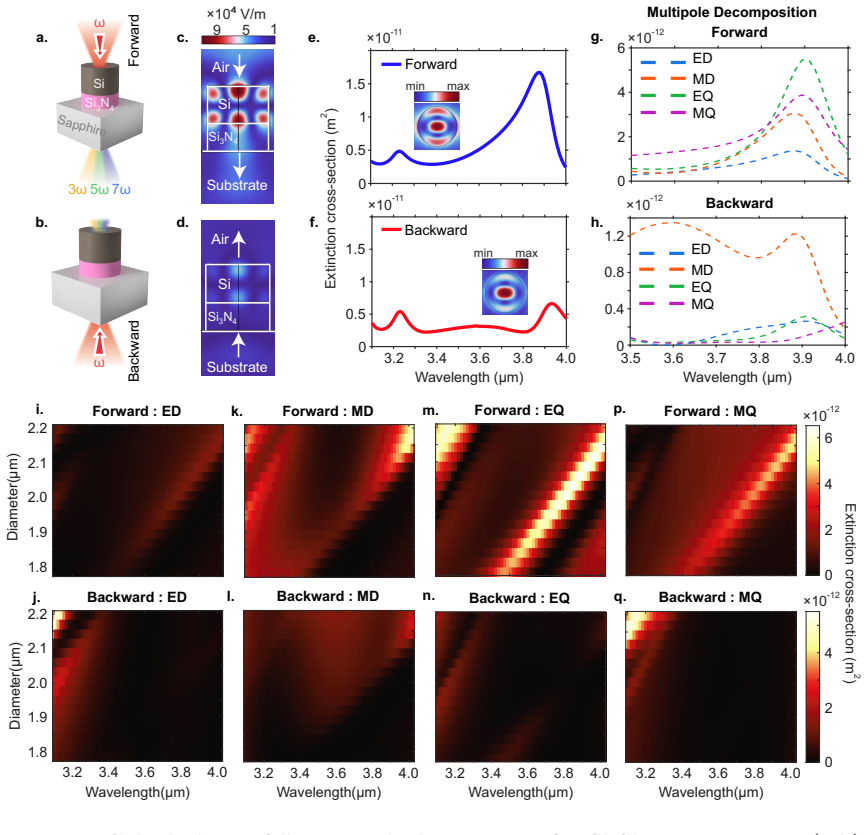
Summary. The manuscript experimentally demonstrates and theoretically interprets direction-selective high-harmonic generation (third, fifth, and seventh) from a single subwavelength bilayer dielectric resonator (a-Si / Si3N4 cylinder on sapphire). Structural asymmetry along the propagation axis produces bianisotropy, so that opposite illumination directions excite different multipolar compositions (primarily EQ/MQ vs MD) of the Mie response. This yields measured forward-to-backward intensity contrasts as large as ~55 for the fifth harmonic, systematically mapped versus resonator diameter and pump wavelength. Linear COMSOL calculations of near-field confinement (mode volume 0.03 λ^{3}), extinction, and approximate multipole decompositions are shown to track the spectral locations of the observed HHG asymmetry. The central claim is that a single bianisotropic Mie resonator can function as a compact, direction-selective high-harmonic source.
Significance. If the reported contrasts and spectral maps hold, the work supplies a concrete new control knob—propagation-direction asymmetry engineered via refractive-index bilayering—for solid-state HHG. Prior nanophotonic HHG studies have emphasized field enhancement, wavefront shaping, or chirality; direction-selective emission from an isolated subwavelength resonator (geometrical volume 0.12 λ^{3}) is a distinct addition to that toolbox and is relevant to compact attosecond or EUV sources. Strengths include systematic experimental diameter–wavelength maps for multiple harmonics, large measured contrasts, and transparent linear simulations that locate the resonances. The multipole analysis, while approximate, is presented only as a qualitative mechanism and is not required for the experimental claim itself.
major comments (2)
- Theory section (after Eq. 6 and Figs. 1g,h): the multipole decomposition is performed for a substrate-supported resonator yet is formally valid only in a homogeneous background. The authors correctly label it “approximate” and “qualitative,” but the subsequent claim that forward excitation preferentially drives EQ/MQ while backward drives MD is used to explain the HHG asymmetry. A short quantitative check (e.g., comparison of the multipole-reconstructed far-field with the full COMSOL far-field, or a homogeneous-background reference calculation) would strengthen the mechanistic link without altering the experimental result.
- Experiment / Fig. 3: the third- and fifth-harmonic contrast maps are obtained after a 3 imes3 Gaussian-weighted average. The raw (unaveraged) data should be shown in the SI or as an inset so that readers can judge whether the reported peak contrasts (30 for 3rd, 55 for 5th) and the spectral offset between 3rd- and 5th-harmonic maxima survive without smoothing. This is load-bearing for the quantitative claim of “pronounced” asymmetry.
minor comments (4)
- Abstract and Introduction: the phrase “optical mode volume is 0.03 λ^{3}” is given without stating the precise integration domain or the wavelength used for normalization; a one-sentence clarification (already present later in Theory) would help.
- Fig. 1 caption and panels i–q: axis labels and color-bar units are dense; increasing font size or splitting the multipole maps into two figures would improve readability.
- Methods: the average power is fixed at 10 mW, but the corresponding peak intensity at the sample is stated only later; moving the intensity figure of merit earlier would aid comparison with damage-threshold literature.
- References: a few recent works on bianisotropic dielectric meta-atoms and on substrate effects in multipole expansions could be added for completeness, but this is optional.
Circularity Check
No significant circularity; experimental HHG asymmetries are independent measurements, with multipole analysis used only for post-hoc qualitative interpretation.
full rationale
The paper's central claim is an experimental demonstration of direction-dependent third-, fifth-, and seventh-harmonic generation from a single bilayer Si/Si3N4 subwavelength resonator (geometrical volume 0.12 λ^{3}, mode volume 0.03 λ^{3}), with measured F/B intensity contrasts up to 55 (Figs. 2–4). Linear COMSOL calculations of near-fields, extinction, and approximate multipole decompositions (Theory section, Eqs. 1–6, Figs. 1c–q and 3a) supply a plausible mechanism via multipolar bianisotropy in the E1 subspace of C∞v, but these are not used to fit free parameters that are later re-presented as predictions, nor do they define the measured contrasts by construction. The multipole decomposition is explicitly flagged as approximate for a substrate-supported scatterer and treated only as a qualitative diagnostic. Self-citations (e.g., to prior metasurface work [27]) are comparative only and not load-bearing. Symmetry arguments invoke standard group theory and external references. No self-definitional loops, fitted-input-as-prediction, uniqueness theorems imported from the authors, or ansatz smuggling appear. The derivation chain is therefore self-contained against external experimental benchmarks.
Assumptions & free parameters
free parameters (2)
- Si / Si3N4 layer heights =
1.21 µm / 0.9 µm
- resonator diameters =
1.77–2.20 µm
assumptions (3)
- domain assumption Exact multipole expansion of the scattered field remains a qualitatively valid diagnostic even when the scatterer sits on a substrate whose reflectance is small.
- domain assumption Centrosymmetric bulk nonlinearities of a-Si and Si3N4 produce only odd-order harmonics; geometric symmetry breaking is insufficient to generate detectable even harmonics under the present design.
- standard math C∞v point-group selection rules allow electric-field coupling between electric and magnetic multipoles of the same azimuthal order m=1 (E1 irrep).
Cite this review
Pith. "Pith review of Asymmetric high-harmonic generation from subwavelength bianisotropic resonators." pith.science (2026). https://pith.science/paper/OKBXMXFU
@misc{pith2026260708715,
  author       = {Pith},
  title        = {Pith review of: Asymmetric high-harmonic generation from subwavelength bianisotropic resonators},
  year         = {2026},
  howpublished = {\url{https://pith.science/paper/OKBXMXFU}},
  note         = {Machine review of arXiv:2607.08715}
}
abstract
High-harmonic generation (HHG) enables attosecond light pulses and table-top sources of coherent extreme-ultraviolet and soft X-ray radiation. Although HHG has long been associated with gases and plasma, nanostructured solids are emerging as new alternative sources enabling both the enhancement and control of HHG. Here, we experimentally demonstrate and theoretically describe that a single dielectric subwavelength resonator can act as a direction-selective high-harmonic source, enabling control over multiple harmonic orders through the excitation and hybridization of Mie modes. The resonator's geometrical volume is $0.12 \lambda^3$, and its optical mode volume is $0.03 \lambda^3$ at its pump wavelength. Structural asymmetry of the resonator along the propagation direction translates into different mode coupling under opposite illumination directions, resulting in pronounced forward-backward asymmetry in the generation of the third, fifth, and seventh harmonics. These results establish bianisotropic subwavelength resonators as a platform for flexible asymmetric generation of high harmonics, expanding the toolbox for controlling strong-field light-matter interactions with Mie-resonant nanophotonics.
Figures


Figures from the paper (2 more)


Reference graph
Works this paper leans on
-
[1]
Enhancement of HHG has been investigated across various resonant nanophotonic platforms, beginning with plasmonic nanostructures [10, 16–21]
often via excitation of localized Mie modes or bound states in the continuum. Enhancement of HHG has been investigated across various resonant nanophotonic platforms, beginning with plasmonic nanostructures [10, 16–21]. While plasmonic structures offered strong field enhancements combined with tight field confinements, they suffered from intrinsic Ohmic l...
-
[2]
forward” and “backward
and 2 nd [28] harmonics. Here, by leveraging the interplay between nonlinear light-matter interactions and bianisotropic response in asymmetric nanoresonators, we experimentally demonstrate direction-dependent generation of multiple harmon- ics. Our platform consists of individual subwavelength resonators composed of two layers: amorphous silicon (Si) and...
1950
-
[3]
Ferray, A
M. Ferray, A. L’Huillier, X. Li, L. Lompre, G. Mainfray, and C. Manus, Multiple- harmonic conversion of 1064 nm radiation in rare gases, Journal of Physics B: Atomic, Molecular and Optical Physics21, L31 (1988)
1988
-
[4]
Burnett, H
N. Burnett, H. Baldis, M. Richardson, and G. Enright, Harmonic generation in CO 2 laser target interaction, Applied Physics Letters31, 172 (1977)
1977
-
[5]
Ghimire, A
S. Ghimire, A. D. DiChiara, E. Sistrunk, P. Agostini, L. F. DiMauro, and D. A. Reis, Observation of high-order harmonic generation in a bulk crystal, Nature Physics7, 138 (2011)
2011
-
[6]
Goulielmakis and T
E. Goulielmakis and T. Brabec, High harmonic generation in condensed matter, Na- ture Photonics16, 411 (2022)
2022
-
[7]
Ghimire and D
S. Ghimire and D. A. Reis, High-harmonic generation from solids, Nature Physics15, 10 (2019)
2019
-
[8]
Schubert, M
O. Schubert, M. Hohenleutner, F. Langer, B. Urbanek, C. Lange, U. Huttner, D. Golde, T. Meier, M. Kira, S. W. Koch,et al., Sub-cycle control of terahertz high- harmonic generation by dynamical bloch oscillations, Nature Photonics8, 119 (2014)
2014
Show all 50 references
-
[9]
T. T. Luu, M. Garg, S. Y. Kruchinin, A. Moulet, M. T. Hassan, and E. Goulielmakis, Extreme ultraviolet high-harmonic spectroscopy of solids, Nature521, 498 (2015)
2015
-
[10]
M. R. Shcherbakov, H. Zhang, M. Tripepi, G. Sartorello, N. Talisa, A. AlShafey, Z. Fan, J. Twardowski, L. A. Krivitsky, A. I. Kuznetsov,et al., Generation of even and odd high harmonics in resonant metasurfaces using single and multiple ultra- intense laser pulses, Nature Comm...
2021
-
[11]
Zalogina, L
A. Zalogina, L. Carletti, A. Rudenko, J. V. Moloney, A. Tripathi, H.-C. Lee, I. Shadrivov, H.-G. Park, Y. Kivshar, and S. S. Kruk, High-harmonic generation from a subwavelength dielectric resonator, Science Advances9, eadg2655 (2023)
2023
-
[12]
Vampa, B
G. Vampa, B. Ghamsari, S. Siadat Mousavi, T. Hammond, A. Olivieri, E. Lisicka- Skrek, A. Y. Naumov, D. Villeneuve, A. Staudte, P. Berini,et al., Plasmon-enhanced high-harmonic generation from silicon, Nature Physics13, 659 (2017)
2017
-
[13]
Zograf, K
G. Zograf, K. Koshelev, A. Zalogina, V. Korolev, R. Hollinger, D.-Y. Choi, M. Zuerch, C. Spielmann, B. Luther-Davies, D. Kartashov,et al., High-harmonic generation from resonant dielectric metasurfaces empowered by bound states in the continuum, ACS Photonics9, 567 (2022)
2022
-
[14]
An and K.-H
J.-K. An and K.-H. Kim, Efficient non-perturbative high-harmonic generation from nonlinear metasurfaces with low pump intensity, Optics & Laser Technology135, 106702 (2021)
2021
-
[15]
S. D. Roscam Abbing, R. Kolkowski, Z.-Y. Zhang, F. Campi, L. L¨ otgering, A. F. Koen- derink, and P. M. Kraus, Extreme-ultraviolet shaping and imaging by high-harmonic generation from nanostructured silica, Physical Review Letters128, 223902 (2022)
2022
-
[16]
Jangid, F
P. Jangid, F. U. Richter, M. L. Tseng, I. Sinev, S. Kruk, H. Altug, and Y. Kivshar, Spectral tuning of high-harmonic generation with resonance-gradient metasurfaces, Advanced Materials36, 2307494 (2024)
2024
-
[17]
Zubyuk, L
V. Zubyuk, L. Carletti, M. Shcherbakov, and S. Kruk, Resonant dielectric metasur- faces in strong optical fields, APL Materials9(2021)
2021
-
[18]
S. Kim, J. Jin, Y.-J. Kim, I.-Y. Park, Y. Kim, and S.-W. Kim, High-harmonic gener- ation by resonant plasmon field enhancement, Nature453, 757 (2008)
2008
-
[19]
Sivis, M
M. Sivis, M. Duwe, B. Abel, and C. Ropers, Extreme-ultraviolet light generation in plasmonic nanostructures, Science340, 164 (2013). 16
2013
-
[20]
Sivis, M
M. Sivis, M. Taucer, J. Aguirre, N. Yoshikawa, A. Erfanian, I. De Leon, C. Ropers, and R. W. Boyd, Tailored high-harmonic generation by plasmonic nanostructures, Nature541, 466 (2017)
2017
-
[21]
Park, Y.-M
I.-Y. Park, Y.-M. Kim, J. Choi, D.-H. Lee, J. Kim, M. F. Kling, M. I. Stockman, and S.-W. Kim, Plasmonic nanoantennas for intense field enhancement, Nature Photonics 5, 677 (2011)
2011
-
[22]
H¨ uttner, I
A. H¨ uttner, I. Bertelli, A. R¨ ottger, N. Pfullmann, K. I. Willig, C. Lienau, and M. Sivis, Plasmonic metasurfaces for strong-field and high-harmonic generation, ACS Photonics 8, 2708 (2021)
2021
-
[23]
Y. S. Youet al., High-harmonic generation from plasmonic metasurfaces with con- trolled near-field localization, Physical Review Letters130, 1 (2023)
2023
-
[24]
Tonkaev, F
P. Tonkaev, F. Lai, S. Kruk, Q. Song, M. Scalora, K. Koshelev, and Y. Kivshar, Even-order optical harmonics generated from centrosymmetric-material metasurfaces, Physical Review Research6, 033073 (2024)
2024
-
[25]
Mathew, R
A. Mathew, R. Aschwanden, A. Tripathi, P. Jangid, B. Sain, T. Zentgraf, and S. Kruk, Nonreciprocal metasurfaces with epsilon-near-zero materials, Nano Letters25, 3259 (2025)
2025
-
[26]
Tripathi, C
A. Tripathi, C. F. Ugwu, V. S. Asadchy, I. Faniayeu, I. Kravchenko, S. Fan, Y. Kivshar, J. Valentine, and S. S. Kruk, Nanoscale optical nonreciprocity with nonlinear meta- surfaces, Nature Communications15, 5077 (2024)
2024
-
[27]
J. King, C. Wan, T. J. Park, S. Deshpande, Z. Zhang, S. Ramanathan, and M. A. Kats, Electrically tunable VO2–metal metasurface for mid-infrared switching, limiting and nonlinear isolation, Nature Photonics18, 74 (2024)
2024
-
[28]
Cotrufo, A
M. Cotrufo, A. Cordaro, D. L. Sounas, A. Polman, and A. Al` u, Passive bias-free non-reciprocal metasurfaces based on thermally nonlinear quasi-bound states in the continuum, Nature Photonics18, 81 (2024). 17
2024
-
[29]
S. S. Kruk, L. Wang, B. Sain, Z. Dong, J. Yang, T. Zentgraf, and Y. Kivshar, Asym- metric parametric generation of images with nonlinear dielectric metasurfaces, Nature Photonics16, 561 (2022)
2022
-
[30]
Boroviks, A
S. Boroviks, A. Kiselev, K. Achouri, and O. J. Martin, Demonstration of a plasmonic nonlinear pseudodiode, Nano Letters23, 3362 (2023)
2023
-
[31]
V. S. Asadchy, A. D´ ıaz-Rubio, and S. A. Tretyakov, Bianisotropic metasurfaces: physics and applications, Nanophotonics7, 1069 (2018)
2018
-
[32]
Alaee, M
R. Alaee, M. Albooyeh, A. Rahimzadegan, M. S. Mirmoosa, Y. S. Kivshar, and C. Rockstuhl, All-dielectric reciprocal bianisotropic nanoparticles, Physical Review B92, 245130 (2015)
2015
-
[33]
Alaeian, R
H. Alaeian, R. Ritter, M. Basic, R. L¨ ow, and T. Pfau, Cavity QED based on room temperature atoms interacting with a photonic crystal cavity: a feasibility study, Applied Physics B126, 25 (2020)
2020
-
[34]
Srinivasan, M
K. Srinivasan, M. Borselli, O. Painter, A. Stintz, and S. Krishna, Cavity Q, mode volume, and lasing threshold in small diameter AlGaAs microdisks with embedded quantum dots, Optics Express14, 1094 (2006)
2006
-
[35]
Alaee, C
R. Alaee, C. Rockstuhl, and I. Fernandez-Corbaton, An electromagnetic multipole expansion beyond the long-wavelength approximation, Optics Communications407, 17 (2018)
2018
-
[36]
Gladyshev, K
S. Gladyshev, K. Frizyuk, and A. Bogdanov, Symmetry analysis and multipole clas- sification of eigenmodes in electromagnetic resonators for engineering their optical properties, Physical Review B102, 075103 (2020)
2020
-
[37]
Pascale, G
M. Pascale, G. Miano, R. Tricarico, and C. Forestiere, Full-wave electromagnetic modes and hybridization in nanoparticle dimers, Scientific reports9, 14524 (2019)
2019
-
[38]
Bernal Arango, T
F. Bernal Arango, T. Coenen, and A. F. Koenderink, Underpinning hybridization intuition for complex nanoantennas by magnetoelectric quadrupolar polarizability re- 18 trieval, ACS Photonics1, 444 (2014)
2014
-
[39]
Mun and J
J. Mun and J. Rho, Importance of higher-order multipole transitions on chiral nearfield interactions, Nanophotonics8, 941 (2019)
2019
-
[40]
Proust, N
J. Proust, N. Bonod, J. Grand, and B. Gallas, Optical monitoring of the magneto- electric coupling in individual plasmonic scatterers, ACS Photonics3, 1581 (2016)
2016
-
[41]
Poleva, K
M. Poleva, K. Frizyuk, K. Baryshnikova, A. Evlyukhin, M. Petrov, and A. Bogdanov, Multipolar theory of bianisotropic response of meta-atoms, Physical Review B107, L041304 (2023)
2023
-
[42]
Cannata, J.-P
F. Cannata, J.-P. Dedonder, and A. Ventura, Scattering in pt-symmetric quantum mechanics, Annals of Physics322, 397 (2007)
2007
-
[43]
Prada-Rodrigo, Y
J. Prada-Rodrigo, Y. Di Maio, N. Faure, E. Kachan, J. Colombier, and X. Sedao, Influence of the wavelength on femtosecond laser ablation thresholds and incubation coefficients of silicon and germanium, Journal of Laser Micro/Nanoengineering19 (2024)
2024
-
[44]
Zhang, K
W. Zhang, K. Wang, J. Bai, and Z. Ren, Interaction between femtosecond laser and silicon nitride crystal film, in4th International Symposium on Advanced Optical Manu- facturing and Testing Technologies: Design, Manufacturing, and Testing of Micro-and Nano-Optical Devices and S...
2009
-
[45]
A. J. Qviller, E. S. Marstein, C. C. You, H. Haug, J. R. Webster, B. Hj¨ orvarsson, C. Frommen, and B. C. Hauback, Hydrogen concentration in photovoltaic a-Si: H annealed at different temperatures measured by neutron reflectometry, IEEE Journal of Photovoltaics8, 1098 (2018)
2018
-
[46]
P. Dani, M. Tuchen, B. Meli, J. Franz, and J. Knoch, Release of hydrogen gas from PECVD silicon nitride thin films in cavities of MEMS sensors, Micro and Nano Engi- neering25, 100291 (2024). 19
2024
-
[47]
Poruba, J
A. Poruba, J. Springer, L. Mullerova, A. Beitlerova, M. Vanˇ eˇ cek, N. Wyrsch, and A. Shah, Temperature dependence of the optical absorption coefficient of microcrys- talline silicon, Journal of Non-crystalline Solids338, 222 (2004)
2004
-
[48]
Sarantseva, M
T. Sarantseva, M. Frolov, N. Manakov, A. Silaev, A. Romanov, N. Vvedenskii, and A. F. Starace, Attosecond-pulse metrology based on high-order harmonic generation, Physical Review A101, 013402 (2020)
2020
-
[49]
A. S. Johnson, D. R. Austin, D. A. Wood, C. Brahms, A. Gregory, K. B. Holzner, S. Jarosch, E. W. Larsen, S. Parker, C. S. Str¨ uber,et al., High-flux soft X-ray harmonic generation from ionization-shaped few-cycle laser pulses, Science Advances4, eaar3761 (2018)
2018
-
[50]
forward” and “backward
Y. Fu, K. Nishimura, R. Shao, A. Suda, K. Midorikawa, P. Lan, and E. J. Takahashi, High efficiency ultrafast water-window harmonic generation for single-shot soft X-ray spectroscopy, Communications Physics3, 92 (2020). 0 2 4 6 3.5 3.6 3.7 3.8 3.9 4.0 Wavelength (μm) 0 0.4 0.8 ...
2020
Reviewed July 14, 2026 · model on record in the stance chip above.
Discussion (0). Continue with ORCID to comment.