REVIEW 3 major objections 4 minor 2 cited by
Solving Three-phase AC Infeasibility Analysis to Near-zero Optimality Gap
T0 review · 3 major / 4 minor · reviewed 2026-08-05 · deepseek-v4-flash
Pith's one-line read This paper claims that three-phase infeasibility analysis, normally solved with local nonlinear solvers, can be reformulated as a bilinear program and solved with spatial branch-and-bound to certify a near-global optimum on distribution fee
desk verdict A practical presolve for spatial branch-and-bound that gets near-zero gaps on large three-phase infeasibility problems, but a wrong interval bound formula undermines the certification claim until fixed. read the letter →
The pith
A machine-rendered reading of the paper's core claim, the machinery that carries it, and where it could break.
The reading
What carries the argument
The central mechanism is the exact bilinear reformulation of TPIA: a lifting variable V_sq replaces the voltage magnitude squared, turning the nonlinear load equations into bilinear products. This enables spatial branch-and-bound, which partitions the continuous feasible space and relaxes bilinear products with convex envelopes to certify a global optimality gap. The engine that makes it scale is sequential bound tightening on the filtered voltage variables, which iteratively solves convex relaxations to shrink bounds and derives bounds for dependent variables such as V_sq, conductance, and susceptance analytically.
What would settle it
Construct a small two-node feeder where a node's real or imaginary voltage interval straddles zero, for example by setting wide voltage bounds around a phase angle near 90 degrees or by allowing a large voltage drop. Run the presolve and then the branch-and-bound: if the presolve-derived bounds exclude the true optimum found without the presolve, or the optimality gap exceeds 10^-4, the near-zero gap claim fails for that class of instances.
Extended reading notes
Core claim
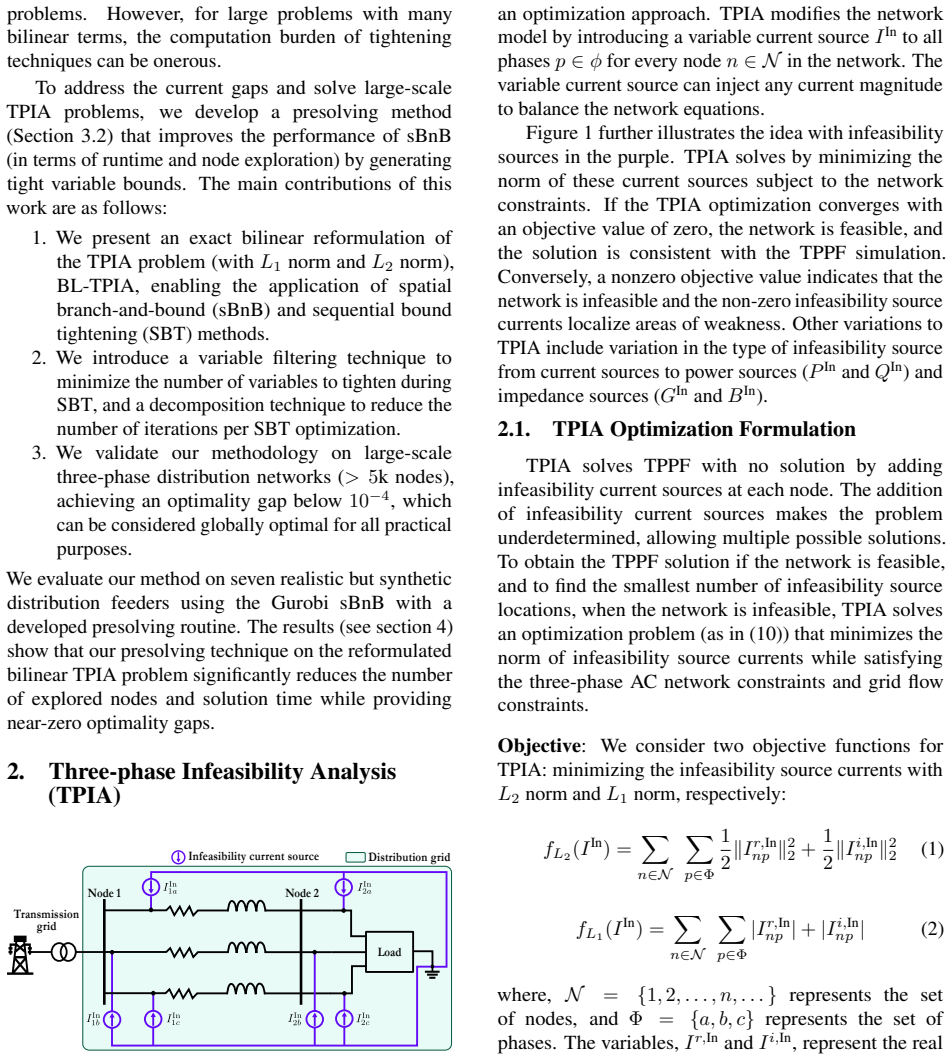
The authors reformulate the three-phase infeasibility analysis problem (TPIA) as an exact bilinear program, BL-TPIA, by introducing a lifting variable for voltage magnitude squared and rewriting load equations as products of variables. They then apply spatial branch-and-bound, which branches on continuous variables and relaxes bilinear terms with convex envelopes, to certify an optimality gap. To make this scale, they develop a sequential bound tightening (SBT) presolve that filters independent voltage variables, decomposes them into nominal and deviation parts, tightens the deviation bounds through small convex relaxations, and derives bounds on dependent variables analytically. On seven sy
Load-bearing premise
The analytic bounds on voltage magnitude squared hold only when each voltage component's interval stays entirely on one side of zero, and the paper does not show that its test cases satisfy this condition; one equation in the paper asserts the bounds are valid for all signs, which is not true.
Editorial extensions
If this is right
- If the method is correct, distribution planners can trust weak-location identification for divergent three-phase feeders, because the solution is certified near-global rather than dependent on the starting point of a local solver.
- Upgrade recommendations such as adding capacitors become grounded in a solution with a quantified optimality gap, so a planner knows how far the identified remediation is from the best possible one.
- The L1-norm sparse solution, which localizes weak sources, is shown to be the global sparse solution rather than an artifact of local optimization.
- The bilinear reformulation plus bound-tightening presolve reduces the number of branch-and-bound nodes explored by up to about 99.98%, making a global certification approach practical on feeders with over 5,000 nodes.
- The computed bounds are reusable across problem instances, so repeated infeasibility studies on the same network become cheaper over time.
Reading between the lines
- The analytic bound computation for voltage magnitude squared is only valid when each voltage-component interval stays entirely on one side of zero; the paper neither states nor proves that its test cases satisfy this, so large voltage drops or unusual phase angles could invalidate the certified bounds.
- The success on synthetic feeders suggests the method should be tested on real feeders with measurement noise and model uncertainty, since the optimality guarantee applies to the model equations, not to the actual physical grid.
- The same bilinear reformulation may port to other circuit-based AC optimizations that use current-injection variables, such as parameter-state estimation, where the linear network equations are already in the required form.
- A concrete stress test would be to run the presolve on a small feeder with voltage bounds that straddle zero and compare the certified gap with an exhaustive search, revealing whether the claimed near-zero gap holds beyond the reported cases.
Editorial analysis
A structured set of objections, weighed in public.
Referee Report
Summary. The paper addresses three-phase AC infeasibility analysis (TPIA), in which local NLP solvers may return suboptimal weak-location and upgrade recommendations. The authors reformulate the nonconvex TPIA NLP as an exact bilinear program (BL-TPIA), apply Gurobi's spatial branch-and-bound (sBnB), and propose a sequential bound tightening (SBT) presolve with variable filtering and variable decomposition. They report on seven synthetic distribution feeders that SBT plus sBnB achieves optimality gaps below 10^-4 (with one acknowledged exception) on systems with up to about 5,200 nodes, and reduces runtime by up to 97%. The paper claims this is the first method to certify near-global optimality for large-scale unbalanced three-phase TPIA problems.
Significance. If the central claim holds, the paper is a valuable practical advance: it would let distribution planners distinguish weak-location and upgrade recommendations that are artifacts of local NLP solutions from those that are certified near-global optima. The paper contains several strengths: the bilinear reformulation of the load-current equations is exact and clearly presented; the use of an NLP solution as an objective cutoff in SBT (33c) is a sound safeguard that does not fit any parameters to the reported results; the variable-filtering and decomposition ideas are sensible and are shown empirically to reduce sBnB node counts and runtimes; and the authors provide code and data links, which aids reproducibility. However, the analytic bound propagation that underpins SBT and the final sBnB bounds has a mathematical flaw that, in at least one reported instance, produces a certified gap for a restricted feasible set rather than for the original TPIA problem.
major comments (3)
- [§3.2.1, Eqs. (21a) and (23); Table 1, R2-12.47-3 (L1)] Equation (21a) and its voltage-specific form (23) compute the lower bound on t = u^2 + v^2 as min(|uL|,|uU|)^2 + min(|vL|,|vU|)^2. This is not the true minimum over the box when an interval contains zero. For example, u∈[-0.1,0.1], v∈[0.9,1.1] gives a computed lower bound of 0.82, but the true minimum of u^2+v^2 is 0.81 (achieved at u=0, v=0.9). The text's assertion that the absolute value 'ensures that the computed lower and upper bounds of t remain valid regardless of the sign of u and v' is therefore false. Since these bounds propagate to (Gload)^U via Eq. (25) and to (Bload)^L via Eq. (26), an overestimated tL can exclude feasible operating points. This is not merely theoretical: in Table 1, R2-12.47-3 with the L1 norm, S-BLP reports Objective=0.0184 and Bestbd=0.0184 (Gap=0.0000%), while BLP reports a feasible objective of 0.0183. A lower bound that is higher than a feasible objecti
- [§3.2.1, Eqs. (25)-(26)] The formulas for (Gload)^L, (Gload)^U, (Bload)^L, (Bload)^U implicitly assume P_load > 0 and Q_load > 0 (with the signs as written). If a load has negative active power (e.g., distributed generation) or negative reactive power (capacitive load), the monotonicity reverses and the lower/upper assignments in (25)-(26) swap. The paper does not state these sign assumptions nor explain how mixed-sign loads are handled. If any test case contains such loads, the unfiltered-variable bounds in constraint (33g) can exclude feasible operating points. Please provide sign-aware bound formulas or justify that all loads in the test cases satisfy the assumed signs.
- [Algorithm 1, line 10 and §4.3] The while-loop termination condition in Algorithm 1 uses 'and' between the lower and upper bound change tests. With 'and', the loop stops as soon as either the lower or the upper bound stops changing, which can leave the other side untightened. This is likely a typo for 'or' (continue while any bound is still changing). In addition, the NLP gap defined in Eq. (34) uses the Bestbd from the BLP run; when BLP hits the time limit (e.g., R5-12.47-2), that Bestbd is a heuristic bound, so the NLP gap is not a certified optimality gap. Please clarify these points.
minor comments (4)
- [§2.1, after Eq. (13)] Typo: 'respectively nd defined as' should be 'respectively, and defined as'.
- [Abstract] '10e-4' should be written as '10^-4' or '10^{-4}' to match the body of the paper.
- [Table 1] For R2-12.47-3 (L1), the S-BLP objective (0.0184) is higher than the BLP objective (0.0183). This discrepancy is not discussed and is directly related to the bound-validity issue raised above; it should at least be acknowledged and explained.
- [Figure 3] The y-axis label 'Bound Value (V)' could be clarified to indicate that it refers to the real/imaginary voltage deviation terms in volts; the figure caption would benefit from stating the units and the specific feeder case.
Circularity Check
No significant circularity: BL-TPIA and sBnB/SBT derivation is self-contained; background self-citations are not load-bearing.
full rationale
The paper's central result is the exact bilinear reformulation of TPIA (Section 3.1) and its solution by Gurobi's spatial branch-and-bound with a sequential bound-tightening presolve (Section 3.2). The reformulation is a standard lifting: equations (15)-(19) introduce Vsq = (Vr)^2 + (Vi)^2 and replace the fractional load equations (7a)-(7b) with bilinear products Gload*Vsq = P and Bload*Vsq = -Q. No term in this chain is defined in terms of the output being predicted. The IPOPT solution is used only as an upper-bound cutoff f(IIn*) in the SBT subproblems (Algorithm 1, Eq. 33c), which is a valid branch-and-bound pruning device; it is not fitted to the reported optimality gap. The near-zero gaps are certified by Gurobi sBnB's lower bounds from McCormick relaxations, which are computed independently of the incumbent solution. Self-citations to [3], [12], [15] provide the TPIA problem setup, the IV formulation, and examples of bound-tightening for transmission networks; these are background, not the load-bearing argument for the new claim, so they do not constitute circularity. The analytic-bound concern raised by the reviewer regarding equations (21a)/(23) when voltage intervals straddle zero is a potential validity/correctness issue in bound propagation, not a circularity: the bounds are derived from independent interval data, and the final certificate is not equal to those bounds by construction. Under the proportionality rule, this warrants at most a low non-circularity score.
Assumptions & free parameters
assumptions (4)
- domain assumption Voltage magnitude squared Vsq = (Vr)^2 + (Vi)^2 is strictly positive for all feasible loads.
- domain assumption The initial bounds on Vr and Vi are sign-definite, or otherwise tight enough that equations (23)-(26) produce valid enclosures.
- domain assumption Gurobi's spatial branch-and-bound correctly certifies optimality for the reformulated bilinear and quadratic program under the reported settings.
- standard math The McCormick outer approximation Pcvx is a valid relaxation of Pblp, so SBT bounds computed from Pcvx are valid enclosures.
Cite this review
Pith. "Pith review of Solving Three-phase AC Infeasibility Analysis to Near-zero Optimality Gap." pith.science (2026). https://pith.science/paper/OLFUCANR
@misc{pith2026250815937,
  author       = {Pith},
  title        = {Pith review of: Solving Three-phase AC Infeasibility Analysis to Near-zero Optimality Gap},
  year         = {2026},
  howpublished = {\url{https://pith.science/paper/OLFUCANR}},
  note         = {Machine review of arXiv:2508.15937}
}
read the original abstract
Recent works have shown the use of equivalent circuit-based infeasibility analysis to identify weak locations in distribution power grids. For three-phase power flow problems, when the power flow solver diverges, three-phase infeasibility analysis (TPIA) can converge and identify weak locations. The original TPIA problem is non-convex, and local minima and saddle points are possible. This can result in grid upgrades that are sub-optimal. To address this issue, we reformulate the original non-convex nonlinear program (NLP) as an exact non-convex bilinear program (BLP). Subsequently, we apply the spatial branch-and-bound (SBnB) algorithm to compute a solution with near-zero optimality gap. To improve SBnB performance, we introduce a bound tightening algorithm with variable filtering and decomposition, which tightens bounds on bilinear variables. We demonstrate that sequential bound tightening (SBT) significantly improves the efficiency and accuracy of Gurobi's SBnB algorithm. Our results show that the proposed method can solve large-scale three-phase infeasibility analysis problems with >5k nodes, achieving an optimality gap of less than 10e-4. Furthermore, we demonstrate that by utilizing the developed presolve routine for bounding, we can reduce the runtime of SBnB by up to 97%.
Figures


Figures from the paper (1 more)

Forward citations
Cited by 2 Pith papers
-
PowerDAG: Supervisory Agentic AI System for Automating Distribution Grid Analysis
PowerDAG achieves 94-100% success on unseen distribution grid analysis queries by combining adaptive retrieval with similarity-decay cutoff and just-in-time supervision, outperforming ReAct, LangChain, and CrewAI baselines.
-
Teleportation based detection of quantum critical points using small spin chains
Teleportation-based detectors locate quantum critical points with only a few percent error in spin chains of about ten qubits at finite temperature, for the XXZ, XX, XY, and Ising models.
Reference graph
Works this paper leans on
-
[1]
Beyond Relaxation and Newton–Raphson: Solving AC OPF for Multi-Phase Systems with Renewables,
A. S. Zamzam et al. , “Beyond Relaxation and Newton–Raphson: Solving AC OPF for Multi-Phase Systems with Renewables,” IEEE Transactions on Smart Grid , vol. 9, no. 5, pp. 3966–3975, 2016
work page 2016
-
[2]
Three-Phase Infeasibility Analysis for Distribution Grid Studies,
E. Foster et al. , “Three-Phase Infeasibility Analysis for Distribution Grid Studies,” Electric Power Systems Research , vol. 212, p. 108 486, 2022
work page 2022
-
[3]
M. H. Ali and A. Pandey, “Distributed Primal-Dual Interior Point Framework for Analyzing Infeasible Combined Transmission and Distribution Grid Networks,” arXiv preprint arXiv:2409.14532, 2024
work page Pith review arXiv 2024
-
[4]
Convex Relaxations and Linear Approximation for Optimal Power Flow in Multiphase Radial Networks,
L. Gan and S. H. Low, “Convex Relaxations and Linear Approximation for Optimal Power Flow in Multiphase Radial Networks,” in Power Systems Computation Conference, IEEE, 2014, pp. 1–9
work page 2014
-
[5]
Linear Power-Flow Models in Multiphase Distribution Networks,
A. Bernstein and E. Dall’Anese, “Linear Power-Flow Models in Multiphase Distribution Networks,” in IEEE PES ISGT-Europe , IEEE, 2017, pp. 1–6
work page 2017
-
[6]
Zero Duality Gap in Optimal Power Flow Problem,
J. Lavaei and S. H. Low, “Zero Duality Gap in Optimal Power Flow Problem,” IEEE Transactions on Power Systems , vol. 27, no. 1, pp. 92–107, 2011
work page 2011
-
[7]
Global Optimization of Optimal Power Flow Using a Branch & Bound Algorithm,
A. Gopalakrishnan et al., “Global Optimization of Optimal Power Flow Using a Branch & Bound Algorithm,” in Allerton Conference on Communication, Control, and Computing, IEEE, 2012, pp. 609–616
work page 2012
-
[8]
Scalable Global Optimization for AC-OPF via Quadratic Convex Relaxation and Branch-and-Bound,
M. Iranpour and M. R. Narimani, “Scalable Global Optimization for AC-OPF via Quadratic Convex Relaxation and Branch-and-Bound,” arXiv preprint arXiv:2505.18435, 2025
arXiv 2025
Show all 22 references
-
[9]
Global Optimisation of General Process Models,
E. M. B. Smith and C. C. Pantelides, “Global Optimisation of General Process Models,” Global Optimization in Engineering Design, pp. 355–386, 1996
1996
-
[10]
Convex Relaxation of Sparse Tableau Formulation for the AC Optimal Power Flow,
B. Park and C. L. DeMarco, “Convex Relaxation of Sparse Tableau Formulation for the AC Optimal Power Flow,” Electric Power Systems Research, vol. 171, pp. 209–218, 2019
2019
-
[11]
Branch-and-Bound Performance Estimation Programming: A Unified Methodology for Constructing Optimal Optimization Methods,
S. Das Gupta et al. , “Branch-and-Bound Performance Estimation Programming: A Unified Methodology for Constructing Optimal Optimization Methods,” Mathematical Programming, vol. 204, no. 1, pp. 567–639, 2024
2024
-
[12]
Circuit-Theoretic Joint Parameter-State Estimation—Balancing Optimality and AC Feasibility,
P. Sang and A. Pandey, “Circuit-Theoretic Joint Parameter-State Estimation—Balancing Optimality and AC Feasibility,” Electric Power Systems Research, vol. 235, p. 110 637, 2024
2024
-
[13]
Tightening McCormick Relaxations for Nonlinear Programs via Dynamic Multivariate Partitioning,
H. Nagarajan et al. , “Tightening McCormick Relaxations for Nonlinear Programs via Dynamic Multivariate Partitioning,” in Principles and Practice of Constraint Programming , Springer, 2016, pp. 369–387
2016
-
[14]
Evaluating Feasibility Within Power Flow,
M. Jereminov et al. , “Evaluating Feasibility Within Power Flow,”IEEE Transactions on Smart Grid, vol. 11, no. 4, pp. 3522–3534, 2020
2020
-
[15]
Robust Power Flow and Three-Phase Power Flow Analyses,
A. Pandey et al. , “Robust Power Flow and Three-Phase Power Flow Analyses,” IEEE Transactions on Power Systems , vol. 34, no. 1, pp. 616–626, 2018
2018
-
[16]
Three-Phase Power Flow Calculations Using the Current Injection Method,
P. A. N. Garcia et al., “Three-Phase Power Flow Calculations Using the Current Injection Method,” IEEE Transactions on Power Systems , vol. 15, no. 2, pp. 508–514, 2000
2000
-
[17]
[Online]
Gurobi Optimization, LLC, Gurobi Optimizer Reference Manual, Version 12.0.2, 2025. [Online]. Available: https://www.gurobi.com
2025
-
[18]
Computability of Global Solutions to Factorable Nonconvex Programs: Part I—Convex Underestimating Problems,
G. P. McCormick, “Computability of Global Solutions to Factorable Nonconvex Programs: Part I—Convex Underestimating Problems,” Mathematical Programming , vol. 10, no. 1, pp. 147–175, 1976. PREPRINT Version: Prepared for Hawaii International Conference on System Sciences (HICSS-59)
1976
-
[19]
Tightening Piecewise McCormick Relaxations for Bilinear Problems,
P. M. Castro, “Tightening Piecewise McCormick Relaxations for Bilinear Problems,” Computers & Chemical Engineering , vol. 72, pp. 300–311, 2015
2015
-
[20]
Modern Grid Initiative Distribution Taxonomy Final Report,
K. P. Schneider et al., “Modern Grid Initiative Distribution Taxonomy Final Report,” Pacific Northwest National Laboratory, Tech. Rep., 2008
2008
-
[21]
On the Implementation of an Interior-Point Filter Line-Search Algorithm for Large-Scale Nonlinear Programming,
A. W ¨achter and L. T. Biegler, “On the Implementation of an Interior-Point Filter Line-Search Algorithm for Large-Scale Nonlinear Programming,” Mathematical Programming , vol. 106, pp. 25–57, 2006
2006
-
[22]
PREPRINT Version: Prepared for Hawaii International Conference on System Sciences (HICSS-59)
The University of Vermont, Vermont Advanced Computing Center, https://www.uvm.edu/ vacc, 2025. PREPRINT Version: Prepared for Hawaii International Conference on System Sciences (HICSS-59)
2025
Reviewed August 5, 2026 · model on record in the stance chip above.
Discussion (0). Continue with ORCID to comment.