REVIEW 3 major objections 4 minor 103 references
Pre-flare processes, flux rope activation, large-scale eruption and associated X-class flare from the active region NOAA 11875
T0 review · 3 major / 4 minor · reviewed 2026-08-14 · deepseek-v4-flash
Pith's one-line read This paper presents evidence that pre-flare activity near one footpoint of a stable magnetic flux rope can destabilize it into eruption, timing the transition between the precursor and impulsive phases of an X1.0 flare.
desk verdict A solid multi-wavelength case study of a pre-existing hot channel's slow rise and eruption, but the claim of a 'precise bifurcation' between precursor and impulsive phases leans harder on one slit measurement than it should. read the letter →
The pith
A machine-rendered reading of the paper's core claim, the machinery that carries it, and where it could break.
The reading
What carries the argument
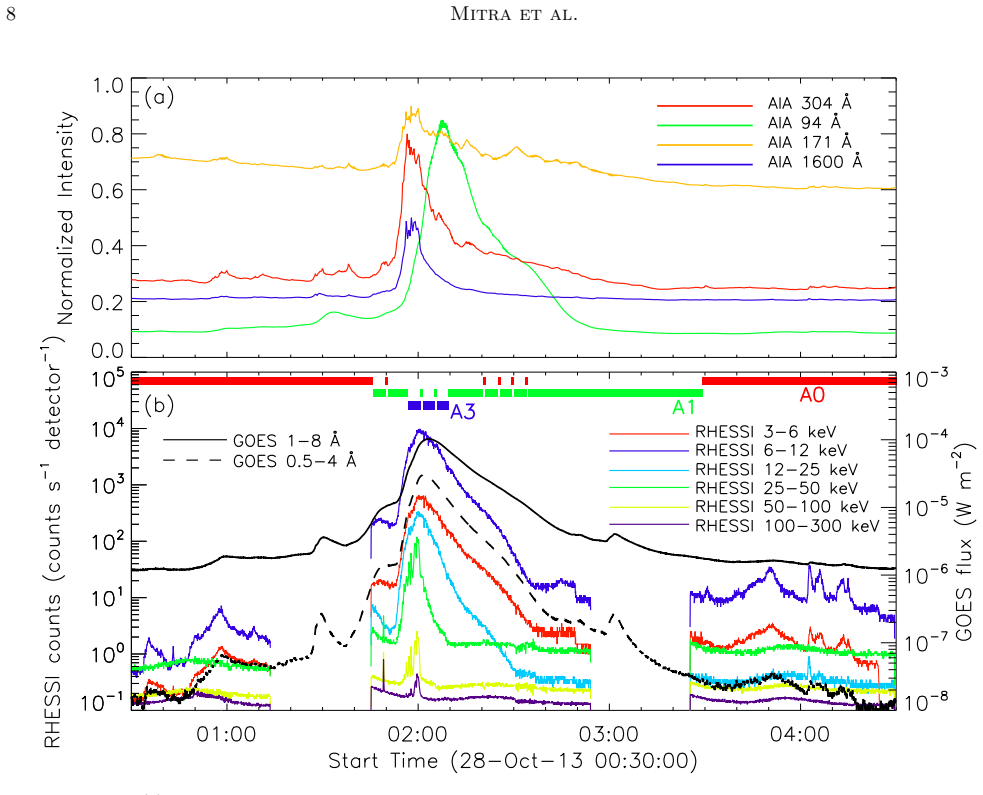
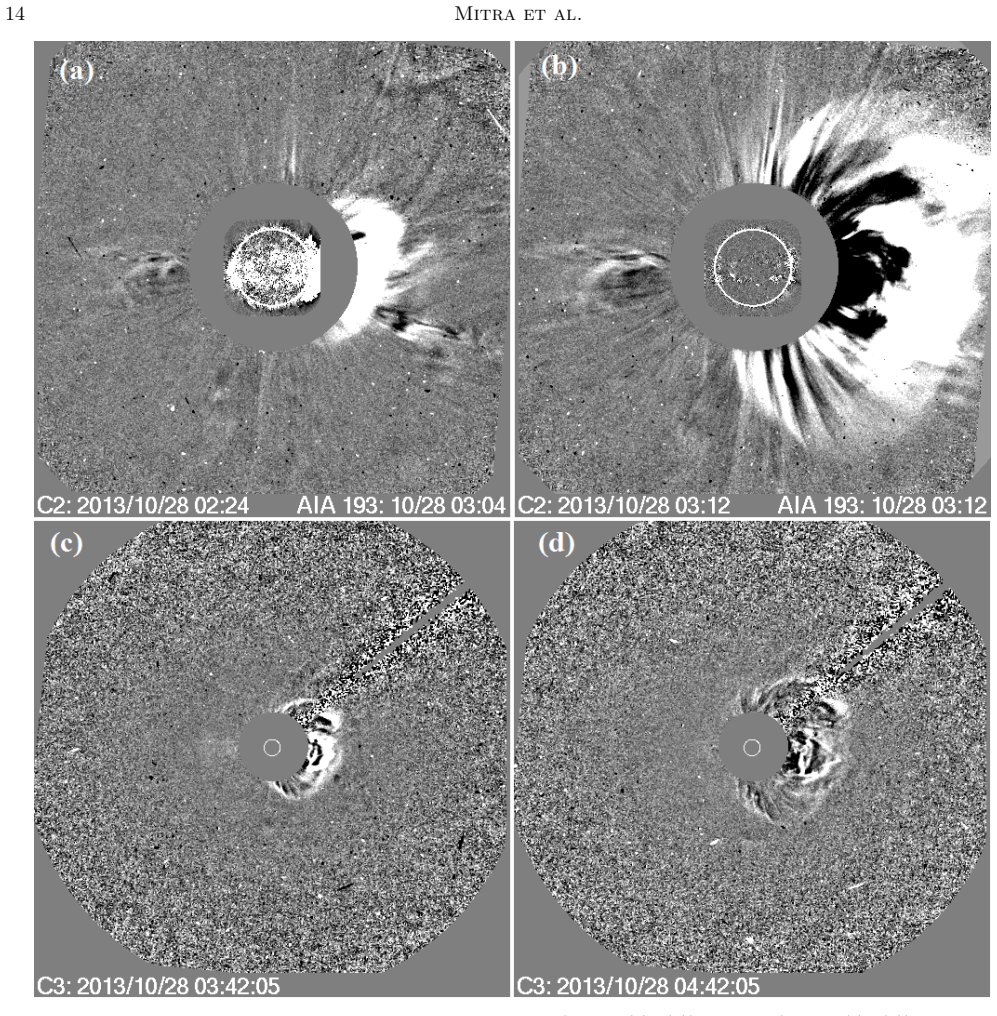
The central object is the hot coronal channel, a coherent bright structure in AIA 94 Å and 131 Å images that the authors identify as the observational counterpart of a magnetic flux rope, a set of twisted magnetic field lines along a common axis. It is what makes the timing argument possible, because it is seen as a stable, pre-existing structure from about 67 minutes before activation. The key measurement is the time-slice diagram built along a narrow slit, which converts the channel's apparent rise into a height–time curve and reveals the sharp transition from slow rise to accelerated eruption. Around it, the paper uses GOES soft X-ray light curves to define the precursor and impulsive phases, RHESSI imaging and spectroscopy to locate thermal and non-thermal X-ray sources, HiRAS dynamic spectra to identify type III, type II, and type IV bursts, and LASCO C2/C3 images to establish the associated halo CME.
What would settle it
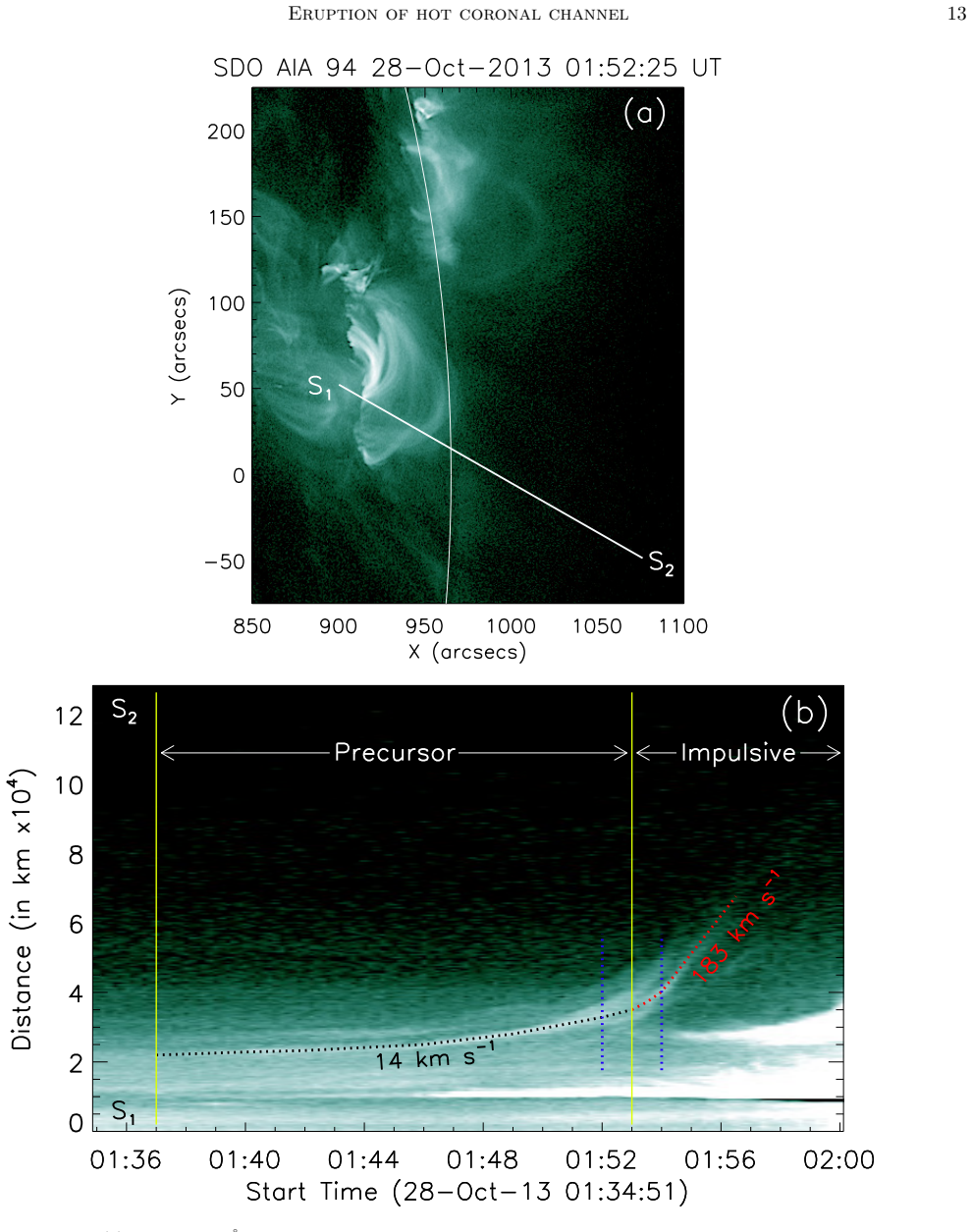
Track the same erupting structure with a second instrument viewpoint, or deproject the motion using the known disk position N07W66, and reconstruct its true three-dimensional height–time profile. If the sharp jump from about 14 km s$^{-1}$ to about 183 km s$^{-1}$ at 01:52–01:54 UT disappears, or if the structure turns out to be a sheared arcade rather than a coherent rope, the claimed precursor/impulsive bifurcation and the destabilization story would lose support.
Extended reading notes
Core claim
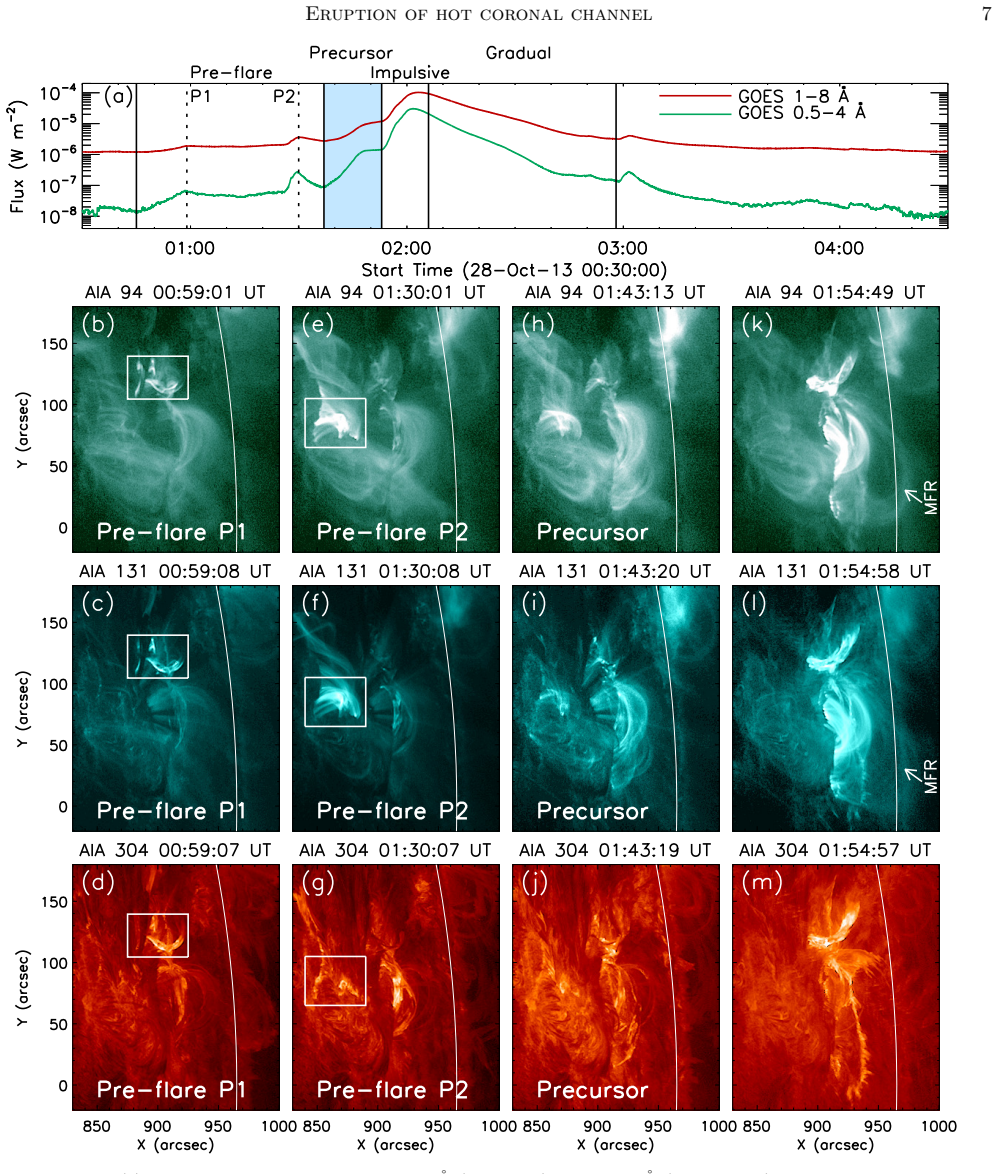
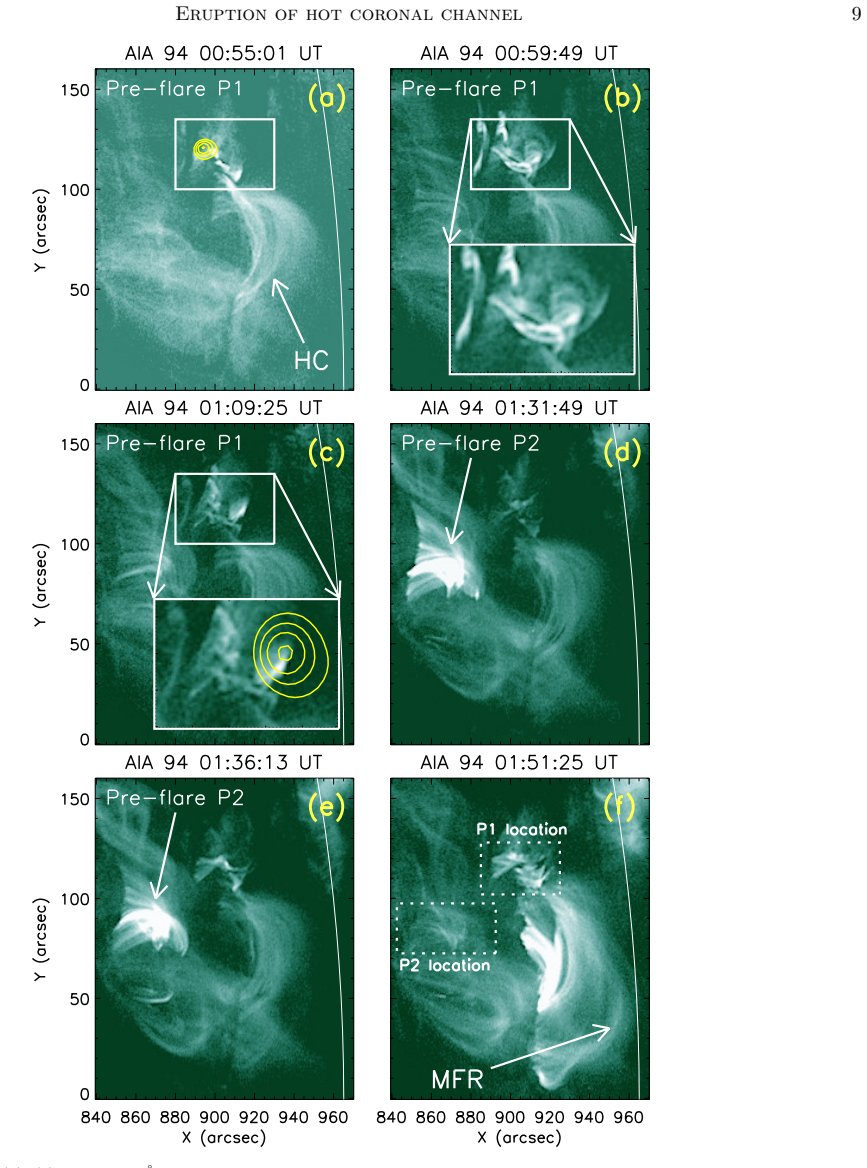
The central discovery is a two-phase kinematic profile of the erupting flux rope. A time-slice diagram along a single slit shows the hot channel rising steadily at about 14 km s$^{-1}$ during the precursor phase (about 01:37–01:53 UT), then undergoing a rapid acceleration of about 1.41 km s$^{-2}$ between about 01:52 and 01:54 UT as it reached about 183 km s$^{-1}$, exactly when hard X-ray and soft X-ray fluxes marked the impulsive phase. Because a site adjacent to one footpoint of the channel showed continuous EUV brightening, hard X-ray emission up to about 50 keV, and small-scale plasma ejections throughout the pre-flare and precursor phases, the authors conclude that ongoing small-scale reconnection progressively reduced the confinement of the pre-existing flux rope and eventually triggered its eruption. They also report coronal and footpoint hard X-ray sources up to about 50 keV and 100 keV, a series of type III radio bursts, and a halo CME with a linear speed of about 695 km s$^{-1}$ in the LASCO field of view.
Load-bearing premise
The conclusions assume that the glowing structure tracked on the images is a single coherent magnetic rope, and that its motion along the chosen line is a true measure of the rope's rise rather than an illusion of angle or a mix of different structures.
Editorial extensions
If this is right
- A hot channel visible in high-temperature EUV passbands can mark a pre-existing flux rope about an hour before it erupts, making it an early CME signature in the source active region.
- Prolonged, localized reconnection near a footpoint of a flux rope can act as the destabilizing agent for a subsequent eruption, supporting tether-cutting-like triggering.
- The onset of the impulsive phase of a flare can be identified with the moment a rising flux rope begins its fast acceleration, so flare-phase boundaries and CME initiation can be tied to one observable.
- The near-simultaneous appearance of fast flux-rope acceleration, hard X-ray bursts above 25 keV, and type III radio bursts indicates a feedback between early CME dynamics and the rate of magnetic reconnection.
Reading between the lines
- If the two-phase rise is a common feature, precursor phases in other eruptive flares could be identified by tracking hot channels in 94 Å and 131 Å images rather than relying only on GOES soft X-ray light curves.
- A quantitative check would be to compare the observed onset of fast acceleration with the decay-index threshold for torus instability; pre-flare reconnection should lower the effective confinement so that eruption begins before an ideal instability criterion alone would predict.
- The persistent hard X-ray source at the footpoint-adjacent pre-flare site suggests a localized magnetic restructuring that could be tested by nonlinear force-free field extrapolations before and after the precursor phase.
- A stereo view of a similar event, using two vantage points, could determine whether the 14 km s$^{-1}$ to 183 km s$^{-1}$ transition is a true kinematic feature rather than a projection or feature-tracking artifact.
Signed reviews
Editorial analysis
A structured set of objections, weighed in public.
Referee Report
Summary. The paper presents a multi-wavelength study of the X1.0 flare of 2013 October 28 in active region NOAA 11875, combining AIA/SDO, HMI/SDO, RHESSI, HiRAS, and LASCO observations. The authors identify a pre-existing hot coronal channel that they interpret as a stable magnetic flux rope, document two localized pre-flare brightenings (P1 and P2), and describe a precursor phase (01:37–01:53 UT) during which the hot channel rises slowly at about 14 km/s. At the onset of the impulsive phase, the channel transitions to a fast eruption with a linear speed of about 183 km/s and a brief acceleration of about 1.41 km/s^2. The paper argues that the adjacent pre-flare activity destabilized the flux rope, and that the kinematic transition precisely separates the precursor and impulsive phases, implying a feedback relationship between early CME dynamics and flare reconnection. The eruption is accompanied by type III radio bursts, hard X-ray footpoint and looptop sources, and a halo CME.
Significance. If the central kinematic result is robust, the paper provides a valuable observational case of a pre-existing, quasi-stable flux rope whose slow-rise phase is temporally tied to a distinct precursor phase, and whose rapid acceleration coincides with the impulsive phase of an X-class flare. The multi-instrument combination (EUV imaging, RHESSI imaging/spectroscopy, radio spectrography, and coronagraph data) is a strength, and the phase definitions (Table 1) are internally consistent across GOES, AIA, RHESSI, and HiRAS. The analysis uses standard, well-established tools (PIXON imaging, OSPEX forward fitting), and the paper's claim that pre-flare reconnection near a footpoint can destabilize a stable flux rope is a testable and plausible scenario. However, the load-bearing timing measurement—the 'precise bifurcation' of precursor and impulsive phases—rests on a single straight-slit time-slice without reported uncertainties or a demonstrated identity of the tracked feature, which currently limits the strength of the conclusions.
major comments (3)
- [§3.2.2, Figure 7(b)] The quoted rise speed (≈14 km/s), eruption speed (≈183 km/s), and acceleration (≈1.41 km/s^2) are given without any uncertainties or fitting details. Since the paper's central claim of a 'precise bifurcation' between the precursor and impulsive phases rests on this time-slice, the authors should specify the fitting procedure, the number of independent measurements used for each linear segment, the estimated uncertainties on the slopes and on the break time, and preferably an objective two-slope fit that determines the transition time rather than an eye-judged boundary.
- [§3.2.2, Figure 7(a)] The slit S1S2 is a straight sky-plane line, and the active region is at N07W66, so the measured displacement is a projected quantity and no deprojection is applied. More importantly, during 01:52–01:54 UT the impulsive phase begins and flare loops and post-arcade emission fill the field of view; without multi-slit or running-difference tracking it is not demonstrated that the same physical structure (the flux rope axis) is followed throughout the entire interval. If the slit records an apparent front produced by newly brightening flare loops rather than the rising flux rope, the kinematic break would not provide independent evidence of a feedback relationship.
- [Abstract and §4, page 16] The claim that the kinematic transition 'precisely bifurcated' the precursor and impulsive phases is stronger than what the data support. The impulsive-phase onset is defined from GOES/RHESSI at ≈01:53 UT, while the acceleration transition is assigned to the 01:52–01:54 UT interval; with a quoted transition interval of about two minutes, the timing match is consistent but not shown to be precise at better than 1–2 minutes. The language should be moderated or supplemented with a quantitative comparison of the break time and the GOES/RHESSI onset, including estimated timing uncertainties.
minor comments (4)
- [Throughout] There are several typographical artifacts (e.g., 'T able' at the start of the table caption, 'studied' where 'studies' is meant on page 6, and inconsistent spacing in 'RHESSI ;'). A careful proofreading pass is needed.
- [§3.2.2, Figure 7] The figure caption states that the hot channel was 'found to be slowly elevating' and then 'underwent eruption with a linear speed of ≈183 km/s', but the reader is not told how these values were extracted from the time-slice (e.g., linear fits to the bright ridge over which time intervals). Please add this information to the caption or text.
- [§3.3, RHESSI spectroscopy] The spectroscopy section reports temperature, emission measure, spectral index, and break energy, but the time intervals used for the displayed spectra in Figure 9 are not explicitly stated in the text (only 'three selected intervals'). Please specify the intervals in the figure caption or text.
- [§4, CME speed] The LASCO CME linear speed (≈695 km/s) and deceleration (12.1 m/s^2) are quoted without uncertainties; adding the standard errors from the CME catalog fit would be helpful, though this is not central to the paper's main claim.
Circularity Check
No significant circularity: the kinematic-flare timing comparison rests on independent multi-instrument measurements, not on definitions or fitted predictions.
full rationale
This paper is an observational case study, not a first-principles derivation, so the circularity checks apply only to whether any stated result is forced by its own definitions, fitted inputs, or load-bearing self-citations. The central claims—pre-existence of a hot coronal channel, slow rise during the precursor phase, rapid acceleration at the impulsive onset, and a feedback relationship between CME dynamics and reconnection—are supported by independent measurements: GOES soft X-ray flux, RHESSI hard X-ray imaging and spectroscopy, AIA EUV imaging including the time-slice diagram, HiRAS radio spectra, and LASCO CME observations. No parameter is fitted to one quantity and then reported as a prediction of a closely related quantity; the quoted speeds and acceleration are direct kinematic measurements along a stated slit, and the phase boundaries are set by GOES/RHESSI temporal profiles rather than by the slit measurement itself. The paper does invoke some prior studies by the same authors (e.g., Joshi et al. 2013; Mitra et al. 2018), but these are contextual citations for the interpretation of pre-flare reconnection and hot channels as flux-rope signatures, and they are accompanied by numerous independent references from the wider literature (Chen 2011; Cheng et al. 2014a; Song et al. 2015b; Temmer et al. 2008; Zhang & Dere 2006). The identification of a hot channel with a magnetic flux rope is a standard observational consensus, not a uniqueness theorem imported from the authors' own prior work. Although Table 1 labels the precursor phase partly by the hot channel's slow rise, the impulsive onset at about 01:53 UT is independently identified from the GOES flux enhancement and RHESSI hard X-ray onset, so the reported 'precise bifurcation' is a comparison of separate measurements rather than a tautology. No circular step meets the requirement of quoting a specific reduction of one result to another by construction or by a fitted parameter renamed as a prediction.
Assumptions & free parameters
assumptions (4)
- domain assumption Hot coronal channels observed in AIA 94 Å and 131 Å are the observational signature of coherent magnetic flux ropes.
- domain assumption RHESSI hard X-ray footpoint sources are produced by thick-target bremsstrahlung from accelerated electrons, and looptop sources mark the reconnection or acceleration region.
- domain assumption Type III radio bursts indicate near-relativistic electron beams propagating along open or newly opened field lines, timed with reconnection episodes.
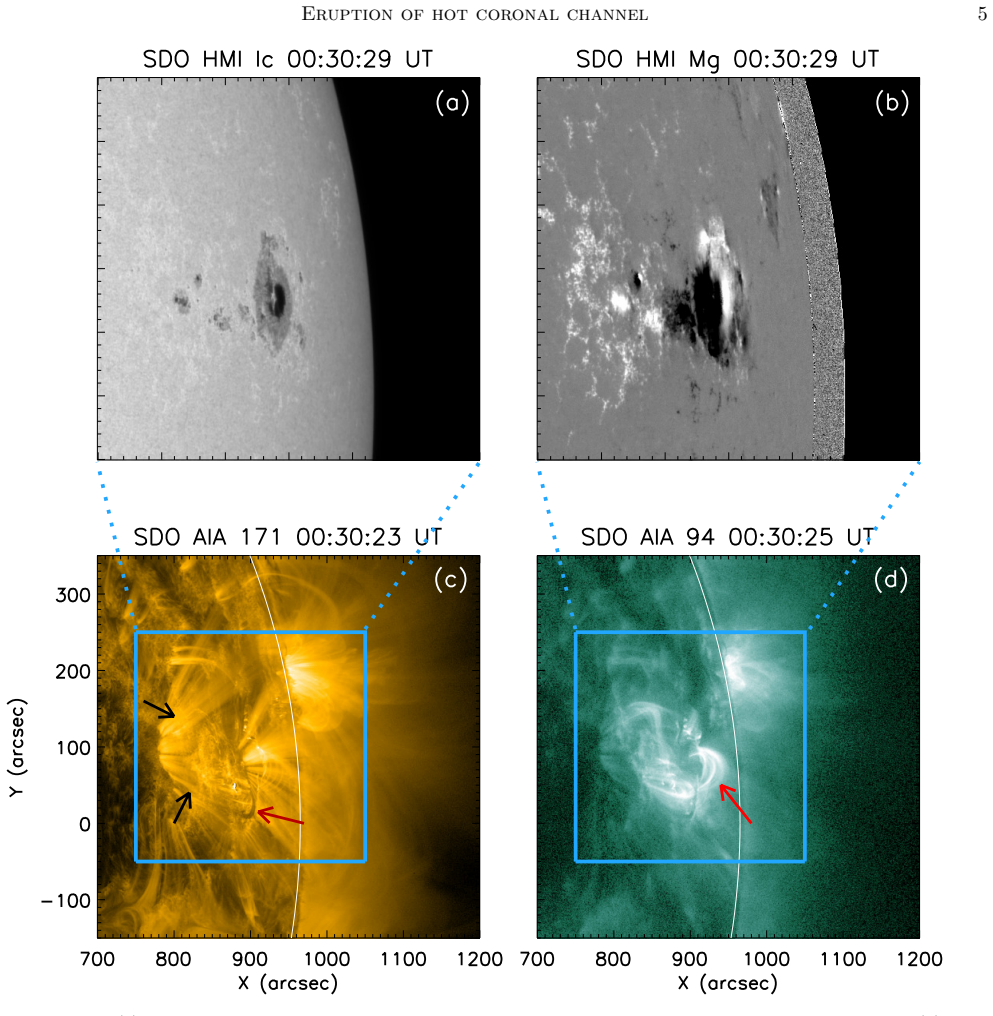
- domain assumption Line-of-sight HMI magnetograms and AIA EUV images close to the limb (N07W66) allow reliable co-registration of pre-flare locations with the flux rope footpoints.
Cite this review
Pith. "Pith review of Pre-flare processes, flux rope activation, large-scale eruption and associated X-class flare from the active region NOAA 11875." pith.science (2026). https://pith.science/paper/OLGZLAUF
@misc{pith2026190804059,
  author       = {Pith},
  title        = {Pith review of: Pre-flare processes, flux rope activation, large-scale eruption and associated X-class flare from the active region NOAA 11875},
  year         = {2026},
  howpublished = {\url{https://pith.science/paper/OLGZLAUF}},
  note         = {Machine review of arXiv:1908.04059}
}
abstract
We present a multi-wavelength analysis of the eruption of a hot coronal channel associated with an X1.0 flare (SOL2013-10-28T02:03) from the active region NOAA 11875 by combining observations from AIA/SDO, HMI/SDO, RHESSI, and HiRAS. EUV images at high coronal temperatures indicated the presence of a hot channel at the core of the active region from the early pre-flare phase evidencing the pre-existence of a quasi-stable magnetic flux rope. The hot channel underwent an activation phase after a localized and prolonged pre-flare event occurring adjacent to one of its footpoints. Subsequently, the flux rope continued to rise slowly for $\approx$16 min during which soft X-ray flux gradually built-up characterizing a distinct precursor phase. The flux rope transitioned from the state of slow rise to the eruptive motion with the onset of the impulsive phase of the X1.0 flare. The eruptive expansion of the hot channel is accompanied by a series of type III radio bursts in association with impulsive rise of strong hard X-ray non-thermal emissions that included explicit hard X-ray sources of energies up to $\approx$50 keV from the coronal loops and $\approx$100 keV from their footpoint locations. Our study contains evidence that pre-flare activity occurring within the spatial extent of a stable flux rope can destabilize it toward eruption. Moreover, sudden transition of the flux rope from the state of slow rise to fast acceleration precisely bifurcated the precursor and the impulsive phases of the flare which points toward a feedback relationship between early CME dynamics and the strength of the large-scale magnetic reconnection.
Figures
Figures from the paper (7 more)




Reference graph
Works this paper leans on
-
[1]
Acton, L. W. 1968, ApJ, 152, 305
1968
-
[2]
F., Mikic, Z., & Linker, J
Amari, T., Luciani, J. F., Mikic, Z., & Linker, J. 1999, ApJL, 518, L57 —. 2000, ApJL, 529, L49
1999
-
[3]
K., Dahlburg, R
Antiochos, S. K., Dahlburg, R. B., & Klimchuk, J. A. 1994, ApJL, 420, L41
1994
-
[4]
K., DeVore, C
Antiochos, S. K., DeVore, C. R., & Klimchuk, J. A. 1999, ApJ, 510, 485
1999
-
[5]
2004, A&A, 426, 1047
Archontis, V., Moreno-Insertis, F., Galsgaard, K., Hood, A., & O’Shea, E. 2004, A&A, 426, 1047
2004
-
[6]
2011, ApJ, 730, 57
Aurass, H., Mann, G., Zlobec, P., & Karlick´ y, M. 2011, ApJ, 730, 57
2011
-
[7]
S., Benz, A
Bastian, T. S., Benz, A. O., & Gary, D. E. 1998, ARA&A, 36, 131
1998
-
[8]
Benz, A. O. 2017, Living Reviews in Solar Physics, 14, 2
2017
Show all 103 references
-
[9]
Brown, J. C. 1971, SoPh, 18, 489
1971
-
[10]
C., Aschwanden, M
Brown, J. C., Aschwanden, M. J., & Kontar, E. P. 2002, Solar Physics, 210, 373
2002
-
[11]
E., Howard, R
Brueckner, G. E., Howard, R. A., Koomen, M. J., et al. 1995, Solar Physics, 162, 357
1995
-
[12]
H., Knock, S., Robinson, P., & Kuncic, Z
Cairns, I. H., Knock, S., Robinson, P., & Kuncic, Z. 2003, Space Science Reviews, 107, 27
2003
-
[13]
1995, ApJ, 441, 886 Canfield, R
Caligari, P., Moreno-Insertis, F., & Schussler, M. 1995, ApJ, 441, 886 Canfield, R. C., Hudson, H. S., & McKenzie, D. E. 1999, Geophys. Res. Lett., 26, 627
1995
-
[14]
1964, NASA Special Publication, 50, 451
Carmichael, H. 1964, NASA Special Publication, 50, 451
1964
-
[15]
Chen, P. F. 2011, Living Reviews in Solar Physics, 8, 1
2011
-
[16]
2016, ApJL, 820, L37 Eruption of hot coronal channel 19
Chen, Y., Du, G., Zhao, D., et al. 2016, ApJL, 820, L37 Eruption of hot coronal channel 19
2016
-
[17]
Cheng, X., & Ding, M. D. 2016, The Astrophysical Journal Supplement Series, 225, 16
2016
-
[18]
D., Liu, Y., & Poomvises, W
Cheng, X., Zhang, J., Ding, M. D., Liu, Y., & Poomvises, W. 2013, ApJ, 763, 43
2013
-
[19]
Cheng, X., Zhang, J., Liu, Y., & Ding, M. D. 2011, ApJ, 732, L25
2011
-
[20]
E., Tripathi, D., Isobe, H., & Asai, A
Chifor, C., Mason, H. E., Tripathi, D., Isobe, H., & Asai, A. 2006, A&A, 458, 965
2006
-
[21]
E., & Dennis, B
Chifor, C., Tripathi, D., Mason, H. E., & Dennis, B. R. 2007, A&A, 472, 967
2007
-
[22]
2015, ApJ, 809, 34
Chintzoglou, G., Patsourakos, S., & Vourlidas, A. 2015, ApJ, 809, 34
2015
-
[23]
L., Holt, S
Cline, T. L., Holt, S. S., & Hones, Jr., E. W. 1968, J. Geophys. Res., 73, 434
1968
-
[24]
2015, A&A, 574, A37 D´ emoulin, P., & Aulanier, G
Dalmasse, K., Chandra, R., Schmieder, B., & Aulanier, G. 2015, A&A, 574, A37 D´ emoulin, P., & Aulanier, G. 2010, ApJ, 718, 1388
2015
-
[25]
Domingo, V., Fleck, B., & Poland, A. I. 1995, SoPh, 162, 1
1995
-
[26]
Emslie, A. G. 1983, ApJ, 271, 367
1983
-
[27]
1997, Filament Channels in the Corona, ed
Engvold, O. 1997, Filament Channels in the Corona, ed. Z. Mouradian & M. Stavinschi (Dordrecht: Springer Netherlands), 125–130
1997
-
[28]
2001, ApJ, 554, L111 F´ arn´ ık, F., Hudson, H., & Watanabe, T
Fan, Y. 2001, ApJ, 554, L111 F´ arn´ ık, F., Hudson, H., & Watanabe, T. 1996, SoPh, 165, 169 F´ arn´ ık, F., Hudson, H. S., Karlick´ y, M., & Kosugi, T. 2003, A&A, 399, 1159 F´ arn´ ık, F., & Savy, S. K. 1998, SoPh, 183, 339
2001
-
[29]
R., Hudson, H
Fletcher, L., Dennis, B. R., Hudson, H. S., et al. 2011, SSRv, 159, 19
2011
-
[30]
J., Bothmer, V., Cid, C., et al
Forsyth, R. J., Bothmer, V., Cid, C., et al. 2006, Space Science Reviews, 123, 383
2006
-
[31]
B., Sweetland, C., & Kovacs, A
Gaizauskas, V., Zirker, J. B., Sweetland, C., & Kovacs, A. 1997, The Astrophysical Journal, 479, 448
1997
-
[32]
A., & Moore, R
Gary, G. A., & Moore, R. L. 2004, ApJ, 611, 545
2004
-
[33]
E., & Fan, Y
Gibson, S. E., & Fan, Y. 2006, Journal of Geophysical Research (Space Physics), 111, A12103
2006
-
[34]
2004, ApJ, 617, 600
Demoulin, P. 2004, ApJ, 617, 600
2004
-
[35]
E., Fan, Y., T¨ or¨ ok, T., & Kliem, B
Gibson, S. E., Fan, Y., T¨ or¨ ok, T., & Kliem, B. 2006, SSRv, 124, 131
2006
-
[36]
2013, Type II Solar Radio Bursts (American Geophysical Union (AGU)), 123–135
Gopalswamy, N. 2013, Type II Solar Radio Bursts (American Geophysical Union (AGU)), 123–135
2013
-
[37]
M., et al
Hernandez-Perez, A., Su, Y., Veronig, A. M., et al. 2019, ApJ, 874, 122
2019
-
[38]
1974, Solar Physics, 34, 323
Hirayama, T. 1974, Solar Physics, 34, 323
1974
-
[39]
D., Sui, L., Schwartz, R
Holman, G. D., Sui, L., Schwartz, R. A., & Emslie, A. G. 2003, ApJL, 595, L97
2003
-
[40]
D., Aschwanden, M
Holman, G. D., Aschwanden, M. J., Aurass, H., et al. 2011, SSRv, 159, 107
2011
-
[41]
Hudson, H. S. 1972, SoPh, 24, 414
1972
-
[42]
2010, ApJ, 713, 440
Jing, J., Tan, C., Yuan, Y., et al. 2010, ApJ, 713, 440
2010
-
[43]
2018, SoPh, 293, 107
Chakrabarty, D. 2018, SoPh, 293, 107
2018
-
[44]
Joshi, B., Kushwaha, U., Cho, K.-S., & Veronig, A. M. 2013, ApJ, 771, 1
2013
-
[45]
M., & Cho, K.-S
Joshi, B., Kushwaha, U., Veronig, A. M., & Cho, K.-S. 2016, ApJ, 832, 130
2016
-
[46]
M., et al
Joshi, B., Kushwaha, U., Veronig, A. M., et al. 2017, ApJ, 834, 42
2017
-
[47]
2007, SoPh, 242, 143
Pandey, K. 2007, SoPh, 242, 143
2007
-
[48]
K., & Somov, B
Joshi, B., Veronig, A., Manoharan, P. K., & Somov, B. V. 2012, in Multi-scale Dynamical Processes in Space and Astrophysical Plasmas, ed. M. P. Leubner & Z. V¨ or¨ os (Berlin, Heidelberg: Springer Berlin Heidelberg), 29–41
2012
-
[49]
M., Lee, J., et al
Joshi, B., Veronig, A. M., Lee, J., et al. 2011, ApJ, 743, 195
2011
-
[50]
S., et al
Joshi, B., Veronig, A., Cho, K. S., et al. 2009, ApJ, 706, 1438
2009
-
[51]
C., Zhu, X., Schmieder, B., et al
Joshi, N. C., Zhu, X., Schmieder, B., et al. 2019, ApJ, 871, 165
2019
-
[52]
R., & Anderson, K
Kane, S. R., & Anderson, K. A. 1970, ApJ, 162, 1003
1970
-
[53]
2006, Physical Review Letters, 96, 255002
Kliem, B., & T¨ or¨ ok, T. 2006, Physical Review Letters, 96, 255002
2006
-
[54]
Kondo, T., Isobe, T., Igi, S., Watari, S., & Tokimura, M. 1995, J. Commun. Res. Lab., Vol. 42, No. 1, p. 111 - 119, 42, 111
1995
-
[55]
A., & Pneuman, G
Kopp, R. A., & Pneuman, G. W. 1976, SoPh, 50, 85
1976
-
[56]
J., & Lin, R
Krucker, S., Hurford, G. J., & Lin, R. P. 2003, ApJ, 595, L103
2003
-
[57]
J., et al
Krucker, S., Battaglia, M., Cargill, P. J., et al. 2008, A&A Rv, 16, 155
2008
-
[58]
Kumar, S., Bhattacharyya, R., Joshi, B., & Smolarkiewicz, P. K. 2016, ApJ, 830, 80
2016
-
[59]
Kundu, M. R. 1963, SSRv, 2, 438
1963
-
[60]
R., Title, A
Lemen, J. R., Title, A. M., Akin, D. J., et al. 2012, SoPh, 275, 17
2012
-
[61]
P., Dennis, B
Lin, R. P., Dennis, B. R., Hurford, G. J., et al. 2002, SoPh, 210, 3
2002
-
[62]
2013, ApJL, 778, L36
Liu, C., Deng, N., Lee, J., et al. 2013, ApJL, 778, L36
2013
-
[63]
2010, ApJ, 725, L84
Liu, R., Liu, C., Wang, S., Deng, N., & Wang, H. 2010, ApJ, 725, L84
2010
-
[64]
2018, ApJ, 868, 59
Liu, T., Su, Y., Cheng, X., van Ballegooijen, A., & Ji, H. 2018, ApJ, 868, 59
2018
-
[65]
2008, The Astrophysical Journal, 679, L151
Liu, Y. 2008, The Astrophysical Journal, 679, L151
2008
-
[66]
K., & Kundu, M
Manoharan, P. K., & Kundu, M. R. 2003, ApJ, 592, 597 Mart´ ınez-Sykora, J., Hansteen, V., & Carlsson, M. 2008, ApJ, 679, 871
2003
-
[67]
1994, Nature, 371, 495
Masuda, S., Kosugi, T., Hara, H., Tsuneta, S., & Ogawara, Y. 1994, Nature, 371, 495
1994
-
[68]
R., Hudson, H
Metcalf, T. R., Hudson, H. S., Kosugi, T., Puetter, R. C., & Pina, R. K. 1996, ApJ, 466, 585
1996
-
[69]
2018, ApJ, 869, 69
Bhattacharyya, R. 2018, ApJ, 869, 69
2018
-
[70]
L., & Roumeliotis, G
Moore, R. L., & Roumeliotis, G. 1992, in Lecture Notes in
1992
-
[71]
L., Sterling, A
Moore, R. L., Sterling, A. C., Hudson, H. S., & Lemen, J. R. 2001, ApJ, 552, 833
2001
-
[72]
L., Koul, P
Moza, K. L., Koul, P. K., Rausaria, R. R., & Khosa, P. N. 1986, Journal of Astrophysics and Astronomy, 7, 39
1986
-
[73]
2015, The Astrophysical Journal, 808, 117 O’Flannagain, A
Nindos, A., Patsourakos, S., Vourlidas, A., & Tagikas, C. 2015, The Astrophysical Journal, 808, 117 O’Flannagain, A. M., Brown, J. C., & Gallagher, P. T. 2015, ApJ, 799, 127
2015
-
[74]
2010, ApJ, 718, 433
Olmedo, O., & Zhang, J. 2010, ApJ, 718, 433
2010
-
[75]
D., Thompson, B
Pesnell, W. D., Thompson, B. J., & Chamberlin, P. C. 2012, Solar Physics, 275, 3
2012
-
[76]
Pevtsov, A. A. 2002, SoPh, 207, 111
2002
-
[77]
R., Hood, A
Priest, E. R., Hood, A. W., & Anzer, U. 1989, ApJ, 344, 1010
1989
-
[78]
W., Bradshaw, S
Reep, J. W., Bradshaw, S. J., & Holman, G. D. 2016, ApJ, 818, 44
2016
-
[79]
Reid, H. A. S., & Ratcliffe, H. 2014, Research in Astronomy and Astrophysics, 14, 773
2014
-
[80]
H., Bush, R
Schou, J., Scherrer, P. H., Bush, R. I., et al. 2012, SoPh, 275, 229
2012
-
[81]
A., Csillaghy, A., Tolbert, A
Schwartz, R. A., Csillaghy, A., Tolbert, A. K., et al. 2002, SoPh, 210, 165
2002
-
[82]
2011, Living Reviews in Solar Physics, 8, 6
Shibata, K., & Magara, T. 2011, Living Reviews in Solar Physics, 8, 6
2011
-
[83]
M., Lin, R
Smith, D. M., Lin, R. P., Turin, P., et al. 2002, SoPh, 210, 33
2002
-
[84]
Q., Zhang, J., Chen, Y., & Cheng, X
Song, H. Q., Zhang, J., Chen, Y., & Cheng, X. 2014, ApJL, 792, L40
2014
-
[85]
Q., Zhang, J., Cheng, X., et al
Song, H. Q., Zhang, J., Cheng, X., et al. 2014, The Astrophysical Journal, 784, 48
2014
-
[86]
Sturrock, P. A. 1966, Nature, 211, 695
1966
-
[87]
Sui, L., & Holman, G. D. 2003, ApJL, 596, L251
2003
-
[88]
I., & Shmeleva, O
Syrovatskii, S. I., & Shmeleva, O. P. 1972, Soviet Ast., 16, 273
1972
-
[89]
1966, PASJ, 18, 57
Takakura, T., & Kai, K. 1966, PASJ, 18, 57
1966
-
[90]
M., Vrˇ snak, B., et al
Temmer, M., Veronig, A. M., Vrˇ snak, B., et al. 2008, ApJL, 673, L95 T¨ or¨ ok, T., Kliem, B., & Titov, V. S. 2004, A&A, 413, L27 van Ballegooijen, A. A., & Martens, P. C. H. 1989, ApJ, 343, 971
2008
-
[91]
2014, The Astrophysical Journal, 797, 80
Vemareddy, P., & Zhang, J. 2014, The Astrophysical Journal, 797, 80
2014
-
[92]
M., Karlick´ y, M., Vrˇ snak, B., et al
Veronig, A. M., Karlick´ y, M., Vrˇ snak, B., et al. 2006, A&A, 446, 675
2006
-
[93]
2017, Nature Communications, 8, 1330
Wang, W., Liu, R., Wang, Y., et al. 2017, Nature Communications, 8, 1330
2017
-
[94]
F., & Howard, T
Webb, D. F., & Howard, T. A. 2012, Living Reviews in Solar Physics, 9, 3
2012
-
[95]
M., Benz, A
White, S. M., Benz, A. O., Christe, S., et al. 2011, SSRv, 159, 225
2011
-
[96]
Wild, J. P. 1950, Australian Journal of Scientific Research A Physical Sciences, 3, 541
1950
-
[97]
2017, ApJL, 840, L23
Xue, Z., Yan, X., Yang, L., Wang, J., & Zhao, L. 2017, ApJL, 840, L23
2017
-
[98]
2018, ApJ, 861, 135
Yang, B., Yang, J., Bi, Y., et al. 2018, ApJ, 861, 135
2018
-
[99]
2012, Nature Communications, 3, 747
Zhang, J., Cheng, X., & Ding, M.-D. 2012, Nature Communications, 3, 747
2012
-
[100]
Zhang, J., & Dere, K. P. 2006, ApJ, 649, 1100
2006
-
[101]
White, S. M. 2001, ApJ, 559, 452
2001
-
[102]
P., Howard, R
Zhang, J., Dere, K. P., Howard, R. A., & Vourlidas, A. 2004, ApJ, 604, 420
2004
-
[103]
P., Zhang, J., & Wang, J
Zhou, G. P., Zhang, J., & Wang, J. X. 2016, ApJL, 823, L19
2016
Reviewed August 14, 2026 · model on record in the stance chip above.
Discussion (0). Continue with ORCID to comment.