SimPol: Simulating polarisation in political belief networks in European countries
Pith reviewed 2026-06-29 01:58 UTC · model grok-4.3
The pith
Belief network structures from European surveys drive different polarization levels across countries.
A machine-rendered reading of the paper's core claim, the machinery that carries it, and where it could break.
Core claim
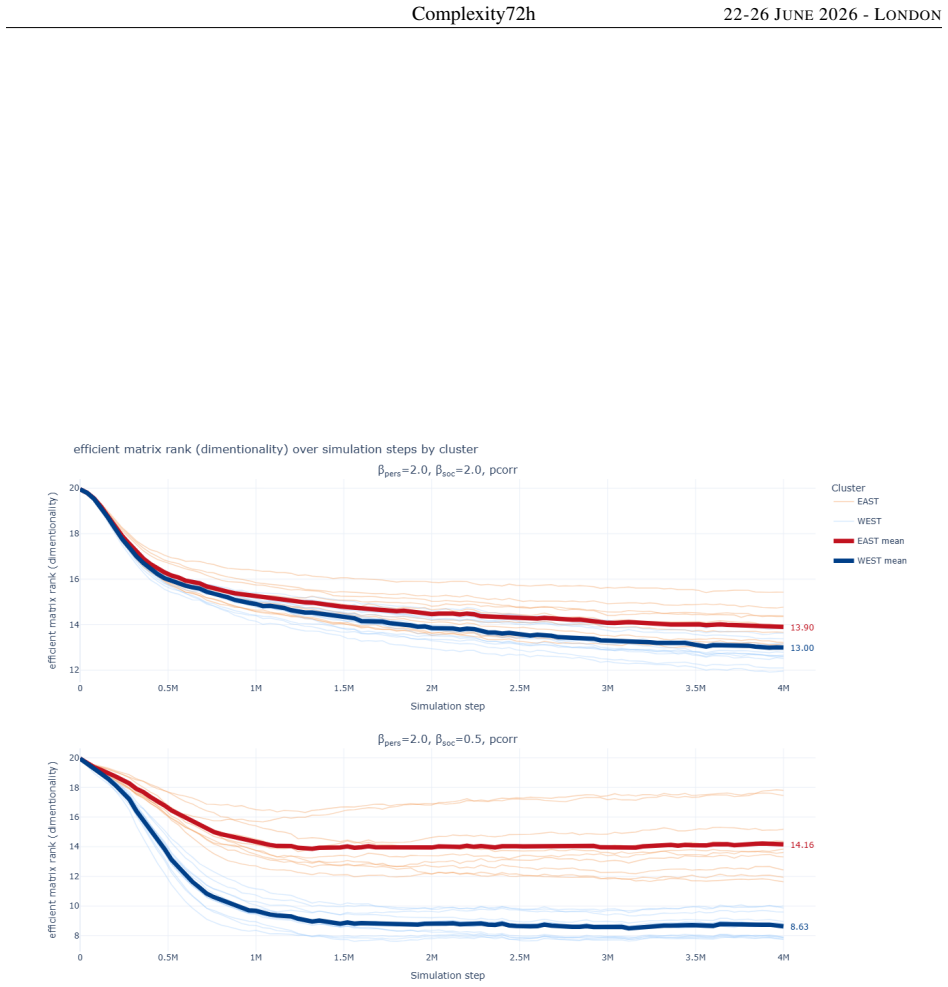
Belief systems across Europe are predominantly organised around immigration, LGBT rights, and economic interventionism, with a Western-Eastern divide in the reliability of left-right self-identification as a predictor of broader belief alignment. When these empirically derived networks are inserted into a sociologically grounded agent-based model, polarisation is amplified by high individual belief rigidity and low susceptibility to social influence, and cross-country differences in polarisation levels mirror the same geographic divide observed in belief network topology. Populations show no polarisation when little attention is placed on maintaining internal coherence and moderate polarisat
What carries the argument
Empirical belief networks inferred via Bayesian algorithm from survey responses, serving as the fixed structure for an agent-based model of individual belief updating under varying rigidity, susceptibility, and attention weights.
If this is right
- High belief rigidity combined with low susceptibility to influence produces greater polarization in the model.
- The Western-Eastern split in network topology produces corresponding differences in simulated polarization levels.
- Little attention to internal coherence results in no polarization across the population.
- High attention to both internal coherence and agreement with others produces moderate polarization.
- Belief network topology functions as the structural feature that transmits these effects across different European contexts.
Where Pith is reading between the lines
- The model could be extended to test whether altering specific belief connections, such as those around immigration, would reduce polarization more effectively in Western versus Eastern networks.
- Similar network inference and simulation methods might reveal whether the same structural drivers operate in non-European political systems.
- If network topology proves stable over time, it could serve as an early indicator for regions likely to experience rising polarization.
- Policy efforts focused on shifting attention weights rather than changing individual beliefs might produce different outcomes depending on the underlying network structure.
Load-bearing premise
The parameters chosen for how rigidly people hold beliefs, how open they are to others' influence, and how much they value internal consistency versus social agreement accurately reflect real human behavior.
What would settle it
A direct comparison of simulated polarization trajectories against measured changes in belief alignment or self-reported polarization in the same 23 countries over subsequent survey waves.
Figures
read the original abstract
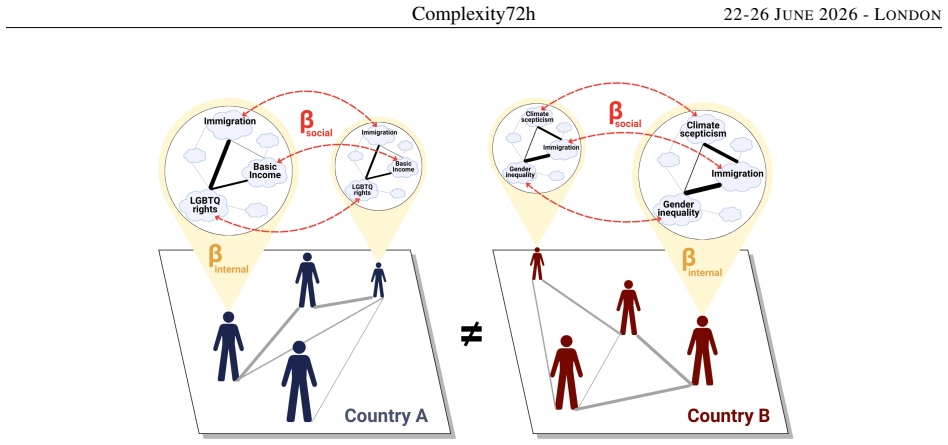
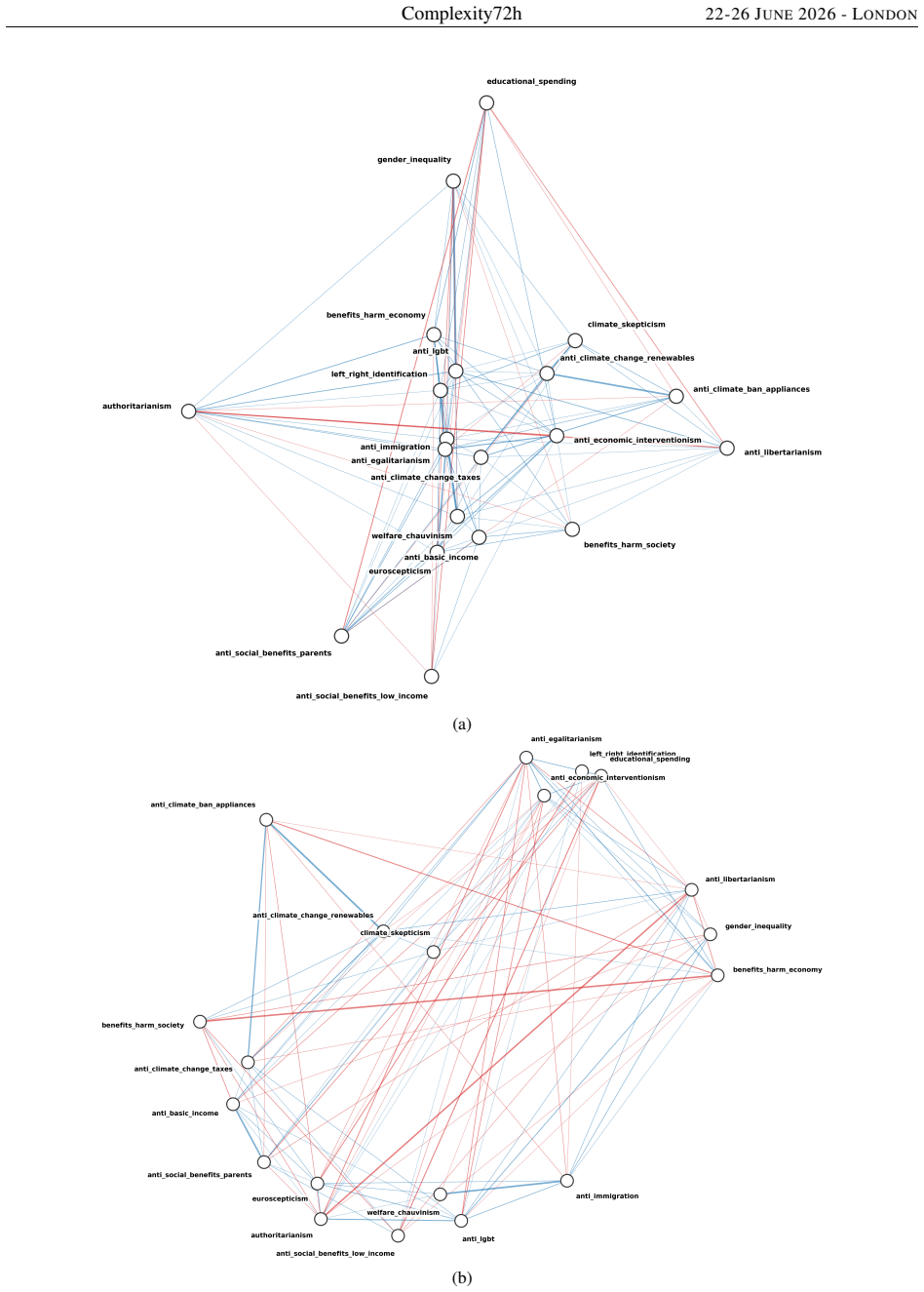
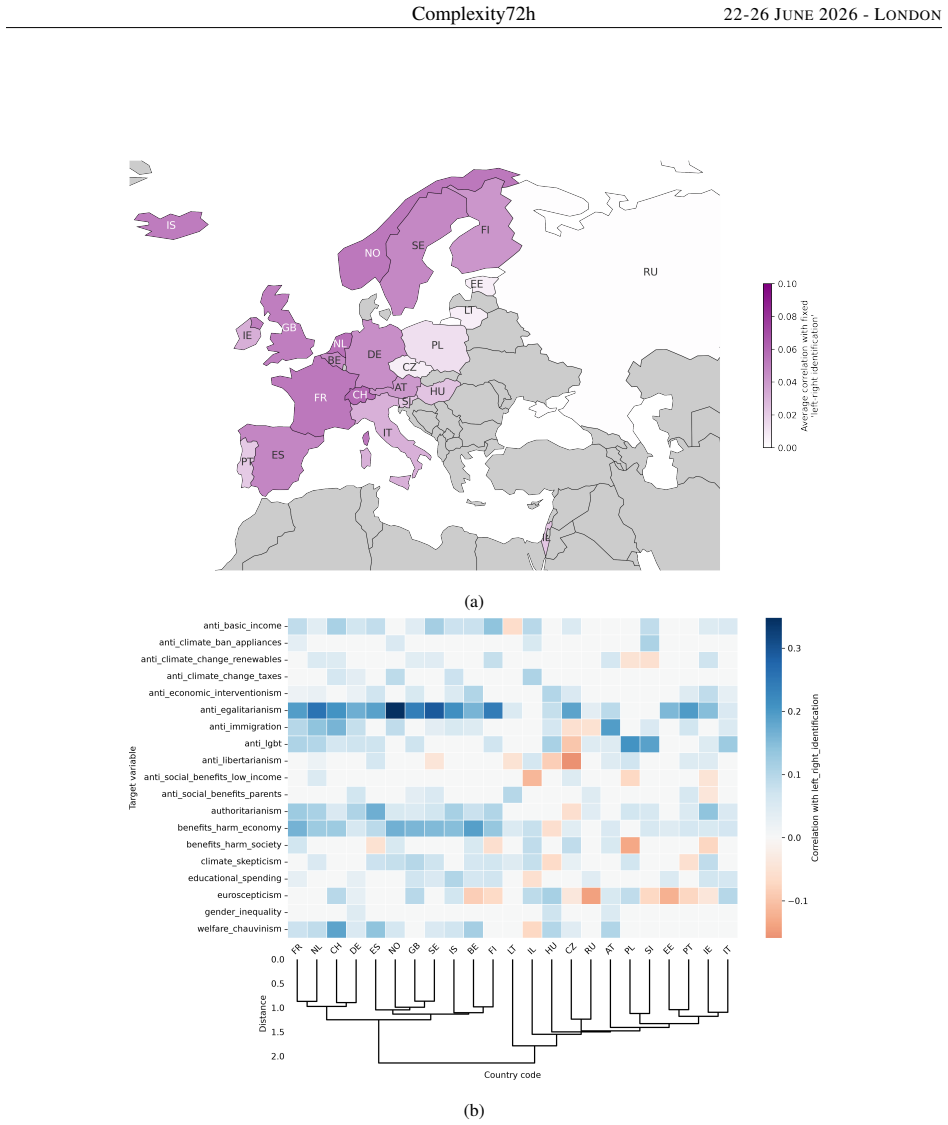
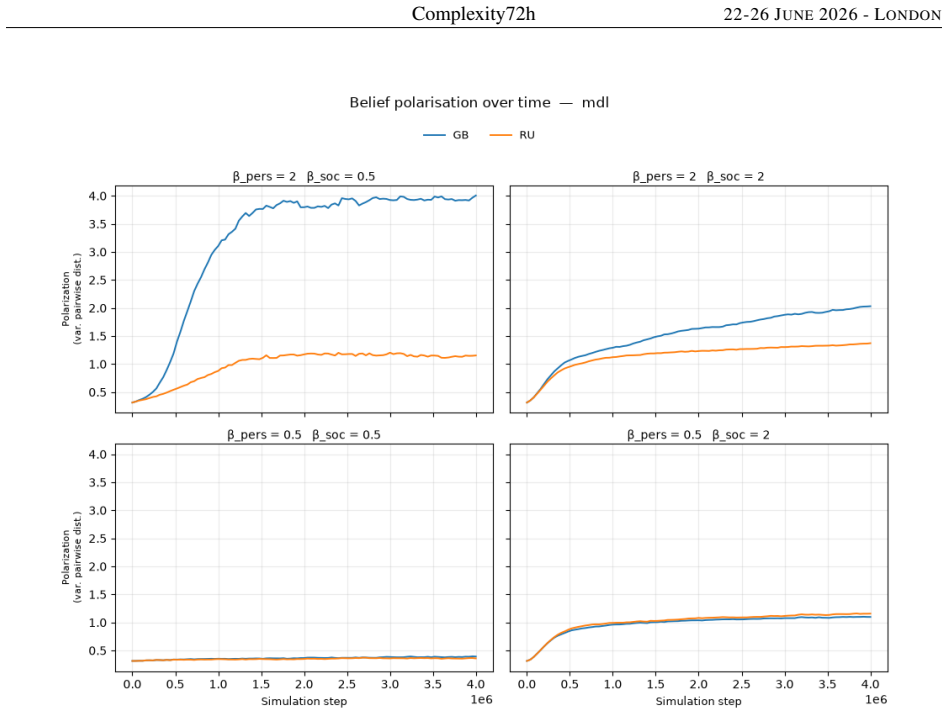
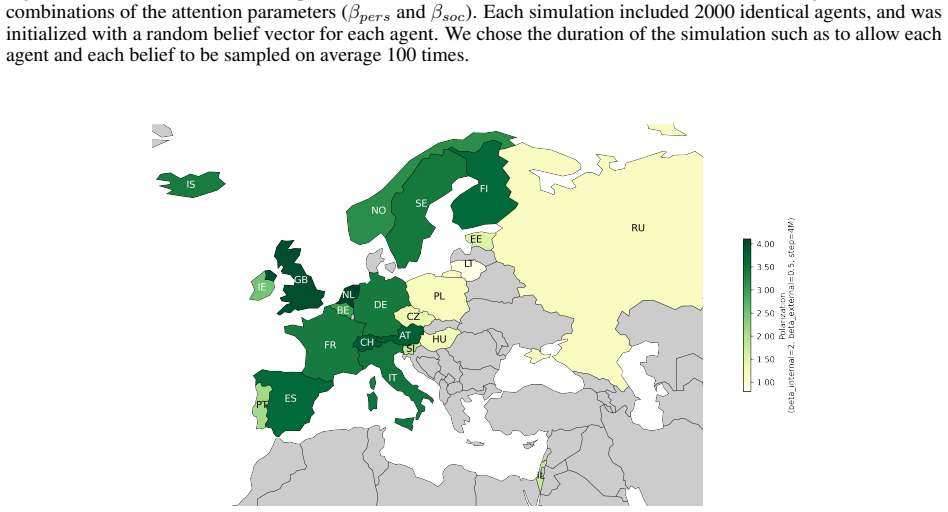
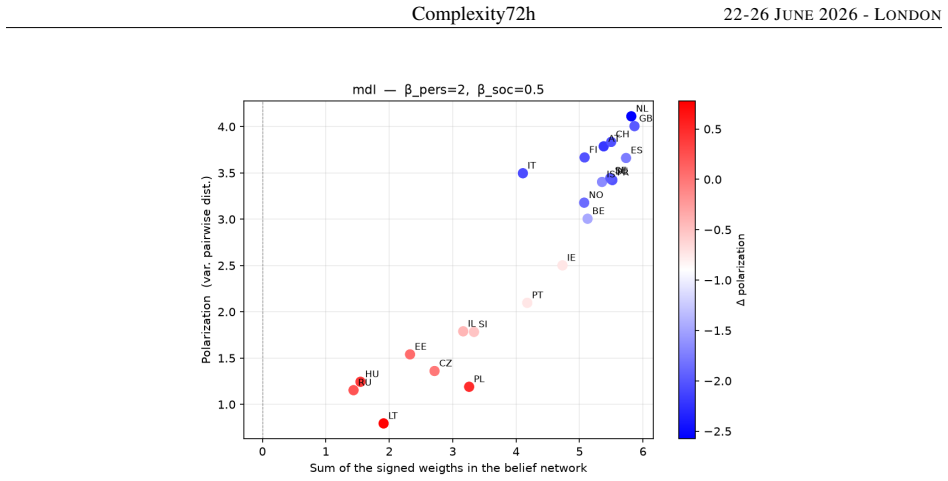
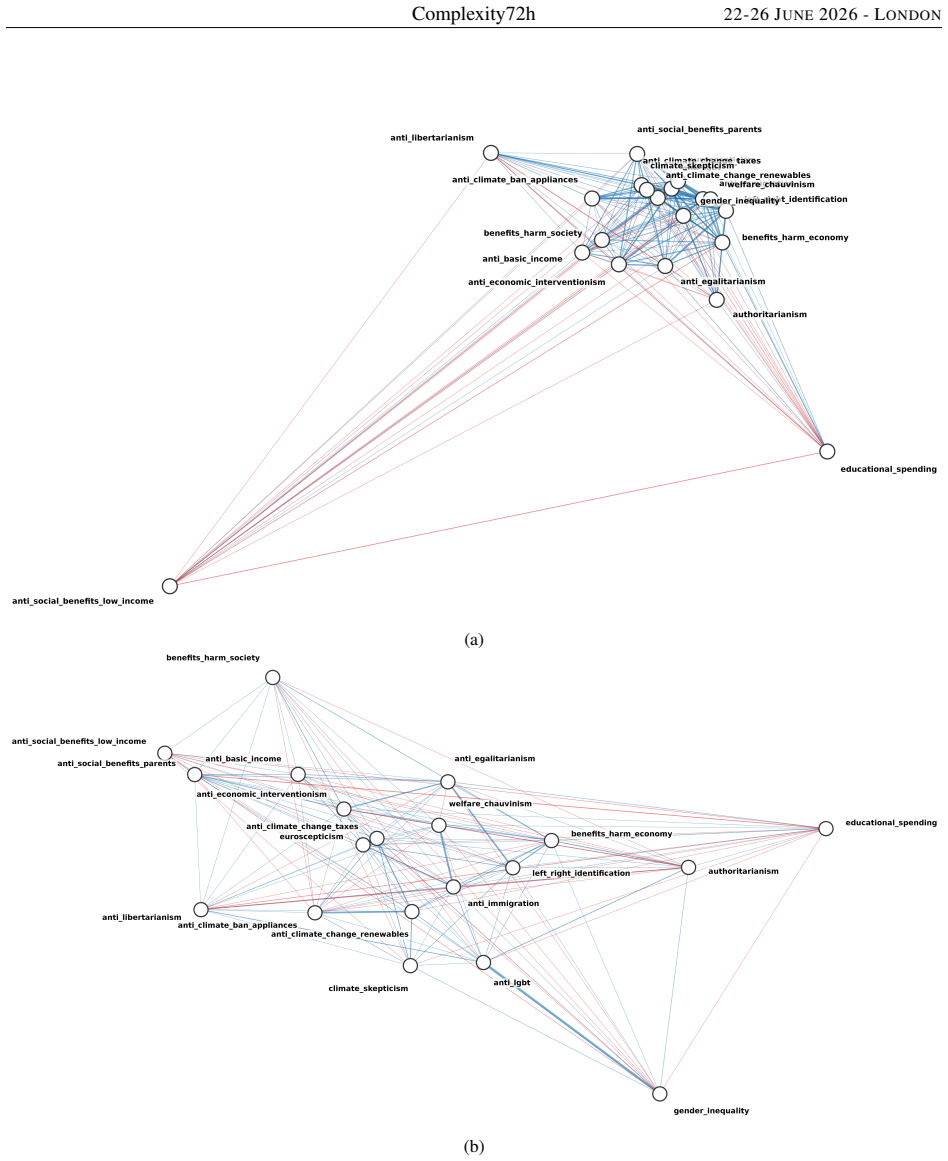
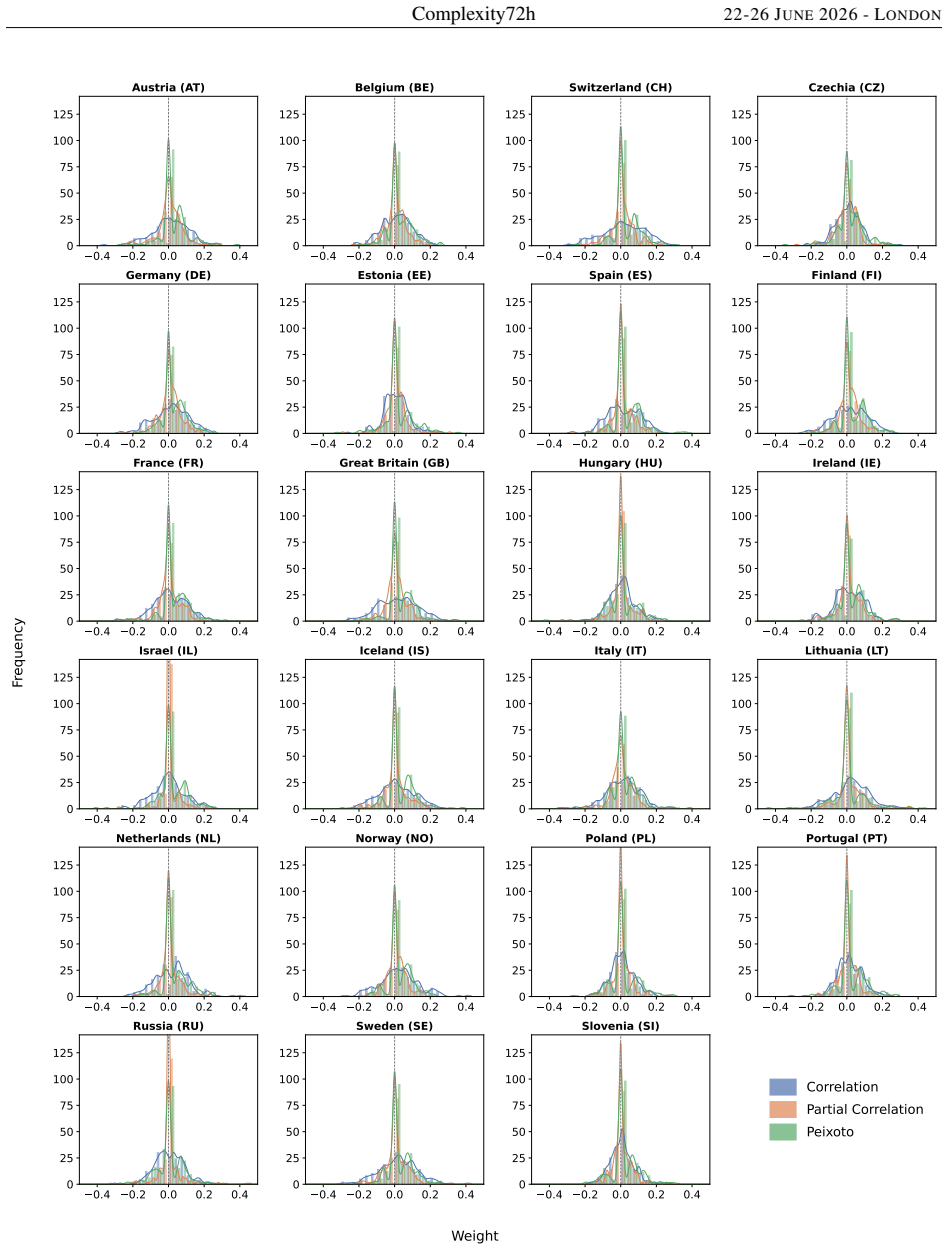
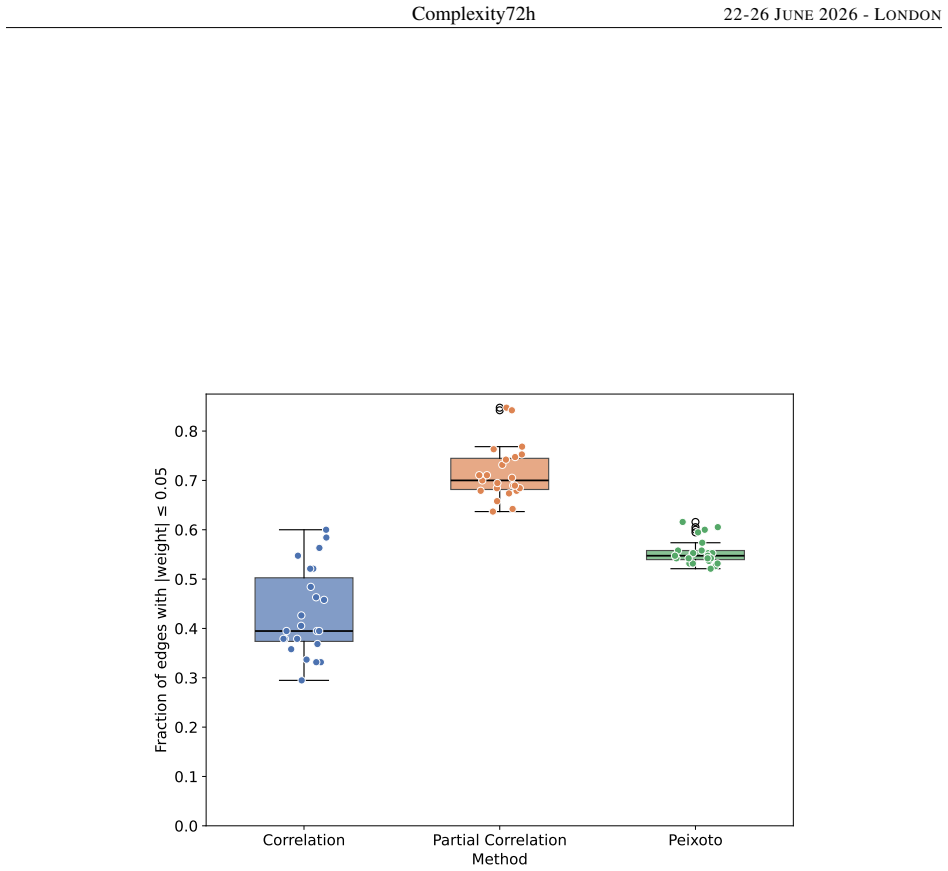
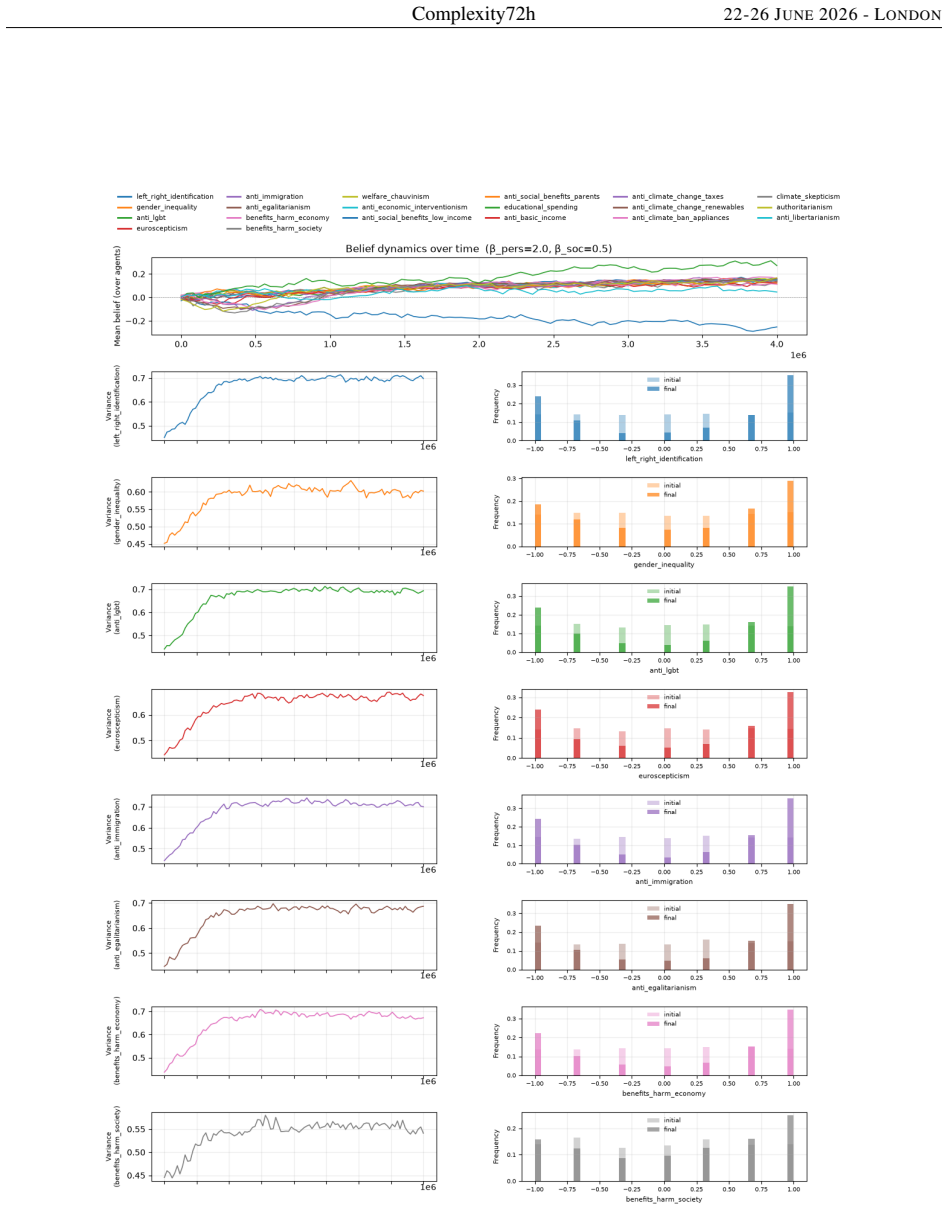
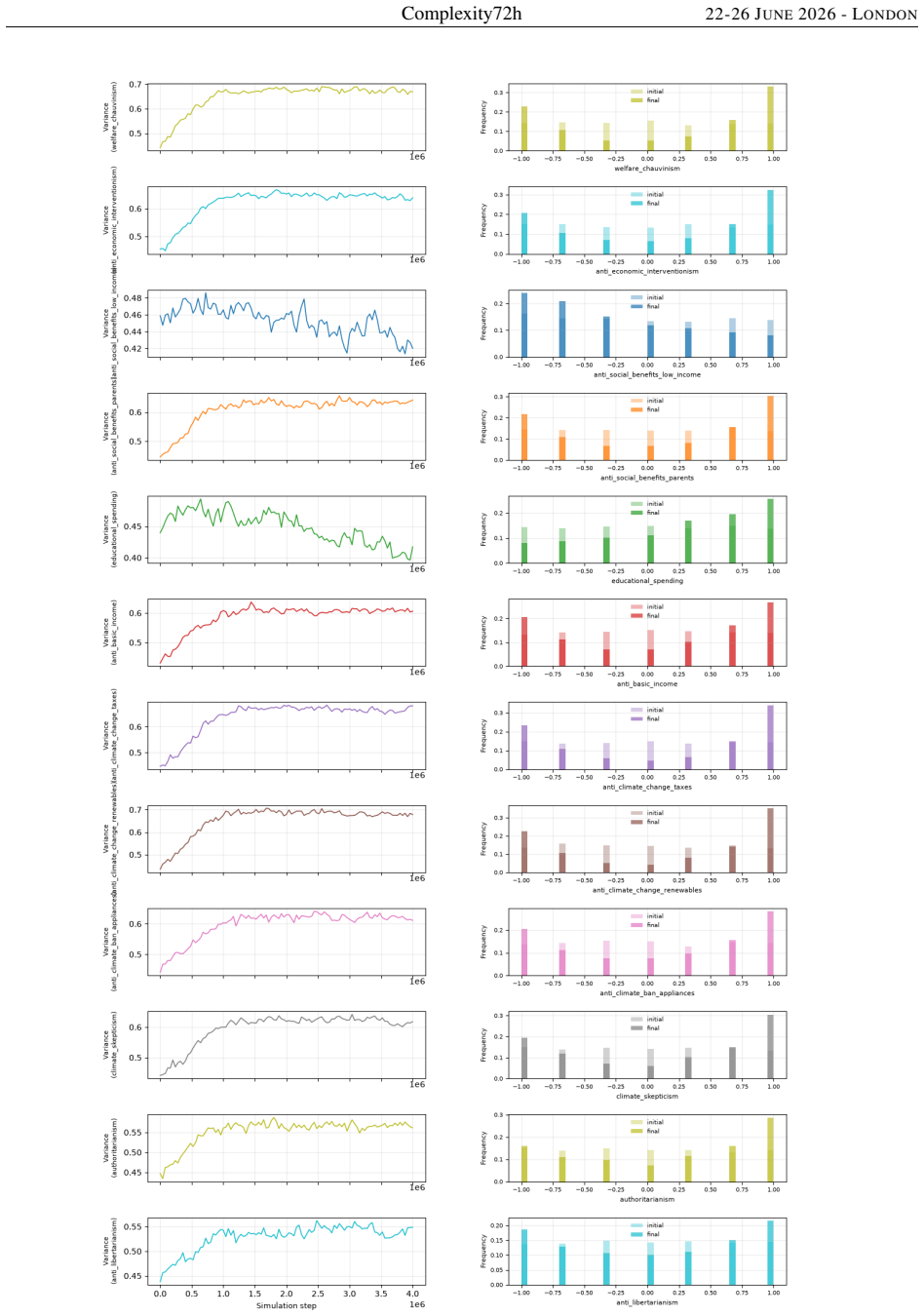
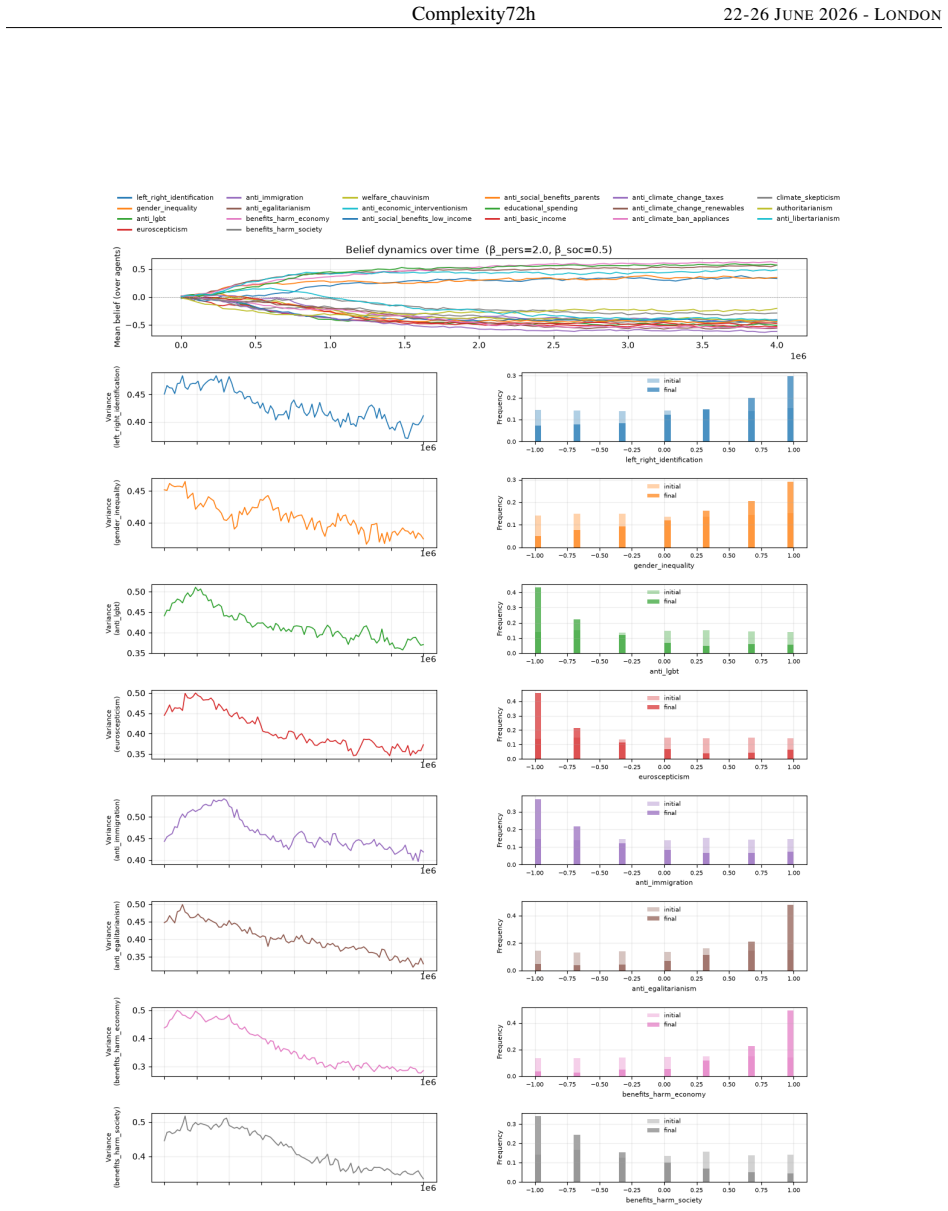
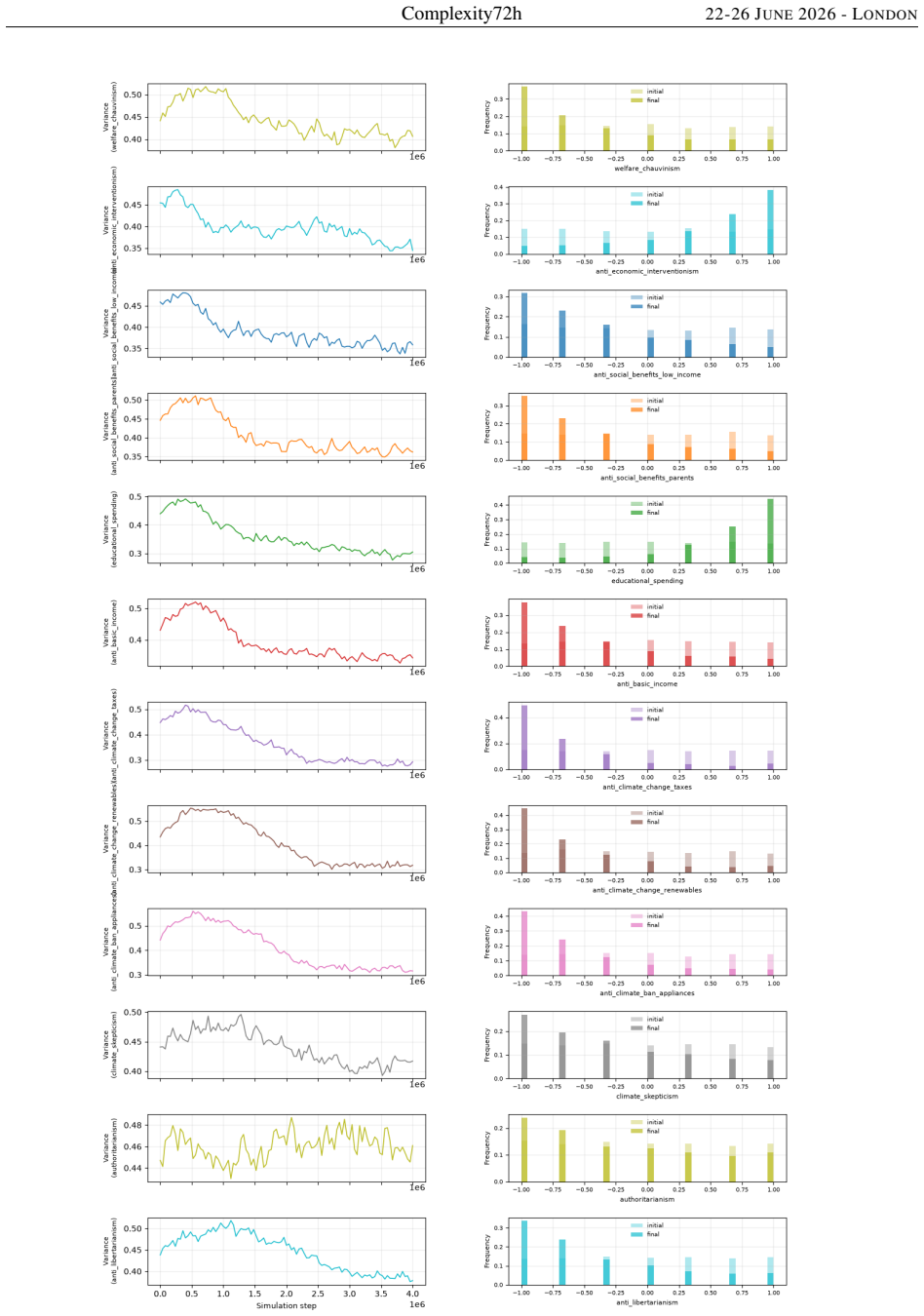
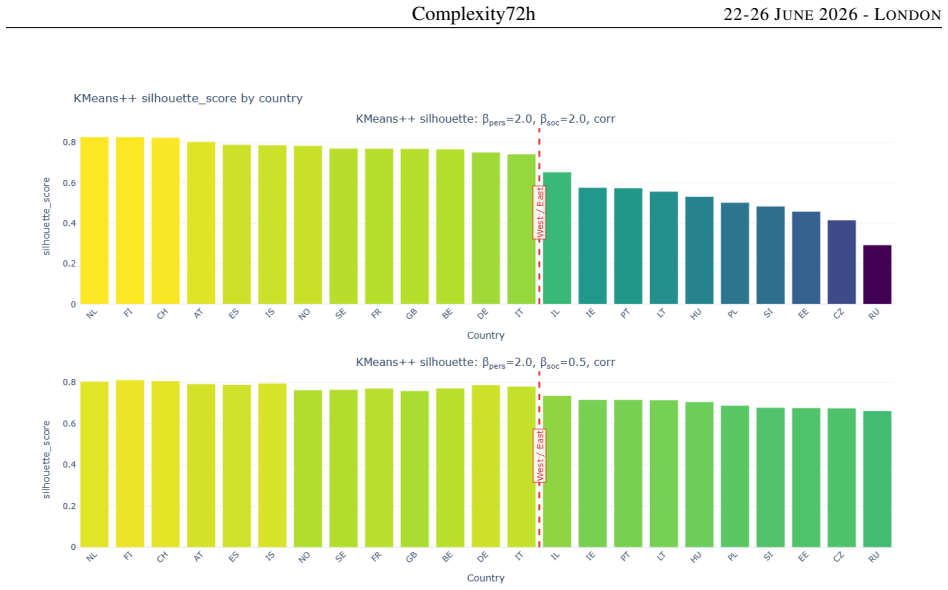
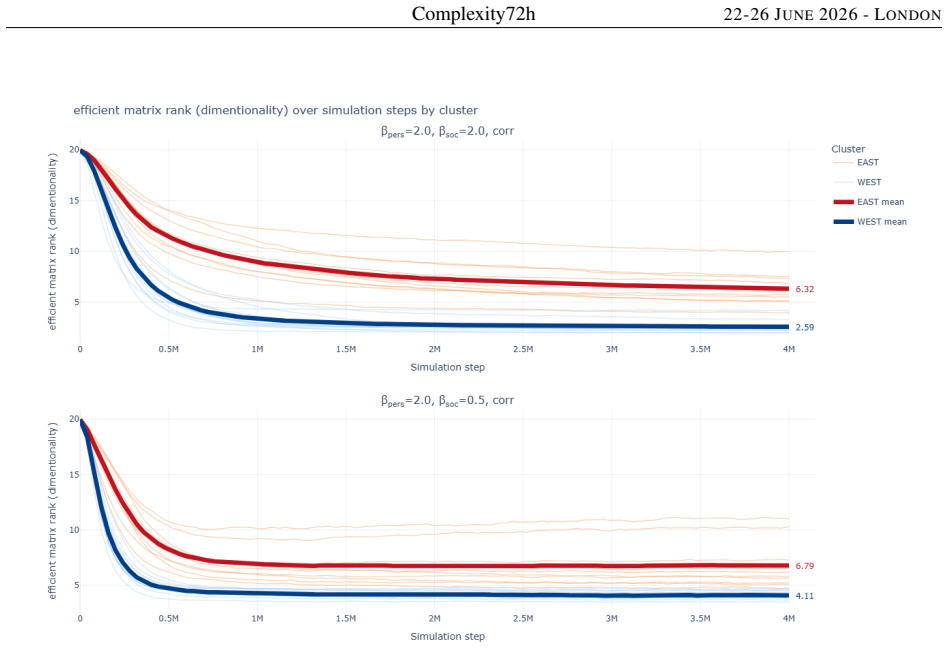
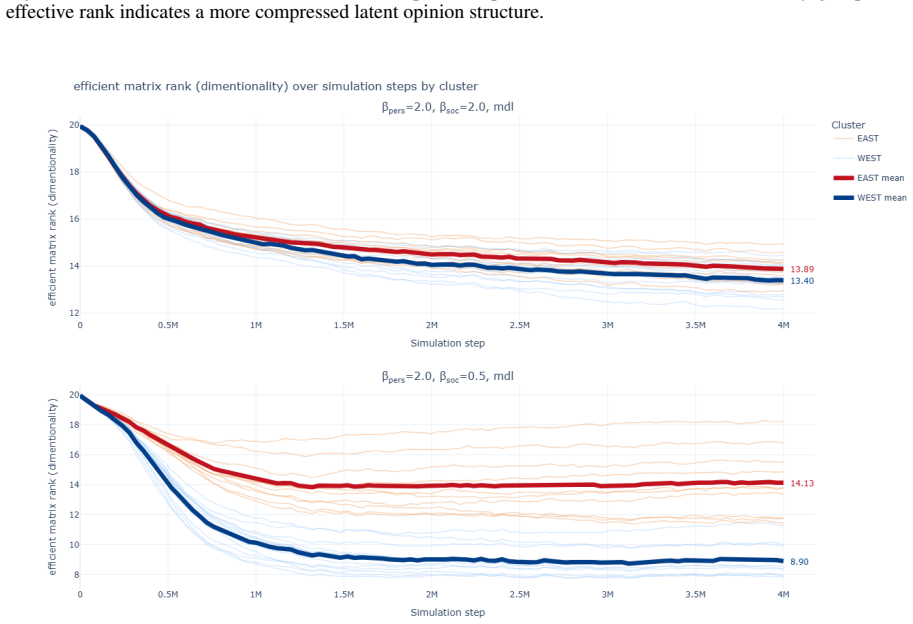
Here we combine empirical network analysis with agent-based modelling to understand how different ways of structuring belief systems may affect the polarisation drive, and how the diversity of belief systems in Europe may result in different polarisation trajectories. Using the 2016 European Social Survey, we infer belief networks across 23 European countries via a Bayesian algorithm, revealing that belief systems are predominantly organised around immigration, LGBT rights, and economic interventionism, reflecting the influence of populist discourse across the continent. We further verify a Western-Eastern divide across the national belief networks: in Western European countries, left-right self-identification is a more reliable predictor of broader belief alignment, whereas in Eastern Europe this relationship breaks down. By applying these empirical belief networks into a sociologically grounded agent-based model, we further show that polarisation is amplified by high individual belief rigidity and low susceptibility to social influence, and that cross-country differences in polarisation levels mirror the same geographic divide observed in belief network topology. These findings establish belief networks topologies as a structural driver of political polarisation, with implications for understanding and anticipating polarisation dynamics across diverse European contexts. We find that populations are not polarised when little attention is placed on maintaining internal coherence and polarisation levels are moderate when high attention is placed in both keeping internal coherence and agreement in beliefs with others.
Editorial analysis
A structured set of objections, weighed in public.
Referee Report
Summary. The manuscript infers belief networks from 2016 European Social Survey data across 23 countries using a Bayesian algorithm, finding predominant organisation around immigration, LGBT rights and economic interventionism plus a Western-Eastern divide in the predictive power of left-right self-identification. These empirical networks are then fed into a sociologically grounded agent-based model (ABM) whose results indicate that polarisation is amplified by high individual belief rigidity and low susceptibility to social influence, that simulated polarisation levels mirror the observed geographic divide, and that populations remain unpolarised when little attention is paid to internal coherence.
Significance. If the ABM outcomes prove robust, the integration of real-data belief networks with an ABM would provide evidence that network topology acts as a structural driver of cross-country polarisation differences, with implications for anticipating dynamics in European contexts. The use of empirical topologies rather than synthetic ones is a methodological strength.
major comments (3)
- [ABM parameter section (abstract and simulation results)] ABM parameter section (abstract and simulation results): the four free parameters (belief rigidity, susceptibility to social influence, attention to internal coherence, attention to agreement with others) are fixed at specific values with no reported calibration to individual-level updating data, no sensitivity sweeps, and no demonstration that the West-East polarisation ordering survives parameter variation; the claim that topologies drive the geographic patterns is therefore shown only conditionally on the chosen regime.
- [Methods and results on network inference] Methods and results on network inference: no validation of the Bayesian algorithm (e.g., recovery on synthetic data), no error bars or uncertainty quantification on the inferred networks, and no comparison of simulated polarisation statistics against any external country-level polarisation metric; this leaves open whether the mirroring patterns arise from the topologies or from unmodeled factors.
- [Simulation results section] Simulation results section: absence of baseline comparisons (randomised networks, null models, or alternative topologies) means the reported amplification and geographic mirroring cannot be isolated as effects of the empirical belief-network structures.
minor comments (2)
- The final sentence of the abstract introduces an additional finding on attention weights that is not clearly separated from the main claims; consider moving or rephrasing for clarity.
- [Methods] Specify the exact numerical values assigned to the four ABM parameters and any justification given for those choices.
Simulated Author's Rebuttal
We thank the referee for their constructive and detailed comments. We address each major point below, indicating where we agree that revisions are warranted and outlining the changes we will make to strengthen the manuscript.
read point-by-point responses
-
Referee: [ABM parameter section (abstract and simulation results)] ABM parameter section (abstract and simulation results): the four free parameters (belief rigidity, susceptibility to social influence, attention to internal coherence, attention to agreement with others) are fixed at specific values with no reported calibration to individual-level updating data, no sensitivity sweeps, and no demonstration that the West-East polarisation ordering survives parameter variation; the claim that topologies drive the geographic patterns is therefore shown only conditionally on the chosen regime.
Authors: We acknowledge that the four parameters were set to representative values drawn from the opinion dynamics literature rather than calibrated against individual-level updating data, and that a systematic sensitivity analysis was not reported. In the revised manuscript we will add a dedicated sensitivity section that sweeps the four parameters over plausible ranges and confirms that the Western-Eastern ordering of polarisation levels is preserved. We will also clarify the sociological rationale for the chosen regime and discuss the absence of suitable calibration data as a limitation. revision: yes
-
Referee: [Methods and results on network inference] Methods and results on network inference: no validation of the Bayesian algorithm (e.g., recovery on synthetic data), no error bars or uncertainty quantification on the inferred networks, and no comparison of simulated polarisation statistics against any external country-level polarisation metric; this leaves open whether the mirroring patterns arise from the topologies or from unmodeled factors.
Authors: The Bayesian inference procedure follows a method previously validated in the literature on belief-network reconstruction. We will incorporate posterior-based uncertainty quantification (error bars) on the reported edge strengths in the revised version. Full synthetic-data recovery tests were outside the scope of the present study, which focuses on applying the method to ESS data; we will add a short reference to prior validation studies. Regarding external country-level metrics, the geographic mirroring is shown against the observed belief-alignment patterns themselves; we will expand the discussion to address possible confounding factors and note the lack of direct external polarisation benchmarks as a limitation. revision: partial
-
Referee: [Simulation results section] Simulation results section: absence of baseline comparisons (randomised networks, null models, or alternative topologies) means the reported amplification and geographic mirroring cannot be isolated as effects of the empirical belief-network structures.
Authors: We agree that null-model comparisons are needed to isolate the contribution of the empirical topologies. In the revised manuscript we will add simulations on degree-preserved randomised networks and report the resulting polarisation statistics, thereby demonstrating that the observed amplification and geographic patterns are attributable to the specific structures inferred from the survey data. revision: yes
Circularity Check
No significant circularity in derivation chain
full rationale
The paper infers empirical belief networks from 2016 European Social Survey data using a Bayesian algorithm, then inserts those networks as fixed inputs into an agent-based model with stated parameters for rigidity, susceptibility, and attention weights. Simulated polarization levels and the reproduced West-East geographic pattern are generated outputs of the model dynamics applied to distinct network topologies; they are not equivalent to the input networks or parameters by construction. No self-definitional equations, fitted inputs renamed as predictions, load-bearing self-citations, or ansatz smuggling appear in the provided text. The pipeline is a standard empirical-to-simulation workflow that remains self-contained against external benchmarks.
Axiom & Free-Parameter Ledger
free parameters (4)
- belief rigidity
- susceptibility to social influence
- attention to internal coherence
- attention to agreement with others
axioms (2)
- domain assumption Political beliefs can be represented as networks whose edges are inferred from co-occurrence patterns in survey responses via a Bayesian algorithm.
- domain assumption An agent-based model whose update rules are governed by the listed rigidity and susceptibility parameters reproduces real-world polarisation dynamics.
Reference graph
Works this paper leans on
-
[1]
URL https://debatingeurope.eu/wp-content/uploads/2025/04/V4C-report-_PDF-version. pdf. Survey conducted November 2024 – January 2025 across Denmark, France, Germany, Italy and Poland. Philip E. Converse. The nature of belief systems in mass publics (1964).Critical Review, 18(1-3):1–74, 2006. ISSN 1933-8007. doi:10.1080/08913810608443650. URLhttp://dx.doi....
-
[2]
Management of large-scale system development
doi:10.1093/actrade/9780190234874.001.0001. Diana C. Mutz. The consequences of cross-cutting networks for political participation.American Journal of Political Science, 46(4):838–855, 2002. doi:10.2307/3088437. Jonas Dalege, Denny Borsboom, Frenk van Harreveld, Helma van den Berg, Mark Conner, and Han L. J. van der Maas. Toward a formalized account of att...
-
[3]
Spread — the distance between the most extreme opinions
-
[4]
Dispersion or statistical variation — the statistical spread of opinions, for example standard deviation or mean absolute deviation
-
[5]
Coverage — the fraction of occupied intervals on the opinion scale; lower coverage indicates that opinions are concentrated in narrower regions
-
[6]
Regionalisation — the number of empty gaps between occupied regions of the distribution
-
[7]
Community fracturing — the number of groups or clusters in the distribution
-
[8]
Distinctness — the degree to which groups are separated from one another
-
[9]
Group divergence — the distance between group means or other central characteristics of groups
-
[10]
Group consensus or solidarity — the degree of agreement within each group; lower within-group variation corresponds to higher polarisation
-
[11]
These nine senses of polarisation are not mutually implied
Size parity — the balance between group sizes; polarisation is higher when groups are comparable in size. These nine senses of polarisation are not mutually implied. For example, a distribution may exhibit strong within-group consensus but have a small overall spread, or it may have large divergence between group means while the groups themselves are high...
2020
-
[12]
Western” and conditionally “Eastern
represent each agent’s opinion as a vector of topic-specific components and introduce the MiDS matrix (C), which encodes interdependencies between issues. Positive couplings in this matrix tend to align topic-specific opinions, whereas negative couplings may lead to their polarisation. Similarly, Baumann et al. [2021] consider opinions as vectors in a mul...
2021
discussion (0)
Sign in with ORCID, Apple, or X to comment. Anyone can read and Pith papers without signing in.