Termination of the Lattice-Automorphism Tower for Direct Products of Symmetric Groups
Pith reviewed 2026-05-21 01:38 UTC · model grok-4.3
The pith
For groups that are direct products of symmetric groups S_k with k at least 3, the sequence of lattice automorphism groups reaches the trivial group after three steps.
A machine-rendered reading of the paper's core claim, the machinery that carries it, and where it could break.
Core claim
Let G be a tower group, so G is isomorphic to the direct product over k at least 3 of S_k raised to a_k. Then LatAut of the product is isomorphic to S_{a_4} times S_B where B is the sum of a_k for k not equal to 4. Consequently the LatAut tower satisfies G_3 equals the trivial group, and there exist tower groups where G_2 is nontrivial so the bound is sharp.
What carries the argument
The LatAut tower, which is the iterated automorphism group of the lattice of normal subgroups, together with the product formula that reduces the computation to symmetric groups on the exponents a_k.
Load-bearing premise
The group must be isomorphic to a finite direct product of symmetric groups S_k with k at least 3.
What would settle it
A specific tower group such as S_3 times S_3 where the third iterate of LatAut is not the trivial group would refute the termination claim.
Figures
read the original abstract
Let $G$ be a finite group. Let $\mathcal{N}(G)$ be the lattice of normal subgroups ordered by inclusion, regarded as an abstract lattice. Define $\operatorname{LatAut}(G) := \operatorname{Aut}(\mathcal{N}(G))$. The \emph{LatAut tower} is the sequence defined by $G_0 = G$, $G_{n+1} = \operatorname{LatAut}(G_n)$. Let $G$ be a \emph{tower group} if $G \cong \prod_{k \geq 3} S_k^{a_k}$ with finitely many $a_k \neq 0$. We establish the following for tower groups. \emph{Product Formula.} $\operatorname{LatAut}\!\bigl(\prod_{k \geq 3} S_k^{a_k}\bigr) \cong S_{a_4} \times S_B$, where $B = \sum_{k \geq 3,\, k \neq 4} a_k$. \emph{Termination Theorem.} For every tower group $G_0$, we prove that $G_3 = 1$, and that this bound is sharp. The proof applies Goursat's lemma to classify $\mathcal{N}(G)$ into three families parameterised by admissible triples $(J,\mathbf{P},H)$ as sub-products, sign-parity elements, and mixed elements, and uses the Krull--Schmidt theorem to identify the direct factors $S_k^{(k,i)}$ as precisely the nontrivial indecomposable complemented elements of $\mathcal{N}(G)$ (the complemented elements being exactly the full sub-products). These results do not extend to groups outside the tower-group family.
Editorial analysis
A structured set of objections, weighed in public.
Referee Report
Summary. The paper defines the lattice automorphism tower for a finite group G by G_0 = G and G_{n+1} = LatAut(G_n), where LatAut(G) is the automorphism group of the lattice of normal subgroups of G. It restricts attention to tower groups, i.e., finite direct products ∏_{k≥3} S_k^{a_k}. The central results are the Product Formula, which asserts LatAut(∏ S_k^{a_k}) ≅ S_{a_4} × S_B with B = ∑_{k≠4} a_k, and the Termination Theorem, which states that G_3 is trivial for every such G_0 and that the bound of three steps is sharp. The proofs proceed by applying Goursat's lemma to partition N(G) into three families of admissible triples (J, P, H), identifying the complemented elements as full sub-products, and invoking Krull-Schmidt to isolate the indecomposable factors S_k^{(k,i)}; iteration of the Product Formula then reduces the relevant parameters until the lattice automorphism group becomes trivial.
Significance. If the results hold, the manuscript supplies an explicit, computable description of lattice automorphisms for an infinite family of groups that includes all non-abelian simple groups of the form S_k (k≥3) and their direct products. The termination bound of three steps, together with the sharpness examples constructed by taking a_4 and B sufficiently large, gives a concrete illustration of how the lattice automorphism tower behaves under direct products. The reliance on Goursat's lemma and Krull-Schmidt is standard yet applied here in a way that yields a parameter-reduction argument; the explicit Product Formula is a strength that may serve as a model for similar computations in other classes of groups.
major comments (2)
- The Product Formula is the load-bearing step for both the explicit description and the termination argument. The manuscript should verify that the three families of admissible triples (J, P, H) obtained via Goursat's lemma are exhaustive and that the only complemented elements are indeed the full sub-products; a short explicit check for the case of two distinct factors S_3 × S_5 would strengthen the claim.
- In the iteration step of the Termination Theorem, the reduction of parameters (a_4 and B) is asserted to force triviality by the third iterate. The manuscript should include a short table or diagram tracking the multiplicity vector through the three steps for a generic choice with a_4 ≥ 1 and at least one other a_k ≥ 1, confirming that the exceptional cases S_2 and the trivial group are handled uniformly.
minor comments (2)
- The notation S_k^{(k,i)} for the indecomposable factors is introduced without an explicit reference to the Krull-Schmidt decomposition; a sentence clarifying that these are the unique (up to isomorphism) indecomposable summands would improve readability.
- The abstract states that the results do not extend outside the tower-group family, but the introduction could briefly indicate the smallest counter-example outside the family (e.g., a direct product involving S_2) to make the boundary of the result concrete.
Simulated Author's Rebuttal
We thank the referee for the careful reading and constructive suggestions. We address each major comment below and will incorporate the recommended clarifications in the revised manuscript.
read point-by-point responses
-
Referee: The Product Formula is the load-bearing step for both the explicit description and the termination argument. The manuscript should verify that the three families of admissible triples (J, P, H) obtained via Goursat's lemma are exhaustive and that the only complemented elements are indeed the full sub-products; a short explicit check for the case of two distinct factors S_3 × S_5 would strengthen the claim.
Authors: We agree that an explicit verification for the small case S_3 × S_5 would strengthen the argument. In the revised manuscript we will add a short subsection applying Goursat's lemma directly to this example, confirming that the three families of admissible triples are exhaustive and that the complemented elements of N(G) are precisely the full sub-products. revision: yes
-
Referee: In the iteration step of the Termination Theorem, the reduction of parameters (a_4 and B) is asserted to force triviality by the third iterate. The manuscript should include a short table or diagram tracking the multiplicity vector through the three steps for a generic choice with a_4 ≥ 1 and at least one other a_k ≥ 1, confirming that the exceptional cases S_2 and the trivial group are handled uniformly.
Authors: We accept the suggestion to improve the clarity of the iteration argument. The revised manuscript will contain a short table tracking the multiplicity parameters a_4 and B through each of the three steps for a representative tower group with a_4 ≥ 1 and at least one other a_k ≥ 1. The table will also note the uniform handling of the cases that produce S_2 or the trivial group. revision: yes
Circularity Check
No significant circularity; derivation uses external theorems
full rationale
The derivation begins by applying Goursat's lemma to classify N(G) for tower groups into admissible triples, then invokes the external Krull-Schmidt theorem to isolate indecomposable complemented elements as the individual S_k factors. The Product Formula is thereby obtained as LatAut(G) ≅ S_{a4} × S_B. Iteration of this formula on the output (itself a tower group or small exceptional case) reduces the multiplicity parameters a4 and B at each step, yielding G3 = 1. All load-bearing steps rest on these standard external lemmas rather than self-definitions, fitted inputs renamed as predictions, or self-citation chains; the argument is therefore self-contained against external benchmarks.
Axiom & Free-Parameter Ledger
axioms (2)
- standard math Goursat's lemma
- standard math Krull-Schmidt theorem
Lean theorems connected to this paper
-
IndisputableMonolith/Foundation/AbsoluteFloorClosure.leanreality_from_one_distinction unclear?
unclearRelation between the paper passage and the cited Recognition theorem.
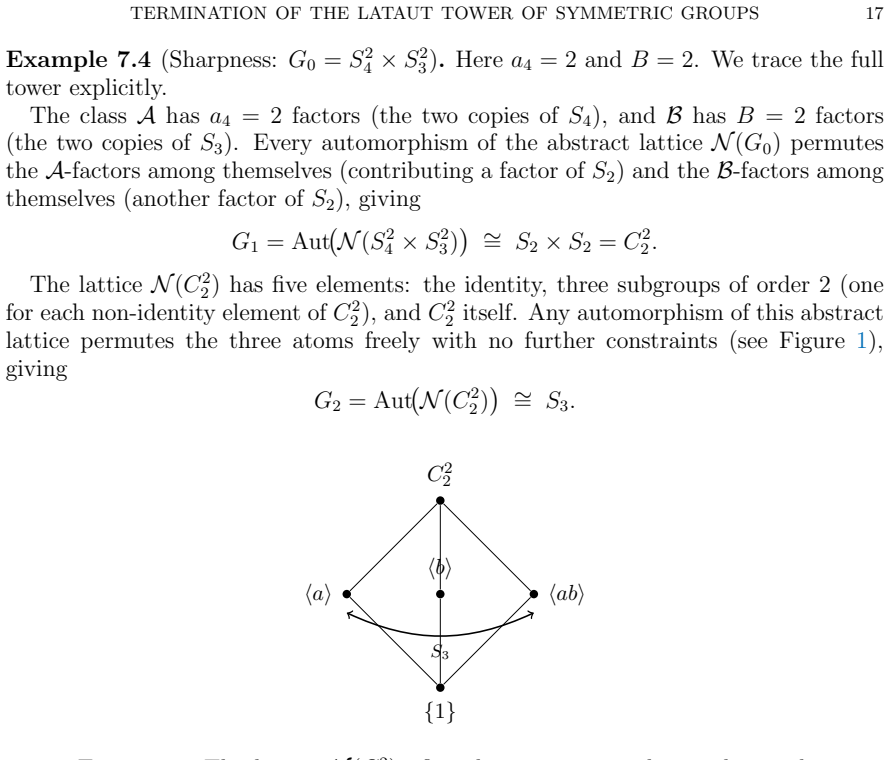
Theorem 1.2 (Termination). For any tower group G0, the LatAut tower satisfies G3=1. This bound is sharp: G0=S2_4×S2_3 gives G3=1 with G2≠1.
What do these tags mean?
- matches
- The paper's claim is directly supported by a theorem in the formal canon.
- supports
- The theorem supports part of the paper's argument, but the paper may add assumptions or extra steps.
- extends
- The paper goes beyond the formal theorem; the theorem is a base layer rather than the whole result.
- uses
- The paper appears to rely on the theorem as machinery.
- contradicts
- The paper's claim conflicts with a theorem or certificate in the canon.
- unclear
- Pith found a possible connection, but the passage is too broad, indirect, or ambiguous to say the theorem truly supports the claim.
Reference graph
Works this paper leans on
-
[1]
Birkhoff,Lattice Theory, 3rd ed., American Mathematical Society Colloquium Publications, vol
G. Birkhoff,Lattice Theory, 3rd ed., American Mathematical Society Colloquium Publications, vol. 25, American Mathematical Society, Providence, RI, 1967
work page 1967
-
[2]
The GAP Group,GAP — Groups, Algorithms, and Programming, Version 4.12.2, 2022,https: //www.gap-system.org
work page 2022
-
[3]
Ore, Structures and group theory II,Duke Math
O. Ore, Structures and group theory II,Duke Math. J.4(1938), no. 2, 247–269
work page 1938
-
[4]
Robinson,A Course in the Theory of Groups, 2nd ed., Graduate Texts in Mathematics, vol
D.J.S. Robinson,A Course in the Theory of Groups, 2nd ed., Graduate Texts in Mathematics, vol. 80, Springer, New York, 1996
work page 1996
-
[5]
Schmidt,Subgroup Lattices of Groups, de Gruyter Expositions in Mathematics, vol
R. Schmidt,Subgroup Lattices of Groups, de Gruyter Expositions in Mathematics, vol. 14, Walter de Gruyter, Berlin, 1994
work page 1994
-
[6]
The Sage Developers,SageMath, the Sage Mathematics Software System (Version 10.3), 2024, https://www.sagemath.org
work page 2024
-
[7]
Thomas, The automorphism tower problem,Proc
S. Thomas, The automorphism tower problem,Proc. Amer. Math. Soc.95(1985), no. 2, 166–168
work page 1985
-
[8]
Wielandt, Eine Verallgemeinerung der invarianten Untergruppen,Math
H. Wielandt, Eine Verallgemeinerung der invarianten Untergruppen,Math. Z.45(1939), 209–244. Department of Mathematics, Manipal Institute of Technology Email address:sonupnkumar@gmail.com Department of Mathematics, Manipal Institute of Technology Email address:vinay.m2000@gmail.com
work page 1939
discussion (0)
Sign in with ORCID, Apple, or X to comment. Anyone can read and Pith papers without signing in.