Effects of nonlocal interactions on s- and d-wave superconducting correlations in the extended Hubbard model
Pith reviewed 2026-06-26 15:35 UTC · model grok-4.3
The pith
Nonlocal interactions in the extended Hubbard model favor s-wave or d-wave pairing depending on which term is included.
A machine-rendered reading of the paper's core claim, the machinery that carries it, and where it could break.
Core claim
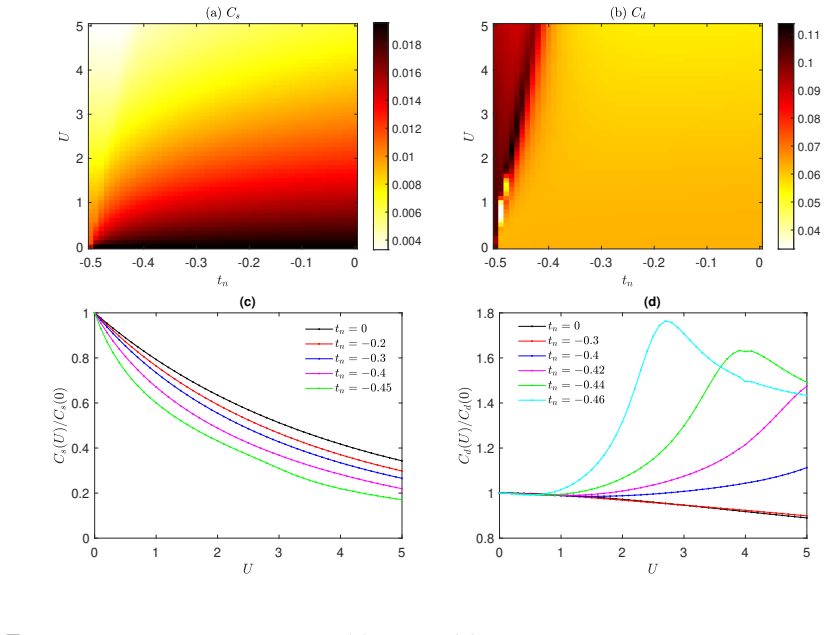
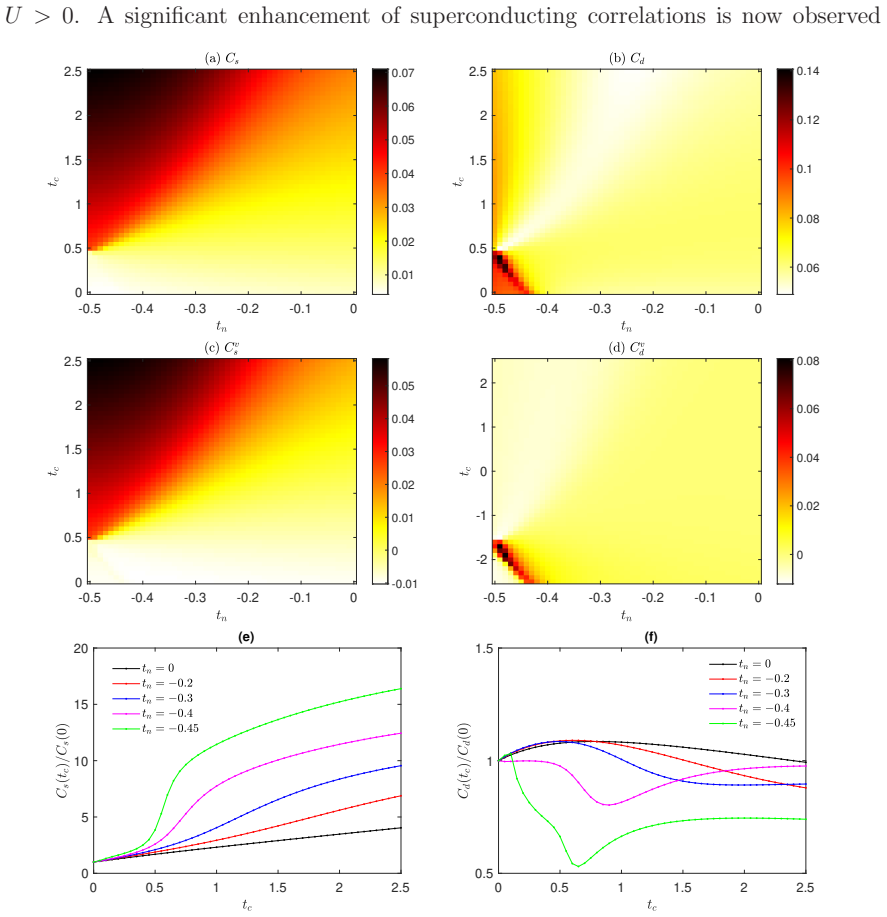
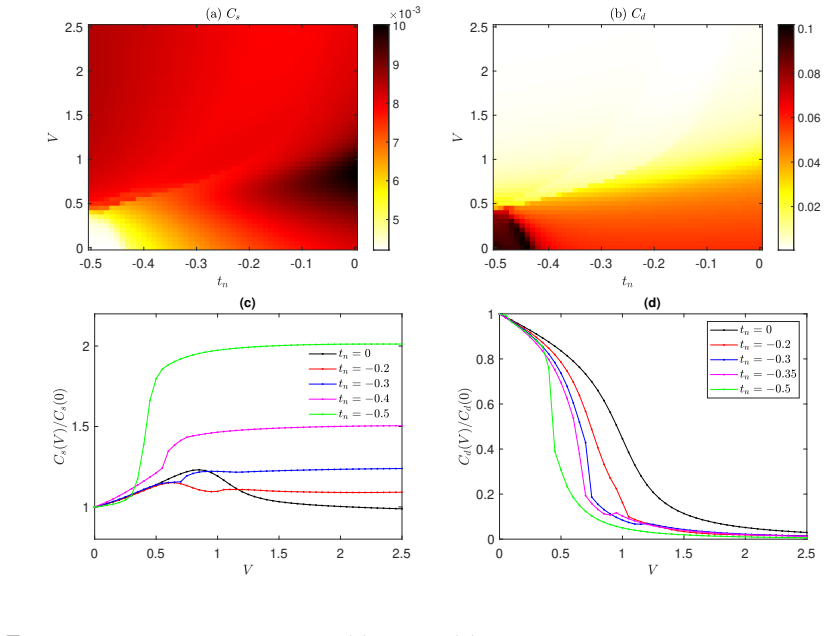
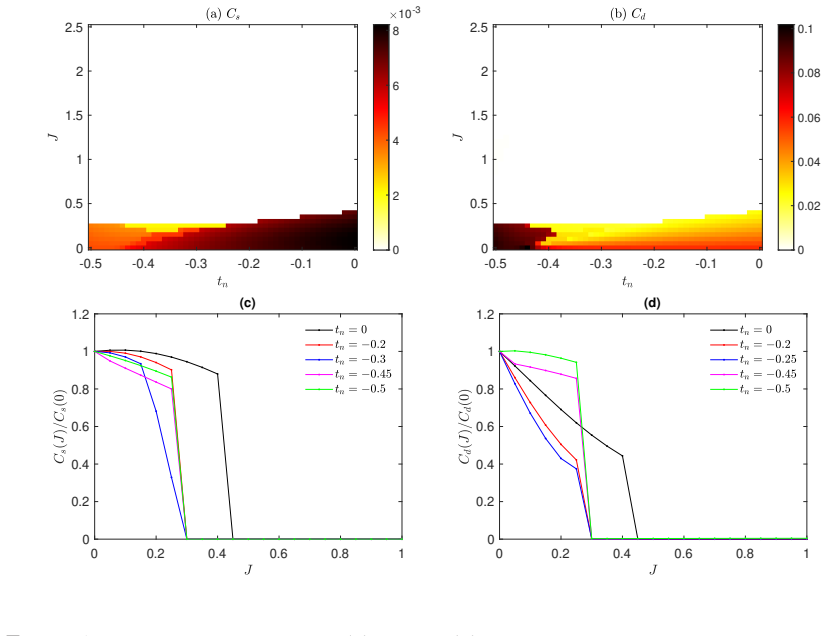
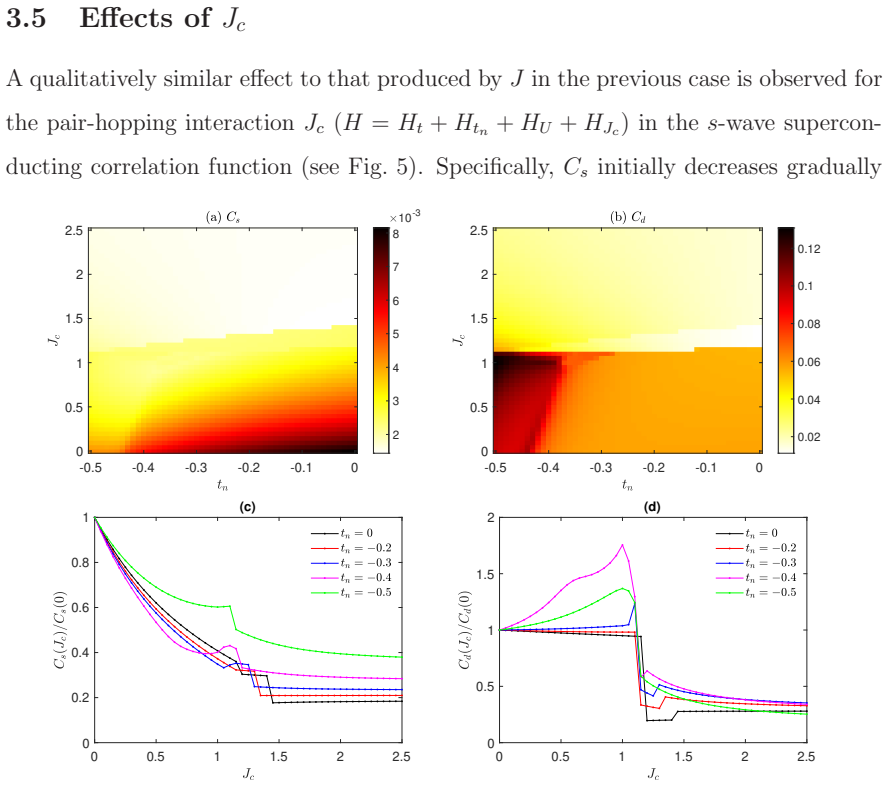
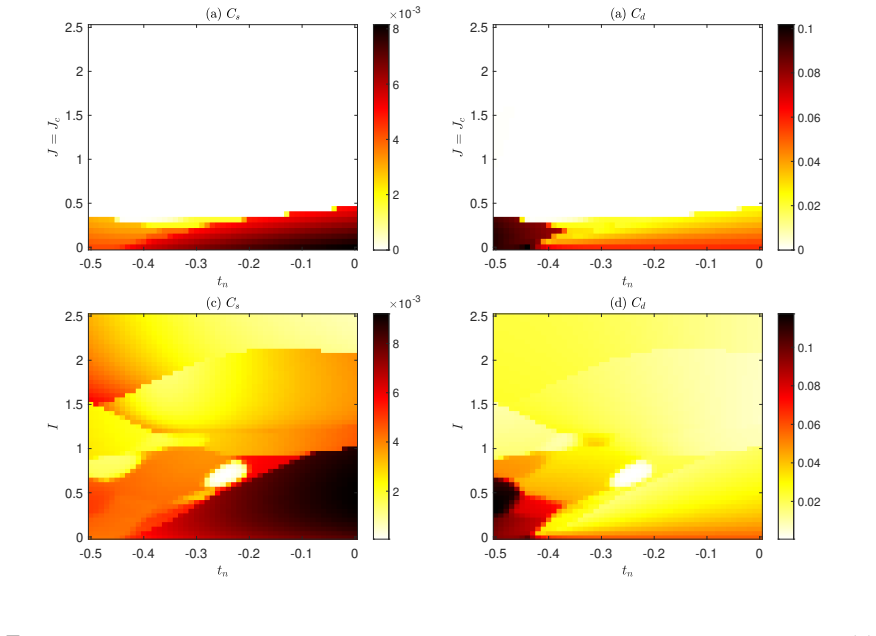
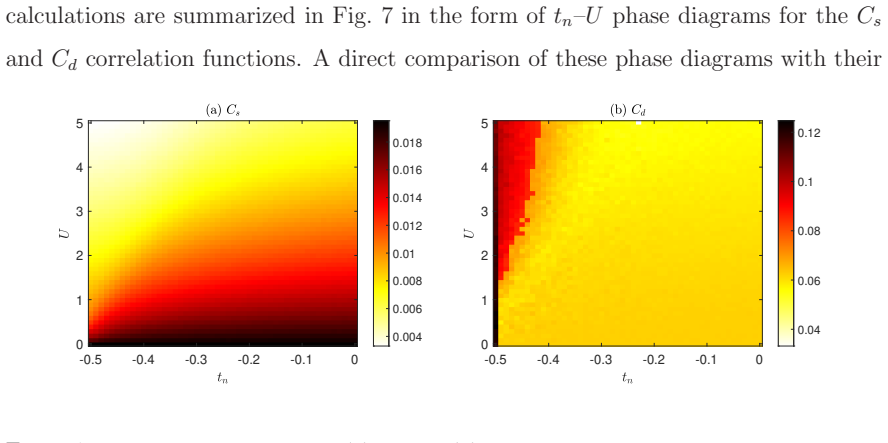
On a 4x4 cluster, on-site repulsion together with next-nearest-neighbor hopping enhances d-wave pairing correlations, correlated hopping and nearest-neighbor Coulomb repulsion promote s-wave correlations, and exchange and pair-hopping interactions suppress superconductivity once their strength exceeds small critical values. Inclusion of all nonlocal terms simultaneously produces phase diagrams marked by competition between the two pairing symmetries.
What carries the argument
Lanczos exact diagonalization on a 4x4 cluster to measure s- and d-wave pairing correlations, supplemented by projector quantum Monte Carlo on selected parameter sets.
If this is right
- On-site repulsion plus next-nearest-neighbor hopping strengthens d-wave pairing tendencies.
- Correlated hopping and nearest-neighbor Coulomb interaction strengthen s-wave pairing tendencies.
- Exchange and pair-hopping interactions suppress both s- and d-wave correlations above small critical strengths.
- When all nonlocal terms act together, the resulting phase diagram shows competition between s-wave and d-wave channels.
Where Pith is reading between the lines
- Material-specific values of the nonlocal parameters could be used to stabilize one pairing symmetry over the other.
- Minimal Hubbard models that omit extended interactions are likely to miss important routes to unconventional superconductivity.
- The symmetry-dependent effects suggest that doping or pressure tuning in real compounds may switch the dominant pairing channel.
Load-bearing premise
Pairing correlations measured on the 4x4 cluster represent the dominant tendencies that would survive on larger lattices or in the thermodynamic limit.
What would settle it
Exact diagonalization or quantum Monte Carlo results on an 8x8 or larger cluster that reverse the reported enhancement of d-wave pairing by next-nearest-neighbor hopping or the promotion of s-wave pairing by correlated hopping would falsify the central claim.
Figures
read the original abstract
We investigate the influence of nonlocal interactions on superconducting correlations within the extended Hubbard model. In addition to the on-site Coulomb interaction and nearest-neighbor hopping, we include next-nearest-neighbor hopping together with several physically relevant nonlocal terms, namely nearest-neighbor Coulomb interaction, correlated hopping, exchange interaction, and pair hopping. Using Lanczos exact diagonalization on a $4\times4$ cluster, supported by projector quantum Monte Carlo simulations for selected parameter regimes, we analyze pairing correlations in both the s- and d-wave channels. We demonstrate that nonlocal interactions exert a highly nontrivial and symmetry-dependent influence on superconducting correlations. While the on-site repulsion in cooperation with next-nearest-neighbor hopping enhances d-wave pairing tendencies, correlated hopping and nearest-neighbor Coulomb interaction strongly promote s-wave correlations, whereas exchange and pair-hopping interactions can efficiently suppress superconductivity beyond relatively small critical strengths. When all nonlocal interactions are considered simultaneously, the resulting phase diagrams reveal a complex interplay and competition between different pairing symmetries. Our results highlight the crucial role of extended interactions in shaping the pairing landscape of strongly correlated systems and demonstrate that a comprehensive treatment beyond the minimal Hubbard model is essential for a realistic description of unconventional superconductivity.
Editorial analysis
A structured set of objections, weighed in public.
Referee Report
Summary. The manuscript examines the extended Hubbard model including next-nearest-neighbor hopping t' together with nonlocal terms (nearest-neighbor Coulomb V, correlated hopping, exchange, and pair hopping). Using Lanczos exact diagonalization on a 4×4 cluster (with projector QMC for selected points), it reports that these terms exert symmetry-dependent effects on pairing correlations: on-site U combined with t' enhances d-wave tendencies, while correlated hopping and V promote s-wave correlations; exchange and pair-hopping interactions suppress both channels beyond small critical values. When all terms are included simultaneously the phase diagrams show complex competition between s- and d-wave pairing.
Significance. If the reported trends survive extrapolation beyond 4×4, the work would demonstrate that extended interactions beyond the minimal Hubbard model are essential for determining pairing symmetry, providing a more realistic framework for unconventional superconductivity. The explicit mapping of how individual nonlocal channels favor or suppress specific symmetries is a useful contribution to the literature on correlated-electron models.
major comments (2)
- [Methods and Results] Methods and Results sections: Pairing correlations are computed exclusively on a 4×4 cluster via Lanczos ED. In the 2D Hubbard model, s- and d-wave pairing correlations exhibit strong finite-size dependence arising from the discrete momentum grid and boundary conditions; the reported critical strengths for suppression by exchange/pair-hopping and the promotion of s-wave by V may shift under extrapolation to larger lattices or the thermodynamic limit. This is load-bearing for the central claim of nontrivial, symmetry-dependent influence.
- [Results] Results section (phase diagrams): The complex interplay when all nonlocal terms are present simultaneously is illustrated only on the 4×4 cluster. Without additional data on larger clusters or finite-size scaling analysis, it remains unclear whether the competition between s- and d-wave channels persists or is an artifact of the small system size.
minor comments (1)
- [Abstract] The abstract and introduction would benefit from a brief statement of the precise definition of the pairing correlation functions used (e.g., which operators and distances).
Simulated Author's Rebuttal
We thank the referee for the careful reading of our manuscript and the constructive comments. We address the major points below.
read point-by-point responses
-
Referee: [Methods and Results] Methods and Results sections: Pairing correlations are computed exclusively on a 4×4 cluster via Lanczos ED. In the 2D Hubbard model, s- and d-wave pairing correlations exhibit strong finite-size dependence arising from the discrete momentum grid and boundary conditions; the reported critical strengths for suppression by exchange/pair-hopping and the promotion of s-wave by V may shift under extrapolation to larger lattices or the thermodynamic limit. This is load-bearing for the central claim of nontrivial, symmetry-dependent influence.
Authors: We agree that finite-size effects represent an important caveat for quantitative claims in the 2D Hubbard model. The 4×4 cluster is the largest size permitting unbiased Lanczos treatment of all nonlocal terms simultaneously. We have already supplemented the ED data with projector QMC on selected points; these calculations, performed on larger lattices, reproduce the same qualitative symmetry-dependent trends. In the revised manuscript we will expand the discussion of finite-size limitations and explicitly compare the ED and QMC results to strengthen the presentation. revision: partial
-
Referee: [Results] Results section (phase diagrams): The complex interplay when all nonlocal terms are present simultaneously is illustrated only on the 4×4 cluster. Without additional data on larger clusters or finite-size scaling analysis, it remains unclear whether the competition between s- and d-wave channels persists or is an artifact of the small system size.
Authors: The phase diagrams are obtained on the 4×4 cluster because simultaneous inclusion of all nonlocal interactions precludes efficient QMC sampling on substantially larger lattices without severe sign problems. The observed s–d competition is driven by the distinct transformation properties of the interaction channels under the lattice point group, which are already manifest on the 4×4 torus. We will add a dedicated paragraph in the revised manuscript acknowledging that a definitive extrapolation requires future work with advanced methods, while emphasizing that the symmetry-selective mechanisms identified here remain robust within the accessible system sizes. revision: partial
- A systematic finite-size scaling analysis for the complete set of nonlocal interactions on clusters larger than 4×4 is computationally prohibitive with present exact and projector methods.
Circularity Check
No circularity: results from direct numerical diagonalization of parameterized Hamiltonian
full rationale
The paper reports pairing correlation functions computed via Lanczos exact diagonalization on a 4x4 cluster (with PQMC cross-checks) for the extended Hubbard model. No load-bearing step reduces a claimed prediction or first-principles result to a fitted input by construction, nor invokes self-citation chains, uniqueness theorems, or ansatzes smuggled from prior work. The central claims are direct outputs of the numerical spectra for the stated Hamiltonian parameters; the derivation chain is therefore self-contained against external benchmarks.
Axiom & Free-Parameter Ledger
free parameters (2)
- nonlocal interaction strengths (nearest-neighbor Coulomb, correlated hopping, exchange, pair hopping)
- next-nearest-neighbor hopping t'
axioms (2)
- domain assumption The 4x4 cluster Lanczos results (and selected PQMC runs) are representative of pairing tendencies in the thermodynamic limit.
- domain assumption The chosen set of nonlocal terms captures the physically relevant extensions beyond the minimal Hubbard model.
Reference graph
Works this paper leans on
-
[1]
D. J. Scalapino, Rev. Mod. Phys. 84, 1383 (2012)
2012
-
[2]
S. Wolf, T. L. Schmidt, and S. Rachel, Phys. Rev. B 98, 174515 (2018)
2018
-
[3]
Jiang and T.P
H.C. Jiang and T.P. Devereaux, Science 365, 6460 (2019)
2019
-
[4]
M. Roig, A. T. Romer, P.J. Hirschfeld, and B. M. Andersen, Phys. Rev. B 106, 214530 (2022)
2022
-
[5]
Hubbard, Proc
J. Hubbard, Proc. Roy. Soc. A 276, 238 (1963)
1963
-
[6]
Kohn and J
W. Kohn and J. M. Luttinger, Phys. Rev. Lett. 15, 524 (1965)
1965
-
[7]
Raghu, S
S. Raghu, S. A. Kivelson, and D. J. Scalapino, Phys. Rev. B 81, 224505 (2010)
2010
-
[8]
T. A. Maier, M. Jarrell, T. C. Schulthess, P. R. C. Kent, and J. B. White, Phys. Rev. Lett. 95, 237001 (2005)
2005
-
[9]
Maier, M
T. Maier, M. Jarrell, T. Pruschke, and M. H. Hettler, Rev. Mod. P hys. 77, 1027 (2005)
2005
-
[10]
Haule and G
K. Haule and G. Kotliar, Phys. Rev. B 76, 104509 (2007)
2007
-
[11]
P. W. Anderson, Science 235, 1196 (1987)
1987
-
[12]
T. K. Lee and S. Feng, Phys. Rev. B 38, 11809 (1988)
1988
-
[13]
Rigol, B
M. Rigol, B. S. Shastry, and S. Haas, Phys. Rev. B 79, 052502 (2009)
2009
-
[14]
Rigol, B
M. Rigol, B. S. Shastry, and S. Haas, Phys. Rev. B 80, 094529 (2009)
2009
-
[15]
C. J. Jia, B. Moritz, C. C. Chen, B. S. Shastry, and T. P. Dever eaux, Phys. Rev. B 84, 125113 (2011)
2011
-
[16]
L. F. Feiner, J. H. Jefferson, and R. Raimondi, Phys. Rev. B 51, 12797 (1995). 19
1995
-
[17]
Strack and D
R. Strack and D. Vollhardt, Phys. Rev. Lett. 70, 2637 (1993)
1993
-
[18]
Strack and D
R. Strack and D. Vollhardt, Phys. Rev. Lett. 72, 3425 (1994)
1994
-
[19]
Amadon and J.E
J.C. Amadon and J.E. Hirsch, Phys. Rev. B 54, 6464 (1996)
1996
-
[20]
Farkˇ sovsk´ y and N
P. Farkˇ sovsk´ y and N. Hudakova, J. Phys.: Condens. Matter 14, 499–506 (2002)
2002
-
[21]
Farkˇ sovsk´ y, Eur
P. Farkˇ sovsk´ y, Eur. Phys. J. B92, 141 (2019)
2019
-
[22]
A. S. Alexandrov and V. V. Kabanov, Phys. Rev. Lett. 106, 136403 (2011)
2011
-
[23]
Gazza, G
C. Gazza, G. B. Martins, J. Riera, and E. Dagotto, Phys. Rev. B 59, R709 (1999)
1999
-
[24]
Onari, R
S. Onari, R. Arita, K. Kuroki, and H. Aoki, Phys. Rev. B 70, 094523 (2004)
2004
-
[25]
Raghu, R
S. Raghu, R. Thomale, and T. H. Geballe, Phys. Rev. B 86, 094506 (2012)
2012
-
[26]
N. M. Plakida and V. S. Oudovenko, Eur. Phys. J. B 86, 115 (2013)
2013
-
[27]
Senechal, A
D. Senechal, A. G. R. Day, V. Bouliane, and A.-M. S. Tremblay, Ph ys. Rev. B 87, 075123 (2013)
2013
-
[28]
Micnas, J
R. Micnas, J. Ranninger, S. Robaszkiewicz, and S. Tabor, Phys . Rev. B 37, 9410 (1988)
1988
-
[29]
Martin, G
I. Martin, G. Ortiz, A. V. Balatsky, and A. R. Bishop, Europhys . Lett. 56, 849 (2001)
2001
-
[30]
W. P. Su and Y. Chen, Phys. Rev. B 64, 172507 (2001)
2001
-
[31]
Zanardi and N
P. Zanardi and N. Paunkovic, Phys. Rev. E 74, 031123 (2006)
2006
-
[32]
Hirsch, Phys
J.E. Hirsch, Phys. Lett. A 134, 451 (1989)
1989
-
[33]
Hirsch, Phys
J.E. Hirsch, Phys. Lett. A 136, 163 (1989)
1989
-
[34]
Hirsch, Physica B 163, 291 (1990)
J.E. Hirsch, Physica B 163, 291 (1990). 20
1990
-
[35]
Lara and G.G
G.A. Lara and G.G. Cabrera, Phys. Rev. B 47, 14417 (1993)
1993
-
[36]
Aligia, E
A.A.. Aligia, E. Gagliano, L. Arrachea, and K. Halberg, Eur. Phys. J. B 5, 371 (1998)
1998
-
[37]
B. R. Bulka, Phys. Rev. B 57, 10303 (1998)
1998
-
[38]
Hori and A
Y. Hori and A. Goto, Journal of Physics: Conference Series 400, 022029 (2012)
2012
-
[39]
Plonka, C.J
N. Plonka, C.J. Jia, Y. Wang, B. Moritz, and T.P. Devereaux, Phy s. Rev. B 92, 024503 (2015)
2015
-
[40]
Cyrot, Physica 91B, 141 (1977)
M. Cyrot, Physica 91B, 141 (1977)
1977
-
[41]
Dagotto, Rev
E. Dagotto, Rev. Mod. Phys. 66, 763 (1994)
1994
-
[42]
C. N. Yang, Rev. Mod. Phys. 34, 694 (1962)
1962
-
[43]
Sorella, S
S. Sorella, S. Baroni, R. Car, and M. Parinello, Europhys. Lett. 8, 663 (1989)
1989
-
[44]
E. Y. Loh and J. E. Gubernatis, in Modern Problems of Condense d Matter Physics, edited by W. Hanke and Y. Kopaev (North Holland, Amsterd am, 1992)
1992
-
[45]
Imada and Y
M. Imada and Y. Hatsugai, J. Phys. Soc. Jpn. 58, 3752 (1989)
1989
-
[46]
Fettes, I
M. Fettes, I. Morgenstern and T. Husslein, Comput. Phys. Co mmun. 106, 1 (1997)
1997
-
[47]
Husslein, M
T. Husslein, M. Fettes and I. Morgenstern, Int. J. Mod. Phys . C 8, 397 (1997)
1997
-
[48]
Farkaˇ sovsk´ y, Physica C: Superconductivity and its applications 602, 1354141 (2022)
P. Farkaˇ sovsk´ y, Physica C: Superconductivity and its applications 602, 1354141 (2022)
2022
-
[49]
Farkaˇ sovsk´ y, Eur
P. Farkaˇ sovsk´ y, Eur. Phys. J. Plus139, 841 (2024)
2024
-
[50]
Farkaˇ sovsk´ y, Eur
P. Farkaˇ sovsk´ y, Eur. Phys. J. Plus140, 1223 (2025). 21
2025
discussion (0)
Sign in with ORCID, Apple, or X to comment. Anyone can read and Pith papers without signing in.