REVIEW 3 major objections 4 minor 45 references
First Demonstration of Resonant Pitch-Angle Scattering of Relativistic Electrons by Externally-Launched Helicon Waves
T0 review · 3 major / 4 minor · reviewed 2026-08-07 · deepseek-v4-flash
Pith's one-line read This paper reports the first experimental demonstration that externally launched helicon waves can resonantly pitch-angle scatter relativistic electrons in a tokamak plasma, capping their energy near 8 MeV even while the accelerating…
desk verdict First experiment to show externally launched helicon waves scatter relativistic electrons, but the quantitative claim of an 8 MeV resonance is undercut by an inconsistent cyclotron frequency and a single estimated k_parallel. read the letter →
The pith
A machine-rendered reading of the paper's core claim, the machinery that carries it, and where it could break.
The reading
What carries the argument
The load-bearing object is the normal cyclotron resonance condition between a helicon wave and a relativistic electron, written in the paper as $\omega - \mathbf{k}\cdot\mathbf{v} = l\Omega/\gamma$ with $l=+1$. The wave's parallel wave number $k_\parallel$ is fixed by the antenna's $n_\parallel=3$ and a toroidal-symmetry upshift ($2.27/1.67$) to $40\ \mathrm{m}^{-1}$ at the magnetic axis, placing the resonance at about 8 MeV for the nearly anti-parallel, low-pitch runaways of the experiment. The mechanism that carries the argument is pitch-angle scattering: a resonant electron's pitch angle increases, which enhances its synchrotron radiation and hence its energy loss, so the distribution is pushed to lower energies. The paper uses the same resonance surface to predict which phase-space electrons are affected and then compares that prediction with hard-X-ray, electron-cyclotron-emission, and synchrotron-camera measurements.
What would settle it
Measure the helicon's parallel wavenumber inside the plasma (for example by scanning the launched $n_\parallel$ from 2 to 4 while holding other parameters fixed) and track the energy at which the hard-X-ray spectrum first drops. If the drop boundary does not move with the predicted resonance energy—or if reversing the launch direction removes the effect—the attribution to the normal cyclotron resonance would be falsified, even if the mitigation effect itself survived.
Extended reading notes
Core claim
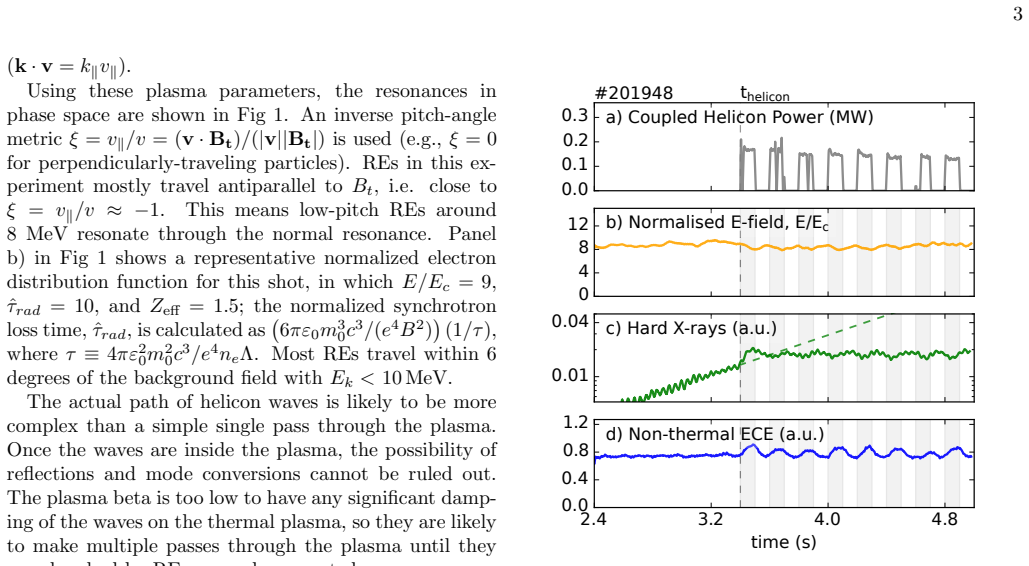
On the paper's own terms: helicon waves (right-handed fast waves at 476 MHz with nominal parallel refractive index $n_\parallel=3$ at the antenna) satisfy the normal wave-particle cyclotron resonance $\omega - \mathbf{k}\cdot\mathbf{v} = \Omega/\gamma$ for electrons near 8 MeV in the DIII-D low-density Ohmic scenario. With $k_\parallel = 40\ \mathrm{m}^{-1}$ at the magnetic axis, the resonance maps to the phase-space region where most runaways sit. After the antenna turns on, the hard X-ray flux, used as an energy-weighted proxy for the confined runaway population, stops growing; energy-resolved gamma-ray-imager spectra show the $>7$ MeV component falling below the noise floor while the $<4$ MeV component increases; non-thermal electron-cyclotron emission rises; and a bright high-field-side synchrotron crescent appears on the first pulse. A multi-shot database shows post-helicon growth rates break from the pre-existing $E/E_c$ trend: populations stop growing or decay despite $E/E_c$ remaining high enough to drive exponential growth without waves. The authors conclude the maximum runaway energy was limited to less than about 8 MeV by resonant pitch-angle scattering.
Load-bearing premise
The argument rests on a single assumed number: the wave's parallel wavenumber at the plasma center, $k_\parallel = 40\ \mathrm{m}^{-1}$, obtained from the antenna's $n_\parallel=3$ and a geometric upshift; if reflections or mode conversion change that wavenumber, the resonance energy shifts and the observed high-energy drop is no longer tied to the normal cyclotron resonance.
Editorial extensions
If this is right
- If the central claim holds, the maximum energy of a runaway population can be set by choosing the wave frequency and parallel wave number, not just by raising the critical electric field.
- The flattening of hard X-ray growth under helicon, with unchanged $E/E_c$, provides a control handle for runaway mitigation that does not rely on increasing plasma density.
- Because the technique caps energy rather than current, it avoids sudden current drops that would induce large toroidal electric fields and accelerate further avalanches.
- The same resonance-based scattering should be testable across a range of energies by scanning the launched $n_\parallel$ or the wave frequency.
Reading between the lines
- A natural extension the paper does not pursue is to measure the scattering rate directly during the first 100 ms pulse and compare it with the avalanche growth rate at the same field.
- Scanning the launched $n_\parallel$ (or measuring the in-plasma $k_\parallel$ spectrum) would test whether the energy at which the hard-X-ray drop begins tracks the predicted resonance; a mismatch would not disprove the mitigation effect but would shift the attribution away from the nominal 8 MeV normal-cyclotron resonance.
- The same mechanism should apply to other externally launched fast waves in any toroidal device with a suitable low-density runaway scenario, since only the dispersion and resonance geometry matter.
Editorial analysis
A structured set of objections, weighed in public.
Referee Report
Summary. The manuscript reports the first experimental evidence that externally launched helicon waves resonantly pitch-angle scatter relativistic electrons in a tokamak. In DIII-D low-density Ohmic discharges, turning on a 476 MHz helicon antenna causes the hard x-ray (HXR) inferred runaway population to stop growing, non-thermal ECE to rise, a synchrotron crescent to appear, and the gamma-ray imager to record a drop in >7 MeV photons and an increase in <4 MeV photons. Using a computed resonance condition with k_parallel=40 m^-1 at the magnetic axis, the authors identify approximately 8 MeV as the normal cyclotron resonance energy. A multi-shot database shows that post-helicon HXR growth rates are reduced relative to the pre-helicon trend with normalized electric field. The paper concludes that helicon waves limit the maximum runaway electron energy through resonant pitch-angle scattering and increased synchrotron damping.
Significance. If the attribution holds, this is an important result for runaway electron mitigation: it proposes a physics-based, non-disruptive method that directly targets the maximum runaway energy, and the supporting diagnostic suite (HXR, ECE, synchrotron imaging, gamma-ray imager) is unusually complete. The resonance energy is computed from basic wave and plasma parameters rather than fitted to the observed spectral break, and the multi-shot comparison strengthens the empirical case. The main caveat is that the quantitative link to the normal cyclotron resonance rests on a single estimated k_parallel value and on an internally inconsistent cyclotron frequency in the text; until these are resolved, the paper demonstrates a strong wave-particle interaction but not uniquely the normal cyclotron resonance at 8 MeV.
major comments (3)
- [§Experimental Design] The central quantitative claim that the >7 MeV HXR deficit corresponds to the normal cyclotron resonance at approximately 8 MeV depends entirely on the estimated k_parallel=40 m^-1 at the magnetic axis. This value is obtained from the antenna n_parallel=3 scaled by the geometric factor 2.27/1.67, with k_perp neglected, and the manuscript itself states that reflections and mode conversions cannot be ruled out and that the wave path is likely complex. Since the resonance energy in Eq. (2) is directly set by k_parallel, a realistic uncertainty or a measured/modeled k_parallel spectrum is required to support the specific attribution; otherwise the observed spectral change is consistent with resonant scattering at some other energy or via a different mechanism.
- [§Experimental Design] The manuscript states that Omega/(2*pi) is approximately 6.5 GHz for B_t=1.4 T. The nonrelativistic electron cyclotron frequency at 1.4 T is f_ce approximately 39.2 GHz. Inserting the stated 6.5 GHz into Eq. (2) with k_parallel=40 m^-1 and v approximately c gives a resonance kinetic energy near 0.9 MeV, not 8 MeV; the 8 MeV value follows only if the correct 39.2 GHz is used. This internal inconsistency must be corrected and the resonance energy recomputed before the quantitative claim can be independently checked.
- [§Experimental Results, Fig. 4] The agreement between the measured spectral break (decrease above 7 MeV, increase below 4 MeV) and the predicted 8 MeV resonance is asserted visually, without a synthetic diagnostic or propagation of the k_parallel uncertainty. Because the HXR spectrum integrates over a line of sight and over electrons with a range of pitch angles, the observed break does not uniquely fingerprint the normal cyclotron resonance. A quantitative comparison, such as a predicted spectral shape or resonance width as a function of k_parallel, is needed to substantiate the statement that the reduction in high-energy REs 'agrees well with the predicted wave-particle resonance.'
minor comments (4)
- [Fig. 1 caption] Calling xi = v_parallel/v an 'inverse pitch-angle metric' is nonstandard; xi is the cosine of the pitch angle and is not 'inverse.' Please clarify the terminology.
- [Fig. 4] The y-axis label 'log10 /s' is unclear; specify whether the plotted quantity is normalized counts per second or a log-scaled rate, and state the normalization.
- [Fig. 2 panel (a)] The label 'thelicon' appears to be a typo; it should likely be 't_helicon' or similar.
- [§Experimental Design] The sentence 'To summarize, these design considerations lead to...' would benefit from a small table or diagram relating the directions of B_t, I_p, launched waves, and RE motion, because the counter-clockwise/clockwise wording is easy to misread.
Circularity Check
No significant circularity: the 8 MeV resonance energy is independently computed from antenna n_parallel=3, toroidal upshift, and Eq. (2); the observed HXR drop is an empirical outcome, not an input to the calculation.
full rationale
The central claim is an experimental observation supported by independent diagnostics (HXR scintillator, gamma-ray imager, ECE radiometer, synchrotron camera). The predicted resonance location is obtained from Eq. (2) using k_parallel = 40 m^-1, which is derived from the antenna's nominal n_parallel = 3 and the geometric toroidal upshift factor 2.27/1.67, not selected to match the measured spectral downturn. The paper explicitly notes that reflections and mode conversions 'cannot be ruled out,' but that admission weakens the k_parallel estimate rather than making the conclusion an input to the inference. The multi-shot database borrows prior data from Ref. [9], which includes an author, but the post-helicon growth rates are measured after the wave application and are compared with, not fitted to, that database. No parameter is fitted and then renamed as a prediction, no uniqueness theorem is imported from the authors' prior work, and no known result is merely relabeled. Two numerical inconsistencies appear in the text (c/omega approximately 10 m should be approximately 0.10 m for the stated frequency, and Omega/(2 pi) approximately 6.5 GHz is inconsistent with B_t = 1.4 T, whose cyclotron frequency is approximately 39.2 GHz); these are correctness and reproducibility concerns about the quantitative attribution and do not constitute circularity.
Assumptions & free parameters
free parameters (1)
- parallel wavenumber k_parallel at magnetic axis =
40 m^-1
assumptions (6)
- standard math The wave-particle resonance condition is omega - k dot v = l * Omega / gamma (Eq. 2).
- domain assumption The effect of k_perp can be neglected, so k dot v is approximately k_parallel * v_parallel.
- domain assumption Toroidal mode number is conserved, so k_parallel upshifts by the ratio of antenna major radius to magnetic-axis major radius (2.27/1.67).
- domain assumption The helicon wave is weakly damped on the thermal plasma and can make multiple passes until absorbed by REs or mode converted.
- domain assumption Hard X-ray flux serves as an energy-weighted proxy for the confined RE population.
- domain assumption The critical field E_C (Eq. 1) and the normalization E/E_C are valid characterizations of the runaway threshold in this plasma.
Cite this review
Pith. "Pith review of First Demonstration of Resonant Pitch-Angle Scattering of Relativistic Electrons by Externally-Launched Helicon Waves." pith.science (2026). https://pith.science/paper/OMXIXQBN
@misc{pith2026250519279,
  author       = {Pith},
  title        = {Pith review of: First Demonstration of Resonant Pitch-Angle Scattering of Relativistic Electrons by Externally-Launched Helicon Waves},
  year         = {2026},
  howpublished = {\url{https://pith.science/paper/OMXIXQBN}},
  note         = {Machine review of arXiv:2505.19279}
}
read the original abstract
Helicon waves satisfying the normal wave-particle cyclotron resonance are observed to limit the growth and maximum energy of relativistic electrons (REs) in low-density Ohmic DIII-D tokamak plasmas. Following the application of helicon waves, pitch-angle scattering of high-energy REs causes an increase in both synchrotron and electron-cyclotron emissions. The hard x-ray emission, a proxy for the RE population, ceases to grow; and energy-resolved hard x-ray measurements also show a striking decrease in the number of high-energy REs (above the resonance at approximately \SI{8}{MeV}) to below the noise floor. This occurs despite the toroidal electric field remaining high enough to drive exponential RE growth in the absence of helicon waves. These results open new directions for limiting the maximum energy of RE populations in laboratory and fusion plasmas.
Figures


Figures from the paper (1 more)

Reference graph
Works this paper leans on
-
[1]
A. H. Boozer, Runaway electrons and ITER, Nuclear Fu- sion 57, 056018 (2017), publisher: IOP Publishing
work page 2017
-
[2]
A. H. Boozer, Pivotal issues on relativistic electrons in ITER, Nuclear Fusion 58, 036006 (2018), publisher: IOP Publishing
work page 2018
-
[3]
A. H. Boozer, Theory of runaway electrons in ITER: Equations, important parameters, and implications for mitigation, Physics of Plasmas 22, 032504 (2015)
work page 2015
-
[4]
E. M. Hollmann, P. B. Aleynikov, T. F¨ ul¨ op, D. A. Humphreys, V. A. Izzo, M. Lehnen, V. E. Lukash, G. Papp, G. Pautasso, F. Saint-Laurent, and J. A. Snipes, Status of research toward the ITER disruption mitigation system, Physics of Plasmas 22, 021802 (2014)
work page 2014
-
[5]
M. Lehnen, K. Aleynikova, P. B. Aleynikov, D. J. Campbell, P. Drewelow, N. W. Eidietis, Y. Gasparyan, R. S. Granetz, Y. Gribov, N. Hartmann, E. M. Holl- mann, V. A. Izzo, S. Jachmich, S. H. Kim, M. Koˇ can, H. R. Koslowski, D. Kovalenko, U. Kruezi, A. Loarte, S. Maruyama, G. F. Matthews, P. B. Parks, G. Pau- tasso, R. A. Pitts, C. Reux, V. Riccardo, R. Ro...
work page 2015
-
[6]
J. W. Connor and R. J. Hastie, Relativistic limitations on runaway electrons, Nuclear Fusion 15, 415 (1975)
work page 1975
-
[7]
J. P. Freidberg, Plasma Physics and Fusion Energy (Cambridge University Press, Cambridge, 2007)
work page 2007
-
[8]
B. N. Breizman, P. Aleynikov, E. M. Hollmann, and M. Lehnen, Physics of runaway electrons in tokamaks, Nuclear Fusion 59, 083001 (2019), publisher: IOP Pub- lishing
work page 2019
Show all 45 references
-
[9]
Paz-Soldan, N
C. Paz-Soldan, N. W. Eidietis, R. Granetz, E. M. Holl- mann, R. A. Moyer, J. C. Wesley, J. Zhang, M. E. Austin, N. A. Crocker, A. Wingen, and Y. Zhu, Growth and decay of runaway electrons above the critical electric field under quiescent conditions, Physics of Plasmas 21, 0225...
2014
-
[10]
R. S. Granetz, B. Esposito, J. H. Kim, R. Koslowski, M. Lehnen, J. R. Martin-Solis, C. Paz-Soldan, T. Rhee, J. C. Wesley, L. Zeng, and ITPA MHD Group, An ITPA joint experiment to study runaway electron generation and suppressiona), Physics of Plasmas21, 072506 (2014)
2014
-
[11]
Aleynikov and B
P. Aleynikov and B. N. Breizman, Theory of Two Thresh- old Fields for Relativistic Runaway Electrons, Physical Review Letters 114, 155001 (2015), publisher: American Physical Society
2015
-
[12]
C. Liu, E. Hirvijoki, G.-Y. Fu, D. P. Brennan, A. Bhat- tacharjee, and C. Paz-Soldan, Role of Kinetic Instabil- ity in Runaway-Electron Avalanches and Elevated Criti- cal Electric Fields, Physical Review Letters 120, 265001 (2018), publisher: American Physical Society
2018
-
[13]
M. N. Rosenbluth and S. V. Putvinski, Theory for avalanche of runaway electrons in tokamaks, Nuclear Fu- sion 37, 1355 (1997)
1997
-
[14]
Greenwald, Status of the SPARC physics basis, Jour- nal of Plasma Physics 86, 861860501 (2020)
M. Greenwald, Status of the SPARC physics basis, Jour- nal of Plasma Physics 86, 861860501 (2020)
2020
-
[15]
D. G. Whyte, T. C. Jernigan, D. A. Humphreys, A. W. Hyatt, C. J. Lasnier, P. B. Parks, T. E. Evans, M. N. Rosenbluth, P. L. Taylor, A. G. Kellman, D. S. Gray, E. M. Hollmann, and S. K. Combs, Mitigation of Toka- mak Disruptions Using High-Pressure Gas Injection, Physical Revie...
2002
-
[16]
Hollmann, M
E. Hollmann, M. Austin, J. Boedo, N. Brooks, N. Com- maux, N. Eidietis, D. Humphreys, V. Izzo, A. James, T. Jernigan, A. Loarte, J. Martin-Solis, R. Moyer, J. Mu˜ noz-Burgos, P. Parks, D. Rudakov, E. Strait, C. Tsui, M. Van Zeeland, J. Wesley, and J. Yu, Con- trol and dissipat...
2013
-
[17]
A. H. Boozer, Two beneficial non-axisymmetric pertur- bations to tokamaks, Plasma Physics and Controlled Fu- sion 53, 084002 (2011)
2011
-
[18]
C. Reux, C. Paz-Soldan, P. Aleynikov, V. Bandaru, O. Ficker, S. Silburn, M. Hoelzl, S. Jachmich, N. Eidietis, M. Lehnen, S. Sridhar, and JET contributors, Demon- stration of Safe Termination of Megaampere Relativistic Electron Beams in Tokamaks, Physical Review Letters 126, 17...
2021
-
[19]
Paz-Soldan, C
C. Paz-Soldan, C. Reux, K. Aleynikova, P. Aleynikov, V. Bandaru, M. Beidler, N. Eidietis, Y. Q. Liu, C. Liu, A. Lvovskiy, S. Silburn, L. Bardoczi, L. Bay- lor, I. Bykov, D. Carnevale, D. D.-C. Negrete, X. Du, O. Ficker, S. Gerasimov, M. Hoelzl, E. Hollmann, S. Jachmich, S. Jar...
2021
-
[20]
Z. Guo, C. J. McDevitt, and X.-Z. Tang, Control of run- away electron energy using externally injected whistler waves, Physics of Plasmas 25, 032504 (2018), publisher: American Institute of Physics
2018
-
[21]
Paz-Soldan, C
C. Paz-Soldan, C. M. Cooper, P. Aleynikov, N. W. Ei- dietis, A. Lvovskiy, D. C. Pace, D. P. Brennan, E. M. Hollmann, C. Liu, R. A. Moyer, and D. Shiraki, Resolv- ing runaway electron distributions in space, time, and energy, Physics of Plasmas 25, 056105 (2018), publisher: Ame...
2018
-
[22]
H. W. Bartels, Impact of runaway electrons, Fusion En- gineering and Design 23, 323 (1994)
1994
-
[23]
Bhattacharjee and D
A. Bhattacharjee and D. A. Gurnett, Waves in a Cold Plasma, in Introduction to Plasma Physics: With Space, Laboratory and Astrophysical Applications (Cambridge University Press, Cambridge, 2017) 2nd ed
2017
-
[24]
T. H. Stix, Waves in Plasmas(Springer Science & Busi- ness Media, 1992) google-Books-ID: OsOWJ8iHpmMC
1992
-
[25]
R. I. Pinsker, Whistlers, helicons, and lower hybrid waves: The physics of radio frequency wave propagation and absorption for current drive via Landau damping, Physics of Plasmas 22, 090901 (2015), publisher: Amer- ican Institute of Physics
2015
-
[26]
B. V. Compernolle, M. W. Brookman, C. P. Moeller, R. I. Pinsker, A. M. Garofalo, R. O’Neill, D. Geng, A. Nagy, J. P. Squire, K. Schultz, C. Pawley, D. Ponce, A. C. Torrezan, J. Lohr, B. Coriton, E. Hinson, R. Kalling, A. Marinoni, E. H. Martin, R. Nguyen, C. C. Petty, M. Porko...
2021
-
[27]
R. I. Pinsker, R. Prater, C. P. Moeller, J. S. deGrassie, C. C. Petty, M. Porkolab, J. P. Anderson, A. M. Garo- falo, C. Lau, A. Nagy, D. C. Pace, H. Torreblanca, J. G. Watkins, and L. Zeng, Experiments on helicons in DIII- D—investigation of the physics of a reactor-relevant ...
2018
-
[28]
Pinsker, B
R. Pinsker, B. Van Compernolle, S. Tang, J. Lestz, C. Moeller, C. Petty, A. Dupuy, J. Squire, A. Garofalo, M. Porkolab, J. Rost, S. Baek, A. Nagy, S. Chowdhury, N. Crocker, G. Degrandchamp, A. McLean, K. Gage, A. Marinoni, E. Martin, G. Ronchi, and t. D.-D. Team, First high-po...
2024
-
[29]
Spong, W
D. Spong, W. Heidbrink, C. Paz-Soldan, X. Du, K. Thome, M. Van Zeeland, C. Collins, A. Lvovskiy, R. Moyer, M. Austin, D. Brennan, C. Liu, E. Jaeger, and C. Lau, First Direct Observation of Runaway-Electron- Driven Whistler Waves in Tokamaks, Physical Review Letters 120, 155002...
2018
-
[30]
W. W. Heidbrink, C. Paz-Soldan, D. A. Spong, X. D. Du, K. E. Thome, M. E. Austin, A. Lvovskiy, R. A. Moyer, 7 R. I. Pinsker, and M. A. V. Zeeland, Low-frequency whistler waves in quiescent runaway electron plasmas, Plasma Physics and Controlled Fusion61, 014007 (2018), publish...
2018
-
[31]
Paz-Soldan, C
C. Paz-Soldan, C. Cooper, P. Aleynikov, D. Pace, N. Ei- dietis, D. Brennan, R. Granetz, E. Hollmann, C. Liu, A. Lvovskiy, R. Moyer, and D. Shiraki, Spatiotempo- ral Evolution of Runaway Electron Momentum Distribu- tions in Tokamaks, Physical Review Letters 118, 255002 (2017), ...
2017
-
[32]
Piron, C
L. Piron, C. Paz-Soldan, L. Pigatto, P. Zanca, O. Sauter, T. Putterich, P. Bettini, M. Bonotto, G. Cunningham, G. De Tommasi, N. Ferron, M. Gambrioli, G. Gra- ham, P. De Vries, Y. Gribov, Q. Hu, K. Kirov, N. Logan, M. Lennholm, M. Mattei, M. Maraschek, T. Markovic, G. Manduchi...
2024
-
[33]
Paz-Soldan, Q
C. Paz-Soldan, Q. Hu, N. Logan, and J.-K. Park, Non- disruptive error field identification based on magnetic island healing, Nuclear Fusion 62, 126007 (2022), pub- lisher: IOP Publishing
2022
-
[34]
Paz-Soldan, R
C. Paz-Soldan, R. Buttery, A. Garofalo, J. Hanson, R. La Haye, M. Lanctot, J. Park, W. Solomon, and E. Strait, The spectral basis of optimal error field cor- rection on DIII-D, Nuclear Fusion 54, 073013 (2014), publisher: IOP Publishing
2014
-
[35]
Scoville, R
J. Scoville, R. La Haye, A. Kellman, T. Osborne, R. Stambaugh, E. Strait, and T. Taylor, Locked modes in DIII-D and a method for prevention of the low density mode, Nuclear Fusion 31, 875 (1991)
1991
-
[36]
Callen, Effects of 3D magnetic perturbations on toroidal plasmas, Nuclear Fusion 51, 094026 (2011)
J. Callen, Effects of 3D magnetic perturbations on toroidal plasmas, Nuclear Fusion 51, 094026 (2011)
2011
-
[37]
W. W. Heidbrink, Neutron fluctuation measurements on TFTR, Review of Scientific Instruments 57, 1769 (1986)
1986
-
[38]
M. E. Austin and J. Lohr, Electron cyclotron emission radiometer upgrade on the DIII-D tokamak, Review of Scientific Instruments 74, 1457 (2003)
2003
-
[39]
C. Liu, L. Shi, E. Hirvijoki, D. P. Brennan, A. Bhat- tacharjee, C. Paz-Soldan, and M. E. Austin, The effects of kinetic instabilities on the electron cyclotron emis- sion from runaway electrons, Nuclear Fusion 58, 096030 (2018), publisher: IOP Publishing
2018
-
[40]
Hoppe, O
M. Hoppe, O. Embr´ eus, C. Paz-Soldan, R. A. Moyer, and T. F¨ ul¨ op, Interpretation of runaway electron synchrotron and bremsstrahlung images, Nuclear Fusion 58, 082001 (2018), publisher: IOP Publishing
2018
-
[41]
Marini, J
C. Marini, J. A. Boedo, E. M. Hollmann, L. Chousal, J. Mills, Z. Popovi´ c, and I. Bykov, The fast camera (Fast- cam) imaging diagnostic systems on the DIII-D tokamak, Review of Scientific Instruments 94, 053509 (2023)
2023
-
[42]
D. C. Pace, C. M. Cooper, D. Taussig, N. W. Eidi- etis, E. M. Hollmann, V. Riso, M. A. Van Zeeland, and M. Watkins, Gamma ray imager on the DIII-D tokamak, Review of Scientific Instruments 87, 043507 (2016)
2016
-
[43]
C. M. Cooper, D. C. Pace, C. Paz-Soldan, N. Commaux, N. W. Eidietis, E. M. Hollmann, and D. Shiraki, Apply- ing the new gamma ray imager diagnostic to measure- ments of runaway electron Bremsstrahlung radiation in the DIII-D Tokamak (invited), Review of Scientific In- strument...
2016
-
[44]
Lvovskiy, C
A. Lvovskiy, C. Paz-Soldan, N. Eidietis, A. Dal Molin, M. Nocente, C. Cooper, D. Rigamonti, M. Tardocchi, and D. Taussig, Upgrades to the gamma ray imager on DIII- D enabling access to high flux hard x-Ray measurements during the runaway electron plateau phase (invited), Re- v...
2022
-
[45]
Wasserman, All of statistics: a concise course in sta- tistical inference, Springer texts in statistics (Springer, New York, 2004) medium: electronic resource, Chapter 23
L. Wasserman, All of statistics: a concise course in sta- tistical inference, Springer texts in statistics (Springer, New York, 2004) medium: electronic resource, Chapter 23
2004
Reviewed August 7, 2026 · model on record in the stance chip above.
Discussion (0). Continue with ORCID to comment.