REVIEW 5 major objections 5 minor 34 references
New Design Paradigm of Distortion Cost Function for Efficient JPEG Steganography
T0 review · 5 major / 5 minor · reviewed 2026-08-14 · deepseek-v4-flash
Pith's one-line read JPEG steganography becomes harder to detect when the distortion cost is computed on decompressed pixels and then transformed to DCT coefficients through inverse-DCT footprints, rather than designed directly on DCT coefficients.
desk verdict Useful extension of JPEG cost design with a real speed advantage, but the headline security claim depends on benchmark-tuned p and the abstract overstates GFR superiority. read the letter →
The pith
A machine-rendered reading of the paper's core claim, the machinery that carries it, and where it could break.
The reading
What carries the argument
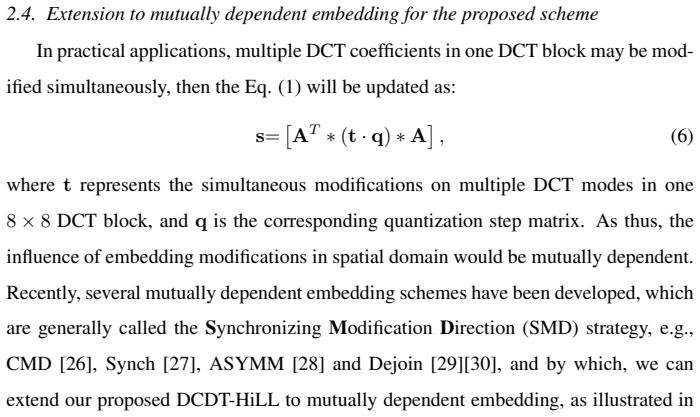
The central object is the DCDT transformation function in Eq. (5): $\rho_{a,b}^{m,n} = \sum_{i,j} (d^{m,n}(i,j))^p |s_{a,b}(i,j)|$. It carries the argument by converting a spatial-domain distortion cost, defined per pixel per unit change, into a DCT-domain cost per coefficient per unit change through the inverse-DCT footprint of each mode. The exponent $p$ is the tunable mechanism: it controls how strongly pixel costs are amplified before summation, which in turn shifts embedding away from low-frequency modes whose spatial footprints are large, and the authors select $p$ by grid search, summarizing it with an empirical linear rule $p = 0.02 (\mathrm{QF} - 75) + 0.48$ for the quality-factor interval 75 to 95. The basis of the whole construction is the stated equivalence that a DCT block and its decompressed pixel block have the same embedding priority, plus the assumption that spatial distortion is linearly proportional to pixel modification amplitude.
What would settle it
Take a single 8-by-8 block with known texture, flip one DCT coefficient, and measure the actual increase in GFR or SCA-GFR feature responses in both the DCT and decompressed spatial domains; if the ranking of candidate coefficients by DCDT cost does not match the ranking by measured feature increase, the linear-proportionality and same-priority assumptions are contradicted.
Extended reading notes
Core claim
The central discovery is that the embedding priority of an 8-by-8 DCT block is the same as that of its decompressed pixel block, and that this equivalence can be made operational through a generalized distortion cost domain transformation. The load-bearing formula is Eq. (5), $\rho_{a,b}^{m,n} = \sum_{i,j} (d^{m,n}(i,j))^p |s_{a,b}(i,j)|$, in which $d^{m,n}(i,j)$ is the spatial distortion cost of the $(i,j)$-th pixel for a unit change, $p$ is an exponent that redistributes embedding across blocks, and $s_{a,b}(i,j)$ is the inverse-DCT spatial footprint produced by a unit modification at DCT mode $(a,b)$. With this formula, JPEG embedding is posed as minimizing distortion in the decompressed spatial domain, which the authors argue is equivalent to maximizing statistical undetectability against phase-aware steganalyzers. In their experiments, DCDT-HiLL (HiLL as the spatial cost) improves classification error over UERD, J-UNIWARD, and GUED against GFR and SCA-GFR when $p$ is tuned, and matches or exceeds BET-HiLL depending on quality factor, all with roughly one order of magnitude less computation; an optional mutually dependent embedding update gives a further gain.
Load-bearing premise
The construction assumes that a pixel's spatial distortion cost grows linearly with the amplitude of the pixel change and that an 8-by-8 block has the same embedding priority in the DCT domain as in the decompressed pixel domain; if either fails, the transformed DCDT cost misrepresents the true embedding impact of a DCT modification.
Editorial extensions
If this is right
- Other spatial-domain cost functions (S-UNIWARD and MiPOD are tested in the paper) can be lifted to JPEG by DCDT, with HiLL giving the best tested security, so advances in spatial steganography transfer directly to JPEG.
- A single scalar exponent $p$ gives the steganographer a lever to trade detectability between DCT-focused and phase-aware steganalyzers, and the paper's empirical rule makes $p$ predictable from the JPEG quality factor.
- At equal embedding payload, DCDT-HiLL reports higher detection-error probability than UERD, J-UNIWARD, and GUED against GFR and SCA-GFR, meaning those steganalyzers would need larger payloads or stronger features to detect it.
- The computation-time measurements, about 0.05 seconds per 512-by-512 image versus about 0.8 seconds for BET-HiLL, imply that the security gain is achievable in practice, not only in principle.
- The mutually dependent embedding extension, although exponential in the number of modified coefficients per block, shows that accounting for joint pixel changes within a block yields additional security, pointing toward joint-cost models.
Reading between the lines
- The authors do not claim, but a natural corollary is that DCDT should generalize to any transform codec with a linear synthesis map, such as HEVC or AV1, since the derivation only needs each coefficient's spatial footprint.
- The authors do not claim, but a learned cost function trained to predict DCDT costs could retain the security gain at even lower runtime, which would matter for video or large-batch image applications.
- The authors do not claim, but the dependence of the optimal exponent on quality factor suggests that a content-adaptive $p$, chosen per block from local texture, might outperform the globally fixed $p$ used in the paper.
- The authors do not claim, but an adaptive steganalyzer retrained on DCDT-specific selection channels could narrow the reported gap, so future work should test DCDT against continual retraining rather than fixed features.
Signed reviews
Editorial analysis
A structured set of objections, weighed in public.
Referee Report
Summary. The paper proposes a new JPEG steganographic distortion cost function obtained by transforming a spatial-domain embedding cost into the DCT domain. The core formula, Eq. (5), computes the cost of a unit change of a DCT coefficient as the p-th power of pixel-level spatial costs weighted by the inverse-DCT footprint of that coefficient change. The authors instantiate the framework with the HiLL spatial cost, tune the exponent p per steganalyzer and quality factor on BOSSBase, and report experiments against CC-JRM, GFR, and SCA-GFR on BOSSBase and BOWS2, comparing with UERD, J-UNIWARD, GUED, and BET-HiLL. They also propose a mutually dependent embedding extension and measure computational complexity.
Significance. If the claims were fully supported, the paper would offer a simple, interpretable, and computationally efficient way to transfer well-developed spatial steganographic costs to JPEG steganography, with particular benefit against phase-aware JPEG steganalyzers. The derivation of Eq. (5) is straightforward, the computational advantage over BET-HiLL is practically relevant, and the BOWS2 transfer test gives some independent support for the SCA-GFR setting. However, the central security claim is weakened by the per-steganalyzer tuning of p on the same benchmark used for evaluation, the absence of variance information, and a stated superiority over GUED that is not borne out in the main table for GFR at Q75. The core idea is defensible, but the current presentation overstates the evidence.
major comments (5)
- [Section 3.4, Table 5] The abstract and the conclusion claim that DCDT-HiLL is superior to GUED in resisting GFR, but Table 5 does not support this for Q75. Under the main setting p=0.5 (chosen for SCA-GFR), DCDT-HiLL has lower PE than GUED at 0.1, 0.2, and 0.3 bpnzAC (40.85 vs 41.57, 29.33 vs 29.93, 18.62 vs 19.13). Even the GFR-tuned DCDT-HiLL-pro with p=0.7 is lower than GUED at 0.1 bpnzAC (41.30 vs 41.57). The claim of superiority against GFR should therefore be weakened to "comparable or mixed" for Q75.
- [Sections 3.2 and 3.4] The exponent p in Eq. (5) is selected by maximizing PE on a 5,000-image subset of BOSSBase separately for each steganalyzer, and the main security tables are then reported on BOSSBase without stating whether the tuning subset is disjoint from the final training/testing images. Because p differs by steganalyzer (0.7 for GFR vs 0.5 for SCA-GFR at Q75), the reported gains against GFR and SCA-GFR are partly a product of per-adversary benchmark tuning. The BOWS2 transfer experiment in Table 9 only evaluates SCA-GFR with the SCA-GFR p, so it does not independently validate the GFR-specific claims. Please report results with a fixed p chosen without reference to the target steganalyzer, or with a fully disjoint validation set, and explicitly state the relationship between the tuning split and the evaluation split.
- [Section 3.6, Eq. (9), Tables 10 and 11] The linear regression rule p = 0.02*(QF-75)+0.48 is fitted to optimal p values at QFs 75, 80, 85, 90, and 95, and Table 11 then evaluates DCDT-HiLL at QFs 80, 85, and 90 using p values from this regression. Since the evaluation QFs are the same ones used to fit the regression, this is not an independent test of the extrapolation rule. To support the claim that the method works for a variety of quality factors, validate on QFs not used in constructing Eq. (9), such as Q82 or Q88, or use leave-one-QF-out cross-validation.
- [Section 2.3, Eq. (4)] The entire DCDT transformation rests on the assumption that spatial distortion cost is linearly proportional to the amplitude of the pixel modification. This is not self-evident because |s_{a,b}(i,j)| can exceed 1 and varies with the DCT mode and QF. The paper provides no empirical validation of this linearity or comparison with alternative amplitude models. Please add a robustness test, for example by replacing |s| with |s|^q or a saturating nonlinearity, or provide explicit justification for the linear model at the tested QFs and payloads.
- [Sections 3.1 and 3.4] Only mean classification error probabilities over ten random test splits are reported, without standard deviations, confidence intervals, or significance tests. Several differences that the paper treats as security gains are below one percentage point, e.g., in Table 5 at Q75 with GFR at 0.4 bpnzAC, DCDT-HiLL has PE 10.97 vs GUED 11.14, and at 0.5 bpnzAC, 6.27 vs 6.10. These differences are likely within sampling noise. Please report error bars or statistical tests for the main comparisons that support the headline claims.
minor comments (5)
- [Section 2.4] The sentence "we set the threshold T and penalty factor v in Eq. (8) as 10" is ambiguous: it is unclear whether both T and v are set to 10 or only one of them. Please clarify.
- [Throughout] The method name is inconsistently capitalized as both 'DCDT-HiLL' and 'DCDT-Hill' (e.g., Sections 3.4 and 3.7, Table 7). Please unify the notation.
- [Section 2.3, after Eq. (5)] The text says that p 'flexibly adjusts the embedding distributions,' but the precise effect of larger p on block and mode selection is not discussed until Section 3.2. Adding one sentence after Eq. (5) explaining that larger p penalizes high-cost pixels more strongly would improve readability.
- [Sections 3.7 and 4] There are typographical errors, including 'espacilly' in Section 3.7 and 'stgeanographic' in Section 4. A careful proofread is recommended.
- [Section 3.4] The statement that using the SCA-GFR parameter setting for other steganalyzers 'won't change much' is supported only by the Q75 DCDT-HiLL-pro rows in Table 5. Consider providing a corresponding comparison for Q95 GFR or CC-JRM, or soften the claim.
Circularity Check
Per-adversary exponent p is tuned on BOSSBase and then presented as DCDT-HiLL's security, so the GFR/SCA-GFR superiority claim is partly a fitted result; BOWS2 transfer provides only partial independence.
-
fitted input called prediction
[Section 3.2 (exponent p in Eq. 5); Section 3.4 uses p]
"We set p in the range of [0.3,1.5] and search with interval 0.1 to find the optimal p* corresponding to the maximum classification error probability P*E at given relative payload α for each of the three tested steganalyzers."
The load-bearing security claim (DCDT-HiLL is superior against GFR/SCA-GFR) is evaluated after p has been chosen by maximizing PE on BOSSBase for each steganalyzer separately. Thus the reported PE is not a parameter-free prediction of the DCDT transform; it is the value obtained by selecting the free exponent against the exact evaluator and dataset used in the headline comparison. The transformation Eqs. (1)-(5) is independent, and BOWS2 later provides a transfer test, but this central performance number reduces in part to the benchmark-specific fit.
-
fitted input called prediction
[Section 3.4, Table 5 (and abstract/conclusion claims)]
"For brevity, the results of our proposed DCDT-HiLL (except DCDT-HiLL-pro) in Table 5 and 6 are obtained with the optimal parameter setting for SCA-GFR (i.e., p=0.5 and p=0.9 for Q75 and Q95, respectively.). This is because SCA-GFR is the most effective steganalyzer and the performance of the proposed DCDT-HiLL with the same parameter setting won’t change much as justified by our experiments."
The paper itself states that the main-table DCDT-HiLL uses the SCA-GFR-tuned p, while the GFR-optimal p (0.7 at Q75) appears only as DCDT-HiLL-pro. The abstract and conclusion claim superiority of DCDT-HiLL against GFR and SCA-GFR without this caveat. In Table 5, Q75, GFR, DCDT-HiLL at p=0.5 gives PE 40.85/29.33/18.62/10.97/6.27 versus GUED 41.57/29.93/19.13/11.14/6.10, so it is not superior to GUED for GFR at 0.1-0.4 bpnzAC unless the GFR-optimized p (itself fitted on the same BOSSBase) is substituted. The claimed superiority is therefore conditional on per-adversary benchmark tuning rather than a robust output of the DCDT derivation.
1 more flagged steps
-
fitted input called prediction
[Section 3.6, Eq. (9), Tables 10-11]
"we can build an empirical rule for parameter p by using an linear regression model w.r.t. p and QF according to the results in Table 10, i.e., p = 0.02× (QF− 75) + 0.48."
Eq. (9) is a regression fitted to p values that were themselves optimized for SCA-GFR on BOSSBaseJ75-J95. The subsequent verification on BOSSBaseJ80/J85/J90 uses images from the same BOSSBase distribution on which p was selected. This 'applicability' test is therefore an in-distribution fit/extrapolation, not an independent validation; the BOWS2 transfer in Table 9 is the only truly external check and is limited to J-UNIWARD comparisons.
full rationale
DCDT is not circular at the level of the transformation: Eq. (1) computes the spatial footprint of a DCT change, Eqs. (4)-(5) combine it with a spatial cost d and an exponent p, and no equation defines d, s, or p in terms of the reported PE. There is also no load-bearing self-citation chain: BET-HiLL and GUED are prior baselines rather than premises of the derivation. The partial circularity is in the empirical evaluation. Section 3.2 treats p as a free parameter and searches it on a 5,000-image split of BOSSBase to maximize PE for each steganalyzer; Section 3.4 uses exactly this SCA-GFR-tuned p for the headline DCDT-HiLL results and only marks the GFR-tuned p as DCDT-HiLL-pro. The abstract's 'superior ... against GFR' therefore cannot be read as a parameter-free consequence of the DCDT transform: the best setting is chosen per adversary on the same benchmark, and with the SCA-GFR p the Table 5 Q75 GFR numbers are not superior to GUED at most payloads. Eq. (9) is likewise a regression on BOSSBase-selected p values used to verify applicability on BOSSBase at other QFs. The BOWS2 result and the Q95 comparison show real transferable content, so the paper is not entirely self-fulfilling. Score 6 = one or more benchmark predictions reduce, in part, to a fitted parameter.
Assumptions & free parameters
free parameters (3)
- Exponent p for DCDT-HiLL (per QF/steganalyzer) =
Q75: CC-JRM 0.7, GFR 0.7, SCA-GFR 0.5; Q95: CC-JRM 0.9, GFR 1.1, SCA-GFR 0.9
- Linear regression rule p = 0.02*(QF-75)+0.48 =
slope 0.02, intercept 0.48
- Penalty factor v and threshold T for DCDT-HiLL_ud =
v = 10, T = 10
assumptions (4)
- domain assumption An 8x8 DCT block and its decompressed 8x8 pixel block have the same embedding priority because they represent the same image information
- domain assumption Spatial distortion cost is linearly proportional to the amplitude of pixel modification
- domain assumption Minimizing overall distortion in the decompressed spatial domain is equivalent to maximizing statistical undetectability
- standard math DCT/IDCT basis relations in Eq. (1)-(3)
Cite this review
Pith. "Pith review of New Design Paradigm of Distortion Cost Function for Efficient JPEG Steganography." pith.science (2026). https://pith.science/paper/OMZHBX53
@misc{pith2026190801947,
  author       = {Pith},
  title        = {Pith review of: New Design Paradigm of Distortion Cost Function for Efficient JPEG Steganography},
  year         = {2026},
  howpublished = {\url{https://pith.science/paper/OMZHBX53}},
  note         = {Machine review of arXiv:1908.01947}
}
read the original abstract
Recently, with the introduction of JPEG phase-aware steganalysis features, e.g., GFR, the design of JPEG steganographic distortion cost function turns to maintain not only the statistical undetectability in DCT domain but also in spatial domain. To tackle this issue, this paper presents a novel paradigm for the design of JPEG steganographic distortion cost function, which calculates the distortion cost via a generalized Distortion Cost Domain Transformation (DCDT) function. The proposed function comprises the decompressed pixel block embedding changes and their corresponding embedding distortion costs for unit change, where the pixel embedding distortion costs are represented in a more general exponential model, aiming to flexibly allocate the embedding data. In this way, the JPEG steganography could be formulated as the optimization problem of minimizing the overall distortion cost in its decompressed spatial domain, which is equivalent to maximizing its statistical undetectability against JPEG phase-aware steganalysis features. Experimental results show that the proposed DCDT equipped with HiLL (a spatial steganographic distortion cost function) is superior to other state-of-the-art JPEG steganographic schemes, e.g., UERD, J-UNIWARD, and GUED in resisting the detection of JPEG phase-aware feature-based steganalyzers GFR and SCA-GFR, and rivals BET-HiLL with one order of magnitude lower computational complexity, along with the possibility of being further improved by considering the mutually dependent embedding interactions. In addition, the proposed DCDT is also verified to be effective for different image databases and quality factors.
Figures


Figures from the paper (2 more)


Reference graph
Works this paper leans on
-
[1]
D, The history of steganography, in: Anderson R
K. D, The history of steganography, in: Anderson R. (eds) Information Hiding. IH 1996. LNCS 1174, Springer, Berlin, Heidelberg, 1996, pp. 1 – 5. doi:10. 1007/3-540-61996-8_27
work page 1996
-
[2]
T. Pevn ´y, J. Fridrich, Benchmarking for steganography, in: Solanki K., Sullivan K., Madhow U. (eds) Information Hiding. IH 2008. LNCS 5284, Springer, Berlin, Heidelberg, 2008, pp. 251 – 267. doi:10.1007/978-3-540-88961-8_ 18. 25
-
[3]
L. Li, W. Zhang, C. Qin, K. Chen, W. Zhou, N. Yu, Adversarial batch im- age steganography against cnn-based pooled steganalysis, Signal Processing 181 (2021) 107920. doi:10.1016/j.sigpro.2020.107920
arXiv 2021
- [4]
-
[5]
T. Qiao, S. Wang, X. Luo, Z. Zhu, Robust steganography resisting jpeg com- pression by improving selection of cover element, Signal Processing 183 (2021) 108048. doi:10.1016/j.sigpro.2021.108048
arXiv 2021
-
[6]
Y . Zhang, C. Qin, W. Zhang, F. Liu, X. Luo, On the fault-tolerant performance for a class of robust image steganography, Signal Processing 146 (2018) 99 – 111. doi:10.1016/j.sigpro.2018.01.011
-
[7]
Y . Su, C. Zhang, C. Zhang, A video steganalytic algorithm against motion-vector- based steganography, Signal Processing 91 (8) (2011) 1901 – 1909. doi:10. 1016/j.sigpro.2011.02.012
work page 2011
-
[8]
Y . Wang, Y . Cao, X. Zhao, Minimizing embedding impact for h.264 steganog- raphy by progressive trellis coding, IEEE Transactions on Information Forensics and Security 16 (2021) 333 – 345. doi:10.1109/TIFS.2020.3013523
arXiv 2021
Show all 34 references
-
[9]
X. Yi, K. Yang, X. Zhao, Y . Wang, H. Yu, Ahcm: Adaptive huffman code map- ping for audio steganography based on psychoacoustic model, IEEE Transac- tions on Information Forensics and Security 14 (8) (2019) 2217 – 2231. doi: 10.1109/TIFS.2019.2895200
2019
-
[10]
Huang, S
Y . Huang, S. Tang, J. Yuan, Steganography in inactive frames of voip streams en- coded by source codec, IEEE Transactions on Information Forensics and Security 6 (2) (2011) 296 – 306. doi:10.1109/TIFS.2011.2108649
2011
-
[11]
B. Li, M. Wang, J. Huang, X. Li, A new cost function for spatial image steganog- raphy, in: 2014 IEEE International Conference on Image Processing (ICIP), 2014, pp. 4206 – 4210. doi:10.1109/ICIP.2014.7025854. 26
2014
-
[12]
W. Su, J. Ni, X. Hu, J. Fridrich, Image steganography with symmetric embedding using gaussian markov random field model, IEEE Transactions on Circuits and Systems for Video Technology 31 (3) (2021) 1001 – 1015. doi:10.1109/ TCSVT.2020.3001122
2021
-
[13]
L. Guo, J. Ni, Y . Q. Shi, Uniform embedding for efficient JPEG steganography, IEEE Transactions on Information Forensics and Security 9 (5) (2014) 814 – 825. doi:10.1109/TIFS.2014.2312817
2014
-
[14]
L. Guo, J. Ni, W. Su, C. Tang, Y . Q. Shi, Using statistical image model for JPEG steganography: Uniform embedding revisited, IEEE Transactions on Information Forensics and Security 10 (12) (2015) 2669 – 2680. doi:10.1109/TIFS. 2015.2473815
2015
-
[15]
Holub, J
V . Holub, J. Fridrich, T. Denemark, Universal distortion function for steganogra- phy in an arbitrary domain, EURASIP Journal on Information Security 2014 (1) (2014) 1 – 13. doi:10.1186/1687-417X-2014-1
2014 doi
-
[16]
W. Su, J. Ni, X. Li, Y . Q. Shi, A new distortion function design for jpeg steganog- raphy using the generalized uniform embedding strategy, IEEE Transactions on Circuits and Systems for Video Technology 28 (12) (2018) 3545 – 3549. doi:10.1109/TCSVT.2018.2865537
2018
-
[17]
X. Hu, J. Ni, Y . Q. Shi, Efficient jpeg steganography using domain transformation of embedding entropy, IEEE Signal Processing Letters 25 (6) (2018) 773 – 777. doi:10.1109/LSP.2018.2818674
2018
-
[18]
Y . Pan, J. Ni, W. Su, Improved uniform embedding for efficient jpeg steganog- raphy, in: Sun X., Liu A., Chao HC., Bertino E. (eds) Cloud Computing and Security. ICCCS 2016. LNCS 10039, Springer, Cham, 2016, pp. 125 – 133. doi:10.1007/978-3-319-48671-0_12
2016 doi
-
[19]
Filler, J
T. Filler, J. Judas, J. Fridrich, Minimizing additive distortion in steganography using syndrome-trellis codes, IEEE Transactions on Information Forensics and Security 6 (3) (2011) 920 – 935. doi:10.1109/TIFS.2011.2134094. 27
2011
-
[20]
X. Song, F. Liu, C. Yang, X. Luo, Y . Zhang, Steganalysis of adaptive JPEG steganography using 2D Gabor filters, in: Proc. of the 3rd ACM Workshop on Information Hiding and Multimedia Security, 2015, pp. 15 – 23. doi: 10.1145/2756601.2756608
2015
-
[21]
Denemark, M
T. Denemark, M. Boroumand, J. Fridrich, Steganalysis features for content- adaptive JPEG steganography, IEEE Transactions on Information Forensics and Security 11 (8) (2016) 1736 – 1746. doi:10.1109/TIFS.2016.2555281
2016
-
[22]
Holub, J
V . Holub, J. Fridrich, Designing steganographic distortion using directional fil- ters, in: 2012 IEEE International Workshop on Information Forensics and Secu- rity (WIFS), 2012, pp. 234 – 239. doi:10.1109/WIFS.2012.6412655
2012
-
[23]
Sedighi, R
V . Sedighi, R. Cogranne, J. Fridrich, Content-adaptive steganography by mini- mizing statistical detectability, IEEE Transactions on Information Forensics and Security 11 (2) (2016) 221 – 234. doi:10.1109/TIFS.2015.2486744
2016
-
[24]
P. Bas, T. Filler, T. Pevn ´y, Break our steganographic system: the ins and outs of organizing BOSS, in: Filler T., Pevn ´y T., Craver S., Ker A. (eds) Information Hiding. IH 2011. LNCS 6958, Springer, Berlin, Heidelberg, 2011, pp. 59 – 70. doi:10.1007/978-3-642-24178-9_5
2011 doi
-
[25]
J. L. Myers, A. D. Well, Research Design and Statistical Analysis, 2nd Edition, Lawrence Erlbaum Associates, 2003
2003
-
[26]
B. Li, M. Wang, X. Li, S. Tan, J. Huang, A strategy of clustering modifica- tion directions in spatial image steganography, IEEE Transactions on Informa- tion Forensics and Security 10 (9) (2015) 1905 – 1917. doi:10.1109/TIFS. 2015.2434600
2015
-
[27]
Denemark, J
T. Denemark, J. Fridrich, Improving steganographic security by synchronizing the selection channel, in: Proc. of the 3rd ACM Workshop on Information Hid- ing and Multimedia Security, 2015, pp. 5 – 14. doi:10.1145/2756601. 2756620. 28
2015 doi
-
[28]
X. Hu, J. Ni, W. Su, J. Huang, Model-based image steganography using asymmet- ric embedding scheme, Journal of Electronic Imaging 27 (4). doi:10.1117/ 1.JEI.27.4.043023
-
[29]
Zhang, Z
W. Zhang, Z. Zhang, L. Zhang, H. Li, N. Yu, Decomposing joint distortion for adaptive steganography, IEEE Transactions on Circuits and Systems for Video Technology 27 (10) (2017) 2274 – 2280. doi:10.1109/TCSVT.2016. 2587388
2017 doi
-
[30]
W. Li, W. Zhang, K. Chen, W. Zhou, N. Yu, Defining joint distortion for jpeg steganography, in: Proceedings of the 6th ACM Workshop on Information Hid- ing and Multimedia Security, 2018, pp. 5 – 16. doi:10.1145/3206004. 3206008
2018 doi
-
[31]
T. P. Bas, Furon, Bows-2 (july 2007). URL http://bows2.gipsa-lab.inpg.fr
2007
-
[32]
URL http://dde.binghamton.edu/download/ stegoalgorithms/
Phil sallee’s matlab jpeg toolbox. URL http://dde.binghamton.edu/download/ stegoalgorithms/
-
[33]
Kodovsk ´y, J
J. Kodovsk ´y, J. Fridrich, Steganalysis of JPEG images using rich models, in: Proc. SPIE 8303, Media Watermarking, Security, and Forensics 2012, 83030A, 2012, pp. 0A 1 – 13. doi:10.1117/12.907495
2012 doi
-
[34]
Kodovsk ´y, J
J. Kodovsk ´y, J. Fridrich, V . Holub, Ensemble classifiers for steganalysis of digital media, IEEE Transactions on Information Forensics and Security 7 (2) (2012) 432 – 444. doi:10.1109/TIFS.2011.2175919. 29
2012
Reviewed August 14, 2026 · model on record in the stance chip above.
Discussion (0). Continue with ORCID to comment.