REVIEW 3 major objections 6 minor 114 references
The impact of the transport of chemicals and electronic screening on helioseismic and neutrino observations in solar models
T0 review · 3 major / 6 minor · reviewed 2026-08-06 · deepseek-v4-flash
Pith's one-line read The main differences between two solar evolution codes trace to a 1.5 percent opacity gap, and a screening-inspired 5 percent cut to nuclear rates reshapes neutrino fluxes without fixing the CNO deficit.
desk verdict A careful two-code solar model comparison with one genuinely new attribution result (opacity interpolation), but the electronic-screening conclusion overreaches because the implemented 5% rate reduction is not the pp-chain-specific correction it is compared against. read the letter →
The pith
A machine-rendered reading of the paper's core claim, the machinery that carries it, and where it could break.
The reading
What carries the argument
The load-bearing comparison is a controlled code-to-code test: the authors take fixed thermodynamic coordinates and chemical composition from one code, call the equation-of-state and opacity routines of the other, and isolate the 1.5 percent opacity difference. That difference, rather than the transport physics under study, explains the shifts in the convective envelope and neutrino fluxes. The screening analysis is carried by a simpler mechanism: a uniform 5 percent reduction of all nuclear reaction efficiencies, applied while keeping weak screening active, used as a proxy for dynamical screening corrections recommended in the literature.
What would settle it
A decisive test would be to run both codes with a genuine per-reaction dynamical screening treatment instead of the flat 5 percent cut and check whether the CNO neutrino fluxes rise to the Borexino value and whether the helioseismic sound-speed agreement improves or worsens. A second check would have the two codes read the same opacity table through the other's interpolation routine to locate the exact source of the 1.5 percent opacity gap.
Extended reading notes
Core claim
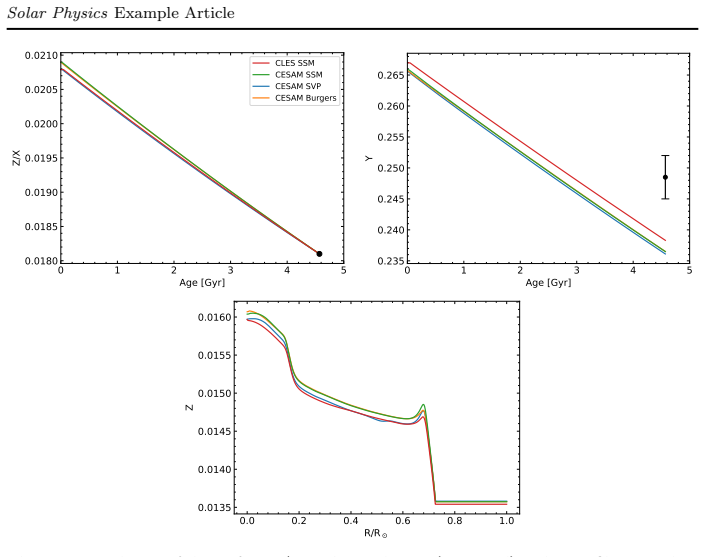
The central claim is that the main differences between CLES and Cesam2k20 solar models come from the slightly different treatment of opacities in the two codes. In a direct test, for chosen density, temperature, and chemical composition, the CLES opacity routine returned a value 1.5 percent larger than Cesam2k20, and installing the same opacity table and interpolation method in Cesam2k20 removed a large part of the structural differences, including the position of the base of the convective envelope. The paper further finds that the choice of atomic diffusion formalism has minor helioseismic impact, that turbulent mixing can reproduce lithium and beryllium depletion but degrades inversion agreement, and that reducing all nuclear reaction efficiencies by 5 percent—the recommended proxy for dynamical electronic screening—significantly raises predicted neutrino fluxes but leaves CNO fluxes below the Borexino measurements and worsens the sound-speed agreement. The authors conclude that electronic screening is an important ingredient for accurate solar models, but that it does not reconcile the models with the observed CNO fluxes.
Load-bearing premise
The screening conclusions rest on treating dynamical screening as a flat 5 percent reduction of all nuclear reaction efficiencies, even though the paper itself notes that screening is thought to matter more for the CNO cycle than for the pp chain.
Editorial extensions
If this is right
- At the precision of solar data, opacity table interpolation details are as influential as some physical processes, so code comparisons must control them before attributing differences to transport or screening.
- None of the atomic diffusion formalisms tested is decisively favoured by sound-speed or Ledoux-discriminant inversions, even though tracking individual elements remains preferable on physical grounds.
- Turbulent mixing can match the observed lithium and beryllium depletion, with a sharp density dependence needed to preserve beryllium, but it does not significantly improve the helioseismic fit.
- A 5 percent reduction of nuclear rates, the adopted dynamical-screening proxy, substantially alters all predicted neutrino fluxes and worsens the sound-speed agreement, so screening-based improvements to neutrino fluxes come at a helioseismic cost.
- With the low-metallicity solar abundance mixture used throughout, both codes produce CNO neutrino fluxes below the Borexino measurements, confirming the known deficit in standard solar models.
Reading between the lines
- If the 1.5 percent opacity gap is generic to currently available interpolation schemes, then other published solar model comparisons that use different opacity routines may contain similar hidden offsets; re-analysing past comparisons with a common opacity module would test this.
- Because the paper's screening proxy applies a flat 5 percent cut while noting that screening should be stronger for CNO reactions, a reaction-by-reaction dynamical screening implementation might change CNO fluxes more than pp fluxes and deserves a dedicated implementation in both codes.
- The same code-comparison approach could be applied to other Sun-like stars targeted by future asteroseismic surveys, where 1 percent differences in thermodynamic quantities are no longer negligible.
- The opacity test suggests that helioseismic determinations of the solar metal mass fraction or of the solar radiative opacity may be sensitive to the interpolation routine, so opacity table interpolation uncertainty should be quantified in opacity-inference studies.
Editorial analysis
A structured set of objections, weighed in public.
Referee Report
Summary. This paper compares solar models computed with two stellar evolution codes, CLES and Cesam2k20, across a range of physical prescriptions: different atomic diffusion formalisms (T94, MP93, Burgers), radiative accelerations, ad hoc turbulent mixing models (R00 and PM91), convection treatments (MLT, CGM, ECM), and modifications to nuclear screening and reaction efficiencies. The authors calibrate each model to the solar radius, luminosity, and surface Z/X, and for turbulent-mixing models also to the lithium abundance. They then evaluate helioseismic agreement via SOLA inversions of sound speed and Ledoux discriminant, and compare predicted neutrino fluxes with Borexino measurements. The main quantitative claim is that the residual differences between the two codes—such as the position of the convective envelope base and core temperature gradients—are largely attributable to a ~1.5% difference in the opacity interpolation, demonstrated by swapping the same opacity tables and interpolation method into Cesam2k20. A secondary claim is that reducing all nuclear reaction efficiencies by 5% as a proxy for dynamical electronic screening significantly changes neutrino fluxes and worsens helioseismic agreement, which is contrasted with the slight improvement reported by Mussack and Däppen (2011).
Significance. The paper is a careful and useful code-comparison study for the solar modeling community. Its main strength is the controlled opacity test: swapping the same opacity table and interpolation method into Cesam2k20 directly isolates the source of the code-to-code differences, and this experiment is well designed. The comparisons of atomic diffusion formalisms are also systematically controlled and use external helioseismic and Borexino data that are not part of the calibration, which gives the results independence. The turbulent-mixing calibrations to the lithium abundance are acknowledged as such, and the beryllium diagnostic adds a useful additional constraint. If the opacity attribution and the screening sensitivity results hold, the paper provides valuable guidance for interpreting precision solar models. However, the screening conclusion is weakened by an inconsistency in what the 5% reduction actually modifies, and this affects one of the paper's stated contributions.
major comments (3)
- [Section 2.4 vs Section 5, Figure 5] The paper states in Section 2.4 that the 5% reduction is applied 'to all nuclear reactions,' but Section 5 and Figure 5 describe the test as a '5% modification of the pp chain reaction.' This inconsistency is load-bearing because Mussack and Däppen (2011) specifically derived a dynamical screening correction for the pp chain, not a uniform reduction of all rates. Reducing the CNO cycle rates as well, especially 14N(p,γ)15O, changes the CNO neutrino flux in a way that is not representative of their prescription. Consequently, the comparison in Section 6 (Figure 7) with Mussack and Däppen's reported slight improvement in sound speed, and the conclusion in Section 7 that the test 'confirms that electronic screening of nuclear reactions is an important ingredient,' go beyond what the implemented proxy can support. The manuscript should either recompute a model with only pp-chain rates reduced by 5% (or otherwise isolate the pp-chain effect), or explicitly reframe the test as a generic sensitivity study and remove the direct comparison with Mussack and Däppen.
- [Section 5, Figure 5 and Section 7] The neutrino flux plot is presented without quantitative agreement metrics, and the text disclaims any intention to quantify agreement. However, the conclusion in Section 7 draws a strong inference: the 5% rate reduction 'greatly affects the predictions of neutrino fluxes, but is still far from the observations of the CNO neutrinos.' Because the implemented model reduces CNO rates by 5%, the CNO flux suppression is partly an artifact of the chosen proxy rather than a physical prediction. The paper itself notes that screening is thought to be more important for the CNO cycle, so the statement that the CNO shortfall persists under this test does not constitute evidence against dynamical screening of the CNO cycle. This should be clarified, or the conclusion should be softened to what the proxy actually shows.
- [Section 2.7, Figure 1] The claim that 'a large part of the difference comes from the slightly different treatment of opacities' is not quantified. While Figure 1 visually shows that the dashed curves (with swapped opacity tables) are much closer, the residual difference in the convective envelope position and in the density or temperature profiles is not given numerically. Since this is the paper's central quantitative claim, please state the residual BCZ difference (and, if possible, the residual difference in the sound-speed inversion or core temperature) before and after swapping the opacity treatment. This would strengthen the attribution from a visual impression to a quantitative statement.
minor comments (6)
- [Abstract] The name 'Cesam2k2' in the abstract should be 'Cesam2k20' for consistency with the rest of the text.
- [Section 5] There is a typo: 'eletronic' should be 'electronic'.
- [Figure 5 caption] The label '9B' in the caption should be '8B' (boron-8), matching the text and the common notation.
- [Section 2.7] The phrase 'CLES returned a a value' contains a duplicated article; it should read 'CLES returned a value'.
- [Reference list] The entries for Boothroyd and Sackmann (2003a) and (2003b) appear identical, with the same title and page numbers; one of them likely refers to a different paper (perhaps 'Our Sun. V'), so the citation should be corrected or disambiguated.
- [Section 2.1, 2.5] Minor formatting: 'theT (τ )' in Section 2.1 and '4 .570 Gyr' in Section 2.5 have spacing issues that should be fixed.
Circularity Check
Only lithium is a fitted outcome; the opacity-difference and screening comparisons are not circular.
-
fitted input called prediction
[Section 2.5 (calibration) and Section 4 (Additional transport and light elements)]
"When turbulent mixing is included in the models, the reference depth is calibrated (in temperature or mass) or the value of ω when the Proffitt and Michaud (1991) formalism is used. In these cases, we consider the additional constraint on the lithium surface abundance A(Li) = 0.96 ± 0.05 dex (Wang et al., 2021). ... As expected from the calibration, lithium is well reproduced in all models, with slightly different behavior during the evolution."
The turbulent-mixing strength/reference depth is a free parameter calibrated to the observed lithium abundance A(Li)=0.96. Consequently the DT0/DM0/DCZ models' final 7Li values (0.96–0.98 in Table 2) match the constraint by construction; presenting lithium as 'well reproduced' is a restatement of the calibration, not an independent prediction. The paper's own 'As expected from the calibration' phrasing makes this explicit. Beryllium is not calibrated and therefore retains predictive content, but the lithium statement carries no independent evidential weight.
full rationale
The paper's main quantitative claims are self-contained against external data. The opacity-difference claim is established by a fixed-coordinate audit of the two codes' opacity routines and by re-running Cesam2k20 with CLES's table/interpolation; this is a controlled experiment, not a circular derivation. The helioseismic inversions and Borexino comparisons use external datasets (Basu et al. 2009; Davies et al. 2014; Appel et al. 2022) that are not used to calibrate the models' free parameters. The turbulent-mixing models do fit A(Li)=0.96, so the resulting lithium agreement is a calibrated constraint; the paper acknowledges this, and beryllium remains a genuine discriminator. The electronic-screening test is assumption-laden (a flat 5% reduction applied to all reactions rather than a pp-chain-specific correction), but it is an external proxy from Mussack and Däppen (2011), not a parameter fitted to the compared neutrino or helioseismic data; any mismatch is a correctness/fidelity concern, not circularity. Self-citations (Buldgen et al. 2017, 2019, 2023, 2025; Manchon et al. 2024) are used for method description and prior context; the load-bearing comparisons here are recomputed with two codes and external observables. The only circular element is the acknowledged lithium fit, so the score is 2.
Assumptions & free parameters
free parameters (7)
- alpha_MLT (mixing length parameter) =
not tabulated individually; calibrated per model to match R and L
- Y0 (initial helium mass fraction) =
0.2569 to 0.2670 (Table 2)
- (Z/X)0 (initial metal-to-hydrogen ratio) =
0.0181 to 0.0209 (Table 2)
- Turbulent mixing amplitude or reference depth =
values not reported; calibrated to lithium abundance A(Li)=0.96
- Turbulent mixing exponent n =
3 (DT0 and DCZ) or 4 (DM0)
- Nuclear reaction efficiency factor (nuc models) =
0.95 applied to all reactions
- Envelope overshoot parameter (ECM model only) =
not reported
assumptions (7)
- domain assumption The Sun is modeled as a non-rotating, non-magnetic 1 Msun star with no mass loss, evolving from the pre-main sequence to an age of 4.570 Gyr.
- domain assumption The adopted microphysics (AGSS09 mixture, SAHA-S EOS, OPAL high-T plus Ferguson low-T opacities, NACRE plus LUNA reaction rates, Vernazza et al. atmosphere) are accurate enough for the conclusions.
- domain assumption Calibration to R, L, and surface Z/X=0.0181 (IAU 2015 values) yields representative solar models.
- ad hoc to paper The ad hoc turbulent diffusion parameterizations of Richer et al. (2000) and Proffitt and Michaud (1991) capture the macroscopic mixing needed to deplete lithium.
- ad hoc to paper A flat 5 percent reduction of all nuclear reaction rates is a valid proxy for dynamical electronic screening.
- standard math The SOLA inversion technique with a 6th-order surface correction and the Rabello-Soares et al. (1999) parameter calibration provides reliable structural difference estimates.
- domain assumption The observed lithium abundance A(Li)=0.96 +/- 0.05 of Wang et al. (2021) is the correct constraint for calibrating turbulent mixing.
Cite this review
Pith. "Pith review of The impact of the transport of chemicals and electronic screening on helioseismic and neutrino observations in solar models." pith.science (2026). https://pith.science/paper/ONSPGERY
@misc{pith2026250712335,
  author       = {Pith},
  title        = {Pith review of: The impact of the transport of chemicals and electronic screening on helioseismic and neutrino observations in solar models},
  year         = {2026},
  howpublished = {\url{https://pith.science/paper/ONSPGERY}},
  note         = {Machine review of arXiv:2507.12335}
}
read the original abstract
The transport of chemical elements in stellar interiors is one of the greatest sources of uncertainties of solar and stellar modelling. The Sun, with its exquisite spectroscopic, helioseismic and neutrino observations, offers a prime environment to test the prescriptions used for both microscopic and macroscopic transport processes. We study in detail the impact of various formalisms for atomic diffusion on helioseismic constraints in both CLES (Scuflaire et al., 2008a) and Cesam2k2 (Morel and Lebreton 2008; Marques et al. 2013; Deal et al. 2018) models and compare both codes in detail. Moreover, due to the inability of standard models using microscopic diffusion to reproduce light element depletion in the Sun (Li, Be), another efficient process must be included to reproduce these constraints (rotation-induced: Eggenberger et al. 2022, overshooting -- or penetrative convection -- below the convective envelope: Th\'evenin et al. 2017, or ad hoc turbulence: Lebreton and Maeder 1987; Richer, Michaud, and Turcotte 2000). However, introducing such an extra mixing leads to issues with the CNO neutrino fluxes (see Buldgen et al. 2023), which seem to be systematically lower than the Borexino observations (Appel et al., 2022. Another key aspect to consider when reconciling models with neutrino fluxes is the impact of electronic screening (Mussack and D\"appen, 2011).
Figures


Figures from the paper (9 more)


Reference graph
Works this paper leans on
-
[1]
barticle Alecian , G. , LeBlanc , F. : 2020 , An improved parametric method for evaluating radiative accelerations in stellar interiors . 498 , 3420 . https://doi.org/10.1093/mnras/staa2584 . 2020MNRAS.498.3420A . barticle
-
[2]
barticle Amarsi , A.M. , Ogneva , D. , Buldgen , G. , Grevesse , N. , Zhou , Y. , Barklem , P.S. : 2024 , The solar beryllium abundance revisited with 3D non-LTE models . 690 , A128 . https://doi.org/10.1051/0004-6361/202451778 . 2024A&A...690A.128A . barticle
-
[3]
: 1999 , NACRE: A European Compilation of Reaction rates for Astrophysics
bchapter Angulo , C. : 1999 , NACRE: A European Compilation of Reaction rates for Astrophysics . In: American Institute of Physics Conference Series , American Institute of Physics Conference Series 495 , 365 . https://doi.org/10.1063/1.1301821 . 1999AIPC..495..365A . bchapter
-
[4]
O . , Pietrofaccia , L. , Pilipenko , N. , Pocar , A. , Raikov , G. , Ranalli , M.T. , Ranucci , G. , Razeto , A. , Re , A. , Redchuk , M. , Rossi , N. , Sch \
barticle Appel , S. , Bagdasarian , Z. , Basilico , D. , Bellini , G. , Benziger , J. , Biondi , R. , Caccianiga , B. , Calaprice , F. , Caminata , A. , Cavalcante , P. , Chepurnov , A. , D'Angelo , D. , Derbin , A. , Di Giacinto , A. , Di Marcello , V. , Ding , X.F. , Di Ludovico , A. , Di Noto , L. , Drachnev , I. , Franco , D. , Galbiati , C. , Ghiano ...
2022
-
[5]
barticle Asplund , M. , Amarsi , A.M. , Grevesse , N. : 2021 , The chemical make-up of the Sun: A 2020 vision . 653 , A141 . https://doi.org/10.1051/0004-6361/202140445 . 2021A&A...653A.141A . barticle
-
[6]
barticle Asplund , M. , Grevesse , N. , Sauval , A.J. , Scott , P. : 2009 , The Chemical Composition of the Sun . 47 , 481 . https://doi.org/10.1146/annurev.astro.46.060407.145222 . 2009ARA\ barticle
arXiv 2009
-
[7]
, Auvergne , M
bchapter Baglin , A. , Auvergne , M. , Boisnard , L. , Lam-Trong , T. , Barge , P. , Catala , C. , Deleuil , M. , Michel , E. , Weiss , W. : 2006 , CoRoT: a high precision photometer for stellar ecolution and exoplanet finding . In: 36th COSPAR Scientific Assembly 36 , 3749 . 2006cosp...36.3749B . bchapter
2006
-
[8]
barticle Basu , S. , Antia , H.M. : 2008 , Helioseismology and solar abundances . 457 , 217 . https://doi.org/10.1016/j.physrep.2007.12.002 . 2008PhR...457..217B . barticle
Show all 114 references
-
[9]
, Christensen-Dalsgaard , J
barticle Basu , S. , Christensen-Dalsgaard , J. , Chaplin , W.J. , Elsworth , Y. , Isaak , G.R. , New , R. , Schou , J. , Thompson , M.J. , Tomczyk , S. : 1997 , Solar internal sound speed as inferred from combined BiSON and LOWL oscillation frequencies . 292 , 243 . https://d...
1997 doi
-
[10]
, Chaplin , W.J
barticle Basu , S. , Chaplin , W.J. , Elsworth , Y. , New , R. , Serenelli , A.M. : 2009 , Fresh Insights on the Structure of the Solar Core . 699 , 1403 . https://doi.org/10.1088/0004-637X/699/2/1403 . 2009ApJ...699.1403B . barticle
2009 doi
-
[11]
, Ayukov , S.V
bchapter Baturin , V.A. , Ayukov , S.V. , Gryaznov , V.K. , Iosilevskiy , I.L. , Fortov , V.E. , Starostin , A.N. : 2013 , The Current Version of the SAHA-S Equation of State: Improvement and Perspective . In: Shibahashi , H. , Lynas-Gray , A.E. (eds.) Progress in Physics of t...
2013
-
[12]
, D \"a ppen , W
barticle Baturin , V.A. , D \"a ppen , W. , Morel , P. , Oreshina , A.V. , Th \'e venin , F. , Gryaznov , V.K. , Iosilevskiy , I.L. , Starostin , A.N. , Fortov , V.E. : 2017 , Equation of state SAHA-S meets stellar evolution code CESAM2k . 606 , A129 . https://doi.org/10.1051/...
2017 doi
-
[13]
, Oreshina , A.V
barticle Baturin , V.A. , Oreshina , A.V. , Buldgen , G. , Ayukov , S.V. , Gryaznov , V.K. , Iosilevskiy , I.L. , Noels , A. , Scuflaire , R. : 2024 , Heavy Elements Abundances Inferred from the First Adiabatic Exponent in the Solar Envelope . 299 , 142 . https://doi.org/10.10...
2024 doi
-
[14]
, Ayukov , S.V
barticle Baturin , V.A. , Ayukov , S.V. , Oreshina , A.V. , Gorshkov , A.B. , Gryaznov , V.K. , Iosilevskiy , I.L. , D \"a ppen , W. : 2025 , Hydrogen Ionization Inside the Sun . 300 , 3 . https://doi.org/10.1007/s11207-024-02413-9 . 2025SoPh..300....3B . barticle
2025 doi
-
[15]
o hm-Vitense , E. : 1958 , \
barticle B \"o hm-Vitense , E. : 1958 , \"U ber die Wasserstoffkonvektionszone in Sternen verschiedener Effektivtemperaturen und Leuchtkr \"a fte. Mit 5 Textabbildungen . 46 , 108 . 1958ZA.....46..108B . barticle
1958
-
[17]
, Sackmann , I.-J
barticle Boothroyd , A.I. , Sackmann , I.-J. : 2003 b, Our Sun. IV. The Standard Model and Helioseismology: Consequences of Uncertainties in Input Physics and in Observed Solar Parameters . 583 , 1004 . https://doi.org/10.1086/345407 . 2003ApJ...583.1004B . barticle
2003 doi
-
[18]
, Koch , D
barticle Borucki , W.J. , Koch , D. , et al. : 2010 , Kepler Planet-Detection Mission: Introduction and First Results . Science 327 , 977 . https://doi.org/10.1126/science.1185402 . 2010Sci...327..977B . barticle
2010 doi
-
[19]
, Sawyer , R.F
barticle Brown , L.S. , Sawyer , R.F. : 1997 , Nuclear reaction rates in a plasma . Reviews of Modern Physics 69 , 411 . https://doi.org/10.1103/RevModPhys.69.411 . 1997RvMP...69..411B . barticle
1997 doi
-
[20]
, Antia , H.M
barticle Brun , A.S. , Antia , H.M. , Chitre , S.M. , Zahn , J.-P. : 2002 , Seismic tests for solar models with tachocline mixing . 391 , 725 . https://doi.org/10.1051/0004-6361:20020837 . 2002A&A...391..725B . barticle
2002 doi
-
[21]
, Salmon , S
barticle Buldgen , G. , Salmon , S. , Noels , A. : 2019 , Progress in global helioseismology: a new light on the solar modelling problem and its implications for solar-like stars . Frontiers in Astronomy and Space Sciences 6 , 42 . https://doi.org/10.3389/fspas.2019.00042 . 20...
2019
-
[22]
, Salmon , S.J.A.J
barticle Buldgen , G. , Salmon , S.J.A.J. , Godart , M. , Noels , A. , Scuflaire , R. , Dupret , M.A. , Reese , D.R. , Colgan , J. , Fontes , C.J. , Eggenberger , P. , Hakel , P. , Kilcrease , D.P. , Richard , O. : 2017 , Inversions of the Ledoux discriminant: a closer look at...
2017 doi
-
[23]
, Salmon , S.J.A.J
barticle Buldgen , G. , Salmon , S.J.A.J. , Noels , A. , Scuflaire , R. , Montalban , J. , Baturin , V.A. , Eggenberger , P. , Gryaznov , V.K. , Iosilevskiy , I.L. , Meynet , G. , Chaplin , W.J. , Miglio , A. , Oreshina , A.V. , Richard , O. , Starostin , A.N. : 2019 , Combini...
2019 doi
-
[24]
, Eggenberger , P
barticle Buldgen , G. , Eggenberger , P. , Noels , A. , Scuflaire , R. , Amarsi , A.M. , Grevesse , N. , Salmon , S. : 2023 , Higher metal abundances do not solve the solar problem . 669 , L9 . https://doi.org/10.1051/0004-6361/202245448 . 2023A&A...669L...9B . barticle
2023 doi
-
[25]
, Noels , A
barticle Buldgen , G. , Noels , A. , Baturin , V.A. , Oreshina , A.V. , Ayukov , S.V. , Scuflaire , R. , Amarsi , A.M. , Grevesse , N. : 2024 a, Helioseismic determination of the solar metal mass fraction . 681 , A57 . https://doi.org/10.1051/0004-6361/202346928 . 2024A&A...68...
2024 doi
-
[26]
, Noels , A
barticle Buldgen , G. , Noels , A. , Scuflaire , R. , Amarsi , A.M. , Grevesse , N. , Eggenberger , P. , Colgan , J. , Fontes , C.J. , Baturin , V.A. , Oreshina , A.V. , Ayukov , S.V. , Hakel , P. , Kilcrease , D.P. : 2024 b, In-depth analysis of solar models with high-metalli...
2024 doi
-
[27]
, Noels , A
barticle Buldgen , G. , Noels , A. , Amarsi , A.M. , Nandal , D. , Pezzotti , C. , Scuflaire , R. , Deal , M. , Grevesse , N. : 2025 , Constraints on the properties of macroscopic transport in the Sun from combined lithium and beryllium depletion . 694 , A285 . https://doi.org...
2025 doi
-
[28]
, Pain , J.-C
barticle Buldgen , G. , Pain , J.-C. , Coss \'e , P. , Blancard , C. , Gilleron , F. , K. Pradhan , A. , J. Fontes , C. , Colgan , J. , Noels , A. , Christensen-Dalsgaard , J. , Deal , M. , V. Ayukov , S. , A. Baturin , V. , V. Oreshina , A. , Scuflaire , R. , Pin c on , C. , ...
2025 doi
-
[29]
: 1969 , Flow Equations for Composite Gases
bbook Burgers , J.M. : 1969 , Flow Equations for Composite Gases . 1969fecg.book.....B . bbook
1969
-
[30]
, Mazzitelli , I
barticle Canuto , V.M. , Mazzitelli , I. : 1991 , Stellar Turbulent Convection: A New Model and Applications . 370 , 295 . https://doi.org/10.1086/169815 . 1991ApJ...370..295C . barticle
1991 doi
-
[31]
, Goldman , I
barticle Canuto , V.M. , Goldman , I. , Mazzitelli , I. : 1996 , Stellar Turbulent Convection: A Self-consistent Model . 473 , 550 . https://doi.org/10.1086/178166 . 1996ApJ...473..550C . barticle
1996 doi
-
[32]
: 2002 , Helioseismology
barticle Christensen-Dalsgaard , J. : 2002 , Helioseismology . Reviews of Modern Physics 74 , 1073 . https://doi.org/10.1103/RevModPhys.74.1073 . 2002RvMP...74.1073C . barticle
2002 doi
-
[33]
: 2021 , Solar structure and evolution
barticle Christensen-Dalsgaard , J. : 2021 , Solar structure and evolution . Living Reviews in Solar Physics 18 , 2 . https://doi.org/10.1007/s41116-020-00028-3 . 2021LRSP...18....2C . barticle
2021 doi
-
[34]
, Gough , D.O
barticle Christensen-Dalsgaard , J. , Gough , D.O. , Knudstrup , E. : 2018 , On the hydrostatic stratification of the solar tachocline . 477 , 3845 . https://doi.org/10.1093/mnras/sty752 . 2018MNRAS.477.3845C . barticle
2018 doi
-
[35]
, Proffitt , C.R
barticle Christensen-Dalsgaard , J. , Proffitt , C.R. , Thompson , M.J. : 1993 , Effects of Diffusion on Solar Models and Their Oscillation Frequencies . 403 , L75 . https://doi.org/10.1086/186725 . 1993ApJ...403L..75C . barticle
1993 doi
-
[36]
, Giuli , R.T
bbook Cox , J.P. , Giuli , R.T. : 1968 , Principles of stellar structure . 1968pss..book.....C . bbook
1968
-
[37]
: 2024 , The Current State of the Controversy over Screening in Nuclear Reactions
barticle D \"a ppen , W. : 2024 , The Current State of the Controversy over Screening in Nuclear Reactions . 299 , 128 . https://doi.org/10.1007/s11207-024-02377-w . 2024SoPh..299..128D . barticle
2024 doi
-
[38]
, Broomhall , A.M
barticle Davies , G.R. , Broomhall , A.M. , Chaplin , W.J. , Elsworth , Y. , Hale , S.J. : 2014 , Low-frequency, low-degree solar p-mode properties from 22 years of Birmingham Solar Oscillations Network data . 439 , 2025 . https://doi.org/10.1093/mnras/stu080 . 2014MNRAS.439.2...
2014 doi
-
[39]
, Alecian , G
barticle Deal , M. , Alecian , G. , Lebreton , Y. , Goupil , M.J. , Marques , J.P. , LeBlanc , F. , Morel , P. , Pichon , B. : 2018 , Impacts of radiative accelerations on solar-like oscillating main-sequence stars . 618 , A10 . https://doi.org/10.1051/0004-6361/201833361 . 20...
2018 doi
-
[40]
, Palacios , A
barticle Dumont , T. , Palacios , A. , Charbonnel , C. , Richard , O. , Amard , L. , Augustson , K. , Mathis , S. : 2021 , Lithium depletion and angular momentum transport in solar-type stars . 646 , A48 . https://doi.org/10.1051/0004-6361/202039515 . 2021A&A...646A..48D . barticle
2021 doi
-
[41]
, Pamyatnykh , A.A
barticle Dziembowski , W.A. , Pamyatnykh , A.A. , Sienkiewicz , R. : 1990 , Solar model from helioseismology and the neutrino flux problem . 244 , 542 . 1990MNRAS.244..542D . barticle
1990
-
[42]
, Turck-Chieze , S
barticle Dzitko , H. , Turck-Chieze , S. , Delbourgo-Salvador , P. , Lagrange , C. : 1995 , The Screened Nuclear Reaction Rates and the Solar Neutrino Puzzle . 447 , 428 . https://doi.org/10.1086/175887 . 1995ApJ...447..428D . barticle
1995 doi
-
[43]
, Buldgen , G
barticle Eggenberger , P. , Buldgen , G. , Salmon , S.J.A.J. , Noels , A. , Grevesse , N. , Asplund , M. : 2022 , The internal rotation of the Sun and its link to the solar Li and He surface abundances . Nature Astronomy 6 , 788 . https://doi.org/10.1038/s41550-022-01677-0 . 2...
2022 doi
-
[44]
, Dupret , M.-A
barticle Farnir , M. , Dupret , M.-A. , Buldgen , G. , Salmon , S.J.A.J. , Noels , A. , Pin c on , C. , Pezzotti , C. , Eggenberger , P. : 2020 , Thorough characterisation of the 16 Cygni system. I. Forward seismic modelling with WhoSGlAd . 644 , A37 . https://doi.org/10.1051/...
2020 doi
-
[45]
, Alexander , D.R
barticle Ferguson , J.W. , Alexander , D.R. , Allard , F. , Barman , T. , Bodnarik , J.G. , Hauschildt , P.H. , Heffner-Wong , A. , Tamanai , A. : 2005 , Low-Temperature Opacities . 623 , 585 . https://doi.org/10.1086/428642 . 2005ApJ...623..585F . barticle
2005 doi
-
[46]
, Ricci , B
barticle Fiorentini , G. , Ricci , B. , Villante , F.L. : 2001 , Helioseismology and screening of nuclear reactions in the Sun . Physics Letters B 503 , 121 . https://doi.org/10.1016/S0370-2693(01)00221-0 . 2001PhLB..503..121F . barticle
2001 doi
-
[47]
: 1997 , Influence of heavy element and rotationally induced diffusions on the solar models
barticle Gabriel , M. : 1997 , Influence of heavy element and rotationally induced diffusions on the solar models. 327 , 771 . https://doi.org/10.48550/arXiv.astro-ph/9706213 . 1997A&A...327..771G . barticle
-
[48]
, Baturin , V.A
barticle Gorshkov , A.B. , Baturin , V.A. : 2008 , Diffusion settling of heavy elements in the solar interior . Astronomy Reports 52 , 760 . https://doi.org/10.1134/S1063772908090072 . 2008ARep...52..760G . barticle
2008 doi
-
[49]
, Weiss , N.O
barticle Gough , D.O. , Weiss , N.O. : 1976 , The calibration of stellar convection theories. 176 , 589 . https://doi.org/10.1093/mnras/176.3.589 . 1976MNRAS.176..589G . barticle
1976 doi
-
[50]
, Kosovichev , A.G
barticle Gough , D.O. , Kosovichev , A.G. , Toomre , J. , Anderson , E. , Antia , H.M. , Basu , S. , Chaboyer , B. , Chitre , S.M. , Christensen-Dalsgaard , J. , Dziembowski , W.A. , Eff-Darwich , A. , Elliott , J.R. , Giles , P.M. , Goode , P.R. , Guzik , J.A. , Harvey , J.W....
1996
-
[51]
, Dewitt , H.E
barticle Graboske , H.C. , Dewitt , H.E. , Grossman , A.S. , Cooper , M.S. : 1973 , Screening Factors for Nuclear Reactions. II. Intermediate Screen-Ing and Astrophysical Applications . 181 , 457 . https://doi.org/10.1086/152062 . 1973ApJ...181..457G . barticle
1973 doi
-
[52]
, Ayukov , S.V
bchapter Gryaznov , V.K. , Ayukov , S.V. , Baturin , V.A. , Iosilevskiy , I.L. , Starostin , A.N. , Fortov , V.E. : 2004 , SAHA-S model: Equation of State and Thermodynamic Functions of Solar Plasma . In: Celebonovic , V. , Gough , D. , D \"a ppen , W. (eds.) Equation-of-State...
2004 doi
-
[53]
, Kupka , F
barticle Heiter , U. , Kupka , F. , van't Veer-Menneret , C. , Barban , C. , Weiss , W.W. , Goupil , M.-J. , Schmidt , W. , Katz , D. , Garrido , R. : 2002 , New grids of ATLAS9 atmospheres I: Influence of convection treatments on model structure and on observable quantities ....
2002 doi
-
[54]
, Rogers , F.J
barticle Iglesias , C.A. , Rogers , F.J. : 1996 , Updated Opal Opacities . 464 , 943 . https://doi.org/10.1086/177381 . 1996ApJ...464..943I . barticle
1996 doi
-
[55]
u l \"o p , Z. , Gervino , G. , Guglielmetti , A. , Gustavino , C. , Gy \
barticle Imbriani , G. , Costantini , H. , Formicola , A. , Bemmerer , D. , Bonetti , R. , Broggini , C. , Corvisiero , P. , Cruz , J. , F \"u l \"o p , Z. , Gervino , G. , Guglielmetti , A. , Gustavino , C. , Gy \"u rky , G. , Jesus , A.P. , Junker , M. , Lemut , A. , Menegaz...
2004
-
[56]
, Guillot , T
barticle Kunitomo , M. , Guillot , T. : 2021 , Imprint of planet formation in the deep interior of the Sun . 655 , A51 . https://doi.org/10.1051/0004-6361/202141256 . 2021A&A...655A..51K . barticle
2021 doi
-
[57]
, Guillot , T
barticle Kunitomo , M. , Guillot , T. , Buldgen , G. : 2022 , Evidence of a signature of planet formation processes from solar neutrino fluxes . 667 , L2 . https://doi.org/10.1051/0004-6361/202244169 . 2022A&A...667L...2K . barticle
2022 doi
-
[58]
, Maeder , A
barticle Lebreton , Y. , Maeder , A. : 1987 , Stellar evolution with turbulent diffusion mixing. VI - The solar model, surface Li-7, and He-3 abundances, solar neutrinos and oscillations . 175 , 99 . 1987A&A...175...99L . barticle
1987
-
[59]
, Goupil , M.J
bchapter Lebreton , Y. , Goupil , M.J. , Montalb \'a n , J. : 2014 a, How accurate are stellar ages based on stellar models?. I. The impact of stellar models uncertainties . In: Lebreton , Y. , Valls-Gabaud , D. , Charbonnel , C. (eds.) EAS Publications Series , EAS Publicatio...
2014
-
[60]
, Goupil , M.J
bchapter Lebreton , Y. , Goupil , M.J. , Montalb \'a n , J. : 2014 b, How accurate are stellar ages based on stellar models?. II. The impact of asteroseismology . In: Lebreton , Y. , Valls-Gabaud , D. , Charbonnel , C. (eds.) EAS Publications Series , EAS Publications Series 6...
2014
-
[61]
, Montalb \'a n , J
bchapter Lebreton , Y. , Montalb \'a n , J. , Christensen-Dalsgaard , J. , Th \'e ado , S. , Hui-Bon-Hoa , A. , Monteiro , M.J.P.F.G. , Degl'Innocenti , S. , Marconi , M. , Morel , P. , Prada Moroni , P.G. , Weiss , A. : 2007 , Microscopic Diffusion in Stellar Evolution Codes:...
2007 doi
-
[62]
, Montalb \'a n , J
barticle Lebreton , Y. , Montalb \'a n , J. , Christensen-Dalsgaard , J. , Roxburgh , I.W. , Weiss , A. : 2008 , CoRoT/ESTA TASK 1 and TASK 3 comparison of the internal structure and seismic properties of representative stellar models: Comparisons between the ASTEC, CESAM, CLE...
2008 doi
-
[63]
, Freytag , B
barticle Ludwig , H.-G. , Freytag , B. , Steffen , M. : 1999 , A calibration of the mixing-length for solar-type stars based on hydrodynamical simulations. I. Methodical aspects and results for solar metallicity . 346 , 111 . barticle
1999
-
[64]
: 2009 , Physics, Formation and Evolution of Rotating Stars
bbook Maeder , A. : 2009 , Physics, Formation and Evolution of Rotating Stars . https://doi.org/10.1007/978-3-540-76949-1 . 2009pfer.book.....M . bbook
2009 doi
-
[65]
, Weiss , A
barticle Magic , Z. , Weiss , A. , Asplund , M. : 2015 , The Stagger-grid: A grid of 3D stellar atmosphere models. III. The relation to mixing length convection theory . 573 , A89 . https://doi.org/10.1051/0004-6361/201423760 . 2015A&A...573A..89M . barticle
2015 doi
-
[66]
, Prsa , A
botherref Mamajek , E.E. , Prsa , A. , Torres , G. , Harmanec , P. , Asplund , M. , Bennett , P.D. , Capitaine , N. , Christensen-Dalsgaard , J. , Depagne , E. , Folkner , W.M. , Haberreiter , M. , Hekker , S. , Hilton , J.L. , Kostov , V. , Kurtz , D.W. , Laskar , J. , Mason ...
-
[67]
, Deal , M
barticle Manchon , L. , Deal , M. , Goupil , M.-J. , Serenelli , A. , Lebreton , Y. , Klevas , J. , Ku c inskas , A. , Ludwig , H.-G. , Montalb \'a n , J. , Gizon , L. : 2024 , Entropy-calibrated stellar modeling: Testing and improving the use of prescriptions for the entropy ...
2024 doi
-
[68]
, Mussack , K
barticle Mao , D. , Mussack , K. , D \"a ppen , W. : 2009 , Dynamic Screening in Solar Plasma . 701 , 1204 . https://doi.org/10.1088/0004-637X/701/2/1204 . 2009ApJ...701.1204M . barticle
2009 doi
-
[69]
, Goupil , M.J
barticle Marques , J.P. , Goupil , M.J. , Lebreton , Y. , Talon , S. , Palacios , A. , Belkacem , K. , Ouazzani , R.-M. , Mosser , B. , Moya , A. , Morel , P. , Pichon , B. , Mathis , S. , Zahn , J.-P. , Turck-Chi \`e ze , S. , Nghiem , P.A.P. : 2013 , Seismic diagnostics for ...
2013 doi
-
[70]
, Proffitt , C.R
bchapter Michaud , G. , Proffitt , C.R. : 1993 , Particle transport processes . In: Weiss , W.W. , Baglin , A. (eds.) IAU Colloq. 137: Inside the Stars , Astronomical Society of the Pacific Conference Series 40 , 246 . 1993ASPC...40..246M . bchapter
1993
-
[71]
, Richer , J
barticle Michaud , G. , Richer , J. , Vick , M. : 2011 , Sirius A: turbulence or mass loss? 534 , A18 . https://doi.org/10.1051/0004-6361/201116999 . 2011A\ barticle
2011 doi
-
[72]
: 1977 , Thermonuclear ion-electron screening at all densities
barticle Mitler , H.E. : 1977 , Thermonuclear ion-electron screening at all densities. I. Static solution. 212 , 513 . https://doi.org/10.1086/155071 . 1977ApJ...212..513M . barticle
1977 doi
-
[73]
, Th \'e ado , S
bchapter Montalb \'a n , J. , Th \'e ado , S. , Lebreton , Y. : 2007 , Comparisons for ESTA-Task3: CLES and CESAM . In: Straka , C.W. , Lebreton , Y. , Monteiro , M.J.P.F.G. (eds.) EAS Publications Series , EAS Publications Series 26 , 167 . https://doi.org/10.1051/eas:2007135...
2007 doi
-
[74]
, Lebreton , Y
barticle Montalb \'a n , J. , Lebreton , Y. , Miglio , A. , Scuflaire , R. , Morel , P. , Noels , A. : 2008 , Thorough analysis of input physics in CESAM and CL \'E S codes . 316 , 219 . https://doi.org/10.1007/s10509-008-9803-x . 2008Ap&SS.316..219M . barticle
2008 doi
-
[75]
, Lebreton , Y
bchapter Monteiro , M.J.P.F.G. , Lebreton , Y. , Montalban , J. , Christensen-Dalsgaard , J. , Castro , M. , Degl'Innocenti , S. , Moya , A. , Roxburgh , I.W. , Scuflaire , R. , Baglin , A. , Cunha , M.S. , Eggenberger , P. , Fernandes , J. , Goupil , M.J. , Hui-Bon-Hoa , A. ,...
-
[76]
, Lebreton , Y
barticle Morel , P. , Lebreton , Y. : 2008 , CESAM: a free code for stellar evolution calculations . 316 , 61 . https://doi.org/10.1007/s10509-007-9663-9 . 2008Ap\ barticle
2008 doi
-
[77]
, D \"a ppen , W
barticle Mussack , K. , D \"a ppen , W. : 2011 , Dynamic Screening Correction for Solar p-p Reaction Rates . 729 , 96 . https://doi.org/10.1088/0004-637X/729/2/96 . 2011ApJ...729...96M . barticle
2011 doi
-
[78]
, Pelletier , C
barticle Paquette , C. , Pelletier , C. , Fontaine , G. , Michaud , G. : 1986 , Diffusion Coefficients for Stellar Plasmas . 61 , 177 . https://doi.org/10.1086/191111 . 1986ApJS...61..177P . barticle
1986 doi
-
[79]
, Thompson , M.J
barticle Pijpers , F.P. , Thompson , M.J. : 1994 , The SOLA method for helioseismic inversion . 281 , 231 . 1994A&A...281..231P . barticle
1994
-
[80]
, Michaud , G
barticle Proffitt , C.R. , Michaud , G. : 1991 , Gravitational Settling in Solar Models . 380 , 238 . https://doi.org/10.1086/170580 . 1991ApJ...380..238P . barticle
1991 doi
-
[81]
, Basu , S
barticle Rabello-Soares , M.C. , Basu , S. , Christensen-Dalsgaard , J. : 1999 , On the choice of parameters in solar-structure inversion . 309 , 35 . https://doi.org/10.1046/j.1365-8711.1999.02785.x . 1999MNRAS.309...35R . barticle
1999
-
[82]
, Aerts , C
barticle Rauer , H. , Aerts , C. , Cabrera , J. , Deleuil , M. , Erikson , A. , Gizon , L. , Goupil , M. , Heras , A. , Walloschek , T. , Lorenzo-Alvarez , J. , Marliani , F. , Martin-Garcia , C. , Mas-Hesse , J.M. , O'Rourke , L. , Osborn , H. , Pagano , I. , Piotto , G. , Po...
2025
- [83]
-
[84]
, Michaud , G
barticle Richard , O. , Michaud , G. , Richer , J. : 2001 , Iron Convection Zones in B, A, and F Stars . 558 , 377 . https://doi.org/10.1086/322264 . 2001ApJ...558..377R . barticle
2001 doi
-
[85]
, Michaud , G
barticle Richard , O. , Michaud , G. , Richer , J. : 2002 , Models of Metal-poor Stars with Gravitational Settling and Radiative Accelerations. III. Metallicity Dependence . 580 , 1100 . https://doi.org/10.1086/343733 . 2002ApJ...580.1100R . barticle
2002 doi
- [86]
-
[87]
, Michaud , G
barticle Richer , J. , Michaud , G. , Turcotte , S. : 2000 , The Evolution of AMFM Stars, Abundance Anomalies, and Turbulent Transport . 529 , 338 . https://doi.org/10.1086/308274 . 2000ApJ...529..338R . barticle
2000 doi
-
[88]
: 2016 , The Transiting Exoplanet Survey Satellite (TESS): Discovering Exoplanets in the Solar Neighborhood
bchapter Ricker , G.R. : 2016 , The Transiting Exoplanet Survey Satellite (TESS): Discovering Exoplanets in the Solar Neighborhood . In: AGU Fall Meeting Abstracts , P13C . 2016AGUFM.P13C..01R . bchapter
2016
-
[89]
, Nayfonov , A
barticle Rogers , F.J. , Nayfonov , A. : 2002 , Updated and Expanded OPAL Equation-of-State Tables: Implications for Helioseismology . 576 , 1064 . https://doi.org/10.1086/341894 . 2002ApJ...576.1064R . barticle
2002 doi
-
[90]
, Buldgen , G
barticle Salmon , S.J.A.J. , Buldgen , G. , Noels , A. , Eggenberger , P. , Scuflaire , R. , Meynet , G. : 2021 , Standard solar models: Perspectives from updated solar neutrino fluxes and gravity-mode period spacing . 651 , A106 . https://doi.org/10.1051/0004-6361/202140769 ....
2021 doi
-
[91]
: 1954 , Electrons Screening and Thermonuclear Reactions
barticle Salpeter , E.E. : 1954 , Electrons Screening and Thermonuclear Reactions . Australian Journal of Physics 7 , 373 . https://doi.org/10.1071/PH540373 . 1954AuJPh...7..373S . barticle
1954 doi
-
[92]
, Kupka , F
barticle Samadi , R. , Kupka , F. , Goupil , M.J. , Lebreton , Y. , van't Veer-Menneret , C. : 2006 , Influence of local treatments of convection upon solar p mode excitation rates . 445 , 233 . https://doi.org/10.1051/0004-6361:20052904 . 2006A&A...445..233S . barticle
2006 doi
-
[93]
: 2002 , Microscopic diffusion of partly ionized metals in the Sun and metal-poor stars
barticle Schlattl , H. : 2002 , Microscopic diffusion of partly ionized metals in the Sun and metal-poor stars . 395 , 85 . https://doi.org/10.1051/0004-6361:20021212 . 2002A&A...395...85S . barticle
2002 doi
-
[94]
, Th \'e ado , S
barticle Scuflaire , R. , Th \'e ado , S. , Montalb \'a n , J. , Miglio , A. , Bourge , P.-O. , Godart , M. , Thoul , A. , Noels , A. : 2008 a, CL \'E S, Code Li \'e geois d' \'E volution Stellaire . 316 , 83 . https://doi.org/10.1007/s10509-007-9650-1 . 2008Ap&SS.316...83S . barticle
2008 doi
-
[95]
, Montalb \'a n , J
barticle Scuflaire , R. , Montalb \'a n , J. , Th \'e ado , S. , Bourge , P.-O. , Miglio , A. , Godart , M. , Thoul , A. , Noels , A. : 2008 b, The Li \`e ge Oscillation code . 316 , 149 . https://doi.org/10.1007/s10509-007-9577-6 . 2008Ap&SS.316..149S . barticle
2008 doi
-
[96]
, Bergemann , M
barticle Semenova , E. , Bergemann , M. , Deal , M. , Serenelli , A. , Hansen , C.J. , Gallagher , A.J. , Bayo , A. , Bensby , T. , Bragaglia , A. , Carraro , G. , Morbidelli , L. , Pancino , E. , Smiljanic , R. : 2020 , The Gaia-ESO survey: 3D NLTE abundances in the open clus...
2020 doi
-
[97]
, Basu , S
barticle Serenelli , A.M. , Basu , S. , Ferguson , J.W. , Asplund , M. : 2009 , New Solar Composition: The Problem with Solar Models Revisited . 705 , L123 . https://doi.org/10.1088/0004-637X/705/2/L123 . 2009ApJ...705L.123S . barticle
2009 doi
-
[98]
: 2004 , Numerical experiments in screening theory
barticle Shaviv , G. : 2004 , Numerical experiments in screening theory . 418 , 801 . https://doi.org/10.1051/0004-6361:20034516 . 2004A&A...418..801S . barticle
2004 doi
-
[99]
, Shaviv , G
barticle Shaviv , N.J. , Shaviv , G. : 1996 , The Electrostatic Screening of Thermonuclear Reactions in Astrophysical Plasmas. I. 468 , 433 . https://doi.org/10.1086/177702 . 1996ApJ...468..433S . barticle
1996 doi
-
[100]
, Demarque , P
barticle Spada , F. , Demarque , P. : 2019 , Testing the entropy calibration of the radii of cool stars: models of Centauri A and B . 489 , 4712 . https://doi.org/10.1093/mnras/stz2465 . 2019MNRAS.489.4712S . barticle
2019 doi
-
[101]
, Demarque , P
barticle Spada , F. , Demarque , P. , Kupka , F. : 2021 , Stellar evolution models with entropy-calibrated mixing-length parameter: application to red giants . 504 , 3128 . https://doi.org/10.1093/mnras/stab1106 . 2021MNRAS.504.3128S . barticle
2021 doi
-
[102]
, Demarque , P
barticle Spada , F. , Demarque , P. , Basu , S. , Tanner , J.D. : 2018 , Improved Calibration of the Radii of Cool Stars Based on 3D Simulations of Convection: Implications for the Solar Model . 869 , 135 . https://doi.org/10.3847/1538-4357/aaee75 . 2018ApJ...869..135S . barticle
2018 doi
-
[103]
, Basu , S
barticle Tanner , J.D. , Basu , S. , Demarque , P. : 2016 , Entropy in Adiabatic Regions of Convection Simulations . 822 , L17 . https://doi.org/10.3847/2041-8205/822/1/L17 . 2016ApJ...822L..17T . barticle
2016 doi
-
[104]
, Oreshina , A.V
barticle Th \'e venin , F. , Oreshina , A.V. , Baturin , V.A. , Gorshkov , A.B. , Morel , P. , Provost , J. : 2017 , Evolution of lithium abundance in the Sun and solar twins . 598 , A64 . https://doi.org/10.1051/0004-6361/201629385 . 2017A&A...598A..64T . barticle
2017 doi
-
[105]
, Christensen-Dalsgaard , J
barticle Thompson , M.J. , Christensen-Dalsgaard , J. , Miesch , M.S. , Toomre , J. : 2003 , The Internal Rotation of the Sun . 41 , 599 . https://doi.org/10.1146/annurev.astro.41.011802.094848 . 2003ARA&A..41..599T . barticle
2003 arXiv
-
[106]
, Bahcall , J.N
barticle Thoul , A.A. , Bahcall , J.N. , Loeb , A. : 1994 , Element diffusion in the solar interior . 421 , 828 . https://doi.org/10.1086/173695 . 1994ApJ...421..828T . barticle
1994 doi
-
[107]
, Richer , J
barticle Turcotte , S. , Richer , J. , Michaud , G. , Iglesias , C.A. , Rogers , F.J. : 1998 , Consistent Solar Evolution Model Including Diffusion and Radiative Acceleration Effects . ApJ 504 , 539 . https://doi.org/10.1086/306055 . 1998ApJ...504..539T . barticle
1998 doi
-
[108]
, Avrett , E.H
barticle Vernazza , J.E. , Avrett , E.H. , Loeser , R. : 1981 , Structure of the solar chromosphere. III. Models of the EUV brightness components of the quiet sun. 45 , 635 . https://doi.org/10.1086/190731 . 1981ApJS...45..635V . barticle
1981 doi
-
[109]
, Serenelli , A
barticle Villante , F.L. , Serenelli , A. : 2021 , The relevance of nuclear reactions for Standard Solar Models construction . Frontiers in Astronomy and Space Sciences 7 , 112 . https://doi.org/10.3389/fspas.2020.618356 . 2021FrASS...7..112V . barticle
2021
-
[110]
, Baturin , V.A
barticle Vorontsov , S.V. , Baturin , V.A. , Ayukov , S.V. , Gryaznov , V.K. : 2013 , Helioseismic calibration of the equation of state and chemical composition in the solar convective envelope . 430 , 1636 . https://doi.org/10.1093/mnras/sts701 . 2013MNRAS.430.1636V . barticle
2013 doi
-
[111]
, Baturin , V.A
barticle Vorontsov , S.V. , Baturin , V.A. , Ayukov , S.V. , Gryaznov , V.K. : 2014 , Helioseismic measurements in the solar envelope using group velocities of surface waves . 441 , 3296 . https://doi.org/10.1093/mnras/stu813 . 2014MNRAS.441.3296V . barticle
2014 doi
-
[112]
, Nordlander , T
barticle Wang , E.X. , Nordlander , T. , Asplund , M. , Amarsi , A.M. , Lind , K. , Zhou , Y. : 2021 , 3D NLTE spectral line formation of lithium in late-type stars . 500 , 2159 . https://doi.org/10.1093/mnras/staa3381 . 2021MNRAS.500.2159W . barticle
2021 doi
-
[113]
, Flaskamp , M
barticle Weiss , A. , Flaskamp , M. , Tsytovich , V.N. : 2001 , Solar models and electron screening . 371 , 1123 . https://doi.org/10.1051/0004-6361:20010225 . 2001A&A...371.1123W . barticle
2001 doi
-
[114]
, Mussack , K
barticle Wood , S.R. , Mussack , K. , Guzik , J.A. : 2018 , Solar Models with Dynamic Screening and Early Mass Loss Tested by Helioseismic, Astrophysical, and Planetary Constraints . 293 , 111 . https://doi.org/10.1007/s11207-018-1334-1 . 2018SoPh..293..111W . barticle
2018 doi
-
[115]
, Li , Y
barticle Zhang , Q.-S. , Li , Y. , Christensen-Dalsgaard , J. : 2019 , Solar Models with Convective Overshoot, Solar-wind Mass Loss, and PMS Disk Accretion: Helioseismic Quantities, Li Depletion, and Neutrino Fluxes . 881 , 103 . https://doi.org/10.3847/1538-4357/ab2f77 . 2019...
2019 doi
Reviewed August 6, 2026 · model on record in the stance chip above.
Discussion (0). Continue with ORCID to comment.