REVIEW 3 major objections 5 minor 18 references
Approximating the Convex Hull via Metric Space Magnitude
T0 review · 3 major / 5 minor · reviewed 2026-08-14 · deepseek-v4-flash
Pith's one-line read Metric-space magnitude assigns each point a "moment," and the paper claims that deleting low-moment points alters the total magnitude little and leaves the convex-hull volume nearly unchanged.
desk verdict Lemma 1 and the moment ordering are real contributions, but the convex-hull guarantee in Section 3.3 fails because it conflates an integral of a max with the max of integrals. read the letter →
The pith
A machine-rendered reading of the paper's core claim, the machinery that carries it, and where it could break.
The reading
What carries the argument
The machinery is the similarity matrix $\zeta_X(i,j)=\exp(-\|x_i-x_j\|)$ for a finite set $X\subset\mathbb{R}^n$, the weight vector $w=\zeta_X^{-1}\mathbf{1}$, and the one-parameter family of scaled spaces $tX$. Lemma 1 expresses the magnitude of $X\setminus Y$ as the original magnitude minus a quadratic form in the deleted weights, with the Schur complement $\zeta_X/\zeta_{X\setminus Y}$ as the middle matrix; Proposition 2 turns that identity into a bound that only involves the number of deleted points and their largest squared weight. The zeroth moment $\mu_0(x)=\int_0^\infty e^{-t}w_t(x)^2\,dt$ removes the scale parameter and supplies the ordering used by Algorithm 1.
What would settle it
Take a finite set in $\mathbb{R}^3$ consisting of many interior Gaussian points plus a sparse layer of extreme vertices, run Algorithm 1, and compare the volume of the returned hull to the claimed $\epsilon$ bound; if a small-magnitude-error deletion causes a large volume drop, the Section 3.3 substitution is false. A cleaner check is to compute, for each $t$, the point $x_{\beta_t}$ maximizing $w_t(x)^2$ and compare it with the point $\hat{x}$ of maximal $\mu_0$; if they differ on a set where the bound is tight, the replacement of the integrated worst-case by $\mu_0(\hat{x})$ fails.
Extended reading notes
Core claim
The paper's central claim is that the per-point entries of the weight vector $w=\zeta_X^{-1}\mathbf{1}$ carry geometric information, and that this information can be integrated over scale to form an ordering. Lemma 1 gives the exact formula $|X\setminus Y| = |X| - w_X|_Y^T (\zeta_X/\zeta_{X\setminus Y}) w_X|_Y$, and Proposition 2 bounds the loss by $|X| \ge |X\setminus Y| \ge |X| - N_Y \max_{y\in Y} w_X(y)^2$. The paper then defines the moment $\mu_0(x)$ as the scale-averaged version of $w_t(x)^2$ and argues, in the informal discussion of Section 3.3, that conditioning on the largest moment in the removed set controls the change in magnitude and, through the volume asymptotic of Theorem 6, controls the change in $\mathrm{Vol}(\mathrm{Conv}(X\setminus Y))$ relative to $\mathrm{Vol}(\mathrm{Conv}(X))$.
Load-bearing premise
The argument needs the unproved step that the volume of the scaled convex hull can be substituted for the magnitude at every scale $t$, and that the single highest-moment point can stand in for the worst-case point that changes with $t$.
Editorial extensions
If this is right
- If the moment ordering is reliable, any exact convex hull algorithm can be preceded by a filtering step that keeps only high-moment points, cutting the input size.
- Proposition 2 gives a quantitative guarantee on the magnitude loss: a subset $Y$ with $\max_{y\in Y} w_X(y)^2 \le \epsilon/N_Y$ can be deleted while keeping $|X\setminus Y|$ within $\epsilon$ of $|X|$.
- Because the moment is intrinsic to the metric structure rather than to the hull's faces, the method works before the hull is known and could be used for dynamic hull maintenance.
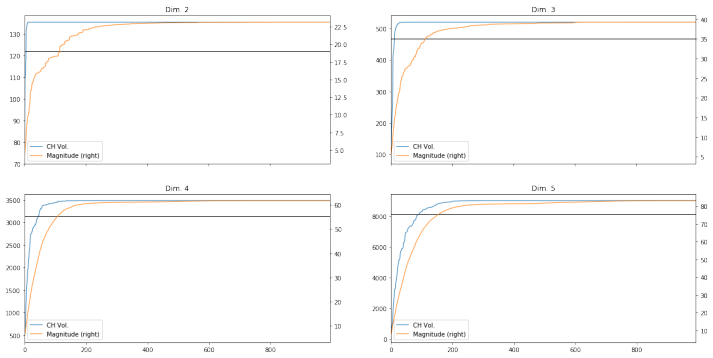
- The experiments suggest the filter is strong: on Gaussian clouds in $\mathbb{R}^2$ through $\mathbb{R}^5$, the average number of points needed to reach 90% of the full hull volume ranges from about 4 to about 80.
Reading between the lines
- The volume guarantee in Section 3.3 is not fully proved, since it substitutes the volume asymptotics for the magnitude at all scales and replaces the worst-case point with the point of maximal moment; a numerical comparison against random subsampling would show whether the moment ordering is doing real work.
- The moment of a point is computed from the full set's weight vector, so it changes when points are removed; Algorithm 1 does not recompute moments after deletion, and an iterative reweighting variant could behave differently.
- Higher moments $\mu_n(x)=\int_0^\infty t^n e^{-t}w_t(x)^2\,dt$ suggest a multiscale description of each point, and could be tested as sharper filters for boundary detection.
Signed reviews
Editorial analysis
A structured set of objections, weighed in public.
Referee Report
Summary. The paper studies the magnitude of finite subsets of Euclidean space and introduces the zeroth moment mu_0(x) = integral_0^infty e^{-t} w_t(x)^2 dt as a per-point geometric score. The main formal results are Lemma 1, expressing |X\Y| in terms of the weight vector of X and a Schur complement, and Proposition 2, giving upper and lower bounds on |X\Y| in terms of the extreme point weights. Based on an informal asymptotic discussion in Section 3.3, the paper proposes Algorithm 1, which removes low-moment points and claims to approximate the convex hull volume, and reports experiments on synthetic Gaussian data in dimensions 2-5.
Significance. If the algorithmic guarantee were established, the paper would offer a novel bridge between metric magnitude and computational geometry, and the zeroth moment would be a valuable intrinsic point-ordering tool. The rigorous parts, Lemma 1 and Proposition 2, appear correct and give an explicit accounting of how deleting points affects the magnitude of a finite Euclidean set. The experiments in Section 4.3 show an empirical phenomenon worth exploring. However, the theoretical argument underpinning the central convex-hull claim contains a reversed inequality and an invalid asymptotic substitution, so the advertised guarantee is not currently supported. The paper is honest in calling Section 3.3 a discussion, but the flaw is not a matter of missing technical hypotheses; it is a logically reversed bound that cannot be repaired by epsilon-chasing within the present algorithmic framework.
major comments (3)
- [Section 3.3, Eq. (12) and following paragraph] The substitution of mu_0(hat x) for the integral of the time-dependent maximum has the wrong inequality direction. Since wt(x_{beta_t})^2 >= wt(x)^2 for every fixed x and every t, integrating gives integral_0^infty e^{-t} wt(x_{beta_t})^2 dt >= mu_0(x) for each x and in particular for hat x. The actual error term in the lower bound for mu_0(|tX\P|) is proportional to that integral, so bounding mu_0(hat x) by epsilon/(|P| n |X|) does not bound the true error; the true error can be arbitrarily larger when the maximizing point changes with t. Thus the claim that Algorithm 1 keeps the magnitude within a predefined threshold is not established.
- [Section 3.3, replacement of |tX| by Vol(Conv(X)) t^n / (n! Vol(B^n))] The replacement of |tX| by the volume-derived expression is unsupported. For finite X, Theorem 3 gives |tX| -> N as t -> infinity, so the finite-set magnitude is asymptotically constant, whereas Vol(Conv(X)) t^n / (n! Vol(B^n)) grows without bound. Theorem 6 is a statement about t Conv(X), not tX, and only in the t -> infinity limit. Because the integral defining the moment is significant over large t, the substitution used to derive the volume error bound is invalid, and the conclusion that Vol(Conv(X\P)) is within epsilon of Vol(Conv(X)) does not follow.
- [Section 4.1, Algorithm 1, Step 3 and the final paragraph of Section 3.3] The criterion in Algorithm 1 is written as mu_0(x_i) <= epsilon/(d_i |X|), but d_i is never defined; Section 3.3 uses epsilon/(|P| n |X|) with n unexplained. More substantively, the algorithm thresholds a per-point moment, whereas Proposition 2's error bound involves the integral of the time-dependent maximum wt(x_{beta_t})^2 over the whole set P being removed. Since the per-point moment is always a lower bound for that error integral, the algorithm's threshold cannot certify the stated magnitude or volume error, even after correcting the notation.
minor comments (5)
- [Section 3.3, first paragraph] The sentence claiming that a sequence {X_k} of independently sampled finite subsets of Conv(X) has monotonically increasing magnitudes |X_k| converging to |Conv(X)| is false without the subsets being nested; Theorems 4 and 5 give convergence for Hausdorff-convergent sequences, not monotonicity for arbitrary uniform samples.
- [Corollary 1, proof] The displayed difference mu_0(x3) - mu_0(x2) is written with the same integrand wt(x3)^2 in both integrals; the second integrand should be wt(x2)^2.
- [Proposition 1, proof] The line 'proving w(x3) >= w(x3)' appears to be a typo; the intended conclusion is w(x3) >= w(x2).
- [Section 4.2, runtime analysis] The runtime analysis counts one matrix inversion as O(n^omega), but the algorithm computes mu_0(x) for every point, which requires solving the n x n system zeta_{tX} w = 1 for many scales t and then numerically integrating over t. The analysis omits the cost of this integration and the choice of quadrature, so the stated complexity of the preprocessing step is incomplete.
- [Throughout] The symbol |X| is used for both the magnitude of X and the number of points in X, and Section 3.3 further proposes using |X| in place of Vol(Conv(X)). This triple overloading makes the inequalities in Section 3.3 and Algorithm 1 ambiguous.
Circularity Check
No significant circularity: the deletion bound is an independently proved linear-algebra statement, and the hull-volume discussion is an unsupported approximation rather than a definitional reduction.
full rationale
The paper's central formal result, Proposition 2, is derived from Lemma 1, which follows from the Schur-complement/inverse-submatrix identity, positive definiteness, and eigenvalue bounds; it does not presuppose the conclusion. The moment µ0(x) is defined as a new integral of squared weights and is not fitted to reconstruct hull volumes. Algorithm 1's criterion is tested empirically rather than derived by fitting parameters. The citations to [5], [6], [2], and [8] are to external authors and are used as background theorems. The Section 3.3 hull-volume passage contains two unjustified substitutions: 'So let us approximate |tX| with the function Vol(Conv(X)) t^n / (n! Vol(B^n))' and 'We will in practice use the value µ0(ˆx) in place of ∫ e^{-t} w_t(xβt)^2 dt.' These are real mathematical gaps, and the second substitution has the wrong inequality direction for the intended guarantee; however, they are non sequiturs or unsupported approximations, not reductions of the claimed result to its own inputs. No fitted parameter is renamed as a prediction, and no load-bearing self-citation or uniqueness import is present. The derivation chain is therefore not circular, though its hull-volume guarantee is not established by the given argument.
Assumptions & free parameters
free parameters (1)
- epsilon (volume/magnitude error threshold) =
user-specified
assumptions (6)
- domain assumption For finite X subset R^n, zeta_X and zeta_X^{-1} are symmetric positive definite (Theorem 2.5.3 of Leinster).
- domain assumption The magnitude function t maps to |tX| is analytic on (0, infinity] for finite X subset R^n (Proposition 2.2.6 of Leinster).
- domain assumption For finite Y subset X, 1 <= |Y| <= |X| (Corollary 2.10 of Leinster and Meckes).
- domain assumption Magnitude is continuous under Hausdorff convergence for compact sets (Corollary 2.7 of Meckes).
- domain assumption For compact X, |tX|/t^n tends to Vol(X)/(n! Vol(B^n)) as t tends to infinity (Theorem 1 of Barcelo and Carbery).
- standard math Inverse of a principal submatrix formula (Theorem 5.1 of Ruiz et al.).
invented entities (1)
-
zeroth moment of a point, mu_0(x)
Cite this review
Pith. "Pith review of Approximating the Convex Hull via Metric Space Magnitude." pith.science (2026). https://pith.science/paper/ONT2CJ77
@misc{pith2026190802692,
  author       = {Pith},
  title        = {Pith review of: Approximating the Convex Hull via Metric Space Magnitude},
  year         = {2026},
  howpublished = {\url{https://pith.science/paper/ONT2CJ77}},
  note         = {Machine review of arXiv:1908.02692}
}
abstract
Magnitude of a finite metric space and the related notion of magnitude functions on metric spaces is an active area of research in algebraic topology. Magnitude originally arose in the context of biology, where it represents the number of effective species in an environment; when applied to a one-parameter family of metric spaces $tX$ with scale parameter $t$, the magnitude captures much of the underlying geometry of the space. Prior work has mostly focussed on properties of magnitude in a global sense; in this paper we restrict the sets to finite subsets of Euclidean space and investigate its individual components. We give an explicit formula for the corrected inclusion-exclusion principle, and define a quantity associated with each point, called the $\textit{moment}$ which gives an intrinsic ordering to the points. We exploit this in order to form an algorithm which approximates the convex hull.
Figures

Reference graph
Works this paper leans on
-
[1]
C. Bradford Barber, David P. Dobkin, David P. Dobkin, and Hannu Huhdanpaa. The quickhull algorithm for convex hulls. ACM Trans. Math. Softw. , 22(4):469--483, December 1996
work page 1996
-
[2]
On the magnitudes of compact sets in Euclidean spaces
Juan Antonio Barcelo and Anthony Carbery. On the magnitudes of compact sets in Euclidean spaces . American Journal of Mathematics , 140(2):449--494, 2018
work page 2018
-
[3]
Gene H. Golub and Charles F. Van Loan. Matrix Computations . Johns Hopkins University Press, third edition edition, Oct 1996
work page 1996
-
[4]
K \:u hne, and Christian Plessl
Michael Lass, Stephan Mohr, Hendrik Wiebeler, Thomas D. K \:u hne, and Christian Plessl. A Massively Parallel Algorithm for the Approximate Calculation of Inverse p-th Roots of Large Sparse Matrices . Proceedings of ACM Conference , April 2017
work page 2017
-
[5]
The magnitude of metric spaces
Tom Leinster. The magnitude of metric spaces. Documenta Mathematica , 18:857–905, 2013
work page 2013
-
[6]
The magnitude of a metric space: From category theory to geometric measure theory
Tom Leinster and Mark Meckes. The magnitude of a metric space: From category theory to geometric measure theory. Aug 2018
work page 2018
-
[7]
On the asymptotic magnitude of subsets of euclidean space
Tom Leinster and Simon Willerton. On the asymptotic magnitude of subsets of euclidean space. Geometriae Dedicata , 164(1):287--310, Jun 2013
work page 2013
-
[8]
M. W. Meckes. Positive definite metric spaces. Positivity , 17:733--757, Sept 2013
work page 2013
Show all 18 references
-
[9]
Ju \'a rez Ruiz, R
E. Ju \'a rez Ruiz, R. Cortes Maldonado, and Francisco Rodr \'i guez. Relationship between the inverses of a matrix and a submatrix. Computaci \'o n y Sistemas , 20, 2016
2016
-
[10]
Bradford Barber, David P
C. Bradford Barber, David P. Dobkin, David P. Dobkin, and Hannu Huh-danpaa. The quickhull algorithm for convex hulls. ACM Trans. Math. Softw., 22(4):469–483, December 1996
1996
-
[11]
Golub and Charles F
Gene H. Golub and Charles F. Van Loan. Matrix Computations. Johns Hopkins University Press, third edition edition, Oct 1996
1996
-
[12]
K uhne, and Christian Plessl
Michael Lass, Stephan Mohr, Hendrik Wiebeler, Thomas D. K uhne, and Christian Plessl. A Massively Parallel Algorithm for the Approximate Calculation of Inverse p-th Roots of Large Sparse Matrices. Proceedings of ACM Conference, April 2017
2017
-
[13]
Ju \'a rez Ruiz, R
E. Ju \'a rez Ruiz, R. Cortes Maldonado, and Francisco Rodr \'i guez. Relationship between the inverses of a matrix and a submatrix. Computaci \'o n y Sistemas, 20, 2016
2016
-
[14]
The magnitude of metric spaces
Tom Leinster. The magnitude of metric spaces. Documenta Mathematica, 18:857–905, 2013
2013
-
[15]
On the asymptotic magnitude of subsets of euclidean space
Tom Leinster and Simon Willerton. On the asymptotic magnitude of subsets of euclidean space. Geometriae Dedicata, 164(1):287–310, Jun 2013
2013
-
[16]
The magnitude of a metric space: From category theory to geometric measure theory
Tom Leinster and Mark Meckes. The magnitude of a metric space: From category theory to geometric measure theory. arXiv:1606.00095v2 [math.MG]
-
[17]
On the magnitudes of compact sets in Euclidean spaces
Juan Antonio Barcelo and Anthony Carbery. On the magnitudes of compact sets in Euclidean spaces. American Journal of Mathematics, 140(2):449, 2018
2018
-
[18]
M. W. Meckes. Positive definite metric spaces. Positivity, 17:733
Reviewed August 14, 2026 · model on record in the stance chip above.
Discussion (0). Continue with ORCID to comment.