REVIEW 3 major objections 5 minor 8 references
How big can style be? Addressing high dimensionality for recommending with style
T0 review · 3 major / 5 minor · reviewed 2026-08-14 · deepseek-v4-flash
Pith's one-line read Style embeddings for fashion products can be shrunk from 600k features to 512 with a 99.91% memory cut, while preserving most recommendation quality.
desk verdict Honest engineering paper: compressing style embeddings to 512 dims works well on fidelity to the uncompressed model, but the style-over-ResNet50 advantage is underpowered and the abstract overstates it. read the letter →
The pith
A machine-rendered reading of the paper's core claim, the machinery that carries it, and where it could break.
The reading
What carries the argument
The central object is the Gram matrix $G^l = F^l (F^l)^\top$ of a convolutional layer's feature maps, whose entries summarize the correlations between filter responses and thereby encode texture/style. The paper takes the upper triangle of each of five layer matrices (discarding the diagonal), normalizes each layer's entries by the feature-map size, and concatenates them into a single style vector. The machinery that makes the argument work is compression: either randomly sampling a fraction $\alpha$ of feature maps before the Gram matrices are formed, or applying Truncated SVD to the concatenated embedding, with Precision@100 and nDCG@100 against the full embedding as the quality yardstick.
What would settle it
Take a held-out sample of product images from the same catalog, compute the full Gram matrices (including diagonal) and the paper's upper-triangle-only embeddings, and run the same top-100 nearest-neighbour evaluation. If the diagonal-augmented embeddings change the ranking order at the head of the list or improve Precision@10 on the expert-labeled style matches, then the 'negligible diagonal' premise is falsified.
Extended reading notes
Core claim
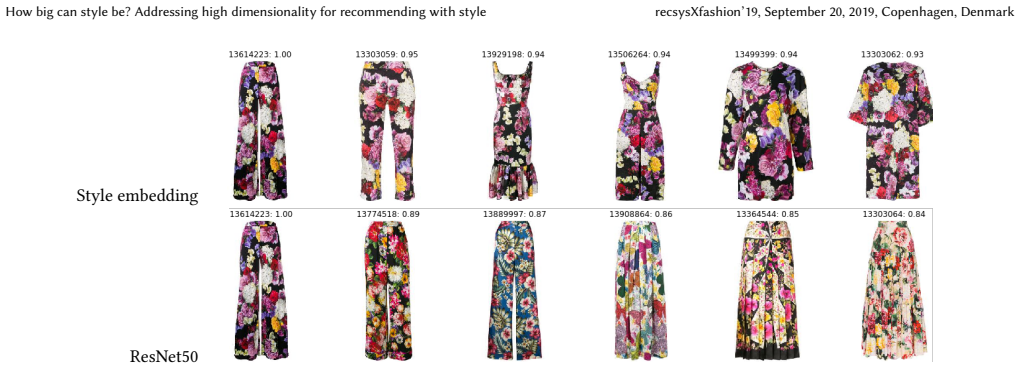
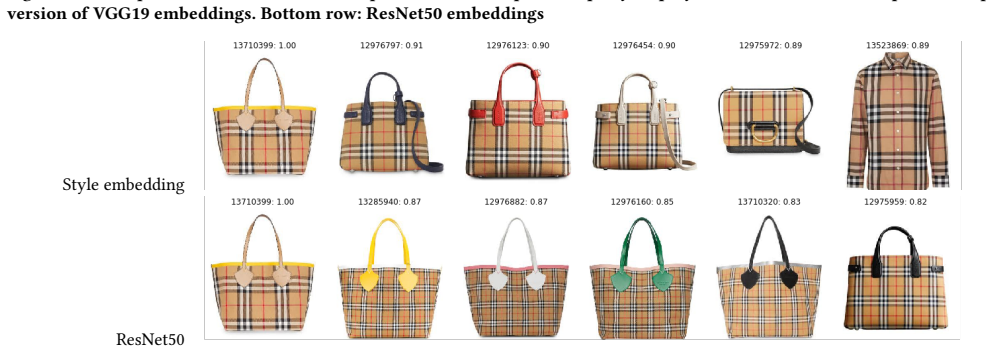
The paper's discovery is that style, understood as texture/print/material rather than shape, can be extracted from the Gram matrices of five VGG19 convolutional layers, and that this representation is highly compressible without losing its usefulness. In a large fashion product catalog, the adapted VGG19 embeddings retrieved style-matched products with Precision@10 of 0.38 by expert evaluation, versus 0.35 for ResNet50 embeddings, and the example retrievals show prints and textures being matched across product categories. Truncating the 304,416-dimensional embedding to 512 components retains 0.966 Precision@100 and 0.985 nDCG@100 relative to the full embedding, while sampling feature maps down to 10% retains 0.71 Precision@100 and 0.90 nDCG@100. The authors conclude that a reduction from roughly 600k features to 512, a memory cut of 99.91%, does not critically compromise recommendation quality.
Load-bearing premise
The load-bearing premise is that the diagonal of each Gram matrix—the per-filter response energy—is negligible and can be discarded, so the style embedding can be built from the upper triangle alone.
Editorial extensions
If this is right
- A 512-dimensional style embedding can be stored and searched for a catalog of millions of products, making style-aware retrieval a practical addition to production recommender systems.
- Style embeddings can be dropped into collaborative-filtering or outfit-composition models as side information without a prohibitive memory cost.
- When Truncated SVD cannot be run at scale, sampling feature maps before forming the Gram matrices offers a simpler fallback at a higher quality cost.
- Compression preserves the head of the recommendation list better than the tail, so top-of-list style matches are the most reliable when using reduced embeddings.
Reading between the lines
- If the discarded Gram-matrix diagonal (per-filter response energy) is not actually negligible, including it could improve style retrieval at modest cost; this can be tested by rerunning the evaluation with the full Gram vector.
- The near-perfect fit of Truncated SVD down to 512 components suggests style space has low intrinsic dimensionality; estimating that dimensionality per layer could replace the grid search over embedding sizes.
- Because the VGG19 weights are frozen, the same Gram-based compression recipe could transfer to other texture-sensitive domains, such as fabric, wallpaper, or architectural materials, without retraining.
Editorial analysis
A structured set of objections, weighed in public.
Referee Report
Summary. The paper proposes a method for fashion product style recommendation using Gram-matrix style embeddings extracted from VGG19, following Gatys et al. To address the high dimensionality of the resulting embedding (~600k features), the authors propose two reduction approaches: random sampling of feature maps before Gram computation, and truncated SVD on the concatenated embedding. They report that a 512-dimensional SVD embedding preserves 0.966 Precision@100 and 0.985 nDCG@100 agreement with the full baseline, yielding a 99.91% memory reduction. They also compare the full style embedding against ResNet50 features in a small expert study (177 items), finding a slight but untested advantage.
Significance. If the reported 512-dimensional results reflected independent recommendation quality, this would be a practically useful contribution: style-aware retrieval becomes memory-feasible for large catalogs. Strengths include the use of a large real-world Farfetch catalog, a straightforward implementation of two reduction strategies, and the attempt to validate style capture via human experts. However, the compression evaluation measures agreement with the uncompressed baseline, not ground-truth style relevance, and the only external validation (Table 2) is underpowered. The Gram-diagonal justification is also mathematically questionable. With additional evidence, the approach could be valuable for production style retrieval.
major comments (3)
- [§3.2–3.3, Tables 3–4] The Precision@100 and nDCG@100 values are computed as agreement between the compressed embeddings' top-100 neighbor lists and the full 'style embedding' baseline's top-100 lists. This makes them fidelity-to-baseline measures, not independent measures of recommendation quality. Consequently, the abstract's claim that recommendations are 'not critically compromised' is only as strong as the external validity of the baseline. The only external check, Table 2, shows Precision@10 0.38 vs 0.35 (SD 0.21) on 177 items, which the authors themselves describe as 'not very significant' and is not accompanied by a statistical test. The central claim therefore needs either a larger, statistically powered expert study comparing the full and reduced embeddings, or a recasting of the contribution as 'compression without losing the baseline's output.'
- [§2.1, Eq. (1)–(2)] The statement that the Gram matrices 'are symmetric and with a negligible diagonal' is incorrect for the Gram matrix defined in Eq. (1). The diagonal entries are squared L2 norms of the individual feature maps, which are energy statistics that are typically large, not correlations. Discarding the diagonal (via the upper-triangle selection) removes this per-filter magnitude information from the style representation. Since the authors provide no ablation showing that the diagonal does not affect style matching, this assumption should be either justified empirically or removed.
- [§2.2, Eq. (4)–(5)] The feature-map sampling method is stochastic, yet Table 3 reports a single run for each α. Without repeated sampling or confidence intervals, it is not possible to tell whether the reported differences between α=0.7 and α=0.5, or between 0.5 and 0.3, are within the noise of the random selection. Reporting standard errors over multiple random seeds would make the comparison in Table 3 meaningful.
minor comments (5)
- [Section 2.1] There is a typo in the layer dimensions: '64, 128, 256, 515 and 512' should read '64, 128, 256, 512, and 512' (the fifth block has 512 filters, as Table 1 confirms).
- [Abstract and Section 1] The phrase 'previous to the top layers' is unclear; it should be 'the layer before the final classification layer'.
- [Section 3.1] The procedure for the expert study is under-specified: it is unclear how many queries were used, how many experts participated, and whether the 177 'Pop. size' refers to products or recommendations. Adding these details would aid reproducibility.
- [References] The two Gatys et al. references [1] and [2] are both marked as '2015' but refer to 'A Neural Algorithm of Artistic Style' and 'Texture Synthesis...'; consider clarifying which is which in the text.
- [Section 2.3] The phrase 'PCA via an encoder-decoder approach' is vague; defining the attempted method precisely would help readers understand why it was memory-inefficient.
Circularity Check
Compression 'quality' is measured as agreement with the uncompressed style baseline, while the baseline's own style advantage is admitted to be not significant.
-
fitted input called prediction
[Abstract; Section 3.2 (Table 3); Section 3.3 (Table 4)]
"The feature reduction we propose allows for reducing the embedding vector from 600k features to 512, leading to a memory reduction of 99.91% without critically compromising the quality of the recommendations. ... To understand the loss of quality by the process of randomly slicing the feature maps, we computed the top 100 recommendations to the new embeddings obtained in the smaller feature maps and compared the recommendations against the baseline model which has 100% of the feature maps (α = 1). ..."
The abstract's quality claim is supported only by Tables 3 and 4, where Precision@100/nDCG@100 are computed against the baseline model's own top-100 lists. The ground truth is the uncompressed baseline's output, so 'without critically compromising the quality' reduces by construction to 'the compressed embeddings reproduce the uncompressed embeddings' recommendations.' The only external quality check, Table 2, is weak by the authors' own admission: it reports Precision@10 of 0.38 versus 0.35 with SD 0.21 and population 177, and the text says 'Although not presenting very significant results.' Thus the central reduction claim measures self-consistency with an unevaluated baseline, not independent recommendation quality.
full rationale
The style-embedding construction in Section 2.1 (Equations 1-3) is a faithful adaptation of Gatys et al. and is not itself circular: Gram matrices are computed from VGG19 feature maps, and no fitted parameter is renamed as a prediction. There is no load-bearing self-citation chain, since the cited style and texture works are external. The material circularity is confined to the framing of the compression results: Tables 3 and 4 are labeled Precision/nDCG@100 but are operationally the overlap between the reduced embeddings' top-100 lists and the uncompressed baseline's top-100 lists; the abstract then calls this 'without critically compromising the quality of the recommendations.' This is a self-referential quality metric. The external anchor, Table 2, is explicitly weak ('not very significant'), so the baseline's quality is not independently established. The Gram-matrix diagonal assumption (Section 2.1, 'negligible diagonal') is an empirical validity concern rather than a circular step, and the human expert comparison of style versus ResNet50 does provide partial independent grounding. Overall, the compression claim is partially circular in its evaluation label and interpretation, but the underlying SVD and sampling implementations are not tautological; hence a moderate score of 4.
Assumptions & free parameters
free parameters (5)
- Feature map sampling proportion alpha =
grid search over 1.0, 0.7, 0.5, 0.3, 0.1
- Truncated SVD target dimension =
grid search over 2048, 1024, 512, 128, 64
- VGG19 layer selection =
block1_conv1, block2_conv1, block3_conv1, block4_conv1, block5_conv1
- Normalization factor 1/(N_l * M_l) =
one per layer
- Upper-triangle and diagonal exclusion =
n/a
assumptions (4)
- domain assumption The style of a fashion product is equivalent to the texture of its main image and can be captured by the correlation statistics of convolutional feature maps.
- domain assumption A VGG19 network pre-trained on ImageNet provides feature maps that represent the style/texture of fashion product images.
- ad hoc to paper The diagonal of each Gram matrix is negligible and can be discarded.
- ad hoc to paper Randomly sampling feature maps retains enough texture information for style recommendation.
Cite this review
Pith. "Pith review of How big can style be? Addressing high dimensionality for recommending with style." pith.science (2026). https://pith.science/paper/OOFVWLOY
@misc{pith2026190810642,
  author       = {Pith},
  title        = {Pith review of: How big can style be? Addressing high dimensionality for recommending with style},
  year         = {2026},
  howpublished = {\url{https://pith.science/paper/OOFVWLOY}},
  note         = {Machine review of arXiv:1908.10642}
}
read the original abstract
Using embeddings as representations of products is quite commonplace in recommender systems, either by extracting the semantic embeddings of text descriptions, user sessions, collaborative relationships, or product images. In this paper, we present an approach to extract style embeddings for using in fashion recommender systems, with a special focus on style information such as textures, prints, material, etc. The main issue of using such a type of embeddings is its high dimensionality. So, we propose feature reduction solutions alongside the investigation of its influence in the overall task of recommending products of the same style based on their main image. The feature reduction we propose allows for reducing the embedding vector from 600k features to 512, leading to a memory reduction of 99.91\% without critically compromising the quality of the recommendations.
Figures


Figures from the paper (2 more)

Reference graph
Works this paper leans on
-
[1]
Leon A. Gatys, Alexander S. Ecker, and Matthias Bethge. 2015. A Neural Algorithm of Artistic Style. (2015), 3–7. https://doi.org/10.1167/16.12.326 arXiv:1508.06576
arXiv 2015
-
[2]
Leon A. Gatys, Alexander S. Ecker, and Matthias Bethge. 2015. Texture synthesis and the controlled generation of natural stimuli using convolutional neural networks. CoRR abs/1505.07376 (2015). arXiv:1505.07376 http://arxiv.org/abs/ 1505.07376
arXiv 2015
-
[3]
João Gomes. 2017. Boosting Recommender Systems with Deep Learning. In Proceedings of the Eleventh ACM Conference on Recommender Systems (RecSys ’17) . ACM, New York, NY, USA, 344–344. https://doi.org/10.1145/3109859.3109926
arXiv 2017
-
[4]
Xintong Han, Zuxuan Wu, Yu-Gang Jiang, and Larry S. Davis. 2017. Learning Fashion Compatibility with Bidirectional LSTMs. CoRR abs/1707.05691 (2017). arXiv:1707.05691 http://arxiv.org/abs/1707.05691
work page Pith review arXiv 2017
-
[5]
Hanbit Lee, Jinseok Seol, and Sang-goo Lee. 2017. Style2Vec: Representa- tion Learning for Fashion Items from Style Sets. CoRR abs/1708.04014 (2017). arXiv:1708.04014 http://arxiv.org/abs/1708.04014
arXiv 2017
-
[6]
Yuncheng Li, Liangliang Cao, Jiang Zhu, and Jiebo Luo. 2016. Mining Fashion Outfit Composition Using An End-to-End Deep Learning Approach on Set Data. CoRR abs/1608.03016 (2016). arXiv:1608.03016 http://arxiv.org/abs/1608.03016
work page Pith review arXiv 2016
-
[7]
K. Simonyan and A. Zisserman. 2014. Very Deep Convolutional Networks for Large-Scale Image Recognition. CoRR abs/1409.1556 (2014)
arXiv 2014
-
[8]
Texture Synthesis Using Shallow Convolutional Networks with Random Filters
Ivan Ustyuzhaninov, Wieland Brendel, Leon A. Gatys, and Matthias Bethge. 2016. Texture Synthesis Using Shallow Convolutional Networks with Random Filters. CoRR abs/1606.00021 (2016). arXiv:1606.00021 http://arxiv.org/abs/1606.00021
work page Pith review arXiv 2016
Reviewed August 14, 2026 · model on record in the stance chip above.
Discussion (0). Continue with ORCID to comment.