REVIEW 2 major objections 3 minor 1 cited by
Topology via Spectral Projectors with Staggered Fermions
T0 review · 2 major / 3 minor · reviewed 2026-08-14 · deepseek-v4-flash
Pith's one-line read Staggered spectral projectors give a well-posed lattice definition of the topological susceptibility, with only $O(a^2)$ artifacts and a generalization to higher cumulants.
desk verdict Staggered spectral-projector topology is a real, useful extension of the Giusti-Lüscher method, with clean numerics, but the key renormalization step is imported from older work and the cumulant formula is asserted rather than proved. read the letter →
The pith
A machine-rendered reading of the paper's core claim, the machinery that carries it, and where it could break.
The reading
What carries the argument
The central object is the orthogonal spectral projector $P_M$ onto the eigenspace of the staggered Dirac operator $D_{st}$ with $|\lambda| \le M$, which replaces the inverse powers $(D_{st}^\dagger D_{st})^{-k}$ appearing in the Wilson derivation. All relevant quantities are traces of this projector: $\nu(M)=\mathrm{Tr}\,P_M$, $\mathrm{Tr}\,\Gamma_5 P_M$, and $\mathrm{Tr}\,\Gamma_5 P_M\Gamma_5 P_M$. The renormalization factor $(Z_P^{(s)}/Z_S^{(s)})^2$ is written as the ratio $\langle\mathrm{Tr}\,P_M\rangle/\langle\mathrm{Tr}\,\Gamma_5 P_M\Gamma_5 P_M\rangle$, following the staggered singlet Ward identities, and the overall factor $2^{-d}$ removes the $2^{d/2}$-fold taste degeneracy.
What would settle it
Compute the ratio $Z_P^{(s)}/Z_S^{(s)}$ on the same ensembles by a scheme independent of spectral sums, for instance from Green functions of the singlet scalar and pseudoscalar densities, and compare it with $\sqrt{\langle\mathrm{Tr}\,P_M\rangle/\langle\mathrm{Tr}\,\Gamma_5 P_M\Gamma_5 P_M\rangle}$ at several $M$ and $\beta$. A persistent mismatch would show that the multiplicative renormalization is incomplete. Alternatively, compare staggered spectral-projector $\chi_{SP}$ configuration-by-configuration with an overlap-operator index on identical gauge fields; residual $M_R$-dependent disagreement surviving the continuum limit would signal missing additive terms.
Extended reading notes
Core claim
The central claim is that the staggered Dirac operator's eigenmodes carry the topological charge through the bare expression $Q_{0\mathrm{st}} = (-2)^{-d/2}\mathrm{Tr}\,\Gamma_5 P_M$, with the renormalization factor $Z_P^{(s)}/Z_S^{(s)}$ obtained from the spectral-sum ratio $\langle\mathrm{Tr}\,P_M\rangle/\langle\mathrm{Tr}\,\Gamma_5 P_M\Gamma_5 P_M\rangle$. This gives Eq. (24), $\chi_{SP} = 2^{-d}\,\frac{\langle\mathrm{Tr}\,P_M\rangle}{\langle\mathrm{Tr}\,\Gamma_5 P_M\Gamma_5 P_M\rangle}\,\frac{\langle(\mathrm{Tr}\,\Gamma_5 P_M)^2\rangle}{V}$, and its generalization to all $b_{2n}$ in Eq. (27). Because the projector is a fast-decreasing function in the ultraviolet, no additive renormalization is needed; tuning to fixed renormalized $M_R$ leaves only $O(a^2)$ artifacts. In the pure gauge test, the continuum-extrapolated $\chi_{SP}$ agrees with the gluonic, overlap, and Wilson spectral determinations, and the high-temperature $b_2$ matches the gluonic value.
Load-bearing premise
The load-bearing premise is that the staggered singlet Ward identities renormalize the bare charge purely multiplicatively, $Q_{st} = (Z_P^{(s)}/Z_S^{(s)})\,Q_{0\mathrm{st}}$, and that the spectral-sum ratio in Eq. (22) equals exactly that multiplicative factor; this input is imported from two earlier staggered Ward-identity papers rather than derived here, and if the singlet scalar density needs an additive subtraction or extra operator mixing at finite lattice spacing, Eq. (24) would not produce the correct continuum topological susceptibility.
Editorial extensions
If this is right
- Staggered QCD simulations can now measure the topological susceptibility with a fermionic definition that needs no smoothing and no additive subtraction.
- With the renormalized cut-off $M_R$ kept fixed, the remaining lattice artifacts are $O(a^2)$, comparable to Wilson spectral projectors and cooled gluonic measurements.
- Equation (27) extends the fermionic definition to every higher-order cumulant $b_{2n}$ of the topological charge, so the full $\theta$-expansion of the free energy becomes accessible in principle.
- In dynamical simulations with light staggered quarks, matching the topological observable to the fermion discretization of the measure may reduce the lattice artifacts that are known to affect gluonic determinations.
- The quenched numerical agreement between staggered spectral, Wilson spectral, overlap, and gluonic definitions supports using the new observable as a cross-check in future studies.
Reading between the lines
- Because staggered fermions are substantially cheaper than overlap fermions, this construction makes high-statistics $\theta$-dependence measurements feasible on large dynamical lattices where overlap-based indices would be computationally prohibitive.
- Applying the formula to 2+1-flavor staggered QCD at finite temperature would be a direct test of whether a matched fermionic definition reduces the topological-susceptibility artifacts seen in full QCD, a question the paper states as its main motivation.
- The $b_{2n}$ formula implies that fermionic spectral measurements could in principle map out the whole $\theta$-dependence of the free energy; measuring $b_4$ and beyond would require large statistics but is a natural next step.
- An independent determination of $Z_S^{(s)}/Z_P^{(s)}$ in a different renormalization scheme would upgrade the numerical agreement from a consistency check into a direct confirmation of the Ward-identity input.
Signed reviews
Editorial analysis
A structured set of objections, weighed in public.
Referee Report
Summary. The paper proposes a staggered-fermion version of the spectral-projectors definition of the topological charge and susceptibility. Starting from the staggered singlet axial Ward identities, it writes the renormalized charge as Q_st = (Z_P^(s)/Z_S^(s)) Q0_st, expresses the renormalization factor through spectral sums, and replaces the inverse powers by the projector P_M, obtaining Eq. (24) for the topological susceptibility. It also generalizes the construction to all coefficients b_{2n} of the theta-expansion, Eq. (27). Numerical tests in quenched SU(3) at beta = 5.9, 6.0, 6.125, 6.25 use 300 configurations per ensemble; the staggered spectral-projector value of chi agrees within errors with the cooled gluonic definition and with previous overlap and Wilson spectral-projector values. A high-temperature determination of b_2 at beta = 6.305 agrees with the gluonic determination on the same sample and with the literature value. A practical prescription for fixing the renormalized cutoff M_R by keeping the mode density nu(M)/V fixed is also presented.
Significance. If the construction is correct, it provides a fermionic, renormalization-simple definition of topology that can be used directly in staggered QCD simulations, avoiding the need for smoothing and additive subtractions. This is practically important for future studies of theta-dependence with staggered fermions, and the extension to higher-order cumulants is a useful new tool. The paper is strengthened by its explicit spectral-sum expressions and by the honest comparison with independent determinations, including overlap and Wilson spectral-projector results. The main theoretical input, namely the staggered singlet Ward identity and the absence of additive renormalization, is imported from Refs. [17,18] rather than derived in the manuscript, and the numerical evidence for that input is supportive but limited in precision. With that input supplied or clearly justified, the result would be a solid contribution to the lattice-topology literature.
major comments (2)
- [Sec. 2B, Eq. (22)] The identification (Z_P^(s)/Z_S^(s))^2 = Tr{P_M} / Tr{Gamma5 P_M Gamma5 P_M} is the load-bearing step of the paper, but it is not derived in the manuscript; it is imported from Refs. [17,18]. If the staggered singlet scalar density required an additive subtraction or additional operator mixing at finite lattice spacing, Eq. (22) and hence Eq. (24) would not have the claimed multiplicative form. The numerical agreement reported in Tables I and II is encouraging, but with 300 configurations per ensemble and no same-configuration comparison with an exact-index operator it is not a substitute for presenting the derivation. Please include a concise derivation of Eq. (22), or a precise statement of the assumptions from Refs. [17,18] and of why no additive renormalization appears, preferably in an appendix.
- [Sec. 2C, Eq. (27)] The formula for all higher-order cumulants b_{2n} is stated with the remark that it is 'easy to prove,' but no proof is given. Since this is one of the two central claims of the paper, the derivation should be written out: in particular, how the multiplicative factor (Z_P^(s)/Z_S^(s))^{2n} acts on connected cumulants, and how the factor 2^{-dn} arises from the (-2)^{-d/2} normalization of the bare staggered charge. Without this, the generalization beyond the one numerically tested case n=1 is unsupported.
minor comments (3)
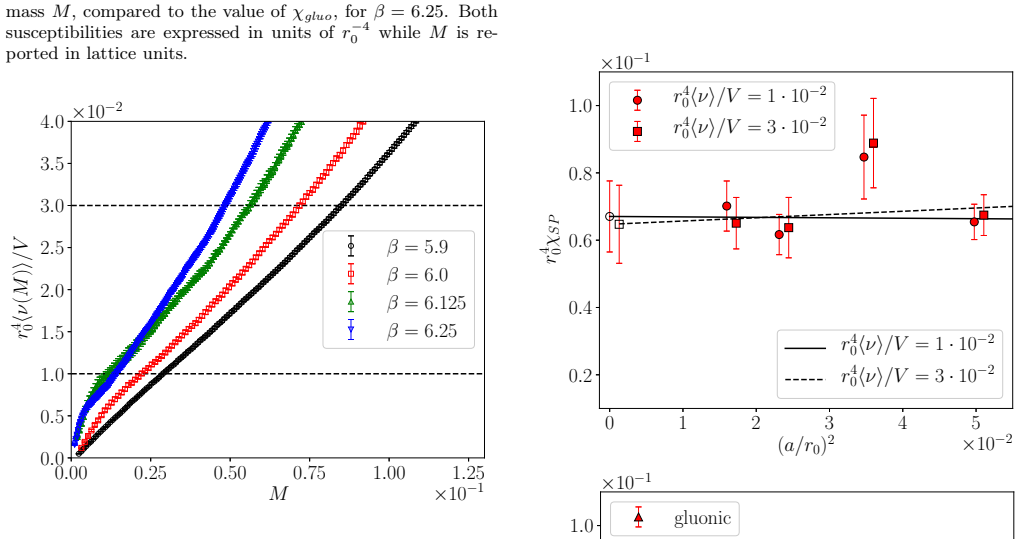
- [Fig. 3 caption vs. Table I] The caption of Fig. 3 reports r0^4 <nu>/V = 1 x 10^-2 and 3 x 10^-2, while Table I defines the two renormalized cutoffs M1 and M2 by r0^4 <nu>/V = 1 x 10^-3 and 3 x 10^-3. Please correct this apparent mismatch.
- [Eq. (27)] The notation for connected cumulants of Tr{Gamma5 P_M} would be clearer if written as <(Tr{Gamma5 P_M})^{2n+2}>_c; as printed, the expression can be misread as a single power of the trace inside the connected bracket.
- [Sec. 2D, Eq. (34)] The justification for keeping nu(M)/V fixed assumes the leading-order Banks-Casher relation. At the quoted values M1 ~ 33 MeV and M2 ~ 98 MeV, the paper should discuss the expected size of corrections to Eq. (34) and why the residual M_R dependence does not bias the continuum extrapolation.
Circularity Check
No circularity: the staggered spectral-projector susceptibility is derived from an external Ward-identity result and validated against independent gluonic and overlap determinations.
full rationale
The derivation chain is not circular. Equation (16) imports the staggered singlet Ward-identity result Q_st = (Z_P^(s)/Z_S^(s)) Q0_st from Refs. [17,18] (Smit and Vink), which are independent prior works, not self-citations. Equations (21) and (22) express the renormalization ratio in terms of spectral sums, following the same projector replacement as Ref. [20]; this is a stated external input, not a definition of the target susceptibility. Equation (24) then combines that ratio with the projected bare charge, and the cut-off M is fixed by a mode-density criterion (Eq. (34)) that does not use chi as an input. The numerical results are compared against gluonic, overlap, and Wilson spectral-projector determinations, so the target observable is not used to fit any parameter. The only potential concern is that Eq. (16) is imported rather than re-derived, but that is an external-evidence issue, not circularity. No equation is defined in terms of the quantity it claims to predict, and no fitted parameter is renamed as a prediction.
Assumptions & free parameters
free parameters (1)
- Spectral cut-off mass M (renormalized scale M_R) =
M1 ≈ 33 MeV, M2 ≈ 98 MeV, set via r0^4<ν>/V = 1e-3 and 3e-3
assumptions (4)
- domain assumption The staggered Dirac operator has 2^{d/2} degenerate tastes, so the index-theorem relation reads Q = (-2)^{-d/2} Tr Γ5.
- domain assumption The staggered singlet Ward identities give the renormalized charge as Q_st = (Z_P^{(s)}/Z_S^{(s)}) Q0_st, with no additional additive renormalization.
- domain assumption The spectral sums σ_k and σ_{k,l} renormalize as scalar/pseudo-scalar density chains, so the ratio σ_{k+l}/σ_{k,l} equals (Z_P^{(s)}/Z_S^{(s)})^2, and inverse powers can be replaced by the projector P_M.
- domain assumption In the large-volume, chiral limit, the eigenmode density obeys Eq. (34), ν(M)/V = (2/π) Σ M, with Σ renormalization-group invariant; fixing ν/V therefore keeps the renormalized cut-off M_R fixed.
Cite this review
Pith. "Pith review of Topology via Spectral Projectors with Staggered Fermions." pith.science (2026). https://pith.science/paper/OORPS5HX
@misc{pith2026190811832,
  author       = {Pith},
  title        = {Pith review of: Topology via Spectral Projectors with Staggered Fermions},
  year         = {2026},
  howpublished = {\url{https://pith.science/paper/OORPS5HX}},
  note         = {Machine review of arXiv:1908.11832}
}
abstract
The spectral projectors method is a way to obtain a theoretically well posed definition of the topological susceptibility on the lattice. Up to now this method has been defined and applied only to Wilson fermions. The goal of this work is to extend the method to staggered fermions, giving a definition for the staggered topological susceptibility and testing it in the pure $SU(3)$ gauge theory. Besides, we also generalize the method to higher-order cumulants of the topological charge distribution.
Figures


Figures from the paper (2 more)


Forward citations
Cited by 1 Pith paper
-
The gluino condensate of large-$N$ SUSY Yang-Mills
The large-N SUSY gluino condensate is computed on the lattice for the first time and agrees, within errors, with the weak-coupling instanton value.
Reference graph
Works this paper leans on
-
[1]
INTRODUCTION The properties related to the existence of field con- figurations with non-trivial topology, and the associated non-trivial dependence on the topological parameter θ, represent some of the most significant non-perturbative aspects of QCD and QCD-like theories. Monte Carlo sim- ulations on a lattice are the most natural first principle tool to inv...
-
[2]
θ-DEPENDENCE VIA SPECTRAL PROJECTORS: FROM WILSON TO ST AGGERED FERMIONS In this Section, after a brief review of the main ideas underlying the method of spectral projectors for Wilson fermions, we show how they can be extended to the stag- gered case, obtaining a similar expression for the topolog- ical susceptibility. We also discuss about the extension...
-
[3]
NUMERICAL TESTS IN THE PURE GAUGE THEOR Y In order to test the definition of topological quantities via staggered spectral projectors, we have considered the pureSU (3) Yang-Mills theory. Configurations have been generated using the standard Wilson plaquette action for Nc = 3: SL = − β Nc ∑ x,µ>ν ℜ Tr{Π µν (x)}. (35) and a standard local algorithm consistin...
-
[4]
0 r4 0⟨ν(M )⟩/V ×10−2 β = 5. 9 β = 6. 0 β = 6. 125 β = 6. 25 Figure 2: Behavior of ⟨ν(M )⟩/V as a function of the bare cut-off mass M for 4 different values of the lattice spacing. The mean number of modes is expressed in units of r− 4 0 while M is in lattice units. obtained with spectral projectors and with the gluonic definition. As shown in Table II, the ...
-
[5]
B. Berg, Phys. Lett. B 104, 475 (1981); Y. Iwasaki and T. Yoshie, Phys. Lett. B 131, 159 (1983); S. Itoh, Y. Iwasaki and T. Yoshie, Phys. Lett. B 147, 141 (1984); M. Teper, Phys. Lett. B 162, 357 (1985); E. -M. Ilgenfritz e al. , Nucl. Phys. B 268, 693 (1986); M. Campostrini, A. Di Giacomo, H. Panagopoulos and E. Vicari, Nucl. Phys. B 329, 683 (1990)
work page 1981
-
[6]
This is due to the fact that we are dealing with singlet, rather than non-singlet, densities
for Wilson fermions. This is due to the fact that we are dealing with singlet, rather than non-singlet, densities. Following the same line of reasoning of Ref. [20], one can trade also in this case the inverse powers of D† stDst for a fast-decreasing function, in particular for PM , where now PM is the orthogonal projector on eigenspaces of the Dirac oper...
-
[7]
and ( 8) lead to pseudo-scalar density chains ( 9) and ( 10) because of the γ5-hermiticity of the Wilson operator: γ5D† Wγ5 =DW . Eq. ( 6) holds for high enough values of k and l, but also if the inverse powers of D† WDW are traded for a generic, fast-decreasing function f (D† WDW ) (see Ref. [20] for more details). Choosing the Heaviside func- tionf (x) ...
-
[8]
8 r4 0χ SP ×10−1 gluonic spectral projectors Figure 1: Behavior of χ SP as a function of the bare cut-off mass M , compared to the value of χ gluo, for β = 6 . 25. Both susceptibilities are expressed in units of r− 4 0 while M is re- ported in lattice units
Show all 55 references
-
[9]
00 0 . 25 0 . 50 0 . 75 1 . 00 1 . 25 M ×10−1
-
[10]
0 r4 0χ SP ×10−1 r4 0⟨ν⟩/V = 1 · 10−2 r4 0⟨ν⟩/V = 3 · 10−2 r4 0⟨ν⟩/V = 1 · 10−2 r4 0⟨ν⟩/V = 3 · 10−2 0 1 2 3 4 5 (a/r 0)2 ×10⁻²
-
[11]
7 Method r4 0χ Stag
0 r4 0χ gluo ×10−1 gluonic Figure 3: Extrapolation towards the continuum of χ SP and χ gluo at T = 0. 7 Method r4 0χ Stag. Spectral Proj. M1 0.067(11) Stag. Spectral Proj. M2 0.065(12) Gluonic Def. + Cooling 0.058(9) Overlap Operator [14] 0.059(3) Wilson Spectral Proj. [21] 0....
-
[12]
Despite the different patterns of chiral symmetry break- ing, the final formula for the topological susceptibility, Eq
DISCUSSION AND CONCLUSIONS In this work we have defined the extension of the spec- tral projectors method to the case of staggered fermions. Despite the different patterns of chiral symmetry break- ing, the final formula for the topological susceptibility, Eq. ( 24), turns out to...
-
[13]
M. F. Atiyah and I. M. Singer, Annals Math. 93, 139 (1971); Proc. Nat. Acad. Sci. 81, 2597 (1984)
1971
-
[14]
Di Vecchia, K
P. Di Vecchia, K. Fabricius, G. C. Rossi and G. Veneziano, Nucl. Phys. B 192, 392 (1981)
1981
-
[15]
Campostrini, A
M. Campostrini, A. Di Giacomo and H. Panagopoulos, Phys. Lett. B 212, 206 (1988)
1988
-
[16]
D’Elia, Nucl
M. D’Elia, Nucl. Phys. B 661, 139 (2003) [hep- lat/0302007]
2003
-
[17]
Smit and J
J. Smit and J. C. Vink, Nucl. Phys. B 298, 557 (1988)
1988
-
[18]
Luscher, Commun
M. Luscher, Commun. Math. Phys. 293, 899 (2010) [arXiv:0907.5491 [hep-lat]]
2010 arXiv
-
[19]
Luscher, JHEP 1008, 071 (2010) [arXiv:1006.4518 [hep-lat]]
M. Luscher, JHEP 1008, 071 (2010) [arXiv:1006.4518 [hep-lat]]
2010 arXiv
-
[20]
Bonati and M
C. Bonati and M. D’Elia, Phys. Rev. D 89, no. 10, 105005 (2014) [arXiv:1401.2441 [hep-lat]]
2014 arXiv
-
[21]
Alexandrou, A
C. Alexandrou, A. Athenodorou and K. Jansen, Phys. Rev. D 92, no. 12, 125014 (2015) [arXiv:1509.04259 [hep- lat]]
2015 arXiv
-
[22]
P. H. Ginsparg and K. G. Wilson, Phys. Rev. D 25, 2649 (1982)
1982
-
[23]
Neuberger, Phys
H. Neuberger, Phys. Rev. D 57, 5417 (1998) [hep- lat/9710089]; Phys. Rev. Lett. 81, 4060 (1998) [hep- lat/9806025]
1998
-
[24]
(28) limiting the sum over eigenvalues up the threshold λmax = aM
and (27) expressed the projector PM through the eigenvec- tors of Dst : PM = ∑ |λ |≤ λ max ∑ λ i=λ uiu† i. (28) limiting the sum over eigenvalues up the threshold λmax = aM . The relevant quantities entering the ex- pressions for the topological susceptibility and the highe r ...
-
[25]
Luscher, Phys
M. Luscher, Phys. Lett. B 428, 342 (1998) [hep- lat/9802011]
1998
-
[26]
Del Debbio and C
L. Del Debbio and C. Pica, JHEP 0402, 003 (2004) [hep- lat/0309145]
2004
-
[27]
Del Debbio, L
L. Del Debbio, L. Giusti and C. Pica, Phys. Rev. Lett. 94, 032003 (2005) [hep-th/0407052]
2005 arXiv
-
[28]
Bochicchio, L
M. Bochicchio, L. Maiani, G. Martinelli, G. C. Rossi and M. Testa, Nucl. Phys. B 262, 331 (1985)
1985
- [29]
-
[30]
J. C. Vink, Phys. Lett. B 212, 483 (1988); Nucl. Phys. Proc. Suppl. 4, 519 (1988)
1988
-
[31]
Luscher, Phys
M. Luscher, Phys. Lett. B 593, 296 (2004) [hep- th/0404034]
2004
- [32]
-
[33]
Luscher and F
M. Luscher and F. Palombi, JHEP 1009, 110 (2010) [arXiv:1008.0732 [hep-lat]]
2010 arXiv
-
[34]
Cichy et al
K. Cichy et al. [ETM Collaboration], JHEP 1509, 020 (2015) [arXiv:1504.07954 [hep-lat]]
2015 arXiv
-
[35]
Alexandrou, A
C. Alexandrou, A. Athenodorou, K. Cichy, M. Constanti- nou, D. P. Horkel, K. Jansen, G. Koutsou and C. Larkin, Phys. Rev. D 97, no. 7, 074503 (2018) [arXiv:1709.06596 [hep-lat]]
2018 arXiv
-
[36]
Bonati, M
C. Bonati, M. D’Elia, M. Mariti, G. Martinelli, M. Mesiti, F. Negro, F. Sanfilippo and G. Villadoro, JHEP 1603, 155 (2016) [arXiv:1512.06746 [hep-lat]]
2016 arXiv
-
[37]
Petreczky, H
P. Petreczky, H. P. Schadler and S. Sharma, Phys. Lett. B 762, 498 (2016) [arXiv:1606.03145 [hep-lat]]
2016 arXiv
-
[38]
Borsanyi et al
S. Borsanyi et al. , Nature 539, no. 7627, 69 (2016) [arXiv:1606.07494 [hep-lat]]
2016 arXiv
-
[39]
Burger, E
F. Burger, E. M. Ilgenfritz, M. P. Lombardo and A. Trunin, Phys. Rev. D 98, no. 9, 094501 (2018) [arXiv:1805.06001 [hep-lat]]
2018 arXiv
-
[40]
Bonati, M
C. Bonati, M. D’Elia, G. Martinelli, F. Negro, F. San- filippo and A. Todaro, JHEP 1811, 170 (2018) [arXiv:1807.07954 [hep-lat]]
2018 arXiv
-
[41]
Gattringer, Phys
C. Gattringer, Phys. Rev. Lett. 88, 221601 (2002) [hep- lat/0202002]
2002
-
[42]
Bruckmann and E
F. Bruckmann and E. M. Ilgenfritz, Phys. Rev. D 72, 114502 (2005) [hep-lat/0509020]. 9
2005 arXiv
-
[43]
Bruckmann, C
F. Bruckmann, C. Gattringer, E. M. Ilgenfritz, M. Muller-Preussker, A. Schafer and S. Solbrig, Eur. Phys. J. A 33, 333 (2007) [hep-lat/0612024]
2007 arXiv
-
[44]
D. H. Adams, Phys. Rev. Lett. 104, 141602 (2010) [arXiv:0912.2850 [hep-lat]]
2010 arXiv
-
[45]
Azcoiti, G
V. Azcoiti, G. Di Carlo, E. Follana and A. Vaquero, Phys. Lett. B 744, 303 (2015) [arXiv:1410.5733 [hep-lat]]
2015 arXiv
-
[46]
Vicari and H
E. Vicari and H. Panagopoulos, Phys. Rept. 470, 93 (2009) [arXiv:0803.1593 [hep-th]]
2009 arXiv
-
[47]
Del Debbio, H
L. Del Debbio, H. Panagopoulos and E. Vicari, JHEP 0208, 044 (2002) [hep-th/0204125]
2002 arXiv
-
[48]
Bonati, M
C. Bonati, M. D’Elia and A. Scapellato, Phys. Rev. D 93, no. 2, 025028 (2016) [arXiv:1512.01544 [hep-lat]]
2016 arXiv
-
[49]
Guagnelli, R
M. Guagnelli, R. Sommer and H. Wittig, Nucl. Phys. B 535, 389-402 (1998) [arXiv:hep-lat/9806005]
1998 arXiv
-
[50]
Sommer, PoS LATTICE2013, 015 (2014) [arXiv:1401.3270 [hep-lat]]
R. Sommer, PoS LATTICE2013, 015 (2014) [arXiv:1401.3270 [hep-lat]]
2014 arXiv
-
[51]
Giusti, F
L. Giusti, F. Rapuano, M. Talevi and A. Vladikas, Nucl. Phys. B 538, 249-277 (1999) [arXiv:hep-lat/9807014]
1999 arXiv
-
[52]
Giusti, S
L. Giusti, S. Petrarca and B. Taglienti, Phys. Rev. D 76, 094510 (2007) [arXiv:0705.2352 [hep-th]]
2007 arXiv
-
[53]
M. Cè, C. Consonni, G. P. Engel and L. Giusti, Phys. Rev. D 92, no. 7, 074502 (2015) [arXiv:1506.06052 [hep- lat]]
2015 arXiv
-
[54]
Bonati, M
C. Bonati, M. D’Elia, P. Rossi and E. Vicari, Phys. Rev. D 94, no. 8, 085017 (2016) [arXiv:1607.06360 [hep-lat]]
2016 arXiv
-
[55]
Bonati, M
C. Bonati, M. D’Elia, H. Panagopoulos and E. Vi- cari, Phys. Rev. Lett. 110, no. 25, 252003 (2013) [arXiv:1301.7640 [hep-lat]]
2013 arXiv
Reviewed August 14, 2026 · model on record in the stance chip above.
Discussion (0). Continue with ORCID to comment.