REVIEW 2 major objections 2 minor 2 cited by
The JADES Mass-Metallicity and Fundamental Metallicity Relations at $z\gtrsim2$ Using New High-Redshift Metallicity Calibrations
T0 review · 2 major / 2 minor · reviewed 2026-06-29 · grok-4.3
Pith's one-line read The mass-metallicity relation keeps a nearly constant slope out to redshift 5 while its overall level drops steadily, with signs of an emerging fundamental metallicity relation by z~5.
desk verdict The paper gives the first MZR and FMR constraints at z>5 using high-redshift-tuned calibrations on a large JADES sample, but the trends rest on those calibrations having no large residual systematics from high-z ISM conditions. read the letter →
The pith
A machine-rendered reading of the paper's core claim, the machinery that carries it, and where it could break.
The reading
What carries the argument
The mass-metallicity relation (MZR) derived from strong-line metallicity calibrations applied to stacked emission-line spectra of galaxies binned by mass and redshift.
What would settle it
A direct electron-temperature metallicity measurement on a large sample of individual z greater than 2 galaxies that yields a significantly different MZR slope or normalization from the strong-line stacked results.
Extended reading notes
Core claim
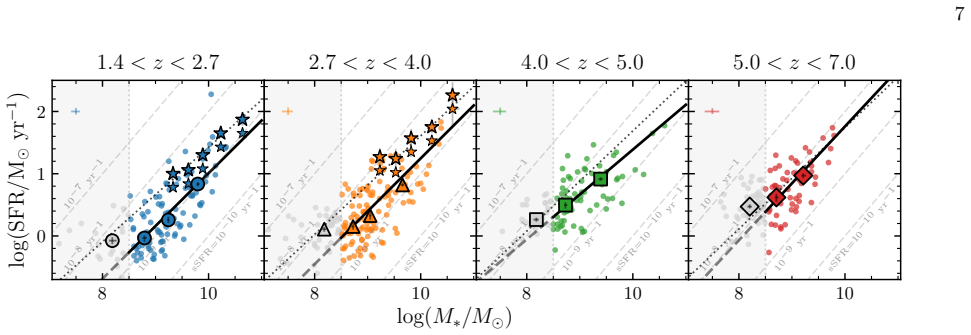
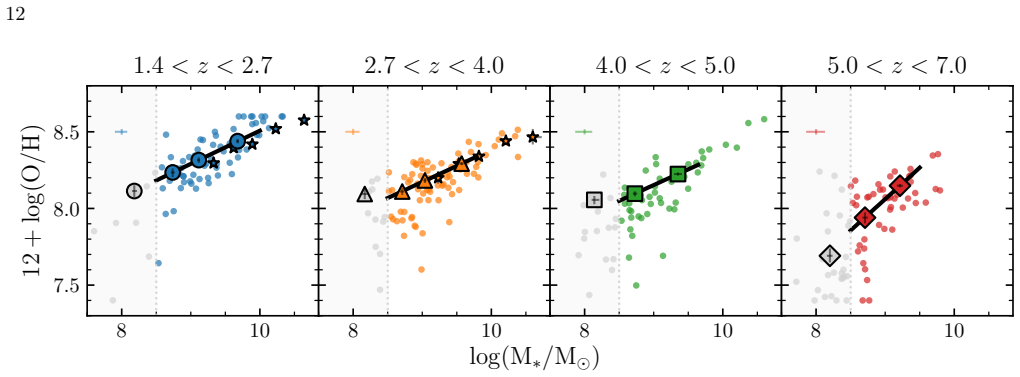
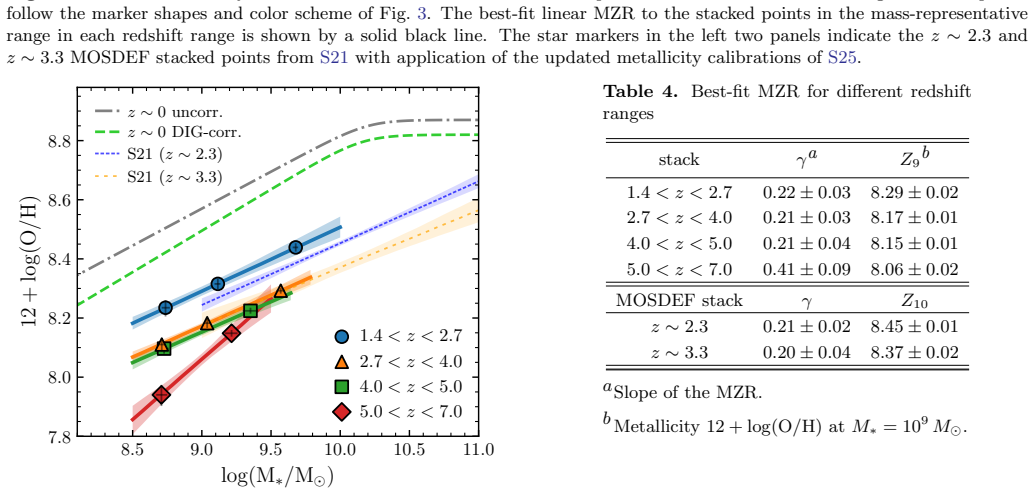
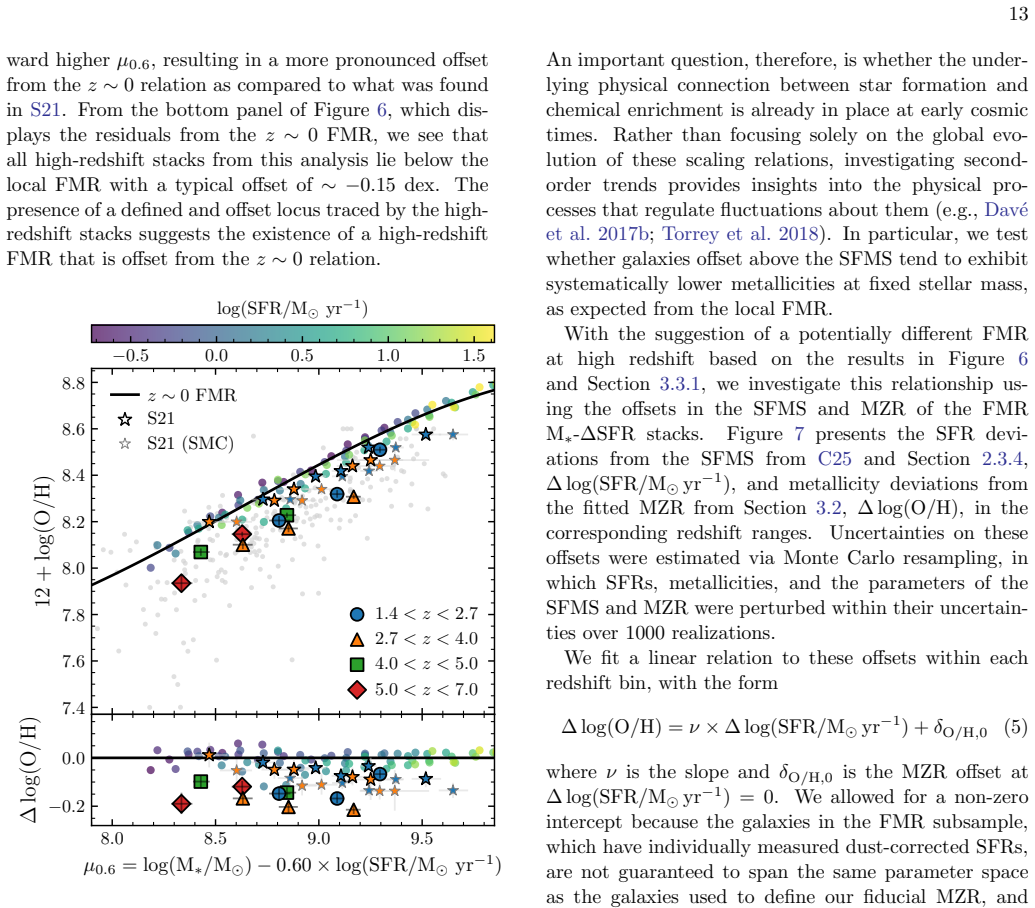
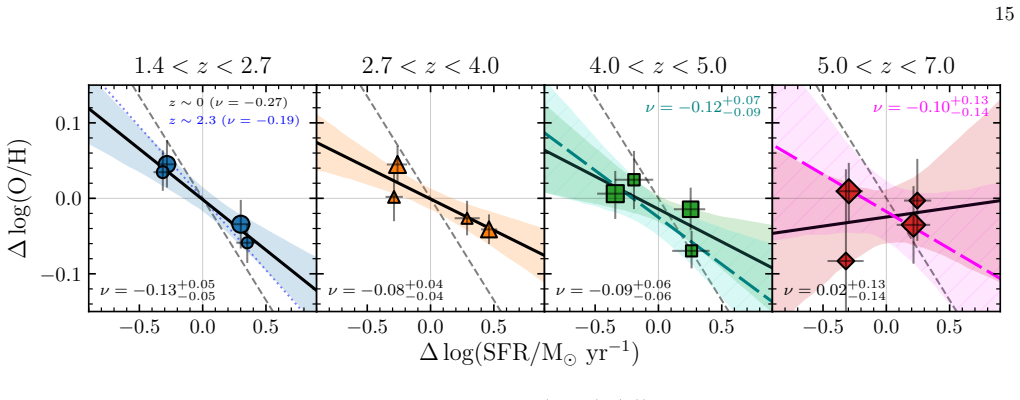
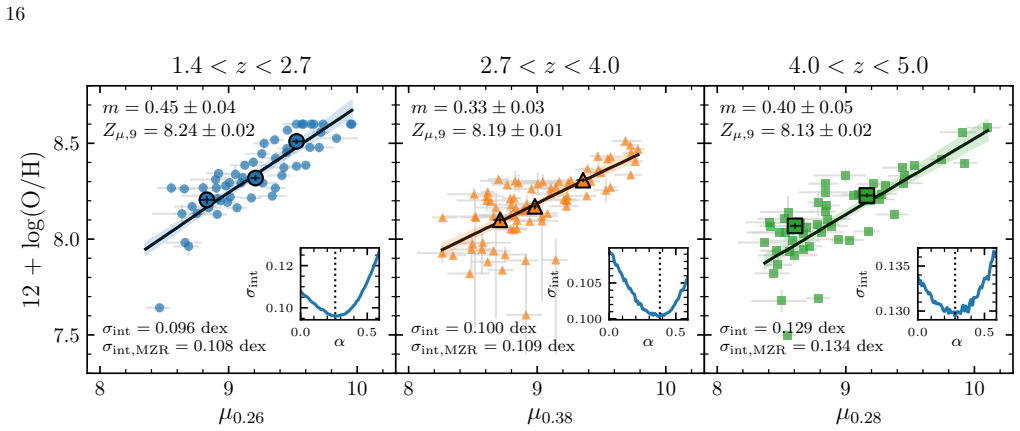
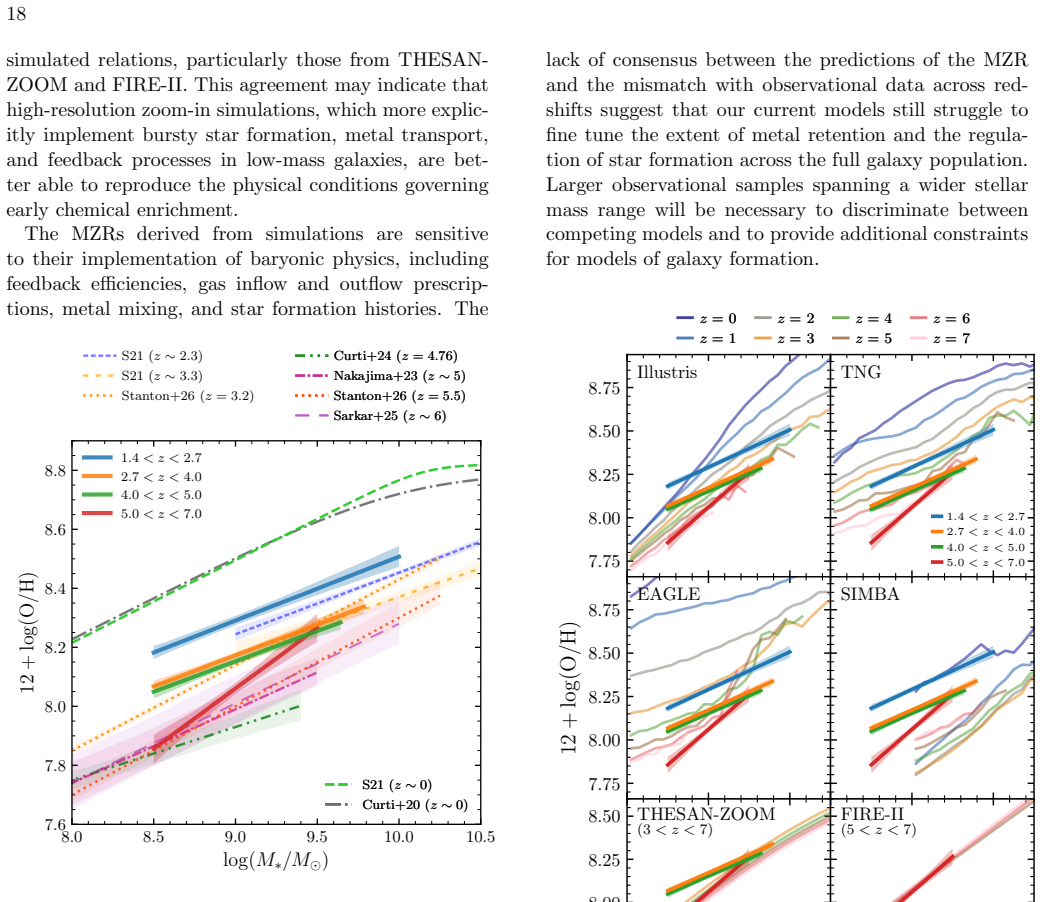
Using composite NIRSpec spectra binned by stellar mass, redshift, and SFMS offset, the mass-metallicity relation shows a slope gamma approximately 0.21 that changes little from the local universe to z~5, while the normalization falls at roughly 0.1 dex per unit redshift out to z~4. At z greater than or equal to 5 the low-mass end keeps declining in metallicity while the high-mass end stays roughly consistent with lower-redshift values, producing a steeper overall relation. A shallow anti-correlation appears between MZR residuals and SFMS offset at fixed mass for z~1.4-5, indicating that an FMR is beginning to take shape.
Load-bearing premise
The new high-redshift strong-line calibrations convert observed emission-line ratios into accurate gas-phase oxygen abundances without large systematic offsets from changed ionization, density, or abundance patterns at z greater than 2.
Editorial extensions
If this is right
- The MZR slope remains approximately 0.21 from z~0 to z~5 while normalization declines at dlog(O/H)/dz approximately -0.1 out to z~4.
- Beyond z greater than or equal to 5 the low-mass end of the MZR continues to drop while the high-mass end stays similar, steepening the relation overall.
- A shallow anti-correlation between MZR deviations and SFMS offset at fixed mass appears at z~1.4-5, weaker than the local FMR but already detectable.
- Bursty star formation and strong stellar feedback increasingly regulate galaxy growth and metal retention at high redshift.
- No single cosmological simulation reproduces the observed slopes and normalizations simultaneously across all redshifts.
Reading between the lines
- The observed decline in normalization may trace higher gas accretion or outflow rates that dilute metals more effectively at earlier times.
- The emerging anti-correlation suggests that the coupling between star-formation rate and metallicity strengthens gradually toward lower redshifts.
- Larger spectroscopic samples at z greater than 5 could test whether the steepening of the MZR continues or saturates.
- Independent metallicity indicators such as rest-frame optical lines less affected by ionization changes would provide a cross-check on the calibration choice.
Signed reviews
Editorial analysis
A structured set of objections, weighed in public.
Referee Report
Summary. The paper measures the mass-metallicity relation (MZR) and fundamental metallicity relation (FMR) at 1.4 < z < 7 using stacked JWST/NIRSpec spectra of 601 JADES star-forming galaxies. Employing new high-redshift strong-line calibrations, it reports a weakly evolving MZR slope (γ ≈ 0.21 ± 0.03) to z ∼ 5, a smooth decline in normalization (d log(O/H)/dz ∼ −0.1 to z ∼ 4), a steeper MZR beyond z ≳ 5, and a shallow anti-correlation between MZR residuals and SFMS offset at z ∼ 1.4–5, interpreted as the early emergence of an FMR. Results are compared to observations and simulations.
Significance. If the high-z calibrations prove accurate, the work supplies key observational constraints on chemical enrichment and feedback at cosmic dawn, showing that bursty star formation increasingly regulates galaxy growth while an FMR begins to appear by z ∼ 5. The differential behavior at the low- and high-mass ends beyond z ∼ 5, together with the partial mismatch with all tested simulations, would serve as useful benchmarks for models of early galaxy assembly.
major comments (2)
- [Abstract, §3] Abstract and §3 (calibration application): the central MZR slopes, normalizations, and FMR claim rest on the new strong-line calibrations mapping line ratios to O/H without large residual systematics from elevated ionization parameters, densities, or abundance patterns at z > 2. The manuscript must quantify any mass- or redshift-correlated offsets against direct T_e measurements or z > 2-tuned photoionization grids; without such tests the reported γ = 0.21 ± 0.03 and d log(O/H)/dz ∼ −0.1 remain vulnerable to calibration bias that propagates through the stacked bins.
- [§4.2, Table 2] §4.2 and Table 2: the steeper high-z MZR is driven by continued decline at the low-mass end while the high-mass end stays flat. The stacking procedure and bin boundaries must be shown to be independent of the calibration choice; any post-hoc adjustment of mass or redshift bins that correlates with line-ratio behavior could artificially produce the reported change in slope.
minor comments (2)
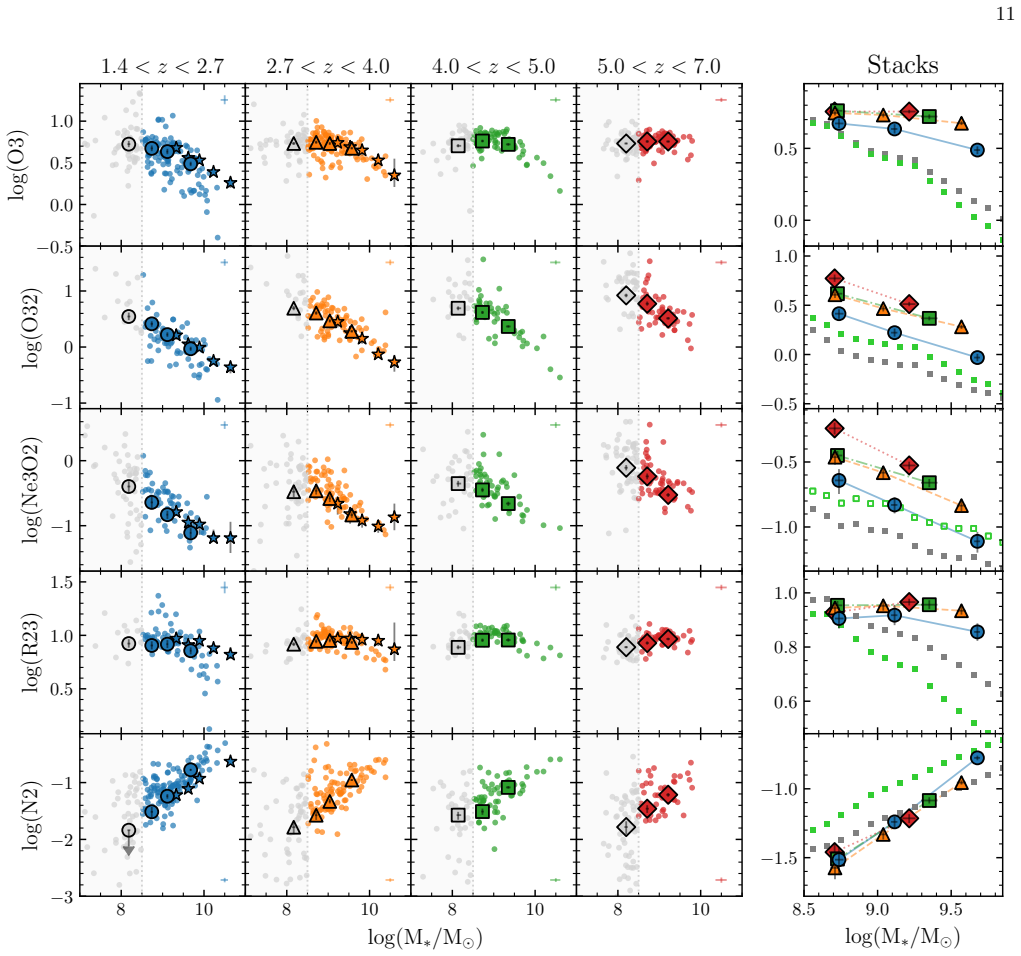
- [Figure 3] Figure 3: axis labels and legend should explicitly state the adopted calibration set and the exact line ratios used in each redshift bin for reproducibility.
- [§2.3] §2.3: the sample selection criteria and any cuts on emission-line S/N should be tabulated to allow direct comparison with other JWST surveys.
Simulated Author's Rebuttal
We thank the referee for their constructive comments on our manuscript. We address each major point below and have revised the text where appropriate to strengthen the presentation of our results.
read point-by-point responses
-
Referee: [Abstract, §3] Abstract and §3 (calibration application): the central MZR slopes, normalizations, and FMR claim rest on the new strong-line calibrations mapping line ratios to O/H without large residual systematics from elevated ionization parameters, densities, or abundance patterns at z > 2. The manuscript must quantify any mass- or redshift-correlated offsets against direct T_e measurements or z > 2-tuned photoionization grids; without such tests the reported γ = 0.21 ± 0.03 and d log(O/H)/dz ∼ −0.1 remain vulnerable to calibration bias that propagates through the stacked bins.
Authors: We agree that explicit quantification of potential systematics is necessary. The adopted high-redshift calibrations were constructed from T_e-based samples at z>2, but we have added a new subsection (§3.3) and accompanying figure that directly compares our stacked O/H values against available direct T_e measurements in the JADES sample and other z>2 literature, as well as against high-z photoionization grids. These tests show mass- and redshift-dependent offsets remain below 0.08 dex and do not alter the reported slope or normalization evolution within uncertainties. The abstract has been updated to reference this validation. revision_made = yes revision: yes
-
Referee: [§4.2, Table 2] §4.2 and Table 2: the steeper high-z MZR is driven by continued decline at the low-mass end while the high-mass end stays flat. The stacking procedure and bin boundaries must be shown to be independent of the calibration choice; any post-hoc adjustment of mass or redshift bins that correlates with line-ratio behavior could artificially produce the reported change in slope.
Authors: The mass and redshift bins were defined a priori in §2.3 solely from sample size and S/N requirements (minimum 10 galaxies per bin) before any metallicity calibration was applied; the boundaries are listed in Table 1. In the revised manuscript we have added an explicit test in §4.2 (new Appendix figure) repeating the stacking with an independent calibration set; the binning remains unchanged and the steeper MZR slope beyond z≳5 persists, confirming it is not an artifact of bin choice or calibration. No post-hoc adjustments were performed. revision_made = partial revision: partial
Circularity Check
No circularity: MZR/FMR derived from independent JWST stacks using external calibrations
full rationale
The derivation chain starts from observed JWST/NIRSpec line ratios in JADES galaxies, applies cited strong-line calibrations (described as up-to-date external inputs based on high-redshift galaxies), and reports measured slopes/normalizations. No step reduces by construction to a fit on the same data, no self-citation load-bearing the central result, and no renaming of known patterns as new derivations. The relations are direct empirical outputs against external benchmarks; the paper is self-contained.
Assumptions & free parameters
assumptions (1)
- domain assumption Strong-line ratios map monotonically to gas-phase metallicity via the adopted high-redshift calibrations across the full mass and redshift range studied.
Cite this review
Pith. "Pith review of The JADES Mass-Metallicity and Fundamental Metallicity Relations at $z\gtrsim2$ Using New High-Redshift Metallicity Calibrations." pith.science (2026). https://pith.science/paper/OS2WRVEJ
@misc{pith2026260530513,
  author       = {Pith},
  title        = {Pith review of: The JADES Mass-Metallicity and Fundamental Metallicity Relations at $z\gtrsim2$ Using New High-Redshift Metallicity Calibrations},
  year         = {2026},
  howpublished = {\url{https://pith.science/paper/OS2WRVEJ}},
  note         = {Machine review of arXiv:2605.30513}
}
abstract
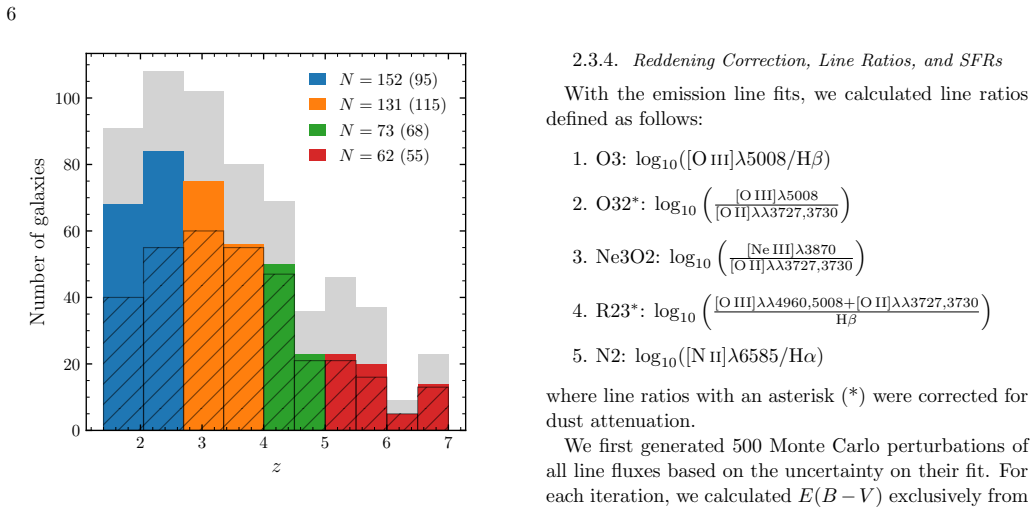
We present measurements of the mass-metallicity relation (MZR) and fundamental metallicity relation (FMR) at $1.4<z<7.0$ using stacked JWST/NIRSpec spectra of 601 star-forming galaxies from the JWST Advanced Deep Extragalactic Survey (JADES). Using the most up-to-date strong-line metallicity calibrations based on high-redshift galaxies, we derive gas-phase metallicities from composite spectra binned by stellar mass, redshift, and star-forming main sequence (SFMS) offset. We find that the MZR slope evolves weakly from $z\sim0$ out to $z\sim5$, with $\gamma\sim0.21\pm0.03$, while the normalization decreases smoothly with redshift at a rate of $d\log(\mathrm{O/H})/dz\sim-0.1$ out to $z\sim4$. Beyond $z\gtrsim5$, the low-mass end continues to decline in metallicity while the high-mass end remains broadly consistent with lower-redshift relations, producing a steeper overall MZR. We additionally find evidence for a shallow anti-correlation between deviations from the MZR and SFMS at fixed stellar mass at $z\sim1.4-5$. This anti-correlation, albeit with weaker SFR coupling than observed locally, suggests that an FMR is already beginning to emerge by $z\sim5$. Comparisons with recent observations and cosmological simulations show broad agreement, though no single simulation simultaneously reproduces the observed slopes and normalizations across all redshifts. Our results support a picture in which bursty star formation and strong stellar feedback increasingly shape the regulation of galaxy growth at high redshift, while also highlighting the need for substantially larger spectroscopic samples to robustly constrain the evolution of galaxy scaling relations at high-redshift.
Figures
Figures from the paper (6 more)
Forward citations
Cited by 2 Pith papers
-
Do we understand the star formation history of the universe?
Star formation rates required by the evolving stellar mass function yield a main sequence that agrees with JWST spectroscopy and theory but differs from prior concordance relations.
-
JADES: the mass-metallicity relation at $z=1-10$. New calibrations, extremely metal-poor galaxies, and chemical diversity
New stack-based strong-line calibrations from ~1500 spectra yield mass-metallicity relations at z=1-10 with decreasing metallicity toward higher redshift and no slope change, plus 50 EMPG candidates at 1-4% solar meta...
Reference graph
Works this paper leans on
-
[1]
Andrews, B. H., & Martini, P. 2013, ApJ, 765, 140, doi: 10.1088/0004-637X/765/2/140
-
[2]
The chemical make-up of the Sun: A 2020 vision
Asplund, M., Amarsi, A. M., & Grevesse, N. 2021, A&A, 653, A141, doi: 10.1051/0004-6361/202140445
-
[3]
Bian, F., Kewley, L. J., & Dopita, M. A. 2018, ApJ, 859, 175, doi: 10.3847/1538-4357/aabd74
-
[4]
Bunker, A. J., Cameron, A. J., Curtis-Lake, E., et al. 2024, A&A, 690, A288, doi: 10.1051/0004-6361/202347094
-
[5]
Byler, N., Dalcanton, J. J., Conroy, C., & Johnson, B. D. 2017, ApJ, 840, 44, doi: 10.3847/1538-4357/aa6c66
-
[6]
The Dust Content and Opacity of Actively Star-Forming Galaxies
Calzetti, D., Armus, L., Bohlin, R. C., et al. 2000, ApJ, 533, 682, doi: 10.1086/308692
-
[7]
Cardelli, J. A., Clayton, G. C., & Mathis, J. S. 1989, ApJ, 345, 245, doi: 10.1086/167900
-
[8]
Carnall, A. C. 2017, arXiv e-prints, arXiv:1705.05165, doi: 10.48550/arXiv.1705.05165
work page Pith review arXiv doi:10.48550/arxiv.1705.05165 2017
Show all 99 references
-
[9]
2003, PASP, 115, 763, doi: 10.1086/376392
Chabrier, G. 2003, PASP, 115, 763, doi: 10.1086/376392
2003 doi
-
[10]
2025, ApJ, 985, 24, doi: 10.3847/1538-4357/adc7b5
Chakraborty, P., Sarkar, A., Smith, R., et al. 2025, ApJ, 985, 24, doi: 10.3847/1538-4357/adc7b5
2025 doi
-
[11]
2024, ApJL, 976, L15, doi: 10.3847/2041-8213/ad8dc9
Chemerynska, I., Atek, H., Dayal, P., et al. 2024, ApJL, 976, L15, doi: 10.3847/2041-8213/ad8dc9
2024 doi
-
[12]
2016, ApJ, 823, 102, doi: 10.3847/0004-637X/823/2/102
Choi, J., Dotter, A., Conroy, C., et al. 2016, ApJ, 823, 102, doi: 10.3847/0004-637X/823/2/102
2016 doi
-
[13]
E., et al
Clarke, L., Lam, N., Shapley, A. E., et al. 2026, ApJL, 1002, L15, doi: 10.3847/2041-8213/ae57a6
2026 doi
-
[14]
E., Lam, N., et al
Clarke, L., Shapley, A. E., Lam, N., et al. 2025, arXiv e-prints, arXiv:2510.06681, doi: 10.48550/arXiv.2510.06681
2025 doi
-
[15]
W., Papovich, C., Finkelstein, S
Cole, J. W., Papovich, C., Finkelstein, S. L., et al. 2025, ApJ, 979, 193, doi: 10.3847/1538-4357/ad9a6a
2025 doi
-
[16]
Conroy, C., & Gunn, J. E. 2010, ApJ, 712, 833, doi: 10.1088/0004-637X/712/2/833 22
2010 doi
-
[17]
E., & White, M
Conroy, C., Gunn, J. E., & White, M. 2009, ApJ, 699, 486, doi: 10.1088/0004-637X/699/1/486
2009 doi
-
[18]
2017, MNRAS, 465, 1384, doi: 10.1093/mnras/stw2766
Curti, M., Cresci, G., Mannucci, F., et al. 2017, MNRAS, 465, 1384, doi: 10.1093/mnras/stw2766
2017 doi
-
[19]
2020, MNRAS, 491, 944, doi: 10.1093/mnras/stz2910
Curti, M., Mannucci, F., Cresci, G., & Maiolino, R. 2020, MNRAS, 491, 944, doi: 10.1093/mnras/stz2910
2020 doi
-
[20]
2024, A&A, 684, A75, doi: 10.1051/0004-6361/202346698 Dav´ e, R., Angl´ es-Alc´ azar, D., Narayanan, D., et al
Curti, M., Maiolino, R., Curtis-Lake, E., et al. 2024, A&A, 684, A75, doi: 10.1051/0004-6361/202346698 Dav´ e, R., Angl´ es-Alc´ azar, D., Narayanan, D., et al. 2019, MNRAS, 486, 2827, doi: 10.1093/mnras/stz937 Dav´ e, R., Finlator, K., & Oppenheimer, B. D. 2012, MNRAS, 421, 9...
2024 doi
-
[21]
Hopkins, P. F. 2017a, MNRAS, 467, 115, doi: 10.1093/mnras/stx108 —. 2017b, MNRAS, 467, 115, doi: 10.1093/mnras/stx108 de Graaff, A., Brammer, G., Weibel, A., et al. 2025, A&A, 697, A189, doi: 10.1051/0004-6361/202452186 D’Eugenio, F., Cameron, A. J., Scholtz, J., et al. 2025, ...
2025 doi
-
[22]
A., Kewley, L
Dopita, M. A., Kewley, L. J., Sutherland, R. S., & Nicholls, D. C. 2016, Ap&SS, 361, 61, doi: 10.1007/s10509-016-2657-8
2016 doi
- [23]
-
[24]
J., Johnson, B
Eisenstein, D. J., Johnson, B. D., Robertson, B., et al. 2023b, arXiv e-prints, arXiv:2310.12340, doi: 10.48550/arXiv.2310.12340 Faucher-Gigu` ere, C.-A. 2018, MNRAS, 473, 3717, doi: 10.1093/mnras/stx2595
2018 doi
- [25]
-
[26]
M., Torrey, P., Ellison, S., et al
Garcia, A. M., Torrey, P., Ellison, S., et al. 2024, MNRAS, 531, 1398, doi: 10.1093/mnras/stae1252
2024 doi
-
[27]
M., Torrey, P., Ellison, S
Garcia, A. M., Torrey, P., Ellison, S. L., et al. 2025, MNRAS, 536, 119, doi: 10.1093/mnras/stae2587
2025 doi
-
[28]
D., Clayton, G
Gordon, K. D., Clayton, G. C., Misselt, K. A., Landolt, A. U., & Wolff, M. J. 2003, ApJ, 594, 279, doi: 10.1086/376774
2003 doi
-
[29]
C., Johnson, B
Hao, C.-N., Kennicutt, R. C., Johnson, B. D., et al. 2011, ApJ, 741, 124, doi: 10.1088/0004-637X/741/2/124
2011 doi
-
[30]
C., & Hopkins, P
Hayward, C. C., & Hopkins, P. F. 2017, MNRAS, 465, 1682, doi: 10.1093/mnras/stw2888
2017 doi
-
[31]
2024, ApJL, 960, L13, doi: 10.3847/2041-8213/ad12cd
He, X., Wang, X., Jones, T., et al. 2024, ApJL, 960, L13, doi: 10.3847/2041-8213/ad12cd
2024 doi
-
[32]
E., Brammer, G
Heintz, K. E., Brammer, G. B., Watson, D., et al. 2025, A&A, 693, A60, doi: 10.1051/0004-6361/202450243
2025 doi
-
[33]
Y.-Y., Chisholm, J., Berg, D
Hsiao, T. Y.-Y., Chisholm, J., Berg, D. A., et al. 2026, arXiv e-prints, arXiv:2605.06770. https://arxiv.org/abs/2605.06770
2026 arXiv
-
[34]
D., Magee, D., Oesch, P
Illingworth, G. D., Magee, D., Oesch, P. A., et al. 2013, ApJS, 209, 6, doi: 10.1088/0067-0049/209/1/6
2013 doi
-
[35]
Thuan, T. X. 2006, A&A, 448, 955, doi: 10.1051/0004-6361:20053763
2006 doi
-
[36]
D., Leja, J., Conroy, C., & Speagle, J
Johnson, B. D., Leja, J., Conroy, C., & Speagle, J. S. 2021, ApJS, 254, 22, doi: 10.3847/1538-4365/abef67
2021 doi
-
[37]
E., et al
Karthikeyan, S., Clarke, L., Shapley, A. E., et al. 2026, arXiv e-prints, arXiv:2603.11338, doi: 10.48550/arXiv.2603.11338
2026 doi
-
[38]
Kelly, B. C. 2007, ApJ, 665, 1489, doi: 10.1086/519947
2007 doi
- [39]
-
[40]
J., Nicholls, D
Kewley, L. J., Nicholls, D. C., & Sutherland, R. S. 2019, ARA&A, 57, 511, doi: 10.1146/annurev-astro-081817-051832
2019 doi
-
[41]
A., Sanders, R
Khostovan, A. A., Sanders, R. L., Shapley, A. E., et al. 2025, arXiv e-prints, arXiv:2512.16989, doi: 10.48550/arXiv.2512.16989 Korhonen Cuestas, N. A., Strom, A. L., Miller, T. B., et al. 2025, ApJ, 984, 188, doi: 10.3847/1538-4357/adc5f7
2025 doi
-
[42]
2026, A&A, 706, A165, doi: 10.1051/0004-6361/202556597
Kotiwale, G., Matthee, J., Kashino, D., et al. 2026, A&A, 706, A165, doi: 10.1051/0004-6361/202556597
2026 doi
-
[43]
H., Maseda, M
Laseter, I. H., Maseda, M. V., Bunker, A. J., et al. 2025, arXiv e-prints, arXiv:2510.15024, doi: 10.48550/arXiv.2510.15024
2025 doi
-
[44]
Speagle, J. S. 2019, ApJ, 876, 3, doi: 10.3847/1538-4357/ab133c
2019 doi
-
[45]
1979, A&A, 80, 155
Torres-Peimbert, S. 1979, A&A, 80, 155
1979
-
[46]
V., de Graaff, A., et al
Lewis, Z., Maseda, M. V., de Graaff, A., et al. 2025, arXiv e-prints, arXiv:2512.03134, doi: 10.48550/arXiv.2512.03134
2025 doi
-
[47]
2023, ApJL, 955, L18, doi: 10.3847/2041-8213/acf470
Li, M., Cai, Z., Bian, F., et al. 2023, ApJL, 955, L18, doi: 10.3847/2041-8213/acf470
2023 doi
-
[48]
2025, A&A, 703, A106, doi: 10.1051/0004-6361/202555372
Li, Z., Kakiichi, K., Christensen, L., et al. 2025, A&A, 703, A106, doi: 10.1051/0004-6361/202555372
2025 doi
-
[49]
Luridiana, V., Morisset, C., & Shaw, R. A. 2015, A&A, 573, A42, doi: 10.1051/0004-6361/201323152
2015 doi
-
[50]
2010, MNRAS, 408, 2115, doi: 10.1111/j.1365-2966.2010.17291.x
Gnerucci, A. 2010, MNRAS, 408, 2115, doi: 10.1111/j.1365-2966.2010.17291.x
2010 doi
-
[51]
C., & Feldmann, R
Marszewski, A., Sun, G., Faucher-Gigu` ere, C.-A., Hayward, C. C., & Feldmann, R. 2024, ApJL, 967, L41, doi: 10.3847/2041-8213/ad4cee 23
2024 doi
-
[52]
2014, ApJ, 785, 153, doi: 10.1088/0004-637X/785/2/153
Masters, D., McCarthy, P., Siana, B., et al. 2014, ApJ, 785, 153, doi: 10.1088/0004-637X/785/2/153
2014 doi
-
[53]
2026, MNRAS, 548, stag016, doi: 10.1093/mnras/stag016
McClymont, W., Tacchella, S., Smith, A., et al. 2026, MNRAS, 548, stag016, doi: 10.1093/mnras/stag016
2026 doi
-
[54]
2023, ApJS, 269, 33, doi: 10.3847/1538-4365/acd556
Nakajima, K., Ouchi, M., Isobe, Y., et al. 2023, ApJS, 269, 33, doi: 10.3847/1538-4365/acd556
2023 doi
-
[55]
2022, ApJS, 262, 3, doi: 10.3847/1538-4365/ac7710
Nakajima, K., Ouchi, M., Xu, Y., et al. 2022, ApJS, 262, 3, doi: 10.3847/1538-4365/ac7710
2022 doi
-
[56]
2019, Computational Astrophysics and Cosmology, 6, 2, doi: 10.1186/s40668-019-0028-x
Nelson, D., Springel, V., Pillepich, A., et al. 2019, Computational Astrophysics and Cosmology, 6, 2, doi: 10.1186/s40668-019-0028-x
2019 doi
-
[57]
2025, arXiv e-prints, arXiv:2512.12983, doi: 10.48550/arXiv.2512.12983
Nishigaki, M., Nakajima, K., Ouchi, M., et al. 2025, arXiv e-prints, arXiv:2512.12983, doi: 10.48550/arXiv.2512.12983
2025 doi
-
[58]
2023, The JWST FRESCO Survey, STScI/MAST, doi: 10.17909/GDYC-7G80
Oesch, P., & Magee, D. 2023, The JWST FRESCO Survey, STScI/MAST, doi: 10.17909/GDYC-7G80
2023 doi
-
[59]
A., Brammer, G., Naidu, R
Oesch, P. A., Brammer, G., Naidu, R. P., et al. 2023, MNRAS, 525, 2864, doi: 10.1093/mnras/stad2411
2023 doi
-
[60]
E., & Ferland, G
Osterbrock, D. E., & Ferland, G. J. 2006, Astrophysics of gaseous nebulae and active galactic nuclei
2006
-
[61]
2025, A&A, 699, A6, doi: 10.1051/0004-6361/202451742
Pallottini, A., Ferrara, A., Gallerani, S., et al. 2025, A&A, 699, A6, doi: 10.1051/0004-6361/202451742
2025 doi
-
[62]
1967, ApJ, 150, 825, doi: 10.1086/149385
Peimbert, M. 1967, ApJ, 150, 825, doi: 10.1086/149385
1967 doi
-
[63]
2014, MNRAS, 443, 3643, doi: 10.1093/mnras/stu1288 P´ erez-Montero, E
Peng, Y.-j., & Maiolino, R. 2014, MNRAS, 443, 3643, doi: 10.1093/mnras/stu1288 P´ erez-Montero, E. 2017, PASP, 129, 043001, doi: 10.1088/1538-3873/aa5abb
2014 doi
-
[64]
N., Taylor, A
Perry, M. N., Taylor, A. J., Ch´ avez Ortiz,´O. A., et al. 2025, ApJ, 994, 14, doi: 10.3847/1538-4357/ae102f
2025 doi
-
[65]
Pettini, M., & Pagel, B. E. J. 2004, MNRAS, 348, L59, doi: 10.1111/j.1365-2966.2004.07591.x
2004 doi
-
[66]
L., Gottumukkala, R., Heintz, K
Pollock, C. L., Gottumukkala, R., Heintz, K. E., et al. 2026, A&A, 708, A203, doi: 10.1051/0004-6361/202556032
2026 doi
-
[67]
A., Topping, M
Reddy, N. A., Topping, M. W., Shapley, A. E., et al. 2022, ApJ, 926, 31, doi: 10.3847/1538-4357/ac3b4c
2022 doi
-
[68]
2023a, Data from the JWST Advanced Deep Extragalactic Survey (JADES), STScI/MAST, doi: 10.17909/8TDJ-8N28
Rieke, M., Robertson, B., Tacchella, S., et al. 2023a, Data from the JWST Advanced Deep Extragalactic Survey (JADES), STScI/MAST, doi: 10.17909/8TDJ-8N28
-
[69]
J., Robertson, B., Tacchella, S., et al
Rieke, M. J., Robertson, B., Tacchella, S., et al. 2023b, ApJS, 269, 16, doi: 10.3847/1538-4365/acf44d
-
[70]
D., Tacchella, S., et al
Robertson, B., Johnson, B. D., Tacchella, S., et al. 2024, ApJ, 970, 31, doi: 10.3847/1538-4357/ad463d
2024 doi
-
[71]
N., Shapley, A
Runco, J. N., Shapley, A. E., Sanders, R. L., et al. 2021a, MNRAS, 502, 2600, doi: 10.1093/mnras/stab119 —. 2021b, MNRAS, 502, 2600, doi: 10.1093/mnras/stab119 S´ anchez-Bl´ azquez, P., Peletier, R. F., Jim´ enez-Vicente, J., et al. 2006, MNRAS, 371, 703, doi: 10.1111/j.1365-2...
2006 doi
-
[72]
L., Shapley, A
Sanders, R. L., Shapley, A. E., Kriek, M., et al. 2018, ApJ, 858, 99, doi: 10.3847/1538-4357/aabcbd
2018 doi
-
[73]
L., Shapley, A
Sanders, R. L., Shapley, A. E., Reddy, N. A., et al. 2020, MNRAS, 491, 1427, doi: 10.1093/mnras/stz3032
2020 doi
-
[74]
L., Shapley, A
Sanders, R. L., Shapley, A. E., Jones, T., et al. 2021, ApJ, 914, 19, doi: 10.3847/1538-4357/abf4c1
2021 doi
- [75]
-
[76]
2025, ApJ, 978, 136, doi: 10.3847/1538-4357/ad8f32
Sarkar, A., Chakraborty, P., Vogelsberger, M., et al. 2025, ApJ, 978, 136, doi: 10.3847/1538-4357/ad8f32
2025 doi
-
[77]
A., Bower, R
Schaye, J., Crain, R. A., Bower, R. G., et al. 2015, MNRAS, 446, 521, doi: 10.1093/mnras/stu2058
2015 doi
-
[78]
E., Reddy, N
Shapley, A. E., Reddy, N. A., Kriek, M., et al. 2015, ApJ, 801, 88, doi: 10.1088/0004-637X/801/2/88
2015 doi
-
[79]
2024, MNRAS, 535, 2998, doi: 10.1093/mnras/stae2537
Simmonds, C., Tacchella, S., Hainline, K., et al. 2024, MNRAS, 535, 2998, doi: 10.1093/mnras/stae2537
2024 doi
-
[80]
2025, MNRAS, 544, 4551, doi: 10.1093/mnras/staf1950
Simmonds, C., Tacchella, S., McClymont, W., et al. 2025, MNRAS, 544, 4551, doi: 10.1093/mnras/staf1950
2025 doi
-
[81]
S., & Dav´ e, R
Somerville, R. S., & Dav´ e, R. 2015, ARA&A, 53, 51, doi: 10.1146/annurev-astro-082812-140951
2015 doi
-
[82]
C., Feldmann, R., et al
Sparre, M., Hayward, C. C., Feldmann, R., et al. 2017, MNRAS, 466, 88, doi: 10.1093/mnras/stw3011
2017 doi
-
[83]
Silverman, J. D. 2014, ApJS, 214, 15, doi: 10.1088/0067-0049/214/2/15
2014 doi
-
[84]
M., Cullen, F., Carnall, A
Stanton, T. M., Cullen, F., Carnall, A. C., et al. 2026, MNRAS, 547, stag449, doi: 10.1093/mnras/stag449
2026 doi
-
[85]
C., Rudie, G
Steidel, C. C., Rudie, G. C., Strom, A. L., et al. 2014a, ApJ, 795, 165, doi: 10.1088/0004-637X/795/2/165 —. 2014b, ApJ, 795, 165, doi: 10.1088/0004-637X/795/2/165
-
[86]
L., Steidel, C
Strom, A. L., Steidel, C. C., Rudie, G. C., et al. 2017, ApJ, 836, 164, doi: 10.3847/1538-4357/836/2/164
2017 doi
-
[87]
C., & Caplar, N
Tacchella, S., Forbes, J. C., & Caplar, N. 2020, MNRAS, 497, 698, doi: 10.1093/mnras/staa1838
2020 doi
-
[88]
J., Genzel, R., & Sternberg, A
Tacconi, L. J., Genzel, R., & Sternberg, A. 2020, ARA&A, 58, 157, doi: 10.1146/annurev-astro-082812-141034
2020 doi
-
[89]
W., Shapley, A
Topping, M. W., Shapley, A. E., Reddy, N. A., et al. 2020a, MNRAS, 495, 4430, doi: 10.1093/mnras/staa1410 —. 2020b, MNRAS, 499, 1652, doi: 10.1093/mnras/staa2941
-
[90]
W., Shapley, A
Topping, M. W., Shapley, A. E., Sanders, R. L., et al. 2021, MNRAS, 506, 1237, doi: 10.1093/mnras/stab1793
2021 doi
-
[91]
W., Sanders, R
Topping, M. W., Sanders, R. L., Shapley, A. E., et al. 2025, MNRAS, 541, 1707, doi: 10.1093/mnras/staf903
2025 doi
-
[92]
2018, MNRAS, 477, L16, doi: 10.1093/mnrasl/sly031
Torrey, P., Vogelsberger, M., Hernquist, L., et al. 2018, MNRAS, 477, L16, doi: 10.1093/mnrasl/sly031
2018 doi
-
[93]
A., Heckman, T
Tremonti, C. A., Heckman, T. M., Kauffmann, G., et al. 2004, ApJ, 613, 898, doi: 10.1086/423264 24
2004 doi
-
[94]
S., & Werk, J
Tumlinson, J., Peeples, M. S., & Werk, J. K. 2017, ARA&A, 55, 389, doi: 10.1146/annurev-astro-091916-055240
2017 doi
-
[95]
2013, MNRAS, 436, 3031, doi: 10.1093/mnras/stt1789
Vogelsberger, M., Genel, S., Sijacki, D., et al. 2013, MNRAS, 436, 3031, doi: 10.1093/mnras/stt1789
2013 doi
-
[96]
E., Ashas, M., Illingworth, G., et al
Whitaker, K. E., Ashas, M., Illingworth, G., et al. 2019, ApJS, 244, 16, doi: 10.3847/1538-4365/ab3853
2019 doi
-
[97]
2023a, Data from the JWST Extragalactic Medium-band Survey (JEMS), STScI/MAST, doi: 10.17909/FSC4-DT61
Williams, C., Tacchella, S., & Maseda, M. 2023a, Data from the JWST Extragalactic Medium-band Survey (JEMS), STScI/MAST, doi: 10.17909/FSC4-DT61
-
[98]
C., Tacchella, S., Maseda, M
Williams, C. C., Tacchella, S., Maseda, M. V., et al. 2023b, ApJS, 268, 64, doi: 10.3847/1538-4365/acf130
-
[99]
J., Kashino, D., Silverman, J
Zahid, H. J., Kashino, D., Silverman, J. D., et al. 2014, ApJ, 792, 75, doi: 10.1088/0004-637X/792/1/75
2014 doi
Reviewed June 29, 2026 · model on record in the stance chip above.
Discussion (0). Continue with ORCID to comment.