REVIEW 3 major objections 6 minor 25 references
Performance of an HRPPD in Tesla-scale magnetic fields
T0 review · 3 major / 6 minor · reviewed 2026-08-12 · deepseek-v4-flash
Pith's one-line read A microchannel-plate photodetector built for the ePIC experiment sustains gain above 10^6 in magnetic fields up to 1.8 T across inclination angles of ±35°, with the recovery achieved by raising MCP bias voltages by a few tens of volts.
desk verdict Solid detector R&D with an overreach in the abstract's efficiency claim; the gain, afterpulsing, and dark-count data are trustworthy but the single-photon detection efficiency recovery is not directly demonstrated. read the letter →
The pith
A machine-rendered reading of the paper's core claim, the machinery that carries it, and where it could break.
The reading
What carries the argument
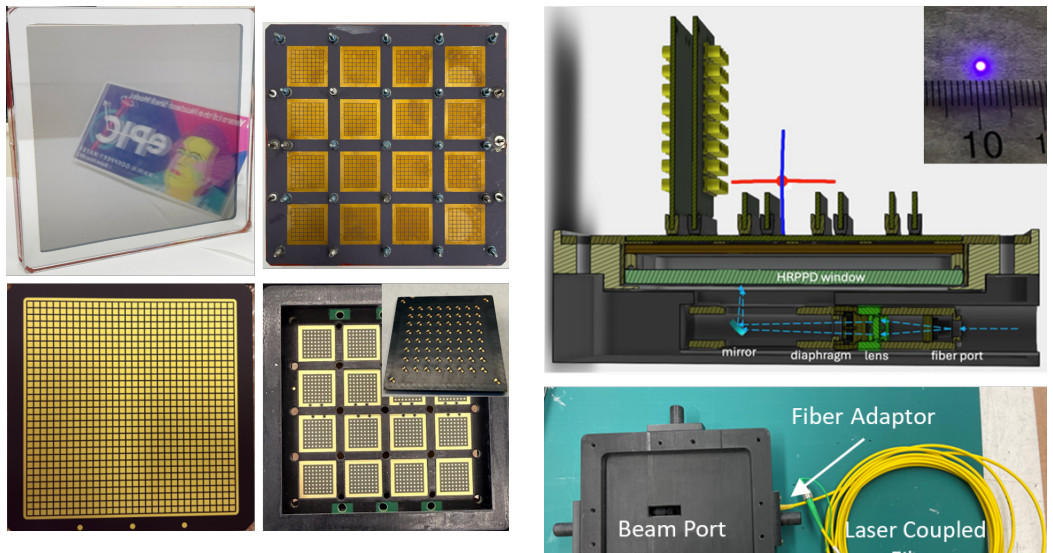
The central object is the EIC-HRPPD, a microchannel-plate photodetector with 10 µm pores, narrow transfer gaps, a chevron MCP stack tilted at 13°, and a DC-coupled pixelated ceramic readout. The mechanism under study is the interplay between the magnetic field and electron transport: field-induced helical gyration, E×B drift, and reduced striking angles suppress gain and yield, with a sharp gain dip when the field aligns with the MCP capillaries. The compensating mechanism is a modest increase in the bias voltage across each MCP, which restores the avalanche multiplication and is identified as the tuning knob that defines a stable operating point at each field and inclination.
What would settle it
Measure absolute single-photon detection efficiency at 1.5 T and 15° inclination on a second tile from the same batch with a calibrated photon source; if the efficiency drops while the yield stays flat, or if the second tile's gain curve differs sharply, the recovery claim is falsified.
Extended reading notes
Core claim
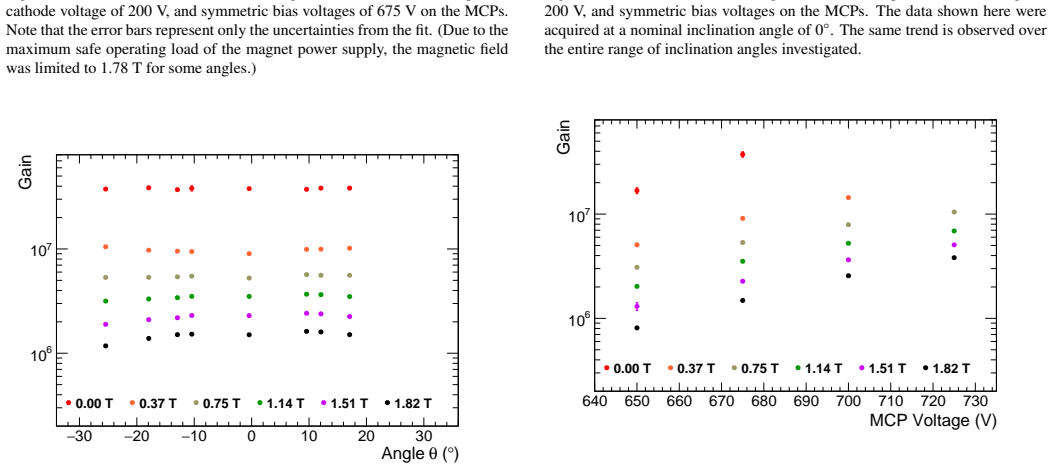
The paper's central claim is that the EIC-HRPPD, an Incom 10-µm-pore microchannel-plate photodetector with a chevron MCP stack tilted at 13°, can be operated at gain above $10^{6}$ in uniform magnetic fields up to 1.8 T over inclination angles from about –35° to +35°, including the ≤15° envelope required for the ePIC pfRICH. It reports that raising the MCP bias voltages by a few tens of volts (nominally 675 V per MCP to 700–725 V) recovers both the gain and the detected signal yield that the field otherwise suppresses. The abstract phrases this as recovery of single-photon detection efficiency; the body quantifies it through signal yield, the number of pulses above threshold at fixed laser intensity. A pronounced gain minimum appears when the field aligns with the first MCP's capillaries near 13°; rotation about the perpendicular axis shows no such dip. At the nominal 675 V operating point in 1.3 T the afterpulsing rate is (1.34 ± 0.15)%, dominated by H+ ions from the first MCP, and the dark-count rate is 24 Hz/cm2. Measured timing resolution is about 49 ps, limited by laser and trigger jitter, from which the paper infers an intrinsic resolution better than 40 ps under ePIC conditions.
Load-bearing premise
The claim that single-photon detection efficiency is recovered rests on signal yield above a 2–4 mV threshold, and the test uses one randomly selected tile assumed to represent the seven-tile production batch.
Editorial extensions
If this is right
- The ePIC pfRICH can operate the EIC-HRPPD at its nominal 675 V-per-MCP setting in 1.5 T fields up to ±15° inclination, with margin to 1.8 T and ±35°.
- A single voltage adjustment of roughly 25–50 V per MCP is sufficient to restore gain and yield across the full tested field and angle range.
- Sensor orientation matters: keeping the magnetic field away from the 13° capillary-alignment direction avoids the gain dip, and rotation about the capillary axis is the sensitive one.
- The measured timing resolution of about 49 ps is dominated by laser and trigger jitter, so the intrinsic resolution is expected to be better than 40 ps once those contributions are removed.
Reading between the lines
- Although the paper does not present an absolute single-photon detection efficiency measurement, its yield-based argument implies that a calibrated PDE measurement at 1.5 T and 15° would directly test the recovery claim; this is a natural next step.
- Because only one randomly selected tile was used, the operating point found here should be checked against at least one more tile from the same seven-tile batch before relying on it for the full system.
- The 13° gain dip tied to capillary alignment suggests that in the final pfRICH integration the sensor orientation relative to the solenoid axis will matter at the level of a few degrees, and could even serve as an in-situ alignment diagnostic.
- The saturation seen in the second MCP implies that rate capability at high field and inclination may be reduced; a rate scan at 1.8 T and 20–30° would quantify the practical high-rate limit.
Signed reviews
Editorial analysis
A structured set of objections, weighed in public.
Referee Report
Summary. The manuscript reports a systematic characterization of a single EIC-HRPPD microchannel-plate photodetector in uniform magnetic fields up to 1.8 T, with the tile oriented at inclination angles up to ±35° about two axes. The authors measure gain spectra from digitized single-photoelectron pulses, signal yield above a 2–4 mV threshold, afterpulsing rates at 1.3 T, dark-count rates versus field and bias, timing resolution from digitizer and oscilloscope data, and rate-saturation behavior. They identify a gain minimum when the field aligns with the 13° MCP pore tilt, show that increasing MCP bias by a few tens of volts restores gain above 10^6, and attribute afterpulses to H+ ions from the first MCP. The paper concludes that the tile achieves gain exceeding 10^6 up to 1.8 T over most angles, with afterpulsing of 1.34% and dark-count rate of 24 Hz/cm^2, and that intrinsic timing resolution is expected to be better than 40 ps under ePIC conditions.
Significance. If the gain, rate, and timing results hold, this is a valuable validation for the ePIC pfRICH photosensor baseline and provides detailed guidance on operating voltages in magnetic fields. The angle-resolved gain scans, the identification of the first-MCP origin of afterpulses, and the cross-checked dark-count measurements are useful contributions. The paper is honest about several limitations (dark-count spatial non-uniformity, laser jitter, small beam spot), and the raw observables are reported directly. However, the abstract's claim that single-photon detection efficiency was recovered over inclination angles up to ±35° is not supported by the yield data presented, which are limited to 0° inclination; this weakens the paper's central claim as currently written.
major comments (3)
- [Sec. 3.2 / Abstract] The abstract states that 'the gain and single photon detection efficiency of the HRRPD could be recovered over a range of polar inclination angles up to ±35°,' but the only efficiency-related observable, signal yield above threshold, is reported in Fig. 11 as a function of magnetic field at 0° only. Figures 7 and 8 show gain versus inclination angle, not detection efficiency; yield is a convolution of quantum efficiency, photoelectron collection, MCP gain, and threshold, and the threshold itself varies between 2 and 4 mV across datasets. Since the pfRICH application requires operation at ±15°, the angle dependence of collection efficiency is exactly what needs to be demonstrated. Please either provide yield-versus-angle data at fixed threshold and intensity, or revise the abstract and conclusions to claim recovery of gain only and defer the detection-efficiency claim to the absolute PDE study in ref. [2].
- [Sec. 3.5 / Sec. 5] The conclusion that the intrinsic timing resolution is 'expected to be better than 40 ps' is an extrapolation, not a measurement: the measured σ in Fig. 15 is about 48.8 ps, and the text states that the PiLas laser contributes about 35 ps and the trigger about 12 ps. The paper does not show the quadrature subtraction, the associated uncertainty, or the field and angle conditions under which the <40 ps expectation applies. If this claim is retained, present the calculation explicitly and state the conditions under which it holds.
- [Sec. 2.1 / Sec. 5] The paper states in Sec. 2.1 that the tile was 'randomly selected from a test batch of seven HRPPDs produced for EIC collaboration in 2024,' but no batch-to-batch variation study is presented, and the conclusions do not qualify the results as single-tile. Since the title and conclusions generalize to the EIC-HRPPD as a detector type, a caveat that these results are from a single tile, or a short argument for why the tile is representative, is needed to support that generalization.
minor comments (6)
- [Abstract] There is a typo in the abstract: 'HRRPD' should be 'HRPPD'.
- [Fig. 11] The y-axis label 'Yields' would be clearer as 'Number of signals above threshold' or 'Yield [arb. units]', and the caption should state the fixed laser intensity and threshold used for all curves.
- [Sec. 3.3 / Sec. 5] The afterpulsing rate of 1.34% is measured at 1.3 T and 0° only; the conclusion quotes this number without those conditions. Please state the conditions in the conclusion or add a qualifier.
- [Sec. 3.4 / Sec. 5] The dark-count rate quoted in the conclusions, 24 Hz/cm^2, should specify the magnetic field and HV at which it was obtained, since Fig. 14 shows a range from about 0 to 60 Hz/cm^2 depending on field and bias.
- [Fig. 9 caption] The caption claims 'The same trend is observed over the entire range of inclination angles investigated,' but no yield-versus-angle data are shown; either provide such data or soften the claim.
- [Sec. 4.3] The two-effect explanation for the timing-resolution peak at low field is speculative, as the authors acknowledge; this is acceptable, but the paragraph could note that the measured timing resolution includes the laser and trigger jitter, so the interpretation applies to the combined system rather than the HRPPD alone.
Circularity Check
No circular derivation: all central claims are direct measurements against external apparatus.
full rationale
This paper is an experimental characterization study, not a derivation chain. The central claims — gain above 10^6 up to 1.8 T, afterpulsing rate 1.34%, dark-count rate 24 Hz/cm^2, and timing resolution of about 49 ps including known laser and trigger jitter — are raw observables obtained from digitized waveforms, oscilloscope traces, and Hall-probe-monitored magnetic field settings. The skewed-Gaussian fit used to extract mean gain is purely descriptive and does not feed back into any predicted quantity. No parameter is fitted to a subset of data and then used to predict a closely related quantity; the signal yield in Fig. 11 and gain in Figs. 7–10 are reported as measured counts and integrated charge. The abstract's statement that gain and single-photon detection efficiency 'could be recovered' is somewhat broader than the in-paper evidence (only yield at 0° is shown, while angle scans show gain), but this is an evidence-strength concern, not circularity: the efficiency claim relies on separate published work (ref. [2]) rather than on a result defined in terms of the present measurements. Self-citations appear only as background references for HRPPD properties and as external absolute-PDE measurements; they are not used as premises to force the present conclusions. No uniqueness theorem, imported ansatz, or renaming of a known result occurs. The paper is self-contained as an experimental report, and the limitations it states (small beam spot, laser jitter, single-pixel dark-count non-uniformity) are acknowledged rather than concealed. Accordingly, no circular step is present, and the appropriate score is 0.
Assumptions & free parameters
free parameters (2)
- Signal threshold =
2-4 mV
- Skewed-Gaussian fit parameters (xi, omega, alpha) =
e.g., E[x] = 9.08e6 for one run
assumptions (5)
- standard math The skewed Gaussian function accurately represents the gain spectrum for the purpose of extracting a mean gain.
- domain assumption The laser produces single-photoelectron pulses with Poisson mean below 0.1.
- domain assumption The tested tile is representative of the EIC-HRPPD production batch.
- domain assumption The magnetic field is uniform over the HRPPD active area to O(10^-3).
- domain assumption The afterpulse peak at about 6.4 ns is the flight time of H+ ions originating from the bottom of the first MCP.
Cite this review
Pith. "Pith review of Performance of an HRPPD in Tesla-scale magnetic fields." pith.science (2026). https://pith.science/paper/OTAWUHT5
@misc{pith2026260807858,
  author       = {Pith},
  title        = {Pith review of: Performance of an HRPPD in Tesla-scale magnetic fields},
  year         = {2026},
  howpublished = {\url{https://pith.science/paper/OTAWUHT5}},
  note         = {Machine review of arXiv:2608.07858}
}
abstract
High-Rate Picosecond Photodetectors (HRPPDs) are state-of-the-art microchannel-plate (MCP) photodetectors that offer excellent timing and spatial resolution, together with high single-photon detection efficiency. They are currently being considered for the ePIC experiment at the future Electron Ion Collider (EIC) at Brookhaven National Laboratory. A key requirement for the application of this technology is reliable operation in a strong magnetic field up to 1.5 T, with magnetic flux lines at an inclination of $\le15^\circ$ to the normal of the MCP surface. Magnetic field-induced distortions of the collected charge in MCP-based detectors can be compensated by tuning the operating parameters; however, the objective of this study is to quantify this performance in the case of the EIC-HRPPD, a particular MCP stack-up specialized for operation within ePIC. This photosensor employs a high quantum efficiency photocathode, 10$~\mu$m capillary pores, narrow transfer gaps, and a custom ceramic pixelated DC-coupled readout. This article explores the optimal operating parameters (mainly the voltages applied across the gaps and the MCPs) for single photon detection at various inclination angles in a uniform field up to 1.8 T. Ultimately, it was found that the gain and single photon detection efficiency of the HRRPD could be recovered over a range of polar inclination angles up to $\pm35^\circ$.
Figures


Figures from the paper (11 more)




Reference graph
Works this paper leans on
- [2]
-
[1]
A. Lyashenko, et al., HRPPD photosensors for RICH detectors with a high resolution timing capability, Nucl. Instrum. Methods A 1082 (2026) 170964.doi:https://doi.org/10.1016/j.nima.2025.170964. URLhttps://www.sciencedirect.com/science/article/pii/ S0168900225007661
-
[3]
Incom Inc.,https://incomusa.com/
-
[4]
Lyashenko, et al., Performance of Large Area Picosecond Photo- Detectors (LAPPD TM), Nucl
A. Lyashenko, et al., Performance of Large Area Picosecond Photo- Detectors (LAPPD TM), Nucl. Instrum. Methods A 958 (2020) 162834, proceedings of the Vienna Conference on Instrumentation 2019.doi: https://doi.org/10.1016/j.nima.2019.162834. URLhttps://www.sciencedirect.com/science/article/pii/ S0168900219312690
-
[5]
A. Kiselev, et al., Capacitively Coupled LAPPDs with 2D Pixelated Read- out Planes for Time of Flight and Ring Imaging Cherenkov Applica- tions, in: 2021 IEEE Nuclear Science Symposium and Medical Imaging Conference (NSS/MIC), 2021, pp. 1–6.doi:10.1109/NSS/MIC44867. 2021.9875860
- [6]
-
[7]
S. Shin, et al., Advances in the Large Area Picosecond Photo-Detector (LAPPDTM): 8”×8” MCP-PMT with Capacitively Coupled Readout, Journal of Instrumentation 19 (06) (2024) P06040.doi:10.1088/ 1748-0221/19/06/P06040. URLhttps://dx.doi.org/10.1088/1748-0221/19/06/P06040
-
[8]
Field, et al., Novel photon detectors for focusing DIRC prototype, Nucl
C. Field, et al., Novel photon detectors for focusing DIRC prototype, Nucl. Instrum. Methods A 518 (2004) 565.doi:https://doi.org/ 10.1016/j.nima.2003.11.086. URLhttps://www.sciencedirect.com/science/article/pii/ S016890020302953X
Show all 25 references
-
[9]
Field, et al., Development of photon detectors for a fast focusing DIRC, Nucl
C. Field, et al., Development of photon detectors for a fast focusing DIRC, Nucl. Instrum. Methods A 553 (2005) 96.doi:https://doi.org/10. 1016/j.nima.2005.08.046. URLhttps://www.sciencedirect.com/science/article/pii/ S0168900205015767
2005
-
[10]
Lehmann, et al., Systematic approach to measure the performance of microchannel-plate photomultipliers, Nucl
A. Lehmann, et al., Systematic approach to measure the performance of microchannel-plate photomultipliers, Nucl. Instrum. Methods A 1065 (2024) 169536.doi:https://doi.org/10.1016/j.nima.2024. 169536. URLhttps://www.sciencedirect.com/science/article/pii/ S0168900224004625
2024 doi
-
[11]
Xie, et al., Rate capability and magnetic field tolerance measurements of fast timing microchannel plate photodetectors, Nucl
J. Xie, et al., Rate capability and magnetic field tolerance measurements of fast timing microchannel plate photodetectors, Nucl. Instrum. Meth- ods A 912 (2018) 85–89, new Developments In Photodetection 2017. doi:https://doi.org/10.1016/j.nima.2017.10.059. URLhttps://www.scie...
2018 doi
-
[12]
Hattawy, et al., Characteristics of fast timing MCP-PMTs in mag- netic fields, Nucl
M. Hattawy, et al., Characteristics of fast timing MCP-PMTs in mag- netic fields, Nucl. Instrum. Methods A 929 (2019) 84–89.doi:https: //doi.org/10.1016/j.nima.2019.03.045. URLhttps://www.sciencedirect.com/science/article/pii/ S0168900219303535
2019 doi
-
[13]
Agarwala, et al., Performance of an LAPPD in magnetic fields, Nucl
J. Agarwala, et al., Performance of an LAPPD in magnetic fields, Nucl. Instrum. Methods A 1072 (2025) 170122.doi:https://doi.org/10. 1016/j.nima.2024.170122. URLhttps://www.sciencedirect.com/science/article/pii/ S0168900224010489
2025
-
[14]
Electron Ion Collider,https://www.bnl.gov/eic/
-
[15]
Page, A proximity-focusing RICH detector for the ePIC Experiment at the EIC, Nucl
B. Page, A proximity-focusing RICH detector for the ePIC Experiment at the EIC, Nucl. Instrum. Methods A 1091 (2026) 171704.doi:https: //doi.org/10.1016/j.nima.2026.171704. URLhttps://www.sciencedirect.com/science/article/pii/ S0168900226004304
2026
-
[16]
Contalbrigo, et al., The ePIC dual-radiator RICH detector, Nucl
M. Contalbrigo, et al., The ePIC dual-radiator RICH detector, Nucl. In- strum. Methods A 1088 (2026) 171537.doi:10.1016/j.nima.2026. 171537
2026 doi
-
[17]
Kalicy, The high-performance DIRC for the ePIC detector at the EIC, Nucl
G. Kalicy, The high-performance DIRC for the ePIC detector at the EIC, Nucl. Instrum. Methods A 1062 (2024) 169168.doi:https: //doi.org/10.1016/j.nima.2024.169168. URLhttps://www.sciencedirect.com/science/article/pii/ S0168900224000949
2024
-
[18]
Aihara, et al., The Belle II detector upgrades framework conceptual design report.arXiv:2406.19421
H. Aihara, et al., The Belle II detector upgrades framework conceptual design report.arXiv:2406.19421
-
[19]
RCDAQ Data Acquisition System,https://www.phenix.bnl.gov/ ~purschke/rcdaq/rcdaq_doc.pdf
-
[20]
Pmonitor Package,https://www.phenix.bnl.gov/ ~purschke/ rcdaq/pmonitor_doc.pdf
-
[21]
URLhttps://www.caen.it/products/v1742/
CAEN S.p.A., V1742: 32+2 Channel 12-bit 5 GS/s Switched Capacitor Digitizer. URLhttps://www.caen.it/products/v1742/
-
[22]
Galanti, R
M. Galanti, R. Gott, J. F. Renaud, A High Resolution, High Sensitivity Channel Plate Image Intensifier for Use in Particle Spectrographs, Review of Scientific Instruments 42 (12) (1971) 1818–1822.doi:10.1063/1. 1685013. URLhttps://doi.org/10.1063/1.1685013
1971 doi
-
[23]
K. Oba, P. Rehak, Studies of High-Gain Micro-Channel Plate Photomul- 10 tipliers, IEEE Transactions on Nuclear Science 28 (1) (1981) 683–688. doi:10.1109/TNS.1981.4331263
1981
-
[24]
Fraser, The gain, temporal resolution and magnetic-field immunity of microchannel plates, Nucl
G. Fraser, The gain, temporal resolution and magnetic-field immunity of microchannel plates, Nucl. Instrum. Methods A 291 (3) (1990) 595–606. doi:https://doi.org/10.1016/0168-9002(90)90009-U. URLhttps://www.sciencedirect.com/science/article/pii/ 016890029090009U
1990 doi
-
[25]
S. J. Jokela, et al., Secondary Electron Yield of Emissive Materials for Large-Area Micro-Channel Plate Detectors: Surface Composition and Film Thickness Dependencies, Physics Procedia 37 (2012) 740–747. doi:https://doi.org/10.1016/j.phpro.2012.03.718. URLhttps://www.sciencedi...
2012 doi
Reviewed August 12, 2026 · model on record in the stance chip above.
Discussion (0). Continue with ORCID to comment.