An End-to-End Performance Analysis for Service Chaining in a Virtualized Network
Pith reviewed 2026-05-25 17:17 UTC · model grok-4.3
The pith
A queueing model for service-chained virtual network functions yields analytical expressions for end-to-end performance metrics.
A machine-rendered reading of the paper's core claim, the machinery that carries it, and where it could break.
Core claim
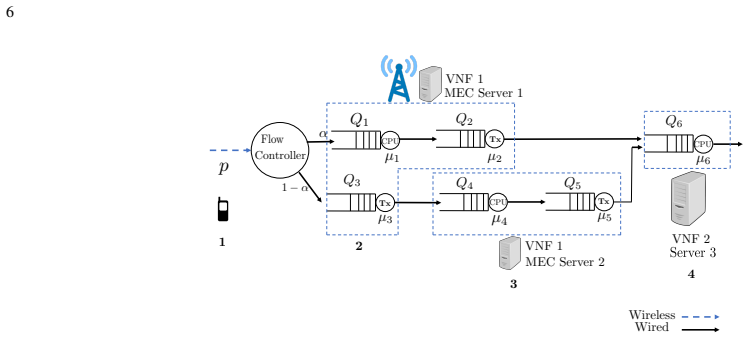
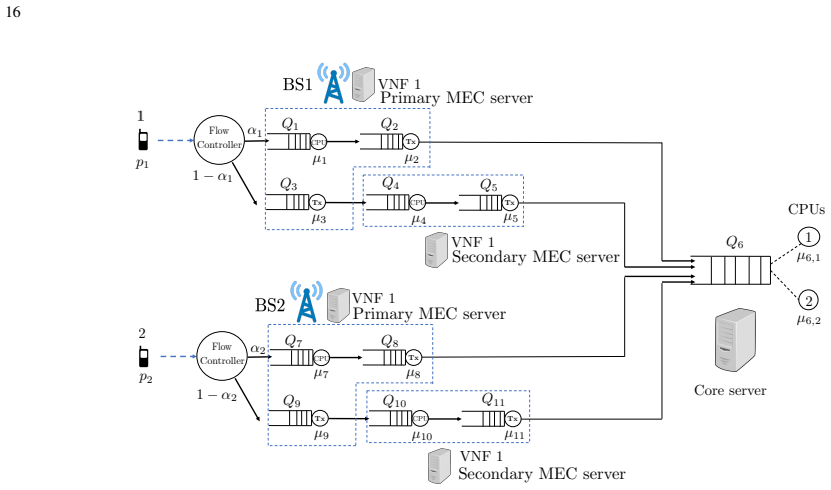
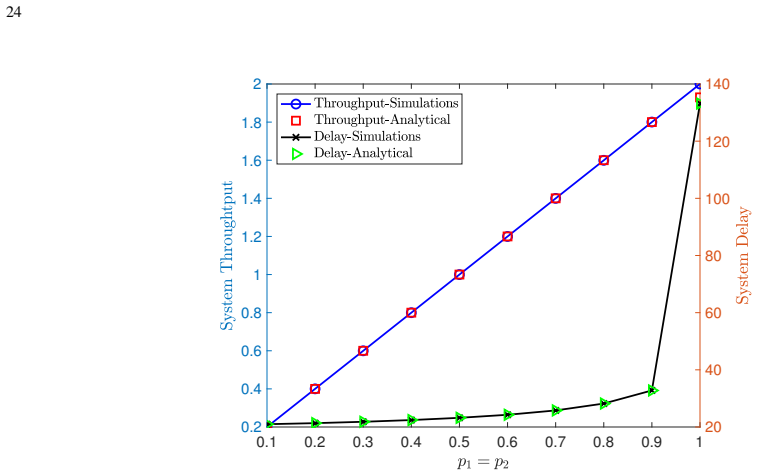
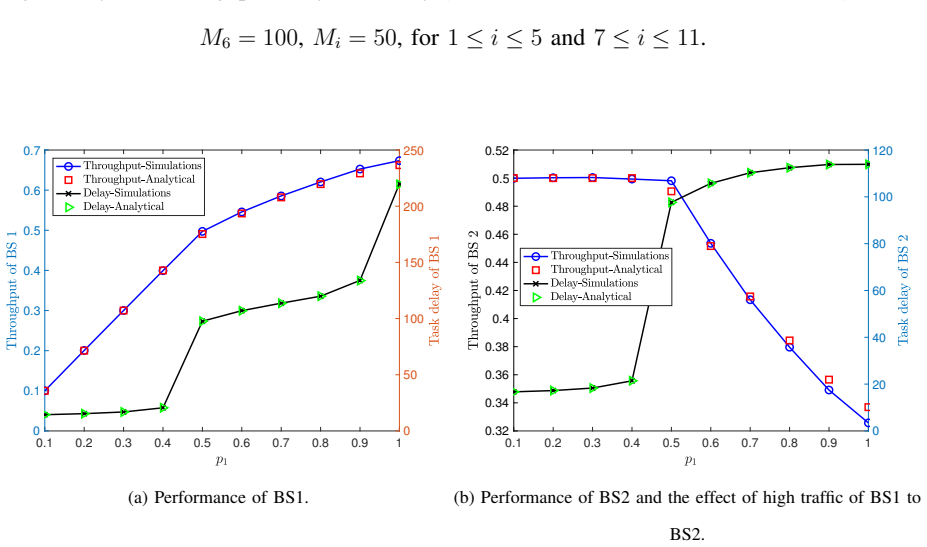
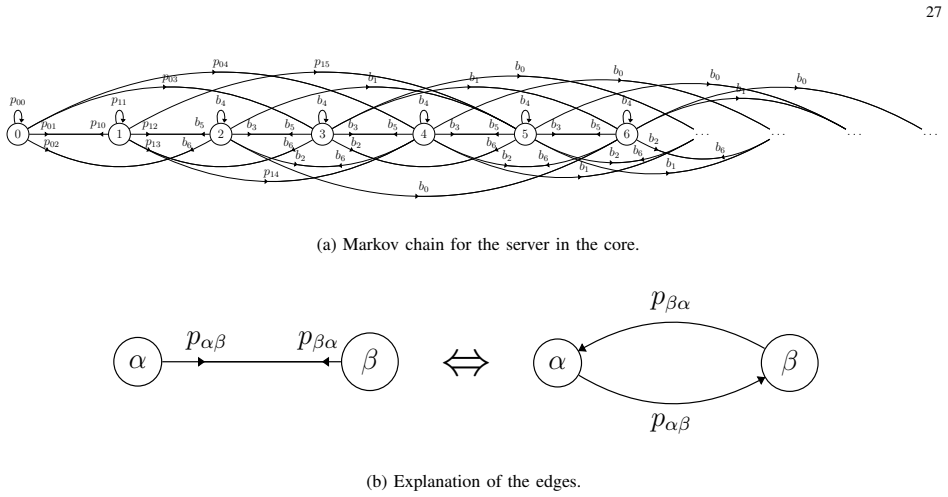
The authors construct a queueing model for a communications system consisting of MEC servers and a core network server with different types of virtual network functions. They propose a method to derive analytical expressions for performance metrics of interest for both the base system and an extended larger system, resulting in a stochastic model. Simulation results coincide with the analytical predictions.
What carries the argument
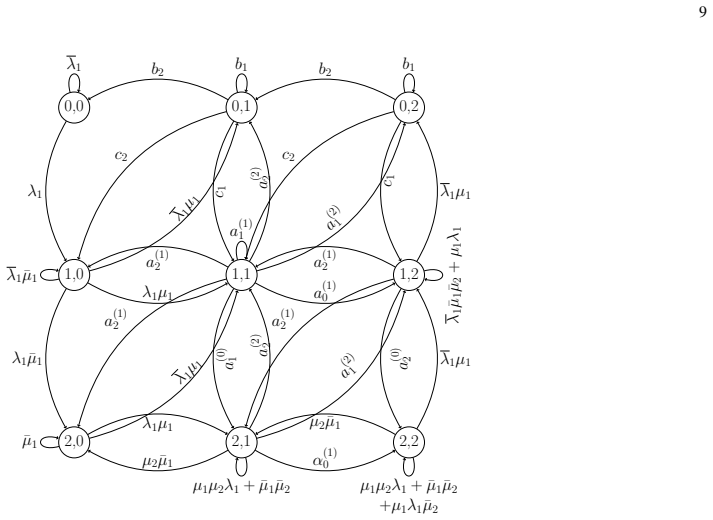
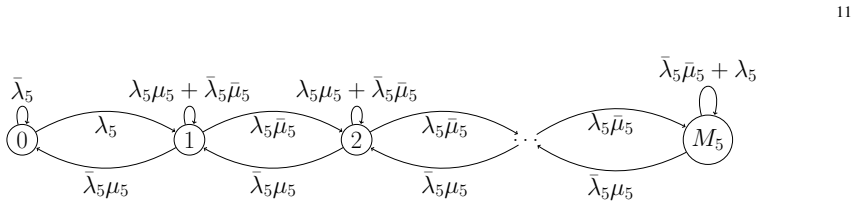
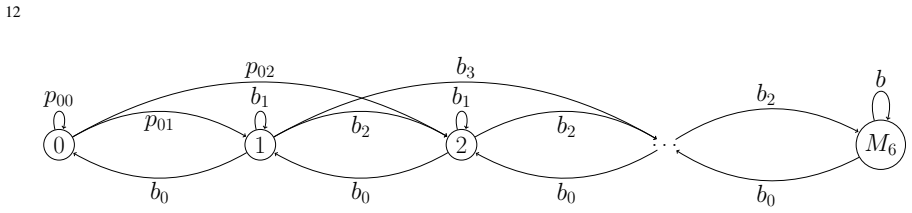
A queueing network model capturing processing at virtual network functions and transmission flows between them in a service chaining setup.
If this is right
- Closed-form expressions for performance metrics allow rapid evaluation of system behavior without running simulations.
- The model supports analysis of larger systems through the same derivation method.
- Insights from different scenarios guide decisions on traffic flow control and its effects on latency and throughput.
Where Pith is reading between the lines
- Such models could help optimize the placement of virtual functions across edge and core to meet latency targets.
- The queueing approach might extend to performance analysis in other distributed computing chains like microservices.
- Validation across more realistic traffic patterns would strengthen applicability to IoT scenarios.
Load-bearing premise
The actual distributed system of virtual network functions with service chaining behaves like the proposed queueing network in terms of processing and transmission flows.
What would settle it
Running simulations or measurements on a physical MEC deployment with service chaining and comparing the observed end-to-end delays against the paper's analytical formulas under varying arrival rates and chain lengths.
Figures
read the original abstract
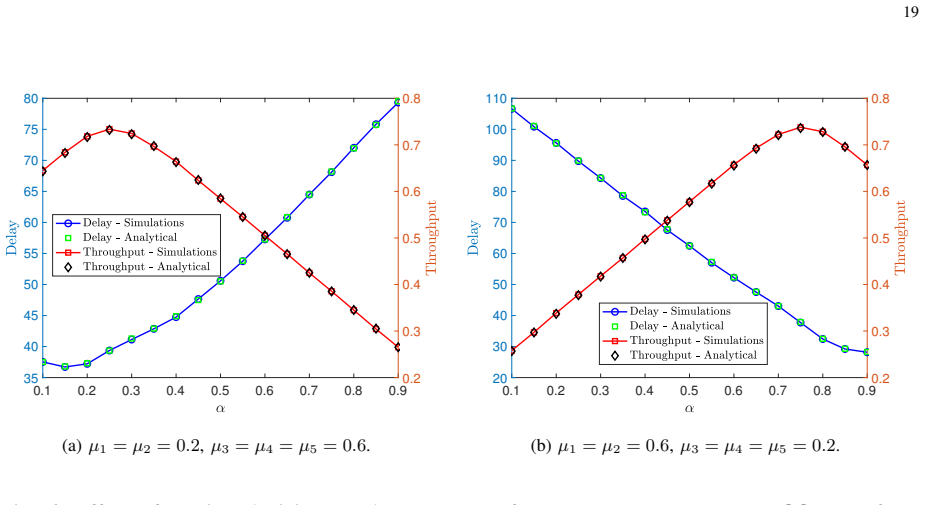
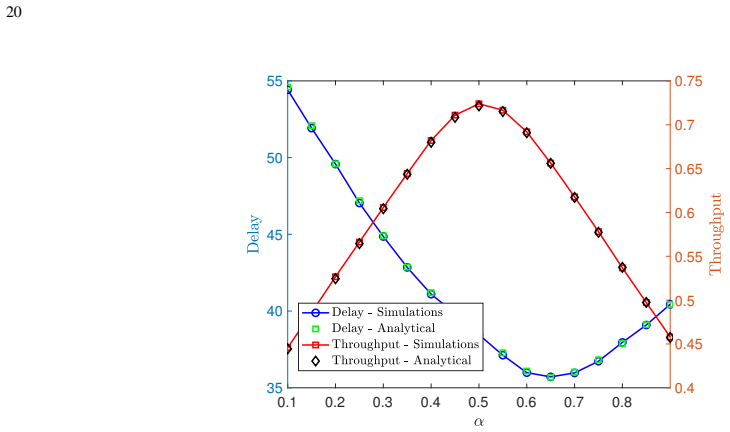
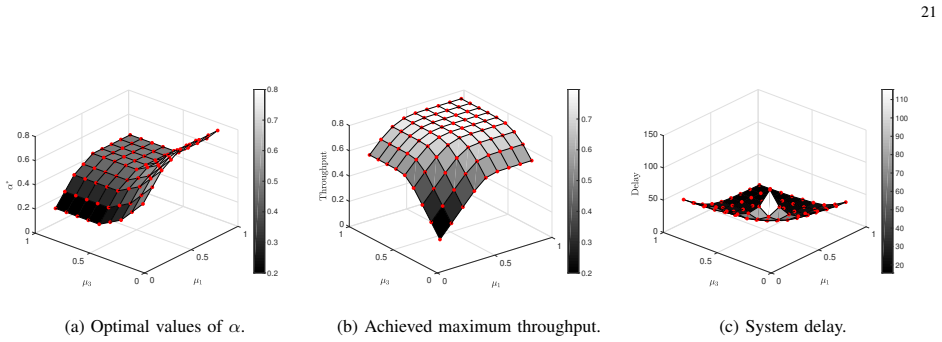
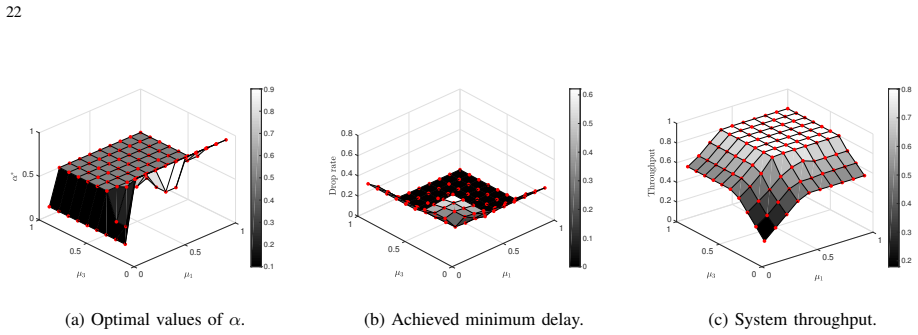
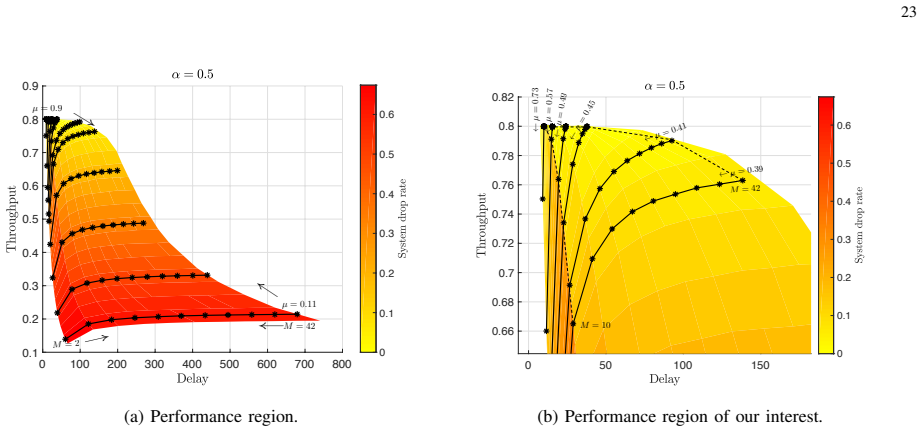
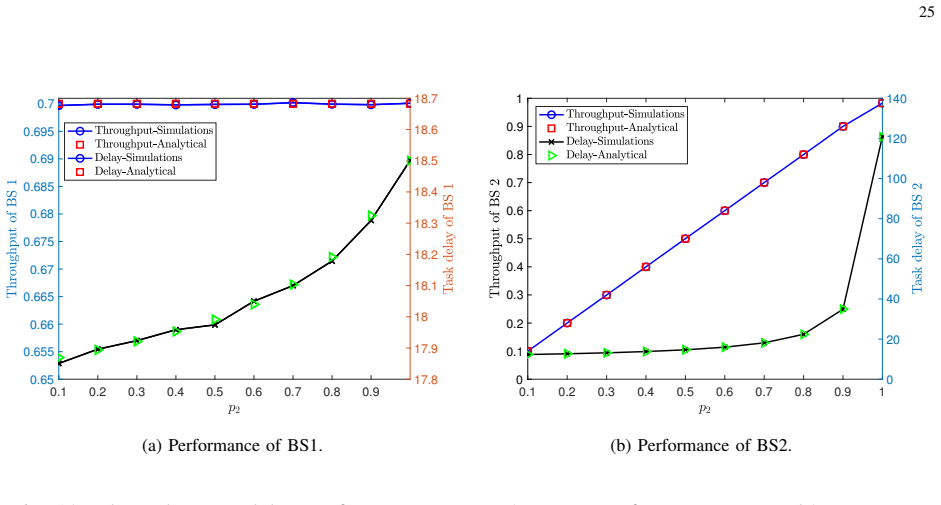
Future mobile networks supporting Internet of Things are expected to provide both high throughput and low latency to user-specific services. One way to overcome this challenge is to adopt Network Function Virtualization (NFV) and Multi-access Edge Computing (MEC). Besides latency constraints, these services may have strict function chaining requirements. The distribution of network functions over different hosts and more flexible routing caused by service function chaining raise new challenges for end-to-end performance analysis. In this paper, as a first step, we analyze an end-to-end communications system that consists of both MEC servers and a server at the core network hosting different types of virtual network functions. We develop a queueing model for the performance analysis of the system consisting of both processing and transmission flows. We propose a method in order to derive analytical expressions of the performance metrics of interest. Then, we show how to apply the similar method to an extended larger system and derive a stochastic model for such systems. We observe that the simulation and analytical results coincide. By evaluating the system under different scenarios, we provide insights for the decision making on traffic flow control and its impact on critical performance metrics.
Editorial analysis
A structured set of objections, weighed in public.
Referee Report
Summary. The paper claims to develop a queueing model for end-to-end performance analysis of a communications system consisting of MEC servers and a core-network server hosting VNFs, with both processing and transmission flows under service chaining. It proposes an (unspecified) method to derive analytical expressions for performance metrics, extends the same method to derive a stochastic model for larger systems, and reports that analytical and simulation results coincide. The work also evaluates different scenarios to yield insights on traffic-flow control decisions.
Significance. If the derivations are correct and the queueing-network representation is faithful, the paper would supply a useful analytical framework for joint processing/transmission performance in NFV/MEC environments with chaining constraints—an area of practical importance for low-latency IoT services. The reported match between analysis and simulation plus the explicit extension to larger systems would be genuine strengths; the absence of free parameters or self-referential fitting is also positive.
major comments (2)
- [Abstract] Abstract (and model-development paragraph): the central claim that 'analytical expressions' exist, match simulation, and extend to larger systems is asserted without any derivation steps, arrival/service process assumptions, independence conditions, or error bounds. This renders the soundness of the performance-metric formulas unverifiable from the supplied text.
- [Abstract] Abstract (weakest-assumption paragraph): the model fidelity claim—that a real distributed VNF chaining system can be faithfully captured by the proposed queueing network—is stated but not supported by any concrete mapping of hosts, routing, or resource-sharing details to queueing primitives, leaving the applicability of the derived expressions untested.
minor comments (1)
- The abstract could explicitly name the performance metrics (e.g., end-to-end delay, throughput) and the queueing disciplines employed.
Simulated Author's Rebuttal
We thank the referee for the constructive comments on our manuscript. Below we provide point-by-point responses to the major comments.
read point-by-point responses
-
Referee: [Abstract] Abstract (and model-development paragraph): the central claim that 'analytical expressions' exist, match simulation, and extend to larger systems is asserted without any derivation steps, arrival/service process assumptions, independence conditions, or error bounds. This renders the soundness of the performance-metric formulas unverifiable from the supplied text.
Authors: The abstract is intended as a concise summary. The full derivations, including arrival and service process assumptions (Poisson arrivals and exponential service times for processing and transmission), independence conditions allowing for product-form solutions, and error bounds via simulation validation, are detailed in the model development and analysis sections of the manuscript. We will revise the abstract to include a short statement on the key assumptions and method to improve verifiability. revision: yes
-
Referee: [Abstract] Abstract (weakest-assumption paragraph): the model fidelity claim—that a real distributed VNF chaining system can be faithfully captured by the proposed queueing network—is stated but not supported by any concrete mapping of hosts, routing, or resource-sharing details to queueing primitives, leaving the applicability of the derived expressions untested.
Authors: The manuscript provides a concrete mapping in the system model section, where MEC servers are represented as queues for VNF processing, the core network server as a queue for both processing and transmission, and service chaining as probabilistic routing between these queues. Resource sharing is incorporated by modeling server capacities. We will update the abstract to briefly describe this mapping to strengthen the fidelity claim. revision: yes
Circularity Check
No significant circularity detected
full rationale
The paper constructs a standard queueing network model for joint processing and transmission flows in a service-chaining NFV/MEC system, then applies an (unspecified) derivation method to obtain performance metrics. Validation consists of matching these expressions to independent simulation runs. No load-bearing step reduces by construction to a fitted parameter, self-citation, or self-definitional relation; the derivation chain is presented as following from classical queueing principles and remains externally falsifiable via simulation.
Axiom & Free-Parameter Ledger
axioms (1)
- domain assumption The end-to-end system with distributed virtual network functions can be represented as a queueing network whose processing and transmission components admit closed-form or tractable performance expressions.
Reference graph
Works this paper leans on
-
[1]
Traversing virtual network functions from the edge to the core: An end-to-end performance analysis,
E. Fountoulakis, Q. Liao, and N. Pappas, “Traversing virtual network functions from the edge to the core: An end-to-end performance analysis,” in in Proc. IEEE International Symposium on Wireless Communication System (ISWCS), Aug. 2019
work page 2019
-
[2]
Network function virtualization: State- of-the-art and research challenges,
R. Mijumbi, J. Serrat, J.-L. Gorricho, N. Bouten, F. De Turck, and R. Boutaba, “Network function virtualization: State- of-the-art and research challenges,” IEEE Communications Surveys & Tutorials , vol. 18, no. 1, pp. 236–262, 2016
work page 2016
-
[3]
Integrated NFV/SDN architectures: A systematic literature review,
M. S. Bonfim, K. L. Dias, and S. F. L. Fernandes, “Integrated NFV/SDN architectures: A systematic literature review,” ACM Comput. Surv., vol. 51, no. 6, pp. 1–39, Feb. 2019
work page 2019
-
[4]
Software-defined network function virtualization: A survey,
Y . Li and M. Chen, “Software-defined network function virtualization: A survey,” IEEE Access , vol. 3, pp. 2542–2553, 2015
work page 2015
-
[5]
Mobile edge computing–A key technology towards 5G,
Y . C. Hu, M. Patel, D. Sabella, N. Sprecher, and V . Young, “Mobile edge computing–A key technology towards 5G,” ETSI white paper, vol. 11, no. 11, pp. 1–16, 2015
work page 2015
-
[6]
T. Taleb, K. Samdanis, B. Mada, H. Flinck, S. Dutta, and D. Sabella, “On multi-access edge computing: A survey of the emerging 5G network edge cloud architecture and orchestration,” IEEE Communications Surveys & Tutorials , vol. 19, no. 3, pp. 1657–1681, 2017
work page 2017
-
[7]
End-to-end delay modeling for embedded VNF chains in 5G core networks,
Q. Ye, W. Zhuang, X. Li, and J. Rao, “End-to-end delay modeling for embedded VNF chains in 5G core networks,” IEEE Internet of Things Journal , pp. 692–704, 2018. 29
work page 2018
-
[8]
Modeling and performance analysis for service function chaining in the SDN/NFV architecture,
Q. Duan, “Modeling and performance analysis for service function chaining in the SDN/NFV architecture,” in Proc. IEEE NetSoft, pp. 476–481, 2018
work page 2018
-
[9]
Stochastic performance analysis of network function virtualization in future internet,
W. Miao, G. Min, Y . Wu, H. Huang, Z. Zhao, H. Wang, and C. Luo, “Stochastic performance analysis of network function virtualization in future internet,” IEEE Journal on Selected Areas in Communications , vol. 37, no. 3, pp. 613–626, 2019
work page 2019
-
[10]
An analytical tool for performance evaluation of software defined networking services,
A. Lombardo, A. Manzalini, V . Riccobene, and G. Schembra, “An analytical tool for performance evaluation of software defined networking services,” Proc. IEEE Network Operations and Management Symposium (NOMS) , pp. 1–7, 2014
work page 2014
-
[11]
Performance modeling of SDN with NFV under or aside the controller,
A. Fahmin, Y .-C. Lai, M. S. Hossain, Y .-D. Lin, and D. Saha, “Performance modeling of SDN with NFV under or aside the controller,” in Proc. IEEE Future Internet of Things and Cloud Workshops (FiCloudW) , pp. 211–216, 2017
work page 2017
-
[12]
Modeling and performance evaluation of an openflow architecture,
M. Jarschel, S. Oechsner, D. Schlosser, R. Pries, S. Goll, and P. Tran-Gia, “Modeling and performance evaluation of an openflow architecture,” in Proc. International Teletraffic Congress (ITC) , pp. 1–7, 2011
work page 2011
-
[13]
Queueing analysis of software defined network with realistic openflow–based switch model,
Y . Goto, H. Masuyama, B. Ng, W. K. Seah, and Y . Takahashi, “Queueing analysis of software defined network with realistic openflow–based switch model,” in Proc. IEEE Modeling, Analysis and Simulation of Computer and Telecommunication Systems (MASCOTS), pp. 301–306, 2016
work page 2016
-
[14]
Performance evaluation of openflow-based software-defined networks based on queueing model,
B. Xiong, K. Yang, J. Zhao, W. Li, and K. Li, “Performance evaluation of openflow-based software-defined networks based on queueing model,” Computer Networks, vol. 102, pp. 172–185, 2016
work page 2016
-
[15]
Optimal dynamic cloud network control,
H. Feng, J. Llorca, A. M. Tulino, and A. F. Molisch, “Optimal dynamic cloud network control,” IEEE/ACM Transactions on Networking, no. 99, pp. 1–14, 2018
work page 2018
-
[16]
The cloud service distribution problem in distributed cloud networks,
M. Barcelo, J. Llorca, A. M. Tulino, and N. Raman, “The cloud service distribution problem in distributed cloud networks,” in Proc. IEEE International Conference on Communications (ICC) , pp. 344–350, 2015
work page 2015
-
[17]
Dynamic network service optimization in distributed cloud networks,
H. Feng, J. Llorca, A. M. Tulino, and A. F. Molisch, “Dynamic network service optimization in distributed cloud networks,” in Proc. IEEE International Conference on Computer Communications (INFOCOM) Workshops , pp. 300–305, 2016
work page 2016
-
[18]
Optimal control of wireless computing networks,
——, “Optimal control of wireless computing networks,” IEEE Transactions on Wireless Communications, vol. 17, no. 12, pp. 8283–8298, 2018
work page 2018
-
[19]
Automated function placement and online optimization of network functions virtualization,
X. Chen, W. Ni, I. B. Collings, X. Wang, and S. Xu, “Automated function placement and online optimization of network functions virtualization,” IEEE Transactions on Communications , vol. 67, no. 2, pp. 1225–1237, 2019
work page 2019
-
[20]
L. Gu, D. Zeng, S. Tao, S. Guo, H. Jin, A. Y . Zomaya, and W. Zhuang, “Fairness-aware dynamic rate control and flow scheduling for network utility maximization in network service chain,” IEEE Journal on Selected Areas in Communications, vol. 37, no. 5, pp. 1059–1071, 2019
work page 2019
-
[21]
Near optimal placement of virtual network functions,
R. Cohen, L. Lewin-Eytan, J. S. Naor, and D. Raz, “Near optimal placement of virtual network functions,” in Proc. IEEE International Conference on Computer Communications (INFOCOM) , pp. 1346–1354, 2015
work page 2015
-
[22]
L. Wang, Z. Lu, X. Wen, R. Knopp, and R. Gupta, “Joint optimization of service function chaining and resource allocation in network function virtualization,” IEEE Access, vol. 4, pp. 8084–8094, 2016
work page 2016
-
[23]
Delay-aware scheduling and resource optimization with network function virtualization,
L. Qu, C. Assi, and K. Shaban, “Delay-aware scheduling and resource optimization with network function virtualization,” IEEE Transactions on Communications , vol. 64, no. 9, pp. 3746–3758, 2016. 30
work page 2016
-
[24]
Efficient NFV-enabled multicasting in SDNs,
Z. Xu, W. Liang, M. Huang, M. Jia, S. Guo, and A. Galis, “Efficient NFV-enabled multicasting in SDNs,”IEEE Transactions on Communications, vol. 67, no. 3, pp. 2052–2070, 2019
work page 2052
-
[25]
Virtual network functions routing and placement for edge cloud latency minimization,
R. Gouareb, V . Friderikos, and A.-H. Aghvami, “Virtual network functions routing and placement for edge cloud latency minimization,” IEEE Journal on Selected Areas in Communications , vol. 36, no. 10, pp. 2346–2357, 2018
work page 2018
-
[26]
Approximation algorithms for the NFV service distribution problem,
H. Feng, J. Llorca, A. M. Tulino, D. Raz, and A. F. Molisch, “Approximation algorithms for the NFV service distribution problem,” in Proc. IEEE International Conference on Computer Communications (INFOCOM) , pp. 1–9, 2017
work page 2017
-
[27]
A multi-objective heuristic for the optimization of virtual network function chain placement,
S. Lange, A. Grigorjew, T. Zinner, P. Tran-Gia, and M. Jarschel, “A multi-objective heuristic for the optimization of virtual network function chain placement,” in Proc. IEEE International Teletraffic Congress (ITC) , vol. 1, pp. 152–160, 2017
work page 2017
-
[28]
Delay-optimal computation task scheduling for mobile-edge computing systems,
J. Liu, Y . Mao, J. Zhang, and K. B. Letaief, “Delay-optimal computation task scheduling for mobile-edge computing systems,” in Proc. IEEE International Symposium on Information Theory (ISIT) , pp. 1451–1455, 2016
work page 2016
-
[29]
Y . Mao, J. Zhang, S. Song, and K. B. Letaief, “Stochastic joint radio and computational resource management for multi- user mobile-edge computing systems,” IEEE Transactions on Wireless Communications , vol. 16, no. 9, pp. 5994–6009, 2017
work page 2017
-
[30]
Power-optimal scheduling for delay constrained mobile computation offloading,
D. Han, W. Chen, and Y . Fang, “Power-optimal scheduling for delay constrained mobile computation offloading,” in Proc. IEEE International Conference on Communication (ICC) , pp. 1–6, May 2018
work page 2018
-
[31]
Energy-efficient admission of delay-sensitive tasks for mobile edge computing,
X. Lyu, H. Tian, W. Ni, Y . Zhang, P. Zhang, and R. P. Liu, “Energy-efficient admission of delay-sensitive tasks for mobile edge computing,” IEEE Transactions on Communications , vol. 66, no. 6, pp. 2603–2616, 2018
work page 2018
-
[32]
Joint network slicing and mobile edge computing in 5G networks,
B. Xiang, J. Elias, F. Martignon, and N. Elisabetta Di, “Joint network slicing and mobile edge computing in 5G networks,” in Proc. IEEE International Conference on Communications (ICC) , 2019
work page 2019
-
[33]
A. S. Alfa, Applied discrete-time queues . Springer, 2016
work page 2016
-
[34]
Stability conditions for some distributed systems: Buffered random access systems,
W. Szpankowski, “Stability conditions for some distributed systems: Buffered random access systems,” Advances in Applied Probability, vol. 26, no. 2, pp. 498–515, 1994
work page 1994
-
[35]
The stability of a queue with non-independent inter-arrival and service times,
R. M. Loynes, “The stability of a queue with non-independent inter-arrival and service times,” Mathematical Proceedings of the Cambridge Philosophical Society , vol. 58, no. 3, pp. 497–520, 1962
work page 1962
-
[36]
D. P. Bertsekas and R. G. Gallager, Data networks. Prentice-Hall International New Jersey, 1992
work page 1992
discussion (0)
Sign in with ORCID, Apple, or X to comment. Anyone can read and Pith papers without signing in.