REVIEW 2 major objections 2 minor 64 references
Stochastic bifurcation analysis via polynomial chaos: consistency and convergence of branch-approximating solutions
T0 review · 2 major / 2 minor · reviewed 2026-06-28 · grok-4.3
Pith's one-line read A polynomial chaos Galerkin projection recovers entire bifurcation diagrams of parameter-dependent ODEs from a single algebraic solve by isolating branch-approximating roots.
desk verdict PC Galerkin reformulation gives a single-solve route to bifurcation branches but the claimed natural split of roots into oscillatory versus approximating classes needs an explicit, provable identification rule. read the letter →
The pith
A machine-rendered reading of the paper's core claim, the machinery that carries it, and where it could break.
The reading
What carries the argument
Galerkin projection of the stochastic weak form onto a polynomial chaos basis, which produces discrete algebraic roots that separate into oscillatory and branch-approximating classes.
What would settle it
A sequence of Galerkin solves at increasing polynomial chaos degree in which the identified branch-approximating roots fail to approach the known steady states of the underlying deterministic ODE.
Extended reading notes
Core claim
Treating the bifurcation parameter as a random variable and applying a generalized polynomial chaos Galerkin projection to the resulting weak stochastic form yields a single algebraic system; in the non-uniqueness regime its roots naturally separate into highly oscillatory solutions and branch-approximating solutions, with the latter shown to converge to the true steady-state branches of the original deterministic system.
Load-bearing premise
The many roots of the Galerkin algebraic system naturally split into highly oscillatory solutions and a separate class of branch-approximating solutions that converge to the true branches.
Editorial extensions
If this is right
- The entire bifurcation diagram is reconstructed without iterative continuation across parameter values.
- Convergence of the branch-approximating solutions to true steady states holds as the polynomial degree grows.
- Uniqueness of the Galerkin solution is guaranteed under suitable assumptions on the system.
- The framework applies directly to both scalar and vector-valued parameter-dependent ODEs.
Reading between the lines
- The same stochastic projection idea could be tested on parameter-dependent PDEs where classical continuation becomes prohibitively expensive.
- Automated post-processing filters that separate oscillatory from branch-approximating roots would make the method immediately usable in black-box simulators.
- If the parameter domain is high-dimensional the single-run advantage may grow, provided the polynomial chaos basis remains tractable.
Editorial analysis
A structured set of objections, weighed in public.
Referee Report
Summary. The paper proposes treating the bifurcation parameter as a random variable in a generalized polynomial chaos expansion, casting the deterministic parameter-dependent ODE system into a weak stochastic form, and applying Galerkin projection to recover the full bifurcation diagram in a single algebraic solve. It asserts that the resulting nonlinear algebraic system in the non-uniqueness regime produces roots that split into highly oscillatory and branch-approximating classes, develops a theoretical framework proving consistency and convergence of the branch-approximating solutions to the true steady states together with uniqueness of the Galerkin solution under suitable assumptions, and validates the approach numerically on scalar and vector ODE examples.
Significance. If the claimed convergence and separation results hold with explicit, uniform criteria, the method would provide a computationally attractive global alternative to classical continuation techniques, particularly for systems where repeated pointwise solves across parameter ranges are prohibitive. The single-solver reconstruction and the numerical demonstrations on both scalar and vector systems are concrete strengths.
major comments (2)
- [Theoretical framework (consistency and convergence statements)] The central claim that Galerkin roots 'naturally split into two classes' (highly oscillatory vs. branch-approximating) and that only the latter converge requires an explicit, computable separation rule (e.g., a bound on PC-coefficient decay rates, a residual threshold, or a spectral property of the algebraic system) that is proved to isolate the approximating class uniformly in the parameter domain and to survive as the chaos degree tends to infinity. The abstract invokes this splitting without indicating the formal criterion; if the separation is only observed numerically rather than derived, the convergence theorem for the branch-approximating class rests on an unproved premise.
- [Uniqueness theorem] The uniqueness guarantee for the Galerkin solution is stated to hold 'under suitable assumptions,' yet the manuscript must specify whether these assumptions remain valid when the underlying deterministic problem possesses multiple coexisting stable branches or when the PC basis is truncated at finite degree; without this, the reconstruction guarantee for the entire diagram is not secured for the general case claimed.
minor comments (2)
- Notation for the probability measure on the bifurcation parameter and the precise definition of the weak stochastic form should be introduced earlier to aid readers outside the PC community.
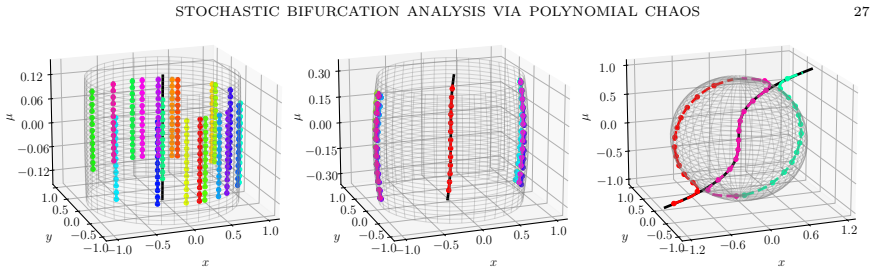
- Figure captions for the numerical bifurcation diagrams should explicitly state the PC degree, the number of roots retained after splitting, and the identification rule used to classify branch-approximating solutions.
Simulated Author's Rebuttal
We thank the referee for the careful reading, the positive assessment of the method's potential, and the constructive comments. We address the two major comments point by point below.
read point-by-point responses
-
Referee: [Theoretical framework (consistency and convergence statements)] The central claim that Galerkin roots 'naturally split into two classes' (highly oscillatory vs. branch-approximating) and that only the latter converge requires an explicit, computable separation rule (e.g., a bound on PC-coefficient decay rates, a residual threshold, or a spectral property of the algebraic system) that is proved to isolate the approximating class uniformly in the parameter domain and to survive as the chaos degree tends to infinity. The abstract invokes this splitting without indicating the formal criterion; if the separation is only observed numerically rather than derived, the convergence theorem for the branch-approximating class rests on an unproved premise.
Authors: The manuscript derives the splitting analytically within the consistency analysis: branch-approximating roots are characterized by PC-coefficient sequences whose higher-mode norms decay at a rate controlled by the smoothness of the underlying deterministic branch (via the projection error bounds), while oscillatory roots exhibit no such decay and produce large residuals in the weak form. This separation is uniform over the parameter domain and persists under degree elevation. To make the criterion fully explicit and computable as requested, we will revise the abstract and add a corollary stating the precise decay threshold (e.g., an L²-norm bound on coefficients beyond a given multi-index) together with a practical residual check that isolates the class. revision: yes
-
Referee: [Uniqueness theorem] The uniqueness guarantee for the Galerkin solution is stated to hold 'under suitable assumptions,' yet the manuscript must specify whether these assumptions remain valid when the underlying deterministic problem possesses multiple coexisting stable branches or when the PC basis is truncated at finite degree; without this, the reconstruction guarantee for the entire diagram is not secured for the general case claimed.
Authors: The uniqueness statement applies to the branch-approximating root of the Galerkin system and rests on local Lipschitz continuity of the nonlinearity and orthogonality of the PC basis; these assumptions are independent of the number of coexisting deterministic branches because the algebraic system is permitted (and shown) to possess multiple distinct roots, each approximating a different branch. Finite truncation is already accounted for by the convergence theorem, which quantifies the truncation error uniformly. We will add a clarifying remark after the uniqueness theorem that explicitly verifies the assumptions hold under multiple branches and finite degree, supported by the vector ODE examples already containing coexisting branches. revision: yes
Circularity Check
No circularity: theoretical claims derive from stochastic reformulation and Galerkin analysis without reduction to inputs.
full rationale
The abstract and description present a framework deriving consistency, convergence, and uniqueness of branch-approximating Galerkin solutions from the weak stochastic form and projection, under stated assumptions. No quoted equations or steps reduce predictions to fitted parameters by construction, invoke self-citations as load-bearing uniqueness theorems, or rename known results. The 'natural split' into oscillatory and branch-approximating roots is asserted as a property of the system rather than a fitted or self-defined input. This is the common case of a self-contained theoretical derivation against external benchmarks.
Assumptions & free parameters
free parameters (2)
- Polynomial chaos degree
- Probability measure on the bifurcation parameter
assumptions (1)
- domain assumption The deterministic parameter-dependent system admits a weak stochastic formulation suitable for Galerkin projection onto a polynomial chaos basis.
Cite this review
Pith. "Pith review of Stochastic bifurcation analysis via polynomial chaos: consistency and convergence of branch-approximating solutions." pith.science (2026). https://pith.science/paper/OV22TDJB
@misc{pith2026260531288,
  author       = {Pith},
  title        = {Pith review of: Stochastic bifurcation analysis via polynomial chaos: consistency and convergence of branch-approximating solutions},
  year         = {2026},
  howpublished = {\url{https://pith.science/paper/OV22TDJB}},
  note         = {Machine review of arXiv:2605.31288}
}
read the original abstract
Parameter-dependent dynamical systems that exhibit bifurcations pose significant computational challenges, as traditional continuation methods require repeated, costly simulations across large ranges of parameter values to capture sudden qualitative changes in the solution. In this work, we propose a systematic approach to reconstruct the branches of the entire bifurcation diagram in a single numerical solver leveraging generalized Polynomial Chaos (PC) expansion. By treating the parameter as a random variable, we cast the deterministic parameter-dependent model in a weak stochastic form, and then use a Galerkin projection to recover bifurcation branches globally across the parameter domain without iterative pointwise continuation. We show that the resulting Galerkin system, in the non-uniqueness regime, produces many discrete algebraic roots that naturally split into two classes: highly oscillatory solutions and branch-approximating ones. We develop a rigorous theoretical framework that establishes consistency, proves convergence of the branch-approximating solutions to the true steady states, and guarantees uniqueness of the Galerkin solution under suitable assumptions. Finally, we confirm these theoretical results with numerical experiments on several parameter-dependent ordinary differential equations (ODEs), demonstrating the accuracy and computational efficiency of our single-run framework in capturing complex bifurcation diagrams for both scalar and vector-valued systems.
Figures


Figures from the paper (9 more)


Reference graph
Works this paper leans on
-
[1]
R. A. Adams and J. J. F. Fournier.Sobolev Spaces, volume 140 ofPure and Applied Mathematics. Academic Press, New York, 2 edition, 2003
2003
-
[2]
E. L. Allgower and K. Georg.Numerical Continuation Methods: An Introduction, volume 13 ofSpringer Series in Computational Mathematics. Springer-Verlag Berlin Heidelberg, 1990
1990
-
[3]
Appell and P
J. Appell and P. P. Zabrejko.Nonlinear Superposition Operators, volume 95. Cambridge University Press, Cam- bridge, 1990
1990
-
[4]
V. I. Arnold.Ordinary Differential Equations. Springer-Verlag, Berlin, Heidelberg, 3 edition, 1992
1992
-
[5]
Bergh and J
J. Bergh and J. L¨ ofstr¨ om.Interpolation Spaces: An Introduction, volume 223 ofGrundlehren der mathematischen Wissenschaften. Springer-Verlag, Berlin Heidelberg, 1976
1976
-
[6]
Bollenbach.Genetic toggle switch
T. Bollenbach.Genetic toggle switch. Advanced Practical Course M Biophysics, University of Cologne, 2023
2023
-
[7]
Boull´ e, V
N. Boull´ e, V. Dallas, and P. E. Farrell. Bifurcation analysis of two-dimensional Rayleigh–B\’enard convection using deflation.Physical Review E, 105(5):055106, 2022
2022
-
[8]
J. P. Boyd.Chebyshev and Fourier Spectral Methods. Dover Publications, 2001
2001
Show all 64 references
-
[9]
S. C. Brenner and L. R. Scott.The Mathematical Theory of Finite Element Methods, volume 15 ofTexts in Applied Mathematics. Springer, New York, 3 edition, 2008
2008
-
[10]
Brezis and P
H. Brezis and P. Mironescu. Gagliardo–nirenberg inequalities and non-inequalities: The full story.Annales de l’Institut Henri Poincar´ e C, 35(5):1355–1376, 2018
2018
-
[11]
S. L. Brunton, J. L. Proctor, and J. N. Kutz. Discovering governing equations from data by sparse identification of nonlinear dynamical systems.Proceedings of the National Academy of Sciences, 113(15):3932–3937, 2016
2016
-
[12]
R. H. Cameron and W. T. Martin. The orthogonal development of non-linear functionals in series of fourier- hermite functionals.Annals of Mathematics, 48:385–413, 1947
1947
-
[13]
Canuto, M
C. Canuto, M. Hussaini, A. Quarteroni, and T. A. Zang.Spectral Methods: Fundamentals in Single Domains. Springer, 2006
2006
-
[14]
Cartan.Differential Calculus
H. Cartan.Differential Calculus. Hermann / Houghton Mifflin, Paris / Boston, 1971
1971
-
[15]
Conti, G
P. Conti, G. Gobat, S. Fresca, A. Manzoni, and A. Frangi. Reduced order modeling of parametrized systems through autoencoders and SINDy approach: Continuation of periodic solutions.Computer Methods in Applied Mechanics and Engineering, 411:116072, 2023
2023
-
[16]
B. J. Debusschere, H. N. Najm, P. P. P´ ebay, O. M. Knio, R. G. Ghanem, and O. P. L. Maˆ ıtre. Numerical challenges in the use of polynomial chaos representations for stochastic processes.SIAM Journal on Scientific Computing, 26(2):698–719, 2005. STOCHASTIC BIFURCATION ANALYSI...
2005
-
[17]
N. Deng, B. R. Noack, M. Morzy´ nski, and L. R. Pastur. Low-order model for successive bifurcations of the fluidic pinball.Journal of Fluid Mechanics, 884:A37, 2020
2020
-
[18]
R. A. DeVore and G. G. Lorentz.Constructive Approximation, volume 303 ofGrundlehren der mathematischen Wissenschaften. Springer-Verlag, Berlin, Heidelberg, 1993
1993
-
[19]
Dini.Fondamenti per la teorica delle funzioni di variabili reali
U. Dini.Fondamenti per la teorica delle funzioni di variabili reali. T. Nistri, Pisa, 1878
-
[20]
P. E. Farrell, ´A. Birkisson, and S. W. Funke. Deflation Techniques for Finding Distinct Solutions of Nonlinear Partial Differential Equations.SIAM Journal on Scientific Computing, 37(4):A2026–A2045, 2015
2015
-
[21]
Fulton.Intersection Theory
W. Fulton.Intersection Theory. Ergebnisse der Mathematik und ihrer Grenzgebiete. 3. Folge. Springer-Verlag, 2nd edition, 1998
1998
-
[22]
T. S. Gardner, C. R. Cantor, and J. J. Collins. Construction of a genetic toggle switch in escherichia coli.Nature, 403(6767):339–342, 2000
2000
-
[23]
R. G. Ghanem and P. D. Spanos.Stochastic Finite Elements: A Spectral Approach. Springer, New York, NY, 1991
1991
-
[24]
I. C. Gonnella, M. Khamlich, F. Pichi, and G. Rozza. A stochastic perturbation approach to nonlinear bifurcating problems. Preprint, arXiv:2402.16803v4, 2024
2024
-
[25]
Gottlieb and C.-W
D. Gottlieb and C.-W. Shu. On the gibbs phenomenon and its resolution.SIAM Review, 39(4):644–668, 1997
1997
-
[26]
Herrero, Y
H. Herrero, Y. Maday, and F. Pla. RB (Reduced basis) for RB (Rayleigh–B´ enard).Computer Methods in Applied Mechanics and Engineering, 261–262:132–141, 2013
2013
-
[27]
J. S. Hesthaven, S. Gottlieb, and D. Gottlieb.Spectral Methods for Time-Dependent Problems. Cambridge Uni- versity Press, Cambridge, 2007
2007
-
[28]
L. V. Kantorovich and G. P. Akilov.Functional Analysis in Normed Spaces. Pergamon Press, Oxford, 1964. Translated from Russian (1959)
1964
-
[29]
Kuehn, C
C. Kuehn, C. Piazzola, and E. Ullmann. Uncertainty quantification analysis of bifurcations of the Allen–Cahn equation with random coefficients.Physica D: Nonlinear Phenomena, 470:134390, 2024
2024
-
[30]
Kumar, F
N. Kumar, F. Pichi, and G. Rozza. Bifurcation curve detection with deflation for multiparametric PDEs. Preprint, arXiv:2602.12940, 2026
2026
-
[31]
Y. A. Kuznetsov.Elements of Applied Bifurcation Theory, volume 112 ofApplied Mathematical Sciences. Springer, Cham / Switzerland, 4 edition, 2023
2023
-
[32]
O. P. Le Maˆ ıtre. A newton method for the resolution of steady stochastic navier-stokes equations.Computers & Fluids, 38(8):1566–1579, 2009
2009
-
[33]
Li and Y
S. Li and Y. Yang. Data-driven modeling of bifurcation systems by learning the bifurcation parameter general- ization.Nonlinear Dynamics, 113(2):1163–1174, 2025
2025
-
[34]
E. N. Lorenz. Deterministic nonperiodic flow.Journal of the Atmospheric Sciences, 20(2):130–141, 1963
1963
-
[35]
G. V. Milovanovi´ c, D. S. Mitrinovi´ c, and T. M. Rassias.Topics in Polynomials: Extremal Problems, Inequalities, Zeros. World Scientific, Singapore, 1994
1994
-
[36]
M. A. Olshanskii and L. G. Rebholz. Approximating a branch of solutions to the Navier–Stokes equations by reduced-order modeling.Journal of Computational Physics, 524:113728, 2025
2025
-
[37]
J. M. Ortega. The newton–kantorovich theorem.The American Mathematical Monthly, 75(6):658–660, 1968. Short note stating the Newton–Kantorovich theorem
1968
-
[38]
Patil and H
P. Patil and H. Babaee. Reduced-order modeling with time-dependent bases for pdes with stochastic boundary conditions.SIAM/ASA Journal on Uncertainty Quantification, 11(2):727–756, 2023
2023
-
[39]
A. D. Pia, D. G. Patsatzis, G. Rozza, L. Russo, and C. Siettos. Surrogate normal-forms for the numerical bifurcation and stability analysis of navier-stokes flows via machine learning. Preprint, arXiv:2506.21275, 2025
2025 arXiv
-
[40]
Pichi, F
F. Pichi, F. Ballarin, G. Rozza, and J. S. Hesthaven. An artificial neural network approach to bifurcating phe- nomena in computational fluid dynamics.Computers & Fluids, 254:105813, 2023
2023
-
[41]
Pichi, B
F. Pichi, B. Moya, and J. S. Hesthaven. A graph convolutional autoencoder approach to model order reduction for parametrized PDEs.Journal of Computational Physics, 501:112762, 2024
2024
-
[42]
Pichi and M
F. Pichi and M. Strazzullo. Deflation-based certified greedy algorithm and adaptivity for bifurcating nonlinear PDEs.Communications in Nonlinear Science and Numerical Simulation, 149:108941, 2025
2025
-
[43]
Pichi, M
F. Pichi, M. Strazzullo, F. Ballarin, and G. Rozza. Driving bifurcating parametrized nonlinear PDEs by optimal control strategies: Application to Navier–Stokes equations with model order reduction.ESAIM: Mathematical Modelling and Numerical Analysis, 56(4):1361–1400, 2022
2022
-
[44]
Pintore, F
M. Pintore, F. Pichi, M. W. Hess, G. Rozza, and C. Canuto. Efficient computation of bifurcation diagrams with a deflated approach to reduced basis spectral element method.Advances in Computational Mathematics, 47(1):1–39, 2021
2021
-
[45]
Quarteroni, A
A. Quarteroni, A. Manzoni, and F. Negri.Reduced Basis Methods for Partial Differential Equations: An Intro- duction. La Matematica per Il 3+2, 92. Springer International Publishing, Cham, 1st ed. 2016. edition, 2016
2016
-
[46]
Quarteroni and G
A. Quarteroni and G. Rozza.Reduced order methods for modeling and computational reduction. Springer, 2014
2014
-
[47]
Rudin.Principles of Mathematical Analysis
W. Rudin.Principles of Mathematical Analysis. McGraw-Hill, New York, 3rd edition, 1976
1976
-
[48]
Rudin.Functional Analysis
W. Rudin.Functional Analysis. McGraw-Hill, 2 edition, 1991
1991
-
[49]
Seydel.Practical Bifurcation and Stability Analysis, volume 5 ofInterdisciplinary Applied Mathematics
R. Seydel.Practical Bifurcation and Stability Analysis, volume 5 ofInterdisciplinary Applied Mathematics. Springer, New York, NY, 3 edition, 2010. 30 STOCHASTIC BIFURCATION ANALYSIS VIA POLYNOMIAL CHAOS
2010
-
[50]
M. L. Shahab and H. Susanto. Neural networks for bifurcation and linear stability analysis of steady states in partial differential equations.Applied Mathematics and Computation, 483:128985, 2024
2024
-
[51]
J. Shen, T. Tang, and L.-L. Wang.Spectral Methods: Algorithms, Analysis and Applications, volume 41 of Springer Series in Computational Mathematics. Springer-Verlag, Berlin Heidelberg, 2011
2011
-
[52]
A. J. Sommese and C. W. Wampler.The Numerical Solution of Systems of Polynomials Arising in Engineering and Science. World Scientific, Singapore, 2005
2005
-
[53]
Sparrow.The Lorenz Equations: Bifurcations, Chaos, and Strange Attractors
C. Sparrow.The Lorenz Equations: Bifurcations, Chaos, and Strange Attractors. Springer-Verlag, New York, 1982
1982
-
[54]
Tartar.An Introduction to Sobolev Spaces and Interpolation Spaces, volume 3 ofLecture Notes of the Unione Matematica Italiana
L. Tartar.An Introduction to Sobolev Spaces and Interpolation Spaces, volume 3 ofLecture Notes of the Unione Matematica Italiana. Springer, Berlin Heidelberg, 2007
2007
-
[55]
Tomada, M
L. Tomada, M. Khamlich, F. Pichi, and G. Rozza. Sparse Identification for bifurcating phenomena in Computa- tional Fluid Dynamics.Computers & Fluids, 302:106841, 2025
2025
-
[56]
L. N. Trefethen.Approximation Theory and Approximation Practice. SIAM, Philadelphia, 1 edition, 2013
2013
-
[57]
Uecker.Numerical Continuation and Bifurcation in Nonlinear PDEs
H. Uecker.Numerical Continuation and Bifurcation in Nonlinear PDEs. Other Titles in Applied Mathematics. Society for Industrial and Applied Mathematics, 2021
2021
-
[58]
Venturi, X
D. Venturi, X. Wan, and G. E. Karniadakis. Stochastic bifurcation analysis of Rayleigh–B´ enard convection. Journal of Fluid Mechanics, 650:391–413, 2010
2010
-
[59]
Wan and G
X. Wan and G. E. Karniadakis. Multi-element generalized polynomial chaos for arbitrary probability measures. SIAM Journal on Scientific Computing, 28(3):901–928, 2006
2006
-
[60]
H. Wang. How much faster does the best polynomial approximation converge than legendre projection?Con- structive Approximation, 54(3):481–504, 2021
2021
-
[61]
Wiggins.Introduction to Applied Nonlinear Dynamical Systems and Chaos
S. Wiggins.Introduction to Applied Nonlinear Dynamical Systems and Chaos. Springer, New York, New York, 2nd edition, 2003
2003
-
[62]
Xiu.Numerical methods for stochastic computations: A spectral method approach
D. Xiu.Numerical methods for stochastic computations: A spectral method approach. Princeton University Press, Princeton, NJ, 2010
2010
-
[63]
Xiu and G
D. Xiu and G. E. Karniadakis. The wiener-askey polynomial chaos for stochastic differential equations.SIAM Journal on Scientific Computing, 24(2):619–644, 2002
2002
-
[64]
Xiu and G
D. Xiu and G. E. Karniadakis. Modeling uncertainty in flow simulations via generalized polynomial chaos.Journal of Computational Physics, 187(1):137–167, 2003. AppendixA. B´ ezout’s Theorem.In Section 2, ifn= 1 and the functionfis polynomial inu, the Galerkin projection is for...
2003
Reviewed June 28, 2026 · model on record in the stance chip above.
Discussion (0). Continue with ORCID to comment.