REVIEW 4 major objections 5 minor 42 references
A Proof of First Digit Law from Laplace Transform
T0 review · 4 major / 5 minor · reviewed 2026-08-14 · deepseek-v4-flash
Pith's one-line read The paper claims that every well-behaved probability density on the positive reals has leading-digit probabilities close to $\log_{10}(1+1/d)$, obtained by exchanging a Laplace transform between the density and the digit-window function.
desk verdict A transparent but overclaimed heuristic derivation of Benford's law, where the uncontrolled sum-to-integral step in Eq. (11) means the abstract's 'proof' should really be read as a suggestive teaching note. read the letter →
The pith
A machine-rendered reading of the paper's core claim, the machinery that carries it, and where it could break.
The reading
What carries the argument
The central object is the digit-window function $g_{b,d,l}(x) = \sum_n [\eta(x-d\,b^n) - \eta(x-(d+l)b^n)]$, which is $1$ exactly on the mantissa intervals whose first block of digits lies between $d$ and $d+l$. The load-bearing identity is the Laplace-transform exchange $\int_0^\infty F(x)g(x)\,dx = \int_0^\infty f(t)G(t)\,dt$, which lets the computation pass from the unknown density $F$ to the Laplace transform $G$ of the digit window. The argument's main step approximates $G_{b,d,l}(t)$ by $(1/t)\log_b(1+l/d)$; together with the normalization $\int_0^\infty f(t)/t\,dt = 1$, this forces the approximate leading-digit probability. This machinery is what makes the law a property of the number system rather than of any particular dataset.
What would settle it
Numerically evaluate both sides of Eq. (11) for, say, $t = 10^{-3}$ and $d = 1$; if the difference does not shrink as $t$ approaches zero, the claimed approximation $G_d(t) \simeq (1/t)\log_{10}(1+1/d)$ breaks down and the proof would not go through.
Extended reading notes
Core claim
On its own terms, the paper's central discovery is that the first digit law $P_d = \log_{10}(1+1/d)$ emerges as the leading term of a Laplace-transform calculation. Writing the leading-digit probability as $P_d = \int_0^\infty F(x)g_d(x)\,dx$, the authors invoke the identity $\int_0^\infty F(x)g(x)\,dx = \int_0^\infty f(t)G(t)\,dt$, where $f$ is the inverse Laplace transform of $F$ and $G$ is the Laplace transform of $g$. They compute $G_d(t)$ by differentiating with respect to $d$ and replacing the sum over integer powers of ten by an integral, finding $G_d(t) \simeq (1/t)\log_{10}(1+1/d)$. The normalization condition $\int_0^\infty f(t)/t\,dt = 1$ then yields $P_d \simeq \log_{10}(1+1/d)$. The same pattern gives $P_{b,d,l,k} = \log_b(1+l/d)$ for base $b$ and leading blocks, with Benford's law and Hill's law as special cases.
Load-bearing premise
The single approximate step, replacing the sum over integer powers of ten by an integral over all real powers, is used without a general error bound in the main text.
Editorial extensions
If this is right
- For any smooth, slowly varying density with an inverse Laplace transform, the leading digit probabilities are close to $\log_{10}(1+1/d)$, so Benford's law is expected rather than surprising for such data.
- The same argument in base $b$ gives $P_d \approx \log_b(1+1/d)$ for $d = 1,\ldots,b-1$, and for blocks of $k$ leading digits it gives $P \approx \log_b(1+l/d)$, making the law scale- and base-invariant.
- Hill's general $i$th-significant digit law and Newcomb's second digit law appear as special cases of the block version, so the paper unifies the known digit laws under one Laplace-transform argument.
- For densities whose inverse Laplace transform is absolutely integrable (completely monotonic densities), the total error is at most $0.03$, and the paper's two worked examples have numerical errors $0.0005$ and $0.009$.
- Distributions that violate Benford's law are precisely those whose inverse Laplace transform oscillates rapidly or locks onto the period $\ln b$, such as uniform or narrow normal distributions.
Reading between the lines
- An immediate testable extension would be to derive a general bound on the sum-to-integral error in Eq. (11) for arbitrary $b$, $d$, and $l$; if the bound grows with $l$ or $d$, the approximation would be weakest for larger digit blocks or larger leading digits.
- The scale-invariant periodic error function $\Delta_{b,d,l}(t)$ suggests that one could build explicit counterexamples by choosing $f(t)$ so that $f(e^s)$ has most of its mass on the points where the periodic error is near its maximum.
- The remark about subtracting the mean for normal distributions implies a practical preprocessing rule: apply Benford checks to mean-centered magnitudes or to residuals, which could be verified on real datasets with known non-Benford distributions.
- Because the derivation only needs Laplace transforms, the same argument may transfer to other integral transforms (e.g., Mellin transforms) and yield digit-law analogues for other number representations, such as reciprocal or mixed-radix systems.
Signed reviews
Editorial analysis
A structured set of objections, weighed in public.
Referee Report
Summary. The paper claims to provide a simple proof of Benford's first-digit law using the Laplace transform. For a probability density F on the positive reals, it defines g_d(x) as the indicator of the union of intervals [d·10^n,(d+1)·10^n), so that P_d = ∫ F(x)g_d(x)dx. Using the identity ∫ F(x)g(x)dx = ∫ f(t)G(t)dt, where f is the inverse Laplace transform of F and G is the Laplace transform of g, the authors compute G_d(t) and approximate its derivative with respect to d by replacing a discrete sum over n by an integral. This yields G_d(t) ≈ (1/t) log10(1+1/d), and hence P_d ≈ log10(1+1/d) after using the normalization ∫ f(t)/t dt = 1. The paper also generalizes the result to base b, first k digits, and discusses error estimates for a special case. It identifies the sum-to-integral replacement as the only approximation and states that a rigorous derivation appears in the authors' earlier Ref. [32].
Significance. If the key approximation were rigorously controlled, the derivation would provide an intuitive and compact explanation of Benford's law as a consequence of the decimal representation rather than of empirical data. The paper is transparent about its heuristic character and explicitly points to Ref. [32] for a strict treatment. It also offers a useful discussion of when Benford's law fails, such as for oscillatory inverse Laplace transforms or distributions close to periodic in logarithmic scale. However, as written, the central claim of a proof is not established: the only approximation in the derivation is unquantified for the general case, and the error analysis covers only b=10, d=l=1 under restrictive assumptions. The paper is better read as a pedagogical exposition of a known result than as a new proof.
major comments (4)
- [Eq. (11)] The replacement of the discrete sum over n by an integral over real x in Eq. (11) is the sole approximation and is load-bearing for the entire derivation. No error bound is provided for this step in the general case; the text immediately writes an approximate sign in Eq. (12) and explicitly concedes that a more rigorous derivation appears in Ref. [32]. Consequently, Eq. (13), which is the claimed first-digit law, is not proven in this paper unless the approximation can be justified. The later error analysis does not fill this gap for general d, b, or l.
- [Eqs. (29)-(31)] The only quantitative error estimate is restricted to b=10, d=l=1, and it bounds the maximum of |Δ~10,1,1(s)| rather than the actual total error for an arbitrary density. The total error bound in Eq. (31) additionally requires absolute integrability of ~f(s), i.e., complete monotonicity of F. No bound is supplied for d=2,...,9 or for general b,d,l in the generalized law Eq. (19). Since the sum-to-integral approximation is least secure precisely when the inverse Laplace transform oscillates, the stated 'well-behaved' condition (smooth, no violent oscillation) is too vague to support the claimed generality.
- [Eq. (9) and Eq. (10)] The interchange of integrals in Eq. (9) and the interchange of the sum and integral in Eq. (10) are not justified. The function g_d(x) is not absolutely integrable on (0,∞), and the listed conditions on F (analyticity, growth bound) guarantee existence of an inverse Laplace transform but do not ensure that the required Fubini-type interchanges are valid. Without additional hypotheses, even the starting identity ∫F(x)g_d(x)dx = ∫f(t)G_d(t)dt needs justification, independent of the sum-to-integral approximation.
- [Abstract and title] The paper claims a 'proof' of the first-digit law, but the derivation yields only an approximate statement, as the authors themselves acknowledge through the approximately equal signs in Eqs. (11)-(13) and the reference to Ref. [32] for strictness. The mismatch between the claim of a proof and the actual content is a central issue. The paper should either provide a rigorous error estimate in full generality or clearly present itself as a heuristic derivation, leaving the proof to Ref. [32].
minor comments (5)
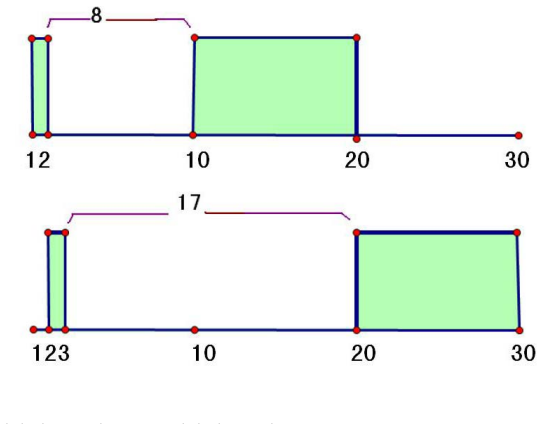
- [Fig. 2 caption] The caption contains a typo: 'the gap between the colored areas in g2(x) is wider than than that is g1(x)' should read 'wider than that in g1(x)'.
- [General text] The phrase 'err term' appears several times (e.g., in the introduction and near Eq. (31)); it should be 'error term'.
- [Eq. (20)] In Eq. (20), the notation 'logb(1 + l d)' appears to be missing a slash; it should likely be 'log_b(1 + l/d)' as in Eq. (18) and Eq. (19).
- [Paragraph after Eq. (31)] The statement 'If f(s) is a positive or negative definite function' is confusing: the variable should be ~f(s), and 'definite' should be 'definite sign' or 'nonnegative/nonpositive'. The connection to complete monotonicity of F is also stated imprecisely.
- [References] The error estimate in Eq. (29) relies on Corollary 2 of Ref. [34], but the relation between ~f(s) and h1(x) is stated too briefly; a reader would need more detail to verify the applicability of that result.
Circularity Check
No significant circularity: Benford's law is derived, not assumed; the uncontrolled sum-to-integral approximation in Eq. (11) is a rigor gap, not circular reasoning.
full rationale
The derivation chain is self-contained: P_d is defined exactly as ∫F g_d (Eqs. (3)-(6)); the Laplace-transform identity (9) is exact; Eq. (11) approximates a discrete sum by an integral and produces G_d(t) ≈ (1/t) log10(1+1/d); Eq. (14) is a normalization condition; and the Benford log term appears only as the output of these manipulations. No parameter is fitted to first-digit data, and Benford's law is not assumed as a premise. The main caveat is that the sum-to-integral replacement in Eq. (11) is asserted without a general error bound, and the paper defers the rigorous version to the authors' own Ref. [32]; however, that is a mathematical rigor/correctness concern, not an instance of the conclusion being equivalent to the premises by construction. The paper is transparent that Eqs. (11)-(13) are approximate, and the numerical bound for the special case b=10, d=l=1 comes from the external Ref. [34]. Thus there is no circular step; the self-citation for the strict treatment is minor and not load-bearing.
Assumptions & free parameters
assumptions (2)
- domain assumption Every 'well-behaved' probability density F admits a representation F(x) = ∫_0^∞ f(t) e^{−xt} dt for some function f (the inverse Laplace transform).
- ad hoc to paper The discrete sum over integer n in Eq. (10) may be replaced by an integral over real x as in Eq. (11) with negligible error.
Cite this review
Pith. "Pith review of A Proof of First Digit Law from Laplace Transform." pith.science (2026). https://pith.science/paper/OV5UFF2U
@misc{pith2026190804670,
  author       = {Pith},
  title        = {Pith review of: A Proof of First Digit Law from Laplace Transform},
  year         = {2026},
  howpublished = {\url{https://pith.science/paper/OV5UFF2U}},
  note         = {Machine review of arXiv:1908.04670}
}
abstract
The first digit law, also known as Benford's law or the significant digit law, is an empirical phenomenon that the leading digit of numbers from real world sources favors small ones in a form $\log(1+{1}/{d})$, where $d=1, 2, ..., 9$. Such a law keeps elusive for over one hundred years because it was obscure whether this law is due to the logical consequence of the number system or some mysterious mechanism of the nature. We provide a simple and elegant proof of this law from the application of the Laplace transform, which is an important tool of mathematical methods in physics. We reveal that the first digit law is originated from the basic property of the number system, thus it should be attributed as a basic mathematical knowledge for wide applications.
Figures

Reference graph
Works this paper leans on
- [32]
-
[1]
F(x) is analytic on C except for a finite number of isolated singularities; 4 FIG. 2: Images of g1(x) (upper) and g2(x) (lower), from which we notice that the gap between the colored areas in g2(x) is wider than than that is g1(x). This shows that the distribution of g1(x) is more dense than g2(x) in the whole number range
-
[2]
F(x) is analytic on the half plane {x|Rez >0}
-
[3]
There are positive constantsM,R, andβ such that|F (x)|≤ M/|x|β whenever|z|≥ R, F(x) has an inverse Laplace transform. We call a probability density function “well-behaved” if it satisfies these three conditions and its inverse Laplace transform is smooth enough, i.e., without violent oscillation. Expo- nential functions, some fractional functions, and a ha...
-
[4]
The integral of the product of F (x) and g(x) equals the integral of the product of the inverse Laplace transform of F (x) and the Laplace transform of g(x), i.e., Eq. (9). 7
-
[5]
The Laplace transform of g(x) approximately equals the Benford term divided by t, i.e., Eq. (12)
-
[6]
The normalization condition of F (x) guarantees that the integral of the inverse Laplace transform of F (x) divided by t equals 1, i.e., Eq. (14)
-
[7]
Therefore, the integral of the product of F (x) and g(x) approximately equals the Benford term, i.e., Eq. (13). Such a chain of logic is not apparent in Ref. [32]. The second significant digit law was also given by Newcomb [1]. In the decimal system, it is P (2nd digit being d) = 9∑ k=1 log10(1 + (10k +d)−1),d = 0, 1,..., 9. (15) Hill derived a general ith...
Show all 42 references
-
[8]
In fact, numerical results are 0.0005 and 0.009
We can assert that in these cases, the total errors are less than 0.03. In fact, numerical results are 0.0005 and 0.009. This verifies our estimation. As a rule of thumb, distributions with monotonic decreasing and relatively smooth proba- bility density functions often conform...
-
[9]
Newcomb S 1881 Am. J. Math. 4 39
-
[10]
Benford F 1938 Proc. Am. Phil. Soc. 78 551
1938
-
[11]
Burke J and Kincanon E 1991 Am. J. Phys. 59 952
1991
-
[12]
Ley E 1996 Am. Stat. 50 311
1996
-
[13]
Torres J, Fern´ andez S, Gamero A and Sola A 2007 Eur. J. Phys. 28 L17
2007
-
[14]
Leemis L M, Schmeiser B W and Evans D L 2000 Am. Stat. 54 236
2000
-
[15]
130 1280
Brown R J C 2005 Analyst. 130 1280
2005
-
[16]
Costas E, L´ opez-Rodas V, Toro F J and Flores-Moya A 2008 Aquat. Bot. 89 341
2008
-
[17]
Nigrini M and Miller S J 2007 Mathematical Geology 39 469
2007
-
[18]
Shao L and Ma B Q 2010 Astropart. Phys. 33 255
2010
-
[19]
Shao L and Ma B Q 2010 Physica A 389 3109
2010
-
[20]
Shao L and Ma B Q 2010 Phys. Rev. E 82 041110
2010
-
[21]
Buck B, Merchant A C and Perez S M 1993 Eur. J. Phys. 14 59
1993
-
[22]
Ni D and Ren Z 2008 Eur. Phys. J. A 38 251
2008
-
[23]
Ni D D, Wei L and Ren Z Z 2009 Commun. Theor. Phys. 51 713
2009
-
[24]
Liu X J, Zhang X P, Ni D D and Ren Z Z 2011 Eur. Phys. J. A 47 78
2011
-
[25]
Jiang H, Shen J J and Zhao Y M 2011 Chin. Phys. Lett. 28 032101
2011
-
[26]
Shao L and Ma B Q 2009 Mod. Phys. Lett. A 24 3275
2009
-
[27]
Tolle C R, Budzien J L and LaViolette R A 2000 Chaos 10 331
2000
-
[28]
Berger A, Bunimovich L A and Hill T P 2005 Trans. Am. Math. Soc. 357 197
2005
-
[29]
Berger A 2005 Discrete. Cont. Dyn. Sys. A 13 219 12
2005
-
[30]
Nigrini M J 1996 J. Am. Tax. Assoc. 18 72
1996
-
[31]
Auditor 56 21
Nigrini M J 1999 Intern. Auditor 56 21
1999
-
[33]
Diekmann A 2007 J. Appl. Stat. 34 321
2007
-
[34]
Pinkham R S 1961 Ann. Math. Stat. 32 1223
1961
-
[35]
Berger A, Hill T P and Morrison K E 2008 J. Theor. Probab. 21 97
2008
-
[36]
Hill T P 1995 Am. Math. Mon. 102 322
1995
-
[37]
Hill T P 1995 Proc. Am. Math. Soc. 123 887
1995
-
[38]
Hill T P 1995 Stat. Sci. 10 354
1995
-
[39]
Berger A, Hill T P and Rogers E 2009 Benford Online Bibliography http://www.benfordonline.net/
2009
-
[40]
Cong M, Li C and Ma B Q 2019 Phys. Lett. A 383 1836
2019
-
[41]
(New York: W
Marsden J and Hoffman M 1999 Basic complex analysis– 3rd ed. (New York: W. H. Freeman) 471
1999
-
[42]
Probabil
Engel H A and Leuenberger C 2003 Stat. Probabil. Lett. 63 361 13
2003
Reviewed August 14, 2026 · model on record in the stance chip above.
Discussion (0). Continue with ORCID to comment.