REVIEW 3 major objections 5 minor 14 references
A Microphone Array and Voice Algorithm based Smart Hearing Aid
T0 review · 3 major / 5 minor · reviewed 2026-08-14 · deepseek-v4-flash
Pith's one-line read A tabletop microphone-array hearing aid prototype reports tracking a moving speaker from five meters away and delivering a noise-suppressed voice to the user's earpiece.
desk verdict A clear, honest demo paper about a genuinely built tabletop hearing-aid prototype, but the central benefit—cleaner, intelligible earpiece audio—is never actually measured. read the letter →
The pith
A machine-rendered reading of the paper's core claim, the machinery that carries it, and where it could break.
The reading
What carries the argument
The central object is the ReSpeaker v2 microphone array, whose on-board chip runs DSP voice algorithms and outputs both a processed audio channel and raw microphone channels over USB. Because the array has multiple MEMS microphones with known spatial geometry, it can estimate the direction of arrival of a voice and form a beam that passes sound from that direction while suppressing sound from elsewhere. A Linux single-board computer runs a script that tunes the DSP parameters according to user input from the Android GUI and streams the processed channel over Bluetooth to the user's earpiece.
What would settle it
Play a recording of a noisy group conversation through the device and have hearing-impaired listeners complete a word-recognition test on the raw microphone feed and on the processed earpiece output; if the processed feed is not more intelligible, or is delayed or distorted enough to hinder conversation, the central claim fails.
Extended reading notes
Core claim
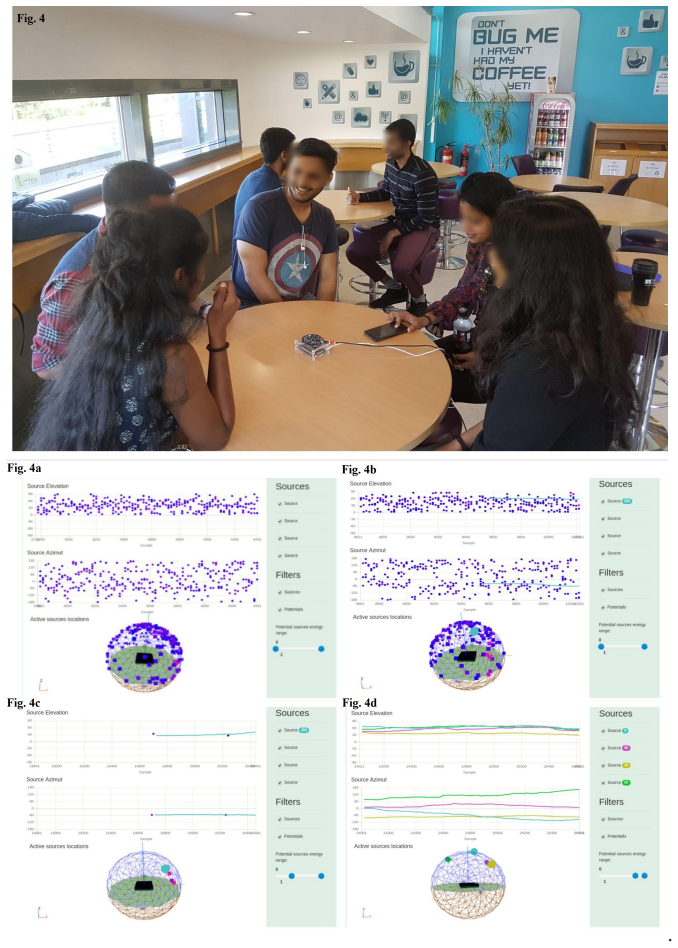
The central claim is that a four-microphone array with on-chip DSP can function as a far-field hearing aid. In the authors' tests, the device localizes a lead speaker's direction, beamforms toward that speaker, suppresses stationary and non-stationary noise, and delivers the processed audio to the user's earpiece while a ring of LEDs indicates where the sound is coming from. In a simulated lecture hall, the authors report capturing and tracking a moving lecturer from roughly five meters away; in a cafeteria, they show sound-source maps before and after noise suppression, with several voices of interest isolated from the surrounding noise. The user can adjust processing parameters, including gain, noise suppression, high-pass filtering, comfort noise insertion, and echo-cancellation threshold, through an Android interface, and can also manually select a different voice when one speaker is softer than another.
Load-bearing premise
The load-bearing premise is that the audio delivered to the user's earpiece is genuinely clearer and easier to understand than the raw microphone feed; the paper demonstrates direction tracking and noise-suppression processing, but never measures what a listener actually hears.
Editorial extensions
If this is right
- A working version of this device would let a hearing-impaired person follow a group conversation without asking speakers to wear microphones or sit close.
- The reported five-meter range suggests the same unit could be used in classrooms and lectures, with the beam automatically following a moving instructor.
- Automated speaker switching removes the need for the user to point a device or adjust direction as conversation turns from person to person.
- Phone-based tuning of gain, noise suppression, and echo thresholds makes it possible to adapt the same hardware to quiet rooms, cafeterias, and reverberant spaces.
Reading between the lines
- The paper's evidence is localization plots and LED indicators, not listening tests; the most direct next step is to measure speech intelligibility in hearing-impaired users, comparing raw microphone audio with the device's processed output.
- Because the processed output is a single stream, a future version might need to preserve spatial cues or offer binaural output so the user still senses where each speaker is located.
- End-to-end latency of the Bluetooth path is unmeasured; if it is long, live conversation could become harder despite cleaner audio, so a delay measurement would settle whether the design is practical.
- The same microphone-array and visualization pipeline could be used to quantify how many simultaneous speakers can be separated and how quickly the system switches, which the paper reports only qualitatively.
Signed reviews
Editorial analysis
A structured set of objections, weighed in public.
Referee Report
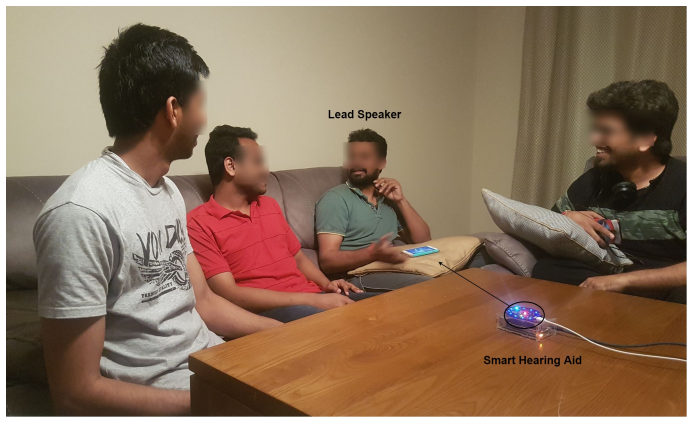
Summary. The manuscript describes a prototype "Smart Hearing Aid" built from a Linux single-board computer, a ReSpeaker v2 microphone array (XMOS XVF-3000), and an Android GUI for parameter tuning. The device is intended to capture sound from a circular microphone array, localize and track a lead speaker using beamforming, suppress stationary and non-stationary noise, cancel acoustic echo, and stream a noise-suppressed audio feed to a hearing-impaired user's Bluetooth earpiece. The paper presents the system architecture, a list of tunable DSP parameters with claimed benefits, and qualitative results from three test environments (home sitting room, university cafeteria, and simulated lecture hall). Results are illustrated with ODAS unit-sphere visualizations of sound sources and LED indicator directions that track a moving lecturer from about five meters.
Significance. If the device works as claimed, it would be a useful low-cost application of existing microphone-array hardware to a real hearing-assistive scenario, particularly for group conversations and far-field lecture listening. The paper's strengths are its integration of publicly available components (ReSpeaker v2, ODAS), the provision of a user-facing tuning interface, and concrete descriptions of deployment environments. However, the significance is currently limited because the central functional claim that the processed audio delivered to the earpiece is perceptually clearer or more intelligible than the raw microphone feed is not supported by any objective or perceptual measurement. The work is best viewed as a prototype demonstration with qualitative system-level validation.
major comments (3)
- [Section IV and Section IV-A] The central claim that the device provides a noise-suppressed, intelligible feed to the user is not directly supported. Section IV reports ODAS localization plots and LED direction indicators, which verify that sound sources can be spatially localized and tracked, but no measurement of the audio signal actually delivered to the earpiece is provided. There is no SNR measurement, no speech-intelligibility test (e.g., word recognition rate in noise), no latency measurement, and no listening test with hearing-impaired participants. Section IV-A explicitly claims far-field voice capture and noise suppression up to five meters, but these claims are supported only by visualizations. I request either objective acoustic metrics (e.g., SNR improvement, delay) or a controlled perceptual evaluation comparing the processed channel-zero audio with the raw microphone mix.
- [Section III-A and Section III-B] The signal path from the ReSpeaker v2 to the user's earpiece is described only at the block level: channel zero from the XVF-3000 via USB, then streamed via Bluetooth. The paper does not specify which DSP algorithm blocks operate on channel zero, how the Android GUI parameters map to actual firmware settings, or the sampling rate, bit depth, and end-to-end latency of the audio stream. This matters because several claimed benefits (AGC, non-stationary noise suppression, de-reverberation, AEC) are attributed to the ReSpeaker v2 firmware and are not independently verified. Without this information, it is impossible to assess whether the delivered audio is perceptually improved or simply a processed version with unknown artifacts.
- [Section II and Section IV (cafeteria test)] The automatic lead-speaker selection and voice-switching behavior is described qualitatively but no algorithm is specified, and no test is reported for the difficult case of overlapping speakers. In the cafeteria scenario the paper notes that two or more people were talking simultaneously, but the reported ODAS figures show localization of sources, not the device's selection behavior. If the switching logic is inaccurate during overlapping speech, the user could receive chopped or mis-selected audio, which would defeat the hearing aid's purpose. The authors should describe the voice activity detection and prioritization algorithm, or at least report a controlled test with overlapping talkers and measure switching accuracy and its effect on the delivered audio.
minor comments (5)
- [Section IV-d] The word "paticular" should be "particular".
- [References] Reference [10] is a self-citation to this same manuscript (arXiv:1908.07324) and should not be cited as prior work; it also makes the sentence "Recent relevant works are done by authors from [8][9][10]" confusing because [10] is the present paper.
- [Section IV] The paper says ODAS was "utilized to visualize" the sound sources, but it is unclear whether ODAS runs on the same Linux SBC as part of the prototype or on a separate evaluation setup. This distinction affects the claimed system integration and should be clarified.
- [Abstract and Section I] The phrase "6.2% of the world's population (466 million people)" is dated; the WHO has updated these estimates, but this is a minor data currency issue.
- [General] The paper contains many instances of inconsistent capitalization (e.g., "Respeaker v2" vs. "ReSpeaker v2") and some grammatical errors (e.g., "four identified voice source of interest" in the Fig. 4 caption); a careful proofread is needed.
Circularity Check
No significant circularity: the paper is an observational system description whose claims rest on external firmware and live tests, not on self-derived quantities.
full rationale
The paper contains no derivation chain in the sense of fitted parameters, equations, or predictions; it describes a prototype built around the ReSpeaker v2 microphone array and ODAS localization. The central claims (five-meter far-field capture, beam tracking, noise suppression) are supported by the device's own firmware behavior and by the Section IV test observations (ODAS unit-sphere plots and LED pixel-ring responses), not by quantities defined in terms of the claims. The self-citations [8], [9], and [10] occur only in a related-work sentence noting that the authors previously used microphone arrays in smart speakers; no load-bearing conclusion is imported from them, and [10] is merely the same arXiv preprint. Nothing is fitted and then renamed a prediction, and no uniqueness theorem or ansatz is invoked. The absence of intelligibility, SNR, or latency measurements is an evidentiary gap about whether the processed feed is perceptually better; that is a correctness concern, not circularity. The claim is therefore self-contained against external benchmarks to the extent it is testable.
Assumptions & free parameters
assumptions (3)
- domain assumption The ReSpeaker v2's on-chip DSP algorithms perform as specified by the manufacturer.
- domain assumption ODAS visualizations accurately represent the true sound sources and processed output.
- domain assumption The Linux SBC and Bluetooth earpiece deliver the processed audio without significant delay or quality loss.
Cite this review
Pith. "Pith review of A Microphone Array and Voice Algorithm based Smart Hearing Aid." pith.science (2026). https://pith.science/paper/OWC6VPAH
@misc{pith2026190807324,
  author       = {Pith},
  title        = {Pith review of: A Microphone Array and Voice Algorithm based Smart Hearing Aid},
  year         = {2026},
  howpublished = {\url{https://pith.science/paper/OWC6VPAH}},
  note         = {Machine review of arXiv:1908.07324}
}
read the original abstract
Approximately 6.2% of the world's population (466 million people) suffer from disabling hearing impairment [1]. Hearing impairment impacts negatively on one's education, financial success [2][3], cognitive development in childhood [4], including increased risk of dementia in older adulthood [5]. Lack of or reduced social interaction due to hearing impairment affects creating or maintaining healthy relationships at home, school and work [5]. Hence, hearing impairment genuinely affects the overall quality of life and wellbeing. The cocktail party effect, which is a healthy hearing individual's ability to understand one voice in a cacophony of other voices or sounds, is an important ability lacking in people with hearing impairment. This inability results in difficulties with simple daily activities such as partaking in group discussions or conversing in noisy restaurants [6]. This smart hearing aid aims to provide much-needed assistance with understanding speech in noisy environments. For example, if a person wants to partake in a group discussion, he/she needs to place the microphone array based unit on a flat surface in front of him/her, such as a table. When conversations take place, the microphone array will capture and process sound from all directions, intelligently prioritise and provide the lead speaker's voice by suppressing unwanted noises, including speeches of other people. This device selects and alternates voices between speakers automatically using voice algorithms. Additionally, the user has the option of further fine-tuning the acoustic parameters as needed through a smartphone interface. This paper describes the development and functions of this new Smart Hearing Aid.
Figures


Figures from the paper (2 more)

Reference graph
Works this paper leans on
-
[8]
B. Sudharsan, S. P. Kumar, and R. Dhakshinamurthy, “Ai vision: Smart speaker design and implementation with object detection custom skill and advanced voice interaction capability,” IEEE Xplore, p. 97102, 12
-
[9]
B. Sudharsan, P. Corcoran, and M. Ali, “Smart speaker design and implementation with biometric authentication and advanced voice interaction capability.” [Online]. Available: http://ceur-ws.org/V ol- 2563/aics 29.pdf
-
[10]
A Microphone Array and Voice Algorithm based Smart Hearing Aid
S. Bharath and C. Manigandan, “A microphone array and voice algo- rithm based smart hearing aid,” ArXiv, vol. abs/1908.07324, 2019
work page Pith review arXiv 1908
-
[1]
“Deafness and hearing loss,” Who.int, 03 2019. [On- line]. Available: https://www.who.int/en/news-room/fact-sheets/detail/ deafness-and-hearing-loss
work page 2019
-
[2]
Panel 1: Epidemiology and diagnosis,
P. Home, K. Kvrner, J. R. Casey, R. A. M. J. Damoiseaux, T. M. A. van Dongen, H. Gunasekera, R. G. Jensen, E. Kvestad, P. S. Morris, and H. M. Weinreich, “Panel 1: Epidemiology and diagnosis,” Otolaryngol- ogyHead and Neck Surgery , vol. 156, pp. S1–S21, 04 2017
work page 2017
-
[3]
The impact of hearing loss on quality of life in older adults,
D. S. Dalton, K. J. Cruickshanks, B. E. K. Klein, R. Klein, T. L. Wiley, and D. M. Nondahl, “The impact of hearing loss on quality of life in older adults,” The Gerontologist , vol. 43, pp. 661–8, 2003. [Online]. Available: https://www.ncbi.nlm.nih.gov/pubmed/14570962
-
[4]
Quality of life of deaf and hard of hearing students in ibadan metropolis, nigeria,
M. T. Jaiyeola and A. A. Adeyemo, “Quality of life of deaf and hard of hearing students in ibadan metropolis, nigeria,” PLOS ONE, vol. 13, p. e0190130, 01 2018. [Online]. Available: https://pdfs.semanticscholar. org/8b1e/6fddb66dd43de8fd190e187edeb877d7c1bd.pdf
work page 2018
-
[5]
Auditory deprivation and health in the elderly,
M. Cherko, L. Hickson, and M. Bhutta, “Auditory deprivation and health in the elderly,” Maturitas, vol. 88, pp. 52–57, 06 2016
work page 2016
Show all 14 references
-
[6]
Hearing aid use in everyday life: Managing contextual variability,
B. Williger and F. R. Lang, “Hearing aid use in everyday life: Managing contextual variability,” Gerontology, vol. 61, pp. 158–165, 11 2014
2014
-
[7]
Why do people fitted with hearing aids not wear them?
A. McCormack and H. Fortnum, “Why do people fitted with hearing aids not wear them?” International Journal of Audiology , vol. 52, pp. 360–368, 03 2013. [Online]. Available: https://www.ncbi.nlm.nih.gov/ pmc/articles/PMC3665209/
2013
-
[11]
Respeaker mic array v2.0 - seeed wiki,
Bill, “Respeaker mic array v2.0 - seeed wiki,” Seeedstudio.com,
-
[12]
introlab/odas,
introlab, “introlab/odas,” GitHub, 03 2019. [Online]. Available: https://github.com/introlab/odas
2019
-
[2016]
Available: http://wiki.seeedstudio.com/ReSpeaker Mic Array v2.0/
[Online]. Available: http://wiki.seeedstudio.com/ReSpeaker Mic Array v2.0/
-
[2019]
Available: https://ieeexplore.ieee.org/abstract/document/ 9087275
[Online]. Available: https://ieeexplore.ieee.org/abstract/document/ 9087275
Reviewed August 14, 2026 · model on record in the stance chip above.
Discussion (0). Continue with ORCID to comment.