REVIEW 2 major objections 4 minor 40 references
Cylindrical vector beam generator using a two-element interferometer
T0 review · 2 major / 4 minor · reviewed 2026-08-14 · deepseek-v4-flash
Pith's one-line read A two-element interferometer turns a single laser vortex into a cylindrical vector beam.
desk verdict A practical, inexpensive two-element interferometer for generating cylindrical vector beams; the experimental demonstration is convincing but the key phase/topological-charge assumptions about the cube beamsplitter are only qualitatively verified. read the letter →
The pith
A machine-rendered reading of the paper's core claim, the machinery that carries it, and where it could break.
The reading
What carries the argument
The key object is the two-element interferometer formed by a beam displacer (BD) and a cube beamsplitter (CBS) with its semi-reflecting layer parallel to the propagation direction. The BD separates the input into two parallel, orthogonally polarized vortices without changing their helicity, while the CBS reflection acts like a Dove prism: it flips the sign of the orbital angular momentum and adds a $\pi/2$ phase shift. This reflection-induced mode conversion, combined with a quarter-wave plate, produces the coherent superposition of $LG_{-m}$ and $LG_m$ with opposite circular polarizations that defines a cylindrical vector beam; the input polarization angles $\alpha$ and $\theta$ then position the state on the higher-order Poincaré sphere.
What would settle it
Send a pure $LG_m$ beam into the cube beamsplitter in the same orientation and measure the reflected beam's phase structure or orbital angular momentum spectrum; if the reflected beam does not carry charge $-m$ with a uniform $\pi/2$ phase, the predicted $U_3$ field would not occur. A second check is to measure the output Stokes images while rotating the input polarization: the pattern should rotate exactly with $\alpha$ on the higher-order Poincaré sphere, and any systematic asymmetry would trace to the beamsplitter's angle-dependent phase.
Extended reading notes
Core claim
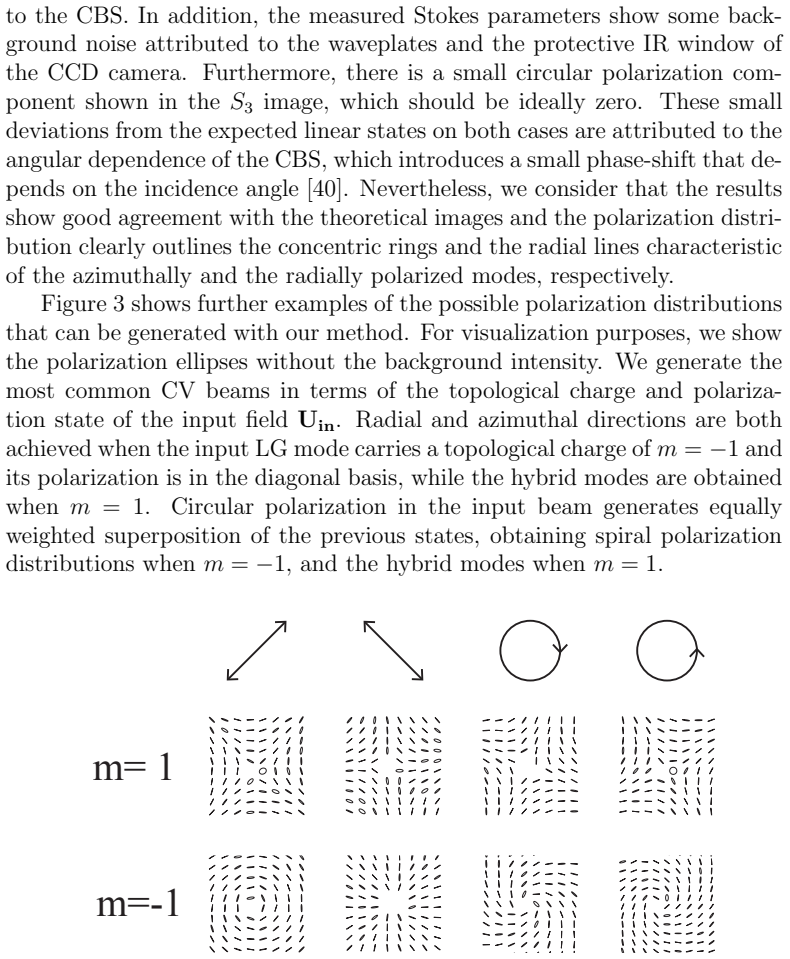
The central claim is that the two-element interferometer maps a homogeneously polarized vortex $LG_m(\cos\alpha\,\hat{x}+e^{i\theta}\sin\alpha\,\hat{y})$ onto a vector beam whose transverse polarization pattern is set by the input parameters $\alpha$ and $\theta$. After the beam displacer splits the beam into two parallel, orthogonally polarized copies, the cube beamsplitter transmits one copy and reflects the other; the reflection reverses the sign of the topological charge, $m\to -m$, and adds a $\pi/2$ phase. A following quarter-wave plate converts the linear polarization basis into circular, yielding $U_3=\frac{i}{\sqrt{2}}[\cos\alpha\,LG_{-m}\hat{c}_R-\sin\alpha\,e^{i\theta}LG_m\hat{c}_L]$. The authors show experimentally that $\alpha=-\pi/4$ reproduces the standard CV family, other input states give hybrid and spiral patterns, and $m=\pm2$ produces flower and spider-web singularities.
Load-bearing premise
The load-bearing assumption is that the cube beamsplitter's reflection flips the sign of the vortex's topological charge and adds the same $\pi/2$ phase to both polarization components; if that reflection does not act as a Dove prism for both components, the needed superposition of opposite-helicity modes is not produced.
Editorial extensions
If this is right
- A single input vortex can generate radial, azimuthal, hybrid, and spiral polarization patterns simply by setting the input polarization state.
- Higher-order polarization singularities such as vectorial flowers and spider webs become available by using input vortices with $m=\pm2$.
- Because the polarization pattern is set by input polarization rather than by any moving element, the device can be switched by rotating a wave plate or changing a retardance.
- The all-refractive construction avoids absorptive metasurfaces and can be scaled to high-power beams or integrated into a monolithic interferometer.
- The method is a practical alternative to Pancharatnam-Berry phase elements for labs that have standard optics but no custom fabrication.
Reading between the lines
- The scheme is not limited to a single wavelength: since the beam displacer and beamsplitter are refractive and only the quarter-wave plate is chromatic, the same two-element interferometer should work across a broad spectral range with minor realignment.
- Because the output $U_4$ is the partner field with $m\to -m$ and $\theta\to\theta+\pi$, both interferometer outputs could be used simultaneously to produce complementary polarization patterns in two arms.
- The Dove-prism assumption for the beamsplitter reflection could be checked directly by measuring the orbital angular momentum spectrum of the reflected beam alone; a clean test would separate the core mechanism from the angular-dependent phase shift the authors attribute to the cube beamsplitter.
- The same interferometer could be cascaded or fiber-coupled to produce vector beams in different spatial modes or to prepare quantum states in the hybrid spatial-polarization basis.
Signed reviews
Editorial analysis
A structured set of objections, weighed in public.
Referee Report
Summary. This paper describes and demonstrates a two-element interferometric generator of cylindrical vector beams. A Laguerre-Gaussian vortex with elliptical polarization enters a beam displacer that separates it into two orthogonally polarized vortices; a cube beamsplitter then superposes the transmitted arm of one beam with the reflected arm of the other, where the reflection is assumed to add a π/2 phase and invert the vortex charge m. A quarter-wave plate converts the linear basis to circular, yielding Eq. (8), a superposition of opposite-charge vortices in opposite circular polarizations. The authors present Stokes-polarimetry measurements of radial, azimuthal, hybrid, spiral, and higher-order (flower/spider) polarization patterns and show how the input polarization parameters (α, θ) map to paths on the higher-order Poincaré sphere.
Significance. If the characterization in Eqs. (6)-(9) is correct, the paper offers a simple, robust, off-the-shelf alternative to q-plates and metasurfaces, with a clear mapping to the higher-order Poincaré sphere and plausible monolithic and high-power variants. The analytic model is explicit, the experiments cover a broad set of cylindrical-vector-beam families, and the component count is genuinely minimal. The main weakness is that the central model imports a Dove-prism-like reflection behavior from Ref. [38] to a cube beamsplitter without independent verification, and the experimental comparison is qualitative. These issues are addressable and do not undermine the potential value of the device, but they are load-bearing for the paper's central claim.
major comments (2)
- [§3, Eqs. (6)-(8)] The derivation assumes two properties of the cube-beamsplitter reflection: a π/2 phase shift and an inversion m→−m for both reflected beams. Ref. [38] supports the charge inversion for a Dove prism, not for a cube beamsplitter; the geometry of reflection at the internal coating is different, and the reflection phase is not shown to be π/2 for both polarization components. Because Eq. (8) is the theoretical backbone for all subsequent experimental claims, this assumption is load-bearing rather than a detail. Please add an independent determination of the CBS reflection operation, for example by sending a known LG mode through the reflected arm alone and measuring the output mode and relative phase, and use the result to update Eqs. (6)-(9). The paper's own caveat in §5 that the CBS has an angular-dependent phase shift (Ref. [40]) makes this verification necessary; any deviation from π/2 changes the relative phase between the c_R and c_L components and moves the output to a different point on the higher-order Poincaré sphere than the one claimed.
- [§5, Figs. 2-4] The experimental validation is qualitative: agreement between theory and experiment is judged visually, and the measured Stokes images are not compared numerically with the simulations. Since the theory already encodes the unverified CBS phase and mode-inversion assumptions, visually similar patterns are not a strong independent check; a range of phase errors near π/2 would still produce recognizable radial or azimuthal patterns. Please provide a quantitative fidelity metric, for example normalized root-mean-square errors of S1, S2, and S3, a correlation coefficient between measured and predicted Stokes images, or measured S3 statistics, for the cases in Figs. 2 and 4, and state the implied uncertainty in the CBS phase.
minor comments (4)
- [§3, after Eq. (7)] The transformation of U3' and U4' into U3 and U4 by the quarter-wave plate at 45° is not written explicitly; please include the QWP Jones matrix or specify the convention for c_R and c_L so that the sign of θ in Eq. (8) is unambiguous.
- [§5] The statement that deviations are attributed to the angular dependence of the CBS cites Ref. [40], which concerns polarizing beam-splitter cubes; please clarify how this reference applies to the non-polarizing BS013 used here and give a quantitative estimate of the expected phase variation.
- [§3, Eqs. (4)-(5)] The phase difference between the ordinary and extraordinary paths in the beam displacer is neglected with a note that it can be compensated through θ, but no calibration is described; please state whether the waveplates were used to cancel this phase and how the residual was assessed.
- [Abstract and §4] The phrase 'a single vortex beam' could be read as a fixed input mode; because the topological charge m is changed between measurements to obtain the different families, please clarify that the input vortex charge is a control parameter.
Circularity Check
No circularity: the output field is a genuine model prediction from independently controlled input parameters, not a fit or self-citation result.
full rationale
The derivation chain is self-contained: Eq. (8) is obtained by applying explicit, stated transformation rules to the input field Eq. (2): the beam displacer separates the polarization components, the cube beamsplitter transmits a replica while reflecting with a pi/2 phase shift and an m-to-minus-m inversion taken from the external Dove-prism result of Ref. [38], and the quarter-wave plate converts the basis to circular polarization. No parameter is fitted to the output field; alpha, theta, and m are independently controlled input variables, and the measured Stokes parameters are compared with the theoretical field rather than used to infer it. There are no self-citations carrying the argument; the cited Dove-prism OAM inversion is an external result, and the claim that a cube beamsplitter reflection behaves analogously is an assumption that could be wrong but is not circular. The acknowledged angular-dependent phase shift introduced by the CBS [40] is a limitation and error source, not a circular step. Under the stated rules, no equation or claim reduces by construction to its own inputs, so the circularity score is 0.
Assumptions & free parameters
assumptions (3)
- domain assumption Reflection at the cube beamsplitter inverts OAM helicity (m to -m) and imparts a pi/2 phase shift, equivalent to a Dove prism, for both incident polarizations.
- domain assumption The beam displacer separates the input into two orthogonally polarized beams with identical spatial mode and no relative phase.
- standard math The quarter-wave plate at 45 degrees converts the Cartesian polarization basis to the circular basis c_R = x - i y, c_L = x + i y.
Cite this review
Pith. "Pith review of Cylindrical vector beam generator using a two-element interferometer." pith.science (2026). https://pith.science/paper/OYFGD55P
@misc{pith2026190807562,
  author       = {Pith},
  title        = {Pith review of: Cylindrical vector beam generator using a two-element interferometer},
  year         = {2026},
  howpublished = {\url{https://pith.science/paper/OYFGD55P}},
  note         = {Machine review of arXiv:1908.07562}
}
read the original abstract
We realize a robust and compact cylindrical vector beam generator which consists of a simple two-element interferometer composed of a beam displacer and a cube beamsplitter. The interferometer operates on the higher-order Poincare sphere transforming a homogeneously polarized vortex into a cylindrical vector (CV) beam. We experimentally demonstrate the transformation of a single vortex beam into all the well-known CV beams and show the operations on the higher-order Poincare sphere according to the control parameters. Our method offers an alternative to the Pancharatnam-Berry phase optical elements and has the potential to be implemented as a monolithic device.
Figures


Figures from the paper (2 more)


Reference graph
Works this paper leans on
-
[40]
J. Larry Pezzaniti and Russell A. Chipman. Angular dependence of polarizing beam-splitter cubes. Applied Optics, 33:1916, 1994. 17
work page 1916
-
[38]
Gonz´ alez, Gabriel Molina-Terriza, and Juan P
N. Gonz´ alez, Gabriel Molina-Terriza, and Juan P. Torres. How a dove prism transforms the orbital angular momentum of a light beam. Opt. Express, 14:9093, 2006
work page 2006
-
[1]
Thomas G. Brown and Qiwen Zhan. Focus issue: Unconventional po- larization states of light. Opt. Express, 18:10775–10776, 2010
work page 2010
-
[2]
Cylindrical vector beams: from mathematical concepts to applications
Qiwen Zhan. Cylindrical vector beams: from mathematical concepts to applications. Advances in Optics and Photonics , 1:1–57, 2009
work page 2009
-
[3]
Vectorial optical fields: recent advances and future prospects
Jian Chen, Chenhao Wan, and Qiwen Zhan. Vectorial optical fields: recent advances and future prospects. Science Bulletin, 63:54–74, 2018
work page 2018
-
[4]
Galvez, Shreeya Khadka, William H
Enrique J. Galvez, Shreeya Khadka, William H. Schubert, and Sean Nomoto. Poincar´ e-beam patterns produced by nonseparable superpo- sitions of Laguerre–Gauss and polarization modes of light. Appl. Opt., 51:2925–2934, 2012
work page 2012
-
[5]
A new type of vector fields with hybrid states of polarization
Xi-Lin Wang, Yongnan Li, Jing Chen, Cheng-Shan Guo, Jianping Ding, and Hui-Tian Wang. A new type of vector fields with hybrid states of polarization. Opt. Express, 18:10786–10795, 2010
work page 2010
-
[6]
Tailored intensity landscapes by tight focusing of singular vector beams
Eileen Otte, Kemal Tekce, and Cornelia Denz. Tailored intensity landscapes by tight focusing of singular vector beams. Opt. Express , 25:20194–20201, 2017
work page 2017
Show all 40 references
-
[7]
Polarization flowers
Isaac Freund. Polarization flowers. Opt. Comm., 199:47–63, 2001
2001
-
[8]
Tight focusing of spirally polarized vortex beams
Jixiong Pu and Zhiming Zhang. Tight focusing of spirally polarized vortex beams. Optics & Laser Technology, 42:186–191, 2010. 13
2010
-
[9]
Porfirev, Andrey V
Alexey P. Porfirev, Andrey V. Ustinov, and Svetlana N. Khonina. Polar- ization conversion when focusing cylindrically polarized vortex beams. Scientific Reports, 6:6, 2016
2016
-
[10]
Biss, Kathleen S
David P. Biss, Kathleen S. Youngworth, and Thomas G. Brown. Dark- field imaging with cylindrical-vector beams. Applied Optics, 45:470–479, 2006
2006
-
[11]
Hell and Jan Wichmann
Stefan W. Hell and Jan Wichmann. Breaking the diffraction resolution limit by stimulated emission: stimulated-emission-depletion fluorescence microscopy. Optics Letters, 19:780–782, 1994
1994
-
[12]
David G. Grier. A revolution in optical manipulation. Nature, 424:810, 2003
2003
-
[13]
Optical cage generated by azimuthal- and radial-variant vector beams
Zhongsheng Man, Zhidong Bai, Jinjian Li, Shuoshuo Zhang, Xiaoyu Li, Yuquan Zhang, Xiaolu Ge, and Shenggui Fu. Optical cage generated by azimuthal- and radial-variant vector beams. Applied Optics, 57:3592– 3597, 2018
2018
-
[14]
Turpin, V
A. Turpin, V. Shvedov, C. Hnatovsky, Yu V. Loiko, J. Mompart, and W. Krolikowski. Optical vault: A reconfigurable bottle beam based on conical refraction of light. Optics Express, 21:26335–26340, 2013
2013
-
[15]
Cre- ation of tunable multiple 3d dark spots with cylindrical vector beam
Xiaoyu Weng, Xiumin Gao, Hanming Guo, and Songlin Zhuang. Cre- ation of tunable multiple 3d dark spots with cylindrical vector beam. Applied Optics, 53:2470–2476, 2014
2014
-
[16]
Microdrilling in steel using ultrashort pulsed laser beams with radial and azimuthal polarization
Martin Kraus, Marwan Abdou Ahmed, Andreas Michalowski, Andreas Voss, Rudolf Weber, and Thomas Graf. Microdrilling in steel using ultrashort pulsed laser beams with radial and azimuthal polarization. Optics Express, 18:22305–22313, 2010
2010
-
[17]
Shvedov, and Wieslaw Krolikowski
Cyril Hnatovsky, Vladlen G. Shvedov, and Wieslaw Krolikowski. The role of light-induced nanostructures in femtosecond laser micromachin- ing with vector and scalar pulses. Optics Express, 21:12651–12656, 2013
2013
-
[18]
Optical-vortex laser ablation
Junichi Hamazaki, Ryuji Morita, Keisuke Chujo, Yusuke Kobayashi, Satoshi Tanda, and Takashige Omatsu. Optical-vortex laser ablation. Optics Express, 18:2144–2151, 2010. 14
2010
-
[19]
Shvedov, Natalia Shostka, Andrei V
Cyril Hnatovsky, Vladlen G. Shvedov, Natalia Shostka, Andrei V. Rode, and Wieslaw Krolikowski. Polarization-dependent ablation of silicon us- ing tightly focused femtosecond laser vortex pulses.Optics Lett., 37:226– 228, 2012
2012
-
[20]
Padgett, Mikhail Vas- netsov, Valeriy Pasko, Stephen M
Graham Gibson, Johannes Courtial, Miles J. Padgett, Mikhail Vas- netsov, Valeriy Pasko, Stephen M. Barnett, and Sonja Franke-Arnold. Free-space information transfer using light beams carrying orbital an- gular momentum. Optics Express, 12:5448–5456, 2004
2004
-
[21]
Willner, and Siddharth Ramachandran
Nenad Bozinovic, Yang Yue, Yongxiong Ren, Moshe Tur, Poul Kris- tensen, Hao Huang, Alan E. Willner, and Siddharth Ramachandran. Terabit-scale orbital angular momentum mode division multiplexing in fibers. Science, 340:1545–1548, 2013
2013
-
[22]
Generation of a radially polarized laser beam by use of a conical Brewster prism
Yuichi Kozawa and Shunichi Sato. Generation of a radially polarized laser beam by use of a conical Brewster prism. Optics Letters, 30:3063– 3065, 2005
2005
-
[23]
Vogel, and Thomas Graf
Marwan Abdou Ahmed, Andreas Voss, Moritz M. Vogel, and Thomas Graf. Multilayer polarizing grating mirror used for the generation of radial polarization in yb:yag thin-disk lasers. Optics Letters, 32:3272– 3274, 2007
2007
-
[24]
Si- multaneous generation of multiple vector beams on a single SLM.Optics Express, 25:25697–25706, 2017
Carmelo Rosales-Guzm´ an, Nkosiphile Bhebhe, and Andrew Forbes. Si- multaneous generation of multiple vector beams on a single SLM.Optics Express, 25:25697–25706, 2017
2017
-
[25]
Generation of arbitrary vector beams with a spatial light modulator and a common path interferometric arrangement
Xi-Lin Wang, Jianping Ding, Wei-Jiang Ni, Cheng-Shan Guo, and Hui- Tian Wang. Generation of arbitrary vector beams with a spatial light modulator and a common path interferometric arrangement. Optics Letters, 32:3549–3551, 2007
2007
-
[26]
Generation of vector beam with space-variant distribution of both polarization and phase
Hao Chen, Jingjing Hao, Bai-Fu Zhang, Ji Xu, Jianping Ding, and Hui- Tian Wang. Generation of vector beam with space-variant distribution of both polarization and phase. Opt. Lett., 36:3179–81, 2011
2011
-
[27]
An efficient and robust scheme for controlling the states of polarization in a sagnac interferometric con- figuration
Si-Min Li, Sheng-Xia Qian, Ling-Jun Kong, Zhi-Cheng Ren, Yongnan Li, Chenghou Tu, and Hui-Tian Wang. An efficient and robust scheme for controlling the states of polarization in a sagnac interferometric con- figuration. Europhysics Letters, 105:64006, 2014. 15
2014
-
[28]
Compact, ro- bust, and high-efficiency generator of vector optical fields
Rui Liu, Ling-Jun Kong, Wen-Rong Qi, Shuang-Yin Huang, Zhou-Xiang Wang, Chenghou Tu, Yongnan Li, and Hui-Tian Wang. Compact, ro- bust, and high-efficiency generator of vector optical fields. Optics Let- ters, 44:2382–2385, 2019
2019
-
[29]
J. P. Balthasar Mueller, Noah A. Rubin, Robert C. Devlin, Benedikt Groever, and Federico Capasso. Metasurface polarization optics: In- dependent phase control of arbitrary orthogonal states of polarization. Phys. Rev. Lett., 118:113901, 2017
2017
-
[30]
Polarization pattern of vector vortex beams generated by q-plates with different topological charges
Filippo Cardano, Ebrahim Karimi, Sergei Slussarenko, Lorenzo Mar- rucci, Corrado de Lisio, and Enrico Santamato. Polarization pattern of vector vortex beams generated by q-plates with different topological charges. Appl. Opt., 51:C1–C6, 2012
2012
-
[31]
Giovanni Milione, H. I. Sztul, D. A. Nolan, and R. R. Alfano. Higher- order poincar´ e sphere, stokes parameters, and the angular momentum of light. Physical Review Letters, 107:053601, 2011
2011
-
[32]
Evans, D
Giovanni Milione, S. Evans, D. A. Nolan, and R. R. Alfano. Higher order pancharatnam-berry phase and the angular momentum of light. Phys. Rev. Lett., 108:190401, 2012
2012
-
[33]
Classical and quantum properties of cylindri- cally polarized states of light
Annemarie Holleczek, Andrea Aiello, Christian Gabriel, Christoph Mar- quardt, and Gerd Leuchs. Classical and quantum properties of cylindri- cally polarized states of light. Optics Express, 19:9714, 2011
2011
-
[34]
Yao and Miles J
Alison M. Yao and Miles J. Padgett. Orbital angular momentum: ori- gins, behavior and applications. Adv. Opt. Photon. , 3, 2011
2011
-
[35]
Accurate encoding of arbitrary complex fields with amplitude-only liquid crystal spatial light modulators
Victor Arriz´ on, Guadalupe M´ endez, and David S´ anchez de La-Llave. Accurate encoding of arbitrary complex fields with amplitude-only liquid crystal spatial light modulators. Opt. Express, 13:7913–7927, 2005
2005
-
[36]
Mode transformations in terms of the constituent Hermite-Gaussian or Laguerre-Gaussian modes and the variable-phase mode converter
Anna T O Neil and Johannes Courtial. Mode transformations in terms of the constituent Hermite-Gaussian or Laguerre-Gaussian modes and the variable-phase mode converter. Optics Communications, 181:35–45, 2000
2000
-
[37]
Ferrari and Erna M
Jos´ e A. Ferrari and Erna M. Frins. Single-element interferometer.Optics Communications, 279:235–239, 2007. 16
2007
-
[39]
Polarized light and optical systems
Young G Chipman R A, Lam W T. Polarized light and optical systems . CRC Press, Boca Raton, FL, 2019
2019
Reviewed August 14, 2026 · model on record in the stance chip above.
Discussion (0). Continue with ORCID to comment.