REVIEW 3 major objections 4 minor 31 references
Evaluation of cosmogenic Ge-68 background in a high purity germanium detector via a time series fitting method
T0 review · 3 major / 4 minor · reviewed 2026-08-11 · deepseek-v4-flash
Pith's one-line read A maximum-likelihood fit to 90 days of count-rate time series in a shielded HPGe detector separates the decaying Ge-68 signal from airborne radon-daughter variations, yielding an initial Ge-68 activity of 477 ± 112 µBq/kg and showing it…
desk verdict A plausible and useful Ge-68 measurement for the CJPL detector that needs a systematics pass and a corrected abstract before the 477 µBq/kg number should be quoted. read the letter →
The pith
A machine-rendered reading of the paper's core claim, the machinery that carries it, and where it could break.
The reading
What carries the argument
The central object is the time-series count-rate model, which expresses the rate in each energy window as a sum of three terms: a sum over cosmogenic isotopes decaying with their known half-lives, a sum over airborne radon daughters scaled by their concentrations, and a per-window time-invariant background. The argument is carried by combining three energy windows—609 ± 5 keV and 1764 ± 6 keV, which are dominated by airborne Bi-214, and 1000-3000 keV, the Ge-68/Ga-68 signal region—so that the Bi-214 peaks fix the radon term while the 1-3 MeV series carries the Ge-68 decay information. Detection efficiencies connecting count rate to activity and concentration are computed with a Monte Carlo simulation of the detector and its shielding, and the parameters are estimated by maximizing the Poisson likelihood with Markov-chain Monte Carlo sampling.
What would settle it
Measure the same detector's Ge-68 activity independently through the 10.38 keV KX-ray peak or with a calibrated Ge-68 source and compare with the 477 µBq/kg value; alternatively, fit Bi-214 concentrations separately from the 609 keV and 1764 keV lines and check their consistency—a large discrepancy would indicate non-uniform radon-daughter distributions and invalidate the efficiency scaling.
Extended reading notes
Core claim
The paper's central discovery is that Ge-68 activity in an underground HPGe spectrometer can be extracted from the time dependence of the 1-3 MeV count rate, provided the airborne radon-daughter term is simultaneously constrained by its characteristic gamma lines. Modeling each energy window as the sum of an exponentially decaying cosmogenic component, a time-varying Bi-214 component, and a constant background, and fitting with a Poisson maximum-likelihood MCMC, the authors obtain an initial Ge-68 activity of 476.95 ± 112.38 µBq/kg and an average airborne Bi-214 concentration of 1.42 ± 0.17 Bq/m³. The no-Ge-68 hypothesis is rejected at 99.64% confidence, and the fitted activity implies that Ge-68 and Ga-68 supplied 55.9 ± 13.2 counts per day of the 90.9 ± 1.0 counts per day measured in the 1-3 MeV region—about 62% at the start of the measurement. Over the 90-day window the Ge-68 contribution decays by roughly 30%.
Load-bearing premise
The load-bearing premise is that airborne radon daughters are uniformly distributed in the measurement chamber and that Bi-214 is the only radon component that varies in time; if radon daughters plate out on surfaces instead, the conversion from Bi-214 concentration to count rate is wrong and the fitted Ge-68 activity shifts because the two time shapes are partially correlated.
Editorial extensions
If this is right
- Ge-68 and Ga-68 in equilibrium must be included in background models of underground HPGe spectrometers, since they account for about 62% of the 1-3 MeV count rate at the start of this measurement.
- After five years underground, the Ge-68 activity decays to about 4.5 µBq/kg, improving the minimum detectable activity of the four studied gamma lines by 2% to 8%, with the largest gain for the 1764.5 keV Bi-214 line.
- The fitted airborne Bi-214 concentration, averaging 1.42 ± 0.17 Bq/m³ and about 40 times below the hall radon level, provides a way to monitor nitrogen purging and shielding integrity.
- The time-series fitting approach can be extended to other cosmogenic isotopes such as Mn-54, Co-57, and Co-58, as long as their decay is large enough to be seen over the measurement period.
Reading between the lines
- If the method is correct, any underground HPGe spectrometer with a stable purge and a low constant background could use the same three-window fit to track its own Ge-68 inventory without needing low-energy X-ray capability.
- The strongest correlation in the fit is between Ge-68 activity and the constant 1-3 MeV background, so a longer measurement or additional energy windows that break that degeneracy would likely shrink the ±112 µBq/kg uncertainty.
- The uniform-radon assumption could be tested by fitting Bi-214 concentrations separately from the 609 keV and 1764 keV lines; a large disagreement would indicate plate-out or spatial non-uniformity and would directly call the fitted Ge-68 amplitude into question.
- The sensitivity study implies the method's practical reach is limited to well-shielded, low-background setups, since the Ge-68 significance falls below 90% when the time-invariant background is increased fourfold.
Signed reviews
Editorial analysis
A structured set of objections, weighed in public.
Referee Report
Summary. The paper presents a time-series fitting method to extract the cosmogenic Ge-68 activity in a p-type coaxial HPGe detector operated at CJPL from 90 days of background data. The model combines an exponentially decaying Ge-68/Ga-68 component, airborne Bi-214 concentrations constrained by the 609 keV and 1764 keV peaks, and a time-invariant background in three energy windows. A maximum-likelihood fit with MCMC sampling gives an initial Ge-68 activity of 477.0 ± 112.4 µBq/kg, a 99.64% significance for the Ge-68 signal, a contribution of about 62% to the measured 1–3 MeV background, estimates of airborne Bi-214 variations, and projections of 2–8% MDA improvements for four characteristic gamma lines after five years of underground operation.
Significance. If the fitted activity is reliable, the paper provides a useful complement to X-ray-peak-based Ge-68 assay methods, particularly for detectors without low-energy coverage. The method is also of interest because it uses only the time dependence of a featureless 1–3 MeV continuum plus two radon daughter peaks, and it simultaneously monitors radon daughter levels in the detector chamber. The paper has several strengths: a Geant4 simulation validated against calibration spectra, an MC-based hypothesis test for the Ge-68 signal, a published fitting toolkit (UltraNest), and a quantitative statement of the fit uncertainty. The main weakness is that the two governing assumptions—uniform airborne radon daughters and a 0.5 mm dead layer—are not validated or propagated into the final uncertainty, so the quoted ±112.4 µBq/kg is statistical only.
major comments (3)
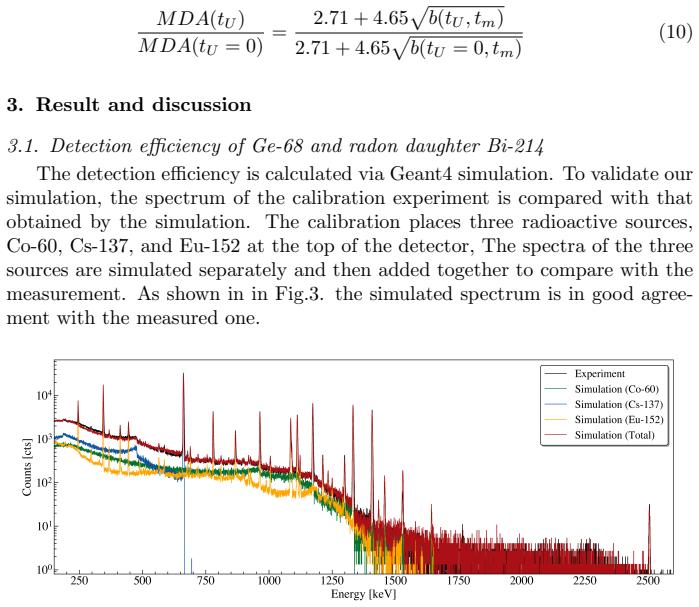
- [Sec. 2.2 and Sec. 3.1] The uniform-volume assumption for airborne Bi-214 is load-bearing and unvalidated. Equations (1)–(3) model Bi-214 as a uniform volume source with efficiencies of 3.1, 0.73, and 7.6 cpd/(Bq/m3) in the 609 keV, 1764 keV, and 1–3 MeV windows, respectively. The calibration comparison in Fig. 3 uses sources placed on top of the detector, so it does not validate the spatial distribution of radon daughters inside the chamber. If radon daughters plate out on the copper or detector surfaces, the ratio of the 609/1764 keV efficiencies to the 1–3 MeV efficiency changes, and the characteristic peaks no longer correctly constrain the Bi-214 contribution in 1–3 MeV. Because C_Bi(t) is a free parameter in every 3-day bin, a slowly varying surface-deposited Bi-214 component could partially mimic the exponential Ge-68 decay. The paper should either validate the uniform-volume assumption (e.g., with a surface-source Geant4 simulation or an independent measurement of plate-out) or quantify how much the fitted Ge-68 activity shifts under an alternative geometry.
- [Sec. 3.1] The dead-layer thickness is fixed at 0.5 mm according to the manufacturer and its uncertainty is not considered. The conversion from fitted count rate to Ge-68 activity in Eq. (1) uses ε_Ge-68 directly, so an incorrect dead layer would change the reported 477 µBq/kg value. This is a systematic effect, not a statistical one, and should be quantified—for example, by repeating the fit and efficiency calculation for a plausible range of dead-layer thicknesses.
- [Abstract and Sec. 3.2] The abstract states that during the measurement Ge-68 activity decreased by about 30%, but the measurement covers 90 days and the Ge-68 half-life is 270.9 days, which implies a decrease of about 21% (exp(-ln2 × 90/270.9) ≈ 0.79). This inconsistency should be corrected.
minor comments (4)
- [Sec. 2.2] There are typographical errors throughout, e.g., 'Possion' should be 'Poisson', 'provids' should be 'provides', 'Tabel.1' should be 'Table 1', 'aclcualtion' should be 'calculation', and 'unknow' should be 'unknown'.
- [Sec. 2.3] In Eq. (6), the P-value is defined as an integral from -∞ to s_obs; for a log-likelihood test statistic, the ordering convention should be stated explicitly so the reader understands why small s_obs corresponds to a 'worse' fit.
- [Sec. 3.3] In the MDA projection, the assumption that airborne radon daughter background is constant is stated for simplicity, but the actual fitted Bi-214 variation in Sec. 3.4 is up to ~5 Bq/m3. A sentence quantifying whether this variation affects the projected MDA improvements would help the reader.
- [Fig. 6] The phrase 'shown in Fig.6 alone with the observed value' should read 'along with the observed value'.
Circularity Check
No significant circularity: the Ge-68 activity is a genuinely fitted parameter from a time-series likelihood, and the MDA projection is a direct application of that fit, not independent evidence.
full rationale
The paper's central quantity, A0,Ge-68, is introduced as a free parameter in the rate model of Eq. (1) and estimated by maximizing the Poisson likelihood in Eq. (4) against three energy windows: the two Bi-214 peaks and the 1-3 MeV window. The Ge-68 amplitude is identified by its known 270.9-day decay time constant, while the Bi-214 contribution is constrained by its characteristic peaks and the time-invariant component is a separate constant. No equation defines A0,Ge-68 in terms of itself or in terms of a previously fitted value, and the significance test in Sec. 2.3 explicitly compares a no-Ge-68 null hypothesis against the best-fit alternative. The MDA improvement in Sec. 3.3 uses the fitted activity in Eq. (9) to project future backgrounds; this is a legitimate application of an estimated parameter, not a 'prediction' of the parameter itself. Self-citations [22] and [23] supply detector geometry, calibration, and prior activities of other cosmogenic isotopes, but these are not the source of the Ge-68 result and are not used to forbid alternative explanations. The uniform-airborne-radon assumption is a modeling assumption with potential systematic impact, but it is not a circularity: the fit would be biased if the geometry were wrong, yet the derivation does not reduce to its inputs by construction. Overall, the core derivation is self-contained; only minor non-load-bearing self-citations warrant a small score.
Assumptions & free parameters
free parameters (3)
- A0,Ge-68 (initial Ge-68 activity) =
476.95 ± 112.38 µBq/kg
- Bi-214 concentration time series (30 values) =
average 1.42 ± 0.17 Bq/m3
- Time-invariant background B in each energy range =
B_609 = 1.24 ± 0.53, B_1764 = 0.12 ± 0.12, B_1-3MeV = 25.81 ± 12.71 cpd
assumptions (6)
- domain assumption Ge-68 and Ga-68 are in radioactive equilibrium
- domain assumption Airborne radon daughters are uniformly distributed in the detector chamber
- domain assumption Time-invariant background is constant over the 90-day measurement
- domain assumption Geant4 simulation with 0.5 mm dead layer accurately reproduces detection efficiencies
- standard math Poisson statistics for counts in each time-energy bin
- ad hoc to paper Contributions from other cosmogenic isotopes (Mn-54, Co-57, Co-58) are negligible in the selected windows
Cite this review
Pith. "Pith review of Evaluation of cosmogenic Ge-68 background in a high purity germanium detector via a time series fitting method." pith.science (2026). https://pith.science/paper/OYNZSZSN
@misc{pith2026241214437,
  author       = {Pith},
  title        = {Pith review of: Evaluation of cosmogenic Ge-68 background in a high purity germanium detector via a time series fitting method},
  year         = {2026},
  howpublished = {\url{https://pith.science/paper/OYNZSZSN}},
  note         = {Machine review of arXiv:2412.14437}
}
abstract
Ge-68 is a cosmogenic isotope in germanium with a half-life of 270.9 days.Ge-68 and its decay daughter Ga-68 contribute considerable background with energy up to 3 MeV to low background $\gamma$ spectrometers using high purity germanium (HPGe) detectors. In this paper, we evaluated the background of Ge-68 and Ga-68 in a $p$-type coaxial HPGe detector operated at China Jinping underground laboratory (CJPL) via a time series fitting method. Under the assumption that Ge-68 and Ga-68 are in radioactive equilibrium and airborne radon daughters are uniformly distributed in the measurement chamber of the spectrometer, we fit the time series of count rate in 1-3 MeV to calculate the Ge-68 activity, radon daughter concentrations, and the time-invariant background component. A total of 90-day measurement data were used in the analysis, a hypothesis test confirmed a significant Ge-68 signal at 99.64% confidence level. The initial activity of Ge-68 is fitted to be 477.0$\pm$112.4 $\mu$Bq/kg, corresponding to an integral count rate of 55.9 count/day in the 1-3 MeV range. During the measurement, Ge-68 activity decreased by about 30%, contributing about 62% of the total background in the 1-3 MeV range. Our method also provides an estimation of the variation of airborne radon daughter concentrations in the measurement chamber, which could be used to monitor the performance of radon reduction measures.
Figures


Figures from the paper (9 more)


Reference graph
Works this paper leans on
-
[1]
R. D. Baertsch and N. R. Hall. IEEE Trans Nucl Sci.17, 3, 235-240, (1970)
work page 1970
-
[2]
W. L. Hansen. Nucl. Instrum. Methods. 94, 377-380 (1971)
work page 1971
-
[3]
E.E. Haller. Mater Sci Semicond Process. 9, 4, 408-422 (2006)
work page 2006
-
[4]
E. V. Bugaev, et al . Phys. Rev. D. 58, 054001 (1998)
work page 1998
-
[5]
W. H. Zeng, et al . NUCL SCI TECH. 31, 51 (2020)
work page 2020
- [6]
-
[7]
S. Agostinelli, et al . Nucl. Instrum. Meth. A. 506, 250-303 (2003)
work page 2003
- [8]
Show all 31 references
-
[9]
Allison, et al
J. Allison, et al . Nucl. Instrum. Meth. A. 835, 186-225 (2016)
2016
-
[10]
J. L. Ma, et al . Sci. China-Phys. Mech. Astron. 62, 011011 (2019)
2019
-
[11]
Turkat, et al
S. Turkat, et al . Astropart. Phys. 148, 102816 (2023)
2023
-
[12]
Aralis, et al
T. Aralis, et al . (SuperCDMS Collaboration), Phys. Rev. D. 101, 052008 (2020)
2020
-
[13]
Jiang et al
H. Jiang et al. (CDEX Collaboration), Phys. Rev. Lett.120, 241301 (2018)
2018
-
[14]
Agostini, et al
M. Agostini, et al. (GERDA Collaboration), Phys. Rev. Lett. 125, 252502 (2020)
2020
-
[15]
Arnquist, et al
I.J. Arnquist, et al . (MAJORANA Collaboration), Phys. Rev. Lett. 130, 062501 (2023)
2023
-
[16]
Abgrall, et al
N. Abgrall, et al. (LEGEND Collaboration), AIP Conf Proc. 1894: 020027 (2017)
2017
-
[17]
Abgrall, et al
N. Abgrall, et al . Nucl. Instrum. Meth. A. 877: 314-322 (2018)
2018
-
[18]
Agostini, et al
M. Agostini, et al . JHEP. 03: 139 (2020)
2020
-
[19]
L. T. Yang, et al . Chinese Phys. C. 42, 023002 (2018). 16
2018
-
[20]
Bonet, et al
H. Bonet, et al . Eur. Phys. J. C. 83, 195 (2023)
2023
-
[21]
J. P. Chen, et al . Annu. Rev. Nucl. Part. Sci. 67, 231-51 (2017)
2017
-
[22]
Q. L. Zhang, et al . J. Tsinghua Univ (Sci Technol) (in Chinese). 64, 1 (2024)
2024
-
[23]
J. K. Chen, et al . (in press) (2024)
2024
-
[24]
Biometrika
W.K.Hastings. Biometrika. 57, 1:97-109 (1970)
1970
-
[25]
https://johannesbuchner.github.io/UltraNest/readme.html
UltraNest toolkit. https://johannesbuchner.github.io/UltraNest/readme.html
-
[26]
G. Cowan. Statistical Data Analysis. Clarendon press Oxford. 4, 46-48 (1998)
1998
-
[27]
G. F. Knoll. Radiation Detection and Measurement (4th edition). Wiley (2015)
2015
-
[28]
Wei, et al
W.Z. Wei, et al . Astropart. Phys. 96, 24-31 (2017)
2017
-
[29]
Nie, et al
Q.Y. Nie, et al . JINST. 19, P03002 (2024)
2024
-
[30]
Agostini, et al
M. Agostini, et al . Eur. Phys. J. C. 75, 39 (2015)
2015
-
[31]
S. R. Elliott, et al . Phys. Rev. C. 82, 054610 (2010). 17
2010
Reviewed August 11, 2026 · model on record in the stance chip above.
Discussion (0). Continue with ORCID to comment.