Digital Twins Need Feedback
Pith reviewed 2026-06-26 06:23 UTC · model grok-4.3
The pith
Digital twins require bidirectional feedback between physical and virtual counterparts to count as more than simulations or data mirrors.
A machine-rendered reading of the paper's core claim, the machinery that carries it, and where it could break.
Core claim
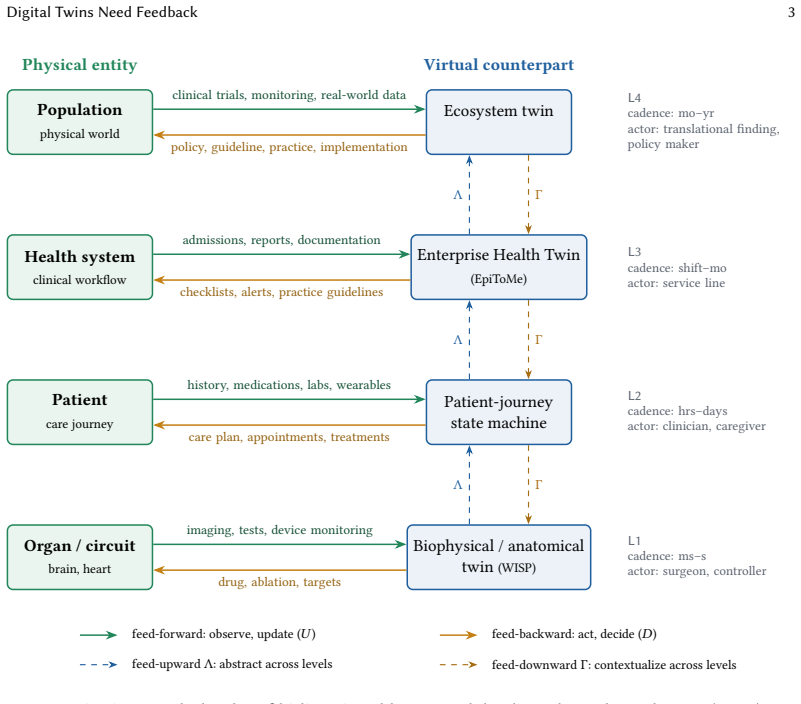
Digital twins are too often described as realistic simulations, anatomical avatars, dashboards, or data mirrors, but the defining property is bidirectional feedback: the physical system continuously updates the virtual one while the virtual system informs actions that change measurement, intervention, operation, or governance in the physical world. The authors propose this bidirectional feedback as the organizing principle and apply it to a nested, multi-scale hierarchy of biological and social organization in which lower-level units combine into higher-level systems, producing desirable properties at each level from cells and tissues to organs, individuals, organizations, and population at
What carries the argument
Bidirectional feedback loop between physical and virtual counterparts, which serves as the organizing principle that turns data into accountable action across scales.
If this is right
- In epilepsy care the feedback integrates cells, circuits, behavior, and care pathways into governance decisions.
- Consortium-scale brain-cell atlas production becomes a process of designing and driving loops that convert data into practice rather than static modeling.
- The same principle scales to organizations and populations, producing desirable properties at each level of the hierarchy.
- Digital twinning is positioned as a multidisciplinary computing paradigm for turning data into accountable action across biological and social systems.
Where Pith is reading between the lines
- The same feedback structure could be tested in non-biological domains such as supply-chain or infrastructure management where physical sensors and virtual models interact continuously.
- Implementation would likely require standardized interfaces for real-time data exchange that the paper does not specify.
- Ethical and accountability questions arise once virtual models begin to direct physical interventions at population scale.
Load-bearing premise
That examples drawn from epilepsy care and consortium-scale brain-cell atlas production are enough to establish bidirectional feedback as the necessary central organizing principle for digital twins.
What would settle it
A working digital twin applied to epilepsy care or brain-cell atlas production that delivers the claimed multi-scale integration and actionable outcomes while operating without continuous bidirectional feedback between physical and virtual parts.
Figures
read the original abstract
Digital twins are too often described as realistic simulations, anatomical avatars, dashboards, or data mirrors. Those artifacts can be useful, but they miss the defining property of a digital twin: bidirectional feedback between a physical counterpart and a virtual counterpart. The physical system continuously updates the virtual one; the virtual system informs actions that change measurement, intervention, operation, or governance in the physical world. We propose such a bidirectional feedback as the organizing principle for digital twins and apply it to a nested, multi-scale hierarchy of biological and social organization, in which lower-level units combine into higher-level systems, producing desirable properties at each level, from cells and tissues to organs, individuals, organizations, and population at large. Neuroinformatics is a stress test for this view because brain health, dementia, epilepsy, and other neurological diseases require the integration of cells, circuits, behavior, care pathways, and the translation of discovery to practice. Examples from epilepsy care and consortium-scale brain-cell atlas production show that digital twinning is not merely multi-scale modeling. It is a rich, multidisciplinary paradigm of computing for designing, governing, and driving feedback loops that turn data into accountable action.
Editorial analysis
A structured set of objections, weighed in public.
Referee Report
Summary. The manuscript claims that bidirectional feedback between physical and virtual counterparts is the defining property of digital twins, proposing it as the organizing principle for a nested, multi-scale hierarchy of biological and social organization. It applies this to levels from cells to populations and uses neuroinformatics examples from epilepsy care and brain-cell atlas production to argue that digital twinning involves rich feedback loops for accountable action beyond mere multi-scale modeling.
Significance. If the central proposal is substantiated, the work could provide a valuable organizing framework for digital twins in complex systems, particularly in neuroinformatics and healthcare, by shifting emphasis from simulation to bidirectional, actionable feedback across scales. This could influence how digital twins are designed and governed in multidisciplinary settings.
major comments (1)
- Abstract: The assertion that the epilepsy care and consortium-scale brain-cell atlas examples 'show that digital twinning is not merely multi-scale modeling' is load-bearing for the central claim but is unsupported by any description of specific bidirectional feedback mechanisms, data flows, decision rules, or metrics in the provided text. This leaves open the possibility that the examples support standard integration rather than the proposed defining property.
minor comments (1)
- Abstract: The phrasing 'We propose such a bidirectional feedback as the organizing principle' could be clarified to distinguish the proposal from existing multi-scale modeling approaches more explicitly.
Simulated Author's Rebuttal
We thank the referee for the detailed and constructive report. The central concern about the abstract's load-bearing claim is well-taken; we address it directly below and will revise accordingly.
read point-by-point responses
-
Referee: Abstract: The assertion that the epilepsy care and consortium-scale brain-cell atlas examples 'show that digital twinning is not merely multi-scale modeling' is load-bearing for the central claim but is unsupported by any description of specific bidirectional feedback mechanisms, data flows, decision rules, or metrics in the provided text. This leaves open the possibility that the examples support standard integration rather than the proposed defining property.
Authors: We agree that the abstract claim is central and that the current text does not supply the requested concrete details on bidirectional mechanisms. The manuscript is a conceptual position paper whose primary contribution is the proposed organizing principle rather than exhaustive case studies; the examples were intended as brief illustrations of the framework's applicability in neuroinformatics. To address the concern, the revised version will expand the relevant sections (and update the abstract) with explicit descriptions of feedback loops, data flows, and decision rules drawn from the epilepsy care pathway (e.g., closed-loop neuromodulation informed by virtual patient models) and the brain-cell atlas consortium (e.g., iterative atlas refinement driven by experimental validation and governance decisions). This will make the distinction from standard multi-scale modeling explicit without altering the paper's scope or length substantially. revision: yes
Circularity Check
No circularity: definitional proposal with illustrative examples, no derivations or reductions to inputs.
full rationale
The paper advances a conceptual definition of digital twins centered on bidirectional feedback and applies it to multi-scale hierarchies, using neuroinformatics cases as illustrations. No equations, parameter fits, predictions derived from data subsets, or self-citation chains appear in the provided text. The central claim is explicitly framed as a proposal ('We propose such a bidirectional feedback as the organizing principle'), not a derivation that reduces to its own inputs by construction. This is a standard non-circular outcome for a position paper introducing an organizing principle.
Axiom & Free-Parameter Ledger
axioms (1)
- domain assumption Lower-level units combine into higher-level systems, producing desirable properties at each level from cells to populations
Reference graph
Works this paper leans on
-
[1]
Julia Adler-Milstein and Ashish K. Jha. 2017. HITECH Act Drove Large Gains in Hospital Electronic Health Record Adoption.Health Affairs36, 8 (2017), 1416–1422. https://doi.org/10.1377/hlthaff.2016.1651
-
[2]
Luigi Atzori, Antonio Iera, and Giacomo Morabito. 2010. The Internet of Things: A Survey.Computer Networks54, 15 (2010), 2787–2805. https://doi.org/10.1016/j.comnet.2010.05.010
-
[3]
Hampson, Antarr T
Wei-Chun Chou, Johnson P. Hampson, Antarr T. Byrd, Samden D. Lhatoo, Guo-Qiang Zhang, and Shiqiang Tao
-
[4]
A Web-Based Interface for Visualizing and Documenting SEEG Strategic Planning (WISP): Development and Qualitative Evaluation.AMIA Annual Symposium Proceedings2024 (2025), 290–299
2025
-
[5]
Jorge Corral-Acero, Francesca Margara, Maciej Marciniak, Cristóbal Rodero, Filip Loncaric, Yingjing Feng, et al. 2020. The ‘Digital Twin’ to Enable the Vision of Precision Cardiology.European Heart Journal41, 48 (2020), 4556–4564. https://doi.org/10.1093/eurheartj/ehaa159
-
[6]
Charles P. Friedman, Adam K. Wong, and David Blumenthal. 2010. Achieving a Nationwide Learning Health System. Science Translational Medicine2, 57 (2010), 57cm29. https://doi.org/10.1126/scitranslmed.3001456
-
[7]
Aidan Fuller, Zhong Fan, Charles Day, and Chris Barlow. 2020. Digital Twin: Enabling Technologies, Challenges and Open Research.IEEE Access8 (2020), 108952–108971. https://doi.org/10.1109/ACCESS.2020.2998358
-
[8]
Timnit Gebru, Jamie Morgenstern, Briana Vecchione, Jennifer Wortman Vaughan, Hanna Wallach, Hal Daumé III, and Kate Crawford. 2021. Datasheets for Datasets.Commun. ACM64, 12 (2021), 86–92. https://doi.org/10.1145/3458723
-
[9]
Edward Glaessgen and David Stargel. 2012. The Digital Twin Paradigm for Future NASA and U.S. Air Force Vehicles. In53rd AIAA/ASME/ASCE/AHS/ASC Structures, Structural Dynamics and Materials Conference. AIAA, Reston, VA, 1818. https://doi.org/10.2514/6.2012-1818
-
[10]
2014.Digital Twin: Manufacturing Excellence Through Virtual Factory Replication
Michael Grieves. 2014.Digital Twin: Manufacturing Excellence Through Virtual Factory Replication. White Paper 1.2014 (2014): 1-7
2014
-
[11]
2007.The Learning Healthcare System: Workshop Summary, Leigh Anne Olsen, Dara Aisner, and J
Institute of Medicine. 2007.The Learning Healthcare System: Workshop Summary, Leigh Anne Olsen, Dara Aisner, and J. Michael McGinnis (Eds.). National Academies Press, Washington, DC. https://doi.org/10.17226/11903
-
[12]
Jirsa, Timothée Proix, Dionysios Perdikis, Michael M
Viktor K. Jirsa, Timothée Proix, Dionysios Perdikis, Michael M. Woodman, Huifang Wang, Jorge Gonzalez-Martinez, Christophe Bernard, Christian Bénar, Maxime Guye, Patrick Chauvel, and Fabrice Bartolomei. 2017. The Virtual Epileptic Patient: Individualized Whole-Brain Models of Epilepsy Spread.NeuroImage145 (2017), 377–388. https: //doi.org/10.1016/j.neuroi...
-
[13]
1967.The Ghost in the Machine
Arthur Koestler. 1967.The Ghost in the Machine. Hutchinson, London
1967
-
[14]
Werner Kritzinger, Matthias Karner, Georg Traar, Jan Henjes, and Wilfried Sihn. 2018. Digital Twin in Manufacturing: A Categorical Literature Review and Classification.IFAC-PapersOnLine51, 11 (2018), 1016–1022. https://doi.org/10. 1016/j.ifacol.2018.08.474
2018
-
[15]
Silverstein, R
Reinhard Laubenbacher, Borna Mehrad, Ilya Shmulevich, Natalia Trayanova, Jonathan C. Silverstein, R. Edwards, et al
-
[16]
https://doi.org/10.1038/s43588-024- 00607-6
Digital Twins in Medicine.Nature Computational Science4 (2024), 184–191. https://doi.org/10.1038/s43588-024- 00607-6
-
[17]
Lee and Sanjit A
Edward A. Lee and Sanjit A. Seshia. 2016.Introduction to Embedded Systems: A Cyber-Physical Systems Approach(2nd ed., 2016). MIT Press, Cambridge, MA
2016
-
[18]
Joshua C. Mandel, David A. Kreda, Kenneth D. Mandl, Isaac S. Kohane, and Rachel B. Ramoni. 2016. SMART on FHIR: A Standards-Based, Interoperable Apps Platform for Electronic Health Records.Journal of the American Medical Informatics Association23, 5 (2016), 899–908. https://doi.org/10.1093/jamia/ocv189
-
[19]
Workshop: Biomedical, Biological, and Behavioral Digital Twins: Foundations, Applications, and Future Directions
Fenglou Mao, Grace Peng, Emily Greenspan, Thomas Houze, Siddharth Shenoy, Emrin Horgusluoglu, Orlando Lopez, Jeffrey Buchsbaum, Julia Berzhanskaya, Yanli Wang, Qilu Yu, Xin Yuan, Mauricio Gomez, Anupama Gururaj, Susan 8 Guo-Qiang Zhang Wright. Workshop: Biomedical, Biological, and Behavioral Digital Twins: Foundations, Applications, and Future Directions....
2026
-
[20]
Margaret Mitchell, Simone Wu, Andrew Zaldivar, Parker Barnes, Lucy Vasserman, Ben Hutchinson, Elena Spitzer, Inioluwa Deborah Raji, and Timnit Gebru. 2019. Model Cards for Model Reporting. InProceedings of the Conference on Fairness, Accountability, and Transparency. ACM, New York, NY, USA, 220–229. https://doi.org/10.1145/3287560.3287596
-
[21]
2024.Foundational Research Gaps and Future Directions for Digital Twins
Willcox, Karen, et al. 2024.Foundational Research Gaps and Future Directions for Digital Twins. National Academies Press, Washington, DC. https://doi.org/10.17226/26894
-
[22]
Satya S. Sahoo, Samden D. Lhatoo, Deepak K. Gupta, Li Cui, Meng Zhao, Catherine Jayapandian, Alireza Bozorgi, and Guo-Qiang Zhang. 2014. Epilepsy and Seizure Ontology: Towards an Epilepsy Informatics Infrastructure for Clinical Research and Patient Care.Journal of the American Medical Informatics Association21, 1 (2014), 82–89. https://doi.org/10.1136/ami...
-
[23]
Tait D. Shanafelt, Lotte N. Dyrbye, Christine Sinsky, Omar Hasan, Daniel Satele, Jeff Sloan, and Colin P. West. 2016. Relationship Between Clerical Burden and Characteristics of the Electronic Environment with Physician Burnout and Professional Satisfaction.Mayo Clinic Proceedings91, 7 (2016), 836–848. https://doi.org/10.1016/j.mayocp.2016.05.007
-
[24]
doi:10.1056/NEJMsb1609216 (2016)
Rachel E. Sherman, Steven A. Anderson, Gerald J. Dal Pan, Gerry W. Gray, Thomas Gross, Nina L. Hunter, Lisa LaVange, Danica Marinac-Dabic, Peter W. Marks, Melissa A. Robb, et al. 2016. Real-World Evidence: What Is It and What Can It Tell Us?.New England Journal of Medicine375, 23 (2016), 2293–2297. https://doi.org/10.1056/NEJMsb1609216
-
[25]
Kimberly Siletti, Rebecca Hodge, Alejandro Mossi Albiach, Ka Wai Lee, Song-Lin Ding, Lijuan Hu, Peter Lönnerberg, Trygve Bakken, et al. 2023. Transcriptomic Diversity of Cell Types Across the Adult Human Brain.Science382, 6667 (2023), eadd7046. https://doi.org/10.1126/science.add7046
-
[26]
Shiqiang Tao, Samden Lhatoo, Johnson Hampson, Licong Cui, and Guo-Qiang Zhang. 2021. A Bespoke Electronic Health Record for Epilepsy Care (EpiToMe): Development and Qualitative Evaluation.Journal of Medical Internet Research23, 2 (2021), e22939. https://doi.org/10.2196/22939
-
[27]
Smith, Lydia Ng, Licong Cui, and Guo-Qiang Zhang
Shiqiang Tao, Xiaojin Li, Yan Huang, Rashmie Abeysinghe, Ling Tong, Shiwei Lin, Wei-Chun Chou, Erge Edgu-Fry, Kimberly A. Smith, Lydia Ng, Licong Cui, and Guo-Qiang Zhang. 2025. Tissue-to-Bytes: A Catalytic Digital Twin Platform for Consortium-Scale Integration of Single-Cell Omics Data Across the BRAIN Initiative Cell Atlas Network. bioRxiv2025, 2025.12....
-
[28]
Huifang E. Wang, Marmaduke Woodman, Paul Triebkorn, Jean-Didier Lemaréchal, Jayant Jha, Borana Dollomaja, Anirudh N. Vattikonda, Viktor Sip, Samuel Medina Villalon, Meysam Hashemi, Maxime Guye, Julia Makhalova, Fabrice Bartolomei, and Viktor Jirsa. 2023. Delineating Epileptogenic Networks Using Brain Imaging Data and Personalized Modeling in Drug-Resistan...
-
[29]
The FAIR Guiding Principles for scientific data management and stewardship
Mark D. Wilkinson, Michel Dumontier, IJsbrand Jan Aalbersberg, Gabrielle Appleton, Myles Axton, Arie Baak, Niklas Blomberg, Jan-Willem Boiten, Luiz Bonino da Silva Santos, Philip E. Bourne, et al. 2016. The FAIR Guiding Principles for Scientific Data Management and Stewardship.Scientific Data3 (2016), 160018. https://doi.org/10.1038/sdata.2016.18
-
[30]
Guo-Qiang Zhang, Licong Cui, Wei-Chun Chou, Johnson Hampson, Samden Lhatoo, and Shiqiang Tao. 2026. Enterprise Health Twins: Conceptual Framework, Design Principles, and Longitudinal Evaluation: Preliminary Results from EpiToMe. Proceedings of the 2026 American Medical Informatics Annual Symposium (In Press)
2026
-
[31]
Kang Zhang, Hong-Yu Zhou, et al. 2024. Concepts and applications of digital twins in healthcare and medicine.Patterns 5, 8 (2024), 101028. DOI:10.1016/j.patter.2024.101028
discussion (0)
Sign in with ORCID, Apple, or X to comment. Anyone can read and Pith papers without signing in.