REVIEW 2 major objections 6 minor 1 cited by
Interacting galaxies in the IllustrisTNG simulations -- VIII: Pericentric star formation rate enhancements are driven both by increased fuelling and efficiency
T0 review · 2 major / 6 minor · reviewed 2026-08-10 · deepseek-v4-flash
Pith's one-line read In close galaxy flybys inside the TNG100-1 simulation, the central star formation burst is mostly driven by higher star formation efficiency (about 70 per cent of the boost), not by extra gas supply.
desk verdict Solid pericentre-stacked measurement of interaction-triggered star formation in TNG100-1, with a real but unquantified time-axis systematic and a definition-dependent fuel/efficiency split. read the letter →
The pith
A machine-rendered reading of the paper's core claim, the machinery that carries it, and where it could break.
The reading
What carries the argument
The load-bearing device is the identity $\mathrm{sSFR} = \mathrm{SFE_H} \times f_{\mathrm{gas}}$, with $\mathrm{SFE_H} \equiv \mathrm{SFR}/M_{\mathrm{H}}$ defined as star formation per unit total hydrogen mass in all gas phases, chosen because TNG100-1 does not report molecular gas mass. Taking logarithms turns the enhancement ratio into a sum, $\log Q(\mathrm{sSFR}) = \log Q(f_{\mathrm{gas}}) + \log Q(\mathrm{SFE_H})$; normalising by $\log Q(\mathrm{sSFR})$ splits the fractional rise $\delta\mathrm{sSFR}/\mathrm{sSFR_i}$ into a fuelled term and an efficiency term that sum to exactly one. Applied to stacked averages phased on reconstructed pericentre times from 6D kinematic interpolation of the pair orbits, this decomposition is what converts two correlated boosts into the quantitative 70/30 split.
What would settle it
Recompute pericentre times directly from the simulation's particle velocities instead of the interpolated orbits and re-stack the 18,534 encounters; if the $1.6 \pm 0.1$ peak, the roughly 0.1 Gyr delay, and the 70/30 efficiency-fuel split shift by more than the quoted uncertainties, the signal is an artefact of the time axis. Running the same stack on the higher-time-resolution TNG50 run, which the paper lists as future work, would settle the question directly.
Extended reading notes
Core claim
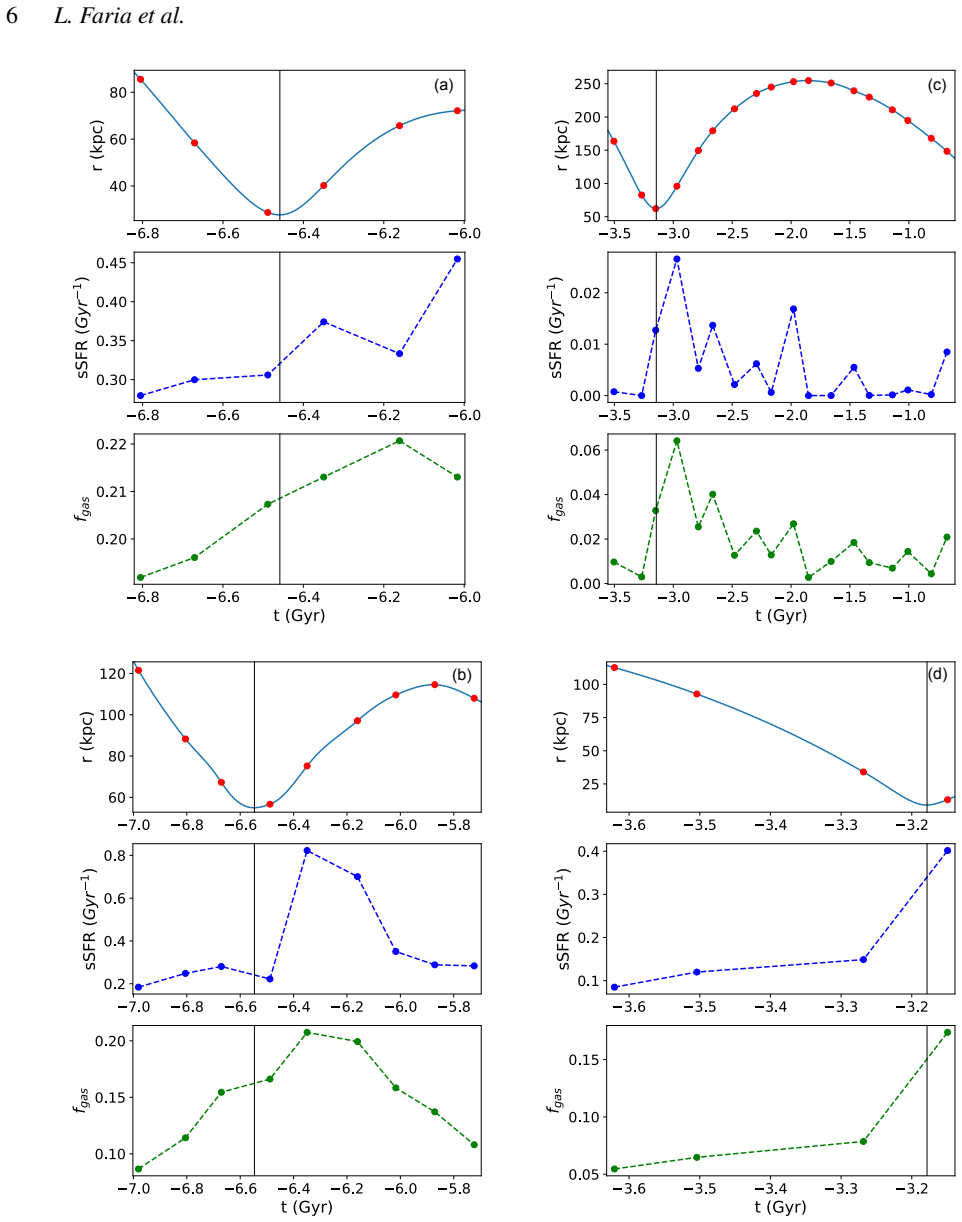
Within the TNG100-1 cosmological simulation, the paper stacks 18,534 distinct pericentric encounters of massive galaxies ($M_* > 10^{10}\,M_\odot$) with companions at stellar mass ratios of 0.1 to 10 and tracks the specific star formation rate, gas fraction, and star formation efficiency inside the central stellar half-mass radius as functions of time relative to closest approach. For the closest encounters ($r_{\mathrm{peri}} \le 50$ kpc), mean central sSFR rises to $1.6 \pm 0.1$ times its pre-encounter value, peaking about 0.1 Gyr after pericentre when the pair is on average about 75 kpc apart; gas fraction peaks at $1.2 \pm 0.1$ and star formation efficiency at $1.4 \pm 0.1$ on the same timescale, while central gas metallicity drops, signalling inflow of metal-poor gas. Because $\mathrm{sSFR} = \mathrm{SFE_H} \times f_{\mathrm{gas}}$, the fractional boost decomposes additively in log space, and the decomposition shows that about 70 per cent of the peak central sSFR enhancement is attributable to the rise in efficiency and 30 per cent to the rise in gas fraction. In the outer shell the same enhancements are weaker and peak about 0.05 Gyr earlier, and in per-galaxy terms 57.1 per cent of galaxies at the peak are individually efficiency-driven.
Load-bearing premise
The stacked timeline rests on the reconstructed moments of closest approach being accurate to better than half the roughly 0.15 Gyr gap between simulation snapshots, and the paper itself notes a systematic periodic pattern at exactly that spacing in how those moments fall.
Editorial extensions
If this is right
- Pair surveys that classify interactions by projected separation should expect the starburst to appear well after closest approach, at mean separations near 75 kpc rather than 30 kpc, which explains enhanced sSFR seen at wide separations.
- Mean sSFR in the closest-encounter bin falls below the passively evolving sample by about 0.5 Gyr after pericentre, so the burst is followed by a phase of suppressed star formation consistent with gas exhaustion or feedback.
- Enhancements in the outer shell are weaker and peak about 0.05 Gyr earlier than in the centre, supporting a picture in which the encounter's effect propagates inward.
- Models that attribute encounter-triggered star formation purely to gas inflow miss the dominant channel: in TNG100-1 the central galaxies become more efficient at assembling and converting star-forming gas.
- Restricting to first-passage encounters, 70 per cent of the sample, reproduces the full-dataset enhancements, so repeated passages are not responsible for the average result.
Reading between the lines
- If higher efficiency is the dominant channel, resolved molecular-gas observations of close pairs should show a shortened depletion time even where the total gas fraction is not yet elevated; this is a direct observational discriminator the paper does not run.
- The 70/30 average may hide subpopulations in which the balance inverts: the per-galaxy split at the peak is only 57/43, so binning by stellar mass ratio or orbital eccentricity could plausibly flip the dominant driver for some subsets.
- Because the paper itself flags the systematic periodicity in pericentre times at the snapshot spacing, re-running the stack on the higher-time-resolution TNG50 run would test whether the roughly 0.1 Gyr delay is physical or pinned to the snapshot grid.
- The inward-propagating signal (outer shell peaking about 0.05 Gyr before the centre) and the roughly 0.4 Gyr metallicity-dilution timescale together imply a measurable central gas inflow that could be checked against particle-level gas velocities in TNG100-1, a test left for future work.
Editorial analysis
A structured set of objections, weighed in public.
Referee Report
Summary. The paper uses the TNG100-1 cosmological simulation to construct a catalogue of 18,534 distinct pericentric encounters from orbit reconstructions of Patton et al. (2024). Stacking galaxy properties relative to pericentre time, it reports that within R1/2 the sSFR of hosts in the r_peri <= 50 kpc bin is enhanced by 1.6 ± 0.1 relative to the pre-encounter value, peaking about 0.1 Gyr after pericentre at a mean pair separation of about 75 kpc. The same stacking gives fgas and SFEH enhancements of 1.2 ± 0.1 and 1.4 ± 0.1, and a log-space decomposition of sSFR = fgas x SFEH is used to attribute roughly 70 per cent of the peak sSFR enhancement to increased SFEH and 30 per cent to increased fgas. The paper also reports central metallicity dilution and an outer-to-inner time lag, interpreted as evidence of inflow of pristine gas toward the centre.
Significance. If the timing result is robust, the paper provides a valuable bridge between observational pair catalogues and high-resolution merger simulations: a large, cosmologically representative sample of interactions with properties measured as a function of orbital phase rather than projected separation. The paper has genuine strengths: a large sample size, transparent discussion of selection effects, dropout-controlled comparison of snapshot-limited subsamples (Fig. 6), a first-passage robustness check (Appendix A), and an explicit statement of the indirect nature of the inflow evidence. The central fuelling-versus-efficiency result, however, rests on two methodological choices that need tightening before the quantitative claim can be accepted.
major comments (2)
- [Section 2.2, Figure 2] The stacked time axis is built from pericentre times reconstructed by 6D kinematic interpolation between snapshots separated by ~0.15 Gyr. The right panel of Figure 2 shows periodic structure in the Delta-t distribution at this cadence, and the text states that these variations "are likely systematic." Because the zero-point of Delta-t enters every stacked curve, a systematic phase error in the reconstructed pericentres would both dilute the peak amplitude and bias the reported peak time of +0.12 Gyr and the corresponding mean separation of 75 kpc in Figures 4, 5, and 7. This is not a cosmetic issue; it directly affects the headline timing result. Please quantify the sensitivity, for example by Monte Carlo perturbing each pericentre time by up to half a snapshot interval, by repeating the stacking with pericentre times fixed to snapshot times, or by splitting the sample according to where in the snapshot interval the pericentre falls, and report the resulting changes in Q(sSFR), Q(fgas), Q(SFEH), the peak time, and the peak separation.
- [Section 3.3, Eq. (4)] SFEH is not measured directly per galaxy; it is computed from the ratio of the sample-averaged sSFR to the sample-averaged fgas (Section 3.3). For individual galaxies sSFR_i = SFEH_i x fgas_i, but the mean of a product is not the product of the means, so this ratio is an fgas-weighted mean SFEH whose weighting can evolve during the encounter. The log-space decomposition in Eqs. (7)-(11) is then an exact identity for the averaged Q values rather than a statement about the average of per-galaxy efficiencies, and the reported 70 per cent / 30 per cent efficiency/fuelling split could change if the covariance between SFEH and fgas evolves with time. Please compute SFEH directly per galaxy (for example SFR/MH) and compare the average of per-galaxy Q(SFEH) with the ratio-derived Q(SFEH), or otherwise demonstrate that the weighting effect is negligible.
minor comments (6)
- [Section 2.2, bullet list] The bullet "At least 4 snapshots between the selected pericentre, and either the next pericentre, the merger..." is ambiguous; it should be reworded to make clear whether this is a required temporal gap before or after the selected pericentre.
- [Figure 5 caption] The caption says "mean pair separation bounded by the 25th and 75th percentiles," which conflates a mean with a percentile range; please clarify that the shaded band spans the interquartile range of separations around the mean.
- [Section 3.1, Eq. (3)] The definition of SFEH as (SFR/MH2) x (MH2/MH) is unnecessarily roundabout; it reduces identically to SFR/MH, and simplifying the definition would avoid the impression that molecular gas directly enters the quantity actually measured.
- [Abstract and Section 3.5] The "70 per cent" attribution is obtained from a log-space decomposition (Eq. 9); the abstract and conclusions should state this explicitly so that readers do not interpret it as a linear additive decomposition of the sSFR enhancement.
- [Figure 11] The shaded regions in Figure 11 are described as 2-sigma errors from a Jackknife technique, while Figures 4, 7, and 8 use the 2-sigma standard error in the mean; please specify the resampling unit and label the two error definitions consistently.
- [Data Availability] The data availability statement mentions only the public IllustrisTNG data; if possible, please also state whether the new 18,534-encounter catalogue will be released, as it would be a valuable community resource.
Circularity Check
No circular derivation: the enhancement factors are direct simulation measurements; the fuelling/efficiency split is a transparent algebraic decomposition, and the only self-citation chain (orbital reconstruction) is external prior work whose timing systematics are acknowledged.
full rationale
The paper's central results are stacked averages of sSFR, fgas, and metallicity measured directly from TNG100-1 snapshots; these are empirical quantities, not outputs of a fitted model. The reported enhancements (Q(sSFR)=1.6±0.1, Q(fgas)=1.2±0.1, Q(SFEH)=1.4±0.1) are mean values from the encounter sample (Figures 4 and 7), with no free parameter fitted to the claimed outcome. Section 3.5's 70/30 per cent split is derived from the exact identity sSFR = fgas multiplied by SFEH (Eq. 4), via log Q(sSFR) = log Q(fgas) + log Q(SFEH) (Eq. 8). This is an accounting decomposition, not an independent physical measurement; the paper explicitly states that SFEH is calculated from the averaged sSFR and fgas according to Equation 4, so it does not present the split as an independent confirmation. The conclusion that enhanced SFEH is the primary driver is definition-dependent on how the fuelled and efficiency fractions are defined, but the construction is transparent and does not involve fitting a parameter and then calling it a prediction. The orbital-reconstruction catalogue (Patton et al. 2024) is self-cited and load-bearing for the pericentre time axis, but it is a separate published reconstruction, not a uniqueness theorem invoked to forbid alternatives. The paper itself flags the periodicity in the time-relative-to-pericentre distribution at the snapshot cadence as 'likely systematic' (Section 2.2, Figure 2), which is an important limitation for the timing and peak-separation claims; however, this is a systematic-error and accuracy concern, not a circularity in the derivation chain. Overall, no claimed result reduces by construction to its own input in a way that would constitute circularity.
Assumptions & free parameters
assumptions (5)
- domain assumption TNG100-1 simulation's subgrid physics (star formation, feedback) and galaxy identification (Subfind) provide a faithful enough model of galaxy interactions to draw conclusions about real galaxies.
- domain assumption The 6D kinematic orbit reconstruction of Patton et al. (2024) accurately locates pericentre times between snapshots.
- domain assumption A galaxy's properties respond primarily to its closest companion; other companions can be ignored.
- domain assumption The first Δt bin (about 0.5 Gyr before pericentre) represents an unperturbed pre-encounter baseline.
- domain assumption Effects of earlier pericentres dissipate within 1 Gyr, so encounters selected with >= 1 Gyr spacing are 'distinct'.
Cite this review
Pith. "Pith review of Interacting galaxies in the IllustrisTNG simulations -- VIII: Pericentric star formation rate enhancements are driven both by increased fuelling and efficiency." pith.science (2026). https://pith.science/paper/OZ2UL6XR
@misc{pith2026250114031,
  author       = {Pith},
  title        = {Pith review of: Interacting galaxies in the IllustrisTNG simulations -- VIII: Pericentric star formation rate enhancements are driven both by increased fuelling and efficiency},
  year         = {2026},
  howpublished = {\url{https://pith.science/paper/OZ2UL6XR}},
  note         = {Machine review of arXiv:2501.14031}
}
abstract
Using the TNG100-1 cosmological simulations, we explore how galaxy properties, such as specific star formation rate ($\rm sSFR=SFR/M_*$), gas fraction ($\rm f_{gas} \,= \, M_{\rm H}/M_{*}$), and star formation efficiency ($\rm SFE_{H} = SFR/M_{H}$), change over the course of galaxy-galaxy interactions. We identify 18,534 distinct encounters from the reconstructed orbits of a sample of massive galaxies ($\rm M_{*} > 10^{10} \; \rm M_{\odot}$) with companions within a stellar mass ratio of 0.1 to 10. Using these encounters, we study the variation of galaxy properties over time as they approach and move away from pericentric encounters over a redshift range of $0 \leq z < 1$. Following the closest pericentric encounters ($\leq 50$ kpc) of a host galaxy with its companion, we find that sSFR is enhanced by a factor of $1.6 \pm 0.1$ on average within the central stellar half-mass radius (R\textsubscript{1/2}) compared to pre-encounter values. Our results show a time delay between pericentre and maximum sSFR enhancement of $\sim$0.1 Gyr with a mean galaxy separation of 75 kpc. We similarly find that $\rm f_{gas}$ is enhanced by a factor of $1.2 \pm 0.1$, and $\rm SFE_{H}$ is enhanced by a factor of $1.4 \pm 0.1$ following the pericentre of an encounter within the same timescale. Additionally, we find evidence of inflowing gas towards the centre, measured by comparing the $\rm f_{gas}$ and metallicity within the central R\textsubscript{1/2} to the galactic outskirts. We find that approximately 70 per cent of the peak sSFR enhancement can be attributed to the increase in $\rm SFE_{H}$, with the increase in $\rm f_{gas}$ contributing the remaining 30 per cent.
Figures


Figures from the paper (8 more)


Forward citations
Cited by 1 Pith paper
-
Performance of morphological classifiers for galaxy mergers compared to current machine learning methods
Updated G-M20 and G-C morphological cuts achieve ~70% merger precision comparable to ML, with better high-z robustness, but only select pre-mergers.
Reference graph
Works this paper leans on
-
[1]
write newline
" write newline "" before.all 'output.state := FUNCTION fin.entry write newline FUNCTION new.block output.state before.all = 'skip after.block 'output.state := if FUNCTION new.sentence output.state after.block = 'skip output.state before.all = 'skip after.sentence 'output.state := if if FUNCTION not #0 #1 if FUNCTION and 'skip pop #0 if FUNCTION or pop #1...
-
[2]
write newline
" write newline "" before.all 'output.state := FUNCTION fin.entry write newline FUNCTION new.block output.state before.all = 'skip after.block 'output.state := if FUNCTION new.sentence output.state after.block = 'skip output.state before.all = 'skip after.sentence 'output.state := if if FUNCTION not #0 #1 if FUNCTION and 'skip pop #0 if FUNCTION or pop #1...
-
[3]
Abazajian K. N., et al., 2009, @doi [ ] 10.1088/0067-0049/182/2/543 , https://ui.adsabs.harvard.edu/abs/2009ApJS..182..543A 182, 543
-
[5]
Barrera-Ballesteros J. K., et al., 2015, @doi [ ] 10.1051/0004-6361/201425397 , https://ui.adsabs.harvard.edu/abs/2015A&A...579A..45B 579, A45
-
[6]
Barton E. J., Geller M. J., Kenyon S. J., 2000, @doi [ ] 10.1086/308392 , https://ui.adsabs.harvard.edu/abs/2000ApJ...530..660B 530, 660
doi:10.1086/308392 2000
-
[7]
Barton E. J., Arnold J. A., Zentner A. R., Bullock J. S., Wechsler R. H., 2007, @doi [ ] 10.1086/522620 , https://ui.adsabs.harvard.edu/abs/2007ApJ...671.1538B 671, 1538
-
[8]
Belfiore F., et al., 2017, @doi [ ] 10.1093/mnras/stx789 , https://ui.adsabs.harvard.edu/abs/2017MNRAS.469..151B 469, 151
-
[9]
Bickley R. W., Ellison S. L., Patton D. R., Bottrell C., Gwyn S., Hudson M. J., 2022, @doi [ ] 10.1093/mnras/stac1500 , https://ui.adsabs.harvard.edu/abs/2022MNRAS.514.3294B 514, 3294
Show all 104 references
-
[10]
W., Ellison S
Bickley R. W., Ellison S. L., Patton D. R., Wilkinson S., 2023, @doi [ ] 10.1093/mnras/stad088 , https://ui.adsabs.harvard.edu/abs/2023MNRAS.519.6149B 519, 6149
2023 doi
-
[11]
W., et al., 2024, @doi [ ] 10.1093/mnras/stae1951 , https://ui.adsabs.harvard.edu/abs/2024MNRAS.533.3068B 533, 3068
Bickley R. W., et al., 2024, @doi [ ] 10.1093/mnras/stae1951 , https://ui.adsabs.harvard.edu/abs/2024MNRAS.533.3068B 533, 3068
2024 doi
-
[12]
A., Barnes J
Blumenthal K. A., Barnes J. E., 2018, @doi [ ] 10.1093/mnras/sty1605 , https://ui.adsabs.harvard.edu/abs/2018MNRAS.479.3952B 479, 3952
2018 doi
-
[13]
Boselli A., Gavazzi G., Donas J., Scodeggio M., 2001, @doi [ ] 10.1086/318734 , https://ui.adsabs.harvard.edu/abs/2001AJ....121..753B 121, 753
2001 doi
-
[14]
R., Ellison S
Brown W., Patton D. R., Ellison S. L., Faria L., 2023, @doi [ ] 10.1093/mnras/stad1314 , https://ui.adsabs.harvard.edu/abs/2023MNRAS.522.5107B 522, 5107
2023 doi
-
[15]
L., Patton D
Bustamante S., Ellison S. L., Patton D. R., Sparre M., 2020, @doi [ ] 10.1093/mnras/staa1025 , https://ui.adsabs.harvard.edu/abs/2020MNRAS.494.3469B 494, 3469
2020 doi
-
[16]
H., Ellison S
Byrne-Mamahit S., Hani M. H., Ellison S. L., Quai S., Patton D. R., 2023, @doi [ ] 10.1093/mnras/stac3674 , https://ui.adsabs.harvard.edu/abs/2023MNRAS.519.4966B 519, 4966
2023 doi
-
[17]
R., Ellison S
Byrne-Mamahit S., Patton D. R., Ellison S. L., Bickley R., Ferreira L., Hani M., Quai S., Wilkinson S., 2024, @doi [ ] 10.1093/mnras/stae419 , https://ui.adsabs.harvard.edu/abs/2024MNRAS.528.5864B 528, 5864
2024 doi
-
[18]
Carton D., et al., 2018, @doi [ ] 10.1093/mnras/sty1343 , https://ui.adsabs.harvard.edu/abs/2018MNRAS.478.4293C 478, 4293
2018 doi
-
[19]
Casteels K. R. V., et al., 2014, @doi [ ] 10.1093/mnras/stu1799 , https://ui.adsabs.harvard.edu/abs/2014MNRAS.445.1157C 445, 1157
2014 doi
-
[20]
Contreras-Santos A., Knebe A., Cui W., Haggar R., Pearce F., Gray M., De Petris M., Yepes G., 2022, @doi [ ] 10.1093/mnras/stac2127 , https://ui.adsabs.harvard.edu/abs/2022MNRAS.515.5375C 515, 5375
2022 doi
-
[21]
J., Jonsson P., Primack J
Cox T. J., Jonsson P., Primack J. R., Somerville R. S., 2006, @doi [ ] 10.1111/j.1365-2966.2006.11107.x , https://ui.adsabs.harvard.edu/abs/2006MNRAS.373.1013C 373, 1013
2006
-
[22]
J., Jonsson P., Somerville R
Cox T. J., Jonsson P., Somerville R. S., Primack J. R., Dekel A., 2008, @doi [ ] 10.1111/j.1365-2966.2007.12730.x , https://ui.adsabs.harvard.edu/abs/2008MNRAS.384..386C 384, 386
2008
-
[23]
H., Appleby S., 2019, @doi [ ] 10.1093/mnras/stz937 , https://ui.adsabs.harvard.edu/abs/2019MNRAS.486.2827D 486, 2827
Dav \'e R., Angl \'e s-Alc \'a zar D., Narayanan D., Li Q., Rafieferantsoa M. H., Appleby S., 2019, @doi [ ] 10.1093/mnras/stz937 , https://ui.adsabs.harvard.edu/abs/2019MNRAS.486.2827D 486, 2827
2019 doi
-
[24]
J., Liske J., Driver S
De Propris R., Conselice C. J., Liske J., Driver S. P., Patton D. R., Graham A. W., Allen P. D., 2007, @doi [ ] 10.1086/520488 , https://ui.adsabs.harvard.edu/abs/2007ApJ...666..212D 666, 212
2007 doi
-
[25]
L., Semelin B., 2007, @doi [ ] 10.1051/0004-6361:20066959 , https://ui.adsabs.harvard.edu/abs/2007A&A...468...61D 468, 61
Di Matteo P., Combes F., Melchior A. L., Semelin B., 2007, @doi [ ] 10.1051/0004-6361:20066959 , https://ui.adsabs.harvard.edu/abs/2007A&A...468...61D 468, 61
2007 doi
-
[26]
Diemer B., et al., 2018, @doi [ ] 10.3847/1538-4365/aae387 , https://ui.adsabs.harvard.edu/abs/2018ApJS..238...33D 238, 33
2018 doi
-
[27]
Diemer B., et al., 2019, @doi [ ] 10.1093/mnras/stz1323 , https://ui.adsabs.harvard.edu/abs/2019MNRAS.487.1529D 487, 1529
2019 doi
-
[28]
Dubois Y., et al., 2014, @doi [ ] 10.1093/mnras/stu1227 , https://ui.adsabs.harvard.edu/abs/2014MNRAS.444.1453D 444, 1453
2014 doi
-
[29]
L., Patton D
Ellison S. L., Patton D. R., Simard L., McConnachie A. W., 2008, @doi [ ] 10.1088/0004-6256/135/5/1877 , https://ui.adsabs.harvard.edu/abs/2008AJ....135.1877E 135, 1877
2008 doi
-
[30]
L., Patton D
Ellison S. L., Patton D. R., Simard L., McConnachie A. W., Baldry I. K., Mendel J. T., 2010, @doi [ ] 10.1111/j.1365-2966.2010.17076.x , https://ui.adsabs.harvard.edu/abs/2010MNRAS.407.1514E 407, 1514
2010
-
[31]
L., Patton D
Ellison S. L., Patton D. R., Mendel J. T., Scudder J. M., 2011, @doi [ ] 10.1111/j.1365-2966.2011.19624.x , https://ui.adsabs.harvard.edu/abs/2011MNRAS.418.2043E 418, 2043
2011
-
[32]
L., Mendel J
Ellison S. L., Mendel J. T., Patton D. R., Scudder J. M., 2013, @doi [ ] 10.1093/mnras/stt1562 , https://ui.adsabs.harvard.edu/abs/2013MNRAS.435.3627E 435, 3627
2013 doi
-
[33]
L., Catinella B., Cortese L., 2018, @doi [ ] 10.1093/mnras/sty1247 , https://ui.adsabs.harvard.edu/abs/2018MNRAS.478.3447E 478, 3447
Ellison S. L., Catinella B., Cortese L., 2018, @doi [ ] 10.1093/mnras/sty1247 , https://ui.adsabs.harvard.edu/abs/2018MNRAS.478.3447E 478, 3447
2018 doi
-
[34]
L., Viswanathan A., Patton D
Ellison S. L., Viswanathan A., Patton D. R., Bottrell C., McConnachie A. W., Gwyn S., Cuillandre J.-C., 2019, @doi [ ] 10.1093/mnras/stz1431 , https://ui.adsabs.harvard.edu/abs/2019MNRAS.487.2491E 487, 2491
2019 doi
-
[35]
L., Thorp M
Ellison S. L., Thorp M. D., Pan H.-A., Lin L., Scudder J. M., Bluck A. F. L., S \'a nchez S. F., Sargent M., 2020a, @doi [ ] 10.1093/mnras/staa001 , https://ui.adsabs.harvard.edu/abs/2020MNRAS.492.6027E 492, 6027
-
[36]
L., et al., 2020b, @doi [ ] 10.1093/mnrasl/slz179 , https://ui.adsabs.harvard.edu/abs/2020MNRAS.493L..39E 493, L39
Ellison S. L., et al., 2020b, @doi [ ] 10.1093/mnrasl/slz179 , https://ui.adsabs.harvard.edu/abs/2020MNRAS.493L..39E 493, L39
-
[37]
L., et al., 2022, @doi [ ] 10.1093/mnrasl/slac109 , https://ui.adsabs.harvard.edu/abs/2022MNRAS.517L..92E 517, L92
Ellison S. L., et al., 2022, @doi [ ] 10.1093/mnrasl/slac109 , https://ui.adsabs.harvard.edu/abs/2022MNRAS.517L..92E 517, L92
2022 doi
- [38]
-
[39]
E., Lara-L \'o pez M
Gardu \ n o L. E., Lara-L \'o pez M. A., L \'o pez-Cruz O., Hopkins A. M., Owers M. S., Pimbblet K. A., Holwerda B. W., 2021, @doi [ ] 10.1093/mnras/staa3799 , https://ui.adsabs.harvard.edu/abs/2021MNRAS.501.2969G 501, 2969
2021 doi
-
[40]
Genel S., et al., 2018, @doi [ ] 10.1093/mnras/stx3078 , https://ui.adsabs.harvard.edu/abs/2018MNRAS.474.3976G 474, 3976
2018 doi
-
[41]
H., Gosain H., Ellison S
Hani M. H., Gosain H., Ellison S. L., Patton D. R., Torrey P., 2020, @doi [ ] 10.1093/mnras/staa459 , https://ui.adsabs.harvard.edu/abs/2020MNRAS.493.3716H 493, 3716
2020 doi
-
[42]
M., Avila-Reese V., Conselice C
Hern \'a ndez-Toledo H. M., Avila-Reese V., Conselice C. J., Puerari I., 2005, @doi [ ] 10.1086/427134 , https://ui.adsabs.harvard.edu/abs/2005AJ....129..682H 129, 682
2005 doi
-
[43]
T., Kudritzki R.-P., Kewley L
Ho I. T., Kudritzki R.-P., Kewley L. J., Zahid H. J., Dopita M. A., Bresolin F., Rupke D. S. N., 2015, @doi [ ] 10.1093/mnras/stv067 , https://ui.adsabs.harvard.edu/abs/2015MNRAS.448.2030H 448, 2030
2015 doi
-
[44]
F., Hernquist L., Cox T
Hopkins P. F., Hernquist L., Cox T. J., Kere s D., 2008, @doi [ ] 10.1086/524362 , https://ui.adsabs.harvard.edu/abs/2008ApJS..175..356H 175, 356
2008 doi
-
[45]
F., Cox T
Hopkins P. F., Cox T. J., Hernquist L., Narayanan D., Hayward C. C., Murray N., 2013, @doi [ ] 10.1093/mnras/stt017 , https://ui.adsabs.harvard.edu/abs/2013MNRAS.430.1901H 430, 1901
2013 doi
-
[46]
S., Mihos J
Iono D., Yun M. S., Mihos J. C., 2004, @doi [ ] 10.1086/424797 , https://ui.adsabs.harvard.edu/abs/2004ApJ...616..199I 616, 199
2004 doi
-
[47]
Kaneko H., Kuno N., Iono D., Tamura Y., Tosaki T., Nakanishi K., Sawada T., 2013, @doi [ ] 10.1093/pasj/65.1.20 , https://ui.adsabs.harvard.edu/abs/2013PASJ...65...20K 65, 20
2013 doi
-
[48]
Kaneko H., Kuno N., Iono D., Tamura Y., Tosaki T., Nakanishi K., Sawada T., 2017, @doi [ ] 10.1093/pasj/psx041 , https://ui.adsabs.harvard.edu/abs/2017PASJ...69...66K 69, 66
2017 doi
-
[49]
J., 1998, @doi [ ] 10.1086/305588 , https://ui.adsabs.harvard.edu/abs/1998ApJ...498..541K 498, 541
Kennicutt Robert C. J., 1998, @doi [ ] 10.1086/305588 , https://ui.adsabs.harvard.edu/abs/1998ApJ...498..541K 498, 541
1998 doi
-
[50]
J., Rupke D., Zahid H
Kewley L. J., Rupke D., Zahid H. J., Geller M. J., Barton E. J., 2010, @doi [ ] 10.1088/2041-8205/721/1/L48 , https://ui.adsabs.harvard.edu/abs/2010ApJ...721L..48K 721, L48
2010 doi
-
[52]
G., Alonso S., Mesa V., O'Mill A
Lambas D. G., Alonso S., Mesa V., O'Mill A. L., 2012, @doi [ ] 10.1051/0004-6361/201117900 , https://ui.adsabs.harvard.edu/abs/2012A&A...539A..45L 539, A45
2012 doi
-
[53]
L., et al., 2016, @doi [ ] 10.3847/0004-637X/825/2/128 , https://ui.adsabs.harvard.edu/abs/2016ApJ...825..128L 825, 128
Larson K. L., et al., 2016, @doi [ ] 10.3847/0004-637X/825/2/128 , https://ui.adsabs.harvard.edu/abs/2016ApJ...825..128L 825, 128
2016 doi
-
[54]
K., Walter F., Brinks E., Bigiel F., de Blok W
Leroy A. K., Walter F., Brinks E., Bigiel F., de Blok W. J. G., Madore B., Thornley M. D., 2008, @doi [ ] 10.1088/0004-6256/136/6/2782 , https://ui.adsabs.harvard.edu/abs/2008AJ....136.2782L 136, 2782
2008 doi
-
[56]
Li W., et al., 2023, @doi [ ] 10.1093/mnras/stad1473 , https://ui.adsabs.harvard.edu/abs/2023MNRAS.523..720L 523, 720
2023 doi
-
[57]
Lin L., et al., 2010, @doi [ ] 10.1088/0004-637X/718/2/1158 , https://ui.adsabs.harvard.edu/abs/2010ApJ...718.1158L 718, 1158
2010 doi
-
[58]
M., Jonsson P., Cox T
Lotz J. M., Jonsson P., Cox T. J., Primack J. R., 2008, @doi [ ] 10.1111/j.1365-2966.2008.14004.x , https://ui.adsabs.harvard.edu/abs/2008MNRAS.391.1137L 391, 1137
2008
-
[59]
Marinacci F., et al., 2018, @doi [ ] 10.1093/mnras/sty2206 , https://ui.adsabs.harvard.edu/abs/2018MNRAS.480.5113M 480, 5113
2018 doi
-
[60]
Michiyama T., et al., 2016, @doi [ ] 10.1093/pasj/psw087 , https://ui.adsabs.harvard.edu/abs/2016PASJ...68...96M 68, 96
2016 doi
-
[61]
C., Hernquist L., 1996, @doi [ ] 10.1086/177353 , https://ui.adsabs.harvard.edu/abs/1996ApJ...464..641M 464, 641
Mihos J. C., Hernquist L., 1996, @doi [ ] 10.1086/177353 , https://ui.adsabs.harvard.edu/abs/1996ApJ...464..641M 464, 641
1996 doi
-
[62]
Moreno J., Bluck A. F. L., Ellison S. L., Patton D. R., Torrey P., Moster B. P., 2013, @doi [ ] 10.1093/mnras/stt1694 , https://ui.adsabs.harvard.edu/abs/2013MNRAS.436.1765M 436, 1765
2013 doi
-
[63]
L., Patton D
Moreno J., Torrey P., Ellison S. L., Patton D. R., Bluck A. F. L., Bansal G., Hernquist L., 2015, @doi [ ] 10.1093/mnras/stv094 , https://ui.adsabs.harvard.edu/abs/2015MNRAS.448.1107M 448, 1107
2015 doi
-
[64]
Moreno J., et al., 2019, @doi [ ] 10.1093/mnras/stz417 , https://ui.adsabs.harvard.edu/abs/2019MNRAS.485.1320M 485, 1320
2019 doi
-
[65]
Moreno J., et al., 2021, @doi [ ] 10.1093/mnras/staa2952 , https://ui.adsabs.harvard.edu/abs/2021MNRAS.503.3113M 503, 3113
2021 doi
-
[66]
P., et al., 2018, @doi [ ] 10.1093/mnras/sty618 , https://ui.adsabs.harvard.edu/abs/2018MNRAS.477.1206N 477, 1206
Naiman J. P., et al., 2018, @doi [ ] 10.1093/mnras/sty618 , https://ui.adsabs.harvard.edu/abs/2018MNRAS.477.1206N 477, 1206
2018 doi
-
[67]
Nelson D., et al., 2019, @doi [Computational Astrophysics and Cosmology] 10.1186/s40668-019-0028-x , https://ui.adsabs.harvard.edu/abs/2019ComAC...6....2N 6, 2
2019 doi
-
[68]
Pan H.-A., et al., 2018, @doi [ ] 10.3847/1538-4357/aaeb92 , https://ui.adsabs.harvard.edu/abs/2018ApJ...868..132P 868, 132
2018 doi
-
[69]
Pan H.-A., et al., 2019, @doi [ ] 10.3847/1538-4357/ab311c , https://ui.adsabs.harvard.edu/abs/2019ApJ...881..119P 881, 119
2019 doi
-
[70]
Richard I., Choi Y.-Y., 2008, @doi [ ] 10.1086/524192 , https://ui.adsabs.harvard.edu/abs/2008ApJ...674..784P 674, 784
Park C., Gott J. Richard I., Choi Y.-Y., 2008, @doi [ ] 10.1086/524192 , https://ui.adsabs.harvard.edu/abs/2008ApJ...674..784P 674, 784
2008 doi
-
[71]
R., et al., 2002, @doi [ ] 10.1086/324543 , https://ui.adsabs.harvard.edu/abs/2002ApJ...565..208P 565, 208
Patton D. R., et al., 2002, @doi [ ] 10.1086/324543 , https://ui.adsabs.harvard.edu/abs/2002ApJ...565..208P 565, 208
2002 doi
-
[72]
R., Grant J
Patton D. R., Grant J. K., Simard L., Pritchet C. J., Carlberg R. G., Borne K. D., 2005, @doi [ ] 10.1086/491672 , https://ui.adsabs.harvard.edu/abs/2005AJ....130.2043P 130, 2043
2005 doi
-
[73]
R., Torrey P., Ellison S
Patton D. R., Torrey P., Ellison S. L., Mendel J. T., Scudder J. M., 2013, @doi [ ] 10.1093/mnrasl/slt058 , https://ui.adsabs.harvard.edu/abs/2013MNRAS.433L..59P 433, L59
2013 doi
-
[74]
R., Qamar F
Patton D. R., Qamar F. D., Ellison S. L., Bluck A. F. L., Simard L., Mendel J. T., Moreno J., Torrey P., 2016, @doi [ ] 10.1093/mnras/stw1494 , https://ui.adsabs.harvard.edu/abs/2016MNRAS.461.2589P 461, 2589
2016 doi
-
[75]
R., et al., 2020, @doi [ ] 10.1093/mnras/staa913 , https://ui.adsabs.harvard.edu/abs/2020MNRAS.494.4969P 494, 4969
Patton D. R., et al., 2020, @doi [ ] 10.1093/mnras/staa913 , https://ui.adsabs.harvard.edu/abs/2020MNRAS.494.4969P 494, 4969
2020 doi
-
[76]
R., Faria L., Hani M
Patton D. R., Faria L., Hani M. H., Torrey P., Ellison S. L., Thakur S. D., Westlake R. I., 2024, @doi [ ] 10.1093/mnras/stae608 , https://ui.adsabs.harvard.edu/abs/2024MNRAS.529.1493P 529, 1493
2024 doi
-
[77]
Pillepich A., et al., 2018a, @doi [ ] 10.1093/mnras/stx2656 , https://ui.adsabs.harvard.edu/abs/2018MNRAS.473.4077P 473, 4077
-
[78]
Pillepich A., et al., 2018b, @doi [ ] 10.1093/mnras/stx3112 , https://ui.adsabs.harvard.edu/abs/2018MNRAS.475..648P 475, 648
-
[79]
H., Ellison S
Quai S., Hani M. H., Ellison S. L., Patton D. R., Woo J., 2021, @doi [ ] 10.1093/mnras/stab988 , https://ui.adsabs.harvard.edu/abs/2021MNRAS.504.1888Q 504, 1888
2021 doi
-
[80]
Rodriguez-Gomez V., et al., 2015, @doi [ ] 10.1093/mnras/stv264 , https://ui.adsabs.harvard.edu/abs/2015MNRAS.449...49R 449, 49
2015 doi
-
[81]
Rupke D. S. N., Kewley L. J., Chien L. H., 2010, @doi [ ] 10.1088/0004-637X/723/2/1255 , https://ui.adsabs.harvard.edu/abs/2010ApJ...723.1255R 723, 1255
2010 doi
-
[82]
Saintonge A., et al., 2012, @doi [ ] 10.1088/0004-637X/758/2/73 , https://ui.adsabs.harvard.edu/abs/2012ApJ...758...73S 758, 73
2012 doi
-
[83]
Saintonge A., et al., 2017, @doi [ ] 10.3847/1538-4365/aa97e0 , https://ui.adsabs.harvard.edu/abs/2017ApJS..233...22S 233, 22
2017 doi
- [84]
-
[85]
L., McAlpine W., Hickox R
Satyapal S., Ellison S. L., McAlpine W., Hickox R. C., Patton D. R., Mendel J. T., 2014, @doi [ ] 10.1093/mnras/stu650 , https://ui.adsabs.harvard.edu/abs/2014MNRAS.441.1297S 441, 1297
2014 doi
-
[86]
Schaye J., et al., 2015, @doi [ ] 10.1093/mnras/stu2058 , https://ui.adsabs.harvard.edu/abs/2015MNRAS.446..521S 446, 521
2015 doi
-
[88]
M., Ellison S
Scudder J. M., Ellison S. L., Torrey P., Patton D. R., Mendel J. T., 2012b, @doi [ ] 10.1111/j.1365-2966.2012.21749.x , https://ui.adsabs.harvard.edu/abs/2012MNRAS.426..549S 426, 549
2012
-
[89]
M., Ellison S
Scudder J. M., Ellison S. L., Momjian E., Rosenberg J. L., Torrey P., Patton D. R., Fertig D., Mendel J. T., 2015, @doi [ ] 10.1093/mnras/stv588 , https://ui.adsabs.harvard.edu/abs/2015MNRAS.449.3719S 449, 3719
2015 doi
-
[90]
D., et al., 2018, @doi [ ] 10.3847/1538-4357/aae25e , https://ui.adsabs.harvard.edu/abs/2018ApJ...867...92S 867, 92
Silverman J. D., et al., 2018, @doi [ ] 10.3847/1538-4357/aae25e , https://ui.adsabs.harvard.edu/abs/2018ApJ...867...92S 867, 92
2018 doi
-
[91]
H., Richter P., Ellison S
Sparre M., Whittingham J., Damle M., Hani M. H., Richter P., Ellison S. L., Pfrommer C., Vogelsberger M., 2022, @doi [ ] 10.1093/mnras/stab3171 , https://ui.adsabs.harvard.edu/abs/2022MNRAS.509.2720S 509, 2720
2022 doi
-
[92]
Springel V., 2010, @doi [ ] 10.1111/j.1365-2966.2009.15715.x , https://ui.adsabs.harvard.edu/abs/2010MNRAS.401..791S 401, 791
2010
-
[93]
Springel V., Hernquist L., 2003, @doi [ ] 10.1046/j.1365-8711.2003.06206.x , https://ui.adsabs.harvard.edu/abs/2003MNRAS.339..289S 339, 289
2003
-
[94]
Springel V., et al., 2005, @doi [ ] 10.1038/nature03597 , https://ui.adsabs.harvard.edu/abs/2005Natur.435..629S 435, 629
2005 doi
-
[95]
Springel V., et al., 2018, @doi [ ] 10.1093/mnras/stx3304 , https://ui.adsabs.harvard.edu/abs/2018MNRAS.475..676S 475, 676
2018 doi
-
[96]
Teyssier R., Chapon D., Bournaud F., 2010, @doi [ ] 10.1088/2041-8205/720/2/L149 , https://ui.adsabs.harvard.edu/abs/2010ApJ...720L.149T 720, L149
2010 doi
-
[97]
D., Ellison S
Thorp M. D., Ellison S. L., Simard L., S \'a nchez S. F., Antonio B., 2019, @doi [ ] 10.1093/mnrasl/sly185 , https://ui.adsabs.harvard.edu/abs/2019MNRAS.482L..55T 482, L55
2019 doi
-
[98]
D., Ellison S
Thorp M. D., Ellison S. L., Pan H.-A., Lin L., Patton D. R., Bluck A. F. L., Walters D., Scudder J. M., 2022, @doi [ ] 10.1093/mnras/stac2288 , https://ui.adsabs.harvard.edu/abs/2022MNRAS.516.1462T 516, 1462
2022 doi
-
[99]
D., Ellison S
Thorp M. D., Ellison S. L., Galicia A., 2024, @doi [ ] 10.1051/0004-6361/202451662 , https://ui.adsabs.harvard.edu/abs/2024A&A...690L...4T 690, L4
2024 doi
-
[100]
J., Kewley L., Hernquist L., 2012, @doi [ ] 10.1088/0004-637X/746/1/108 , https://ui.adsabs.harvard.edu/abs/2012ApJ...746..108T 746, 108
Torrey P., Cox T. J., Kewley L., Hernquist L., 2012, @doi [ ] 10.1088/0004-637X/746/1/108 , https://ui.adsabs.harvard.edu/abs/2012ApJ...746..108T 746, 108
2012 doi
-
[101]
Torrey P., et al., 2019, @doi [ ] 10.1093/mnras/stz243 , https://ui.adsabs.harvard.edu/abs/2019MNRAS.484.5587T 484, 5587
2019 doi
-
[102]
Utomo D., et al., 2017, @doi [ ] 10.3847/1538-4357/aa88c0 , https://ui.adsabs.harvard.edu/abs/2017ApJ...849...26U 849, 26
2017 doi
-
[103]
W., 2022, @doi [ ] 10.3847/1538-4357/ac4fbc , https://ui.adsabs.harvard.edu/abs/2022ApJ...926..203V 926, 203
Vasiliev E., Belokurov V., Evans N. W., 2022, @doi [ ] 10.3847/1538-4357/ac4fbc , https://ui.adsabs.harvard.edu/abs/2022ApJ...926..203V 926, 203
2022 doi
-
[104]
L., Sargent M., Coppin K
Violino G., Ellison S. L., Sargent M., Coppin K. E. K., Scudder J. M., Mendel T. J., Saintonge A., 2018, @doi [ ] 10.1093/mnras/sty345 , https://ui.adsabs.harvard.edu/abs/2018MNRAS.476.2591V 476, 2591
2018 doi
-
[105]
Vogelsberger M., et al., 2014, @doi [ ] 10.1093/mnras/stu1536 , https://ui.adsabs.harvard.edu/abs/2014MNRAS.444.1518V 444, 1518
2014 doi
-
[106]
F., Geller M
Woods D. F., Geller M. J., Barton E. J., 2006, @doi [ ] 10.1086/504834 , https://ui.adsabs.harvard.edu/abs/2006AJ....132..197W 132, 197
2006 doi
-
[107]
F., Geller M
Woods D. F., Geller M. J., Kurtz M. J., Westra E., Fabricant D. G., Dell'Antonio I., 2010, @doi [ ] 10.1088/0004-6256/139/5/1857 , https://ui.adsabs.harvard.edu/abs/2010AJ....139.1857W 139, 1857
2010 doi
-
[108]
S., Allen L., Kenney J
Young J. S., Allen L., Kenney J. D. P., Lesser A., Rownd B., 1996, @doi [ ] 10.1086/118152 , https://ui.adsabs.harvard.edu/abs/1996AJ....112.1903Y 112, 1903
1996 doi
Reviewed August 10, 2026 · model on record in the stance chip above.
Discussion (0). Continue with ORCID to comment.