REVIEW 4 major objections 5 minor 18 references
Charge-exchange measurements of high-energy fast ions in LHD using negative-ion neutral beam injection
T0 review · 4 major / 5 minor · reviewed 2026-08-12 · deepseek-v4-flash
Pith's one-line read A nearly tangential FIDA sightline on LHD resolves fast ions near the injection energy, confirmed by experiment and simulation.
desk verdict First experimental confirmation that a near-tangential FIDA sightline can see fast ions just below NNBI injection energy; solid and useful, but the single-frame background subtraction needs a sensitivity check. read the letter →
The pith
A machine-rendered reading of the paper's core claim, the machinery that carries it, and where it could break.
The reading
What carries the argument
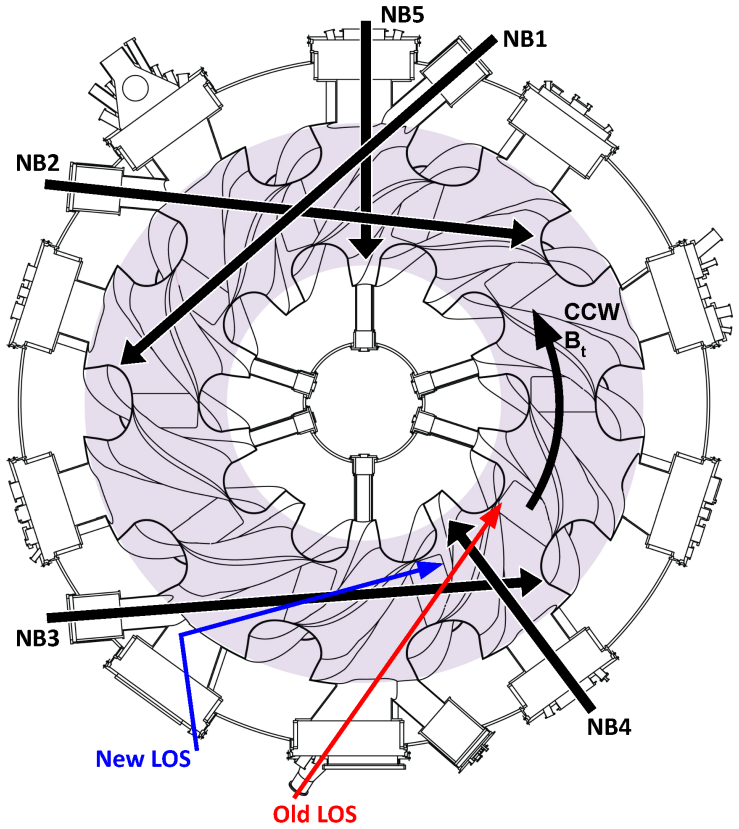
The key object is the sightline geometry: the new LOS forms an angle of about 10 degrees with the NB3 negative-ion beamline, whereas the old LOS forms an angle of about 33 to 37 degrees with the NB4 positive-ion beamline. This small angle makes the relative energy between injected neutrals and fast ions small, so high-energy ions produce resolvable Doppler-shifted Balmer-alpha emission. The analysis is carried by FIDASIM weight functions, W(X,V), which map the phase-space sensitivity of each sightline and convert the fast-ion distribution f into a predicted signal S = ∫ W f dX dV, with the distribution supplied by the GNET transport code.
What would settle it
Compare the beam-off spectrum taken immediately after turn-off with one taken after several slowing-down times; if the subtracted spectrum still shows a Doppler-shifted FIDA feature, residual fast ions contaminate the net signal and the 81 keV peak assignment.
Extended reading notes
Core claim
On LHD, a FIDA sightline nearly parallel to the active NNBI beamline measures Doppler-shifted D-alpha light from fast ions with energy around 81 keV along the sightline, confirming the prediction that this geometry accesses higher-energy fast ions than the conventional perpendicular geometry. The high-energy view's FIDA peak sits at 662.2 nm while the low-energy view peaks at 661.8 nm (71 keV), and the weight functions show the new view peaks above 85 keV whereas the old view peaks near 75 keV. Background-subtracted net signals agree in shape with synthetic FIDASIM spectra computed from a GNET fast-ion distribution for MHD-quiescent plasmas. The observed overestimate of the synthetic magnitude is attributed mainly to fast-ion charge-exchange losses with cold neutrals that are not included in the simulation.
Load-bearing premise
The measurement assumes that during the brief beam-off phase of the 80%-duty-cycle modulation, no fast-ion charge-exchange emission remains, so subtracting that spectrum leaves a clean fast-ion signal.
Editorial extensions
If this is right
- FIDA systems on NNBI-equipped devices can measure fast ions near the injection energy, not just the low-energy population seen by perpendicular views.
- The high-energy view extends the measurable energy along the sightline by roughly 10 keV and shifts the weight-function peak above 85 keV, improving phase-space coverage for fast-ion transport studies.
- Using higher injection energies, such as 500 keV or 1 MeV systems, should make FIDA emission from fast ions above 100 keV measurable in NBI-heated plasmas.
- The simultaneous low- and high-energy views provide complementary pitch-angle and energy coverage that can improve tomographic inversion of the fast-ion distribution.
- The qualitative agreement between FIDASIM and measured net signals supports the use of synthetic diagnostics to design future FIDA sightlines for burning-plasma devices.
Reading between the lines
- If the small-angle principle scales with injection energy, the same sightline design could be applied to the 500 keV JT-60U system or ITER's 1 MeV heating beams, where the charge-exchange cross-section and neutral penetration will differ.
- A testable extension is to sweep the angle between LOS and beam continuously; the measured FIDA peak energy should track the projected fast-ion energy, providing a direct calibration of the velocity-space mapping.
- The beam-off subtraction assumption could be checked by measuring the FIDA spectrum during the NNBI off phase over several slowing-down times; a residual signal would indicate contamination and require a modified background model.
- Tomographic inversions using a fan of near-tangential views could map the fast-ion distribution at high energy, complementing neutron and fast-ion loss diagnostics.
Editorial analysis
A structured set of objections, weighed in public.
Referee Report
Summary. The paper reports a new fast-ion D-alpha (FIDA) sightline on the Large Helical Device that uses a nearly tangential negative-ion neutral beam (NB3) as the active charge-exchange source. In the selected MHD-quiescent discharge, the background-subtracted spectrum shows a Doppler-shifted FIDA feature peaking at 662.2 nm, corresponding to an 81 keV energy component along the sightline, compared with 661.8 nm (71 keV) for the existing low-energy view that uses a perpendicular positive-ion beam. The measured spectra are compared with FIDASIM synthetic spectra driven by a GNET-computed fast-ion distribution; the synthetic spectral shape is reported to agree between 660 and 663 nm, while the synthetic magnitude overestimates both views. The paper also reports parametric trends of the FIDA signal with diagnostic beam power and plasma density, and concludes that nearly tangential viewing geometries can measure high-energy fast ions.
Significance. If the measurement is sound, the result extends FIDA spectroscopy to fast-ion energies closer to the injection energy of high-power negative-ion beams, which is directly relevant to ITER and JT-60SA. The paper has notable strengths: it uses an independent forward-model benchmark (FIDASIM with a GNET distribution), it compares two sightlines in the same discharge, it quantifies MHD activity to select quiescent cases, and it points to a public LHD data repository. However, the central claim rests on a single background-subtracted spectrum, and the synthetic validation is only qualitative because the magnitude mismatch is not quantified. The 10 keV improvement over the old sightline is the key result, but the paper does not yet provide the uncertainty analysis needed to establish that the difference is significant.
major comments (4)
- [Sec. 3, Fig. 5] The net FIDA spectrum is constructed as a single time difference, beam-on at t=3.98 s minus beam-off at t=3.88 s. Because the NNBI is modulated with an 80% duty cycle, the beam-off interval is short, and the paper gives no evidence that the passive fast-ion charge-exchange emission is identical in the two frames. If the fast-ion population changes on the modulation timescale, residual passive emission contaminates the net signal and can shift or even create the 662.2 nm feature assigned to 81 keV ions. Please provide time-resolved beam-off spectra, estimate the fast-ion slowing-down time relative to the beam-off interval, and test the sensitivity of the inferred peak energy to the choice of background time.
- [Sec. 3, Fig. 5(c,d)] The synthetic FIDASIM spectra overestimate the measured magnitude in both views by an unquantified factor, and the discrepancy is attributed qualitatively to fast-ion losses. The validation therefore rests on spectral shape alone. To support the claim that the synthetic spectra confirm the measured 81 keV peak, report a quantitative comparison in the 660-663 nm range, such as residuals or a chi-square metric, the synthetic peak wavelength and corresponding energy, and the sensitivity of the comparison to the assumed loss mechanism.
- [Sec. 3] The conversion from measured wavelengths (662.2 nm and 661.8 nm) to fast-ion energies along the sightline (81 keV and 71 keV) is not documented. No formula, spectral dispersion calibration, or rest-wavelength reference is given, and no uncertainty is propagated from the wavelength calibration or from the sightline-beam angles in Table 1. Because the central claim is a 10 keV increase in accessible energy, the paper must show the wavelength-to-energy mapping and demonstrate that the 0.4 nm separation is statistically significant.
- [Sec. 3] Only one discharge, 172359, is presented in detail, yet the paper selects 81 stable cases from 213. To support the concluding statement that the experiments confirm the predictions, state how many of the selected stable cases reproduce the high-energy FIDA peak and report the case-to-case spread in the inferred peak energy and signal-to-noise ratio. A single realization is a proof of principle, but it is not by itself a confirmation of the geometry claim across the operational range.
minor comments (5)
- [Sec. 2] The beam modulation is described only as an 80% duty cycle for NNBI and a 20% duty cycle for PNBI; specify the modulation period and the exact on/off time windows used for the background subtraction in Fig. 5.
- [Sec. 3] The paper states that BES normalization was unsuitable because the BES signals were truncated, but it does not state whether the FIDA spectral region itself was free of saturation or how the bremsstrahlung normalization was calibrated across the two views; a brief explanation would clarify the absolute comparison with FIDASIM.
- [Sec. 3, Fig. 5] The figure labels 'NB on' and 'NB off' are ambiguous because both the diagnostic beam and the heating beams modulate; use explicit time windows and beamline names in the figure and caption.
- [References] Reference [18] has formatting errors: the URL contains a semicolon and an unresolved DOI string ('10.57451/lhd.analyzed-data') that should be integrated into the citation.
- [Sec. 1] The sentence describing the cross-section peak at 30 keV/amu would benefit from a citation to the original measured or compiled cross-section data rather than to a review of FIDA measurements.
Circularity Check
No significant circularity: the measured FIDA peak and FIDASIM forward-model comparison are independent, with only non-load-bearing self-citations.
full rationale
The central claim is an experimental measurement: a Doppler-shifted FIDA feature at 662.2 nm, assigned to 81 keV fast ions along the new sightline from the standard Doppler-shift relation. This assignment is not fitted from FIDASIM or from the cited prior prediction; it comes directly from the measured spectra in Fig. 5(b). The FIDASIM and GNET codes are used as independent forward models: they take plasma parameters and a modelled distribution function as inputs and predict the spectrum, rather than being adjusted to reproduce the measured peak. The comparison in Figs. 5(c) and 5(d) shows shape agreement but a magnitude overestimate, confirming that the synthetic result is not a tuned reproduction. The only fitted element, the instrumental broadening calibrated with OV impurity lines, broadens the synthetic spectrum but does not determine the peak wavelength or the derived energy; therefore it cannot manufacture the 81 keV peak. The self-citations, including the earlier prediction in [12], are not load-bearing: the present experiment's beam-on/beam-off spectra and the wavelength assignment stand independently even if the earlier idealized prediction were inaccurate. The beam-off subtraction assumption about passive emission is a potential systematic uncertainty, not a circular derivation, because the net signal is not defined as the quantity it claims to predict. No equation is reused as both input and output, and no fitted parameter is renamed as a prediction. The paper's claim is therefore self-contained against external benchmarks, and no significant circularity is present.
Assumptions & free parameters
free parameters (2)
- Instrumental broadening width =
not specified numerically; empirically matched to OV impurity lines
- Mode amplitude noise floor =
1e-9
assumptions (4)
- domain assumption The charge-exchange emission cross-section for hydrogenic ions and its energy dependence (peak near 30 keV/amu) are accurately represented by the FIDASIM model.
- domain assumption The GNET steady-state fast-ion distribution computed with no instabilities matches the experimental distribution for the selected MHD-quiescent cases.
- domain assumption The beam-off spectrum is a valid background with no fast-ion FIDA emission, so beam-on minus beam-off isolates the net FIDA signal.
- domain assumption FIDASIM and GNET are externally validated, published codes (references [13] and [14]) appropriate for this LHD configuration.
Cite this review
Pith. "Pith review of Charge-exchange measurements of high-energy fast ions in LHD using negative-ion neutral beam injection." pith.science (2026). https://pith.science/paper/OZGCGMYK
@misc{pith2026241110597,
  author       = {Pith},
  title        = {Pith review of: Charge-exchange measurements of high-energy fast ions in LHD using negative-ion neutral beam injection},
  year         = {2026},
  howpublished = {\url{https://pith.science/paper/OZGCGMYK}},
  note         = {Machine review of arXiv:2411.10597}
}
read the original abstract
A new sightline geometry for the fast-ion D-alpha (FIDA) diagnostic on the Large Helical Device (LHD) has been confirmed to measure signals for high-energy fast ions produced by negative-ion neutral beam injection. The newly installed sightline uses a 180 keV tangential negative-ion neutral beamline as the active source. Due to the small angle between the beamline and FIDA sightline, the relative velocity between fast ions and injected neutrals is small. This allows for high-energy fast ions just below the beam injection energy to produce measurable Doppler-shifted FIDA emission. Experiments were conducted at LHD in order to compare the new sightline, which views a high-energy negative-ion tangential beamline, and the old sightline, which views a low-energy perpendicular positive-ion neutral beamline. The measured FIDA signal is validated against predictions from the synthetic fast-ion diagnostic code FIDASIM with a distribution function modelled by the 5D transport code GNET. The results of the experiment confirm that reducing the viewing angle with a tangential active beam allows FIDA diagnostic to view high-energy fast ions with a sufficient signal-to-noise ratio.
Figures


Figures from the paper (3 more)


Reference graph
Works this paper leans on
-
[1]
First results of deuterium beam operation on neutral beam injectors in the large helical device
Ikeda K, Tsumori K, Kisaki M, Nakano H, Nagaoka K, Osakabe M, et al. First results of deuterium beam operation on neutral beam injectors in the large helical device. AIP Conf Proc. 2018 Sep;2011(1):060002. Available from: https://doi.org/10.1063/1.5053331
-
[2]
Present status of the negative ion based neutral beam injector for JT-60U
Ohga T, Umeda N, Akino N, Ebisawa N, Grisham L, Hikita S, et al. Present status of the negative ion based neutral beam injector for JT-60U. Rev Sci Instrum. 2002 Feb;73(2):1058-60. Available from: https://pubs.aip.org/rsi/article/ 73/2/1058/725125/Present-status-of-the-negative-ion-based-neutral
work page 2002
-
[3]
Https://www.jt60sa.org/wp/wp- content/uploads/2021/02/JT-60SA Res Plan-5.pdf
JT-60SA Research Plan Research Objectives and Strategy; 2018. Https://www.jt60sa.org/wp/wp- content/uploads/2021/02/JT-60SA Res Plan-5.pdf. Available from: https://www.jt60sa.org/wp/wp-content/ uploads/2021/02/JT-60SA_Res_Plan-5.pdf
work page 2018
-
[4]
Status of the ITER heating neutral beam system
Hemsworth R, Decamps H, Graceffa J, Schunke B, Tanaka M, Dremel M, et al. Status of the ITER heating neutral beam system. Nucl Fusion. 2009 Apr;49(4):045006. Available from: https://iopscience.iop.org/article/10.1088/ 0029-5515/49/4/045006
work page 2009
-
[5]
Alpha particle physics in a tokamak burning plasma experiment
Heidbrink WW. Alpha particle physics in a tokamak burning plasma experiment. Physics of Plasmas. 2002 05;9(5):2113-9. Available from: https://doi.org/10.1063/1.1461383
-
[6]
Extension of the operational regime of the LHD towards a deuterium experiment
Takeiri Y, Morisaki T, Osakabe M, Yokoyama M, Sakakibara S, Takahashi H, et al. Extension of the operational regime of the LHD towards a deuterium experiment. Nuclear Fusion. 2017 aug;57(10):102023. Available from: https://dx.doi.org/10.1088/1741-4326/aa7fc2
-
[7]
The large helical device vertical neutron camera operating in the MHz counting rate range
Ogawa K, Isobe M, Nishitani T, Kobuchi T. The large helical device vertical neutron camera operating in the MHz counting rate range. Rev Sci Instrum. 2018 Nov;89(11):113509. Available from: http://aip.scitation.org/doi/10. 1063/1.5054818
work page 2018
-
[8]
Hydrogenic fast-ion diagnostic using Balmer-alpha light
Heidbrink WW, Burrell KH, Luo Y, Pablant NA, Ruskov E. Hydrogenic fast-ion diagnostic using Balmer-alpha light. Plasma Phys Control Fusion. 2004 Dec;46(12):1855-75. Available from: https://iopscience.iop.org/article/10. 1088/0741-3335/46/12/005
work page 2004
Show all 18 references
-
[9]
Fast ion charge exchange spectroscopy measurement using a radially injected neutral beam on the large helical device
Osakabe M, Murakami S, Yoshinuma M, Ida K, Whiteford A, Goto M, et al. Fast ion charge exchange spectroscopy measurement using a radially injected neutral beam on the large helical device. Rev Sci Instrum. 2008 Oct;79(10):10E519. Available from: http://aip.scitation.org/doi/10...
2008 doi
-
[10]
Fast-ion D-alpha measurements of the fast-ion distribution (invited)
Heidbrink WW. Fast-ion D-alpha measurements of the fast-ion distribution (invited). Rev Sci Instrum. 2010 Oct;81(10):10D727. Available from: http://aip.scitation.org/doi/10.1063/1.3478739
2010 doi
-
[11]
Fast-ion D alpha diagnostic with 3D- supporting FIDASIM in the Large Helical Device
Fujiwara Y, Kamio S, Yamaguchi H, Garcia A V, Stagner L, Nuga H, et al. Fast-ion D alpha diagnostic with 3D- supporting FIDASIM in the Large Helical Device. Nucl Fusion. 2020 Nov;60(11):112014. Available from: https: //iopscience.iop.org/article/10.1088/1741-4326/abae84
2020 doi
-
[12]
Diagnosis of fast ions produced by negative-ion neutral-beam injection with fast-ion deuterium-alpha spectroscopy
Muscatello CM, Heidbrink WW, Boivin RL, Chrystal C, Collins CS, Fujiwara Y, et al. Diagnosis of fast ions produced by negative-ion neutral-beam injection with fast-ion deuterium-alpha spectroscopy. Rev Sci Instrum. 2019 Jul;90(7):073504. Available from: http://aip.scitation.or...
2019 doi
-
[13]
Progress in modelling fast-ion D-alpha spectra and neutral particle analyzer fluxes using FIDASIM
Geiger B, Stagner L, Heidbrink WW, Dux R, Fischer R, Fujiwara Y, et al. Progress in modelling fast-ion D-alpha spectra and neutral particle analyzer fluxes using FIDASIM. Plasma Phys Control Fusion. 2020 Oct;62(10):105008. Available from: https://iopscience.iop.org/article/10....
2020 doi
-
[14]
Effect of Neoclassical Transport Optimization on Energetic Ion Confinement in LHD
Murakami S, Yamada H, Sasao M, Isobe M, Ozaki T, Saida T, et al. Effect of Neoclassical Transport Optimization on Energetic Ion Confinement in LHD. Fusion Science and Technology. 2004;46(2):241-7. Available from: https: //doi.org/10.13182/FST04-A561
2004 doi
-
[15]
Measurements of fast-ion acceleration at cyclotron harmonics using Balmer-alpha spectroscopy
Heidbrink WW, Luo Y, Burrell KH, Harvey R W, Pinsker RI, Ruskov E. Measurements of fast-ion acceleration at cyclotron harmonics using Balmer-alpha spectroscopy. Plasma Phys Control Fusion. 2007 Sep;49(9):1457-75. Available from: https://iopscience.iop.org/article/10.1088/0741-...
2007 doi
-
[16]
Fast-ion diagnostic in fusion plasmas by velocity-space tomography
Salewski M. Fast-ion diagnostic in fusion plasmas by velocity-space tomography. Technical University of Denmark. 2019. Dr. Techn. Thesis
2019
-
[17]
Fast-ion D-alpha measurements and simulations in quiet plasmas
Luo Y, Heidbrink WW, Burrell KH, Ruskov E, Solomon WM. Fast-ion D-alpha measurements and simulations in quiet plasmas. Physics of Plasmas. 2007 11;14(11):112503. Available from: https://doi.org/10.1063/1.2794320
2007 doi
-
[18]
https://www-lhd.nifs.ac.jp/pub/Repository en.html
LHD experiment data repository. https://www-lhd.nifs.ac.jp/pub/Repository en.html;. Https://doi.org/10.57451/lhd.analyzed-data. Available from: https://www-lhd.nifs.ac.jp/pub/Repository_en.html. 6 Figure 1: LHD top-down midplane view with beamlines. The high-energy view uses t...
Reviewed August 12, 2026 · model on record in the stance chip above.
Discussion (0). Continue with ORCID to comment.