REVIEW 4 major objections 5 minor 65 references
Bidirectional anisotropic solar energetic particle events observed by Solar Orbiter
T0 review · 4 major / 5 minor · reviewed 2026-08-06 · deepseek-v4-flash
Pith's one-line read Bidirectional particle bursts trace a flux rope's long field lines.
desk verdict A genuinely new two-event SEP observation with a plausible flux-rope interpretation; event 2's long path length is the weak link but not fatal. read the letter →
The pith
A machine-rendered reading of the paper's core claim, the machinery that carries it, and where it could break.
The reading
What carries the argument
The argument runs on two diagnostics in parallel. Velocity dispersion analysis fits onset time as a function of inverse particle speed, giving release time and path length separately for the sunward and anti-sunward populations, while the first-order anisotropy tells which population dominates at each energy and time. On the magnetic side, an automated Grad-Shafranov-based flux-rope identification routine and a wavelet-derived normalized reduced magnetic helicity locate the small-scale flux rope, with cross-helicity and residual-energy checks distinguishing a twisted rope from Alfvenic fluctuations. The link between the two is the path-length excess: the fitted lengths exceed the nominal Parker spiral length, and that excess is assigned to helical winding around the flux rope's axis, allowing an estimate of the rope's central axis length.
What would settle it
Re-measure event 2's anti-sunward onset from background-subtracted spectra with an automated change-point detector; if a shift of roughly ten minutes or more removes the sunward/anti-sunward path-length asymmetry or brings the lengths back to the nominal Parker value, the flux-rope-guided long-path interpretation for that event fails. A future bidirectional event inside a flux rope with near-equal release times, intensities, and spectral indices for both streams would instead support the mirror-reflection alternative.
Extended reading notes
Core claim
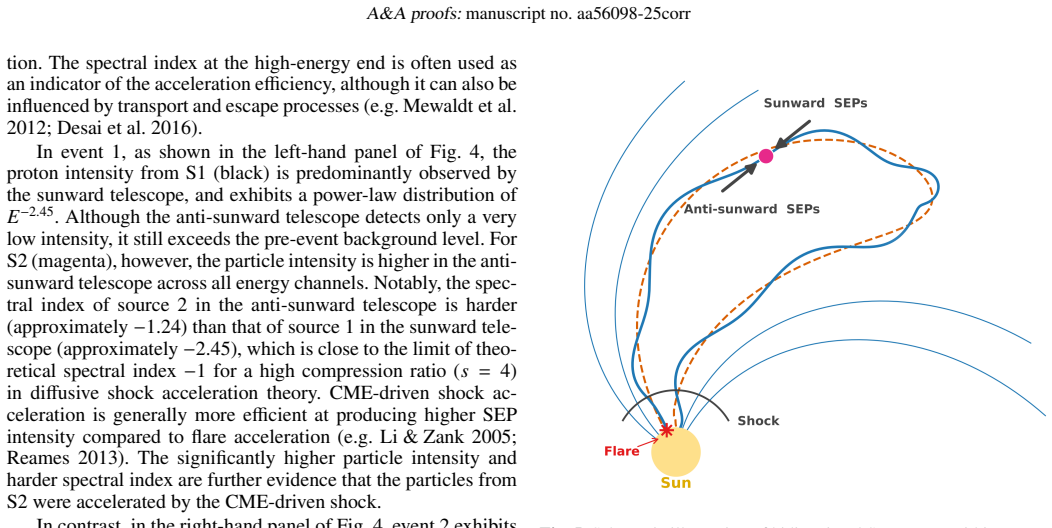
The paper reports two solar energetic particle events in which protons arriving at Solar Orbiter showed two distinct velocity-dispersion tracks with opposite first-order anisotropies at the same time. In each event, the promptly arriving anti-sunward stream matched the timing of a type III radio burst, so it is assigned to flare acceleration; the delayed, more intense, spectrally harder sunward stream is assigned to a CME-driven shock that takes roughly half an hour to become an efficient accelerator. Small-scale magnetic flux ropes were identified in situ during both events, and the velocity dispersion analysis implies path lengths of 1.75 au and 3.04 au in event 1 and 1.51 au and 4.62 au in event 2, all substantially longer than the nominal Parker spiral length. The paper concludes that the flux rope's closed, twisted field lines guide the two populations along different, longer paths, and that simultaneous velocity dispersion from two distinct sources can directly constrain the flux rope's topology and central axis length.
Load-bearing premise
The load-bearing premise is that the anti-sunward onset time in the second event, which had to be estimated by eye against a bright, scattered background, is accurate enough for velocity dispersion analysis to yield the 4.62 au path length that underlies the flux-rope argument.
Editorial extensions
If this is right
- If the interpretation holds, a single spacecraft can estimate the central axis length of a small flux rope by combining velocity-dispersion path lengths with the observed helical twist, as done in Appendix B for event 1.
- The near-zero prompt release of the anti-sunward stream and the roughly 30-minute delayed release of the sunward stream become a usable discriminator between flare and CME-shock acceleration inside a closed magnetic structure.
- Small-scale flux ropes, not only large magnetic clouds, must be included in solar energetic particle transport models to account for sunward streams and path lengths longer than nominal Parker spirals.
- The rarity of clean bidirectional events is partly a detection effect: the first injection must be much weaker than the second, or its anisotropy signature masks the second source.
Reading between the lines
- Beyond the paper, if small flux ropes are as frequent in the slow solar wind as the cited surveys indicate, some solar energetic particle events with anomalously long path lengths or unusual anisotropies may be connectivity effects of these ropes rather than scattering effects.
- A testable extension is to search archival events for two velocity-dispersion tracks and check whether the path-length ratio of sunward to anti-sunward streams correlates with flux-rope twist, as the helical winding picture would predict.
- The spectral asymmetry proposed here implies a statistical prediction: sunward shock-accelerated streams should cluster near the strong-compression spectral index near minus one, while flare-related anti-sunward streams should be softer, which could be checked across a larger sample.
- A rival explanation, mirror reflection, would predict similar release times, intensities, and spectral indices for the two streams; future multipoint observations inside a well-resolved flux rope could test this cleanly by comparing fluxes at the two feet.
Signed reviews
Editorial analysis
A structured set of objections, weighed in public.
Referee Report
Summary. The manuscript reports two solar energetic particle (SEP) events observed by Solar Orbiter on July 13, 2023, and July 23, 2024, in which the proton anisotropy reveals two oppositely directed streaming populations during the onset phase. For each event the authors identify two separate velocity-dispersion tracks, perform velocity dispersion analysis (VDA) to derive release times and path lengths, and combine the path lengths with in situ magnetic-field diagnostics (automated flux-rope identification via PyGS and wavelet magnetic helicity) to argue that a small-scale flux rope channels flare-accelerated anti-sunward particles along a shorter leg and CME-shock-accelerated sunward particles along a longer leg. The paper concludes that the sunward population is delayed, has a harder spectrum, and is more intense, and that the inferred path-length asymmetry constrains the flux-rope topology.
Significance. Event 1 is a convincing and rare observation: two clean velocity-dispersion tracks with opposite anisotropies, a type III radio burst coincident with the prompt release, a PyGS-identified flux rope, and bidirectional suprathermal electrons. If the interpretation is correct, the work provides a direct observational link between small-scale flux ropes and bidirectional SEP transport, and it proposes a new way to use simultaneous injections to constrain flux-rope topology. The paper is generally careful in stating its assumptions and in acknowledging the weaker constraints for event 2; the use of the public PyGS package and the explicit caveat about the event-2 path length are positive features. However, the strength of the event-2 evidence is currently overstated in the abstract, and the quantitative path-length asymmetry in event 2 rests on a visually estimated onset under strong scattering, so the central claim is only partly supported by the second event.
major comments (4)
- [§3, Event 2 (Fig. 3 right panels) and Appendix B, Eq. (B.1)] The 4.62 au S2 path length is the main quantitative support for the path-length asymmetry in event 2 and enters the flux-rope topology argument, yet it is derived from a visually estimated anti-sunward onset in a period of strong scattering and high background. The manuscript itself states that "the path length for this event might be less robust, especially for the S2." Because the S2 onset is measured on top of a decaying, velocity-dispersed S1 population, an energy-dependent late bias in the low-energy onset times would steepen the VDA slope and inflate the inferred path length; the present analysis offers no test of this bias. Please provide a quantitative robustness check, for example a background-subtracted onset fit, a fit restricted to the least contaminated high-energy channels, or a Monte Carlo over plausible onset choices; if such a check is not possible, state explicitly in the abstract and conclusions that the event-2 path-length asymmetry is only qualitative and does not by itself constrain flux-rope topology.
- [Abstract and §3 (Event 2)] The abstract says that "in both cases, small-scale flux ropes were identified in situ," but for event 2 the PyGS algorithm did not reliably detect a flux rope and the identification rests on wavelet helicity with thresholds |σm|≥0.6 and σr≤−0.5, described in the text as a "potentially Alfvénic SFR." This overstates the certainty for event 2. The abstract and the conclusions should carry the same qualification as the body of the paper, namely that the event-2 flux rope is inferred rather than identified.
- [§3 (Event 2) and Fig. 4] The spectral arguments are made without uncertainties: the text contrasts a −2.45 spectral index for S1 with −1.24 for S2 and states that the latter is "close to the limit of theoretical spectral index −1," but no fit uncertainties, energy ranges, or goodness-of-fit values are quoted. Since the spectral hardness is one of the three main discriminants between shock and flare origin, please report the fit errors and the fitting range for each spectrum, or downgrade the spectral claim to a qualitative statement.
- [§3 (release-time interpretation)] The 30-minute release delay is interpreted as shock-acceleration time using assumed values of 1.43 R⊙ for the shock formation height, 3 R⊙ for the release height, and 750 km/s for the average shock speed. These parameters are not measured for these events, and the resulting 24-minute estimate is therefore only a plausibility argument; the delay could also reflect energy-dependent release or transport effects. Please frame this paragraph explicitly as a consistency check and state how the conclusion would change if the assumed heights and speeds were varied over the ranges quoted in the cited statistical studies.
minor comments (5)
- [§3 and Fig. 3] The text refers to "solid lines" and "purple lines" in Fig. 3, while the figure caption describes "dashed black and magenta lines"; please make the line-style and color terminology consistent between text and figure.
- [Appendix B] The notation L0,sun and L0,asun is confusing: L0,sun is derived from the 1.75 au path of the anti-sunward streaming population, whereas the phrase "sunward streaming" elsewhere refers to the 3.04 au population. Please rename these quantities so that the mapping between telescopes, streaming directions, and path lengths is explicit.
- [§3 and Fig. 1] The comparison of derived path lengths with the nominal Parker spiral should quote the actual solar wind speed used, and its uncertainty, for each event; Fig. 1 assumes 400 km/s while Appendix B quotes 300 km/s, and the conclusion that the paths are "substantially greater" depends on this choice.
- [§3 and Fig. 3 caption] Please clarify the radio-burst timing convention: the caption says the vertical line is shifted 7.9 and 7.2 minutes earlier, while the text says the burst began at approximately 06:41 UT from the Sun; state explicitly whether the quoted onset is the time at the Sun or the observed time at the spacecraft.
- [§3] There are two occurrences of "consisting with" where "consistent with" is meant; please correct these in the paragraph discussing the acceleration-time estimate.
Circularity Check
No significant circularity: VDA path lengths, SFR identification, and flux-rope topology inference rest on independent measurements and are not recycled as inputs.
full rationale
The derivation chain is self-contained. VDA release times and path lengths are fitted from the observed energy-dependent onset times in the sunward and anti-sunward telescope channels; these quantities are subsequently compared with, not fitted to, the independent type III radio burst timing and the nominal Parker spiral length. The flux-rope identification uses separate magnetic-field and plasma diagnostics (PyGS GS reconstruction and wavelet helicity/cross-helicity/residual-energy criteria), and Appendix B combines the independently inferred particle path length with the separately measured mean Bt/Bz ratio to estimate the flux-rope axis length. No equation reduces to its own input, and no fitted parameter is renamed as a prediction. The acknowledged weakness in event 2's anti-sunward onset time, visually estimated under strong scattering and conceded by the authors as potentially less robust, is a measurement-uncertainty concern rather than a circularity; it does not make the VDA output equivalent to the flux-rope hypothesis by construction. Self-citations to PyGS and the helicity methodology are supporting references to externally developed or independently published tools, not load-bearing uniqueness claims.
Assumptions & free parameters
free parameters (6)
- Shock formation height =
1.43 solar radii
- Proton release height =
3 solar radii
- Average shock speed =
750 km/s for both events
- Radio burst onset shift =
7.9 min (event 1), 7.2 min (event 2)
- Parker spiral solar wind speed for path-length comparison =
400 km/s (Fig. 1), 300 km/s (Appendix B)
- SFR identification thresholds =
|sigma_m| >= 0.6, sigma_r <= -0.5
assumptions (5)
- domain assumption All energies of a given particle population are released simultaneously at the source (VDA assumption).
- domain assumption The in situ structure carrying bidirectional particles is a closed flux rope with both legs anchored to the Sun.
- domain assumption The wavelet helicity criteria identify flux ropes rather than Alfvenic turbulence.
- domain assumption EPT ion fluxes are proton-dominated.
- domain assumption Shock acceleration delay is governed by t_acc ~ kappa/u^2 equated to the shock dynamic timescale.
Cite this review
Pith. "Pith review of Bidirectional anisotropic solar energetic particle events observed by Solar Orbiter." pith.science (2026). https://pith.science/paper/P27SMMRD
@misc{pith2026250716990,
  author       = {Pith},
  title        = {Pith review of: Bidirectional anisotropic solar energetic particle events observed by Solar Orbiter},
  year         = {2026},
  howpublished = {\url{https://pith.science/paper/P27SMMRD}},
  note         = {Machine review of arXiv:2507.16990}
}
read the original abstract
Solar Energetic Particle (SEP) events are critical for understanding particle acceleration and transport in the heliosphere. While most SEP events involve outward streaming particles along open magnetic field lines, bidirectional events characterized by simultaneous sunward and anti-sunward particle flows offer unique insights into magnetic field topology and the interplay of multiple acceleration sources. We aim to investigate the origin and transport of energetic particles in two rare bidirectional anisotropic SEP events observed by Solar Orbiter. Both events showed two clear velocity dispersion signatures with opposite particle anisotropies during their onset phase. The sunward streaming protons, characterized by delayed release time, harder spectral index, and higher intensities, may be attributed to coronal mass ejection-driven shock acceleration, while the promptly released anti-sunward streaming protons are likely linked to flare acceleration. Notably, in both cases, small-scale flux ropes were identified in situ during the time intervals corresponding to the bidirectional particle streaming. Path lengths derived for sunward and anti-sunward injections were substantially greater than nominal values of the Parker field lines, further supporting the role of the flux rope in shaping particle trajectories. These observations demonstrate that magnetic flux rope could significantly affect magnetic connectivity to the source region and SEP propagation in the inner heliosphere, while simultaneous velocity dispersion from two distinct particle sources allows for direct constraints on the topology of the flux rope. Our results highlight the value of combining particle anisotropy, release time, source spectra, and magnetic structure diagnostics to unravel SEP transport in complex transient magnetic structures, and also present new challenges for the current SEP transport model.
Figures


Figures from the paper (2 more)

Reference graph
Works this paper leans on
-
[1]
Ameri , D., Valtonen , E., Al-Sawad , A., & Vainio , R. 2024, , 299, 133
work page 2024
-
[2]
Cartwright , M. L. & Moldwin , M. B. 2010, Journal of Geophysical Research (Space Physics), 115, A08102
work page 2010
- [3]
-
[4]
Chen, Y., Hu, Q., Zhao, L., Kasper, J. C., & Huang, J. 2021, The Astrophysical Journal, 914, 108
work page 2021
- [5]
- [6]
- [7]
-
[8]
2023, Journal of Geophysical Research (Space Physics), 128, e2023JA031502
Ding , Z., Li , G., Santa Fe Due \ n as , A., et al. 2023, Journal of Geophysical Research (Space Physics), 128, e2023JA031502
work page 2023
Show all 65 references
-
[9]
2022, , 668, A71
Ding , Z., Wijsen , N., Li , G., & Poedts , S. 2022, , 668, A71
2022
-
[10]
F., Kollhoff , A., et al
Ding , Z., Wimmer-Schweingruber , R. F., Kollhoff , A., et al. 2025, , 696, A199
2025
-
[11]
2016, , 586, A55
Dresing , N., G \'o mez-Herrero , R., Heber , B., et al. 2016, , 586, A55
2016
-
[12]
2014, , 567, A27
Dresing , N., G \'o mez-Herrero , R., Heber , B., et al. 2014, , 567, A27
2014
-
[13]
Q., Wu , D
Feng , H. Q., Wu , D. J., & Chao , J. K. 2007, Journal of Geophysical Research (Space Physics), 112, A02102
2007
-
[14]
2023, Frontiers in Astronomy and Space Sciences, 9, 1058810
Gieseler, J., Dresing, N., Palmroos, C., et al. 2023, Frontiers in Astronomy and Space Sciences, 9, 1058810
2023
-
[15]
2017, , 840, 85
G \'o mez-Herrero , R., Dresing , N., Klassen , A., et al. 2017, , 840, 85
2017
-
[16]
2013, Advances in Space Research, 51, 1981
Gopalswamy, N., Xie, H., M \"a kel \"a , P., et al. 2013, Advances in Space Research, 51, 1981
2013
-
[17]
He , H. Q. 2015, , 814, 157
2015
-
[18]
S., O'Brien , H., Carrasco Blazquez , I., et al
Horbury , T. S., O'Brien , H., Carrasco Blazquez , I., et al. 2020, , 642, A9
2020
-
[19]
& Sonnerup , B
Hu , Q. & Sonnerup , B. U. \"O . 2002, Journal of Geophysical Research (Space Physics), 107, 1142
2002
-
[20]
2018, , 239, 12
Hu , Q., Zheng , J., Chen , Y., le Roux , J., & Zhao , L. 2018, , 239, 12
2018
-
[21]
1994, , 428, 837
Kahler , S. 1994, , 428, 837
1994
-
[22]
2012, , 542, A28
Klassen , A., G \'o mez-Herrero , R., Heber , B., et al. 2012, , 542, A28
2012
-
[23]
2015, , 580, A80
Kouloumvakos , A., Nindos , A., Valtonen , E., et al. 2015, , 580, A80
2015
-
[24]
J., Grimm , O., et al
Krucker , S., Hurford , G. J., Grimm , O., et al. 2020, , 642, A15
2020
-
[25]
E., Lin , R
Larson , D. E., Lin , R. P., McTiernan , J. M., et al. 1997, , 24, 1911
1997
-
[26]
A., Cohen, C
Leske, R. A., Cohen, C. M. S., Mewaldt, R. A., et al. 2012, Solar Physics, 281, 301
2012
-
[27]
2017, Science China Earth Sciences, 60, 1440
Li , G. 2017, Science China Earth Sciences, 60, 1440
2017
-
[28]
2021, The Astrophysical Journal, 919, 146
Li , G., Jin , M., Ding , Z., et al. 2021, The Astrophysical Journal, 919, 146
2021
-
[29]
Li , G., Shalchi , A., Ao , X., Zank , G., & Verkhoglyadova , O. P. 2012, Advances in Space Research, 49, 1067
2012
-
[30]
2020, , 905, L1
Li , G., Wu , X., Zhao , L., & Yao , S. 2020, , 905, L1
2020
-
[31]
& Zank , G
Li , G. & Zank , G. P. 2005, Geophysical Research Letters, 32, L02101
2005
-
[32]
P., & Rice , W
Li , G., Zank , G. P., & Rice , W. K. M. 2003, Journal of Geophysical Research (Space Physics), 108, 1082
2003
-
[33]
Lucas, J. M. 1985, Technometrics, 27, 129
1985
-
[34]
2020, Astronomy & Astrophysics, 642, A12
Maksimovic, M., Bale, S., Chust, T., et al. 2020, Astronomy & Astrophysics, 642, A12
2020
-
[35]
E., Sarris , E
Malandraki , O. E., Sarris , E. T., Lanzerotti , L. J., et al. 2002, Journal of Atmospheric and Solar-Terrestrial Physics, 64, 517
2002
-
[36]
2012, Space Science Reviews, 171, 97
Mewaldt, R., Looper, M., Cohen, C., et al. 2012, Space Science Reviews, 171, 97
2012
-
[37]
J., Bruno , R., Livi , S., et al
Owen , C. J., Bruno , R., Livi , S., et al. 2020, , 642, A16
2020
-
[38]
Reames , D. V. 2009, , 693, 812
2009
-
[39]
Reames, D. V. 2013, Space Science Reviews, 175, 53
2013
-
[40]
Richardson , I. G. & Cane , H. V. 1996, , 101, 27521
1996
-
[41]
G., Dvornikov , V
Richardson , I. G., Dvornikov , V. M., Sdobnov , V. E., & Cane , H. V. 2000, , 105, 12579
2000
-
[42]
2025, , 694, A64
Rodr \' guez-Garc \' a , L., G \'o mez-Herrero , R., Dresing , N., et al. 2025, , 694, A64
2025
-
[43]
1999, in International Cosmic Ray Conference, Vol
Rodriguez-Pacheco , J. 1999, in International Cosmic Ray Conference, Vol. 6, 26th International Cosmic Ray Conference (ICRC26), Volume 6, ed. D. Kieda , M. Salamon , & B. Dingus , 468
1999
-
[44]
2003, Solar Physics, 213, 121
Rodr \' guez-Pacheco, J., Cid, C., Blanco, J., & Sequeiros, J. 2003, Solar Physics, 213, 121
2003
-
[45]
F., Mason , G
Rodr \' guez-Pacheco , J., Wimmer-Schweingruber , R. F., Mason , G. M., et al. 2020, , 642, A7
2020
-
[46]
P., Odst r cil , D., Sheeley , N
Rouillard , A. P., Odst r cil , D., Sheeley , N. R., et al. 2011, , 735, 7
2011
-
[47]
P., Sheeley , N
Rouillard , A. P., Sheeley , N. R., Tylka , A., et al. 2012, , 752, 44
2012
-
[48]
2021, The Astrophysical Journal Letters, 908, L19
Shi, C., Zhao, J., Huang, J., et al. 2021, The Astrophysical Journal Letters, 908, L19
2021
-
[49]
Sonnerup , B. U. \"O . & Guo , M. 1996, , 23, 3679
1996
-
[50]
C., Malandraki , O
Tan , L. C., Malandraki , O. E., Reames , D. V., et al. 2012, , 750, 146
2012
-
[51]
& Compo, G
Torrence, C. & Compo, G. P. 1998, Bulletin of the American Meteorological society, 79, 61
1998
-
[52]
2025, The Astrophysical Journal Supplement Series, 277, 2
Trotta, D., Dimmock, A., Hietala, H., et al. 2025, The Astrophysical Journal Supplement Series, 277, 2
2025
-
[53]
O., Dresing , N., et al
Wei , W., Lee , C. O., Dresing , N., et al. 2024, , 973, L52
2024
-
[54]
F., Berger, L., Kollhoff, A., et al
Wimmer-Schweingruber, R. F., Berger, L., Kollhoff, A., et al. 2023, Astronomy & Astrophysics, 678, A98
2023
-
[55]
F., Crooker , N
Wimmer-Schweingruber , R. F., Crooker , N. U., Balogh , A., et al. 2006, , 123, 177
2006
-
[56]
F., Janitzek , N
Wimmer-Schweingruber , R. F., Janitzek , N. P., Pacheco , D., et al. 2021, , 656, A22
2021
-
[57]
2023, Journal of Geophysical Research: Space Physics, e2022JA030939
Wu, X., Li, G., Zhao, L., et al. 2023, Journal of Geophysical Research: Space Physics, e2022JA030939
2023
-
[58]
P., Li, G., Florinski, V., et al
Zank, G. P., Li, G., Florinski, V., et al. 2006, Journal of Geophysical Research: Space Physics, 111, 1
2006
-
[59]
2019, The Astrophysical Journal, 878, 107
Zhao, L., Li, Gang , Zhang, M., et al. 2019, The Astrophysical Journal, 878, 107
2019
-
[60]
L., Zank , G
Zhao , L. L., Zank , G. P., Adhikari , L., et al. 2020, , 246, 26
2020
-
[61]
L., Zank , G
Zhao , L. L., Zank , G. P., He , J. S., et al. 2021 a , , 656, A3
2021
-
[62]
L., Zank , G
Zhao , L. L., Zank , G. P., Hu , Q., et al. 2021 b , , 650, A12
2021
-
[63]
& Hu , Q
Zheng , J. & Hu , Q. 2018, , 852, L23
2018
-
[64]
, " * write output.state after.block = add.period write newline
ENTRY address archiveprefix author booktitle chapter edition editor howpublished institution eprint journal key month note number organization pages publisher school series title type volume year label extra.label sort.label short.list INTEGERS output.state before.all mid.sent...
-
[65]
write newline
" write newline "" before.all 'output.state := FUNCTION n.dashify 't := "" t empty not t #1 #1 substring "-" = t #1 #2 substring "--" = not "--" * t #2 global.max substring 't := t #1 #1 substring "-" = "-" * t #2 global.max substring 't := while if t #1 #1 substring * t #2 gl...
Reviewed August 6, 2026 · model on record in the stance chip above.
Discussion (0). Continue with ORCID to comment.