REVIEW 3 major objections 5 minor 30 references
PseudoVC: Improving One-shot Voice Conversion with Pseudo Paired Data
T0 review · 3 major / 5 minor · reviewed 2026-08-07 · deepseek-v4-flash
Pith's one-line read PseudoVC beats public voice-conversion models with pseudo paired data
desk verdict Plausible and novel training trick for one-shot VC, but the headline claim of superior performance rests on overlapping confidence intervals and unquantified objective metrics. read the letter →
The pith
A machine-rendered reading of the paper's core claim, the machinery that carries it, and where it could break.
The reading
What carries the argument
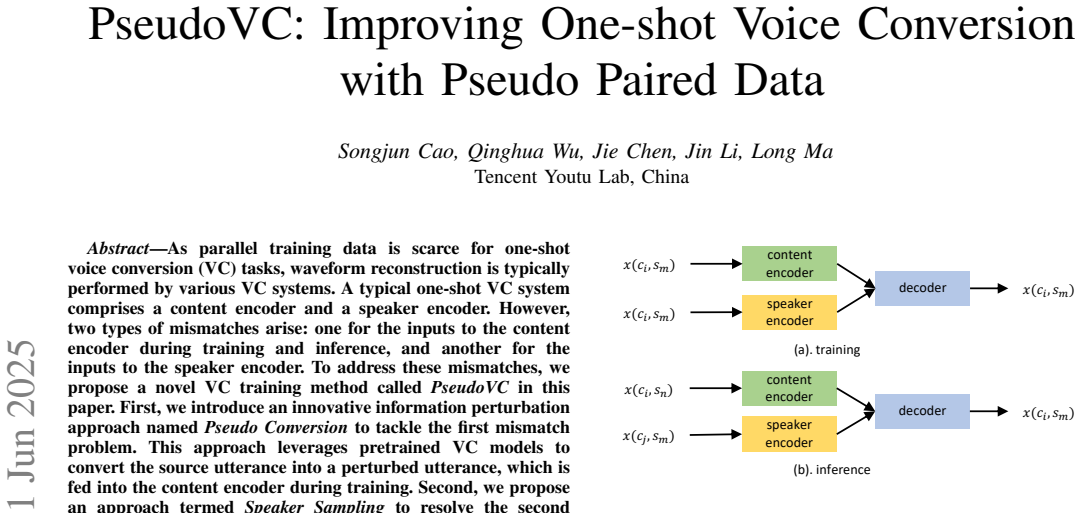
The load-bearing object is pseudo paired data: pairs $((x'(c_i,s_n), x(c_i,s_m)))$ in which the content is fixed to $c_i$ and the speaker label is the source speaker $s_m$, generated by a teacher VC model from the source utterance and a random reference utterance. This pseudo utterance acts as the training-time input to the content encoder, so the student learns to reconstruct the source from an input whose timbre is target-like and diverse, exactly the distribution it will meet at inference. The second component, Speaker Sampling, is a scheduled-sampling-style rule that feeds $x(c_j,s_m)$ into the frozen speaker encoder with probability $\alpha$, forcing the decoder and flow to operate on embeddings drawn from the same speaker but with mismatched content, matching inference conditions.
What would settle it
Measure word error rate on the pseudo utterances $x'(c_i,s_n)$ themselves: if the teacher conversion already confuses words (WER close to or above the student's final WER), then content preservation in Pseudo Conversion fails and the method's benefit would not come from the claimed mechanism; alternatively, train with pseudo utterances produced by a deliberately content-destroying teacher and show intelligibility collapses.
Extended reading notes
Core claim
The central claim is that the train-inference mismatch in one-shot voice conversion can be largely removed by constructing pseudo paired data rather than by collecting real parallel speech. For every training utterance $x(c_i,s_m)$, the authors first train a teacher VC model $M_t$, then generate $N=25$ pseudo utterances $x'(c_i,s_n)=M_t(x(c_i,s_m),x(c_j,s_n))$ by converting the source into randomly chosen reference speakers' voices. During student training, one pseudo utterance is randomly selected and fed to the WavLM content encoder while the original source utterance remains the reconstruction target; with probability $\alpha$, the speaker encoder instead receives another utterance from the same speaker. The paper demonstrates on VCTK training with LibriTTS test that this combined strategy outperforms all compared baselines (PH, DDDM-VC, FreeVC) on MOS, SMOS, WER, and speaker-encoder cosine similarity, and the ablation attributes similarity gains to Pseudo Conversion and intelligibility gains to Speaker Sampling.
Load-bearing premise
The teacher model used to generate pseudo utterances preserves the content of the source utterance while changing the timbre, so the content encoder is trained on uncorrupted linguistic information.
Editorial extensions
If this is right
- If PseudoVC's central claim is right, one-shot VC can be improved without any new parallel corpus, since the pseudo paired data are generated from the training set itself.
- Pseudo Conversion dominates earlier perturbation methods (VTLP, NANSY, SR) on speaker similarity, suggesting that learned conversions preserve content better than signal-processing distortions.
- Speaker Sampling with a small $\alpha$ (e.g., 0.01) improves intelligibility over no sampling, while a large $\alpha$ (0.1) hurts similarity, so the probability must be kept small.
- The two-stage cost of training a teacher first is a real price, and the paper's own conclusion points to a one-stage variant as the natural next step.
- Because the method is training-data-agnostic, it should transfer to other one-shot VC architectures that share the content-encoder/speaker-encoder/decoder structure.
Reading between the lines
- Editorial inference: the pseudo-utterance set $S(x(c_i,s_m))$ essentially performs dataset expansion; one could anneal $\alpha$ over training (as in scheduled sampling) rather than fixing it, which would likely preserve similarity while keeping the intelligibility gain.
- Editorial inference: nothing in the method is specific to FreeVC, so PseudoVC could be dropped into any WavLM-based one-shot VC system or even into TTS front-ends that need disentangled content and speaker codes.
- Editorial inference: the teacher's content-preservation failure mode suggests a filtering step—only accept pseudo utterances whose transcription matches the source—which would turn Pseudo Conversion into a more robust semi-supervised scheme and reduce confirmation bias.
- Editorial inference: a direct comparison of WER on pseudo utterances themselves would decouple the contribution of content preservation from the benefit of timbre diversity, a measurement the paper does not report.
Editorial analysis
A structured set of objections, weighed in public.
Referee Report
Summary. The paper proposes PseudoVC, a training method for one-shot voice conversion that addresses two train/inference mismatches: the content-encoder input during training comes from a teacher VC model (Pseudo Conversion), and the speaker-encoder input is randomly replaced by another same-speaker utterance (Speaker Sampling). The model is built on FreeVC with a WavLM content encoder, a speaker encoder, flow, and HiFi-GAN decoder. Experiments on VCTK/LibriTTS compare PseudoVC with PH, DDDM-VC, and FreeVC, and ablations compare Pseudo Conversion with VTLP, NANSY, and SR perturbation methods and study the speaker-sampling probability alpha. The authors claim PseudoVC outperforms all baselines and that Pseudo Conversion improves speaker similarity while Speaker Sampling improves intelligibility.
Significance. If the reported results are reliable, the proposed training strategies are simple and potentially general recipes for any encoder-decoder one-shot VC system: they reduce the gap between training-time and inference-time inputs without changing the architecture, and they use a pretrained teacher to generate pseudo paired data, which is an underexplored form of information perturbation. The paper is clearly written, the two mismatches are well motivated, the ablations are structured to isolate each component, and the authors provide a public audio demo and t-SNE visualizations. The main weakness is statistical: the headline improvements over FreeVC are small, with overlapping MOS confidence intervals and no significance testing for WER and SECS. The paper also does not validate the central content-preservation assumption of the pseudo utterances.
major comments (3)
- [IV.D, Table I; IV.E; IV.F] The headline claim that PseudoVC outperforms all baselines is not established by the reported statistics. In Table I, the MOS difference between PseudoVC (4.35±0.08) and FreeVC (4.25±0.08) has overlapping 95% confidence intervals, and no paired significance test is reported. WER (6.1 vs 6.7) and SECS (0.778 vs 0.751) are point estimates without error bars or significance tests, although they are computed on 4,800 utterances. The same problem affects Tables II and III: for example, b3 versus a3 have identical WER (6.7) and a SECS difference of only 0.029, and c1/c2 versus b3 differ by 0.6/0.7 WER points with no variance reported. Please report per-utterance bootstrap confidence intervals or paired significance tests for all objective metrics, and state whether the MOS/SMOS differences are significant at the utterance level.
- [III.B.1, Eq. (2)] The method assumes that the pseudo utterance x'(ci,sn)=Mt(x(ci,sm),x(cj,sn)) preserves the content ci while changing timbre, but this premise is never validated. Because the student's WavLM content encoder is trained on these pseudo utterances, any content errors introduced by the teacher become training noise in the content pathway, and intelligibility could degrade rather than improve. Please measure content preservation of the pseudo utterances directly (e.g., WER or phone accuracy of x'(ci,sn) against the source transcript) and relate it to downstream WER, or add an oracle-content-control experiment to establish that the gains come from timbre diversity and not from teacher artifacts.
- [IV.A, IV.F, Table III] The final configuration used for the main results in Table I is underspecified. Section IV.A fixes N=25, but no alpha value is given for the final PseudoVC model, and Table III reports two alpha settings with different trade-offs. The text says that the model with speaker sampling c2 yields better WER, yet c1 (alpha=0.1) has a lower WER (6.0) than c2 (alpha=0.01, WER 6.1); the choice of c2 is not justified. Please state which alpha was used in the main results, report the full trade-off curve, and explain the selection criterion, so that the main result is reproducible.
minor comments (5)
- [Title page and Abstract] There are typos in the displayed title and abstract: 'V oice' and 'PseudoVCin' should be 'Voice' and 'PseudoVC in'.
- [I. Introduction] The footnote 'Here we simply the model structure' should read 'Here we simplify the model structure'.
- [IV.C] Please state how many ratings each utterance received, whether all 15 participants rated all systems, and inter-rater agreement; the current description ('15 participants evaluate the scores of 300 utterances') is ambiguous.
- [IV.E.1 and Fig. 3] The claim that Pseudo Conversion exhibits the 'greatest speaker diversity' is based only on a t-SNE plot from a single source utterance; please report a quantitative diversity metric (e.g., mean pairwise cosine distance of speaker embeddings) and specify the t-SNE hyperparameters.
- [IV.E, Table II] The table header 'Mt' may confuse readers: clarify that a1, a2, and a3 serve both as the information-perturbation baselines and as the teacher models used by b1, b2, and b3, respectively.
Circularity Check
No circularity: PseudoVC is an empirical training-strategy paper whose pseudo-data loop is evaluated externally against independent baselines.
full rationale
This paper makes no derived prediction that reduces to its own inputs. The teacher model M_t is trained following FreeVC (Ref. [2]) and then used through Eq. 2 to synthesize pseudo utterances x'(c_i, s_n), which are fed to the content encoder during training; the student is trained with the standard reconstruction loss of Eq. 1. That is a self-training/data-augmentation loop, not a definitional equivalence. All reported claims are evaluated on held-out VCTK and LibriTTS test data against independent public baselines (PH, DDDM-VC, FreeVC), and the ablations in Tables II and III compare variants that differ only in the perturbation method or the speaker-sampling probability alpha. Thus the improvement attributed to Pseudo Conversion and Speaker Sampling is not forced by construction. The only author-overlapping citation is Ref. [23] (Censer) in a grouped citation for semi-supervised learning; it is not load-bearing, and no uniqueness theorem or fitted parameter is renamed as a prediction. The overlapping MOS confidence intervals and the absence of error bars for WER/SECS in Table I are legitimate statistical-evidence concerns, but they are concerns about significance and reporting, not about circularity.
Assumptions & free parameters
free parameters (3)
- N (number of pseudo utterances per source utterance) =
25
- alpha (speaker sampling probability) =
0.01 (final model; 0.1 also tested)
- Teacher model M_t =
Variants a1, a2, or a3 in Table II; final model uses a3 (SR-based teacher)
assumptions (3)
- standard math Standard neural network training converges and backpropagation works as expected.
- domain assumption Pretrained WavLM and speaker verification encoders provide sufficient content and speaker representations.
- domain assumption Teacher-generated pseudo utterances x'(ci, sn) preserve the content ci of the source utterance.
Cite this review
Pith. "Pith review of PseudoVC: Improving One-shot Voice Conversion with Pseudo Paired Data." pith.science (2026). https://pith.science/paper/P3AAV3SN
@misc{pith2026250601039,
  author       = {Pith},
  title        = {Pith review of: PseudoVC: Improving One-shot Voice Conversion with Pseudo Paired Data},
  year         = {2026},
  howpublished = {\url{https://pith.science/paper/P3AAV3SN}},
  note         = {Machine review of arXiv:2506.01039}
}
read the original abstract
As parallel training data is scarce for one-shot voice conversion (VC) tasks, waveform reconstruction is typically performed by various VC systems. A typical one-shot VC system comprises a content encoder and a speaker encoder. However, two types of mismatches arise: one for the inputs to the content encoder during training and inference, and another for the inputs to the speaker encoder. To address these mismatches, we propose a novel VC training method called \textit{PseudoVC} in this paper. First, we introduce an innovative information perturbation approach named \textit{Pseudo Conversion} to tackle the first mismatch problem. This approach leverages pretrained VC models to convert the source utterance into a perturbed utterance, which is fed into the content encoder during training. Second, we propose an approach termed \textit{Speaker Sampling} to resolve the second mismatch problem, which will substitute the input to the speaker encoder by another utterance from the same speaker during training. Experimental results demonstrate that our proposed \textit{Pseudo Conversion} outperforms previous information perturbation methods, and the overall \textit{PseudoVC} method surpasses publicly available VC models. Audio examples are available.
Figures


Reference graph
Works this paper leans on
-
[1]
Dddm-vc: Decoupled denoising diffusion models with disentangled representation and prior mixup for verified robust voice conversion,
H.-Y . Choi, S.-H. Lee, and S.-W. Lee, “Dddm-vc: Decoupled denoising diffusion models with disentangled representation and prior mixup for verified robust voice conversion,” inProceedings of the AAAI Conference on Artificial Intelligence, vol. 38, no. 16, 2024, pp. 17 862–17 870
2024
-
[2]
Freevc: Towards high-quality text-free one-shot voice conversion,
J. Li, W. Tu, and L. Xiao, “Freevc: Towards high-quality text-free one-shot voice conversion,” inICASSP 2023-2023 IEEE International Conference on Acoustics, Speech and Signal Processing (ICASSP). IEEE, 2023, pp. 1–5
2023
-
[3]
Phoneme hallucinator: One-shot voice conversion via set expansion,
S. Shan, Y . Li, A. Banerjee, and J. B. Oliva, “Phoneme hallucinator: One-shot voice conversion via set expansion,” inProceedings of the AAAI Conference on Artificial Intelligence, vol. 38, no. 13, 2024, pp. 14 910–14 918
work page 2024
-
[4]
V oice conversion with just nearest neighbors,
M. Baas, B. van Niekerk, and H. Kamper, “V oice conversion with just nearest neighbors,”arXiv preprint arXiv:2305.18975, 2023
arXiv 2023
-
[5]
Yourtts: Towards zero-shot multi-speaker tts and zero-shot voice conversion for everyone,
E. Casanova, J. Weber, C. D. Shulby, A. C. Junior, E. G ¨olge, and M. A. Ponti, “Yourtts: Towards zero-shot multi-speaker tts and zero-shot voice conversion for everyone,” inInternational Conference on Machine Learning. PMLR, 2022, pp. 2709–2720
2022
-
[6]
Gr0: Self-supervised global representation learning for zero-shot voice conversion,
Y . Wang, J. Su, A. Finkelstein, and Z. Jin, “Gr0: Self-supervised global representation learning for zero-shot voice conversion,” inICASSP 2024- 2024 IEEE International Conference on Acoustics, Speech and Signal Processing (ICASSP). IEEE, 2024, pp. 10 786–10 790
work page 2024
-
[7]
Parallel-data-free voice conver- sion using cycle-consistent adversarial networks,
T. Kaneko and H. Kameoka, “Parallel-data-free voice conver- sion using cycle-consistent adversarial networks,”arXiv preprint arXiv:1711.11293, 2017
arXiv 2017
-
[8]
Average modeling approach to voice conversion with non-parallel data
X. Tian, J. Wang, H. Xu, E. S. Chng, and H. Li, “Average modeling approach to voice conversion with non-parallel data.” inOdyssey, vol. 2018, 2018, pp. 227–232
work page 2018
Show all 30 references
-
[9]
The voice conversion challenge 2018: Promoting development of parallel and nonparallel methods,
J. Lorenzo-Trueba, J. Yamagishi, T. Toda, D. Saito, F. Villavicencio, T. Kinnunen, and Z. Ling, “The voice conversion challenge 2018: Promoting development of parallel and nonparallel methods,”arXiv preprint arXiv:1804.04262, 2018
2018 arXiv
-
[10]
Unsupervised speech decomposition via triple information bottleneck,
K. Qian, Y . Zhang, S. Chang, M. Hasegawa-Johnson, and D. Cox, “Unsupervised speech decomposition via triple information bottleneck,” inInternational Conference on Machine Learning. PMLR, 2020, pp. 7836–7846
2020
-
[11]
Speech- split2. 0: Unsupervised speech disentanglement for voice conversion without tuning autoencoder bottlenecks,
C. H. Chan, K. Qian, Y . Zhang, and M. Hasegawa-Johnson, “Speech- split2. 0: Unsupervised speech disentanglement for voice conversion without tuning autoencoder bottlenecks,” inICASSP 2022-2022 IEEE International Conference on Acoustics, Speech and Signal Processing (ICASSP). ...
2022
-
[12]
Neural analysis and synthesis: Reconstructing speech from self-supervised representations,
H.-S. Choi, J. Lee, W. Kim, J. Lee, H. Heo, and K. Lee, “Neural analysis and synthesis: Reconstructing speech from self-supervised representations,”Advances in Neural Information Processing Systems, vol. 34, pp. 16 251–16 265, 2021
2021
-
[13]
Scheduled sampling for sequence prediction with recurrent neural networks,
S. Bengio, O. Vinyals, N. Jaitly, and N. Shazeer, “Scheduled sampling for sequence prediction with recurrent neural networks,”Advances in neural information processing systems, vol. 28, 2015
2015
-
[14]
V ocal tract length perturbation (vtlp) improves speech recognition,
N. Jaitly and G. E. Hinton, “V ocal tract length perturbation (vtlp) improves speech recognition,” inProc. ICML workshop on deep learning for audio, speech and language, vol. 117, 2013, p. 21
2013
-
[15]
Wavlm: Large-scale self-supervised pre- training for full stack speech processing,
S. Chen, C. Wang, Z. Chen, Y . Wu, S. Liu, Z. Chen, J. Li, N. Kanda, T. Yoshioka, X. Xiaoet al., “Wavlm: Large-scale self-supervised pre- training for full stack speech processing,”IEEE Journal of Selected Topics in Signal Processing, vol. 16, no. 6, pp. 1505–1518, 2022
2022
-
[16]
Variational inference with normalizing flows,
D. Rezende and S. Mohamed, “Variational inference with normalizing flows,” inInternational conference on machine learning. PMLR, 2015, pp. 1530–1538
2015
-
[17]
Any-to-many voice conversion with location-relative sequence-to-sequence modeling,
S. Liu, Y . Cao, D. Wang, X. Wu, X. Liu, and H. Meng, “Any-to-many voice conversion with location-relative sequence-to-sequence modeling,” IEEE/ACM Transactions on Audio, Speech, and Language Processing, vol. 29, pp. 1717–1728, 2021
2021
-
[18]
Waveglow: A flow-based generative network for speech synthesis,
R. Prenger, R. Valle, and B. Catanzaro, “Waveglow: A flow-based generative network for speech synthesis,” inICASSP 2019-2019 IEEE International Conference on Acoustics, Speech and Signal Processing (ICASSP). IEEE, 2019, pp. 3617–3621
2019
-
[19]
Hifi-gan: Generative adversarial networks for efficient and high fidelity speech synthesis,
J. Kong, J. Kim, and J. Bae, “Hifi-gan: Generative adversarial networks for efficient and high fidelity speech synthesis,”Advances in neural information processing systems, vol. 33, pp. 17 022–17 033, 2020
2020
-
[20]
Least squares generative adversarial networks,
X. Mao, Q. Li, H. Xie, R. Y . Lau, Z. Wang, and S. Paul Smolley, “Least squares generative adversarial networks,” inProceedings of the IEEE international conference on computer vision, 2017, pp. 2794–2802
2017
-
[21]
Autoencoding beyond pixels using a learned similarity metric,
A. B. L. Larsen, S. K. Sønderby, H. Larochelle, and O. Winther, “Autoencoding beyond pixels using a learned similarity metric,” in International conference on machine learning. PMLR, 2016, pp. 1558– 1566
2016
-
[22]
Fixmatch: Simplifying semi- supervised learning with consistency and confidence,
K. Sohn, D. Berthelot, N. Carlini, Z. Zhang, H. Zhang, C. A. Raffel, E. D. Cubuk, A. Kurakin, and C.-L. Li, “Fixmatch: Simplifying semi- supervised learning with consistency and confidence,”Advances in neural information processing systems, vol. 33, pp. 596–608, 2020
2020
-
[23]
Censer: Curriculum semi-supervised learning for speech recognition based on self-supervised pre-training,
B. Zhang, S. Cao, X. Zhang, Y . Zhang, L. Ma, and T. Shinozaki, “Censer: Curriculum semi-supervised learning for speech recognition based on self-supervised pre-training,”arXiv preprint arXiv:2206.08189, 2022
2022 arXiv
-
[24]
Pseudo-labeling and confirmation bias in deep semi-supervised learn- ing,
E. Arazo, D. Ortego, P. Albert, N. E. O’Connor, and K. McGuinness, “Pseudo-labeling and confirmation bias in deep semi-supervised learn- ing,” in2020 International joint conference on neural networks (IJCNN). IEEE, 2020, pp. 1–8
2020
-
[25]
Cstr vctk corpus: English multi-speaker corpus for cstr voice cloning toolkit,
C. Veaux, J. Yamagishi, and K. MacDonald, “Cstr vctk corpus: English multi-speaker corpus for cstr voice cloning toolkit,” 2017
2017
-
[26]
Libritts: A corpus derived from librispeech for text-to-speech,
H. Zen, V . Dang, R. Clark, Y . Zhang, R. J. Weiss, Y . Jia, Z. Chen, and Y . Wu, “Libritts: A corpus derived from librispeech for text-to-speech,” arXiv preprint arXiv:1904.02882, 2019
1904 arXiv
-
[27]
Amphion: An open-source audio, music and speech generation toolkit,
X. Zhang, L. Xue, Y . Gu, Y . Wang, H. He, C. Wang, X. Chen, Z. Fang, H. Chen, J. Zhang, T. Y . Tang, L. Zou, M. Wang, J. Han, K. Chen, H. Li, and Z. Wu, “Amphion: An open-source audio, music and speech generation toolkit,”arXiv, vol. abs/2312.09911, 2024
2024 arXiv
-
[28]
Robust speech recognition via large-scale weak supervi- sion,
A. Radford, J. W. Kim, T. Xu, G. Brockman, C. McLeavey, and I. Sutskever, “Robust speech recognition via large-scale weak supervi- sion,” inInternational conference on machine learning. PMLR, 2023, pp. 28 492–28 518
2023
-
[29]
Generalized end-to-end loss for speaker verification,
L. Wan, Q. Wang, A. Papir, and I. L. Moreno, “Generalized end-to-end loss for speaker verification,” in2018 IEEE International Conference on Acoustics, Speech and Signal Processing (ICASSP). IEEE, 2018, pp. 4879–4883
2018
-
[30]
Visualizing data using t-sne
L. Van der Maaten and G. Hinton, “Visualizing data using t-sne.”Journal of machine learning research, vol. 9, no. 11, 2008
2008
Reviewed August 7, 2026 · model on record in the stance chip above.
Discussion (0). Sign in to comment.