REVIEW 3 major objections 6 minor 36 references
Exploiting Pinching-Antenna Systems in Multicast Communications
T0 review · 3 major / 6 minor · reviewed 2026-08-07 · deepseek-v4-flash
Pith's one-line read A reconfigurable pinching-antenna system can deliver a higher worst-user multicast rate than a fixed-location antenna array, and for a single antenna the gain grows as the square of the coverage-region side length.
desk verdict A genuinely new PASS multicast formulation with a fixable but real sign error in the headline rate-gain proof and a Lemma/proof mismatch; worth refereeing after a careful revision. read the letter →
The pith
A machine-rendered reading of the paper's core claim, the machinery that carries it, and where it could break.
The reading
What carries the argument
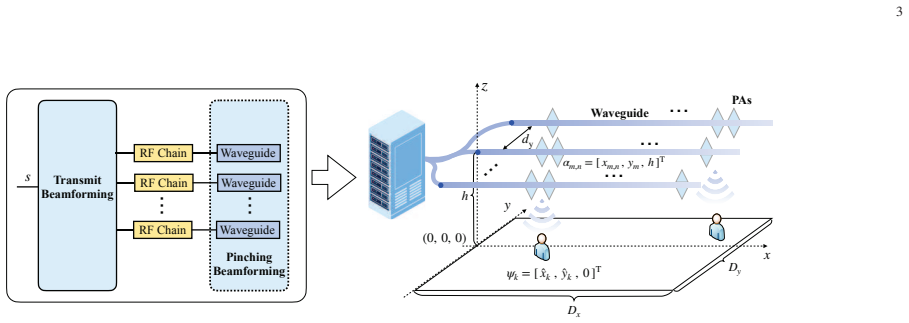
The mechanism is pinching beamforming realized by the in-waveguide phase progression: a pinching antenna at distance $x$ along the waveguide contributes an effective phase $e^{-j(\kappa_g x+\kappa D_k(x))}$ and a $1/D_k(x)$ amplitude to each user, so the multicast rate is the minimum over users of $\log_2(1+C_k/D_k^2(x))$. The key mathematical object is the Chebyshev-center reduction: for linearly distributed users with identical parameters, maximizing the worst-user rate is equivalent to minimizing $\max_k D_k^2(x)$, whose optimum is the midpoint between the extreme users; this gives the closed-form rate and the quadratic high-SNR gain formula. For the general cases, the algorithms are built on an element-wise alternating-optimization update with one-dimensional grid search for each antenna position, and on a majorization-minimization technique that replaces the nonconvex rate objective with a concave surrogate, combined with second-order cone programming for the power-constrained transmit beamformer.
What would settle it
Recompute the high-SNR multicast-rate difference from equations (33) and (34): the printed difference (35) is negative for every $K\ge 1$, while Remark 1 claims a positive gain, so the intended sign of the coefficient is a concrete point to check. Experimentally, a 28 GHz line-of-sight comparison of one pinching antenna placed at the midpoint between extreme users against a fixed antenna at the region center, with $K$ users uniformly placed on a line of length $D_x$, would settle whether the rate advantage grows with $D_x^2$; a second check is to evaluate the surrogate inequality $\tilde{R}_k(X,w)\le R_k(X,w)$ on random channels, because the Appendix C proof derives a surrogate with the opposite sign.
Extended reading notes
Core claim
On the paper's own terms, the discovery is that pinching beamforming—choosing where along a waveguide to place active pinching antennas—can directly attack the worst-user bottleneck of physical-layer multicast. For a single pinching antenna serving $K$ users uniformly distributed on a line, the multicast rate is maximized by placing the antenna at the midpoint of the two extreme users, because the worst-user squared distance is minimized by equalizing the distances to the two extreme users. Averaging over random user placements yields a closed-form average multicast rate, and the high-SNR approximations $C_{\mathrm{PASS}}\approx \log_2(P_{\mathrm{eff}}/A)-\frac{D_x^2}{24A\ln2}$ and $C_{\mathrm{Conv}}\approx \log_2(P_{\mathrm{eff}}/A)-\frac{K D_x^2}{4A(K+2)\ln2}$ are used to claim that PASS is strictly better, with a gain that grows with $D_x^2$. The paper also claims that the multiple-waveguide variant with jointly optimized transmit and pinching beamformers outperforms conventional MIMO, analog beamforming, hybrid MIMO, and even fully digital massive MIMO in the simulated settings, with the advantage increasing in the number of users and the coverage size.
Load-bearing premise
The load-bearing premise is the ideal pinching-antenna channel, in which each pinching antenna (PA) applies a pure phase shift proportional to its distance along a lossless waveguide, splits power equally, and radiates into free space with only $1/D$ path loss and no angle-dependent pattern; if real PAs have directionality or in-waveguide loss, the midpoint rule and the quadratic gain formulas change, and separately the convergence guarantee for the MM algorithm depends on the Lemma 2 surrogate, whose Appendix C derivation carries the opposite sign, leaving that guarantee unsupported.
Editorial extensions
If this is right
- If the closed-form result holds in practice, a single movable pinching antenna can beat a fixed antenna placed at the center of a multicast region, and the advantage grows quadratically with region size.
- Because several active pinching antennas on one waveguide share a single radio-frequency chain, increasing the number of pinching antennas improves multicast rate without the per-antenna RF cost of conventional MIMO.
- The numerical comparisons indicate that the proposed multiple-waveguide design can outperform fully digital massive MIMO under the same transmit power, so antenna placement can substitute for RF-chain count.
- The advantage over fixed-location systems increases with the number of users, because the pinching antenna keeps repositioning toward the worst user rather than averaging over all users.
Reading between the lines
- Editorial inference: the same Chebyshev-center reduction should apply to other worst-case fairness metrics, such as maximizing the minimum signal-to-interference-plus-noise ratio or minimizing outage probability, whenever the per-user objective is a monotone decreasing function of squared distance.
- Editorial inference: the paper fixes total transmit power, so a natural extension is to compare pinching-antenna and fixed-array systems at fixed per-user rate or fixed outage probability, where the quadratic-gain formula may translate into a transmit-power saving that grows with area.
- Editorial inference: the ideal model ignores radiation-pattern directionality and in-waveguide loss; adding an angle-dependent antenna gain to the model would likely shift the optimal position away from the pure midpoint and is a direct testable modification.
Editorial analysis
A structured set of objections, weighed in public.
Referee Report
Summary. The paper studies multicast transmission in pinching-antenna systems (PASS). For the single-waveguide single-PA configuration with linearly distributed users, it derives a closed-form optimal PA position and an average-rate expression (Lemma 1), then compares the high-SNR multicast rate with a conventional fixed-location antenna system through Eqs. (33)-(35). For multiple PAs and multiple waveguides, the paper proposes element-wise alternating optimization and an MM-based AO algorithm with SOCP for transmit beamforming, and reports numerical gains over conventional MIMO, analog beamforming, massive MIMO, and hybrid MIMO baselines.
Significance. If the analytical claims are repaired, the paper provides a useful demonstration that movable antenna positions can improve the worst-user multicast rate without additional RF chains, with a closed-form gain that scales with the square of the coverage side length. The closed-form rate expressions and the explicit comparison with a fixed-location antenna are valuable and checkable. However, the current manuscript contains a sign error in the key rate-gain formula and an inconsistency between Lemma 2 and its proof, so the advertised analytical contributions are not yet supported.
major comments (3)
- [Section III-A, Eq. (35)] Equation (35) has the wrong sign in the rate-gain formula. Subtracting Eq. (34) from Eq. (33) gives ΔC = (K/(4(K+2)) - 1/24) D_x²/(A ln2), which is positive for every K≥1. The printed expression ΔC = (1/24 - K/(4(K+2))) D_x²/(A ln2) is negative for all K≥1, so Eq. (35) as written proves that PASS is worse than the fixed-location antenna, the opposite of Remark 1. The sign must be corrected; the simulation results in Fig. 3b are consistent with the corrected sign.
- [Lemma 2 and Appendix C] The MM surrogate in Lemma 2 is stated as ~R_k = c_k + 2Re{a_k g_eff,k} - b_k g_eff,k² ≤ R_k, with b_k > 0. Appendix C, Eq. (85), derives R_k(w) ≥ 2Re{a_k h_eff,k^H w} + b_k |h_eff,k^H w|² + c_k, i.e., the opposite sign on the quadratic term. Since b_k>0, the expression in (45) is concave in w while the expression in (85) is convex, so the proof does not establish the lemma. Consequently, the monotone-convergence guarantee for Algorithm 2 in Section IV-D is unsupported. In addition, Lemma 2 asserts biconcavity in X and w, but the proof in Appendix C only treats dependence on w and gives no argument for concavity in the pinching variables X.
- [Section III-A, paragraph before Eq. (20)] The claim that R_mc(x) is strictly unimodal because it is the lower envelope of strictly unimodal per-user rate functions is not a general mathematical consequence, and the cited reference [31] concerns unimodality of probability measures rather than pointwise minima of functions. The candidate-set argument in Eqs. (20)-(22) may be salvageable, but it needs a direct proof for the specific functions R_k(x) = log2(1 + C_k/D_k²(x)) or a revised argument that the global maximizer lies in X_sp.
minor comments (6)
- [Section I-B] The contribution bullet states that a closed-form Chebyshev-center solution is derived for arbitrary user distributions, but the Chebyshev-center argument in Section III-A is only developed for linearly distributed users with a common y-coordinate; arbitrary distributions are handled by the candidate-point search. Please correct the contribution statement or provide the missing derivation.
- [Section III-A, after Eq. (20)] The cardinality of X_sp is stated as 1 + K(K-1)/2, but X1 has K points and X2 has K(K-1)/2 points, so the cardinality is K + K(K-1)/2 = K(K+1)/2 for K≥1.
- [Appendix C] The proof uses a variable t_k and derivatives with respect to t_k and t_k^* that are never defined; these should be g_k and g_k^*, respectively.
- [Eq. (53)] The summation notation in the definition of S_{m,n}^- is malformed: 'N M∑' and the index set p,q ≠ m,n should be spelled out consistently.
- [Fig. 8 caption] The caption says 'Multicast rate versus the wavelength,' but the horizontal axis is the side length D_x, not the wavelength.
- [Eq. (28)] Eq. (28) is described as a closed-form upper bound, but for the linear user distribution with common system parameters it appears to be the exact multicast rate for the midpoint placement; please clarify the wording.
Circularity Check
No circularity: the central analytical claims are self-contained derivations from stated channel-model assumptions, with no fitted parameters renamed as predictions and no load-bearing self-citation chain.
full rationale
The paper's main derivation chain is self-contained. Lemma 1 (Eq. (29)) is obtained by integrating the closed-form single-PA rate expression (28) over the assumed uniform user span using a stated PDF, and Appendices A and B give the full integrals. The high-SNR approximations (33) and (34) are separately derived from those integrals under the stated Peff >> 1 regime, and Eq. (35) is the algebraic difference of those two expressions. No parameter is fitted to data and then reported as a prediction; the rate-gain claim in Remark 1 is an analytic comparison between PASS and a fixed-location antenna under the same LoS channel model. The numerical results validate the analytical formulas and benchmarks within the same model, which is standard practice, not circular. The paper does cite prior PASS work, including by some of the present authors, for the physical channel model, the equal-power-scaling assumption rho^2 = 1/N, and array-gain observations, but these citations are used as modeling assumptions or external context rather than as a justification that makes the present result equal to its inputs. The apparent sign error in Eq. (35) and the questionable surrogate sign in Lemma 2/Appendix C are correctness concerns, not circularity: a wrong sign does not make a derivation circular, and correctly subtracting (33) and (34) would still yield a derived, non-circular expression. Accordingly, no specific circular step can be exhibited, and the honest finding is no significant circularity.
Assumptions & free parameters
assumptions (5)
- domain assumption Ideal PASS channel model: LoS free-space path loss with √η/D amplitude and phase κD, plus in-waveguide phase κ_g x with equal power splitting ρ^2=1/N.
- domain assumption Users are uniformly distributed in a rectangular region; for the closed-form case they lie on a line with identical noise and channel gain.
- domain assumption High-SNR approximation P_eff >> 1 is used for the rate-gain analysis.
- ad hoc to paper The multicast-rate lower envelope is strictly unimodal, so the global maximizer is in the candidate set.
- ad hoc to paper The MM surrogate in Lemma 2 is a global concave lower bound of the user rate.
Cite this review
Pith. "Pith review of Exploiting Pinching-Antenna Systems in Multicast Communications." pith.science (2026). https://pith.science/paper/P3RTRWOG
@misc{pith2026250600616,
  author       = {Pith},
  title        = {Pith review of: Exploiting Pinching-Antenna Systems in Multicast Communications},
  year         = {2026},
  howpublished = {\url{https://pith.science/paper/P3RTRWOG}},
  note         = {Machine review of arXiv:2506.00616}
}
read the original abstract
The pinching-antenna system (PASS) reconfigures wireless links through pinching beamforming, in which the activated locations of pinching antennas (PAs) along dielectric waveguides are optimized. This article investigates the application of PASS in multicast communication systems, where pinching beamforming is designed to maximize the multicast rate. i) In the single-waveguide scenario, a closed-form solution for the optimal activated location is derived under the assumption of a single PA and linearly distributed users. Based on this, a closed-form expression for the achievable multicast rate is obtained and proven to be larger than that of conventional fixed-location antenna systems. For the general multiple-PA case with arbitrary user distributions, an element-wise alternating optimization (AO) algorithm is proposed to design the pinching beamformer. ii) In the multiple-waveguide scenario, an AO-based method is developed to jointly optimize the transmit and pinching beamformers. Specifically, the transmit beamformer is updated using a majorization-minimization (MM) framework together with second-order cone programming (SOCP), while the pinching beamformer is optimized via element-wise sequential refinement. Numerical results are provided to demonstrate that: i) PASS achieves significantly higher multicast rates than conventional fixed-location antenna systems, particularly when the number of users and spatial coverage increase; ii) increasing the number of PAs further improves the multicast performance of PASS.
Figures


Figures from the paper (5 more)


Reference graph
Works this paper leans on
-
[31]
E. M. J. Bertin, I. Cuculescu, and R. Theodorescu, Unimodality of Probability Measures. Springer, Berlin, Germany, 2013
work page 2013
-
[1]
A mathematical theory of communication,
C. E. Shannon, “A mathematical theory of communication, ” Bell Syst. Tech. J., vol. 27, no. 3, pp. 379–423, Jul. 1948
1948
-
[2]
Terahertz band: Next frontier for wireless communications,
I. F. Akyildiz, J. M. Jornet, and C. Han, “Terahertz band: Next frontier for wireless communications,” Phys. Commun., vol. 12, pp. 16–32, 2022
work page 2022
-
[3]
Towards smart wireless communications via intelligent reflecting surfaces: A contemporary survey,
S. Gong et al. , “Towards smart wireless communications via intelligent reflecting surfaces: A contemporary survey,” IEEE Commun. Surveys Tuts., vol. 22, no. 4, pp. 2283–2314, 4th Quart. 2020
work page 2020
-
[4]
Q. Wu and R. Zhang, “Intelligent reflecting surface enhan ced wireless network: Joint active and passive beamforming design,” IEEE Trans. Wireless Commun., vol. 19, no. 4, pp. 2207–2221, Apr. 2021
work page 2021
-
[5]
Fl uid antenna systems,
K.-K. Wong, A. Shojaeifard, K.-F. Tong, and Y . Zhang, “Fl uid antenna systems,” IEEE Trans. Wireless Commun., vol. 20, no. 3, pp. 1950–1962, Mar. 2021
1950
-
[6]
MIMO evolution beyond 5G through reconfigurable intelligent sur faces and fluid antenna systems,
A. Shojaeifard, K.-K. Wong, K.-F. Tong, Z. Chu, A. Mourad , A. Haghighat, I. Hemadeh, N. T. Nguyen, V . Tapio, and M. Juntti, “MIMO evolution beyond 5G through reconfigurable intelligent sur faces and fluid antenna systems,” Proc. IEEE , vol. 110, no. 9, pp. 1244–1265, Sep. 2022
work page 2022
-
[7]
W. K. New, K.-K. Wong, H. Xu, C. Wang, F. R. Ghadi, J. Zhang, J. Rao, R. Murch, P . Ram´ ırez-Espinosa, D. Morales-Jimenez et al. , “A tutorial on fluid antenna system for 6G networks: Encompassing commun ication theory, optimization methods and hardware designs,” IEEE Commun. Surveys Tuts., early access, 2024
work page 2024
Show all 36 references
-
[8]
Modeling and performance ana lysis for movable antenna enabled wireless communications,
L. Zhu, W. Ma, and R. Zhang, “Modeling and performance ana lysis for movable antenna enabled wireless communications,” IEEE Trans. Wireless Commun., vol. 23, no. 6, pp. 6234–6250, Jun. 2024
2024
-
[9]
A tutorial on movable antennas for wi reless networks,
L. Zhu, W. Ma, W. Mei, Y . Zeng, Q. Wu, B. Ning, Z. Xiao, X. Sha o, J. Zhang, and R. Zhang, “A tutorial on movable antennas for wi reless networks,” IEEE Commun. Surveys Tuts. , early access, 2025
2025
-
[10]
Pinching antenna: Using a dielectric waveguide as an anten na,
A. Fukuda, H. Y amamoto, H. Okazaki, Y . Suzuki, and K. Kaw ai, “Pinching antenna: Using a dielectric waveguide as an anten na,” NTT DOCOMO Tech. J. , vol. 23, no. 3, pp. 5–12, 2022
2022
-
[11]
Pinching antennas: Principles, applications and challe nges,
Z. Y ang, N. Wang, Y . Sun, Z. Ding, R. Schober, G. K. Karagi annidis, et al. , “Pinching antennas: Principles, applications and challe nges,” arXiv preprint arXiv:2501.10753 , 2025
2025 arXiv
-
[12]
Pinc hing- antenna systems (PASS): Architecture designs, opportunit ies, and out- look,
Y . Liu, Z. Wang, X. Mu, C. Ouyang, X. Xu, and Z. Ding, “Pinc hing- antenna systems (PASS): Architecture designs, opportunit ies, and out- look,” arXiv preprint arXiv:2501.18409 , 2025
2025 arXiv
-
[13]
A vision to smart radio environment: Surface wave communication superhighw ays,
K.-K. Wong, K.-F. Tong, Z. Chu, and Y . Zhang, “A vision to smart radio environment: Surface wave communication superhighw ays,” IEEE Wireless Commun., vol. 28, no. 1, pp. 112–119, Feb. 2021
2021
-
[14]
Path loss and surface impedance models for surface w ave- assisted wireless communication system,
H. Liu, W. K. New, H. Xu, Z. Chu, K.-F. Tong, K.-K. Wong, an d Y . Zhang, “Path loss and surface impedance models for surface w ave- assisted wireless communication system,” IEEE Access , vol. 12, pp. 125786–125799, 2024
2024
-
[15]
On propagation characteristics of reconfigurable surface wav e platform: Simulation and experimental verification,
Z. Chu, K.-F. Tong, K.-K. Wong, C.-B. Chae, and C. H. Chan , “On propagation characteristics of reconfigurable surface wav e platform: Simulation and experimental verification,” IEEE Access , vol. 12, pp. 168744–168754, 2024
2024
-
[16]
Flexible-antenna s ystems: A pinching-antenna perspective,
Z. Ding, R. Schober, and H. V . Poor, “Flexible-antenna s ystems: A pinching-antenna perspective,” IEEE Trans. Commun. , early access, 2025
2025
-
[17]
Performance analys is of pinching-antenna systems,
D. Tyrovolas, S. A. Tegos, P . D. Diamantoulakis, S. Ioan nidis, C. K. Liaskos, and G. K. Karagiannidis, “Performance analys is of pinching-antenna systems,” IEEE Trans. Green Commun. Netw. , early access, 2025
2025
-
[18]
Array gain for pi nching- antenna systems (PASS),
C. Ouyang, Z. Wang, Y . Liu, and Z. Ding, “Array gain for pi nching- antenna systems (PASS),” IEEE Commun. Lett. , early access, 2025
2025
-
[19]
Chan nel estimation for mmWave pinching-antenna systems,
G. Zhou, V . Papanikolaou, Z. Ding, and R. Schober, “Chan nel estimation for mmWave pinching-antenna systems,” arXiv preprint arXiv:2504.09317, 2025
2025 arXiv
-
[20]
Channel estimation for pin ching-antenna systems (PASS),
J. Xiao, J. Wang, and Y . Liu, “Channel estimation for pin ching-antenna systems (PASS),” arXiv preprint arXiv:2503.13268 , 2025
2025 arXiv
-
[21]
Minimum data rate maximization for uplink pinching-anten na systems,
S. A. Tegos, P . D. Diamantoulakis, Z. Ding, and G. K. Kara giannidis, “Minimum data rate maximization for uplink pinching-anten na systems,” IEEE Wireless Commun. Lett., vol. 14, no. 5, pp. 1516–1520, May 2025
2025
-
[22]
On the performance o f uplink pinching antenna systems (PASS),
T. Hou, Y . Liu, and A. Nallanathan, “On the performance o f uplink pinching antenna systems (PASS),” arXiv preprint arXiv:2502.12365 , 2025
2025 arXiv
-
[23]
Rate maximizat ion for downlink pinching-antenna systems,
Y . Xu, Z. Ding, and G. K. Karagiannidis, “Rate maximizat ion for downlink pinching-antenna systems,” IEEE Wireless Commun. Lett. , vol. 14, no. 5, pp. 1431–1435, May 2025
2025
-
[24]
Modeling a nd beamforming optimization for pinching-antenna systems,
Z. Wang, C. Ouyang, X. Mu, Y . Liu, and Z. Ding, “Modeling a nd beamforming optimization for pinching-antenna systems,” arXiv preprint arXiv:2502.05917, 2025
2025 arXiv
-
[25]
Downlink beamforming with pinching-antenna assisted MIMO systems,
A. Bereyhi, S. Asaad, C. Ouyang, Z. Ding, and H. V . Poor, “ Downlink beamforming with pinching-antenna assisted MIMO systems, ” in Proc. IEEE ICC W orkshops, 2025
2025
-
[26]
GPASS: Deep learnin g for beamforming in pinching-antenna systems (PASS),
J. Guo, Y . Liu, and A. Nallanathan, “GPASS: Deep learnin g for beamforming in pinching-antenna systems (PASS),” arXiv preprint arXiv:2502.01438, 2025
2025 arXiv
-
[27]
Joint transmit and pinching beamforming for pinching antenna systems (PASS): Optimiza tion-based or learning-based?,
X. Xu, X. Mu, Y . Liu, and A. Nallanathan, “Joint transmit and pinching beamforming for pinching antenna systems (PASS): Optimiza tion-based or learning-based?,” arXiv preprint arXiv:2502.08637 , 2025
2025 arXiv
-
[28]
Antenna activation fo r NOMA as- sisted pinching-antenna systems,
K. Wang, Z. Ding, and R. Schober, “Antenna activation fo r NOMA as- sisted pinching-antenna systems,” IEEE Wireless Commun. Lett., vol. 14, no. 5, pp. 1526–1530, May 2025
2025
-
[29]
Waveguide divi sion multiple access for pinching-antenna systems (PASS),
J. Zhao, X. Mu, K. Cai, Y . Zhu, and Y . Liu, “Waveguide divi sion multiple access for pinching-antenna systems (PASS),” arXiv preprint arXiv:2502.17781, 2025
2025 arXiv
-
[30]
Integrated sensing and communications for pinching-antenna systems (PASS),
Z. Zhang, Y . Liu, B. He, and J. Chen, “Integrated sensing and communications for pinching-antenna systems (PASS),” arXiv preprint arXiv:2504.07709, 2025
2025 arXiv
-
[32]
Minmax-distance approx imation and sep- aration problems: geometrical properties,
F. Plastria and E. Carrizosa, “Minmax-distance approx imation and sep- aration problems: geometrical properties,” Mathematical Programming, vol. 133, no. 1–2, pp. 173–195, 2012
2012
-
[33]
Boyd and L
S. Boyd and L. V andenberghe, Convex Optimization. Cambridge Univ. Press, Cambridge, U.K., 2004
2004
-
[34]
Biconvex sets and optimization with biconvex functions: A survey and extensions,
J. Gorski, F. Pfeuffer, and K. Klamroth, “Biconvex sets and optimization with biconvex functions: A survey and extensions,” Math. Oper . Res. , vol. 66, no. 3, pp. 373–407, Aug. 2007
2007
-
[35]
CVX: MA TLAB software for discipli ned convex programming,
M. Grant and S. Boyd, “CVX: MA TLAB software for discipli ned convex programming,” V ersion 2.1. [Online]. Available: http://cvxr .com/cvx , Dec. 2018
2018
-
[36]
The MOSEK optimization toolbox for MA TLAB manual,
“The MOSEK optimization toolbox for MA TLAB manual,” V ersion 7.1 (revision 28). [Online]. Available: http://mosek.com , accessed on: Mar. 20, 2015
2015
Reviewed August 7, 2026 · model on record in the stance chip above.
Discussion (0). Sign in to comment.