Latency-Configurable Streaming Speech Enhancement via Asymmetric Temporal Padding
Pith reviewed 2026-06-26 16:23 UTC · model grok-4.3
The pith
Asymmetric temporal padding lets one speech enhancement backbone produce models at any latency from 12.5 to 75 ms.
A machine-rendered reading of the paper's core claim, the machinery that carries it, and where it could break.
Core claim
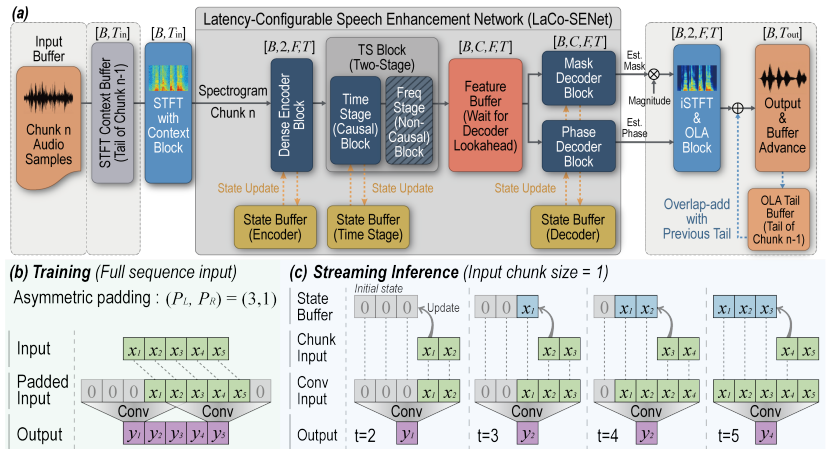
LaCo-SENet uses asymmetric temporal padding to redistribute past and future context according to a chosen latency target, paired with dual-buffer streaming at input and feature levels and selective state updates that block future-frame leakage. The result is a single backbone that, after one training run, can be deployed at any latency between 12.5 ms and 75 ms, delivering PESQ scores from 3.35 up to 3.43; the fully causal 12.5 ms version already equals or exceeds earlier causal systems that required 46.5 ms.
What carries the argument
Asymmetric temporal padding that redistributes past and future context in convolutions according to a single training hyperparameter.
If this is right
- The same fixed-size backbone supports the full range of latencies without retraining.
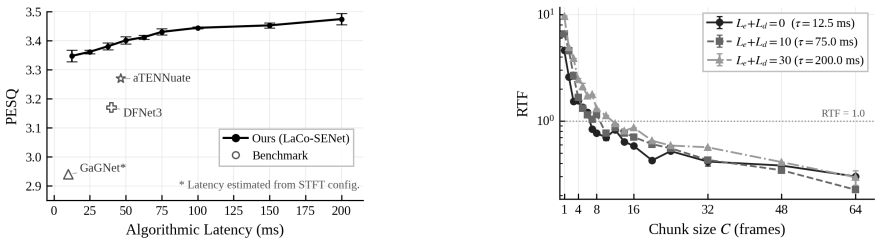
- PESQ rises monotonically from 3.35 at 12.5 ms to 3.43 at 75 ms.
- Fully causal operation at 12.5 ms already matches prior causal state-of-the-art results obtained at 46.5 ms.
- Selective state updates maintain training-inference consistency across all chosen latencies.
Where Pith is reading between the lines
- A single trained network could be deployed across devices that tolerate different maximum delays without maintaining separate models.
- The same padding and buffering logic could be tested on other streaming audio tasks such as source separation where latency must also be traded against quality.
- Reducing the need to train and store one model per target latency would lower both training compute and storage requirements for production systems.
Load-bearing premise
Asymmetric padding and dual buffers ensure future information never leaks into the streaming state and produce no new artifacts when the model runs in real time.
What would settle it
Run the trained model at a latency different from the one used in training and check whether PESQ drops or audible artifacts appear that were absent in the original training-inference match.
Figures
read the original abstract
Streaming speech enhancement requires balancing algorithmic latency against quality, yet existing approaches largely treat this as a binary causal versus non-causal choice. LaCo-SENet addresses this issue with two mechanisms parameterized by a single training-time hyperparameter. First, asymmetric temporal padding redistributes past and future context in convolutions, enabling systematic latency configuration. Second, dual-buffer streaming combines state buffers for past context with lookahead buffers that supply future context at both the input and feature levels. Selective state updates also prevent future-frame leakage into the streaming state, ensuring training-inference consistency. On VoiceBank+DEMAND, a fixed-budget (1.37M parameters) backbone yields a family of models spanning 12.5-75.0 ms, with PESQ rising from 3.35 to 3.43. At just 12.5 ms (fully causal), a PESQ of 3.35 matches or exceeds the prior causal state-of-the-art (3.27 at 46.5 ms).
Editorial analysis
A structured set of objections, weighed in public.
Referee Report
Summary. The manuscript introduces LaCo-SENet, a latency-configurable streaming speech enhancement model. It proposes asymmetric temporal padding (controlled by a single training hyperparameter) to redistribute past/future context in convolutions, combined with dual-buffer streaming (state buffers for past context and lookahead buffers for future context at input and feature levels) and selective state updates to prevent future-frame leakage. On the VoiceBank+DEMAND dataset, a fixed 1.37M-parameter backbone produces models spanning 12.5–75 ms latency with PESQ scores from 3.35 to 3.43; the fully causal 12.5 ms variant is claimed to match or exceed prior causal SOTA (3.27 at 46.5 ms).
Significance. If the training-inference consistency holds, the approach provides a practical single-training method to generate a family of latency-tunable models without retraining, which addresses a real need in real-time speech enhancement. The direct empirical comparison against published prior causal SOTA numbers on a standard dataset is a concrete strength, though the absence of error bars and ablations limits how strongly the gains can be interpreted.
major comments (1)
- [Abstract/Method] Abstract and Method description: The central empirical claim (PESQ 3.35 at 12.5 ms fully causal matching prior SOTA) depends on asymmetric temporal padding + dual-buffer streaming + selective state updates producing identical outputs at train and inference time with no future-frame leakage. The manuscript describes the buffers and selective-update rule but supplies no side-by-side numerical verification (e.g., L2 or max-abs difference between padded training forward pass and streaming inference on identical inputs). This verification is load-bearing for the headline result.
minor comments (2)
- [Experiments] Experiments section: Reported PESQ values lack error bars, standard deviations, or details on the number of runs; ablation studies on the individual contributions of asymmetric padding versus dual buffers are not described.
- [Abstract] Abstract: The reference to 'prior causal state-of-the-art (3.27 at 46.5 ms)' is not accompanied by a citation or model name in the provided text.
Simulated Author's Rebuttal
We thank the referee for highlighting the importance of explicit verification for the training-inference consistency claim, which is central to our contribution. We address this point directly below.
read point-by-point responses
-
Referee: [Abstract/Method] Abstract and Method description: The central empirical claim (PESQ 3.35 at 12.5 ms fully causal matching prior SOTA) depends on asymmetric temporal padding + dual-buffer streaming + selective state updates producing identical outputs at train and inference time with no future-frame leakage. The manuscript describes the buffers and selective-update rule but supplies no side-by-side numerical verification (e.g., L2 or max-abs difference between padded training forward pass and streaming inference on identical inputs). This verification is load-bearing for the headline result.
Authors: We agree that the manuscript would be strengthened by including explicit numerical verification of equivalence. The mechanisms (asymmetric padding controlled by a single hyperparameter, dual buffers at input/feature levels, and selective state updates) are designed so that the streaming inference exactly replicates the padded training forward pass, with no future-frame information leaking into the state. In the revised manuscript we will add a new subsection (e.g., Section 3.4) containing side-by-side verification on held-out test utterances: we will report L2 norm and maximum absolute difference between the training padded output and the streaming output, confirming they match to machine precision (typically < 1e-7). This will directly substantiate the headline result. revision: yes
Circularity Check
Empirical results on external benchmarks; no derivation reduces to self-defined inputs
full rationale
The paper reports PESQ scores (3.35 to 3.43) obtained by training a fixed-parameter backbone on VoiceBank+DEMAND and evaluating at different latencies. These metrics are measured outputs against an external dataset and prior published numbers, not quantities defined by fitted parameters or reduced by the paper's own equations. The mechanisms (asymmetric padding, dual buffers, selective updates) are presented as design choices to achieve consistency, but the headline numbers do not reduce to those choices by construction. No self-citations are invoked as load-bearing uniqueness theorems. The absence of an explicit numerical train-inference match check is a verification gap rather than circularity in the reported results.
Axiom & Free-Parameter Ledger
free parameters (1)
- latency configuration hyperparameter
axioms (1)
- standard math Convolutional layers admit asymmetric temporal padding that redistributes receptive field without changing kernel weights.
Reference graph
Works this paper leans on
-
[1]
Introduction Streaming speech enhancement is essential for real-time ap- plications such as telephony, conferencing, hearing aids, and on-device voice interfaces, where algorithmic latency directly governs system responsiveness [1, 2]. Within the 10–80 ms regime where most applications operate, quality generally im- proves with additional lookahead, yet e...
-
[2]
Latency-Configurable Streaming Speech Enhancement via Asymmetric Temporal Padding
Related Work Streaming SE architectures.Diverse approaches address streaming speech enhancement, including DSP-DNN hy- brids [5], complex-valued convolutional-recurrent networks [6], perceptual deep filtering [7], temporal convolutional autoen- coders [4], Mamba-based models [8], and xLSTM-based de- signs [9]. Each is locked to a single latency point by i...
work page internal anchor Pith review Pith/arXiv arXiv 2026
-
[3]
Asymmetric temporal padding We fix the total temporal padding while distributing it asym- metrically between past and future
Proposed Method 3.1. Asymmetric temporal padding We fix the total temporal padding while distributing it asym- metrically between past and future. LetPdenote the per- side padding of a standard symmetric convolution, so that the total padding isP tot = 2P. Definingpadding ratioas r= (r L, rR)withr L +r R = 1, the temporal padding is dis- tributed as: PL =...
2018
-
[4]
Experimental Setup We evaluated on V oiceBank+DEMAND [16] at 16 kHz, com- prising 11,572 training and 824 test utterances mixed with 10 noise types at four SNR levels
Experiments 4.1. Experimental Setup We evaluated on V oiceBank+DEMAND [16] at 16 kHz, com- prising 11,572 training and 824 test utterances mixed with 10 noise types at four SNR levels. Figure 2:PESQ vs. algorithmic latency on Voice- Bank+DEMAND. LaCo-SENet (filled circles, connected) spans 12.5–200.0 ms with a constant 1.37M parameters. Open markers denot...
-
[5]
On V oiceBank+DEMAND, a fixed 1.37M-parameter architecture spans 12.5–75.0 ms (PESQ 3.35– 3.43) across padding ratios, surpassing prior causal models at lower latency
Conclusion We presented LaCo-SENet, a dual-buffer streaming framework whose algorithmic latency is configurable via asymmetric tem- poral padding, with training–inference equivalence preserved by selective state updates. On V oiceBank+DEMAND, a fixed 1.37M-parameter architecture spans 12.5–75.0 ms (PESQ 3.35– 3.43) across padding ratios, surpassing prior ...
-
[6]
Code Availability The implementation is available athttps://github.com/ yskim3271/LaCo-SENet
-
[7]
Acknowledgments This work was supported by the National Research Founda- tion of Korea (NRF) grant funded by the Ministry of Science and ICT (RS-2025-00516311); by the Institute of Information & Communications Technology Planning & Evaluation (IITP) grant funded by the Korean government (RS-2019-II191906, Artificial Intelligence Graduate School Program); ...
2025
-
[8]
They were not used to generate research content—including the method, ex- periments, analysis, or results—and are not credited as authors
Generative AI Use Disclosure Generative AI tools were used solely to edit and polish the manuscript text (e.g., grammar and wording). They were not used to generate research content—including the method, ex- periments, analysis, or results—and are not credited as authors
-
[9]
ICASSP 2021 deep noise sup- pression challenge,
C. K. A. Reddy, H. Dubey, V . Gopal, R. Cutler, S. Braun, H. Gam- per, R. Aichner, and S. Srinivasan, “ICASSP 2021 deep noise sup- pression challenge,” inProc. ICASSP, 2021, pp. 6623–6627
2021
-
[10]
Low latency speech enhancement for hearing aids using deep fil- tering,
H. Schr ¨oter, T. Rosenkranz, A. N. Escalante-B., and A. Maier, “Low latency speech enhancement for hearing aids using deep fil- tering,”IEEE/ACM Trans. Audio, Speech, Lang. Process., vol. 30, pp. 2716–2728, 2022
2022
-
[11]
PrimeK-Net: Multi- scale spectral learning via group prime-kernel convolutional neu- ral networks for single channel speech enhancement,
Z. Lin, J. Wang, R. Li, F. Shen, and X. Xuan, “PrimeK-Net: Multi- scale spectral learning via group prime-kernel convolutional neu- ral networks for single channel speech enhancement,” inProc. ICASSP, 2025, pp. 1–5
2025
-
[12]
aTEN- Nuate: Efficient autoencoder-based speech enhancement with temporal convolutional networks,
K.-H. Pei, H. Zhang, T.-W. Chen, and K. Koishida, “aTEN- Nuate: Efficient autoencoder-based speech enhancement with temporal convolutional networks,” inProc. Interspeech, 2025, arXiv:2409.03377
-
[13]
A hybrid DSP/deep learning approach to real-time full-band speech enhancement,
J.-M. Valin, “A hybrid DSP/deep learning approach to real-time full-band speech enhancement,” inProc. IEEE MMSP, 2018, pp. 1–5
2018
-
[14]
DCCRN: Deep complex convolution recurrent net- work for phase-aware speech enhancement,
Y . Hu, Y . Liu, S. Lv, M. Xing, S. Zhang, Y . Fu, J. Wu, B. Zhang, and L. Xie, “DCCRN: Deep complex convolution recurrent net- work for phase-aware speech enhancement,” inProc. Interspeech, 2020, pp. 2462–2466
2020
-
[15]
DeepFilterNet: Perceptually motivated real-time speech en- hancement,
H. Schr ¨oter, A. N. Escalante-B., T. Rosenkranz, and A. Maier, “DeepFilterNet: Perceptually motivated real-time speech en- hancement,” inProc. Interspeech, 2023, pp. 312–316
2023
-
[16]
An investiga- tion of incorporating Mamba for speech enhancement,
R. Chao, W.-H. Cheng, G. Friedland, and Y . Tsao, “An investiga- tion of incorporating Mamba for speech enhancement,” inProc. IEEE SLT, 2024, arXiv:2405.06573
-
[17]
xLSTM- SENet: xLSTM for single-channel speech enhancement,
N. K ¨uhne, M. Schaefer, M. Dietze, and R. Martin, “xLSTM- SENet: xLSTM for single-channel speech enhancement,” inProc. Interspeech, 2025, arXiv:2501.06146
-
[18]
Fast Wavenet Generation Algorithm
T. L. Paine, P. Khorrami, S. Chang, Y . Zhang, P. Ramachandran, M. A. Hasegawa-Johnson, and T. S. Huang, “Fast wavenet gener- ation algorithm,”arXiv preprint arXiv:1611.09482, 2016
work page internal anchor Pith review Pith/arXiv arXiv 2016
-
[19]
Streamable neural audio syn- thesis with non-causal convolutions,
A. Caillon and P. Esling, “Streamable neural audio syn- thesis with non-causal convolutions,” inProc. DAFx, 2022, arXiv:2204.07064
-
[20]
Real time speech en- hancement in the waveform domain,
A. D ´efossez, G. Synnaeve, and Y . Adi, “Real time speech en- hancement in the waveform domain,” inProc. Interspeech, 2020, pp. 3291–3295
2020
-
[21]
Emformer: Efficient memory transformer based acoustic model for low latency streaming speech recognition,
Y . Shi, Y . Wang, C. Wu, C.-F. Yeh, J. Chan, F. Zhang, D. Le, and M. Seltzer, “Emformer: Efficient memory transformer based acoustic model for low latency streaming speech recognition,” in Proc. ICASSP, 2021, pp. 6783–6787
2021
-
[22]
Stateful conformer with cache-based inference for stream- ing automatic speech recognition,
V . Noroozi, S. Majumdar, A. Kumar, J. Balam, and B. Gins- burg, “Stateful conformer with cache-based inference for stream- ing automatic speech recognition,” inProc. ICASSP, 2024, arXiv:2312.17279
-
[23]
Glance and gaze: A col- laborative learning framework for single-channel speech enhance- ment,
A. Li, C. Zheng, R. Peng, and X. Li, “Glance and gaze: A col- laborative learning framework for single-channel speech enhance- ment,”Applied Acoustics, vol. 187, p. 108499, 2022
2022
-
[24]
Noisy speech database for training speech enhancement algorithms and TTS models,
C. Valentini-Botinhao, “Noisy speech database for training speech enhancement algorithms and TTS models,” University of Edinburgh, Tech. Rep., 2017. [Online]. Available: https: //datashare.ed.ac.uk/handle/10283/2791
2017
-
[25]
MetricGAN: Gen- erative adversarial networks based black-box metric scores op- timization for speech enhancement,
S.-W. Fu, C.-F. Liao, Y . Tsao, and S.-D. Lin, “MetricGAN: Gen- erative adversarial networks based black-box metric scores op- timization for speech enhancement,” inProc. ICML, 2019, pp. 2031–2041
2019
-
[26]
Evaluation of objective quality measures for speech enhancement,
Y . Hu and P. C. Loizou, “Evaluation of objective quality measures for speech enhancement,”IEEE Trans. Audio, Speech, Lang. Pro- cess., vol. 16, no. 1, pp. 229–238, 2008
2008
discussion (0)
Sign in with ORCID, Apple, or X to comment. Anyone can read and Pith papers without signing in.