Rarefaction-induced inflation and similarity breakdown of hypersonic bow shocks over a circular cylinder
Pith reviewed 2026-05-20 14:45 UTC · model grok-4.3
The pith
Rarefied hypersonic bow shocks inflate through a coupled compression-relaxation process rather than a single-scale rescaling of a continuum shock layer.
A machine-rendered reading of the paper's core claim, the machinery that carries it, and where it could break.
Core claim
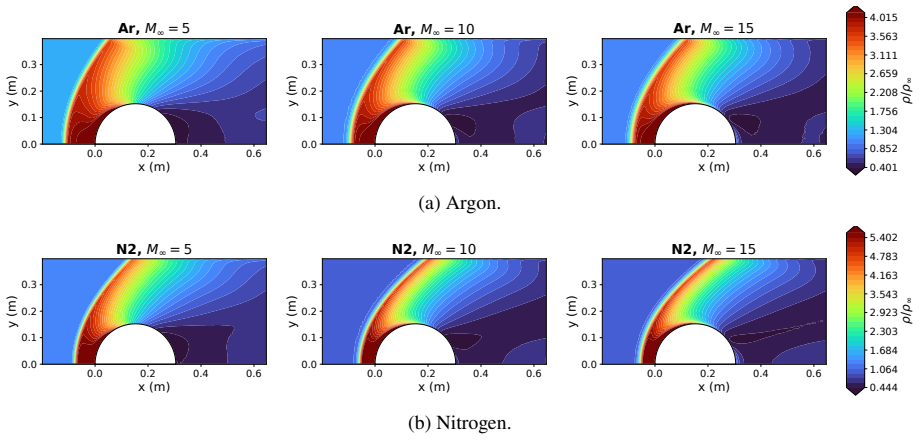
Rarefied bow-shock inflation is therefore a coupled compression--relaxation process, not a single-scale rescaling of a continuum-like shock. The Knudsen- and Mach-number sweeps separate two mechanisms. At fixed Mach the continuum normal-shock density ratio provides a useful low-rarefaction reference compression scale, whereas the measured standoff growth is governed primarily by the kinetic mean free path; the effective density thickness shows an intermediate minimum before increasing in the diffuse regime. At fixed low Kn, changing Mach mainly changes compression strength and curvature, preserving a coherent attached-layer structure. Density-registered profiles and shock-attached POD show,
What carries the argument
Ray-based density-gradient ridge for reproducible shock location at low rarefaction, replaced by profile-based standoff and thickness metrics at high Knudsen, together with density-registered proper orthogonal decomposition that isolates rank-one density behavior.
Load-bearing premise
The assumption that a ray-based density-gradient ridge accurately locates the bow shock at low rarefaction and that profile-based standoff and thickness metrics can reliably characterize the structure at high Knudsen numbers where no clear shock line exists.
What would settle it
An observation or calculation in which Mach number and thermal variables also collapse to rank-one modal content under the same density registration would indicate single-scale rescaling and falsify the coupled multi-scale claim.
Figures




read the original abstract
Rarefied hypersonic bow shocks over blunt bodies inflate as the Knudsen number increases, but it remains unclear whether this inflation is a simple shift and broadening of one common shock layer or a multi-scale change of the macroscopic and internal-energy fields. We address this question using direct simulation Monte Carlo (DSMC) data for Mach-10 flow over a circular cylinder in argon and nitrogen over \(Kn_\infty \approx 0.01\)--\(1\), together with a Mach-number sweep at \(Kn_\infty=0.01\). At low rarefaction, a ray-based density-gradient ridge gives a reproducible bow-shock location and agrees with an independent schlieren-based shock-wave-detection method. As \(Kn_\infty\) increases, this ridge is replaced by a broad kinetic compression layer, so the high-Knudsen cases are analysed using profile-based standoff and thickness metrics rather than by imposing a visual shock line. The Knudsen- and Mach-number sweeps separate two mechanisms. At fixed \(M_\infty\), the continuum normal-shock density ratio provides a useful low-rarefaction reference compression scale, whereas the measured standoff growth is governed primarily by the kinetic mean free path; the effective density thickness shows an intermediate minimum before increasing in the diffuse regime. At fixed low \(Kn_\infty\), changing \(M_\infty\) mainly changes compression strength and curvature, preserving a coherent attached-layer structure. Density-registered profiles and shock-attached proper orthogonal decomposition (POD) show that, within the present maximum-density-gradient registration, density becomes nearly rank one, whereas Mach number and thermal variables retain independent modal content. Rarefied bow-shock inflation is therefore a coupled compression--relaxation process, not a single-scale rescaling of a continuum-like shock.
Editorial analysis
A structured set of objections, weighed in public.
Referee Report
Summary. The manuscript claims that rarefied hypersonic bow shocks over a circular cylinder inflate with increasing Knudsen number as a coupled compression-relaxation process rather than a single-scale rescaling of a continuum-like shock. This is shown via DSMC simulations of Mach-10 argon and nitrogen flows over Kn_∞ ≈ 0.01–1 together with a Mach-number sweep at fixed low Kn. Low-rarefaction cases locate the bow shock via a ray-based density-gradient ridge (validated against schlieren), while high-Kn cases switch to profile-based standoff and thickness metrics. The Kn and M sweeps separate mechanisms: standoff growth is governed primarily by mean free path while compression follows the continuum normal-shock density ratio. Density-registered profiles and shock-attached POD indicate density becomes nearly rank-1 whereas Mach and thermal fields retain independent modal content.
Significance. If the central claim holds, the work is significant for rarefied gas dynamics and hypersonic aerodynamics. It provides a mechanistic separation of continuum compression from kinetic relaxation effects in the shock layer and demonstrates similarity breakdown via POD. The DSMC parameter sweeps, direct comparison to continuum density-ratio references, and reproducible low-Kn ridge validation against schlieren are strengths that support falsifiable predictions about standoff scaling.
major comments (2)
- [Abstract] Abstract: the transition from the ray-based maximum-density-gradient ridge (used at low Kn and validated against schlieren) to profile-based standoff/thickness metrics at high Kn lacks a unified iso-surface definition or sensitivity quantification. If the high-Kn standoff (e.g., chosen density threshold or inflection) does not map to the same physical surface as the low-Kn ridge, the reported standoff growth law and the conclusion that inflation is a coupled compression-relaxation process (rather than diagnostic artifact) could be affected. A test using one consistent metric (such as 50 % density rise) across the full Kn range is needed to confirm the scaling is intrinsic.
- [POD analysis] POD analysis paragraph: the shock-attached decomposition shows density nearly rank-1 within the maximum-density-gradient registration while Mach and thermal variables retain multi-modal content. Because the registration method itself changes with Kn (ridge only at low Kn), it is unclear whether the rank-1 density result remains robust under a fixed registration scheme. Specify whether POD was performed with a single consistent registration or adapted per Kn case.
minor comments (1)
- The abstract states that 'the effective density thickness shows an intermediate minimum before increasing'; provide the precise operational definition of this thickness metric and how it is computed from the profiles.
Simulated Author's Rebuttal
We thank the referee for the careful and constructive review of our manuscript. The comments highlight important points regarding metric consistency and registration robustness, which we address below with revisions to strengthen the presentation and support the central claims.
read point-by-point responses
-
Referee: [Abstract] Abstract: the transition from the ray-based maximum-density-gradient ridge (used at low Kn and validated against schlieren) to profile-based standoff/thickness metrics at high Kn lacks a unified iso-surface definition or sensitivity quantification. If the high-Kn standoff (e.g., chosen density threshold or inflection) does not map to the same physical surface as the low-Kn ridge, the reported standoff growth law and the conclusion that inflation is a coupled compression-relaxation process (rather than diagnostic artifact) could be affected. A test using one consistent metric (such as 50 % density rise) across the full Kn range is needed to confirm the scaling is intrinsic.
Authors: We agree that demonstrating robustness under a single consistent metric strengthens the conclusion that the observed standoff growth is intrinsic rather than a diagnostic artifact. In the revised manuscript we have added a uniform 50% density-rise iso-surface analysis performed across the entire Kn range. The resulting standoff scaling remains consistent with the original ray- and profile-based results, confirming that the inflation arises from the coupled compression-relaxation mechanism. These additional data are included as a new supplementary figure and briefly discussed in the methods and results sections. revision: yes
-
Referee: [POD analysis] POD analysis paragraph: the shock-attached decomposition shows density nearly rank-1 within the maximum-density-gradient registration while Mach and thermal variables retain multi-modal content. Because the registration method itself changes with Kn (ridge only at low Kn), it is unclear whether the rank-1 density result remains robust under a fixed registration scheme. Specify whether POD was performed with a single consistent registration or adapted per Kn case.
Authors: The registration employed for the POD is the location of the maximum density gradient extracted from the density field itself. This definition is applied uniformly: at low Kn it coincides with the validated ray-based ridge, while at high Kn it is obtained from the same density-gradient maximum along the stagnation streamline. We have revised the manuscript to state this explicitly and to expand the methods section with the precise registration procedure, thereby confirming that the near rank-1 character of density is obtained under a single, consistent registration scheme across all cases. revision: yes
Circularity Check
No significant circularity; claims rest on independent DSMC simulation outputs across parameter sweeps
full rationale
The paper's central claim—that rarefied bow-shock inflation is a coupled compression-relaxation process rather than single-scale rescaling—is obtained by inspecting DSMC data for Mach-10 flow over a cylinder across Kn sweeps and a separate M sweep at fixed low Kn. Shock location at low Kn uses a ray-based density-gradient ridge validated against schlieren; high-Kn cases switch to profile-based standoff and thickness metrics because no clear ridge exists. Density-registered profiles and shock-attached POD are then applied within the chosen registration. No equations, fitted parameters, or self-citations are shown that reduce the reported growth laws, rank-1 density behavior, or mechanism separation to inputs by construction. The derivation therefore remains self-contained against the external benchmark of the DSMC runs themselves.
Axiom & Free-Parameter Ledger
axioms (1)
- domain assumption DSMC accurately captures the macroscopic and internal-energy fields in argon and nitrogen for the stated Mach and Knudsen ranges
Reference graph
Works this paper leans on
-
[1]
Hassan Akhlaghi, Ehsan Roohi, Abbas Daliri, and Mohammad-Reza Soltani
doi: 10.2514/1.J055819. Hassan Akhlaghi, Ehsan Roohi, Abbas Daliri, and Mohammad-Reza Soltani. Shock polar investigation in supersonic rarefied gas flows over a circular cylinder.Physics of Fluids, 33(5):052006,
-
[2]
Gal Berkooz, Philip Holmes, and John L
doi: 10.1063/5.0050571. Gal Berkooz, Philip Holmes, and John L. Lumley. The proper orthogonal decomposition in the analysis of turbulent flows.Annual Review of Fluid Mechanics, 25:539–575,
-
[3]
doi: 10.1146/annurev.fl.25. 010193.002543. Graeme A. Bird.Molecular Gas Dynamics and the Direct Simulation of Gas Flows. Clarendon Press, Oxford,
-
[4]
Behnam Goshayeshi, Ehsan Roohi, and Stefan Stefanov. A novel simplified Bernoulli trials collision scheme in the direct simulation Monte Carlo with intelligence over particle distances.Physics of Fluids, 27(10): 107104, 2015a. doi: 10.1063/1.4934588. Behnam Goshayeshi, Ehsan Roohi, and Stefan Stefanov. DSMC simulation of hypersonic flows using an improved...
-
[5]
doi: 10.1017/S0022112072000084. H. G. Hornung. Shock detachment and drag in hypersonic flow over wedges and circular cylinders.Journal of Fluid Mechanics, 915:A100,
-
[6]
doi: 10.1017/jfm.2021.187. H. G. Hornung, Jan Martinez Schramm, and Klaus Hannemann. Hypersonic flow over spherically blunted cone capsules for atmospheric entry. part
-
[7]
doi: 10.1017/jfm.2019.342. Jin Huang, Kun Xu, and Pu Yu. A unified gas-kinetic scheme for continuum and rarefied flows ii: Multi- dimensional cases.Communications in Computational Physics, 12(3):662–690,
-
[8]
doi: 10.4208/cicp. 120211.220911s. Yazhong Jiang, Xuxu Sun, Jie Niu, and Jun Zhang. Study of shock-shock interactions in rarefied flows using direct simulation Monte Carlo method.Aerospace Science and Technology, 173:111768,
-
[9]
doi: 10.1016/j.ast.2026.111768. B. John, X. J. Gu, R. W. Barber, and D. R. Emerson. High-speed rarefied flow past a rotating cylinder: The inverse magnus effect.AIAA Journal, 54(2):521–532,
-
[10]
doi: 10.1063/5.0281770. Angelos Klothakis, Jr. Quintanilha, Helio, Saurabh S. Sawant, Eftychios Protopapadakis, Vassilis Theofilis, and Deborah A. Levin. Linear stability analysis of hypersonic boundary layers computed by a kinetic approach: A semi-infinite flat plate at Mach 4.5 and 9,
-
[11]
doi: 10.1016/j.jcp.2019.108977. Andrew J. Lofthouse, Iain D. Boyd, and Michael J. Wright. Effects of continuum breakdown on hypersonic aerothermodynamics.Physics of Fluids, 19(2):027105,
-
[12]
doi: 10.1063/1.2710289. Andrew J. Lofthouse, Leonardo C. Scalabrin, and Iain D. Boyd. Velocity slip and temperature jump in hypersonic aerothermodynamics.Journal of Thermophysics and Heat Transfer, 22(1):38–49,
-
[13]
doi: 10.2514/1.31280. John L. Lumley. The structure of inhomogeneous turbulent flows.Atmospheric Turbulence and Radio Wave Propagation, pages 166–178,
-
[14]
doi: 10.1007/978-981-96-8200-3
ISBN 978-981- 96-8200-3. doi: 10.1007/978-981-96-8200-3. Ehsan Roohi, Ahmad Shoja-Sani, and Fahimeh Ebrahimzadeh Azghadi. Neural networks for rarefied gas dynamics: Relaxation problem, polyatomic shock waves, and hypersonic cylinder flow.Physics of Fluids, 38:057108, 2026a. doi: 10.1063/5.0334590. Ehsan Roohi, Ahmad Shoja-Sani, and Stefan Stefanov. Physic...
-
[15]
doi: 10.1017/S0022112010001217. 35 Thomas E. Schwartzentruber, Leonardo C. Scalabrin, and Iain D. Boyd. A modular particle–continuum numerical method for hypersonic non-equilibrium gas flows.Journal of Computational Physics, 225(1): 1159–1174,
-
[16]
doi: 10.1016/j.jcp.2007.01.022. Mert Senkardesler, Irmak T. Karpuzcu, Deborah A. Levin, and Vassilis Theofilis. A molecular gas dynamics study of hypersonic boundary layer second Mack mode instabilities,
-
[17]
Felix Sharipov and Denize Kalempa
doi: 10.1063/1.3580290. Felix Sharipov and Denize Kalempa. Gas flow around a longitudinally moving cylinder in the whole range of the knudsen number.Journal of Vacuum Science & Technology A, 21(3):735–745,
-
[18]
doi: 10.1116/1.1560710. Lawrence Sirovich. Turbulence and the dynamics of coherent structures. part i: Coherent structures. Quarterly of Applied Mathematics, 45(3):561–571,
-
[19]
doi: 10.2514/1.J056060. Aaron Towne, Oliver T. Schmidt, and Tim Colonius. Spectral proper orthogonal decomposition and its relationship to dynamic mode decomposition and resolvent analysis.Journal of Fluid Mechanics, 847: 821–867,
-
[20]
Yajun Zhu, Chengwen Zhong, and Kun Xu
doi: 10.1017/jfm.2018.283. Yajun Zhu, Chengwen Zhong, and Kun Xu. Unified gas-kinetic wave-particle methods. i. continuum and rarefied gas flow.Journal of Computational Physics, 383:190–210,
-
[21]
doi: 10.1016/j.jcp.2019.01.023. 36
discussion (0)
Sign in with ORCID, Apple, or X to comment. Anyone can read and Pith papers without signing in.