Rankine-Hugoniot conditions in Q-variables: a wave-aligned formulation of MHD discontinuities
Pith reviewed 2026-06-26 12:50 UTC · model grok-4.3
The pith
The Rankine-Hugoniot conditions for MHD discontinuities can be rewritten exactly in Q-variables.
A machine-rendered reading of the paper's core claim, the machinery that carries it, and where it could break.
Core claim
Rewriting the ideal MHD equations in a shock-frame form yields explicit Rankine-Hugoniot jump relations in the Q-variables for mass, momentum, magnetic flux and energy; these relations are proven to be exactly equivalent to the standard MHD Rankine-Hugoniot conditions, thereby supplying a wave-aligned representation of MHD discontinuities.
What carries the argument
The Q-variables, a wave-aligned generalisation of the Elsässer representation applicable to Alfvénic, fast, slow and kink waves.
If this is right
- The formulation permits direct discussion of directional wave content across MHD discontinuities.
- Branch-restricted limits become accessible by consistent choice of the wave-branch parameter alpha.
- The approach supplies a natural setting for analysing wave-shock interactions in magnetised plasmas.
Where Pith is reading between the lines
- Numerical codes that already evolve Q-variables could incorporate discontinuities without switching variable sets.
- Extension to resistive or Hall MHD would require checking whether the same equivalence survives additional terms.
Load-bearing premise
The Q-variable formalism developed for continuous wave dynamics extends without modification to discontinuous solutions when the wave-branch parameter alpha is chosen consistently with the relevant characteristic speed at the discontinuity.
What would settle it
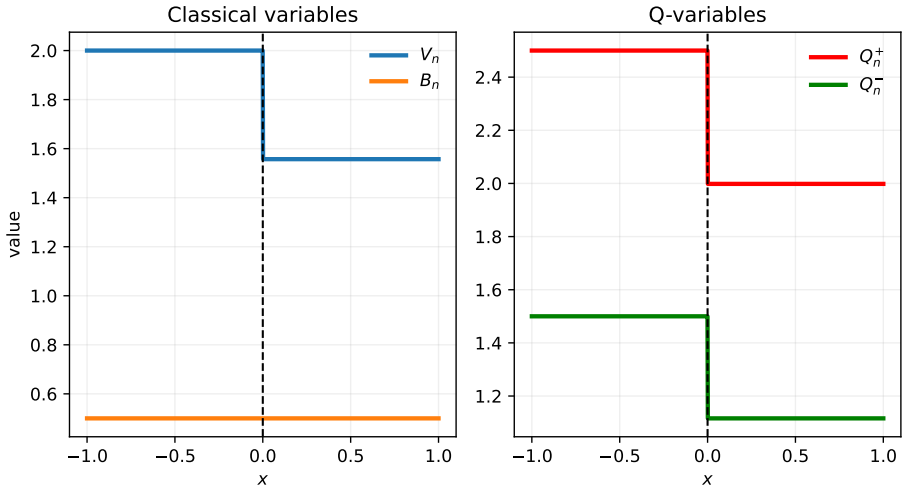
Numerical evaluation of a known MHD shock (for example a perpendicular fast shock with given upstream state) that checks whether the Q-variable jump relations recover the identical downstream state as the classical Rankine-Hugoniot relations.
Figures
read the original abstract
The recently developed Q-variable formalism generalises the Els\"asser representation by providing a wave-aligned representation applicable to a broad class of magnetohydrodynamic disturbances, including Alfv\'enic, fast, slow, and kink waves. While this framework has proven useful for the study of wave dynamics and turbulence, its behaviour in the presence of plasma discontinuities has not yet been established. In this work, we derive the complete set of Rankine-Hugoniot jump conditions in terms of the Q-variables by rewriting the ideal MHD equations in a form suitable for shock-frame jump analysis. This yields explicit jump relations for mass, momentum, magnetic flux, and energy. We then demonstrate analytically that these relations are exactly equivalent to the classical MHD Rankine-Hugoniot conditions. This reformulation provides a wave-aligned representation of MHD discontinuities and offers a natural framework for discussing directional wave content and branch-restricted limits when $\alpha$, the wave-branch parameter entering the Q-variable definition, is chosen consistently with the relevant characteristic speed. The resulting formulation is well suited for the analysis of wave-shock interactions in magnetised plasmas, with potential applications to the solar wind, magnetospheric systems, and large-scale models of structured plasma environments such as UAWSOM.
Editorial analysis
A structured set of objections, weighed in public.
Referee Report
Summary. The manuscript derives the full set of Rankine-Hugoniot jump conditions for ideal MHD discontinuities (mass, momentum, magnetic flux, energy) by rewriting the equations in Q-variables, a wave-aligned generalization of Elsässer variables. It then claims to demonstrate analytically that the resulting relations are exactly equivalent to the classical MHD Rankine-Hugoniot conditions, with the wave-branch parameter α chosen consistently with the relevant characteristic speed at the discontinuity. The reformulation is positioned as a framework for analyzing directional wave content and wave-shock interactions.
Significance. If the claimed analytical equivalence can be verified with explicit steps, the work supplies a wave-aligned representation of MHD discontinuities that extends the authors' prior Q-variable formalism from continuous waves to shocks. This could enable new analyses of wave content across fast, slow, and intermediate families in applications such as solar-wind and magnetospheric modeling.
major comments (2)
- [Abstract and derivation section] The abstract asserts that an analytical equivalence proof was performed, yet the manuscript provides neither the explicit algebraic steps nor verification of the reductions from the ideal MHD equations to the Q-variable jump relations. Without these, the central claim of exact equivalence cannot be assessed.
- [Derivation of jump conditions] The Q-variable definition ties α to a specific characteristic speed. At a discontinuity the normal speed is fixed by the RH conditions, but MHD admits fast, slow, and intermediate families. No explicit prescription is supplied for selecting α (or demonstrating insensitivity to the choice) so that the momentum and energy jumps remain consistent across families; the claimed exact equivalence therefore holds only conditionally.
Simulated Author's Rebuttal
We thank the referee for their careful reading and constructive comments. The points raised identify opportunities to strengthen the clarity of our analytical derivations. We address each major comment below and will revise the manuscript accordingly.
read point-by-point responses
-
Referee: [Abstract and derivation section] The abstract asserts that an analytical equivalence proof was performed, yet the manuscript provides neither the explicit algebraic steps nor verification of the reductions from the ideal MHD equations to the Q-variable jump relations. Without these, the central claim of exact equivalence cannot be assessed.
Authors: We agree that the explicit algebraic steps demonstrating the reductions were not included in the submitted manuscript. In the revised version we will add a dedicated appendix containing the complete step-by-step algebraic derivation from the standard ideal-MHD Rankine-Hugoniot conditions to the Q-variable jump relations, including all intermediate reductions and verifications. revision: yes
-
Referee: [Derivation of jump conditions] The Q-variable definition ties α to a specific characteristic speed. At a discontinuity the normal speed is fixed by the RH conditions, but MHD admits fast, slow, and intermediate families. No explicit prescription is supplied for selecting α (or demonstrating insensitivity to the choice) so that the momentum and energy jumps remain consistent across families; the claimed exact equivalence therefore holds only conditionally.
Authors: The manuscript states that α is to be chosen consistently with the relevant characteristic speed. We acknowledge that an explicit, family-by-family prescription is not supplied in sufficient detail. In the revision we will add a short subsection that (i) specifies the value of α for the fast, slow, and intermediate families and (ii) verifies that, with this choice, the momentum and energy jumps reduce exactly to the classical MHD forms. The equivalence is therefore exact under the stated consistent choice of α rather than conditional in a weaker sense. revision: yes
Circularity Check
Direct algebraic rewriting of standard MHD equations into Q-variables with explicit equivalence proof; no reduction to inputs or self-citation chains
full rationale
The paper's core claim is a rewriting of the ideal MHD equations into Q-variable form for shock-frame analysis, followed by an algebraic demonstration that the resulting jump relations are exactly equivalent to the classical Rankine-Hugoniot conditions. This is a change of representation whose equivalence is shown directly from the equations themselves rather than by fitting, self-definition, or load-bearing self-citation. The wave-branch parameter α is required to be chosen consistently with the characteristic speed, but the equivalence holds under that stated choice without the result being forced by prior self-citation or ansatz smuggling. The derivation is therefore self-contained against the external benchmark of classical MHD RH conditions.
Axiom & Free-Parameter Ledger
axioms (2)
- domain assumption Ideal MHD equations are valid on either side of the discontinuity
- domain assumption Q-variables remain well-defined and applicable when fields are discontinuous
Reference graph
Works this paper leans on
-
[1]
Magnetic Reconnection: MHD Theory and Applications , publisher=
Priest, Eric and Forbes, Terry , year=. Magnetic Reconnection: MHD Theory and Applications , publisher=
-
[2]
2000 , publisher=
Nonlinear Wave Propagation: With Applications to Physics and Magnetohydrodynamics , author=. 2000 , publisher=
2000
-
[3]
Soviet Physics Doklady , year = 1971, month = mar, volume =
A Model of the Interaction of the Solar Wind with the Interstellar Medium. Soviet Physics Doklady , year = 1971, month = mar, volume =
1971
-
[4]
1984 , publisher=
Electrodynamics of Continuous Media , author=. 1984 , publisher=
1984
-
[5]
Magneto-Hydrodynamic Shocks , author =. Phys. Rev. , volume =. 1950 , month =. doi:10.1103/PhysRev.80.692 , url =
-
[6]
Non-relativistic shocks , author=
Fundamentals of collisionless shocks for astrophysical application, 1. Non-relativistic shocks , author=. Astronomy and Astrophysics Review , volume=. 2009 , doi=
2009
-
[7]
E. C. Stone and A. C. Cummings and F. B. McDonald and B. C. Heikkila and N. Lal and W. R. Webber , title =. Science , volume =. 2005 , doi =
2005
-
[8]
Nature , volume =
An asymmetric solar wind termination shock , author =. Nature , volume =. 2008 , doi =
2008
-
[9]
Processes and mechanisms governing the initiation and propagation of CMEs , JOURNAL =
Vr. Processes and mechanisms governing the initiation and propagation of CMEs , JOURNAL =. 2008 , NUMBER =
2008
-
[10]
Living Reviews in Solar Physics , volume=
The Solar Wind as a Turbulence Laboratory , author=. Living Reviews in Solar Physics , volume=. 2013 , doi=
2013
-
[11]
and Andries, J
Goossens, M. and Andries, J. and Soler, R. and Van Doorsselaere, T. and Arregui, I. and Terradas, J. , journal=. Surface Alfv. 2012 , doi=
2012
-
[12]
The Hydromagnetic Equations , author =. Phys. Rev. , volume =. 1950 , month =. doi:10.1103/PhysRev.79.183 , url =
-
[13]
Journal of Plasma Physics , author=
The magnetohydrodynamic equations in terms of waveframe variables , volume=. Journal of Plasma Physics , author=. 2024 , pages=. doi:10.1017/S0022377824000126 , number=
-
[14]
Van Doorsselaere, T. and Sieyra, M. V. and Magyar, N. and Goossens, M. and Banović, L. , year=. Uniturbulence and Alfven wave solar model , volume=. doi:10.1051/0004-6361/202450630 , journal=
-
[15]
Fully Developed Anisotropic Hydromagnetic Turbulence in Interplanetary Space , author =. Phys. Rev. Lett. , volume =. 1980 , month =. doi:10.1103/PhysRevLett.45.144 , url =
-
[16]
Journal of Plasma Physics , author=
Dynamics of correlation functions with Elsässer variables for inhomogeneous MHD turbulence , volume=. Journal of Plasma Physics , author=. 1989 , pages=. doi:10.1017/S0022377800014033 , number=
-
[17]
Journal of Geophysical Research , volume=
Basic properties of solar wind MHD turbulence: Observations and model equations , author=. Journal of Geophysical Research , volume=. 1989 , doi=
1989
-
[18]
Turbulent cascade of incompressible unidirectional Alfv\'en waves in the interplanetary medium , author =. Phys. Rev. Lett. , volume =. 1989 , month =. doi:10.1103/PhysRevLett.63.1807 , url =
-
[19]
Zhou, Ye and Matthaeus, William H. , title =. Geophysical Research Letters , volume =. doi:https://doi.org/10.1029/GL016i007p00755 , url =. https://agupubs.onlinelibrary.wiley.com/doi/pdf/10.1029/GL016i007p00755 , abstract =
-
[20]
Journal of Geophysical Research: Space Physics , volume =
Grappin, Roland and Mangeney, Andre and Marsch, Eckart , title =. Journal of Geophysical Research: Space Physics , volume =. doi:https://doi.org/10.1029/JA095iA06p08197 , url =. https://agupubs.onlinelibrary.wiley.com/doi/pdf/10.1029/JA095iA06p08197 , abstract =
-
[21]
Marsch, E. and Mangeney, A. , title =. Journal of Geophysical Research: Space Physics , volume =. doi:https://doi.org/10.1029/JA092iA07p07363 , url =. https://agupubs.onlinelibrary.wiley.com/doi/pdf/10.1029/JA092iA07p07363 , abstract =
-
[22]
Magyar, N. and Van Doorsselaere, T. and Goossens, M. , title =. The Astrophysical Journal , abstract =. 2019 , month =. doi:10.3847/1538-4357/ab04a7 , url =
-
[23]
Frontiers in Astronomy and Space Sciences , VOLUME=
Ismayilli, Rajab and Van Doorsselaere, Tom and Goossens, Marcel and Magyar, Norbert , TITLE=. Frontiers in Astronomy and Space Sciences , VOLUME=. 2022 , URL=. doi:10.3389/fspas.2021.769173 , ISSN=
-
[24]
The Astrophysical Journal , abstract =
Van Doorsselaere, Tom and Li, Bo and Goossens, Marcel and Hnat, Bogdan and Magyar, Norbert , title =. The Astrophysical Journal , abstract =. 2020 , month =. doi:10.3847/1538-4357/aba0b8 , url =
-
[25]
Fast magneto-acoustic wave turbulence and the Iroshnikov–Kraichnan spectrum , volume=
Galtier, Sébastien , year=. Fast magneto-acoustic wave turbulence and the Iroshnikov–Kraichnan spectrum , volume=. Journal of Plasma Physics , publisher=. doi:10.1017/s0022377823000259 , number=
-
[26]
McMurdo, M. and Van Doorsselaere, T. and Magyar, N. and Banović, L. and Lim, D. , title =. doi:10.1051/0004-6361/202555912
-
[27]
, title =
Priest, Eric R. , title =
-
[28]
Living Reviews in Solar Physics , volume =
Bruno, Roberto and Carbone, Vincenzo , title =. Living Reviews in Solar Physics , volume =. 2013 , doi =
2013
-
[29]
Magnetohydrodynamics of Laboratory and Astrophysical Plasmas , publisher=
Goedbloed, Hans and Keppens, Rony and Poedts, Stefaan , year=. Magnetohydrodynamics of Laboratory and Astrophysical Plasmas , publisher=
-
[30]
Schekochihin, A. A. and Cowley, S. C. and Dorland, W. and Hammett, G. W. and Howes, G. G. and Quataert, E. and Tatsuno, T. , title =. The Astrophysical Journal Supplement Series , abstract =. 2009 , month =. doi:10.1088/0067-0049/182/1/310 , url =
-
[31]
and Van Doorsselaere, T
Magyar, N. and Van Doorsselaere, T. and Goossens, M. , title =. Scientific Reports , volume =. 2017 , doi =
2017
-
[32]
Gary , year=
Leal, L. Gary , year=. Advanced Transport Phenomena: Fluid Mechanics and Convective Transport Processes , publisher=
discussion (0)
Sign in with ORCID, Apple, or X to comment. Anyone can read and Pith papers without signing in.