REVIEW 3 major objections 6 minor 36 references
Statistical Modeling of Networked Solar Resources for Assessing and Mitigating Risk of Interdependent Inverter Tripping Events in Distribution Grids
T0 review · 3 major / 6 minor · reviewed 2026-08-14 · deepseek-v4-flash
Pith's one-line read Interdependent inverter tripping risk can be conservatively predicted from statistics alone.
desk verdict Valuable and mostly sound statistical shortcut for inverter-tripping risk, but the conservative guarantee rests on an unproven independence assumption. read the letter →
The pith
A machine-rendered reading of the paper's core claim, the machinery that carries it, and where it could break.
The reading
What carries the argument
The machinery is the approximate micro-state vector $\hat{\boldsymbol\lambda}$, whose $i$-th entry is a conservative estimate of the probability that inverter $i$ is ON, obtained by replacing the exact step-function tripping condition with Chebyshev's inequality on the squared voltage $v_i = V_i^2$. Voltage mean and variance are then re-expressed through a linearized radial power-flow model in terms of first and second moments of available load/PV active and reactive power, plus cross-correlations. This yields the bilinear self-consistent equation (35), whose structure separates one-node effects in matrix $\mathbf B$ from pairwise interdependent effects in matrices $\mathbf C_i$; it also defines an abstract iterative map whose fixed points solve the model and whose qualitative changes correspond to tripping regime shifts.
What would settle it
Run a high-resolution Monte Carlo of the original tripping equations on a feeder where voltages sit near the protection threshold, and compare the empirical ON probability $\lambda_i$ with the model bound $\hat{\lambda}_i$; any scenario where $\hat{\lambda}_i > \lambda_i$ for some node would refute the claimed conservative property.
Extended reading notes
Core claim
The central discovery is that the coupled tripping equations for N inverters, where each inverter's ON/OFF state depends on nodal voltages and nodal voltages depend on all states, can be summarized by a self-consistent bilinear equation for a vector of approximate ON probabilities, equation (35): $\hat{\boldsymbol\lambda} = \mathbf a_0 + \mathbf B \hat{\boldsymbol\lambda} + [\hat{\boldsymbol\lambda}^\top \mathbf C_1 \hat{\boldsymbol\lambda}, \dots, \hat{\boldsymbol\lambda}^\top \mathbf C_N \hat{\boldsymbol\lambda}]^\top$. The coefficient matrix $\mathbf B$ encodes each node's own power statistics, while the matrices $\mathbf C_i$ encode pairwise cross-correlations between different nodes. Every fixed point of this equation is a conservative estimator of the true system: it satisfies $\hat{\lambda}_i \le \lambda_i$, the actual probability that inverter $i$ remains ON, because Chebyshev's inequality bounds the probability that squared voltage falls inside the protection window using only voltage mean and variance. The paper therefore frames the model both as a conservative risk metric, in which expected curtailment is never understated, and as a tractable constraint for volt-var optimization after convex relaxation.
Load-bearing premise
The derivation assumes the on/off state of each inverter is statistically independent of the available solar power at the same node, even though in reality the state is a function of voltage, which depends on that power.
Editorial extensions
If this is right
- Utilities can estimate the expected fraction of inverters that remain ON, and therefore the risk of solar curtailment, using only mean, variance, and correlation statistics of load/PV power, with no real-time telemetry.
- The same bilinear model can be embedded as quadratic constraints in volt-var optimization, and convex relaxation makes the mitigation problem solvable at feeder scale.
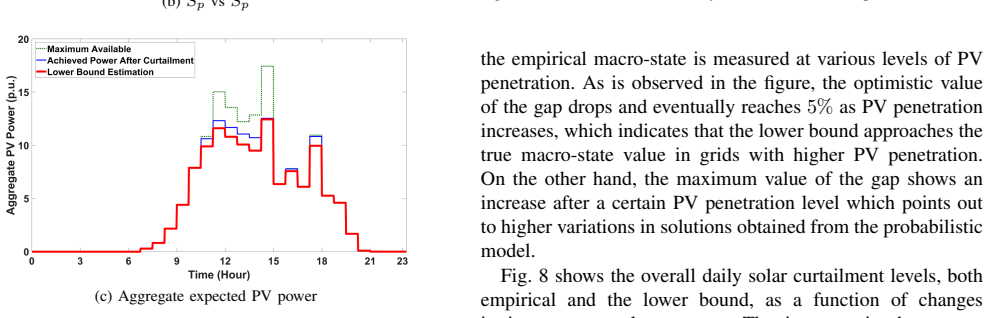
- Because the estimator is conservative, any curtailment level it predicts is an upper bound, so a feeder judged safe under the model is unlikely to suffer worse unobserved tripping.
- Interdependency among inverters weakens roughly as the inverse square of the protection dead-band, so widening inverter dead-bands reduces cascade coupling.
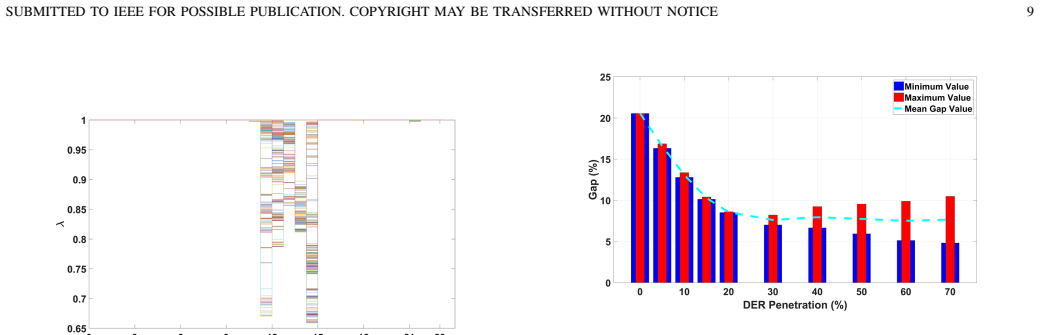
- On the real feeder studied, the model reproduces a regime shift around 30% PV penetration beyond which massive tripping becomes probable, and the lower bound tracks where this transition occurs.
Reading between the lines
- A natural test is to run the exact tripping equations in Monte Carlo on low-penetration weak feeders and check whether $\hat{\lambda}_i \le \lambda_i$ ever fails; failures would pinpoint where the independence assumption in (14) starts to matter.
- One could tighten the bound without changing the framework by replacing the two-sided Chebyshev inequality with one-sided or higher-moment versions, trading some conservatism for accuracy in normal operating regions.
- The bilinear fixed-point structure invites analytic stability analysis: linearizing around a fixed point could predict the PV-penetration threshold at which the tripping regime shifts before running time-series simulations.
- The same statistical machinery should transfer to other voltage-sensitive resources such as ZIP loads and volt-var inverters, since the paper only sketches their inclusion via linearized surrogate injections and leaves detailed validation open.
Signed reviews
Editorial analysis
A structured set of objections, weighed in public.
Referee Report
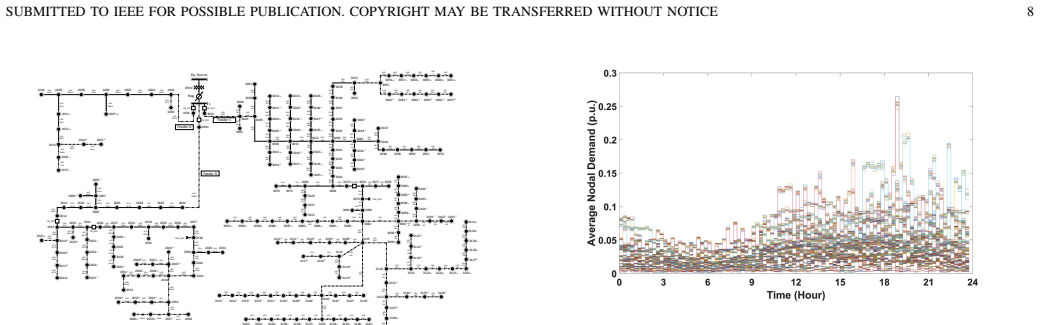
Summary. This paper addresses the problem of estimating the risk of voltage-driven inverter tripping in distribution grids with high PV penetration. The authors start from a deterministic switching model in which each inverter's ON/OFF state is a step function of the squared nodal voltage. To avoid the exponential complexity and non-differentiability of the original tripping equations, they propose a probabilistic surrogate: Chebyshev's inequality (Eq. (11)) gives a distribution-free lower bound on the probability that each inverter is ON, expressed in terms of the mean and variance of the squared nodal voltage. These moments are then parameterized using only the statistics of available active/reactive nodal powers, via a Bernoulli-mixture representation of the realized injections, leading to the bilinear matrix equation (35). The model is used to estimate expected PV curtailment, identify regime shifts in tripping events, and design voltage-regulation countermeasures via an optimization framework with convex relaxations. Numerical experiments on a real 240-node feeder with AMI data are presented to support the claim that the model provides a conservative lower bound on the empirical ON probabilities.
Significance. The paper's core idea of using Chebyshev's inequality to avoid distributional assumptions, and of parameterizing the resulting bound solely from load/PV power statistics, is practically attractive for utilities with limited observability. The integration of the probabilistic model into an optimization-based curtailment mitigation scheme is a useful extension, and the authors share a public test system and real data, which supports reproducibility. If the conservative-bound claim were rigorously established, the model would provide a scalable and statistically grounded tool for tripping-risk assessment. However, as detailed below, the central theoretical guarantee is not proven, and the current numerical evidence is limited to a single feeder.
major comments (3)
- [Section II-C, Eqs. (14) and (22)-(26) and (31)-(32)] The derivation of the realized-power CDF and the moment formulas assumes that each Bernoulli switch state s_j is independent of the available power p_j and q_j at the same node, and that s_j and s_k are independent of each other. In the original tripping model (2)-(9), s_j is a deterministic function of v_j, and v_j depends on p_j and q_j through the power-flow equations, so these independence conditions are violated. The paper never states this assumption explicitly. This is load-bearing: Eq. (16) uses E{p_j s_j} = λ_j P_j, and the variance and covariance formulas (23)-(26) and (32) rely on the same premise. In reality, a high available PV output makes overvoltage tripping more likely, so p_j and s_j will generally be negatively correlated; ignoring this changes the moments and can break the claimed conservativeness.
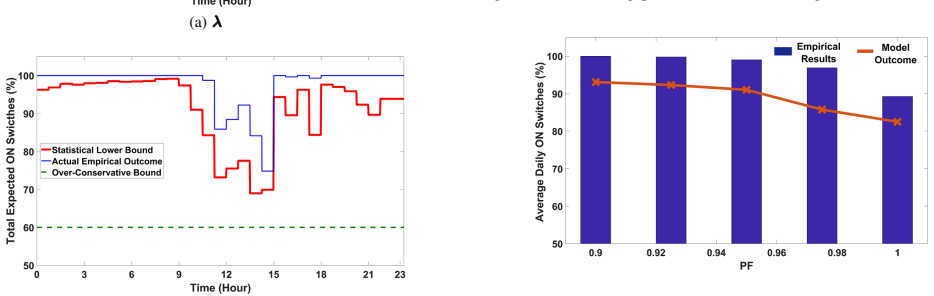
- [Section II-D and Eq. (35)] The central claim that any solution of the approximate model (35) is a conservative estimator (λ̂_i ≤ λ_i) is not proven. Chebyshev's inequality (11) is applied to the true moments μ_vi and σ²_vi of v_i, but the paper substitutes the approximate moments obtained under the independence assumption described above. No argument is given that these approximate moments lead to a λ̂ that still satisfies λ̂_i ≤ λ_i under the fixed-point equation. The misspecification can shift the moment estimates in either direction, so the uniform lower-bound property does not follow from the Chebyshev step alone. The numerical validation in Section IV constitutes a single scenario and cannot establish the general guarantee claimed in Section II-D.
- [Section III, formulations (47) and (48)] The optimization frameworks in (47) and (48) select a fixed point of (35) that maximizes the estimated realized solar power, i.e., the most optimistic solution of the approximate model. The paper does not discuss whether the fixed-point equation possesses a unique solution or whether every solution, or at least the one selected by the optimization, remains a valid lower bound on the true λ_i. Without such a result, the countermeasures designed from the selected fixed point may not be conservative even if the model equations themselves were conservative for every solution.
minor comments (6)
- [Section II-C] The text 'The rational behind (14)' should read 'The rationale behind (14)'.
- [Section III, Eq. (48)] In constraint '0 ≤ ˜λ_j ≤ 1', the tilde symbol is undefined; this should be '0 ≤ λ̂_j ≤ 1'.
- [Section III, Eqs. (50)-(51)] The notation 'ϵϵϵ+/ϵϵϵ+' is malformed; the intended positive and negative slack variables should be denoted ϵ⁺ and ϵ⁻.
- [Section II-C, after Eq. (24)] The symbols P_j^+ and P_j^- are introduced for conditional second moments, but the same superscript notation is also used for the mean available power P_j; this creates a minor notational ambiguity.
- [Abstract and Section I] The phrase 'It is speculated that' is vague; the introduction would be strengthened by stating the concrete physical mechanism and citing specific prior observations of voltage-driven tripping.
- [Figure 5b] The 'lower bound obtained by simply using maximum PV capacities and assuming zero nodal consumption' is labeled but not clearly distinguished from the proposed model; a brief explanation in the caption would improve readability.
Circularity Check
No circularity: Chebyshev-based probabilistic tripping model is derived from load/PV power statistics and network parameters; validation is in-sample but no fitted parameter is disguised as a prediction.
full rationale
The paper's derivation chain is linear and non-circular: original switching equations (2)-(9) are replaced by Bernoulli micro-states; Chebyshev's inequality (11) provides a distribution-free lower bound on each ON probability; and Sections II-C parameterize the required voltage mean/variance using only available load/PV statistics (P_j, Q_j, P+_j, P-_j, etc.) and network constants via Eqs. (14)-(34). The target quantity lambda-hat is not used to define its own inputs: neither the Chebyshev bound nor the moment formulas are fitted to empirical tripping outcomes. The empirical micro-states lambda_i in Eq. (53) are computed from time-series simulations only for validation and gap analysis, not as regression targets for model parameters. The claim that solutions of (35) are conservative rests on the Chebyshev bound combined with a Bernoulli-independence approximation in Eqs. (14), (23), and (26); that independence premise is mathematically questionable because s_j depends on voltage, hence on p_j, but this is a validity/correctness gap rather than an equivalence-by-construction or self-citation issue. The only self-reference is reference [35], a time-series distribution test system by the same group; it supplies the validation feeder and data, not a load-bearing mathematical premise. The main mathematical ingredients (Chebyshev's inequality and the linearized distribution power-flow model) are external textbook/prior-work results. Therefore no circular step is identifiable, and the paper should not receive a circularity penalty; concerns about the unproved independence assumption belong in correctness review.
Assumptions & free parameters
free parameters (3)
- Nodal active/reactive power moments (means, variances, correlations) =
estimated from 1-second Pecan Street AMI data
- Protection thresholds Vmin, Vmax =
0.9 p.u., 1.1 p.u.
- Empirical statistics time window T =
60 minutes (15 minutes in one experiment)
assumptions (4)
- domain assumption Linearized distribution power-flow model from [21] accurately approximates squared voltage magnitudes for unbalanced radial feeders.
- ad hoc to paper The realized power injection distribution can be written as a Bernoulli mixture with switch state independent of available power.
- domain assumption Inverter protection is an instantaneous ON/OFF switch with no ride-through or dynamics; this is a worst-case model.
- standard math Chebyshev's inequality can be applied to the approximate nodal voltage random variables.
Cite this review
Pith. "Pith review of Statistical Modeling of Networked Solar Resources for Assessing and Mitigating Risk of Interdependent Inverter Tripping Events in Distribution Grids." pith.science (2026). https://pith.science/paper/P5BUROGN
@misc{pith2026190801129,
  author       = {Pith},
  title        = {Pith review of: Statistical Modeling of Networked Solar Resources for Assessing and Mitigating Risk of Interdependent Inverter Tripping Events in Distribution Grids},
  year         = {2026},
  howpublished = {\url{https://pith.science/paper/P5BUROGN}},
  note         = {Machine review of arXiv:1908.01129}
}
read the original abstract
It is speculated that higher penetration of inverter-based distributed photo-voltaic (PV) power generators can increase the risk of tripping events due to voltage fluctuations. To quantify this risk utilities need to solve the interactive equations of tripping events for networked PVs in real-time. However, these equations are non-differentiable, nonlinear, and exponentially complex, and thus, cannot be used as a tractable basis for solar curtailment prediction and mitigation. Furthermore, load/PV power values might not be available in real-time due to limited grid observability, which further complicates tripping event prediction. To address these challenges, we have employed Chebyshev's inequality to obtain an alternative probabilistic model for quantifying the risk of tripping for networked PVs. The proposed model enables operators to estimate the probability of interdependent inverter tripping events using only PV/load statistics and in a scalable manner. Furthermore, by integrating this probabilistic model into an optimization framework, countermeasures are designed to mitigate massive interdependent tripping events. Since the proposed model is parameterized using only the statistical characteristics of nodal active/reactive powers, it is especially beneficial in practical systems, which have limited real-time observability. Numerical experiments have been performed employing real data and feeder models to verify the performance of the proposed technique.
Figures


Figures from the paper (7 more)


Reference graph
Works this paper leans on
-
[1]
Impact of high PV penetration on voltage profiles in residential neighborhoods,
R. Tonkoski, D. Turcotte, and T. H. M. El-Fouly, “Impact of high PV penetration on voltage profiles in residential neighborhoods,” IEEE Trans. Sustain. Energy , vol. 3, no. 3, pp. 518–527, Jul. 2012
work page 2012
-
[2]
Microinverter curtailment strategy for increasing photovoltaic penetration in low- voltage networks,
O. Gagrica, P. H. Nguyen, W. L. Kling, and T. Uhl, “Microinverter curtailment strategy for increasing photovoltaic penetration in low- voltage networks,” IEEE Trans. Sustain. Energy , vol. 6, no. 2, pp. 369– 379, Apr. 2015
work page 2015
-
[3]
M. Hasheminamin, V . G. Agelidis, V . Salehi, R. Teodorescu, and B. Hredzak, “Index-based assessment of voltage rise and reverse power flow phenomena in a distribution feeder under high PV penetration,” IEEE J. Photovolt. , vol. 5, no. 4, pp. 1158–1168, Jul. 2015
work page 2015
-
[4]
V . Ferreira, P. M. S. Carvalho, L. A. F. M. Ferreira, and M. D. Ilic, “Distributed energy resources integration challenges in low-voltage networks: voltage control limitations and risk of cascading,”IEEE Trans. Sustain. Energy, vol. 4, no. 1, pp. 82–88, Jan. 2013
work page 2013
-
[5]
Ultimate limits to the fully decentralized power inverter control in distribution grids,
P. M. S. Carvalho, L. A. Ferreira, J. C. Botas, M. D. Ilic, X. Miao, and K. D. Bachovchin, “Ultimate limits to the fully decentralized power inverter control in distribution grids,” In Power Systems Computation Conference (PSCC), pp. 1–7, Jun. 2016
work page 2016
-
[6]
P. M. S. Carvalho, L. A. Ferreira, and J. J. E. Santana, “Single-phase generation headroom in low-voltage distribution networks under reduced circuit characterization,” IEEE Trans. Power Syst. , vol. 30, no. 2, pp. 1006–1011, Mar. 2015
work page 2015
-
[7]
Understanding factors that influence the risk of a cascade of outages due to inverter disconnection,
C. Popiel and P. D. H. Hines, “Understanding factors that influence the risk of a cascade of outages due to inverter disconnection,” In North American Power Symposium (NAPS) , pp. 1–6, 2019
work page 2019
-
[8]
A. Parchure, S. J. Tyler, M. A. Peskin, K. Rahimi, R. P. Broadwater, and M. Dilek, “Investigating PV generation induced voltage volatility for customers sharing a distribution service transformer,” IEEE Trans. Ind. Appl. , vol. 53, no. 1, pp. 71–79, Jan. 2017
work page 2017
Show all 36 references
-
[9]
Photovoltaic (PV) impact assessment for very high penetration levels,
D. Cheng, B. A. Mather, R. Seguin, J. Hambrick, and R. P. Broadwater, “Photovoltaic (PV) impact assessment for very high penetration levels,” IEEE J. Photovolt. , vol. 6, no. 1, pp. 295–300, Jan. 2016
2016
-
[10]
Importance of detailed modeling of loads/PV systems connected to secondary of dis- tribution transformers,
P. Gupta, K. Rahimi, R. Broadwater, and M. Dilek, “Importance of detailed modeling of loads/PV systems connected to secondary of dis- tribution transformers,” In North American Power Symposium (NAPS) , pp. 1–6, Sep. 2017
2017
-
[11]
On distributed PV hosting capacity estimation, sensitivity study, and improvement,
F. Ding and B. Mather, “On distributed PV hosting capacity estimation, sensitivity study, and improvement,”IEEE Trans. Sustain. Energy, vol. 8, no. 3, pp. 1010–1020, Jul. 2017
2017
-
[12]
Power system voltage stability evaluation considering renewable energy with correlated variabilities,
X. Xu, Z. Yan, M. Shahidehpour, H. Wang, and S. Chen, “Power system voltage stability evaluation considering renewable energy with correlated variabilities,” IEEE Trans. Power Syst. , vol. 33, no. 3, pp. 3236–3245, May 2018
2018
-
[13]
Synchrophasor-based auxiliary controller to enhance the voltage sta- bility of a distribution system with high renewable energy penetration,
H. Jiang, Y . Zhang, J. J. Zhang, D. W. Gao, and E. Muljadi, “Synchrophasor-based auxiliary controller to enhance the voltage sta- bility of a distribution system with high renewable energy penetration,” IEEE Trans. Smart Grid , vol. 6, no. 4, pp. 2107–2115, Jul. 2015
2015
-
[14]
Investigation of the sympathetic tripping problem in power systems with large penetrations of distributed generation,
K. I. Jennett, C. D. Booth, F. Coffele, and A. J. Roscoe, “Investigation of the sympathetic tripping problem in power systems with large penetrations of distributed generation,” IET Gener . Transm. Distrib. , vol. 9, no. 4, pp. 379–385, Dec. 2014
2014
-
[15]
S. M. Ross, Introduction to Probability Models . Academic Press, 2006
2006
-
[16]
WECC PV power plant dynamic modeling guide,
“WECC PV power plant dynamic modeling guide,” Western Electricity Coordinating Council, Tech. Rep., Apr. 2014. [Online]. Available: https://www.wecc.org/Reliability/WECC
2014
-
[17]
NERC reliability guideline: Integrating inverter-based resources into weak power systems - Dec. 2017
“NERC reliability guideline: Integrating inverter-based resources into weak power systems - Dec. 2017.” [Online]. Available: https://www.nerc.com/comm/PC Reliability Guidelines DL/Item 4a. Integrating%20 Inverter-Based Resources into Low Short Circuit Strength Systems - 2017-1...
2017
-
[18]
Australian Energy Market Operator (AEMO) Information & Support Hub: Multiple voltage disturbance ride-through capability, justification of AEMO’s proposal - Mar. 2018
“Australian Energy Market Operator (AEMO) Information & Support Hub: Multiple voltage disturbance ride-through capability, justification of AEMO’s proposal - Mar. 2018.” [Online]. Available: https://www. aemc.gov.au/sites/default/files/2018-03/AEMO%20report%20updated% 20proposed...
2018
-
[19]
Australian Energy Market Operator (AEMO) Informa- tion & Support Hub: Electricity rule change proposal, generator technical requirement - Aug. 2017
“Australian Energy Market Operator (AEMO) Informa- tion & Support Hub: Electricity rule change proposal, generator technical requirement - Aug. 2017.” [Online]. Available: https://www.aemo.com.au/-/media/Files/Electricity/NEM/ Security and Reliability/Reports/2017/AEMO-GTR-RCP...
2017
-
[20]
System strength and weak grids: Fundamentals, challenges, and mitigation strategies,
M. G. Dozein, P. Mancarella, T. K. Saha, and R. Yan, “System strength and weak grids: Fundamentals, challenges, and mitigation strategies,” In Australasian Universities Power Engineering Conference (AUPEC) , pp. 1–7, 2018
2018
-
[21]
Real-time decentralized voltage control in distribution networks,
N. Li, G. Qu, and M. Dahleh, “Real-time decentralized voltage control in distribution networks,” In 52nd Annual IEEE Conference on Commu- nication, Control, and Computing (Allerton) , pp. 582–588, Oct. 2014
2014
-
[22]
Statistical representation of distribution system loads using Gaussian mixture model,
R. Singh, B. C. Pal, and R. A. Jabr, “Statistical representation of distribution system loads using Gaussian mixture model,” IEEE Trans. Power Syst., vol. 25, no. 1, pp. 29–37, Feb. 2010
2010
-
[23]
Modeling load uncertainty in distribution network monitoring,
D. T. Nguyen, “Modeling load uncertainty in distribution network monitoring,” IEEE Trans. Power Syst. , vol. 30, no. 5, pp. 2321–2328, Sep. 2015
2015
-
[24]
Statistical estimation of the residential baseline,
L. Hatton, P. Charpentier, and E. Matzner-Lober, “Statistical estimation of the residential baseline,” IEEE Trans. Power Syst. , vol. 31, no. 3, pp. 1752–1759, May 2016
2016
-
[25]
Pv based distributed generation power system protection: A review,
H. L. van der Walt, R. C. Bansal, and R. Naidoo, “Pv based distributed generation power system protection: A review,” Renewable Energy F ocus, vol. 24, pp. 33–40, Mar. 2018
2018
-
[26]
Thurner, R
S. Thurner, R. Hanel, and P. Klimek, Introduction to the theory of complex systems . Oxford University Press, 2018
2018
-
[27]
Exact mean-field inference in asymmet- ric kinetic Ising systems,
M. Mezard and J. Sakellariou, “Exact mean-field inference in asymmet- ric kinetic Ising systems,” Journal of Statistical Mechanics: Theory and Experiment, no. 07, p. L07001, Jul. 2011
2011
-
[28]
Load modeling - a review,
A. Arif, Z. Wang, J. Wang, B. Mather, H. Bashualdo, and D. Zhao, “Load modeling - a review,” IEEE Trans. Smart Grid , vol. 9, no. 6, pp. 5986–5999, Nov. 2018
2018
-
[29]
Impact of renewable generation on voltage control in distribution systems,
J. O. Petinrin and M. Shaaban, “Impact of renewable generation on voltage control in distribution systems,” Renewable and Sustainable Energy Reviews, vol. 65, pp. 770–783, 2016
2016
-
[30]
Online voltage control in distribution systems with multiple voltage regulating devices,
D. Ranamuka, A. P. Agalgaonkar, and K. M. Muttaqi, “Online voltage control in distribution systems with multiple voltage regulating devices,” IEEE Trans. Sustain. Energy , vol. 5, no. 2, pp. 617–628, Apr. 2014
2014
-
[31]
Coordination of transformer on-load tap changer and PV smart inverters for voltage control of distribution feeders,
T. T. Ku, C. H. Lin, C. S. Chen, and C. T. Hsu, “Coordination of transformer on-load tap changer and PV smart inverters for voltage control of distribution feeders,” IEEE Trans. Ind. Appl. , vol. 55, no. 1, pp. 256–264, Feb. 2019. SUBMITTED TO IEEE FOR POSSIBLE PUBLICATION. CO...
2019
-
[32]
Semidefinite relaxation of quadratic optimization prob- lems and applications,
W. K. K. Ma, “Semidefinite relaxation of quadratic optimization prob- lems and applications,” IEEE Signal Processing Magezine , vol. 1053, no. 5888/10, May 2010
2010
-
[33]
Second order cone programming relaxation of nonconvex quadratic optimization problems,
S. Kim and M. Kojima, “Second order cone programming relaxation of nonconvex quadratic optimization problems,” Optimization methods and software, vol. 15, no. 3–4, pp. 201–224, Jan. 2001
2001
-
[34]
Convex relaxation of bilinear matrix inequalities part i: theoretical results,
M. Kheirandishfard, F. Zohrizadeh, and R. Madani, “Convex relaxation of bilinear matrix inequalities part i: theoretical results,” In IEEE Conference on Decision and Control (CDC) , pp. 67–74, Dec. 2018
2018
-
[35]
F. Bu, Y . Yuan, Z. Wang, K. Dehghanpour, and A. Kimber. (2019) A time-series distribution test system based on real utility data. [Online]. Available: https://arxiv.org/abs/1906.04078
2019 arXiv
-
[36]
Pecan Street Inc.: A test-bed for NILM,
C. Holcomb, “Pecan Street Inc.: A test-bed for NILM,” In International Workshop on Non-Intrusive Load Monitoring , 2012. [Online]. Available: https://www.pecanstreet.org/
2012
Reviewed August 14, 2026 · model on record in the stance chip above.
Discussion (0). Continue with ORCID to comment.