REVIEW 3 major objections 6 minor 3 references
Exploration of another Sol Lewitt puzzle from Barry Cipra
T0 review · 3 major / 6 minor · reviewed 2026-08-14 · deepseek-v4-flash
Pith's one-line read In this 4-by-4 toroidal tile puzzle, the number of loops and the number of crossings always have the same parity, ruling out a single 64-arc loop.
desk verdict A fun recreational puzzle paper whose central parity theorem is probably right, but the keystone checkerboard proof is sketched and the algebra in Theorem 3 overstates what follows; worth refereeing, not desk-rejecting. read the letter →
The pith
A machine-rendered reading of the paper's core claim, the machinery that carries it, and where it could break.
The reading
What carries the argument
The load-bearing identity is the congruence $L \equiv C \pmod 2$, where $L$ counts loops and $C$ counts crossings. The proof mechanism is the local tile switch: replacing non-crossed arcs with crossed arcs (or the reverse) changes both $L$ and $C$ by one in the same direction, preserving parity; the Checkerboard Crossing Theorem supplies the missing Case C exclusion by forcing a global alternation of horizontal and vertical entries once a loop direction is chosen. For divisibility by four, the machinery is a bipartite cube whose eight corners are the oriented arc types, with allowed transitions as edges; the loop's arc counts must satisfy the bipartite, zero-deflection, and balancing equations, which force $A=A'=C=C'$ and $B=B'=D=D'$, so the total length is $4x+4y$ and therefore divisible by four.
What would settle it
Run an exhaustive computer search over all placements of the sixteen tiles on the $4\times4$ torus, with the original orientations, and look for any configuration with an odd number of loops or with a single loop of length 64; any such configuration would refute the Parity Theorem and the claim that 60 is the maximum loop length.
Extended reading notes
Core claim
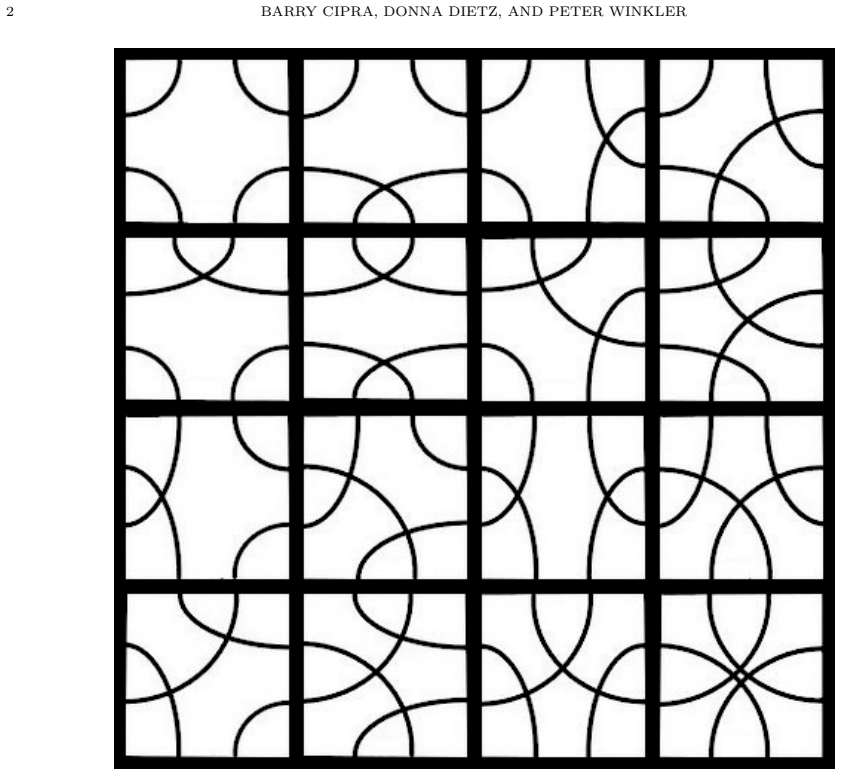
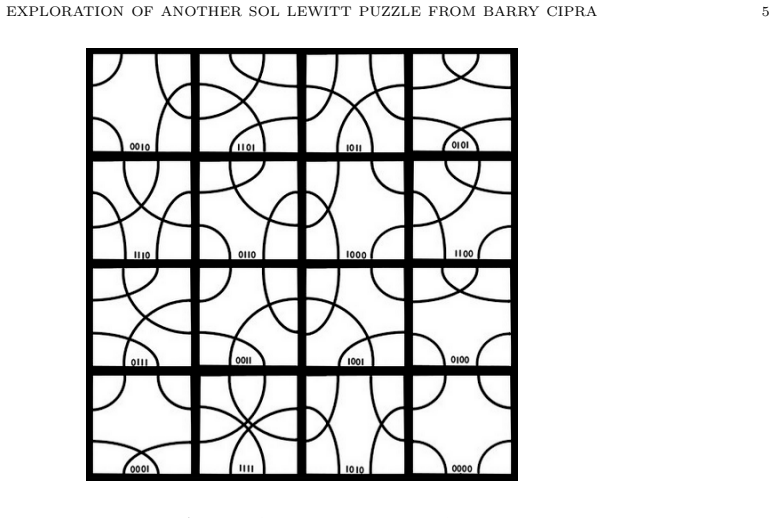
The central discovery is Theorem 1, the Parity Theorem: the number of loops and the number of crossings have the same parity in every toroidal arrangement of the tiles. The proof proceeds by switching individual tiles between non-crossed and crossed arcs, using three cases: Case A merges two loops into one while adding a crossing; Case B splits one loop into two while adding a crossing; Case C, which would add a crossing without changing the loop count, is shown impossible by the Checkerboard Crossing Theorem. That theorem asserts that once a loop's direction is chosen, the loop enters tiles alternately from horizontal and vertical sides, forcing a checkerboard pattern over the whole $4\times4$ torus. Since the portfolio has one tile of each binary type, its crossings sum to an even number, so the loop count must be even; a single 64-arc loop is therefore impossible, and the manually found 60-plus-4 configuration gives the maximum. A separate argument using a bipartite cube of the eight oriented arc types shows every zero-net-deflection loop has length divisible by four.
Load-bearing premise
The parity proof assumes the Checkerboard Crossing Theorem: once a loop's direction is chosen, every tile it enters is entered alternately from a horizontal side and a vertical side, so the whole $4\times4$ torus is forced to carry one checkerboard pattern and the Case C switching scenario cannot occur.
Editorial extensions
If this is right
- No arrangement of the original sixteen tiles on the $4\times4$ torus can produce a single loop of all 64 arcs; the largest possible loop is 60 arcs, with the remaining four arcs forming a separate small loop.
- Every valid arrangement has an even number of loops, since the total number of crossings in the one-of-each-tile portfolio is even.
- Every loop, whether planar or torus, has length divisible by four, because arcs alternate column and row changes and because zero-net-deflection loops satisfy balanced arc-count equations.
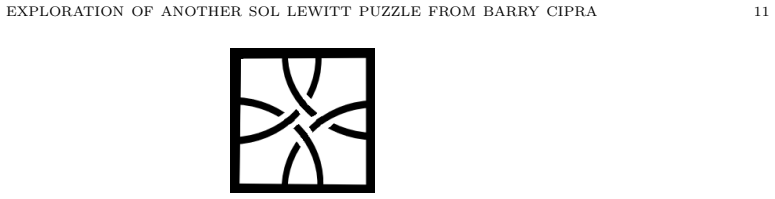
- Marking each crossing with the right-of-way rule makes every loop alternate over and under at successive crossings, producing a consistent weave.
Reading between the lines
- The same logic would predict that a different 16-tile set whose binary labels sum to an odd number must produce an odd number of loops, so a single 64-arc loop could then be possible; a search over alternative portfolios would test this.
- The checkerboard theorem depends on the torus having even side lengths; on odd-sized tori the alternating horizontal/vertical pattern would fail to close, so the parity result may not transfer to other board shapes.
- Reading the right-of-way markings as over/under information turns the loops into alternating links on the torus; checking how many alternating torus links are realizable by these tiles would connect the puzzle to knot theory.
Signed reviews
Editorial analysis
A structured set of objections, weighed in public.
Referee Report
Summary. This paper documents a puzzle proposed by Barry Cipra at MOVES 2019. Sixteen tiles, each carrying quarter-circle arcs and a four-bit label indicating which sides contain crossing points, are placed on a 4x4 torus. The authors define planar and torus loops, present configurations attaining 8 torus loops, 16 planar loops, and a 60-arc loop, and prove or sketch several structural facts. The headline claim is that, with one of each tile, the number of loops and the number of crossings have the same parity; since the portfolio has 32 crossing sides, the number of loops is even, so a single 64-arc loop is impossible and the 60-arc loop of Figure 7 is maximal. The paper also argues that all loop lengths are divisible by four, discusses a right-of-way convention that produces alternating over/under weaves, and sketches variants involving edge loops and magic squares.
Significance. If the proofs are made rigorous, the paper makes a modest but genuine contribution to recreational mathematics. The parity invariant is elegant and gives a sharply falsifiable prediction (the largest loop is 60), and the explicit Figure 7 example supports it. The paper is written in an inviting, exploratory style, and the online availability of the puzzle is a plus. The central derivation is not circular: Theorem 1 is an induction over tile flips and Theorem 2's checkerboard fact is a property of closed alternating walks on the torus, not an assumed conclusion. However, the proof of Theorem 2 is too sketchy to support the parity theorem as written, and the algebra in Theorem 3 is incorrect. Neither issue is fatal, since the needed repairs are short and local, but they are necessary before the claims can be regarded as proven.
major comments (3)
- [Section 4, Theorem 2] The proof as written does not establish the global checkerboard because it does not treat loops that pass through the same tile more than once. The sentence "Our torus is 4x4, or 8x8 if you were to count arc steps. Therefore, the entire torus ... has to honor this checkerboard rule" assumes that a loop's entry direction is a well-defined label on each tile, but a loop could in principle enter a tile horizontally on one visit and vertically on a later visit. The missing step is to observe that the sequence of tile centers traversed by a loop is a closed walk on the bipartite graph C4 x C4; every closed subwalk from a tile back to itself has even length, and since each tile traversal flips horizontal/vertical entry, the entry orientation is the same on every visit. Please add this or an equivalent argument; without it, the exclusion of Case C in Theorem 1 is unjustified.
- [Section 5, Theorem 3] The derivation of the "Solved Balancing Equations" is invalid. The displayed equations give A+A'=C+C' and A+C=A'+C' (and the analogous B/D equations), but these imply only A=C' and A'=C (and B=D', B'=D), not the stronger A=A'=C=C' and B=B'=D=D'. The inference "Let ... 2x ... 2y which means that x=y" is not forced by the earlier equations. Thus the proof that the total number of arcs is divisible by four is incomplete as written. This can be repaired either by using additional properties of the transition graph (e.g., the even number of inflection points) or by relying on the four-coloring argument earlier in Section 5 for the torus setting; the 60-arc conclusion does not depend on this theorem alone.
- [Section 4, proof of Theorem 1] The induction step is only a sketch. The authors present Cases A and B as the only ways a single-tile switch changes the loop count, and Case C as impossible, but they do not explain why these three cases exhaust all possible local configurations, nor do they formally connect a digit flip to the rewiring in Figures 8-10. A rigorous proof should either enumerate the local configurations or provide a general argument that a single crossing toggle changes the number of loops by +/-1 in the two cases shown and cannot change it in any other way. As it stands, the parity theorem should be regarded as an outline, not a complete proof.
minor comments (6)
- [Section 1] The word "termanating" should be "terminating".
- [Sections 3-6] There are several typos: "configuartion" should be "configuration", "argments" should be "arguments", "subtracing" should be "subtracting", and "analsis" should be "analysis".
- [Section 4] The statement that the one-of-each portfolio has even crossing parity should be made explicit: there are 16 four-bit labels, so exactly 32 sides carry a crossing bit, hence the even parity.
- [Section 5] The decomposition of loops into Types I-IV is informal; it would help to spell out what "decomposable" means or to mark this classification as heuristic rather than a formal proof.
- [Section 6] The proof of Theorem 4 covers one entry case and then says the remaining four paths are similar; a short description or additional figure for the remaining cases would improve readability.
- [References] Reference [3] is a Wikipedia page; a standard published reference on Gray codes would be more appropriate for a formal document.
Circularity Check
No significant circularity: the parity theorem is proved from tile mechanics, and the even-crossing count is a fixed property of the one-of-each-tile portfolio.
full rationale
The paper's central derivation is self-contained. Theorem 1 is proved by induction from the tile transition rules, with Cases A and B changing loops and crossings by equal amounts and Case C excluded by the separate Checkerboard Crossing Theorem, not by assuming the parity conclusion. The even number of crossings in the original portfolio is a direct count over the sixteen binary tile labels (each bit position contributes eight ones among 0000 through 1111), not a fitted input or a paraphrase of the conclusion. The headline bound of 60 arcs follows from the parity theorem plus the explicit Figure 7 configuration, so it is not a prediction of a fitted parameter. The only notable weakness is that Theorem 2's proof is only sketched and does not explicitly justify the claim for loops that revisit a tile; however, an incomplete proof is a correctness gap, not circularity. No load-bearing argument reduces to a self-citation, an imported uniqueness theorem, a renamed empirical pattern, or an ansatz smuggled in by citation.
Assumptions & free parameters
assumptions (4)
- domain assumption Tiles are placed on a 4x4 torus with opposite edges identified.
- domain assumption Each tile has four arcs, and every arc connects adjacent sides of the tile and turns through 90 degrees.
- ad hoc to paper The eight directed arc types and their four permitted transitions (the cube in Figure 16) fully represent every possible loop segment.
- standard math Any configuration can be reached from the all-0000 configuration by flipping one tile-side bit at a time.
Cite this review
Pith. "Pith review of Exploration of another Sol Lewitt puzzle from Barry Cipra." pith.science (2026). https://pith.science/paper/P5WWFCYM
@misc{pith2026190805718,
  author       = {Pith},
  title        = {Pith review of: Exploration of another Sol Lewitt puzzle from Barry Cipra},
  year         = {2026},
  howpublished = {\url{https://pith.science/paper/P5WWFCYM}},
  note         = {Machine review of arXiv:1908.05718}
}
read the original abstract
At MOVES 2019, Barry Cipra casually introduced a new "Sol Lewitt" puzzle to fellow conference goers. Several brainstorming sessions ensued with Barry, Peter Winkler , Donna Dietz, and other attendees. This paper is to document the puzzle and some insights so others can enjoy and build on this lovely puzzle. (Look for it in an upcoming book by Peter!)
Figures


Figures from the paper (25 more)






Reference graph
Works this paper leans on
-
[1]
http://www.funmathclub.com/students/sollewitt.html
Fun Math Club, Sol Lewitt Puzzle . http://www.funmathclub.com/students/sollewitt.html
-
[2]
http://www.donnadietz.com/cipra/CiprasPuzzle.html
-
[3]
https://en.wikipedia.org/wiki/Gray Code
Reviewed August 14, 2026 · model on record in the stance chip above.
Discussion (0). Continue with ORCID to comment.