REVIEW 3 major objections 5 minor 18 references
Formation and evolution of globular clusters in cosmological simulations
T0 review · 3 major / 5 minor · reviewed 2026-08-14 · deepseek-v4-flash
Pith's one-line read Most massive globular clusters are born during major galaxy mergers, and the surviving clusters display an age–metallicity relation in which metal-rich clusters are younger by up to 3 Gyr.
desk verdict A clear six-page proceedings summary of previously published simulations, with an overreach in the word 'robust' given the single-halo basis. read the letter →
The pith
A machine-rendered reading of the paper's core claim, the machinery that carries it, and where it could break.
The reading
What carries the argument
The load-bearing mechanism is a sub-grid star-cluster formation prescription that makes star clusters the unit of star formation inside a cosmological hydrodynamic simulation. Cluster particles are first seeded at density peaks of the galactic disk, then grow by accreting gas from the 27 neighboring cells at a rate set by local gas properties and an efficiency parameter $\epsilon_{\rm ff}$; growth stops when the cluster's own energy and momentum feedback terminates accretion, so each cluster's final mass is set by its natal cloud. The same simulation simultaneously evaluates the tidal tensor $-\partial^2\Phi/\partial r_\alpha\partial r_\beta$ along each cluster's orbit and applies an N-body-calibrated disruption rate, so cluster formation and tidal destruction are followed self-consistently rather than added afterward.
What would settle it
Run the same cluster formation model on a sample of Milky Way-mass halos with deliberately different merger histories: if the fraction of clusters with $M > 2\times10^5\,M_\odot$ born during major mergers does not track the number and timing of those mergers, the merger-triggering claim fails. Observationally, a galaxy with no recent major merger should lack the young, metal-rich subpopulation of globular clusters predicted by the age–metallicity relation; finding such clusters in a quiescent galaxy would also falsify the link.
Extended reading notes
Core claim
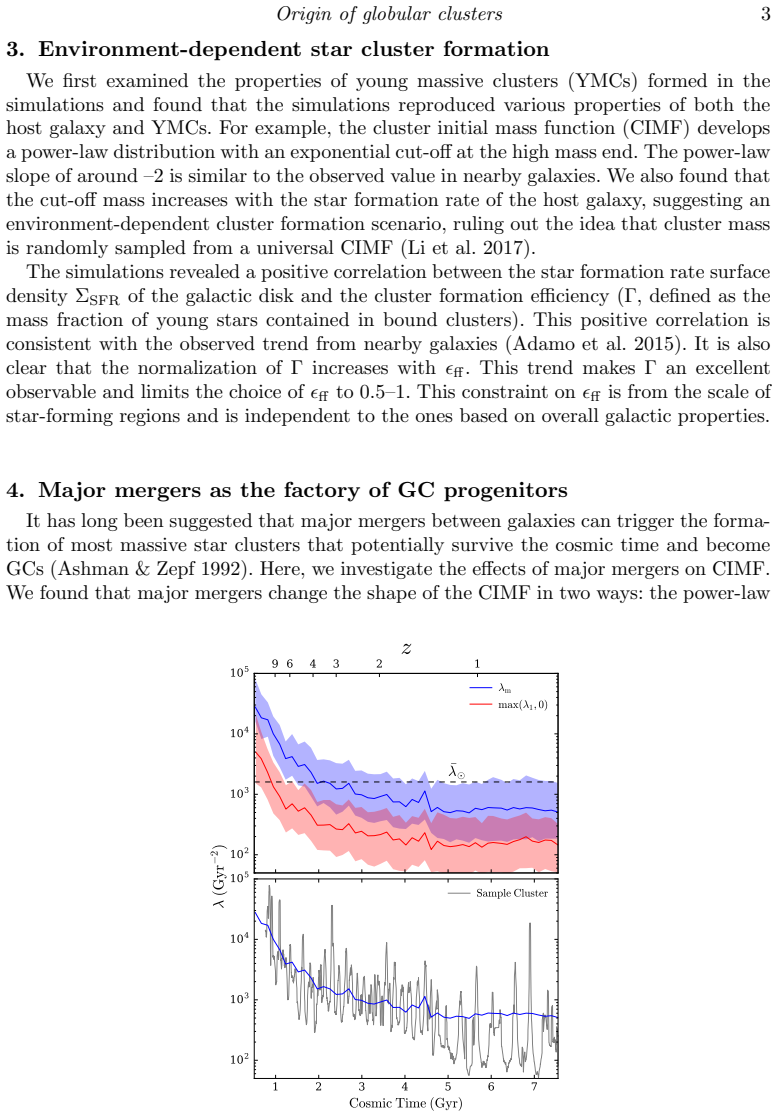
The central claim is that massive star cluster formation is merger-triggered: during major mergers the cluster initial mass function develops a shallower power law and a higher exponential cutoff, which together strongly enhance the production of clusters massive enough to become globular clusters. Applying this model to one simulated Milky Way-sized galaxy yields about 75% of all clusters with $M > 2\times10^5\,M_\odot$ forming during the three major mergers, with a large fraction surviving to $z = 0$. Following each cluster through the time-varying tidal tensor shows that clusters are most vulnerable during their first gigayear inside the dense gaseous disk, and this tidal disruption is what evolves the mass function into the peaked shape seen at the present day. The surviving clusters have [Fe/H] between about –3 and –0.5 and show a clear age–metallicity relation—metal-rich clusters systematically younger than metal-poor ones by up to 3 Gyr—which the authors argue is a robust prediction of hierarchical galaxy formation rather than an imposed assumption.
Load-bearing premise
The central conclusions depend on a single zoom-in simulation of one Milky Way-sized halo being representative, and on a sub-grid prescription that treats unresolved density peaks as cluster seeds; if that halo's assembly history or the seeding prescription is atypical, the 75% merger fraction and the age–metallicity relation may not generalize.
Editorial extensions
If this is right
- The globular cluster mass function's peaked shape is a natural product of tidal disruption acting on an initially power-law population; simulations that resolve this process should not expect a universal, environment-independent cluster initial mass function.
- A galaxy's globular cluster system encodes its merger history: in this model roughly 75% of clusters above $2\times10^5\,M_\odot$ form during major mergers, so massive clusters act as markers of past accretion events.
- The age–metallicity relation is a testable prediction of the model: the most metal-rich globular clusters should be up to 3 Gyr younger than the most metal-poor ones, matching the pattern seen in the Milky Way.
- Cluster formation efficiency, defined as the fraction of young stars in bound clusters, increases with star formation rate surface density, which makes the observed normalization a direct constraint on the sub-grid star formation efficiency, bounding $\epsilon_{\rm ff}$ to roughly 0.5–1.
Reading between the lines
- If merger triggering is general, galaxies with few or no recent major mergers should host fewer massive young clusters per unit star formation than post-merger systems; this is measurable with resolved cluster surveys outside the Local Group.
- The model's age–metallicity relation could be used in reverse: given a globular cluster system's age and metallicity distribution, one could reconstruct the timing of the host's last major mergers, with the youngest metal-rich clusters marking the most recent event.
- A direct generalization would be to run the same prescription on halos with different assembly histories and masses; the predicted fraction of merger-formed massive clusters would likely vary with merger frequency, providing a quantitative explanation for the scatter in globular cluster system properties across galaxies.
- The sub-grid accretion recipe could be tested against cloud-scale observations: if the simulated relation between local gas conditions and cluster growth does not match resolved star-forming regions, the cluster mass scale and merger enhancement would need revision.
Signed reviews
Editorial analysis
A structured set of objections, weighed in public.
Referee Report
Summary. The paper (an IAU Symposium proceedings contribution) summarizes a series of papers by Li and Gnedin implementing a sub-grid star-cluster formation model in a cosmological zoom-in simulation of a Milky Way-sized galaxy. Cluster particles are seeded at gas density peaks and grow by accreting gas from neighboring cells, and their subsequent tidal disruption is tracked. The main claims are: (i) young massive clusters reproduce observed cluster formation efficiencies and mass functions; (ii) most massive clusters (GC candidates, M>2e5 Msun) form preferentially during major mergers (~75% in three mergers); (iii) tidal disruption evolves the cluster mass function from a power law to a peaked shape; (iv) surviving clusters span [Fe/H] from -3 to -0.5; and (v) the model makes a robust prediction of an age-metallicity relation in which metal-rich clusters are younger by up to 3 Gyr.
Significance. If the claims hold, this work is significant because it demonstrates that a physically motivated cluster formation prescription in a cosmological simulation can simultaneously reproduce young massive cluster scaling relations, the globular cluster mass function, and the Milky Way's age-metallicity distribution, directly linking hierarchical assembly to GC populations. The strengths include the high-resolution (5 pc) simulation with radiative transfer and multi-channel stellar feedback, the simultaneous treatment of formation and tidal disruption, and the explicit, falsifiable age-metallicity prediction. The central limitation is the use of a single zoom-in realization, acknowledged in Section 6, which undercuts the 'robust' language in the abstract. The paper is a proceedings summary without derivations or new data tables, which is appropriate for the venue but limits independent verification.
major comments (3)
- [Abstract and Section 6] The age-metallicity relation is called 'a robust prediction' in the abstract, but Section 6 explicitly states that 'the current simulations are from only one realization of the Milky Way-sized galaxies.' With a single halo, the relation could reflect that particular halo's enrichment history rather than a generic outcome. Please either provide at least a second realization or a quantitative assessment of variance across plausible assembly histories, or soften the wording to 'a prediction of the model' and carry the single-realization caveat into the abstract.
- [Section 2 and Section 6, Fig. 4] Because cluster particles are seeded at gas density peaks and grow by accreting gas from the 27 neighboring cells, their metallicity is set by the local gas metallicity at formation. In any hierarchically assembling galaxy with monotonically increasing gas metallicity, younger clusters will automatically be more metal-rich, so the up-to-3 Gyr offset may be inherited from the galaxy's enrichment history rather than being a distinctive outcome of the cluster formation physics. To make the age-metallicity relation a strong test of the model, please show a control: for example, compare the age-metallicity relation of clusters with that of the star-forming gas or of all stars in the simulation, and demonstrate that the cluster relation is not identical to the underlying enrichment trend.
- [Section 4] The claim that roughly 75% of massive clusters with M>2e5 Msun form during major mergers is based on only three merger events in a single halo. No statistical measure is given for whether this fraction is significantly different from the expectation given the overall star formation history, and no comparison is made with equally dense star-forming regions in quiescent phases. Please provide the number of massive clusters formed in each merger, the merger mass ratios and gas fractions, and a bootstrap or Poisson uncertainty on the 75% figure, or explicitly discuss the small-number statistics.
minor comments (5)
- [Section 2, keywords] The keyword line contains 'galacies: star clusters: general'; this should be 'galaxies: star clusters: general.'
- [Section 5] The sentence 'based on a numerical fit from of N-body simulations' contains a typo; it should read 'based on a numerical fit to N-body simulations' or similar.
- [Section 6] The sentence 'It should noted that the current simulations...' is missing the word 'be'; it should read 'It should be noted...'
- [Figure 3, right panel] The legend labels 'Galactic GC SFE50' are ambiguous; please separate the observed Galactic GC sample from the simulation runs more clearly, for example by using distinct symbols and a dedicated legend entry.
- [Section 5] The phrase 'in order to obtain the strong tides in the early time' would read more naturally as 'in order to obtain the strong tides at early times.'
Circularity Check
No significant circularity: the age-metallicity relation and merger-GC connection are emergent simulation outputs, not fitted inputs.
full rationale
The paper's central claims are emergent outputs of a cosmological zoom-in simulation, not quantities fitted to the data they are said to predict. Section 3 contains the only free-parameter calibration: epsilon_ff is limited to 0.5-1 by matching the observed cluster formation efficiency Gamma. The headline results, preferential formation of massive (M > 2 x 10^5 M_sun) clusters during major mergers and the age-metallicity relation with metal-rich clusters younger by up to 3 Gyr, are not fitted to those observables; they emerge from the simulated galaxy's assembly history and metallicity enrichment and are then compared with independent data, including the Galactic GC mass function, metallicity distribution, and the Leaman et al. (2013) age-metallicity points. The explicit self-citations to Li et al. (2017, 2018) and Li and Gnedin (2019) document the numerical method and tidal-field estimator, but these are methodological continuity rather than load-bearing circularity: the tidal disruption rate is based on an external N-body fit, and the present run is a separate realization. The Section 6 caveat that only one Milky Way-sized realization is used is a generality limitation, not a circularity. Because no equation or fitted parameter is equivalent by construction to the paper's predictions, no circular step can be exhibited from the manuscript text.
Assumptions & free parameters
free parameters (2)
- epsilon_ff (star formation efficiency per free-fall time) =
0.5 to 1.0 (constrained by observed Gamma)
- initial bound fraction f_i =
not specified; described as uncertain
assumptions (3)
- domain assumption The sub-grid cluster formation prescription, where cluster particles are seeded at gas density peaks and grow by gas accretion until feedback stops them, faithfully represents real massive cluster formation from unresolved clouds.
- domain assumption The tidal disruption rate, calibrated by a numerical fit to N-body simulations, accurately predicts mass loss of clusters in the galactic tidal field.
- domain assumption A single zoom-in Milky Way-sized halo is representative for drawing general conclusions about globular cluster formation.
Cite this review
Pith. "Pith review of Formation and evolution of globular clusters in cosmological simulations." pith.science (2026). https://pith.science/paper/P6ECYDIH
@misc{pith2026190800984,
  author       = {Pith},
  title        = {Pith review of: Formation and evolution of globular clusters in cosmological simulations},
  year         = {2026},
  howpublished = {\url{https://pith.science/paper/P6ECYDIH}},
  note         = {Machine review of arXiv:1908.00984}
}
abstract
In a series of three papers, we introduced a novel cluster formation model that describes the formation, growth, and disruption of star clusters in high-resolution cosmological simulations. We tested this model on a Milky Way-sized galaxy and found that various properties of young massive clusters, such as the mass function and formation efficiency, are consistent with observations in the local universe. Interestingly, most massive clusters -- globular cluster candidates -- are preferentially formed during major merger events. We follow the dynamical evolution of clusters in the galactic tidal field. Due to tidal disruption, the cluster mass function evolves from initial power law to a peaked shape. The surviving clusters at $z=0$ show a broad range of metallicity [Fe/H] from -3 to -0.5. A robust prediction of the model is the age--metallicity relation, in which metal-rich clusters are systematically younger than metal-poor clusters by up to 3 Gyr.
Figures


Figures from the paper (1 more)

Reference graph
Works this paper leans on
-
[1]
Adamo A., Kruijssen J. M. D., Bastian N., Silva-Villa E., Ryon J., 2015, MNRAS, 452, 246
work page 2015
- [2]
- [3]
-
[4]
Y., Li H., 2018, MNRAS, 480, 2343
Choksi N., Gnedin O. Y., Li H., 2018, MNRAS, 480, 2343
work page 2018
- [5]
-
[6]
R., Choksi N., Boylan-Kolchin M., 2019, MNRAS, 482, 4528
El-Badry K., Quataert E., Weisz D. R., Choksi N., Boylan-Kolchin M., 2019, MNRAS, 482, 4528
work page 2019
-
[7]
Kim J., et al., 2018, MNRAS, 474, 4232
work page 2018
-
[8]
H., Elmegreen B., Hu C.-Y., Walch S., 2019, ApJL, 879, L18
Lah \'e n N., Naab T., Johansson P. H., Elmegreen B., Hu C.-Y., Walch S., 2019, ApJL, 879, L18
work page 2019
Show all 18 references
-
[9]
A., Mendel J
Leaman R., VandenBerg D. A., Mendel J. T., 2013, MNRAS, 436, 122
2013
-
[10]
Y., 2014, ApJ, 796, 10
Li H., Gnedin O. Y., 2014, ApJ, 796, 10
2014
-
[11]
Y., Gnedin N
Li H., Gnedin O. Y., Gnedin N. Y., Meng X., Semenov V. A., Kravtsov A. V., 2017, ApJ, 834, 69
2017
-
[12]
Y., Gnedin N
Li H., Gnedin O. Y., Gnedin N. Y., 2018, ApJ, 861, 107
2018
-
[13]
Y., 2019, MNRAS, 486, 4030
Li H., Gnedin O. Y., 2019, MNRAS, 486, 4030
2019
-
[14]
Y., 2019, MNRAS, 487, 364
Li H., Vogelsberger M., Marinacci F., Gnedin O. Y., 2019, MNRAS, 487, 364
2019
-
[15]
Ma X., et al., 2019, arXiv, arXiv:1906.11261
2019 arXiv
-
[16]
L., Gnedin O
Muratov A. L., Gnedin O. Y., 2010, ApJ, 718, 1266
2010
-
[17]
Pfeffer J., Kruijssen J. M. D., Crain R. A., Bastian N., 2018, MNRAS, 475, 4309
2018
-
[18]
V., Abadi M
Ramos-Almendares F., Sales L. V., Abadi M. G., Doppel J. E., Muriel H., Peng E. W., 2019, arXiv, arXiv:1906.11921
2019 arXiv
Reviewed August 14, 2026 · model on record in the stance chip above.
Discussion (0). Continue with ORCID to comment.