REVIEW 4 major objections 4 minor 1 cited by
Application of Randomized Quadrature Formulas to the Finite Element Method for Elliptic Equations
T0 review · 4 major / 4 minor · reviewed 2026-08-14 · deepseek-v4-flash
Pith's one-line read Randomized quadrature preserves first-order FEM convergence for elliptic problems with rough coefficients.
desk verdict Solid, honest randomized-quadrature FEM analysis; the stiffness-matrix rate needs W^{s,q} regularity that the motivating L^\infty case doesn't get, but the core is sound and worth refereeing. read the letter →
The pith
A machine-rendered reading of the paper's core claim, the machinery that carries it, and where it could break.
The reading
What carries the argument
The stratified Monte Carlo quadrature $Q^{MC}[v]=\sum_{T\in\mathcal T_h} |T|\,v(Z_T)$ with $Z_T\sim U(T)$ independent across triangles. It is unbiased for every $v\in L^1(D)$, and its mean-square error is bounded by $(\sqrt{3}/2) h^2 \|v\|_{L^2}^2$ via Weitzenböck's triangle-area inequality $|T|\le (\sqrt{3}/4)h^2$. Because gradients of piecewise-linear finite element functions are constant on each triangle, the randomized bilinear form $a^{MC}$ remains coercive and bounded pathwise, so each realization is a well-posed sparse linear system. The error estimate for the load-vector term is obtained by expanding the test function in discrete eigenfunctions and using the eigenvalue growth $\lambda_j\sim c j$ together with Gagliardo–Nirenberg and Sobolev-embedding inequalities. The importance-sampling variant samples with density proportional to the basis function $\phi_j$, reducing variance when the forcing term is irregular and gaining order for smooth f.
What would settle it
Take a coefficient σ that is bounded away from zero and infinity but belongs to no $W^{{s,q}}$ with s>0 (for instance, the indicator of a set with fractal boundary), assemble the randomized FEM on a sequence of uniform triangulations, and measure the $L^{2}$(Ω;$H^{1}$) error against the true solution. If the error does not decay as h→0, or decays at a rate strictly worse than first order, the paper's implied robustness of the method for all L^∞ coefficients would be contradicted.
Extended reading notes
Core claim
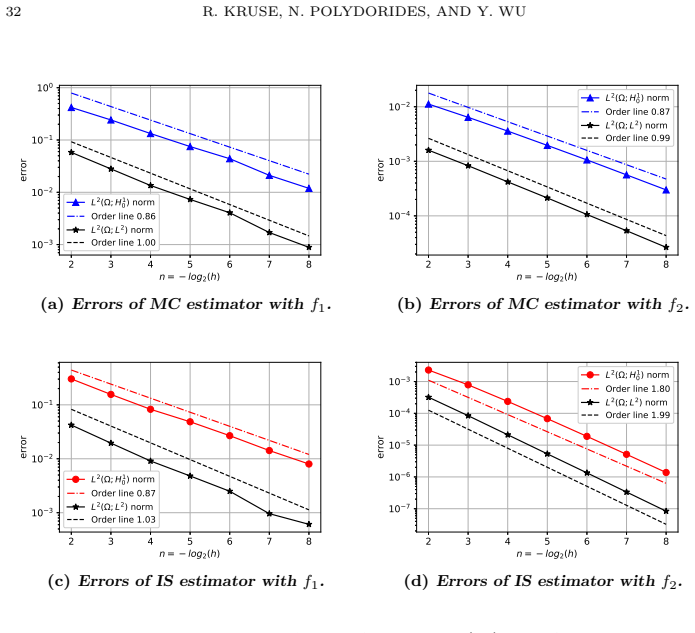
Theorem 3.5 is the paper's central quantitative statement: for σ∈L^∞(D)∩$W^{{s,q}}$(D) with s∈(0,1], q>2, σ≥σ0>0, and f∈L^p(D) with p∈[2,∞), the solution $u_h^{{MC}}$ of the randomized discrete problem satisfies $$\|u-$u_h^{{MC}}$\|_{$L^{2}$(\$\Omega$;$H^{1}$_0(D))} \le C h \|u\|_{$H^{2}$(D)} + C h^s |\$\sigma$|_{$W^{{s,q}}$(D)} \|u\|_{$H^{2}$(D)} + C $h^{{1-2/p}}$ \|f\|_{L^p(D)},$$ with a log-weighted term replacing the last one when f∈L^∞. In words: taking one independent uniform sample per triangle to evaluate σ and f does not degrade the asymptotic first-order convergence of the piecewise-linear finite element method, provided the coefficient has a little fractional regularity. The proof splits the error into the Ritz projection error and a quadrature error, and controls the latter with a variance estimate and an eigenvalue-decay sum over the discrete Laplacian. For the Poisson case σ≡1, the importance-sampling variant $u_h^{{IS}}$ is unbiased with expectation equal to the standard FEM solution, and Theorem 4.5 gives an $L^{2}$(Ω;$L^{2}$(D)) error of order $h^{{1+s}}$ for f∈$W^{{s,2}}$.
Load-bearing premise
The proof of a first-order rate for the randomized stiffness matrix requires the coefficient σ to lie in a fractional Sobolev space $W^{{s,q}}$(D) with s>0 and q>2; for merely bounded measurable coefficients, which are the 'irregular' case motivating the paper, the theorem provides no convergence rate, and the numerical experiments only test σ≡1, so this condition is neither demonstrated nor tested.
Editorial extensions
If this is right
- Randomized assembly restores first-order convergence for the Galerkin method under minimal integrability assumptions: σ only needs to be bounded and measurable for well-posedness, and the theorem adds only a mild fractional regularity to get the rate.
- The per-triangle sampling cost is O(1) per entry, the stiffness matrix stays sparse, and the linear solve is unchanged, so the method drops into existing finite element codes.
- Singular or discontinuous forcing terms no longer require adaptive mesh refinement or a priori knowledge of singularity locations for quadrature to be reliable.
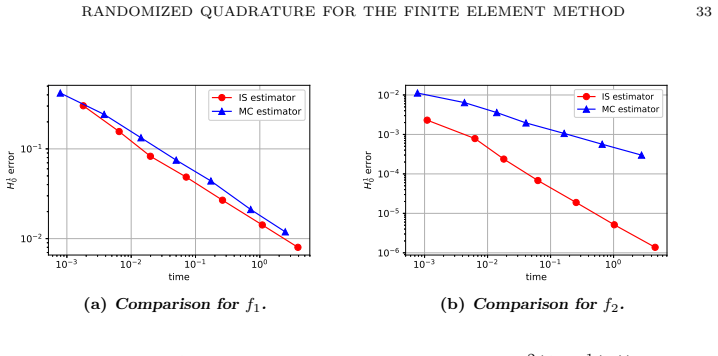
- For the Poisson case with smooth data, the importance-sampling variant achieves near-second-order convergence in the mean-square H^1 norm, offering a practical speed-up over plain Monte Carlo assembly.
- In the Poisson case the randomized solution's expectation coincides with the standard FEM solution, so variance, rather than bias, is the only quadrature-induced error.
Reading between the lines
- The unbiasedness of the estimator for every σ∈L^1 suggests the randomized method may converge for merely L^∞ coefficients too, but the rate—or whether first order persists—is an open question the paper does not answer.
- For higher-order finite elements, gradients are no longer piecewise constant, so the stiffness estimator becomes biased; extending the analysis would require bounding the product of coefficient smoothness and trial-function smoothness, likely yielding rates that interpolate between the two.
- The one-sample-per-cell method could be combined with adaptive mesh refinement to allocate more samples where the coefficient is rough, giving a natural a posteriori error indicator.
Signed reviews
Editorial analysis
A structured set of objections, weighed in public.
Referee Report
Summary. This paper studies randomized quadrature in finite element assembly for the model problem -div(σ∇u)=f with piecewise-linear conforming finite elements on quasi-uniform triangulations in two dimensions. It introduces a stratified Monte Carlo quadrature rule (18) with one independent uniform point per triangle for both the stiffness matrix and the load vector, and an importance-sampling variant (35) for the load vector in the Poisson case. The main theorem (Theorem 3.5) gives an L2(Ω;H1_0) error bound of order O(h||u||_{H2} + h^s |σ|_{W^{s,q}}||u||_{H2} + h^{1-2/p}||f||_{Lp}) under σ ∈ L∞ ∩ W^{s,q}, s ∈ (0,1], q > 2, f ∈ L^p, together with log-weighted variants. Theorems 4.4 and 4.5 provide error estimates for the importance-sampling method in the H1 and L2 norms, Section 5 gives implementation details using a reference triangle and rejection sampling, and Section 6 reports numerical experiments for the Poisson equation with singular and smooth forcing terms.
Significance. If the results hold, the paper provides a detailed, parameter-free analysis showing that randomized quadrature can replace deterministic quadrature in finite element assembly for coefficients that are not continuous, with explicit convergence rates depending on the regularity of σ and f. The proofs are carried out in full detail for the main cases, no fitted constants appear, and the unbiasedness of both estimators is established. The comparison with the deterministic barycentric rule for a singular forcing term is informative and demonstrates a practical advantage. The main caveat is that the central stiffness-matrix estimate requires fractional Sobolev regularity of σ and the numerical experiments do not exercise the stiffness quadrature at all, since they all set σ ≡ 1.
major comments (4)
- [Section 3, Theorem 3.5 and Eq. (31)] The central error bound for the stiffness matrix requires σ ∈ W^{s,q}(D) with s > 0 and q > 2. For σ ∈ L∞(D) only, the second term in (31) is only O(1): the factor |T|^{-1}∫_T (σ(x)-σ(z))^2 dx is bounded by a constant independent of h when σ has no fractional regularity, so the assembled stiffness matrix is not shown to converge as h → 0. Since the introduction motivates the method for 'general σ ∈ L∞(D)' and for irregular coefficients, the proven result covers a narrower class than the motivation. Please state this limitation prominently, and clarify whether the W^{s,q} condition is believed necessary for a positive rate for the stiffness term.
- [Section 6, Figures 2 and 3, Table 1] All numerical experiments set σ ≡ 1, so the randomized stiffness quadrature in Step 5 of Algorithm 1 is never exercised. The observed rates therefore validate only the load-vector quadrature, and the term h^s |σ|_{W^{s,q}} in Theorem 3.5 is not tested. Please add experiments with a rough, non-continuous coefficient in W^{s,q} (for example, a piecewise-constant or oscillatory σ) and report the H1 error against the predicted rate, so that the main claim about irregular coefficients is supported numerically.
- [Theorem 3.5, end of proof] The border case s = 1 is dismissed with 'the details are left to the reader.' This case is part of the theorem and is the one that yields the first-order term h||u||_{H2}; please provide the Poincaré–Wirtinger argument in full or as a lemma rather than deferring it.
- [Theorem 4.5, final line] The border case s = 0 is likewise left to the reader with 'proven analogously.' Since Theorem 4.5 is a main result for the L2 norm, please include the s = 0 argument explicitly, or state and prove the required L2-load-error bound used in the Nitsche trick.
minor comments (4)
- [Lemma 4.1, second assertion] The constant 1/(4√12) in the statement does not match the constant obtained in the proof around (38), which gives a factor of order 1/√(2√3). Please align the constants or indicate that the stated constant is a more conservative bound.
- [Theorem 4.5, proof] There is a typo in the last sentence: 'boarder case' should read 'border case.'
- [Introduction, paragraph before (18)] The sentence stating that the randomized quadrature formula is 'convergent at least with order 1' refers to the quadrature estimator itself, not to the finite-element solution error. To avoid confusion, please add a sentence clarifying that the solution error in Theorem 3.5 has the combined rate min(h, h^s, h^{1-2/p}) and is first-order only in the special cases s = 1 and p = ∞.
- [Assumption 2.1 and Theorem 3.5] The paper would benefit from a short comment on the compatibility of Assumption 2.1 (u ∈ H2) with the coefficient class W^{s,q} for s < 1; the cited sufficient condition for Assumption 2.1 is a Lipschitz coefficient, which is stronger than W^{s,q} for s < 1.
Circularity Check
No significant circularity: the error estimates are derived from explicit assumptions via standard tools, with no fitted parameters and no load-bearing self-citation.
full rationale
The paper's central claim, Theorem 3.5, is a rigorous a priori error bound for randomized quadrature in finite element assembly. The proof combines Lemma 3.1 (unbiasedness and mean-square error of the stratified Monte Carlo quadrature), Lemma 3.4 (load-vector bias), standard finite element interpolation estimates for the Ritz projector, and Hölder/Sobolev embedding arguments. Each ingredient is stated with explicit hypotheses (Assumptions 2.1 and 2.2, sigma in L^infinity ∩ W^{s,q}, f in L^p), and no parameter is fitted to data. The numerical experiments in Section 6 are illustrative and are not used to infer or calibrate any constant in the theorems; they only demonstrate rates for the Poisson case sigma = 1, which is a limitation in scope rather than circularity. The authors' self-citations ([10], [25], [26]) appear only for measurability of the random FEM solution and as motivation from randomized time-stepping; they are not invoked to establish the convergence estimate itself, nor do they import a uniqueness theorem that forces the method. The unproven rate for merely L^infinity coefficients is an honest gap in the theorem's hypotheses, not a circular substitution of the desired conclusion into the assumptions. The derivation is self-contained in the relevant sense: no prediction in Theorem 3.5 is equal by construction to any fitted input, and no renamed empirical pattern is presented as a new result.
Assumptions & free parameters
assumptions (6)
- domain assumption Assumption 2.1: the weak solution u belongs to H1_0(D) intersection H2(D).
- domain assumption Assumption 2.2: admissible quasi-uniform triangulations with |T| >= c h^2.
- domain assumption sigma in L^infinity(D) intersection W^{s,q}(D) with s in (0,1], q in (2,infinity), and sigma >= sigma0 > 0 almost everywhere.
- domain assumption f in L^p(D) for p in [2,infinity] (or f in W^{s,2}(D) in Theorem 4.5).
- domain assumption D is a convex, bounded, polygonal domain in R^2.
- standard math Standard FEM a priori estimates, inverse estimates, and maximum-norm estimates from Brenner-Scott and Thomee.
Cite this review
Pith. "Pith review of Application of Randomized Quadrature Formulas to the Finite Element Method for Elliptic Equations." pith.science (2026). https://pith.science/paper/P6TE7N7C
@misc{pith2026190808901,
  author       = {Pith},
  title        = {Pith review of: Application of Randomized Quadrature Formulas to the Finite Element Method for Elliptic Equations},
  year         = {2026},
  howpublished = {\url{https://pith.science/paper/P6TE7N7C}},
  note         = {Machine review of arXiv:1908.08901}
}
read the original abstract
The implementation of the finite element method for linear elliptic equations requires to assemble the stiffness matrix and the load vector. In general, the entries of this matrix-vector system are not known explicitly but need to be approximated by quadrature rules. If the coefficient functions of the differential operator or the forcing term are irregular, then standard quadrature formulas, such as the barycentric quadrature rule, may not be reliable. In this paper we investigate the application of two randomized quadrature formulas to the finite element method for such elliptic boundary value problems with irregular coefficient functions. We give a detailed error analysis of these methods, discuss their implementation, and demonstrate their capabilities in several numerical experiments.
Figures

Forward citations
Cited by 1 Pith paper
-
Exact Integration for singular Zienkiewicz and Guzman-Neilan Finite Elements with Implementation
An exact quadrature for rational polynomial integrals on 2D triangles enables exact MATLAB implementations of singular Zienkiewicz and Guzmán-Neilan elements.
Reference graph
Works this paper leans on
-
[1]
R. A. Adams and J. J. F. Fournier. Sobolev Spaces, volume 140 of Pure and Applied Mathe- matics. Elsevier/Academic Press, Amsterdam, second edition, 2003
work page 2003
-
[2]
A. Barth and A. Stein. A study of elliptic partial differential equations with jump diffusion coefficients. SIAM/ASA J. Uncertain. Quantif. , 6(4):1707–1743, 2018
work page 2018
-
[3]
H. Bauer. Measure and Integration Theory, volume 26 of de Gruyter Studies in Mathematics . Walter de Gruyter & Co., Berlin, 2001. Translated from the German by Robert B. Burckel. RANDOMIZED QUADRATURE FOR THE FINITE ELEMENT METHOD 35
work page 2001
-
[4]
S. C. Brenner and L. R. Scott. The Mathematical Theory of Finite Element Methods , vol- ume 15 of Texts in Applied Mathematics . Springer, New York, third edition, 2008
work page 2008
-
[5]
H. Brezis. Functional Analysis, Sobolev Spaces and Partial Differential Equations . Universi- text. Springer, New York, 2011
work page 2011
-
[6]
S. Cambanis and E. Masry. Trapezoidal stratified Monte Carlo integration. SIAM J. Numer. Anal., 29(1):284–301, 1992
work page 1992
-
[7]
D. L. Cohn. Measure Theory. Birkh¨ auser Advanced Texts: Basler Lehrb¨ ucher. Birkh¨ auser/ Springer, New York, second edition, 2013
work page 2013
-
[8]
T. Daun. On the randomized solution of initial value problems. J. Complexity, 27(3-4):300– 311, 2011
work page 2011
Show all 39 references
-
[9]
Di Nezza, G
E. Di Nezza, G. Palatucci, and E. Valdinoci. Hitchhiker’s guide to the fractional Sobolev spaces. Bull. Sci. Math. , 136(5):521–573, 2012
2012
-
[10]
Eisenmann, M
M. Eisenmann, M. Kov´ acs, R. Kruse, and S. Larsson. On a randomized backward Euler method for nonlinear evolution equations with time-irregular coefficients. Found. Comput. Math., 2019. (Online first)
2019
-
[11]
L. C. Evans. Partial Differential Equations , volume 19 of Graduate Studies in Mathematics . American Mathematical Society, Providence, RI, second edition, 2010
2010
-
[12]
Evans and T
M. Evans and T. Swartz. Approximating Integrals via Monte Carlo and Deterministic Meth- ods. Oxford Statistical Science Series. Oxford University Press, Oxford, 2000
2000
-
[13]
Grisvard
P. Grisvard. Elliptic Problems in Nonsmooth Domains , volume 69 of Classics in Applied Mathematics. Society for Industrial and Applied Mathematics (SIAM), Philadelphia, PA,
-
[14]
S. Haber. A modified Monte-Carlo quadrature. Math. Comp., 20:361–368, 1966
1966
-
[15]
S. Haber. A modified Monte-Carlo quadrature. II. Math. Comp., 21:388–397, 1967
1967
-
[16]
S. Haber. Stochastic quadrature formulas. Math. Comp., 23:751–764, 1969
1969
-
[17]
Hackbusch
W. Hackbusch. Iterative Solution of Large Sparse Systems of Equations, volume 95 of Applied Mathematical Sciences. Springer-Verlag, Cham, second edition, 2016
2016
-
[18]
Heinrich
S. Heinrich. The randomized information complexity of elliptic PDE. J. Complexity , 22(2):220–249, 2006
2006
-
[19]
Heinrich and B
S. Heinrich and B. Milla. The randomized complexity of initial value problems.J. Complexity, 24(2):77–88, 2008
2008
-
[20]
Hofmanov´ a, M
M. Hofmanov´ a, M. Kn¨ oller, and K. Schratz. Stratified exponential integrator for modulated nonlinear Schr¨ odinger equations.ArXiv preprint, arXiv:1711.01091 , 2017
2017 arXiv
-
[21]
Jentzen and A
A. Jentzen and A. Neuenkirch. A random Euler scheme for Carath´ eodory differential equa- tions. J. Comput. Appl. Math. , 224(1):346–359, 2009
2009
-
[22]
J.-M. Jin. The Finite Element Method in Electromagnetics . John Wiley & Sons, New York, third edition, 2015
2015
-
[23]
Kallenberg
O. Kallenberg. Foundations of Modern Probability. Probability and its Applications. Springer- Verlag, New York, second edition, 2002
2002
-
[24]
A. Klenke. Probability Theory: A Comprehensive Course . Universitext. Springer, London, second edition, 2014
2014
-
[25]
Kruse and Y
R. Kruse and Y. Wu. Error analysis of randomized Runge–Kutta methods for differential equations with time-irregular coefficients. Comput. Methods Appl. Math. , 17(3):479–498, 2017
2017
-
[26]
Kruse and Y
R. Kruse and Y. Wu. A randomized Milstein method for stochastic differential equations with non-differentiable drift coefficients. Discrete Contin. Dyn. Syst. Ser. B , 24(8):3475– 3502, 2019
2019
-
[27]
M. G. Larson and F. Bengzon. The Finite Element Method: Theory, Implementation, and Applications, volume 10 of Texts in Computational Science and Engineering . Springer, Hei- delberg, 2013
2013
-
[28]
Larsson and V
S. Larsson and V. Thom´ ee.Partial Differential Equations with Numerical Methods, volume 45 of Texts in Applied Mathematics. Springer-Verlag, Berlin, 2009. Paperback reprint of the 2003 edition
2009
-
[29]
N. Madras. Lectures on Monte Carlo Methods , volume 16 of Fields Institute Monographs . American Mathematical Society, Providence, RI, 2002
2002
-
[30]
Masry and S
E. Masry and S. Cambanis. Trapezoidal Monte Carlo integration. SIAM J. Numer. Anal. , 27(1):225–246, 1990. 36 R. KRUSE, N. POLYDORIDES, AND Y. WU
1990
-
[31]
M¨ uller-Gronbach, E
T. M¨ uller-Gronbach, E. Novak, and K. Ritter.Monte Carlo-Algorithmen. Springer-Lehrbuch. Springer-Verlag, Heidelberg, 2012
2012
-
[32]
Przyby lowicz and P
P. Przyby lowicz and P. Morkisz. Strong approximation of solutions of stochastic differen- tial equations with time-irregular coefficients via randomized Euler algorithm. Appl. Numer. Math., 78:80–94, 2014
2014
-
[33]
Roub´ ıˇ cek.Nonlinear Partial Differential Equations with Applications , volume 153 of In- ternational Series of Numerical Mathematics
T. Roub´ ıˇ cek.Nonlinear Partial Differential Equations with Applications , volume 153 of In- ternational Series of Numerical Mathematics . Birkh¨ auser/Springer Basel AG, Basel, second edition, 2013
2013
-
[34]
G. Stengle. Numerical methods for systems with measurable coefficients. Appl. Math. Lett. , 3(4):25–29, 1990
1990
-
[35]
G. Stengle. Error analysis of a randomized numerical method. Numer. Math., 70(1):119–128, 1995
1995
-
[36]
Strang and G
G. Strang and G. J. Fix. An Analysis of the Finite Element Method . Prentice-Hall Series in Automatic Computation. Prentice-Hall, Inc., Englewood Cliffs, N. J., 1973
1973
-
[37]
Thom´ ee.Galerkin Finite Element Methods for Parabolic Problems , volume 25 of Springer Series in Computational Mathematics
V. Thom´ ee.Galerkin Finite Element Methods for Parabolic Problems , volume 25 of Springer Series in Computational Mathematics . Springer-Verlag, Berlin, second edition, 2006
2006
-
[38]
Weitzenb¨ ock.¨Uber eine Ungleichung in der Dreieckgsgeometrie
R. Weitzenb¨ ock.¨Uber eine Ungleichung in der Dreieckgsgeometrie. Math. Z., 5(1-2):137–146, 1919. Raphael Kruse, Institut f ¨ur Mathematik, Technische Universit ¨at Berlin, Straße des 17. Juni 136, DE-10623 Berlin, Germany E-mail address: kruse@math.tu-berlin.de Nick Polydori...
1919
-
[2011]
Reprint of the 1985 original, With a foreword by S. C. Brenner
1985
Reviewed August 14, 2026 · model on record in the stance chip above.
Discussion (0). Continue with ORCID to comment.