REVIEW 3 major objections 5 minor 17 references
Morphology and stellar populations of a candidate ultra-diffuse galaxy in early Euclid and Rubin imaging
T0 review · 3 major / 5 minor · reviewed 2026-08-06 · deepseek-v4-flash
Pith's one-line read This paper makes the case that the faint dwarf SMDG0333094-280938 is an ultra-diffuse galaxy at roughly 50–60 Mpc whose recent starburst may have expanded it into its diffuse state.
desk verdict A competent, properly hedged early-data demonstration; the UDG claim itself rests on a photometric distance guess that a single redshift would settle. read the letter →
The pith
A machine-rendered reading of the paper's core claim, the machinery that carries it, and where it could break.
The reading
What carries the argument
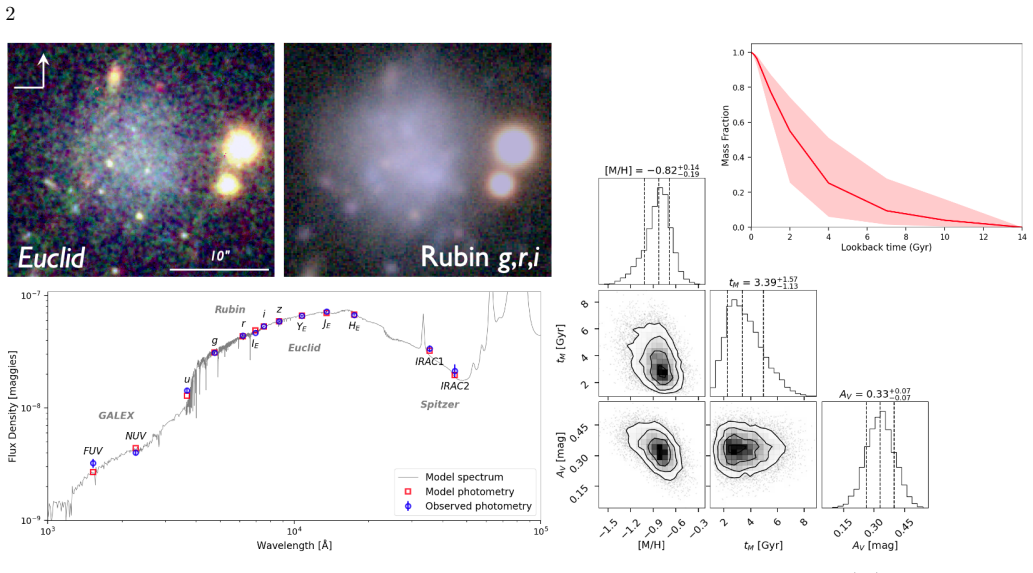
The argument is carried by one galaxy plus a chain of estimators: two-dimensional Sérsic profile fits give the effective radius and mean surface brightness; the colors and magnitudes of the resolved point sources, calibrated against old globular cluster templates, set the distance; and a Bayesian spectral energy distribution fit over 0.15–4.5 $\mu$m photometry from GALEX, Euclid, Rubin, and Spitzer returns a non-parametric star-formation history with 11 time bins, along with age, metallicity, dust extinction, and stellar mass. The recent peak in the star-formation history is the load-bearing link to feedback-driven expansion as the mechanism that made the galaxy diffuse.
What would settle it
Take moderate-resolution spectra of the point sources: old globular clusters at ~55 Mpc would show old stellar absorption features and radial velocities close to the galaxy's systemic velocity, whereas young clusters or foreground stars would show different features and velocities. Alternatively, deeper imaging that resolves the sources into extended background galaxies would falsify the distance estimate and with it the UDG classification.
Extended reading notes
Core claim
On its own terms, the central claim is that SMDG0333094-280938 is a young ultra-diffuse galaxy rather than an ordinary low-surface-brightness dwarf. The distance estimate comes from the galaxy's globular-cluster-like point sources: at ~50–60 Mpc their colors and magnitudes match old globular clusters, and at that distance the measured half-light radius of about 6.2 arcsec (1.5–1.8 kpc) and mean surface brightness of 24.6 mag arcsec$^{-2}$ put the galaxy in UDG territory. The spectral energy distribution fit, using photometry from GALEX, Euclid, Rubin, and Spitzer, yields a stellar mass of log($M_\star/M_\odot$) = 8.02 ± 0.09, a mass-weighted age of 3.39$^{+1.57}_{-1.13}$ Gyr, and a star-formation history that rose over the past ~4 Gyr, peaked 0.6 Gyr ago, and declined to a specific star-formation rate near 5 × 10$^{-11}$ yr$^{-1}$ in the last 10 Myr. The paper concludes that the recent burst may have been strong enough to drive feedback-driven expansion and inflate the dwarf into a UDG.
Load-bearing premise
The UDG classification rests on treating the faint point sources near the galaxy as old globular star clusters at 50–60 Mpc; if they are instead younger dusty clusters, foreground stars, or background galaxies, the galaxy's size and brightness would no longer meet the ultra-diffuse definition.
Editorial extensions
If this is right
- If the galaxy is truly at ~55 Mpc, it satisfies the UDG size and surface-brightness thresholds, making it one of the first field UDGs examined with early Euclid and Rubin data.
- A young stellar population with a starburst 0.6 Gyr ago implies that at least some UDGs are not ancient quenched systems, but can be formed within the last few gigayears through feedback-driven expansion.
- The Euclid-plus-Rubin combination can resolve globular-cluster-like point sources around low-surface-brightness dwarfs and measure their stellar populations, a capability the paper argues will scale to thousands of UDGs.
- The independent mass-metallicity distance estimate of ~40–400 Mpc is consistent with the globular-cluster distance but does not sharpen it, leaving spectroscopy as the decisive next step.
Reading between the lines
- If the globular-cluster interpretation holds up under spectroscopy, this galaxy becomes a direct test of feedback-driven UDG formation: stellar kinematics could show whether the recent starburst actually lowered the galaxy's central density and dark-matter fraction.
- Taking spectra of the point sources would settle the distance immediately, since old globular clusters at 55 Mpc, young dusty clusters, foreground stars, and background galaxies have distinct spectral features and radial velocities.
- The same overlap of Euclid and Rubin data could be mined for other SMUDGes candidates to build a statistical sample of young UDGs with uniform ages, metallicities, and cluster-system measurements.
- The inferred recent decline in star formation suggests the galaxy may be caught transitioning into the quiescent, red UDG population, which would predict continued fading and reddening over the next several gigayears.
Editorial analysis
A structured set of objections, weighed in public.
Referee Report
Summary. The paper presents multi-wavelength imaging and spectral energy distribution (SED) analysis of the low surface brightness dwarf SMDG0333094−280938, using early Euclid Q1 and Rubin DP1 data together with archival GALEX and Spitzer photometry. The authors identify a handful of point sources in the Euclid image whose magnitudes and colors are consistent with old globular clusters at a distance of roughly 50–60 Mpc. At that distance the galaxy’s effective radius of 6.2 arcsec would be about 1.5–1.8 kpc, meeting the size criterion of an ultra-diffuse galaxy, and the authors note that its current mean surface brightness of 24.6 mag arcsec⁻² would satisfy the UDG threshold if the galaxy were to quench and fade. Prospector SED fitting yields a stellar mass of log(M⋆/M⊙)=8.02 at the assumed distance, [M/H]=−0.82, a mass-weighted age of 3.4 Gyr, and a star formation history that rose to a peak about 0.6 Gyr ago and has since declined to a rate bordering on quiescence. The authors propose that feedback-driven expansion during this recent star formation could have created the diffuse structure. The paper highlights the promise of Euclid and Rubin for discovering and characterizing such systems.
Significance. If the distance and stellar population inferences are correct, this would be a rare example of a directly observed young UDG (or UDG progenitor) with candidate globular clusters, offering a direct test of the feedback-driven expansion formation channel. The paper is one of the first to combine actual Euclid Q1 and Rubin DP1 data for a targeted study of a low-surface-brightness galaxy, and it demonstrates the synergy between these facilities. The SED analysis uses standard and publicly available tools (Prospector), and the authors are transparent about the main limitations, including the ambiguity of the point-source interpretation. However, the central UDG classification is not yet secure: it rests on a photometric consistency argument for the distance, and the current surface brightness does not formally meet the adopted UDG threshold without the additional assumption of future fading. The significance is therefore conditional on external confirmation of the distance.
major comments (3)
- [Section 2 (Globular cluster distance)] The distance anchor for the UDG classification is a photometric consistency argument, not a measurement. The point sources with I_E ~ 25.0–26.5 and I_E − H_E ~ 0–1.0 are said to be consistent with old GCs at a distance of ~50–60 Mpc, but the authors immediately concede that they could be young stellar clusters reddened by dust. No quantitative model comparison, photometric error budget, or contamination estimate is provided, and the same section notes that it is unusual for star-forming UDGs to host GCs. Since R_e = 6.2 arcsec only exceeds the 1.5 kpc UDG threshold for D ≳ 50 Mpc, and the stellar mass, SFR, and physical size all scale with D, the UDG claim is not established. A single spectroscopic redshift of the galaxy or of the point sources would settle this; in the manuscript's absence, the authors should at minimum compute the allowed distance range from the GC photometry with realistic uncertainties and present the resulting size/surface-brightness parameter space.
- [Section 3 (Mass–metallicity distance check)] The distance check via the mass–metallicity relation is a loose self-consistency loop: the Prospector stellar mass is computed at the assumed 55 Mpc distance, and the MZ relation for dwarfs is then used to infer a favored distance range of ~40–400 Mpc. This range spans from below the UDG size threshold (~40 Mpc gives R_e ~ 1.2 kpc) to a distance at which the object would be an extreme system (M⋆ ~ 10^8 M⊙ at 400 Mpc is very unusual for a dwarf). The conclusion that this is 'consistent with our initial estimate' is therefore weak. The authors should present the actual joint constraints on distance, size, and mass, and clearly state that the MZ check does not independently confirm the GC interpretation.
- [Abstract and Section 2 (UDG definition)] The manuscript's own definition of a UDG (van Dokkum et al. 2015) requires R_e ≳ 1.5 kpc and mean SB ≳ 25 mag arcsec⁻². For SMDG0333094−280938, the observed SB is 24.6 mag arcsec⁻², which is brighter than the threshold; the text in Section 2 explicitly says the galaxy 'would qualify ... if it were to quench and fade.' The abstract and title nevertheless call it a 'candidate ultra-diffuse galaxy' without this qualifier. This inconsistency should be fixed by consistently referring to the object as a candidate UDG progenitor or by explicitly stating that its current SB does not satisfy the formal definition.
minor comments (5)
- [Figure 1] The caption does not fully describe the right-hand panels (stellar population posteriors) or the SED fit panel; please clarify the layout and include axis labels in the figure itself.
- [Section 2] The number of detected point sources and their individual photometric uncertainties are not stated; please provide a table or at least the counts and magnitude/color ranges to support the GC interpretation.
- [Section 3] The non-parametric SFH is defined with 11 time bins, but the bin edges are not given; please specify them to allow the reader to assess the temporal resolution of the 'peak at ~0.6 Gyr' and the 'decline over the past ~10 Myr' statements.
- [Section 3] The statement 'bordering on quiescence' is based on sSFR ~ 5×10⁻¹¹ yr⁻¹; given the uncertainties in the SED-derived SFR, please provide confidence intervals on the current SFR.
- [Section 2] The phrase 'similar to the full 10-year depth of the Legacy Survey of Space and Time' is ambiguous: it likely refers to the single-visit depth or coadded depth; please clarify.
Circularity Check
No significant circularity: the GC-based distance is a photometric hypothesis with an acknowledged degeneracy, the SED parameters are fitted to independent photometry, and the mass-metallicity distance check is a loose consistency test rather than a forced derivation.
full rationale
The central distance claim in Section 2 rests on photometric consistency of point sources with old GCs at 50-60 Mpc, calibrated by Hunt et al. (2025); the paper explicitly concedes the young-cluster/dust-reddening alternative, which makes the distance uncertain but does not constitute circularity because the GC interpretation is not derived from the UDG classification. The SED fitting in Section 3 uses Prospector on GALEX-to-Spitzer photometry; the inferred age, metallicity, and SFH shape are fitted parameters, not manufactured from the UDG conclusion, and the feedback-expansion scenario is explicitly speculative ('It may be that...'). The mass-metallicity distance estimate (40-400 Mpc) uses an external relation (Simon 2019) and compares it to the Prospector stellar mass; although that mass was computed at the assumed 55 Mpc distance, the MZR mass is distance-independent, so the comparison is a legitimate (if loose) consistency check rather than an identity. Self-citations (Tang et al. 2025 for GALFIT details; Buzzo et al. 2025 for background on GC-rich UDGs) are not load-bearing for the paper's claims. No equation or parameter is defined in terms of the target result.
Assumptions & free parameters
free parameters (2)
- Assumed distance D = 55 Mpc =
55 Mpc (GC-based initial estimate; MZR allows 40-400 Mpc)
- Internal dust extinction AV =
0.33 ± 0.07 mag (Prospector fit)
assumptions (5)
- domain assumption Kroupa (2001) initial mass function for stellar mass and age normalization
- domain assumption Standard dwarf galaxy mass-metallicity relation (Simon 2019)
- domain assumption Hunt et al. (2025) old globular cluster luminosity and color model
- ad hoc to paper Non-parametric 11-bin star formation history with Dirichlet prior in Prospector
- domain assumption Single Sersic profile adequacy for a clumpy, irregular galaxy
Cite this review
Pith. "Pith review of Morphology and stellar populations of a candidate ultra-diffuse galaxy in early Euclid and Rubin imaging." pith.science (2026). https://pith.science/paper/P7A7GGAQ
@misc{pith2026250701942,
  author       = {Pith},
  title        = {Pith review of: Morphology and stellar populations of a candidate ultra-diffuse galaxy in early Euclid and Rubin imaging},
  year         = {2026},
  howpublished = {\url{https://pith.science/paper/P7A7GGAQ}},
  note         = {Machine review of arXiv:2507.01942}
}
read the original abstract
We present multi-wavelength imaging and analysis of a low surface brightness (LSB) dwarf galaxy in the Extended Chandra Deep Field South (ECDFS), SMDG0333094-280938, with particular emphasis on data from the Euclid space telescope and from the Vera C. Rubin Observatory. The galaxy is clumpy and blue, and appears to host globular clusters (GCs), suggesting a distance of ~50-60 Mpc which would make the dwarf an ultra-diffuse galaxy (UDG). We carry out spectral energy distribution (SED) fitting from the far-ultraviolet to the near-infrared, in order to estimate the galaxy age and metallicity. We infer a recent peak of star formation that may have led to the formation of the UDG through feedback-driven expansion. This early analysis illustrates how Euclid and Rubin are poised to identify and characterize many thousands of UDGs and other LSB galaxies in the near future, including their GCs and stellar populations.
Figures
Reference graph
Works this paper leans on
-
[1]
E., Zaritsky, D., Donnerstein, R., et al
Barbosa, C. E., Zaritsky, D., Donnerstein, R., et al. 2020, ApJS, 247, 46, doi: 10.3847/1538-4365/ab7660
-
[2]
Bianchi, L. 2014, Bianchi, Conti, Shiao (BCS) Catalog of Unique GALEX Sources (”BCSCAT”), STScI/MAST, doi: 10.17909/T9D30C
-
[3]
2014, Advances in Space Research, 53, 900–912, doi: 10.1016/j.asr.2013.07.045
Bianchi, L., Conti, A., & Shiao, B. 2014, Advances in Space Research, 53, 900–912, doi: 10.1016/j.asr.2013.07.045
-
[4]
Buzzo, M. L., Forbes, D. A., Romanowsky, A. J., et al. 2025, A&A, 695, A124, doi: 10.1051/0004-6361/202453522
-
[5]
Dey, A., Schlegel, D. J., Lang, D., et al. 2019, AJ, 157, 168, doi: 10.3847/1538-3881/ab089d Di Cintio, A., Brook, C. B., Dutton, A. A., et al. 2017, MNRAS, 466, L1, doi: 10.1093/mnrasl/slw210 Euclid Collaboration, Aussel, H., Tereno, I., et al. 2025, arXiv e-prints, arXiv:2503.15302, doi: 10.48550/arXiv.2503.15302 Euclid Consortium. 2025, Euclid Q1 Level...
-
[6]
Forbes, D. A., & Gannon, J. 2024, MNRAS, 528, 608, doi: 10.1093/mnras/stad4004
-
[7]
K., Annibali, F., Cuillandre, J
Hunt, L. K., Annibali, F., Cuillandre, J. C., et al. 2025, A&A, 697, A9, doi: 10.1051/0004-6361/202450781
-
[8]
D., Leja, J., Conroy, C., & Speagle, J
Johnson, B. D., Leja, J., Conroy, C., & Speagle, J. S. 2021, ApJS, 254, 22, doi: 10.3847/1538-4365/abef67
Show all 17 references
-
[9]
G., Karunakaran, A., Bennet, P., et al
Jones, M. G., Karunakaran, A., Bennet, P., et al. 2023, ApJL, 942, L5, doi: 10.3847/2041-8213/acaaab
2023 doi
-
[10]
2001, MNRAS, 322, 231, doi: 10.1046/j.1365-8711.2001.04022.x
Kroupa, P. 2001, MNRAS, 322, 231, doi: 10.1046/j.1365-8711.2001.04022.x
2001
-
[11]
R., Cuillandre, J
Marleau, F. R., Cuillandre, J. C., Cantiello, M., et al. 2025, A&A, 697, A12, doi: 10.1051/0004-6361/202450799 NSF-DOE Vera C. Rubin Observatory. 2025a, The Vera C. Rubin Observatory Data Preview 1, Technical note, Vera C. Rubin Observatory, doi: 10.71929/rubin/2570536 NSF-DOE...
2025
-
[12]
Y., Ho, L
Peng, C. Y., Ho, L. C., Impey, C. D., & Rix, H.-W. 2002, AJ, 124, 266, doi: 10.1086/340952
2002 doi
-
[13]
2025, A&A, 697, A10, doi: 10.1051/0004-6361/202450784
Saifollahi, T., Voggel, K., Lan¸ con, A., et al. 2025, A&A, 697, A10, doi: 10.1051/0004-6361/202450784
2025 doi
-
[14]
Simon, J. D. 2019, ARA&A, 57, 375, doi: 10.1146/annurev-astro-091918-104453 SLAC National Accelerator Laboratory, & NSF-DOE Vera C. Rubin Observatory. 2024, LSST Commissioning
2019 doi
-
[15]
2020, Spitzer Level 2 / post Basic Calibrated Data, IPAC, doi: 10.26131/IRSA413
Camera, SLAC National Accelerator Laboratory (SLAC), Menlo Park, CA (United States), doi: 10.71929/RUBIN/2561361 Spitzer Science Center. 2020, Spitzer Level 2 / post Basic Calibrated Data, IPAC, doi: 10.26131/IRSA413
2020
-
[16]
J., van Dokkum, P
Tang, Y., Romanowsky, A. J., van Dokkum, P. G., et al. 2025, ApJ, 978, 21, doi: 10.3847/1538-4357/ad8cd0 van Dokkum, P. G., Abraham, R., Merritt, A., et al. 2015, ApJL, 798, L45
2025 doi
-
[17]
2023, ApJS, 267, 27, doi: 10.3847/1538-4365/acdd71
Zaritsky, D., Donnerstein, R., Dey, A., et al. 2023, ApJS, 267, 27, doi: 10.3847/1538-4365/acdd71
2023 doi
Reviewed August 6, 2026 · model on record in the stance chip above.
Discussion (0). Sign in to comment.