REVIEW 4 major objections 5 minor 1 cited by
Enriching Object-Centric Event Data with Process Scopes: A Framework for Aggregation and Analysis
T0 review · 4 major / 5 minor · reviewed 2026-08-05 · deepseek-v4-flash
Pith's one-line read This paper proposes a grammar-based method for embedding analyst-defined process scopes into object-centric event logs while preserving OCEL 2.0 compatibility, enabling multi-level aggregation and analysis of coexisting processes.
desk verdict A useful extension of OCEL with a scoping grammar and tools, but the reproducibility claim rests on an unformalized transformation that has real ambiguities. read the letter →
The pith
A machine-rendered reading of the paper's core claim, the machinery that carries it, and where it could break.
The reading
What carries the argument
The scope-enriched OCEL (POCEL) is the central artifact: an OCEL 2.0 log extended by objects of type process, each connected to the events and objects it covers through E2O and O2O relations. The Enrichment language grammar is the control mechanism: a context-free grammar whose terminals include INCLUDE, EXCLUDE, AND, and OR, and whose statements filter by event or object type or by attribute-value comparisons. Applying a ruleset deterministically filters the log and creates a process object for the scope. The grammar gives scopes a reusable, machine-interpretable form; the process object makes the scope queryable and analyzable with standard OCEL tooling.
What would settle it
Run the same ruleset through two independent implementations of the enrichment procedure on the same source log and compare every event's membership in the resulting process object; any difference in membership shows the transformation is not deterministic as claimed. Also, scan the exported POCEL for an event selected by an INCLUDE rule whose E2O link to the process object is missing.
Extended reading notes
Core claim
The central claim is that process scopes—subjective, context-dependent boundaries drawn by analysts—can be embedded into OCEL as first-class citizens without breaking the standard. It introduces POCEL, a scope-enriched OCEL in which a special object type, process, represents each scope. Scopes are defined by a grammar-based enrichment language with INCLUDE and EXCLUDE rules over event types, object types, and attribute values; applying a ruleset filters the log and links the events and objects in scope to a new process object via E2O and O2O relations. The resulting POCEL keeps the OCEL 2.0 structure, so multiple coexisting processes can be represented in one log and analyzed at different le
Load-bearing premise
The load-bearing premise is that the enrichment procedure's include and exclude rules have one deterministic meaning even though the paper does not formally define their operational semantics, so the same ruleset must produce the same scope-enriched log no matter who applies it.
Editorial extensions
If this is right
- An OCEL can be partitioned into overlapping or nested process scopes without any change to the OCEL 2.0 schema, since each scope is just an object of type process with E2O and O2O links.
- The same ruleset can be reused across logs or organizational units, making process-boundary decisions reproducible rather than ad hoc.
- Analysts can roll fine-grained subprocess scopes up into broader scopes and drill back down, so the same event data supports local and strategic views.
- Process handovers become visible as shared or transferred object types between process nodes, enabling end-to-end dependency analysis along the value chain.
- Scope-enriched logs remain processable by standard OCEL querying and mining tooling, because the enrichment adds content rather than schema changes.
Reading between the lines
- A formal operational semantics and a conformance test would let different tools exchange rulesets and produce identical POCELs; without that, the reproducibility claim rests on implementers agreeing on the grammar's interpretation.
- Because process scopes are stored as ordinary objects of type process, any analysis that counts objects or object types must decide whether to ignore these markers; treating them as regular data would contaminate process-level statistics.
- The same rulesets could serve as ground truth for semi-automatic scope discovery, comparing analyst-defined boundaries with clusters learned from event-object co-occurrence.
Editorial analysis
A structured set of objections, weighed in public.
Referee Report
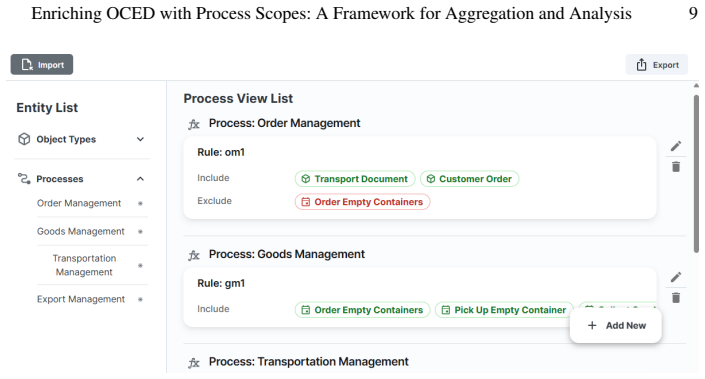
Summary. The paper proposes an extension of OCEL 2.0 in which explicit, analyst-defined process scopes are embedded as process objects, yielding what it calls a scope-enriched OCEL (POCEL). It introduces a grammar-based enrichment language for specifying inclusion/exclusion rules over event types, object types, and attribute-value conditions, and it describes two open-source tools: Procellar for constructing scope-enriched logs and Business Execution Graph (BEG) for visualizing inter-process interactions. The approach is demonstrated on a publicly available logistics OCEL, where four process scopes are defined and later analyzed via a hand-interpreted interaction graph. The central claim is that this enrichment preserves OCEL 2.0 compatibility while enabling structured, reproducible representation of multiple coexisting processes and supporting analysis at multiple levels of abstraction.
Significance. If properly formalized, the idea addresses a real gap in object-centric process mining: current OCEL lacks an explicit, reusable mechanism for delimiting process boundaries that are context-dependent and analyst-defined. The paper also ships open-source tooling and a public artifact, which is commendable. However, the significance is currently limited by the informality of the enrichment semantics and the weakness of Definition 3, which together leave the main reproducibility and structured-representation claims unsupported. The paper is best seen as a promising position/tool paper rather than a fully realized formal framework.
major comments (4)
- [Section 3.2/3.3, Definition 4] The enrichment procedure is load-bearing for the paper's reproducibility claim, but its operational semantics are not defined. Section 3.3 explicitly says the transformation is 'deterministic and straightforward' and declines to formalize it. The grammar in Definition 4 is syntax only and leaves several critical decisions open: (1) whether filter items within a statement are conjoined or disjoined; (2) how INCLUDE and EXCLUDE interact within a rule (set difference, sequential filtering, or exclusion after inclusion); (3) whether EXCLUDE on an object type removes events linked to excluded objects or only removes those objects from the scope; (4) precedence/associativity of AND and OR across rules; (5) the meaning of an empty filter item tuple; and (6) whether an entity is an event type or object type, since xentityy is defined as 'an item P UotypeY Uetype' with no syntactic marker. Under
- [Definition 3] Definition 3 is too weak to capture the intended notion of a process scope. It only requires the existence of one process object o, one event e, one other object o', and relations (e,q,o) and (o,q',o'). Any OCEL that happens to contain a process-typed object with a single event link and a single O2O link would qualify as a POCEL, even if the process object does not correspond to any ruleset-selected set of events and objects. The definition neither characterizes the set of events/objects that a scope should contain nor relates a POCEL to the ruleset that produced it. To make the central claim coherent, the authors should define a well-formedness condition such that a process object's extension via E2O/O2O exactly equals the set of entities selected by the enrichment semantics, or alternatively define POCEL as the output of a formally specified enrichment function.
- [Section 5, Demonstration] The demonstration does not provide evidence for the paper's stronger claims. It uses one hand-selected logistics log and four hand-built rules, and the 'validation' consists of visually inspecting a BEG graph and narratively interpreting its edges. There is no external ground truth, no comparison against alternative scoping strategies, no quantitative evaluation of the enrichment's correctness, and no assessment of whether the produced scopes match domain expectations. The statement in Section 5 that 'this demonstration validates the effectiveness of our approach' is therefore an overstatement. The authors should either reframe the section as an illustrative proof of concept or add a systematic evaluation, e.g., comparing ruleset outputs against a reference scope definition or evaluating inter-annotator agreement.
- [Sections 1 and 3 (aggregation and abstraction claims)] The paper claims to support 'aggregation of event data across scopes' and analysis at 'varying levels of abstraction,' including hierarchical scopes such as P3 encompassing P1 and P2. However, no formal operation for aggregating scopes, forming parent/child scope relations, or drilling down/rolling up is defined anywhere in the paper. The grammar and enrichment procedure produce independent process objects but do not specify how hierarchical scope composition works or how event data are aggregated over a set of scopes. Since these claims appear in the title and the introduction, they need at least a formal or algorithmic treatment, or the paper should limit its claims to flat, explicitly defined scopes.
minor comments (5)
- [Section 3.3] Typographical issues: 'an scope-enriched' and 'the the enrichment language' appear in the text. Also, the sentence beginning 'We do not formalize...' is a central limitation and should be flagged more prominently rather than presented as an aside.
- [Definition 2] There is an inconsistency between the tuple component 'time' and the function name 'evtime' used in the bullet list. The same tuple in Definition 3 also uses 'time.' Please standardize the notation.
- [Definition 4] The terminal set is defined as including PpUotypeq and PpUetypeq (power sets), which is unusual for a context-free grammar whose terminals are typically individual symbols. The intended meaning is presumably that any object type or event type label can be used; please clarify the notation.
- [Definition 1] The notation 'processP Uotype' is ambiguous: it suggests that 'process' is a special element of the set of object types, but the paper later treats it as a constant label. A cleaner formulation would define a distinguished object type constant, e.g., process ∈ Uotype.
- [Figure 4] The BEG visualization in Figure 4 is described qualitatively. Consider adding a table of quantitative edge metrics (object types, counts, flow times) or a machine-readable graph export so that readers can verify the reported interactions.
Circularity Check
No significant circularity: the scope rules are analyst inputs, the enrichment procedure writes them into OCEL, and the demonstration is a tool walk-through rather than a prediction forced to match its own outputs.
full rationale
The paper's central claim is that analyst-defined process scopes can be embedded into OCEL 2.0 via a grammar-based enrichment language and a filtering/instantiation procedure. There is no claimed first-principles derivation or quantitative prediction that must match external data. The scope definitions are inputs supplied by the analyst, so the resulting scope-enriched log is, by design, a function of those definitions; this is an annotation transformation, not a circular derivation. Definitions 1–3 reuse standard OCEL structures and merely add a process object type; the existence condition in Definition 3 is permissive but does not define the enrichment output in terms of the analysis result. Self-citations (e.g., [9], [14], [22]) appear only for background notation, OLAP operations, and prior case studies; they are not load-bearing and no uniqueness theorem or ansatz is imported from them. The Section 5 demonstration uses a public logistics log and four hand-built rulesets; the resulting Business Execution Graph visualizes the selected events and shared object types. The paper's phrase 'This demonstration validates the effectiveness of our approach' is a tool demonstration, not an empirical claim of discovering ground-truth process boundaries, so it is not circular. The main limitation is explicitly stated in Section 3.3: 'We do not formalize the detailed operational semantics of the enrichment process, as the transformation is deterministic and straightforward once the ruleset is defined.' This under-specification is a reproducibility/correctness risk, but it is not circularity because no result is being derived from a semantics that presupposes the result. Overall, no circular step could be identified.
Assumptions & free parameters
assumptions (4)
- domain assumption OCEL 2.0 specification is a valid and sufficient foundation for the extension.
- domain assumption Process boundaries are subjective and context-dependent, so analyst-defined scopes are necessary and cannot always be discovered automatically.
- ad hoc to paper The enrichment transformation from a ruleset to a scope-enriched OCEL is deterministic and straightforward and need not be formalized.
- ad hoc to paper Representing a scope by a process object with E2O and O2O relations captures process interactions.
invented entities (1)
-
Process object type (POCEL process scope)
Cite this review
Pith. "Pith review of Enriching Object-Centric Event Data with Process Scopes: A Framework for Aggregation and Analysis." pith.science (2026). https://pith.science/paper/P7QCT24B
@misc{pith2026250818830,
  author       = {Pith},
  title        = {Pith review of: Enriching Object-Centric Event Data with Process Scopes: A Framework for Aggregation and Analysis},
  year         = {2026},
  howpublished = {\url{https://pith.science/paper/P7QCT24B}},
  note         = {Machine review of arXiv:2508.18830}
}
read the original abstract
Object-Centric Process Mining enables the analysis of complex operational behavior by capturing interactions among multiple business objects (e.g., orders, items, deliveries). These interactions are recorded using Object-Centric Event Data (OCED) formats, such as the Object-Centric Event Log (OCEL). However, existing formats lack explicit definitions of process scopes, which restricts analysis to individual processes and limits insights to a low level of granularity. In practice, OCED often spans multiple interrelated processes, as shared objects connect events across organizational functions. This structure reflects how value is created along the organizational value chain, but introduces challenges for interpretation when process boundaries are not clearly defined. Moreover, process definitions are typically subjective and context-dependent; they vary across organizations, roles, and analytical goals, and cannot always be discovered automatically. To address these challenges, we propose a method for embedding analyst-defined process scopes into OCEL. This enables the structured representation of multiple coexisting processes, supports the aggregation of event data across scopes, and facilitates analysis at varying levels of abstraction. We demonstrate the applicability of our approach using a publicly available OCEL log and provide supporting tools for scope definition and analysis.
Figures


Figures from the paper (1 more)

Forward citations
Cited by 1 Pith paper
-
An ER-Model-Based Framework for Case Notion Selection in Object-Centric Processes
An ER-schema-guided framework defines process cases as connected components of a graph over primary and secondary entity objects, after excluding resource and parent entities.
Reference graph
Works this paper leans on
-
[1]
W.M.P. van der Aalst. Object-centric process mining: Dealing with divergence and conver- gence in event data. In Software Engineering and Formal Methods, pages 3–25. Springer, 2019
work page 2019
-
[2]
Shahrzad Khayatbashi, Viktor Sj ¨olind, Anders Gran˚aker, and Amin Jalali. AI-enhanced busi- ness process automation: a case study in the insurance domain using object-centric process mining. In International Conference on Business Process Modeling, Development and Sup- port (BPMDS), pages 3–18. Springer, 2025
work page 2025
-
[3]
Alessandro Berti, Urszula Jessen, Gyunam Park, Majid Rafiei, and W.M.P. van der Aalst. Analyzing interconnected processes: using object-centric process mining to analyze procure- ment processes. International Journal of Data Science and Analytics, pages 1–23, 2023
work page 2023
-
[4]
Dina Kretzschmann, Gyunam Park, Alessandro Berti, and W.M.P. van der Aalst. Overstock problems in a purchase-to-pay process: An object-centric process mining case study. In Advanced Information Systems Engineering Workshops, pages 347–359. Springer, 2024
work page 2024
-
[5]
Gyunam Park, Sevde Aydin, C ¨uneyt U ˘gur, and W.M.P. van der Aalst. Analyzing an after- sales service process using object-centric process mining: A case study. In Process Mining Workshops, pages 406–418. Springer, 2023
work page 2023
-
[6]
W.M.P. van der Aalst. Academic view: development of the process mining discipline. In Process Mining in Action: Principles, Use Cases and Outlook , pages 181–196. Springer, 2020
work page 2020
-
[7]
Dirk Fahland, Marco Montali, Julian Lebherz, W.M.P. van der Aalst, Maarten van Asseldonk, Peter Blank, Lien Bosmans, Marcus Brenscheidt, Claudio di Ciccio, Andrea Delgado, et al. Towards a simple and extensible standard for object-centric event data (oced)–core model, design space, and lessons learned. arXiv preprint arXiv:2410.14495, 2024. 12 Shahrzad Kh...
arXiv 2024
-
[8]
Multi-dimensional event data in graph databases
Stefan Esser and Dirk Fahland. Multi-dimensional event data in graph databases. Journal on Data Semantics, 10(1):109–141, 2021
work page 2021
Show all 22 references
-
[9]
Transforming object-centric event logs to temporal event knowledge graphs
Shahrzad Khayatbashi, Olaf Hartig, and Amin Jalali. Transforming object-centric event logs to temporal event knowledge graphs. In Business Process Management Workshops: Object- centric Processes from A to Z (OBJECTS), pages 300–313. Springer, 2024
2024
-
[10]
van der Aalst
Alessandro Berti, Istv ´an Koren, Jan Niklas Adams, Gyunam Park, Benedikt Knopp, Nina Graves, Majid Rafiei, Lukas Liß, Leah Tacke Genannt Unterberg, Yisong Zhang, Christopher Schwanen, Marco Pegoraro, and W.M.P. van der Aalst. OCEL (Object-Centric Event Log) 2.0 specification, 2023
2023
-
[11]
van der Aalst and Alessandro Berti
W.M.P. van der Aalst and Alessandro Berti. Discovering object-centric petri nets. Funda- menta informaticae, 175(1-4):1–40, 2020
2020
-
[12]
van der Aalst
Lukas Liss, Caspar Mensing, and W.M.P. van der Aalst. Object-centric causal nets. In International Conference on Advanced Information Systems Engineering (CAiSE), pages 94–
-
[13]
van der Aalst
Jan Niklas Adams and W.M.P. van der Aalst. Precision and fitness in object-centric process mining. In 2021 3rd International Conference on Process Mining (ICPM), pages 128–135. IEEE, 2021
2021
-
[14]
OLAP operations for object-centric process mining
Shahrzad Khayatbashi, Najmeh Miri, and Amin Jalali. OLAP operations for object-centric process mining. In International Conference on Advanced Information Systems Engineering (CAiSE Forum), pages 111–118. Springer, 2025
2025
-
[15]
Object type clustering using markov directly-follow multigraph in object-centric process mining
Amin Jalali. Object type clustering using markov directly-follow multigraph in object-centric process mining. IEEE Access, 10:126569–126579, 2022
2022
-
[16]
van der Aalst
Jan Niklas Adams, Gyunam Park, and W.M.P. van der Aalst. ocpa: A python library for object-centric process analysis. Software Impacts, 14:100438, 2022
2022
-
[17]
Fundamentals of business process management
Marlon Dumas, L Marcello Rosa, Jan Mendling, and A Hajo Reijers. Fundamentals of business process management. Springer, 2018
2018
-
[18]
Business process management: Concepts, languages, architectures
Mathias Weske. Business process management: Concepts, languages, architectures. In Busi- ness process management: Concepts, languages, architectures , pages 333–371. Springer, 2012
2012
-
[19]
van der Aalst
W.M.P. van der Aalst. Process-oriented architectures for electronic commerce and interorga- nizational workflow. Information systems, 24(8):639–671, 1999
1999
-
[20]
van der Aalst
W.M.P. van der Aalst. Intra-and inter-organizational process mining: Discovering processes within and between organizations. In IFIP Working Conference on The Practice of Enter- prise Modeling (POEM), pages 1–11. Springer, 2011
2011
-
[21]
van der Aalst
W.M.P. van der Aalst. Twin transitions powered by event data. using object-centric process mining to make processes digital and sustainable. In Workshop on Algorithms & Theories for the Analysis of Event Data (ATAED), 2023
2023
-
[22]
Advancing object-centric process mining with multi-dimensional data operations
Shahrzad Khayatbashi, Najmeh Miri, and Amin Jalali. Advancing object-centric process mining with multi-dimensional data operations. arXiv preprint arXiv:2412.00393, 2024
2024 arXiv
Reviewed August 5, 2026 · model on record in the stance chip above.
Discussion (0). Continue with ORCID to comment.