REVIEW 6 major objections 5 minor 38 references
MNO : A Multi-modal Neural Operator for Parametric Nonlinear BVPs
T0 review · 6 major / 5 minor · reviewed 2026-08-06 · deepseek-v4-flash
Pith's one-line read This paper introduces the Multi-modal Neural Operator (MNO), a single network that learns the joint map from all inputs of a boundary value problem to its solution, over a family of parametric linear and nonlinear BVPs.
desk verdict A useful new architecture for multi-parameter neural operators, with honest 1D experiments but gaps in baselines and well-posedness. read the letter →
The pith
A machine-rendered reading of the paper's core claim, the machinery that carries it, and where it could break.
The reading
What carries the argument
The load-bearing object is the GFMM block: a feed-forward network shaped like the signal-flow graph of the Fast Multipole Method matrix-vector product, with learnable block matrices on encoder, decoder, and bridge layers. A nonlinear version uses the rational activation φ(x)=x/(1+|x|), chosen because the solution of a linear PDE is a rational function of its coefficients. UNO is a stack of GFMM blocks with multi-channel inputs, good for single-parameter maps such as c ↦ u. The novel piece is multi-modal fusion: at each encoder and decoder layer of the RHS branch, the basis transform's weight tensor is additively corrected by a small matrix produced from the coefficient branch's latent output. This carries the central claim because it is the mechanism that lets one network represent a joint solution operator instead of handling each parameter channel in isolation.
What would settle it
Train MNO and a baseline network that concatenates a, c, f, g into a single input on a 1D BVP where a(x) contains a narrow, high-contrast barrier, for example a(x)=10³ inside a tiny interval and 1 elsewhere, then move the barrier's position in the test set. If the baseline matches or beats MNO on out-of-distribution tests while MNO's residual error jumps by an order of magnitude, the locality and rationality premises that justify the fusion mechanism fail; if MNO still wins, the premises hold for that class of problems.
Extended reading notes
Core claim
The central claim is that the solution operator A†: a, c, f, g → u of a parametric linear or nonlinear BVP can be learned by a single network, and that the right inductive bias is to keep two branches: one reading the coefficients a and boundary functional f, and one reading the right-hand sides c and g. At each layer, outputs from the coefficient branch additively modify the weight tensors of the RHS branch, so the inverse operator is reshaped according to the coefficients without re-solving anything. The paper justifies this by arguing that, for linear problems, the inverse operator and its FMM representation are rational functions of the sampled coefficients, and local coefficient changes mostly move the solution locally. The experiments show MNO tracking simultaneous changes in coefficients, sources, and boundary data on 1D Darcy flow and on the nonlinear BVP, with out-of-distribution relative errors around 10⁻² to 10⁻¹, where uni-modal networks degrade to errors of order 1 or worse. On 1D Poisson, the uni-modal UNO also reaches backward errors near 10⁻⁴ with roughly half the parameters of FNO or DeepONet, which the paper reads as evidence that the GFMM structure is a parameter-efficient representation of the inverse.
Load-bearing premise
The fusion step assumes that local changes to the coefficients move the solution only locally and that the FMM representation of the inverse is a rational function of the coefficients; if a problem has strong global coupling, such as a high-contrast barrier whose position controls the whole field, that justification collapses and a plain network that simply concatenates all inputs could do as well or better.
Editorial extensions
If this is right
- A trained MNO solves the whole parametric family at inference time with one forward pass, so problems that currently need repeated classical solves — variable materials, changing loads, different boundary data — could be served by one frozen network.
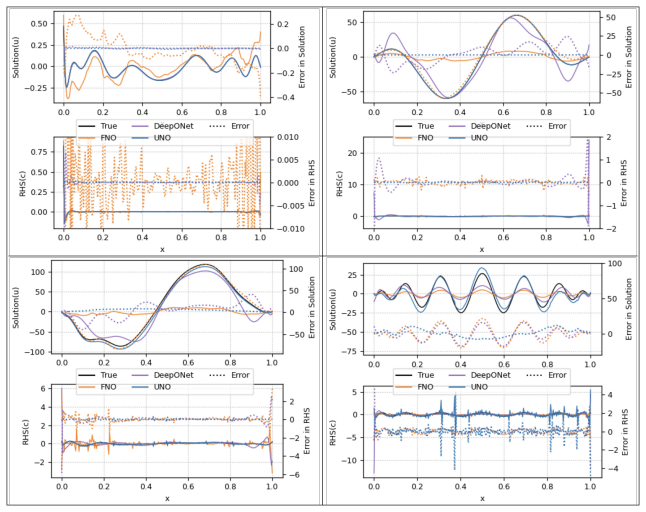
- The GFMM structure halves the parameter count relative to FNO and DeepONet on the 1D Poisson benchmark while lowering backward error, suggesting the FMM-style inductive bias carries much of the workload for linear operators.
- On the nonlinear BVP, MNO keeps residual errors around 10⁻¹ even when coefficients and boundary terms are drawn outside the training distribution, suggesting the joint map generalizes beyond the parameter range seen during training.
- RHS-sampled test data remains the hard case for every model in the paper, with residuals orders of magnitude above the solution-sampled case; a reliable MNO would need extra work to close that distribution shift.
Reading between the lines
- Because the fusion formula is independent of dimension, the same additive weight-correction idea should transfer to 2D and 3D GFMM blocks, which the paper only demonstrates in a uni-modal 2D Poisson experiment; if that transfer works, MNO-style operators could scale to realistic geometries.
- The paper's rationality argument for choosing φ(x)=x/(1+|x|) suggests a concrete test: compare MNO trained with rational activations against the same network with ReLU or learned Pade-like activations on problems with different Green's functions; the rational choice should win exactly when the inverse operator is close to rational.
- The fusion mechanism is essentially a structured, physics-inspired parameter-sharing scheme; viewed that way, it could be applied to other operator families, such as time-dependent or stochastic PDEs, where the coefficient map is also expected to be local in some basis.
- One concrete experiment the paper does not run: use MNO's prediction as the initial guess for an iterative linear solver and count iterations to convergence; the low backward error on 1D Poisson suggests the preconditioning gain could be substantial.
Editorial analysis
A structured set of objections, weighed in public.
Referee Report
Summary. The manuscript introduces the Multi-modal Neural Operator (MNO), a feed-forward architecture inspired by the Fast Multipole Method, and claims that it learns the joint solution operator A† : a, c, f, g → u for parametric linear and nonlinear boundary value problems. The architecture stacks Generalized FMM (GFMM) blocks in a coefficient branch and an RHS branch, and fuses them by making additive weight corrections to the RHS branch from the coefficient branch's latent outputs. Experiments are reported for 1D Poisson (UNO only), 1D Darcy flow (MNO versus UNO variants), and a first-order nonlinear BVP with |u| and an integral boundary condition (MNO versus UNO). The paper reports lower errors for MNO and some robustness to coefficient changes, but the experimental and theoretical support for the central claim has important gaps.
Significance. If the claims hold, MNO is a parameter-efficient operator architecture that jointly handles coefficients, sources, and boundary data, and the use of solution-sampled synthetic training data plus the detailed error tables are useful contributions. The authors also provide a code link, which aids reproducibility. However, the claim is not currently established at the level required for a journal: the baselines are uni-modal or poorly named, the out-of-distribution evaluation is weaker than stated, the well-posedness of the nonlinear BVP is not addressed, and the fusion rationale is asserted rather than demonstrated. The work is promising but needs a substantial revision.
major comments (6)
- [Section 3.3, Eq. (4)] The target operator A† is stated to map (a, b, c, f, g) to u, but the paper gives no existence or uniqueness result for the nonlinear BVP in (4). For a first-order ODE with |u|, the problem is not an initial-value problem, and the integral condition (4b) may select zero, one, or multiple solutions depending on the data. If multiple solutions exist for a single input tuple, A† is not single-valued and the reported training and validation errors are not well-defined. Please state assumptions (e.g., monotonicity or sign conditions on a, b, and the boundary functional) that guarantee well-posedness, or restrict the claim to a numerically verified well-posed subclass.
- [Section 2.3] The fusion mechanism is motivated by two assertions: (i) the FMM representation of the inverse operator is a rational function of the sampled values of a, and (ii) a perturbation analysis shows that localized changes to a primarily affect u in the same location. Neither assertion is derived or supported by a specific citation, and no analogue is provided for the nonlinear BVP in (4) with the additional coefficient b and the |u| nonlinearity. Since multi-modal fusion is the paper's main architectural contribution, the motivation needs either a proof or precise citation, or the claims should be reframed as a heuristic. In addition, an ablation against a non-fused multi-input network is needed to show that the fusion operation itself is responsible for the reported gains.
- [Section 3.2.2, Tables 3-4] The experimental claim that MNO achieves multi-modal generalization is supported only by comparisons to UNO variants that do not receive the coefficient a (or the boundary parameters f, g) as input. This does not establish the necessity or advantage of the two-branch fusion design. Please include standard multi-modal baselines, such as FNO or DeepONet with (a, c) (or (a, b, c, f, g)) concatenated as input channels, so that the reader can separate the benefit of processing multiple inputs from the benefit of the GFMM fusion architecture.
- [Section 3.2.2, Table 3] The label 'unseen coefficients' overstates the out-of-distribution evaluation. The test columns a ∈ (3b) and a ∈ (3c) draw from the same two parametric families (quadratic and log-normal) used to build the training mixture in (3a), so these are not truly unseen coefficient distributions. Please include coefficients from a genuinely different family (for example, oscillatory or piecewise-constant functions) or qualify the claim as generalization between mixture components rather than out-of-distribution generalization.
- [Section 3.3.1] The baseline called UNO for the nonlinear BVP is not uni-modal under the paper's own definition, because Section 3.3.1 states that a, b, c, f, g are stacked as multiple channels of the input to the UNO. This makes the 'uni-modal versus multi-modal' comparison in Table 4 difficult to interpret. Rename this baseline (e.g., 'single-branch multi-channel network') or redesign it so that it actually isolates the contribution of the two-branch fusion architecture.
- [Section 2.3, Algorithm 2] The scalar boundary parameter g in (4b) is listed as an input to MNO, but the paper never states how a single scalar is encoded into the vector-valued RHS branch or the GFMM block. Without this detail, the claimed map g → u is not reproducible. Please describe the encoding (for example, a constant vector appended as a channel, an embedding layer, or a separate scalar conditioning mechanism).
minor comments (5)
- [Eq. (2)] The error metrics are not fully specified: ϵres and ϵrel use different normalizations, and the norm used is not stated. Please state that the standard 2-norm is used and consider normalizing ϵres so that comparisons across problems and tables are meaningful.
- [Appendix C, Figure 7] The comparison between the rational activation and ReLU reports only training curves and training loss/residual trajectories; please provide test-set errors and state that hyperparameters (learning rate, number of iterations, initialization) were matched between the two configurations.
- [Section 1, Related work] The related-work section does not discuss recent multi-input neural operator models such as GNOT or other multi-modal operator designs. Given the paper's goal, a comparison or at least a discussion of these alternatives is needed to position the novelty.
- [Section 3.3.1] The phrase 'join map' should be 'joint map'.
- [Algorithm 1] The pseudocode for the GFMM block is difficult to re-implement as written: the indexing of bridge operators at level 0 and the decoder steps are not fully defined, and the shapes of intermediate variables are not given. Please provide a more complete description or a reference to an implementation.
Circularity Check
No significant circularity: MNO is trained and evaluated on held-out samples; self-citations are background motivation, not load-bearing.
full rationale
The paper's central claims are empirical: it trains MNO (and baselines) on synthetic solution-sampled data and measures generalization on held-out solution-sampled, RHS-sampled, and out-of-distribution data. The 'predictions' in Tables 2-5 are test-set errors, not quantities derived from fitted constants, so there is no fitted-input-called-prediction structure. The FMM motivation in Sections 2.1-2.3 is a design heuristic: the GFMM block is presented as a learnable generalization of the FMM signal-flow graph, and the rational-dependence and locality statements are given as motivating observations, not as theorems that force the experimental outcome. The self-citations to Chandrasekaran et al. [5] and related low-rank linear algebra work [4, 37] support only the background observation that discretized elliptic operators have low-rank off-diagonal structure; the paper does not invoke those results to define MNO's output or to forbid alternative architectures. The missing well-posedness discussion for the nonlinear BVP (4) is a correctness or interpretability risk, not a circular step, since the reported errors are still well-defined numerical measurements of the trained network on the generated data. Overall, the derivation chain is not circular: the architecture's success is judged by external held-out error metrics rather than by construction or by self-citation.
Assumptions & free parameters
free parameters (2)
- Rational activation function phi(x) = x/(1+|x|) =
x / (1 + |x|)
- GFMM hyperparameters (L=4, P=16, layer counts) =
L=4, P=16; 2 GFMM blocks in coefficient branch, 1-2 in RHS branch
assumptions (4)
- ad hoc to paper A discretized PDE inverse operator can be approximated by the GFMM feed-forward architecture with learnable weights (generalized FMM signal flow graph).
- domain assumption The solution to a linear PDE is a rational function of its coefficients (with the FMM representation also rational).
- domain assumption Localized changes to the coefficient a primarily affect the solution u in the same location (perturbation argument).
- domain assumption Synthetic solution-sampled training data (u sampled from Chebyshev basis, c computed) is adequate for learning the operator, and evaluation on RHS-sampled data reflects generalization.
Cite this review
Pith. "Pith review of MNO : A Multi-modal Neural Operator for Parametric Nonlinear BVPs." pith.science (2026). https://pith.science/paper/P7SSRRJA
@misc{pith2026250711870,
  author       = {Pith},
  title        = {Pith review of: MNO : A Multi-modal Neural Operator for Parametric Nonlinear BVPs},
  year         = {2026},
  howpublished = {\url{https://pith.science/paper/P7SSRRJA}},
  note         = {Machine review of arXiv:2507.11870}
}
read the original abstract
We introduce a novel Multimodal Neural Operator (MNO) architecture designed to learn solution operators for multi-parameter nonlinear boundary value problems (BVPs). Traditional neural operators primarily map either the PDE coefficients or source terms independently to the solution, limiting their flexibility and applicability. In contrast, our proposed MNO architecture generalizes these approaches by mapping multiple parameters including PDE coefficients, source terms, and boundary conditions to the solution space in a unified manner. Our MNO is motivated by the hierarchical nested bases of the Fast Multipole Method (FMM) and is constructed systematically through three key components: a parameter efficient Generalized FMM (GFMM) block, a Unimodal Neural Operator (UNO) built upon GFMM blocks for single parameter mappings, and most importantly, a multimodal fusion mechanism extending these components to learn the joint map. We demonstrate the multimodal generalization capacity of our approach on both linear and nonlinear BVPs. Our experiments show that the network effectively handles simultaneous variations in PDE coefficients and source or boundary terms.
Figures


Figures from the paper (8 more)




Reference graph
Works this paper leans on
-
[1]
Z. Aldirany, R. Cottereau, M. Laforest, and S. Prudhomme. Multi-level neural networks for accurate solutions of boundary-value problems. Computer Methods in Applied Mechanics and Engineering, 419: 116666, 2024
work page 2024
-
[2]
S. Börm, L. Grasedyck, and W. Hackbusch. Introduction to hierarchical matrices with applications. Engineering analysis with boundary elements, 27(5):405–422, 2003
work page 2003
-
[3]
S. Cai, Z. Wang, L. Lu, T. A. Zaki, and G. E. Karniadakis. Deepm&mnet: Inferring the electroconvection multiphysics fields based on operator approximation by neural networks.Journal of Computational Physics, 436:110296, 2021
work page 2021
-
[4]
S. Chandrasekaran, P. Dewilde, M. Gu, T. Pals, X. Sun, A. van der Veen, and D. White. Fast stable solvers for sequentially semi-separable linear systems of equations and least squares problems. SIAM Journal on Matrix Analysis and Applications, 2003
work page 2003
-
[5]
S. Chandrasekaran, P. Dewilde, M. Gu, and N. Somasunderam. On the numerical rank of the off- diagonal blocks of schur complements of discretized elliptic pdes. SIAM Journal on Matrix Analysis and Applications, 31(5):2261–2290, 2010
work page 2010
-
[6]
F. Chen, Z. Liu, G. Lin, J. Chen, and Z. Shi. Nsno: Neumann series neural operator for solving helmholtz equations in inhomogeneous medium. Journal of Systems Science and Complexity, 37(2):413–440, 2024
work page 2024
-
[7]
W. Chen, J. Song, P. Ren, S. Subramanian, D. Morozov, and M. W. Mahoney. Data-efficient operator learning via unsupervised pretraining and in-context learning. Advances in Neural Information Processing Systems, 37:6213–6245, 2024
work page 2024
-
[8]
Y . Fan, J. Feliu-Faba, L. Lin, L. Ying, and L. Zepeda-Núnez. A multiscale neural network based on hierarchical nested bases. Research in the Mathematical Sciences, 6(2):21, 2019
work page 2019
Show all 38 references
-
[9]
Gómez-Castro
D. Gómez-Castro. Beginner’s guide to aggregation-diffusion equations. SeMA Journal, 81(4):531–587, 2024
2024
-
[10]
Greengard and V
L. Greengard and V . Rokhlin. A fast algorithm for particle simulations.Journal of computational physics, 73(2):325–348, 1987
1987
-
[11]
Gupta, X
G. Gupta, X. Xiao, and P. Bogdan. Multiwavelet-based operator learning for differential equations. In Neural Information Processing Systems, 2021. URL https://arxiv.org/pdf/2109.13459.pdf
2021 arXiv
-
[12]
Z. Hao, Z. Wang, H. Su, C. Ying, Y . Dong, S. Liu, Z. Cheng, J. Song, and J. Zhu. Gnot: A general neural operator transformer for operator learning. In International Conference on Machine Learning , pages 12556–12569. PMLR, 2023
2023
-
[13]
Hasani and R
E. Hasani and R. A. Ward. Generating synthetic data for neural operators.arXiv preprint arXiv:2401.02398, 2024
2024 arXiv
-
[14]
Helwig, X
J. Helwig, X. Zhang, C. Fu, J. Kurtin, S. Wojtowytsch, and S. Ji. Group equivariant fourier neural operators for partial differential equations. In International Conference on Machine Learning, 2023. URL https://api.semanticscholar.org/CorpusId:259129662. 10
2023
-
[15]
D. P. Kingma. Adam: A method for stochastic optimization. arXiv preprint arXiv:1412.6980, 2014
2014 arXiv
-
[16]
Kovachki, Z
N. Kovachki, Z. Li, B. Liu, K. Azizzadenesheli, K. Bhattacharya, A. Stuart, and A. Anandkumar. Neural operator: Learning maps between function spaces with applications to pdes. Journal of Machine Learning Research, 24(89):1–97, 2023
2023
-
[17]
Lerer, I
B. Lerer, I. Ben-Yair, and E. Treister. Multigrid-augmented deep learning preconditioners for the helmholtz equation using compact implicit layers. SIAM Journal on Scientific Computing, 46(5):S123–S144, 2024
2024
-
[18]
Z. Li, N. Kovachki, K. Azizzadenesheli, B. Liu, K. Bhattacharya, A. Stuart, and A. Anandkumar. Fourier neural operator for parametric partial differential equations. In International Conference on Learning Representations, 2021
2021
-
[19]
Z.-Y . Li, N. B. Kovachki, K. Azizzadenesheli, B. Liu, K. Bhattacharya, A. M. Stuart, and A. Anandkumar. Multipole graph neural operator for parametric partial differential equations. ArXiv, abs/2006.09535, 2020. URL https://arxiv.org/pdf/2006.09535.pdf
2006 arXiv
-
[20]
Z. Long, Y . Lu, X. Ma, and B. Dong. Pde-net: Learning pdes from data. InInternational conference on machine learning, pages 3208–3216. PMLR, 2018
2018
-
[21]
L. Lu, P. Jin, G. Pang, Z. Zhang, and G. E. Karniadakis. Learning nonlinear operators via deeponet based on the universal approximation theorem of operators. Nature Machine Intelligence, 3(3):218–229, Mar. 2021. ISSN 2522-5839. doi: 10.1038/s42256-021-00302-5. URL http://dx.do...
2021 doi
-
[22]
Z. Mao, L. Lu, O. Marxen, T. A. Zaki, and G. E. Karniadakis. Deepm&mnet for hypersonics: Predicting the coupled flow and finite-rate chemistry behind a normal shock using neural-network approximation of operators. Journal of computational physics, 447:110698, 2021
2021
-
[23]
Molina, P
A. Molina, P. Schramowski, and K. Kersting. Pad \’e activation units: End-to-end learning of flexible activation functions in deep networks. arXiv preprint arXiv:1907.06732, 2019
1907 arXiv
-
[24]
Pathak, S
J. Pathak, S. Subramanian, P. Harrington, S. Raja, A. Chattopadhyay, M. Mardani, T. Kurth, D. Hall, Z. Li, K. Azizzadenesheli, et al. Fourcastnet: A global data-driven high-resolution weather model using adaptive fourier neural operators, arxiv [preprint], 10.48550. arXiv prep...
-
[25]
Raissi, P
M. Raissi, P. Perdikaris, and G. E. Karniadakis. Physics-informed neural networks: A deep learning framework for solving forward and inverse problems involving nonlinear partial differential equations. Journal of Computational physics, 378:686–707, 2019
2019
-
[26]
Raoni’c, R
B. Raoni’c, R. Molinaro, T. D. Ryck, T. Rohner, F. Bartolucci, R. Alaifari, S. Mishra, and E. de B’ezenac. Convolutional neural operators for robust and accurate learning of pdes. In Neural Information Processing Systems, 2023. URL https://api.semanticscholar.org/CorpusId:258968120
2023
-
[27]
Ronneberger, P
O. Ronneberger, P. Fischer, and T. Brox. U-net: Convolutional networks for biomedical image segmentation. In Medical image computing and computer-assisted intervention–MICCAI 2015: 18th international conference, Munich, Germany, October 5-9, 2015, proceedings, part III 18 , pa...
2015
-
[28]
R. C. Sau and L. Yin. A review of neural network solvers for second-order boundary value problems, 2024. URL https://arxiv.org/abs/2407.00442
2024 arXiv
-
[29]
J. Shen, T. Marwah, and A. Talwalkar. UPS: Efficiently building foundation models for PDE solving via cross-modal adaptation. Transactions on Machine Learning Research, 2024. ISSN 2835-8856. URL https://openreview.net/forum?id=0r9mhjRv1E
2024
-
[30]
Sushnikova, P
D. Sushnikova, P. Kharyuk, and I. Oseledets. Fmm-net: neural network architecture based on the fast multipole method. arXiv preprint arXiv:2212.12899, 2022
2022 arXiv
-
[31]
Telgarsky
M. Telgarsky. Benefits of depth in neural networks. In Conference on learning theory, pages 1517–1539. PMLR, 2016
2016
-
[32]
Totounferoush, S
A. Totounferoush, S. Kotchourko, M. W. Mahoney, and S. Staab. Paving the way for scientific foundation models: enhancing generalization and robustness in pdes with constraint-aware pre-training. arXiv preprint arXiv:2503.19081, 2025
2025 arXiv
-
[33]
Vaswani, N
A. Vaswani, N. Shazeer, N. Parmar, J. Uszkoreit, L. Jones, A. N. Gomez, Ł. Kaiser, and I. Polosukhin. Attention is all you need. Advances in neural information processing systems, 30, 2017. 11 Figure 6: Computational graph of FMM matrix-vector product
2017
-
[34]
H. Wang, J. Li, A. Dwivedi, K. Hara, and T. Wu. Beno: Boundary-embedded neural operators for elliptic pdes. ArXiv, abs/2401.09323, 2024. URL https://api.semanticscholar.org/CorpusId: 267027614
2024 arXiv
-
[35]
S. Wang, H. Wang, and P. Perdikaris. Learning the solution operator of parametric partial differential equations with physics-informed deeponets. Science advances, 7(40):eabi8605, 2021
2021
-
[36]
H. Wu, H. Luo, H. Wang, J. Wang, and M. Long. Transolver: A fast transformer solver for pdes on general geometries. ArXiv, abs/2402.02366, 2024. URL https://api.semanticscholar.org/CorpusId: 267411758
2024 arXiv
-
[37]
J. Xia, S. Chandrasekaran, M. Gu, and X. S. Li. Fast algorithms for hierarchically semiseparable matrices. Numerical Linear Algebra with Applications, 17(6):953–976, 2010
2010
-
[38]
Zhang, A
E. Zhang, A. Kahana, A. Kopaniˇcáková, E. Turkel, R. Ranade, J. Pathak, and G. E. Karniadakis. Blending neural operators and relaxation methods in pde numerical solvers. Nature Machine Intelligence, pages 1–11, 2024. A FMM Matrix-vector product Figure 6 shows the computational...
2024
Reviewed August 6, 2026 · model on record in the stance chip above.
Discussion (0). Continue with ORCID to comment.