REVIEW 4 major objections 6 minor 34 references
Whole-Body Constrained Learning for Legged Locomotion via Hierarchical Optimization
T0 review · 4 major / 6 minor · reviewed 2026-08-07 · deepseek-v4-flash
Pith's one-line read A constrained RL framework routes learned joint commands through a hierarchical-optimization whole-body follower, and on a hexapod this reduced slips, torque violations, and collisions on snow, ice, slopes, and stairs while keeping…
desk verdict A sensible RL+WBC architecture with a useful training/deployment constraint split, but the safety claim waits on validation of the online friction estimate. read the letter →
The pith
A machine-rendered reading of the paper's core claim, the machinery that carries it, and where it could break.
The reading
What carries the argument
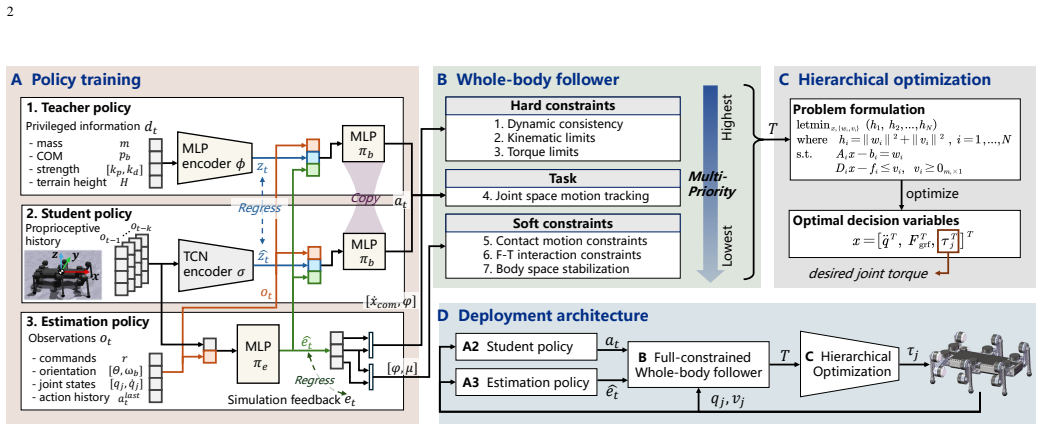
The load-bearing mechanism is the hierarchical quadratic programme (HQP) whole-body follower, whose decision variable stacks generalized accelerations, ground reaction forces, and joint torques, and whose seven priority-ranked tasks encode dynamics, kinematic limits, torque limits, joint tracking, contact no-slip conditions, foot-terrain interaction limits, and body stabilization. The foot-terrain interaction constraints come from a terramechanics model that bounds tangential foot force from normal force, friction coefficient, cohesion, and shear deformation; those bounds become linear inequalities in the HQP. The estimation policy, a temporal-convolutional network trained by supervised learning, outputs body velocity, contact states, and the online friction coefficient $\mu$, so the foot-terrain constraints track the environment rather than being fixed at training time. The separation of hard constraints (training) from soft constraints (deployment) is what allows the same RL policy to be fine-tuned by editing optimization parameters instead of retraining.
What would settle it
Run the same policy on the same low-friction surface with the friction coefficient deliberately fixed to a value much higher than the estimated one while keeping every other constraint identical; if foot slips, torque exceedances, and collisions do not increase, then the estimated foot-terrain constraint is not the mechanism delivering the safety improvement.
Extended reading notes
Core claim
The central claim is that a hierarchical-optimization whole-body follower placed beneath an RL policy can translate the policy's joint position commands into safer locomotion without sacrificing the policy's speed or robustness. The follower solves a priority-ordered hierarchy of quadratic programs over the decision variable $x=[\ddot{q}^\top, F_{\mathrm{grf}}^\top, \tau_j^\top]^\top$, with seven tasks: dynamic consistency, kinematic limits, torque limits, joint-space motion tracking, contact-motion no-slip constraints, foot-terrain interaction constraints, and body-space stabilization. Hard constraints are active during training; the three soft constraint tasks are activated at deployment and parameterized by an estimation policy that infers body velocity, foot contact states, and friction coefficient from proprioceptive history. In simulation the method reached 2.3 m/s and 2.6 rad/s with only three hazardous events in twenty slope-and-stairs trials, fewer than the unconstrained RL baselines, and on the real hexapod the whole-body follower kept joint angles and torques inside limits on a slippery oil-film surface where a plain PD follower tracking the same policy slipped and collided. The paper concludes that separating hard constraints (training) from soft constraints (deployment) enables online policy fine-tuning through constraint parameters and eases sim-to-real transfer for safety-critical missions.
Load-bearing premise
The load-bearing premise is that the learned estimator's online friction coefficient is accurate enough on real snow, ice, and oiled film for the foot-terrain constraints to describe the actual ground; if that estimate is wrong, the reported safety gains could come from conservatism rather than from a correct terrain model.
Editorial extensions
If this is right
- In simulation, the constrained policy retained a 2.3 m/s maximum linear speed and a 2.6 rad/s maximum angular speed while recording far fewer slips, torque exceedances, and joint collisions than unconstrained RL baselines on slopes and stairs.
- On a real low-friction oil-film surface, the whole-body follower reached the 1 m/s command within 0.3 seconds with roll angle fluctuations below 0.03 radians and no torque or collision violations, whereas a PD follower took 1 second, slipped severely, exceeded torque limits, and collided.
- Changing the foot-terrain friction coefficient or the hip joint's motion range during deployment measurably changed foot slip and joint behavior, showing that a trained policy can be adapted to a new environment without retraining.
- The learned estimation policy replaces a separate state estimator by providing body velocity, foot contact states, and friction estimates directly to the whole-body follower.
- The framework is stated to be adaptable to other legged robots with similar configurations, not only the hexapod used in the experiments.
Reading between the lines
- A useful testable extension would be to compare the learned friction estimate against a direct force/torque-based measurement on the same ice or snow surface; this would separate how much of the safety gain comes from an accurate terrain model versus from conservative constraint parameters.
- The same HQP hierarchy could host stronger formal safety machinery, such as constraints that certify the robot remains inside a safe set, because new inequality tasks can be added without retraining the RL policy.
- The constraint-modification results suggest an outer auto-tuning loop in which constraint violations or estimator uncertainty adjust parameters like the friction coefficient online; the paper shows the adjustments work but does not close this loop.
- If the friction estimate is deliberately set far too high on a slippery surface and the robot still shows no extra slips or torque spikes, that would indicate the optimizer's constraints themselves, rather than the estimator's accuracy, are carrying the safety benefit.
Editorial analysis
A structured set of objections, weighed in public.
Referee Report
Summary. This paper proposes a hierarchical whole-body constrained RL framework for legged locomotion. An RL teacher-student policy outputs desired joint positions, and a whole-body controller formulated as a hierarchical quadratic program (HQP) tracks them while enforcing hard constraints (dynamics, kinematic and torque limits) and, at deployment, soft constraints including contact-motion and foot-terrain interaction constraints. An estimation policy, trained concurrently, provides body velocity, contact states, and friction coefficient to the follower. The authors report simulation comparisons against WBC, end-to-end RL, and RMA in terms of maximum speed, slope/stairs success, and hazard counts, plus hardware experiments on a hexapod on low-friction and outdoor terrains, and constraint-modification experiments. The central claim is that the constrained follower preserves RL agility while reducing hazardous situations such as slips, collisions, and torque exceedances.
Significance. If the result holds, this paper is a useful demonstration that model-based constraints can be injected into an RL locomotion pipeline at deployment time without retraining, and that the safety/agility trade-off can be tuned by adjusting physically meaningful constraint parameters. The architecture is a reasonable extension of teacher-student RL and WBC/HQP, and the hardware tests on snow, ice, and other outdoor terrains are valuable. The main contributions—train/deploy separation of constraints and online friction estimation for constraint tightening—are plausible. However, the safety claim is currently supported by limited evidence: the friction/terrain model is not validated on the deployment surfaces, and the key comparisons are single counts or single trials. With additional validation, the framework would be of interest to the legged-locomotion community.
major comments (4)
- [IV-B-6, Eq. (12)] The F-T interaction constraint is the load-bearing mechanism for slip prevention, but it depends on the estimated friction coefficient μ from π_e (Eq. (18)) and the terramechanics model of Eq. (2), neither of which is validated on oil-coated film, ice, or snow. The paper reports no ground-truth μ measurements, no estimation-error statistics, and no check that Eq. (2) describes these hard, low-friction surfaces. Because an overestimated μ loosens Fxy,max and an underestimated μ makes the policy conservative, this validation gap directly affects the central safety claim. I ask for offline accuracy evaluation of π_e against simulated ground truth, direct friction measurements on the test surfaces, and/or a sensitivity analysis of the safety metrics with respect to μ.
- [Table IV] Table IV reports hazard counts as single numbers per condition with no error bars, confidence intervals, or significance tests; with ten trials per condition, differences such as 1 vs. 5 slippage events are not established as reliable. The thresholds for a 'hazardous situation' (slip > 4 cm, torque > 20 Nm, collision) are stated without justification, and no severity measure is reported. Please report per-trial distributions over multiple seeds, add statistical tests, and justify the thresholds.
- [V-C-1, Fig. 4] The hardware safety comparison is based on one trial per follower. The claim that the whole-body follower tracked 1 m/s within 0.3 s and produced no collisions or torque exceedances is anecdotal; the PD follower's failure around 8 s may not be representative. Please repeat the experiment multiple times and report aggregate statistics.
- [Eq. (12)] The parameters ξ_xy,max and δ_max in Eq. (12) are not reported; the paper only says they are chosen from workspace and motor limits. Since these values directly determine how tight the F-T constraints are, omitting them prevents replication and makes it impossible to tell whether the safety improvement is due to the model or to conservative constraint settings. Please state these values and any tuning procedure.
minor comments (6)
- [Eq. (1) and surrounding text] F_grf is written as R^n, but it has dimension 3c for c feet; this is only correct when n=3c (as for the 18-DoF hexapod with c=6). Please clarify the general dimensions.
- [Eq. (2) and Section IV-B-4] There is a Chinese comma after 'in which' in the text following Eq. (2), and 'the joint space motion tracking task T4 is aims' should be 'aims'.
- [II-B] The characterization of [22] as using 'soft constraints like action rate limits' is inaccurate; [22] uses constraints as termination conditions. This related-work description should be corrected.
- [IV-C-1] The estimation policy is said to be trained via supervised learning following [28], but the loss function, label sources, and domain randomization for μ are not specified. Please add a few sentences.
- [Fig. 4] The phrase 'the blue region corresponds to the frozen frames of the robot at that moment' is unclear; specify what the blue region denotes (e.g., the time window of the slip event).
- [Figs. 6 and 7] The captions use the vague term 'Software constraint'; rename to 'foot-terrain interaction constraint' and 'kinematic limit' respectively.
Circularity Check
No significant circularity: the constrained-follower claim is an empirical engineering result, and the self-cited foot-terrain model is independently validated prior work.
full rationale
The claimed contribution is an engineering architecture, not a formal derivation, and the safety comparisons are empirical benchmark results. The RL policy outputs joint position targets a_t; the hierarchical whole-body follower tracks them through Eq. (9)-(10) and enforces hard constraints (dynamics, kinematic limits, torque limits) and soft constraints (contact motion, F-T interaction, body stabilization). The F-T bound F_xy,max in Eq. (12) is computed from the foot-terrain model in Eq. (2), which is imported from the authors' earlier work [26]; that source reports its own experimental validation and is not derived from any quantity measured in this paper, so citing it is real evidence rather than circularity. The friction coefficient μ enters as privileged information during training and is estimated online by π_e (Eq. (18)); the estimator is supervised to regress a simulation ground-truth quantity, and the reported hazard counts (slip >4 cm, torque >20 Nm, collisions) are measured independently rather than defined by the constraints. The constraints do make the safety outcomes more likely by construction in the engineering sense (limiting torque and slip), but that is an intervention with externally evaluated effect, not a prediction that is identical to its input. A genuine limitation is flagged in V-C.1 and the skeptic analysis: the real low-friction surface ('oil-coated plastic film') is never characterized by ground-truth μ, and the single hardware comparison with the PD follower is anecdotal; however, this undermines external validity and evidential strength, not the logical independence of the claim. No uniqueness theorem is imported from the authors, and no result is renamed from a known pattern. The paper therefore has no significant circularity.
Assumptions & free parameters
free parameters (6)
- Reward weights (Table II) =
Final values in Table II
- WBC PD gains kp, kd =
Not stated numerically; included in privileged vector d_t (Eq. 17)
- F-T constraint limits xi_xy,max and delta_max =
Not given numerically
- Kinematic limit deceleration time Delta_t =
10 * delta_t (Eq. 6)
- Estimated friction coefficient mu from pi_e =
Estimated online; no real-ground-truth validation
- Hazard thresholds for safety metrics =
slip > 4 cm; torque > 20 Nm; joint collision (Sec. V-B)
assumptions (5)
- standard math Floating-base rigid-body dynamics as in Eq. (1)
- domain assumption Foot-terrain interaction model of Eq. (2) from [26]
- domain assumption Stance foot no-slip condition in Eq. (11)
- domain assumption HQP solved with qpOASES at 500 Hz (Sec. V-A)
- domain assumption Sim-to-real transfer via domain randomization (Sec. V-A)
Cite this review
Pith. "Pith review of Whole-Body Constrained Learning for Legged Locomotion via Hierarchical Optimization." pith.science (2026). https://pith.science/paper/P7UHHE2M
@misc{pith2026250605115,
  author       = {Pith},
  title        = {Pith review of: Whole-Body Constrained Learning for Legged Locomotion via Hierarchical Optimization},
  year         = {2026},
  howpublished = {\url{https://pith.science/paper/P7UHHE2M}},
  note         = {Machine review of arXiv:2506.05115}
}
read the original abstract
Reinforcement learning (RL) has demonstrated impressive performance in legged locomotion over various challenging environments. However, due to the sim-to-real gap and lack of explainability, unconstrained RL policies deployed in the real world still suffer from inevitable safety issues, such as joint collisions, excessive torque, or foot slippage in low-friction environments. These problems limit its usage in missions with strict safety requirements, such as planetary exploration, nuclear facility inspection, and deep-sea operations. In this paper, we design a hierarchical optimization-based whole-body follower, which integrates both hard and soft constraints into RL framework to make the robot move with better safety guarantees. Leveraging the advantages of model-based control, our approach allows for the definition of various types of hard and soft constraints during training or deployment, which allows for policy fine-tuning and mitigates the challenges of sim-to-real transfer. Meanwhile, it preserves the robustness of RL when dealing with locomotion in complex unstructured environments. The trained policy with introduced constraints was deployed in a hexapod robot and tested in various outdoor environments, including snow-covered slopes and stairs, demonstrating the great traversability and safety of our approach.
Figures


Figures from the paper (4 more)


Reference graph
Works this paper leans on
-
[1]
Virtual model control: An intuitive approach for bipedal locomotion,
J. Pratt, C.-M. Chew, A. Torres, P. Dilworth, and G. Pratt, “Virtual model control: An intuitive approach for bipedal locomotion,”The International Journal of Robotics Research, vol. 20, no. 2, pp. 129–143, 2001
work page 2001
-
[2]
Dynamic locomotion in the mit cheetah 3 through convex model-predictive con- trol,
J. Di Carlo, P. M. Wensing, B. Katz, G. Bledt, and S. Kim, “Dynamic locomotion in the mit cheetah 3 through convex model-predictive con- trol,” in2018 IEEE/RSJ International Conference on Intelligent Robots and Systems (IROS), 2018, pp. 1–9
work page 2018
-
[3]
Perception-less terrain adaptation through whole body control and hierarchical optimization,
C. Dario Bellicoso, C. Gehring, J. Hwangbo, P. Fankhauser, and M. Hut- ter, “Perception-less terrain adaptation through whole body control and hierarchical optimization,” in2016 IEEE-RAS 16th International Conference on Humanoid Robots (Humanoids), 2016, pp. 558–564
work page 2016
-
[4]
Highly dynamic quadruped locomotion via whole-body impulse control and model predictive control,
D. Kim, J. D. Carlo, B. Katz, G. Bledt, and S. Kim, “Highly dynamic quadruped locomotion via whole-body impulse control and model predictive control,”ArXiv, vol. abs/1909.06586, 2019. [Online]. Available: https://api.semanticscholar.org/CorpusID:202577921
arXiv 1909
-
[5]
Stance: Locomotion adaptation over soft terrain,
S. Fahmi, M. Focchi, A. Radulescu, G. Fink, V . Barasuol, and C. Semini, “Stance: Locomotion adaptation over soft terrain,”IEEE Transactions on Robotics, vol. 36, no. 2, pp. 443–457, 2020
work page 2020
-
[6]
Optimized jumping on the mit cheetah 3 robot,
Q. Nguyen, M. J. Powell, B. Katz, J. D. Carlo, and S. Kim, “Optimized jumping on the mit cheetah 3 robot,” in2019 International Conference on Robotics and Automation (ICRA), 2019, pp. 7448–7454
work page 2019
-
[7]
Mini cheetah: A platform for pushing the limits of dynamic quadruped control,
B. Katz, J. D. Carlo, and S. Kim, “Mini cheetah: A platform for pushing the limits of dynamic quadruped control,” in2019 International Conference on Robotics and Automation (ICRA), 2019, pp. 6295–6301
work page 2019
-
[8]
Learning quadrupedal locomotion over challenging terrain,
J. Lee, J. Hwangbo, L. Wellhausen, V . Koltun, and M. Hutter, “Learning quadrupedal locomotion over challenging terrain,”Science Robotics, vol. 5, no. 47, p. eabc5986, 2020
2020
Show all 34 references
-
[9]
Learning robust perceptive locomotion for quadrupedal robots in the wild,
T. Miki, J. Lee, J. Hwangbo, L. Wellhausen, V . Koltun, and M. Hutter, “Learning robust perceptive locomotion for quadrupedal robots in the wild,”Science Robotics, vol. 7, no. 62, p. eabk2822, 2022
2022
-
[10]
Learning quadrupedal locomotion on deformable terrain,
S. Choi, G. Ji, J. Park, H. Kim, J. Mun, J. H. Lee, and J. Hwangbo, “Learning quadrupedal locomotion on deformable terrain,”Science Robotics, vol. 8, no. 74, p. eade2256, 2023
2023
-
[12]
Visual whole-body control for legged loco-manipulation,
M. Liu, Z. Chen, X. Cheng, Y . Ji, R.-Z. Qiu, R. Yang, and X. Wang, “Visual whole-body control for legged loco-manipulation,” in8th Annual Conference on Robot Learning, 2024
2024
-
[13]
Rl + model-based control: Using on-demand optimal control to learn versatile legged locomotion,
D. Kang, J. Cheng, M. Zamora, F. Zargarbashi, and S. Coros, “Rl + model-based control: Using on-demand optimal control to learn versatile legged locomotion,”IEEE Robotics and Automation Letters, vol. 8, no. 10, pp. 6619–6626, 2023
2023
-
[14]
Run like a dog: Learning based whole-body control framework for quadruped gait style transfer,
F. Yin, A. Tang, L. Xu, Y . Cao, Y . Zheng, Z. Zhang, and X. Chen, “Run like a dog: Learning based whole-body control framework for quadruped gait style transfer,” in2021 IEEE/RSJ International Conference on Intelligent Robots and Systems (IROS), 2021, pp. 8508–8514
2021
-
[15]
Opt-mimic: Imitation of optimized trajectories for dynamic quadruped behaviors,
Y . Fuchioka, Z. Xie, and M. Van de Panne, “Opt-mimic: Imitation of optimized trajectories for dynamic quadruped behaviors,” in2023 IEEE International Conference on Robotics and Automation (ICRA), 2023, pp. 5092–5098
2023
-
[16]
Imitation-enhanced reinforcement learning with priv- ileged smooth transition for hexapod locomotion,
Z. Zhang, T. Liu, L. Ding, H. Wang, P. Xu, H. Yang, H. Gao, Z. Deng, and J. Pajarinen, “Imitation-enhanced reinforcement learning with priv- ileged smooth transition for hexapod locomotion,”IEEE Robotics and Automation Letters, vol. 10, no. 1, pp. 350–357, 2025
2025
-
[17]
RMA: Rapid motor adaptation for legged robots,
A. Kumar, Z. Fu, D. Pathak, and J. Malik, “RMA: Rapid motor adaptation for legged robots,” inRobotics: Science and Systems, 2021
2021
-
[18]
Dynamics randomization revisited: A case study for quadrupedal locomotion,
Z. Xie, X. Da, M. van de Panne, B. Babich, and A. Garg, “Dynamics randomization revisited: A case study for quadrupedal locomotion,” in2021 IEEE International Conference on Robotics and Automation (ICRA), 2021, pp. 4955–4961
2021
-
[19]
Learning agile and dynamic motor skills for legged robots,
J. Hwangbo, J. Lee, A. Dosovitskiy, D. Bellicoso, V . Tsounis, V . Koltun, and M. Hutter, “Learning agile and dynamic motor skills for legged robots,”Science Robotics, vol. 4, no. 26, p. eaau5872, 2019
2019
-
[20]
Agile but safe: Learning collision-free high-speed legged locomotion,
T. He, C. Zhang, W. Xiao, G. He, C. Liu, and G. Shi, “Agile but safe: Learning collision-free high-speed legged locomotion,” inRobotics: Science and Systems (RSS), 2024
2024
-
[21]
Learn from safe experience: Safe reinforcement learning for task automation of surgical robot,
K. Fan, Z. Chen, G. Ferrigno, and E. D. Momi, “Learn from safe experience: Safe reinforcement learning for task automation of surgical robot,”IEEE Transactions on Artificial Intelligence, vol. 5, no. 7, pp. 3374–3383, 2024
2024
-
[22]
Cat: Constraints as terminations for legged locomotion reinforcement learning,
E. Chane-Sane, P.-A. Leziart, T. Flayols, O. Stasse, P. Sou `eres, and N. Mansard, “Cat: Constraints as terminations for legged locomotion reinforcement learning,” inIEEE/RSJ International Conference on In- telligent Robots and Systems (IROS), 2024
2024
-
[23]
Evaluation of constrained reinforcement learning algorithms for legged locomotion,
J. Lee, L. Schroth, V . Klemm, M. Bjelonic, A. Reske, and M. Hutter, “Evaluation of constrained reinforcement learning algorithms for legged locomotion,” 2023. [Online]. Available: https://arxiv.org/abs/2309.15430
2023 arXiv
-
[24]
Not only rewards but also constraints: Applications on legged robot locomotion,
Y . Kim, H. Oh, J. Lee, J. Choi, G. Ji, M. Jung, D. Youm, and J. Hwangbo, “Not only rewards but also constraints: Applications on legged robot locomotion,”IEEE Transactions on Robotics, vol. 40, pp. 2984–3003, 2024
2024
-
[25]
Learning- based legged locomotion: State of the art and future perspectives,
S. Ha, J. Lee, M. Panne, Z. Xie, W. Yu, and M. Khadiv, “Learning- based legged locomotion: State of the art and future perspectives,”The International Journal of Robotics Research, 01 2025
2025
-
[26]
Foot–terrain interaction mechanics for legged robots: Modeling and ex- perimental validation,
L. Ding, H. Gao, Z. Deng, J. Song, Y . Liu, G. Liu, and K. Iagnemma, “Foot–terrain interaction mechanics for legged robots: Modeling and ex- perimental validation,”The International Journal of Robotics Research, vol. 32, no. 13, pp. 1585–1606, 2013
2013
-
[27]
Optimization-based control for dynamic legged robots,
P. M. Wensing, M. Posa, Y . Hu, A. Escande, N. Mansard, and A. D. Prete, “Optimization-based control for dynamic legged robots,”IEEE Transactions on Robotics, vol. 40, pp. 43–63, 2024
2024
-
[28]
Concurrent training of a control policy and a state estimator for dynamic and robust legged locomotion,
G. Ji, J. Mun, H. Kim, and J. Hwangbo, “Concurrent training of a control policy and a state estimator for dynamic and robust legged locomotion,” IEEE Robotics and Automation Letters, vol. 7, no. 2, pp. 4630–4637, 2022
2022
-
[29]
State estimation for legged robots: Consistent fusion of leg kinematics and imu,
M. Bloesch, M. Hutter, M. A. Hoepflinger, S. Leutenegger, C. Gehring, C. D. Remy, and R. Siegwart, “State estimation for legged robots: Consistent fusion of leg kinematics and imu,” 2013
2013
-
[30]
Isaac gym: High performance gpu-based physics simulation for robot learning,
V . Makoviychuk, L. Wawrzyniak, Y . Guo, M. Lu, K. Storey, M. Macklin, D. Hoeller, N. Rudin, A. Allshire, A. Handa, and G. State, “Isaac gym: High performance gpu-based physics simulation for robot learning,” 2021
2021
-
[31]
Proximal policy optimization algorithms,
J. Schulman, F. Wolski, P. Dhariwal, A. Radford, and O. Klimov, “Proximal policy optimization algorithms,” 2017. [Online]. Available: https://arxiv.org/abs/1707.06347
2017 arXiv
-
[32]
Learning to walk in minutes using massively parallel deep reinforcement learning,
N. Rudin, D. Hoeller, P. Reist, and M. Hutter, “Learning to walk in minutes using massively parallel deep reinforcement learning,” in5th Annual Conference on Robot Learning, 2021
2021
-
[33]
The pinocchio c++ library – a fast and flexible implementation of rigid body dynamics algorithms and their analytical derivatives,
J. Carpentier, G. Saurel, G. Buondonno, J. Mirabel, F. Lamiraux, O. Stasse, and N. Mansard, “The pinocchio c++ library – a fast and flexible implementation of rigid body dynamics algorithms and their analytical derivatives,” inIEEE International Symposium on System Integration...
2019
-
[34]
qpOASES: A parametric active-set algorithm for quadratic programming,
H. Ferreau, C. Kirches, A. Potschka, H. Bock, and M. Diehl, “qpOASES: A parametric active-set algorithm for quadratic programming,”Mathe- matical Programming Computation, vol. 6, no. 4, pp. 327–363, 2014
2014
-
[35]
Mujoco: A physics engine for model-based control,
E. Todorov, T. Erez, and Y . Tassa, “Mujoco: A physics engine for model-based control,” in2012 IEEE/RSJ International Conference on Intelligent Robots and Systems. IEEE, 2012, pp. 5026–5033
2012
Reviewed August 7, 2026 · model on record in the stance chip above.
Discussion (0). Sign in to comment.