Distributions of Iwasawa λ-invariants of Z_p-towers over supersingular isogeny graphs
Pith reviewed 2026-05-25 04:09 UTC · model grok-4.3
The pith
As ℓ varies over infinitely many primes, the Iwasawa λ-invariants of constant Z_p-towers on supersingular ℓ-isogeny graphs distribute according to patterns from the Fourier coefficients of newforms of level r.
A machine-rendered reading of the paper's core claim, the machinery that carries it, and where it could break.
Core claim
By fixing primes r and p and letting ℓ vary over infinitely many primes, the distribution of the Iwasawa λ-invariants of the constant Z_p-towers over the supersingular ℓ-isogeny graphs reveals connections among graph theory, Iwasawa theory, elliptic curves, and the Galois representations attached to newforms. At the end of this paper, a conjecture is proposed concerning the Galois orbits of newforms.
What carries the argument
The supersingular ℓ-isogeny graphs whose adjacency-matrix eigenvalues equal the ℓ-th Fourier coefficients of the weight-2 newforms and Eisenstein series of level r; these eigenvalues determine the Iwasawa λ-invariants of the constant Z_p-towers.
If this is right
- The λ-invariants are completely determined by the eigenvalues of the adjacency matrices of the supersingular ℓ-isogeny graphs.
- As ℓ varies, the observed distributions of these invariants carry information about the newforms of level r.
- The arithmetic of elliptic curves over finite fields is thereby tied directly to the Iwasawa-theoretic invariants of the towers.
- The proposed conjecture asserts a precise relation between the Galois orbits of the newforms and the observed distributions.
Where Pith is reading between the lines
- Graph algorithms on the supersingular isogeny graphs could in principle be used to compute or bound the Iwasawa λ-invariants for large ℓ.
- The conjecture on Galois orbits could be checked numerically by comparing newform databases with explicit eigenvalue lists for small r.
- The same distribution technique might apply to other families of graphs or to non-constant Z_p-towers.
Load-bearing premise
The Iwasawa λ-invariants of the constant Z_p-towers over the supersingular ℓ-isogeny graphs remain well-defined and are meaningfully captured by the adjacency eigenvalues for infinitely many primes ℓ.
What would settle it
A single prime ℓ for which the λ-invariant read from the adjacency eigenvalues of the corresponding supersingular ℓ-isogeny graph fails to match the value expected from the Galois representation of the associated newform of level r.
Figures
read the original abstract
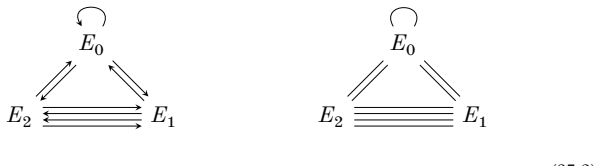
A graph-theoretic analogue of Iwasawa theory, initiated by Gonet and Valli\`eres, has attracted considerable interest in the study of Iwasawa invariants. On the other hand, for a pair of prime numbers $(r,\ell)$, one obtains a graph, called the supersingular $\ell$-isogeny graph (SIG), whose adjacency matrix has eigenvalues given by the $\ell$-th Fourier coefficients of the weight 2 Eisenstein series and newforms of level $r$. In this paper, we fix prime numbers $r$ and $p$, and let $\ell$ vary over infinitely many primes. We then investigate the distribution of the Iwasawa $\lambda$-invariants of the constant $\mathbf{Z}_p$-towers over the SIGs, thereby revealing connections among graph theory, Iwasawa theory, elliptic curves, and the Galois representations attached to newforms. At the end of this paper, we propose a conjecture concerning the Galois orbits of newforms.
Editorial analysis
A structured set of objections, weighed in public.
Referee Report
Summary. The manuscript extends the graph-theoretic analogue of Iwasawa theory (Gonet-Vallières) to supersingular ℓ-isogeny graphs (SIGs). For fixed primes r and p, it lets ℓ vary over infinitely many primes and studies the distribution of the Iwasawa λ-invariants of the constant Z_p-towers over these graphs. The adjacency eigenvalues of the SIGs are identified with the ℓ-Fourier coefficients of the weight-2 Eisenstein series and newforms of level r. The work claims this distribution reveals links among graph theory, Iwasawa theory, elliptic curves, and Galois representations attached to newforms, and concludes by proposing a conjecture on the Galois orbits of newforms.
Significance. If the distributions are rigorously derived from the adjacency spectra and the conjecture is supported, the paper would furnish a concrete bridge between Iwasawa invariants and the Hecke eigenvalues of newforms via graph spectra, potentially yielding new arithmetic information on Galois representations. The approach of letting ℓ vary infinitely is a natural and falsifiable direction.
major comments (2)
- [Abstract] The central construction—extracting the Iwasawa λ-invariant of the constant Z_p-tower directly from the adjacency eigenvalues of the SIG—requires an explicit definition or theorem (e.g., relating λ to the multiplicity or sum of certain eigenvalues). No such formula appears in the abstract, and without it the distribution claim cannot be verified.
- [Abstract] The statement that the distribution 'reveals connections' among the four areas is asserted but not instantiated by any theorem, table of computed λ-values, or asymptotic statement. A concrete result (e.g., a limit law or density for λ as ℓ → ∞) is needed to make the claim load-bearing.
Simulated Author's Rebuttal
We thank the referee for the careful reading and the specific suggestions for improving the abstract. We address the two major comments point by point below.
read point-by-point responses
-
Referee: [Abstract] The central construction—extracting the Iwasawa λ-invariant of the constant Z_p-tower directly from the adjacency eigenvalues of the SIG—requires an explicit definition or theorem (e.g., relating λ to the multiplicity or sum of certain eigenvalues). No such formula appears in the abstract, and without it the distribution claim cannot be verified.
Authors: The relation is stated precisely in Theorem 3.4 of the manuscript: for the constant Z_p-tower, λ equals the sum, over the newform eigenvalues a_ℓ(f), of v_p(a_ℓ(f) - (ℓ+1)) minus a correction term coming from the Eisenstein eigenvalue. We agree the abstract should make this link visible at a glance. We will revise the abstract to include one sentence summarizing this formula. revision: yes
-
Referee: [Abstract] The statement that the distribution 'reveals connections' among the four areas is asserted but not instantiated by any theorem, table of computed λ-values, or asymptotic statement. A concrete result (e.g., a limit law or density for λ as ℓ → ∞) is needed to make the claim load-bearing.
Authors: The concrete link is the identification, proved in Section 2, that the adjacency spectrum of the SIG is exactly the set of ℓ-Fourier coefficients of the weight-2 newforms of level r together with the Eisenstein series; the distribution of the resulting λ-invariants is then studied through this dictionary and is summarized by the conjecture on Galois orbits stated in Section 5. No limit law is proved in the paper; the work is exploratory and ends with the conjecture rather than an asymptotic theorem. We will add a short clause to the abstract indicating that the connections are realized via the eigenvalue–Fourier-coefficient dictionary and the proposed conjecture. revision: partial
Circularity Check
No significant circularity; derivation self-contained via external priors
full rationale
The paper's central objects—the Iwasawa λ-invariants of constant Z_p-towers over supersingular ℓ-isogeny graphs—are explicitly constructed from the prior Gonet-Vallières graph-theoretic Iwasawa theory and the independently known adjacency spectra of SIGs (eigenvalues from ℓ-Fourier coefficients of weight-2 Eisenstein series and newforms). No step reduces a claimed prediction or distribution result to a self-definition, a fitted parameter renamed as output, or a load-bearing self-citation chain; the distribution over varying ℓ and the final conjecture on Galois orbits are presented as consequences of these external inputs rather than tautological rearrangements of the paper's own data or assumptions.
Axiom & Free-Parameter Ledger
Reference graph
Works this paper leans on
-
[1]
Adachi, T., Mizuno, K., & Tateno, S. (2026). Iwasawa theory for weighted graphs. Ann. Math. Québec, 50, 231–265
work page 2026
-
[2]
Birch, B. J., & Kuyk, W . (Eds.). (1972). Modular Functions of One Variable IV . Springer Berlin, Heidelberg
work page 1972
-
[3]
Deligne, P. (1974). La conjecture de W eil. I. Publications Mathématiques de L’Institut des Hautes Études Scientifiques, 43, 273–307
work page 1974
-
[4]
Deligne, P., & Serre, J.-P. (1974). Formes modulaires de poids 1. Ann. Sci. École Norm. Sup., 4, 507–530
work page 1974
-
[5]
Diamond, F., & Shurman, J. (2005). A First Course in Modular Forms. Springer New York
work page 2005
-
[6]
Dion, C., Lei, A., Ray, A., & Vallières, D. (2024). On the distribution of Iwasawa invariants associated to multigraphs. Nagoya Math. J. , 253, 48–90
work page 2024
-
[7]
DuBose, S., & Vallières, D. (2023). On ℤ𝑑 ℓ-towers of graphs. Algebr. Comb., 6 (5), 1331– 1346. 23
work page 2023
-
[8]
Eichler, M. (1973). The Basis Problem for Modular Forms and the Traces of the Hecke Operators. In Kuijk, W . (Eds.)., Modular Functions of One Variable I. Lecture Notes in Mathematics, 320, 75–151. Springer Berlin, Heidelberg
work page 1973
-
[9]
Eichler, M. (1977). On theta functions of real algebraic number fields. Acta Arithmetica 33(3), 269–292
work page 1977
-
[10]
Gonet, S. R. (2022). Iwasawa theory of Jacobians of graphs. Algebr. Comb., 5(5), 827–848
work page 2022
-
[11]
Goren, E. Z., & Love, J. (2024). Supersingular elliptic curves, quaternion algebras and applications to cryptography. NATO Science for Peace and Security Series - D: Information and Communication Security, 66 , 123–200
work page 2024
-
[12]
Gross, B. H. (1986). Heights and the Special Values of L-series. CMS Conf. Proceedings, Vol. 7, AMS, 115–187
work page 1986
-
[13]
Hartshorne, R. (1977). Algebraic Geometry. Springer New York
work page 1977
-
[14]
Iwasawa, K. (1959). On Γ-extensions of algebraic number fields. Bull. Amer. Math. Soc., 65, 183–226
work page 1959
- [15]
-
[16]
Kleine, S., & Müller, K. (2024). On the growth of the Jacobians in ℤ𝑝-voltage covers of graphs. Algebr. Comb., 7(4), 1011–1038
work page 2024
-
[17]
Lei, A., Loeffler, D., & Zerbes, S. L. (2014). Euler systems for Rankin-Selberg convolutions of modular forms. Annals of Mathematics , 180, 653–771
work page 2014
-
[18]
Lei, A., & Müller, K. (2025). On towers of isogeny graphs with full level structures. Res. Math. Sci., 12, Article 4
work page 2025
-
[19]
Elliptic curves and the special values of 𝐿-functions
(2025). Isogeny graphs with level structures arising from the Verschiebung map . arXiv preprint, arXiv:2501.03846v1 [math.NT] . To appear in the proceedings of the ICTS program “Elliptic curves and the special values of 𝐿-functions”
-
[20]
On ℤ𝑝-towers of graph coverings arising from a constant voltage assign- ment
(2025). On ℤ𝑝-towers of graph coverings arising from a constant voltage assign- ment. arXiv preprint, arXiv:2501.03852v2 [math.NT] . To appear in Glasgow Mathemati- cal Journal
-
[21]
Iwasawa theory for abelian towers of digraphs
(2026). Iwasawa theory for abelian towers of digraphs . arXiv preprint, arXiv:2601.19571v1 [math.NT]
-
[22]
Loeffler, D. (2017). Images of adelic Galois representations for modular forms. Glasgow Mathematical Journal, 59(1), 11–25
work page 2017
-
[23]
McGown, K., & Vallières, D. (2024). On abelian ℓ-towers of multigraphs III. Ann. Math. Québec, 48, 1–19
work page 2024
-
[24]
Momose, F. (1981). On ℓ-adic representations attached to modular forms, J. Fac. Sci. Univ. Tokyo Sec. IA Math. , 28(1), 89–109
work page 1981
-
[25]
Munier, N., & Shnidman, A. (2023). Sandpile groups of supersingular isogeny graphs, Jour- nal de Théorie des Nombres de Bordeaux , 35, 751–774
work page 2023
- [26]
-
[27]
Ribet, K. (1980). Twists of Modular Forms and Endomorphisms of Abelian Varieties. Math- ematische Annalen, 253, 43–62
work page 1980
-
[28]
On l-adic representations attached to modular forms II
(1985). On l-adic representations attached to modular forms II. Glasgow Mathemat- ical Journal, 27, 185–194
work page 1985
-
[29]
Serre, J.-P. (1980). Trees. Springer Berlin, Heidelberg. 24
work page 1980
-
[30]
Silverman, J. H. (2009). The Arithmetic of Elliptic Curves (2nd ed.). Springer New York
work page 2009
-
[31]
The L-functions and modular forms database [Online; accessed 7 April 2026]
The LMFDB Collaboration (2026). The L-functions and modular forms database [Online; accessed 7 April 2026]
work page 2026
-
[32]
Terras, A. (2010). Zeta Functions of Graphs: A Stroll through the Garden . Cambridge University Press
work page 2010
-
[33]
SageMath, the Sage Mathematics Software System (V ersion 10.8) [Computer software]
The Sage Developers (2025). SageMath, the Sage Mathematics Software System (V ersion 10.8) [Computer software]
work page 2025
-
[34]
Vallières, D. (2021). On abelian ℓ-towers of multigraphs. Ann. Math. Qué. , 45(2), 433– 452
work page 2021
-
[35]
V élu, J. (1971). Isogénies entre courbes elliptiques. Comptes rendus de l’Académie des Sci- ences de Paris, Série A , 273(4), 238–241. 25
work page 1971
discussion (0)
Sign in with ORCID, Apple, or X to comment. Anyone can read and Pith papers without signing in.