REVIEW 4 major objections 4 minor 114 references
Positioning Monocular Optical See Through Head Worn Displays in Glasses for Everyday Wear
T0 review · 4 major / 4 minor · reviewed 2026-08-15 · deepseek-v4-flash
Pith's one-line read This paper consolidates human-factors studies to conclude that a monocular see-through display worn as everyday glasses should place its virtual image vertically centered and offset from +8.7° to +23.7° toward the ear, with a 15°…
desk verdict A genuinely useful synthesis that gives HWD makers a concrete design target, but the left edge of the recommended window rests on a display-off combiner study that hasn't been tested for active imagery. read the letter →
The pith
A machine-rendered reading of the paper's core claim, the machinery that carries it, and where it could break.
The reading
What carries the argument
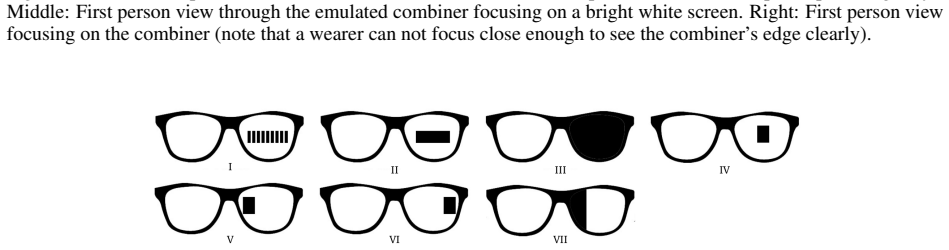
The reasoning rests on a set of angular thresholds from different studies: an 8° radius around gaze where centered imagery causes cognitive capture; the roughly 25° limit of eye-only gaze shifts; the -20.2° to +8.7° window where visible combiner edges annoy wearers even when the display is off; and the -24.6° to +19.6° comfort range for sustained reading. The recommendation interval is the intersection of these constraints: to the ear side of the visible-edge boundary, inside the sustained-reading comfort bound, and within eye-only reach.
What would settle it
Empirical test: have participants wear a right-eye waveguide display with a lit 15° virtual image whose inner edge sits at +6°, +8.7°, and +11° while doing a text-reading task, and record annoyance and performance; if the +6° condition is not rated more annoying or more visibly edged than the +8.7° condition, the recommended left boundary is not supported.
Extended reading notes
Core claim
The paper's central claim is that for a right-eye monocular display worn like ordinary glasses, the virtual image should be vertically centered but horizontally offset so that it occupies +8.7° to +23.7° toward the ear, giving a 15° horizontal field of view for text. Glanceable content may extend to +30° for short interactions, while sustained reading sessions of thirty minutes or more should stay inside +19.6°. The paper also concludes that when the display is off, optical combiner edges should lie outside the -20.2° to +8.7° window around straight-ahead gaze. These bounds come from combining constraints on cognitive capture, eye-movement comfort, combiner-edge visibility, and social perception. The paper recommends the narrower +8.7° to +19.6° window for sessions of half an hour or more.
Load-bearing premise
The load-bearing premise is that the +8.7° inner-edge boundary, measured for the appearance of an unlit optical combiner in emulated glasses, applies unchanged to the inner edge of a lit virtual image on a real waveguide display.
Editorial extensions
If this is right
- Waveguide optics for everyday glasses can be designed to center a 15° horizontal field of view at about +16° azimuth on the right lens.
- Real-time captioning for deaf and hard-of-hearing users is best served by a 15° field of view at roughly 9° offset toward the ear, with larger fields causing eye and head strain and smaller fields providing too little context.
- Content should be kept inside +30° toward the ear even for short glances, and inside +19.6° for reading sessions of 30 minutes or more.
- A right-eyed display can still overlay graphics on the world ahead because the wearer can simply turn the head approximately 15° to bring the earward image into alignment.
- Displays placed below eye level can feel socially awkward in face-to-face conversation, so the recommended earward, vertically centered position avoids that risk.
Reading between the lines
- The paper's results are for right-eye wearers; by symmetry a left-eye display would mirror the window, but the social-perception and combiner studies do not test the mirrored case, so a left-eye recommendation remains an extrapolation.
- The +8.7° inner edge comes from an inactive-combiner study; until a lit active image edge is tested at several offsets, the exact left boundary of the recommendation is provisional.
- The 30° glanceable cap assumes eye-only shifts; if users are willing to move their heads, the practical positional envelope is larger, which could matter for glanceable notifications.
- Future gaze-contingent designs could place optics more centrally and shift content only during use, but the paper's recommendation is for fixed, static positioning in the frame.
Signed reviews
Editorial analysis
A structured set of objections, weighed in public.
Referee Report
Summary. The paper consolidates recent and prior research on monocular optical see-through head-worn display (OST-HWD) placement, with the aim of deriving a concrete design guideline for everyday eyeglasses. After reviewing interruption, comfort, performance, and social perception studies, the authors recommend a 15° horizontal field of view for the virtual image in the right lens, vertically centered and offset horizontally from +8.7° to +23.7° toward the ear relative to the principal position of gaze (PPOG), with glanceable content allowed up to +30° for short interactions. The paper also includes sections on field-of-view trade-offs, inactive optical combiner comfort, social perception of lens tint, overlay capabilities, and optical architecture considerations (freespace and flat lightguide).
Significance. If the recommended interval (+8.7° to +23.7°) is accepted, this paper would provide one of the few concrete, quantitative targets for positioning monocular OST-HWDs in everyday glasses, which is genuinely useful for hardware designers. The paper performs a valuable service by synthesizing aviation HUD, automotive HUD, and wearable HWD studies into a single framework, and it explicitly raises less commonly considered constraints such as the appearance of an inactive optical combiner and social perception of downward gaze. The recommendation is falsifiable and clearly stated, and the paper honestly distinguishes published from ongoing/unpublished work. However, the central numeric boundaries are less strongly supported than the prose implies, because the inner-edge boundary (+8.7°) comes from an unlit-combiner study, the 15° FOV relies in part on an unpublished captioning study, and the paper's own active-display comfort data indicate a more conservative outer bound (+19.6°) for extended reading.
major comments (4)
- [Section 6, with Section 5.2.2] The inner edge of the recommended active-image interval is set at +8.7°, but the source study (Song and Arora et al. [71,96]) measured comfort of unlit optical-combiner edges in emulated glasses, not of a lit virtual image with text. The paper presents no direct evidence that the comfort boundary for an inactive combiner edge transfers unchanged to the inner edge of an active display. Because the entire left boundary of the final recommendation rests on this transfer, this is a load-bearing gap; the authors should either mark +8.7° as a provisional boundary or report an active-display test of inner-edge placement near 8°–12°.
- [Section 4 and Section 6] The 15° FOV recommendation is supported primarily by an ongoing, unpublished captioning study (Kwok et al.) whose 9° offset was itself chosen from Arora et al.'s +8.7° combiner-edge boundary; the paper later treats +8.7° as an independent constraint, making the argument partly circular. Moreover, Section 6 attributes a 15° FOV suggestion to "Martin et al. and Britain et al.," but the cited reference [109] is the same paper as [70] (Britain et al.), which actually reports a preferred 20°–30° FOV for captioning. The cited published work therefore does not support the 15° value. The authors should correct this attribution and state explicitly which parts of the 15° recommendation depend on unpublished results.
- [Section 5.2.2 and Section 6] Section 5.2.2 concludes that optical combiner edges should be placed "outside the range of -20.2° and +8.7°" from PPOG, meaning an edge at +8.7° is on the boundary of the forbidden zone rather than outside it. The final recommendation places the inner edge of the virtual image at exactly +8.7°. The paper should clarify whether +8.7° is an acceptable location for an active-image edge (e.g., because the 8.7° value includes a safety margin beyond Dowell's 8° cognitive-capture radius) or whether the recommended interval should begin strictly beyond +8.7° (e.g., at +9° or +10°).
- [Section 5.2.1 and Section 6] The paper's own active-display comfort data (Haynes, Song, and Arora) identify +19.6° as the comfortable outer bound for extended reading and +30° for shorter interactions, yet the final recommendation allows a 15° FOV extending to +23.7° for text-based tasks. Since text-based tasks are typically prolonged (reading, captioning), the 15° recommendation exceeds the stated extended-use bound without additional justification. The authors should either reconcile the +23.7° outer edge with the +19.6° extended-use threshold or restrict the 15° FOV to shorter interaction contexts.
minor comments (4)
- [References [70] and [109]] References [70] and [109] appear to be the same paper (Britain et al., "Preferences for captioning on emulated head worn displays while in group conversation"); duplicate references and the unexplained "Martin et al." attribution in Section 6 should be corrected.
- [Section 9.2 and 9.3] Sections 9.2 and 9.3 refer to "Figure 1 (left)" and "Figure 1 (right)" as examples of freespace and flat lightguide architectures, but Figure 1 shows photographs of Google Glass and the Vuzix Z100; the intended figures appear to be Figure 14 and Figure 15. The cross-references should be fixed.
- [Section 4] The word "contraints" in Section 4 (paragraph on high FOV and all-day wear) is a typo for "constraints."
- [Throughout] The paper inconsistently uses "principal point of gaze" in the abstract and "Principal Position Of Gaze (PPOG)" in Section 3.3; the terminology should be unified.
Circularity Check
The exact 15° interval recycles the +8.7° boundary used to choose the offset of the very study cited as evidence, and the 15° width rests on an unpublished self-cited study.
-
fitted input called prediction
[Section 4 ('Choosing a field of view for everyday use') and Section 6 ('Resulting Position of the Display')]
"However, an ongoing study building on Britain’s work by Kwok et al. suggests that a 15° FOV image may be ideal for captioning at a 9° offset towards the ear. This 9° offset towards the ear was chosen based on the findings of Arora [71] which found that a monocular display on the right eye between -20.2° and +8.7° can be annoying due to the edges and distortions caused by optical combiners. ... Thus, we suggest offsetting a right-eyed HWD’s virtual image such that it extends between +8.7° and +23.7° to the right of principal position of gaze (PPOG) and up to +30° for shorter interactions."
The paper selects the 9° offset of its validating captioning study from Arora's +8.7° combiner-edge boundary, then recommends exactly that +8.7° as the inner edge of the 15° image. The Kwok study was constructed so that its near edge complied with the very boundary the paper later presents as its independent inner-edge constraint. A positive result in that study cannot validate the +8.7° boundary because the boundary was an input to the study design, not a conclusion drawn from it. The recommendation's inner edge is therefore an input recycled as an output.
-
self citation load bearing
[Section 4 ('Choosing a field of view for everyday use')]
"However, an ongoing study building on Britain’s work by Kwok et al. suggests that a 15° FOV image may be ideal for captioning at a 9° offset towards the ear."
The central quantitative width, 15°, is justified by an 'ongoing' study by co-authors, with no protocol, data, or statistics reported in this paper. Section 6 also attributes the 15° value to 'Martin et al. and Britain et al. [109]', although reference [109] is the same Britain et al. paper that Section 4 describes as reporting a 20–30° preference for centered displays. The key FOV value thus rests on an unpublished, self-referential source with inconsistent provenance, making the recommended interval [+8.7°, +23.7°] depend on a non-independent and uncheckable citation chain.
full rationale
The exact recommendation [+8.7°, +23.7°] is assembled from two inputs that are not independent of each other. Section 4 says Kwok et al.'s captioning study used a 9° offset 'chosen based on the findings of Arora [71]', whose +8.7° boundary is then re-used in Section 6 as the inner edge of the recommended 15° FOV; the study cited as validating the placement was constructed around the very boundary it is used to justify. Section 6's 15° FOV width is also supported by an 'ongoing' co-authored study with no reported data, and its citation to 'Martin et al. and Britain et al. [109]' conflicts with Section 4's account of Britain et al. as a 20–30° centered-display preference. These are load-bearing self-references, so the exact interval is partially circular. However, the broader conclusion—offset a monocular display to the right, outside roughly 8° from PPOG and within roughly ±25°—is independently supported by external aviation HUD work (Dowell, Foyle), automotive HUD studies (Yoo, Watanabe, Tsimhoni), Chua et al., and Sidenmark et al. Those independent threads prevent the central claim from being wholly defined by the self-citation chain, so 4/10 is appropriate rather than 6+ or higher. The transfer of the inactive-combiner edge result to an active virtual image is an extrapolation, but the paper states its own 'implies' reasoning, so I treat that as a correctness risk rather than an additional circular step.
Assumptions & free parameters
free parameters (4)
- Recommended horizontal FOV =
15°
- Inner-edge offset from PPOG =
+8.7° toward the ear
- Extended-use outer limit =
+19.6° toward the ear
- Short-interaction outer limit =
up to +30° toward the ear
assumptions (6)
- domain assumption Text-based task performance is a valid proxy for most monocular OST-HWD tasks.
- domain assumption Dowell's 8° cognitive-capture radius for aviation HUD symbology transfers to monocular OST-HWDs in everyday use.
- domain assumption Sidenmark's ±25° eyes-only gaze shift limit applies to reading a 15° FOV HWD.
- domain assumption Emulated displays (opaque monoculars, video pass-through VR, semi-transparent films) preserve the ergonomically relevant properties of real optical see-through waveguides.
- ad hoc to paper The comfortable position of the inactive optical combiner's edges sets the acceptable inner edge of the active virtual image.
- domain assumption Right-eye measurements provide a general recommendation for right-lens placement without adjustment for ocular dominance or left-eye users.
Cite this review
Pith. "Pith review of Positioning Monocular Optical See Through Head Worn Displays in Glasses for Everyday Wear." pith.science (2026). https://pith.science/paper/PAQJZ5GN
@misc{pith2026250509047,
  author       = {Pith},
  title        = {Pith review of: Positioning Monocular Optical See Through Head Worn Displays in Glasses for Everyday Wear},
  year         = {2026},
  howpublished = {\url{https://pith.science/paper/PAQJZ5GN}},
  note         = {Machine review of arXiv:2505.09047}
}
read the original abstract
Head-worn displays for everyday wear in the form of regular eyeglasses are technically feasible with recent advances in waveguide technology. One major design decision is determining where in the user's visual field to position the display. Centering the display in the principal point of gaze (PPOG) allows the user to switch attentional focus between the virtual and real images quickly, and best performance often occurs when the display is centered in PPOG or is centered vertically below PPOG. However, these positions are often undesirable in that they are considered interruptive or are associated with negative social perceptions by users. Offsetting the virtual image may be preferred when tasks involve driving, walking, or social interaction. This paper consolidates findings from recent studies on monocular optical see-through HWDs (OST-HWDs), focusing on potential for interruption, comfort, performance, and social perception. For text-based tasks, which serve as a proxy for many monocular OST-HWD tasks, we recommend a 15{\deg} horizontal field of view (FOV) with the virtual image in the right lens vertically centered but offset to +8.7{\deg} to +23.7{\deg} toward the ear. Glanceable content can be offset up to +30{\deg} for short interactions.
Figures


Figures from the paper (12 more)




Reference graph
Works this paper leans on
-
[109]
Preferences for captioning on emulated head worn displays while in group conversation
Gabriel Wade Britain, David Martin, Tyler Kwok, Adam Sumilong, and Thad Starner. Preferences for captioning on emulated head worn displays while in group conversation. In Proceedings of the 2022 ACM International Symposium on Wearable Computers, pages 17–22, 2022
work page 2022
-
[70]
Preferences for captioning on emulated head worn displays while in group conversation
Gabriel Wade Britain, David Martin, Tyler Kwok, Adam Sumilong, and Thad Starner. Preferences for captioning on emulated head worn displays while in group conversation. In Proceedings of the 2022 ACM International Symposium on Wearable Computers , ISWC ’22, page 17–22, New York, NY , USA, 2022. Association for Computing Machinery
work page 2022
-
[1]
Towards accessible conversations in a mobile context for people who are deaf and hard of hearing
Dhruv Jain, Rachel Franz, Leah Findlater, Jackson Cannon, Raja Kushalnagar, and Jon Froehlich. Towards accessible conversations in a mobile context for people who are deaf and hard of hearing. In Proceedings of the 20th International ACM SIGACCESS Conference on Computers and Accessibility , pages 81–92, 2018
2018
-
[2]
The use of smart glasses for lecture comprehension by deaf and hard of hearing students
Ashley Miller, Joan Malasig, Brenda Castro, Vicki L Hanson, Hugo Nicolau, and Alessandra Brandão. The use of smart glasses for lecture comprehension by deaf and hard of hearing students. In Proceedings of the 2017 chi conference extended abstracts on human factors in computing systems , pages 1909–1915, 2017
2017
-
[3]
Caption placement on an augmented reality head worn device
Chris Schipper and Bo Brinkman. Caption placement on an augmented reality head worn device. In Proceedings of the 19th International ACM SIGACCESS Conference on Computers and Accessibility , pages 365–366, 2017. 18 Positioning Monocular OST-HWD in Glasses for Everyday Wear
2017
-
[4]
Helmet-mounted displays and sights
Mordekhai Velger. Helmet-mounted displays and sights. 1998
1998
-
[5]
smart glasses
Sunwook Kim, Maury A Nussbaum, and Joseph L Gabbard. Augmented reality “smart glasses” in the workplace: industry perspectives and challenges for worker safety and health. IIE transactions on occupational ergonomics and human factors, 4(4):253–258, 2016
2016
-
[6]
Magic Leap
Inc. Magic Leap. Magic leap, 2025. Accessed: 2025-01-01
2025
Show all 114 references
-
[7]
Hololens, 2025
Microsoft Corporation. Hololens, 2025. Accessed: 2025-01-01
2025
-
[8]
Apple vision pro, 2025
Apple Inc. Apple vision pro, 2025. Accessed: 2025-01-01
2025
-
[9]
Meta Platforms
Inc. Meta Platforms. Meta orion, 2025. Accessed: 2025-01-01
2025
-
[10]
Snap spectacles, 2025
Snap Inc. Snap spectacles, 2025. Accessed: 2025-01-01
2025
-
[11]
Properties of a peripheral head-mounted display (phmd)
Denys JC Matthies, Marian Haescher, Rebekka Alm, and Bodo Urban. Properties of a peripheral head-mounted display (phmd). In HCI International 2015-Posters’ Extended Abstracts: International Conference, HCI International 2015, Los Angeles, CA, USA, August 2–7, 2015. Proceedings...
2015
-
[12]
Impacts of using a head-worn display on gait performance during level walking and obstacle crossing
Sunwook Kim, Maury A Nussbaum, and Sophia Ulman. Impacts of using a head-worn display on gait performance during level walking and obstacle crossing. Journal of Electromyography and Kinesiology, 39:142– 148, 2018
2018
-
[13]
Enabling mobile microinteractions
Daniel L Ashbrook. Enabling mobile microinteractions. Georgia Institute of Technology, 2010
2010
-
[14]
The enigmatic display
Thad E Starner. The enigmatic display. IEEE pervasive computing, 2(1):15–18, 2003
2003
-
[15]
Google glass lead: How wearing tech on our bodies actually helps it get out of our way
Thad Starner. Google glass lead: How wearing tech on our bodies actually helps it get out of our way. Wired Magazine. December, 17, 2013
2013
-
[16]
Learning visual models of social engagement
Bradley A Singletary and Thad E Starner. Learning visual models of social engagement. In Proceedings IEEE ICCV Workshop on Recognition, Analysis, and Tracking of Faces and Gestures in Real-Time Systems , pages 141–148. IEEE, 2001
2001
-
[17]
Wearable agents
Thad E Starner. Wearable agents. IEEE pervasive computing, 1(2):90–92, 2002
2002
-
[18]
Aware- ness of the real-world environment when using augmented reality head-mounted display
Susanna Aromaa, Antti Väätänen, Iina Aaltonen, Vladimir Goriachev, Kaj Helin, and Jaakko Karjalainen. Aware- ness of the real-world environment when using augmented reality head-mounted display. Applied ergonomics, 88:103145, 2020
2020
-
[19]
Vuzix ultralite, 2024
Vuzix Corporation. Vuzix ultralite, 2024. Accessed: 2025-01-01
2024
-
[20]
Even realities g1, 2024
Even Realities. Even realities g1, 2024. Accessed: 2025-01-01
2024
-
[21]
Optometric and perceptual issues with head-mounted displays , page 205–276
Eli Peli. Optometric and perceptual issues with head-mounted displays , page 205–276. 1999
1999
-
[22]
Cognitive considerations for helmet-mounted display design
Gregory Francis and Clarence E Rash. Cognitive considerations for helmet-mounted display design. InHead-and Helmet-Mounted Displays XV: Design and Applications , volume 7688, pages 88–98. SPIE, 2010
2010
-
[23]
Velocity characteristics of normal human saccades
D Boghen, BT Troost, RB Daroff, LF Dell’Osso, and JE Birkett. Velocity characteristics of normal human saccades. Investigative Ophthalmology & Visual Science, 13(8):619–623, 1974
1974
-
[24]
Coordination of the eyes and head during visual orienting
Edward G Freedman. Coordination of the eyes and head during visual orienting. Experimental brain research, 190:369–387, 2008
2008
-
[25]
Human eye-head coordination in two dimensions under different sensorimotor conditions
Hieronymus HLM Goossens and AJ Van Opstal. Human eye-head coordination in two dimensions under different sensorimotor conditions. Experimental Brain Research, 114:542–560, 1997
1997
-
[26]
Looking and acting: vision and eye movements in natural behaviour
Michael Land and Benjamin Tatler. Looking and acting: vision and eye movements in natural behaviour . Oxford University Press, USA, 2009
2009
-
[27]
Dowell, David C
Susan R. Dowell, David C. Foyle, Becky L. Hooey, and Jennifer L. Williams. The effect of visual location on cognitive tunneling with superimposed hud symbology. Proceedings of the Human Factors and Ergonomics Society Annual Meeting, 46(1):121–125, 2002
2002
-
[28]
Foyle, Robert S
David C. Foyle, Robert S. McCann, Beverly D. Sanford, and Martin F.J. Schwirzke. Attentional effects with superimposed symbology: Implications for head-up displays (hud). Proceedings of the Human Factors and Ergonomics Society Annual Meeting, 37(19):1340–1344, 1993
1993
-
[29]
Display of hud warnings to drivers: Determining an optimal location
Herbert Yoo. Display of hud warnings to drivers: Determining an optimal location. Technical report, 1999
1999
-
[30]
The effect of hud warning location on driver responses
Hiroshi Watanabe, Herbert Yoo, Omer Tsimhoni, and Paul Green. The effect of hud warning location on driver responses. In Sixth World congress on Intelligent Transport Systems, Toronto, Canada. Citeseer, 1999. 19 Arora et al
1999
-
[31]
Display of short text messages on automotive huds: Effects of driving workload and message location
Omer Tsimhoni. Display of short text messages on automotive huds: Effects of driving workload and message location. Technical report, 2000
2000
-
[32]
Detecting and reading text on huds: effects of driving workload and message location
Omer Tsimhoni, Paul Green, Hiroshi Watanabe, et al. Detecting and reading text on huds: effects of driving workload and message location. In 11th Annual ITS America Meeting, Miami, FL, CD-ROM , 2001
2001
-
[33]
Stepping into ar: Exploring optimal positioning for monocular head-worn displays for reading on the go
Priyanka Mosur, Ethan Kimmel, Parth Arora, Rajandeep Singh, Atharva Rajesh Madiwale, Jenna Kang, and Thad Starner. Stepping into ar: Exploring optimal positioning for monocular head-worn displays for reading on the go. In Companion of the 2024 on ACM International Joint Confer...
2024
-
[34]
Binocular rivalry in monocular augmented reality devices: a review
Elodie Bayle, Esetelle Guilbaud, Sylvain Hourlier, Sylvie Lelandais, Laure Leroy, Justin Plantier, and Pascaline Neveu. Binocular rivalry in monocular augmented reality devices: a review. Situation Awareness in Degraded Environments 2019, 11019:136–149, 2019
2019
-
[35]
perceived
Randolph Blake. What can be “perceived” in the absence of visual awareness? Current Directions in Psycholog- ical Science, 6(6):157–162, 1997
1997
-
[36]
Binocular rivalry and head-worn displays
Robert Patterson, Marc Winterbottom, Byron Pierce, and Robert Fox. Binocular rivalry and head-worn displays. Human factors, 49(6):1083–1096, 2007
2007
-
[37]
Rivalry and interference with a head-mounted display
Robert Laramee and Colin Ware. Rivalry and interference with a head-mounted display. ACM Transactions on Computer-Human Interaction (TOCHI), 9(3):238–251, 2002
2002
-
[38]
Order picking with head-up displays
Anhong Guo, Xiaolong Wu, Zhengyang Shen, Thad Starner, Hannes Baumann, and Scott Gilliland. Order picking with head-up displays. Computer, 48(6):16–24, 2015
2015
-
[39]
Binocular rivalry in helmet-mounted display applications.AD-AO13, 838:1–146, 1975
ML Hershberger and DF Guerin. Binocular rivalry in helmet-mounted display applications.AD-AO13, 838:1–146, 1975
1975
-
[40]
Visual issues in the use of a head-mounted monocular display
Eli Peli. Visual issues in the use of a head-mounted monocular display. Optical Engineering, 29(8):883–892, 1990
1990
-
[41]
61.3: Invited paper: A virtual display for mobile use
Jukka Häkkinen. 61.3: Invited paper: A virtual display for mobile use. In SID Symposium Digest of Technical Papers, volume 35, pages 1586–1589. Wiley Online Library, 2004
2004
-
[42]
Managing mobile text in head mounted displays: studies on visual preference and text placement
Jason Orlosky, Kiyoshi Kiyokawa, and Haruo Takemura. Managing mobile text in head mounted displays: studies on visual preference and text placement. ACM SIGMOBILE Mobile Computing and Communications Review, 18(2):20–31, 2014
2014
-
[43]
Effects of position and alignment of notifications on ar glasses during social interaction
Rufat Rzayev, Susanne Korbely, Milena Maul, Alina Schark, Valentin Schwind, and Niels Henze. Effects of position and alignment of notifications on ar glasses during social interaction. In Proceedings of the 11th Nordic conference on human-computer interaction: shaping experien...
2020
-
[44]
Peripheral vision annotation: noninterference information presentation method for mobile augmented reality
Yoshio Ishiguro and Jun Rekimoto. Peripheral vision annotation: noninterference information presentation method for mobile augmented reality. In Proceedings of the 2nd Augmented Human International Conference , AH ’11, New York, NY , USA, 2011. Association for Computing Machinery
2011
-
[45]
Wearable subtitles: Augmenting spoken communication with lightweight eyewear for all-day captioning
Alex Olwal, Kevin Balke, Dmitrii V otintcev, Thad Starner, Paula Conn, Bonnie Chinh, and Benoit Corda. Wearable subtitles: Augmenting spoken communication with lightweight eyewear for all-day captioning. In Proceedings of the 33rd Annual ACM Symposium on User Interface Softwar...
2020
-
[46]
Head mounted displays and deaf children: Facilitating sign language in challenging learning environments
Michael Jones, M Jeannette Lawler, Eric Hintz, Nathan Bench, Fred Mangrubang, and Mallory Trullender. Head mounted displays and deaf children: Facilitating sign language in challenging learning environments. In Proceedings of the 2014 conference on Interaction design and child...
2014
-
[47]
A model for notification systems evaluation—assessing user goals for multitasking activity
D Scott McCrickard, Christa M Chewar, Jacob P Somervell, and Ali Ndiwalana. A model for notification systems evaluation—assessing user goals for multitasking activity. ACM Transactions on Computer-Human Interaction (TOCHI), 10(4):312–338, 2003
2003
-
[48]
Spatial information displays on a wearable computer
Mark Billinghurst, Jerry Bowskill, Nick Dyer, and Jason Morphett. Spatial information displays on a wearable computer. IEEE Computer Graphics and Applications , 18(6):24–31, 1998
1998
-
[49]
Perrault, Denys J
Soon Hau Chua, Simon T. Perrault, Denys J. C. Matthies, and Shengdong Zhao. Positioning glass: Investigating display positions of monocular optical see-through head-mounted display. ChineseCHI2016, New York, NY , USA, 2016. Association for Computing Machinery
2016
-
[50]
Towards Finding the Optimum Position in the Visual Field for a Head Worn Display Used for Task Guidance with Non-registered Graphics
Georgianna Lin, Malcolm Haynes, Sarthak Srinivas, Pramod Kotipalli, and Thad Starner. Towards Finding the Optimum Position in the Visual Field for a Head Worn Display Used for Task Guidance with Non-registered Graphics. Proceedings of the ACM on Interactive, Mobile, Wearable a...
2021
-
[51]
The joy of visual perception: A web book
Peter K Kaiser. The joy of visual perception: A web book . York University, 2004
2004
-
[52]
Font size and viewing distance of handheld smart phones
Yuliya Bababekova, Mark Rosenfield, Jennifer E Hue, and Rae R Huang. Font size and viewing distance of handheld smart phones. Optometry and Vision Science, 88(7):795–797, 2011
2011
-
[53]
Column inch, 2025
Wikipedia contributors. Column inch, 2025. Accessed: 2025-01-21
2025
-
[54]
iphone 6 - technical specifications, 2014
Apple Inc. iphone 6 - technical specifications, 2014. Accessed: 2025-01-01
2014
-
[55]
iphone 16 pro max - tech specs, 2024
Apple Inc. iphone 16 pro max - tech specs, 2024. Accessed: 2025-01-01
2024
-
[56]
ipod nano (4th generation) - technical specifications, 2006
Apple Inc. ipod nano (4th generation) - technical specifications, 2006. Accessed: 2025-01-01
2006
-
[57]
ipad mini 2 with retina display - technical specifications, 2017
Apple Inc. ipad mini 2 with retina display - technical specifications, 2017. Accessed: 2025-01-01
2017
-
[58]
ipad air 2 - technical specification, 2017
Apple Inc. ipad air 2 - technical specification, 2017. Accessed: 2025-01-01
2017
-
[59]
ipad pro 13-inch (m4) - tech specs, 2024
Apple Inc. ipad pro 13-inch (m4) - tech specs, 2024. Accessed: 2025-01-01
2024
-
[60]
Smpte standards and practices
Society of Motion Picture and Television Engineers. Smpte standards and practices. Available at: urlhttps://www.smpte.org, 2025. Accessed: 2025-01-14
2025
-
[61]
Thx certification program
THX Ltd. Thx certification program. Available at: urlhttps://www.thx.com, 2025. Accessed: 2025-01-14
2025
-
[62]
Visual requirements in hmds: What can we see and what do we need to see
Elizabeth Thorpe Davis. Visual requirements in hmds: What can we see and what do we need to see. Head mounted displays: Designing for the user , pages 207–252, 1997
1997
-
[63]
Coordinated eye and head movements for gaze interaction in 3D environments
Ludwig Sidenmark. Coordinated eye and head movements for gaze interaction in 3D environments . Lancaster University (United Kingdom), 2023
2023
-
[64]
Vuzix VX Ultralite Video, July 2023
Vuzix Corporation. Vuzix VX Ultralite Video, July 2023
2023
-
[65]
Waveguide technology for ar glasses
Dispelix. Waveguide technology for ar glasses. https://www.dispelix.com/, 2025. Accessed: 2025-01-22
2025
-
[66]
Next-generation ar optics
Digilens. Next-generation ar optics. https://www.bigilens.com/, 2025. Accessed: 2025-01-22
2025
-
[67]
Optical solutions for augmented reality
Lumus. Optical solutions for augmented reality. https://www.lumus-optical.com/, 2025. Accessed: 2025-01-22
2025
-
[68]
The visual effects of head-mounted display (HMD) are not distinguishable from those of desk-top computer display
Eli Peli. The visual effects of head-mounted display (HMD) are not distinguishable from those of desk-top computer display. Vision Research, 38(13):2053–2066, June 1998
1998
-
[69]
Eye gaze tracking techniques for interactive applications.Computer vision and image understanding, 98(1):4–24, 2005
Carlos H Morimoto and Marcio RM Mimica. Eye gaze tracking techniques for interactive applications.Computer vision and image understanding, 98(1):4–24, 2005
2005
-
[71]
Comfortably going blank: Optimizing the position of optical combiners for monocular head-worn displays during inactivity
Parth Arora, Yukun Song, Rajandeep Singh, Srikanth T Varadharajan, Ethan I Kimmel, Katherine Huang, Malcolm Haynes, and Thad Starner. Comfortably going blank: Optimizing the position of optical combiners for monocular head-worn displays during inactivity. In Proceedings of the...
2024
-
[72]
Cognitive issues in head-up displays
Edith Fischer and Richard F Haines. Cognitive issues in head-up displays. Technical report, 1980
1980
-
[73]
Head-up display (hud) utility, ii: Runway to hud transitions monitoring eye focus and decision times
Daniel J Weintraub, Richard F Haines, and Robert J Randle. Head-up display (hud) utility, ii: Runway to hud transitions monitoring eye focus and decision times. In Proceedings of the Human Factors Society Annual Meeting, volume 29, pages 615–619. SAGE Publications Sage CA: Los...
1985
-
[74]
Human factors aspects of using head up displays in automobiles: A review of the literature
Kenneth W Gish and Loren Staplin. Human factors aspects of using head up displays in automobiles: A review of the literature. 1995
1995
-
[75]
See-through head-up display of in-vehicle in- formation systems for vision enhancement
Chun-Wen Chao, Cheng Hung Huang, and Ji-Liang Doong. See-through head-up display of in-vehicle in- formation systems for vision enhancement. In The International Association of Societies of Design Research Conference, 2009
2009
-
[76]
Fukano, S
J. Fukano, S. Okabayashi, M. Sakata, and T. Hatada. Automotive head-up displays for navigation use.Proceedings of International Technical Conference on the Enhanced Safety of V ehicles, 1995:306–314, 1995
1995
-
[77]
Visibility of head up display (hud) for automobiles
Yasuhiro Inuzuka, Yoshimasa Osumi, and Hiroaki Shinkai. Visibility of head up display (hud) for automobiles. Proceedings of the Human Factors Society Annual Meeting , 35(20):1574–1578, 1991
1991
-
[78]
Development of heads-up display for a motor vehicle
Tadashi Lino, Tatsumi Otsuka, and Yoshiyuki Suzuki. Development of heads-up display for a motor vehicle. In SAE International Congress and Exposition . SAE International, feb 1988. 21 Arora et al
1988
-
[79]
Ergonomic guidelines of head-up display user interface during semi-automated driving
Kibum Park and Youngjae Im. Ergonomic guidelines of head-up display user interface during semi-automated driving. Electronics, 9(4), 2020
2020
-
[80]
Human factors in forward collision warning systems: Operating characteristics and user interface requirements (no
DV McGehee, DJ LeBlanc, RJ Kiefer, and J Salinger. Human factors in forward collision warning systems: Operating characteristics and user interface requirements (no. j2400). Warrendale, PA: Society of Automotive Engineers, 2002
2002
-
[81]
Jama guideline for in-vehicle display systems
Yukinobu Nakamura. Jama guideline for in-vehicle display systems. Technical report, SAE Technical Paper, 2008
2008
-
[82]
Evaluating head-up displays across windshield locations
Bethan Hannah Topliss, Sanna M Pampel, Gary Burnett, and Joseph L Gabbard. Evaluating head-up displays across windshield locations. In Proceedings of the 11th International Conference on Automotive User Interfaces and Interactive V ehicular Applications, pages 244–253, 2019
2019
-
[83]
Does workload modulate the effects of in-vehicle display location on concurrent driving and side task performance
William J Horrey, Amy L Alexander, and Christopher D Wickens. Does workload modulate the effects of in-vehicle display location on concurrent driving and side task performance. In Driving Simulation Conference North America, Dearborn, Michigan , pages 1–20, 2003
2003
-
[84]
A comparative study of simulated augmented reality displays for vehicle navigation
Richie Jose, Gun A Lee, and Mark Billinghurst. A comparative study of simulated augmented reality displays for vehicle navigation. In Proceedings of the 28th Australian conference on computer-human interaction , pages 40–48, 2016
2016
-
[85]
Assessing distraction potential of augmented reality head-up displays for vehicle drivers
Hyungil Kim and Joseph L Gabbard. Assessing distraction potential of augmented reality head-up displays for vehicle drivers. Human factors, 64(5):852–865, 2022
2022
-
[86]
Quantifying distraction potential of augmented reality head-up displays for vehicle drivers
Hyungil Kim and Joseph L Gabbard. Quantifying distraction potential of augmented reality head-up displays for vehicle drivers. In Proceedings of the Human Factors and Ergonomics Society Annual Meeting , volume 62, pages 1923–1923. SAGE Publications Sage CA: Los Angeles, CA, 2018
1923
-
[87]
Interaction in 4-second bursts: the fragmented nature of attentional resources in mobile hci
Antti Oulasvirta, Sakari Tamminen, Virpi Roto, and Jaana Kuorelahti. Interaction in 4-second bursts: the fragmented nature of attentional resources in mobile hci. In Proceedings of the SIGCHI conference on Human factors in computing systems , pages 919–928, 2005
2005
-
[88]
Investigating selection and reading performance on a mobile phone while walking
Bastian Schildbach and Enrico Rukzio. Investigating selection and reading performance on a mobile phone while walking. In Proceedings of the 12th international conference on Human computer interaction with mobile devices and services, pages 93–102, 2010
2010
-
[89]
Reading on-the-go: a comparison of audio and hand-held displays
Kristin Vadas, Nirmal Patel, Kent Lyons, Thad Starner, and Julie Jacko. Reading on-the-go: a comparison of audio and hand-held displays. In Proceedings of the 8th conference on Human-computer interaction with mobile devices and services, pages 219–226, 2006
2006
-
[90]
Notifeye: using interactive glasses to deal with notifications while walking in public
Andrés Lucero and Akos Vetek. Notifeye: using interactive glasses to deal with notifications while walking in public. In Proceedings of the 11th conference on advances in computer entertainment technology , pages 1–10, 2014
2014
-
[91]
Meta Quest 3: Mixed Reality Headset
Meta Platforms, Inc. Meta Quest 3: Mixed Reality Headset. Available at: urlhttps://www.meta.com/quest/quest-3/, 2025. Accessed: 2025-01-14
2025
-
[92]
Eye-wearable technology for machine maintenance: Effects of display position and hands-free operation
Xianjun Sam Zheng, Cedric Foucault, Patrik Matos da Silva, Siddharth Dasari, Tao Yang, and Stuart Goose. Eye-wearable technology for machine maintenance: Effects of display position and hands-free operation. In Proceedings of the 33rd Annual ACM Conference on Human Factors in ...
2015
-
[93]
Microoptical sv-6 pc viewer, 2025
MicroOptical Corporation. Microoptical sv-6 pc viewer, 2025. Accessed: 2025-01-01
2025
-
[94]
Effects of lateral eye displacement on comfort while reading from a video display terminal
Malcolm Haynes and Thad Starner. Effects of lateral eye displacement on comfort while reading from a video display terminal. Proceedings of the ACM on Interactive, Mobile, Wearable and Ubiquitous Technologies , 1(4):1–17, 2018
2018
-
[95]
Looking from a different angle: Placing head-worn displays near the nose
Yukun Song, Parth Arora, Srikanth T Varadharajan, Rajandeep Singh, Malcolm Haynes, and Thad Starner. Looking from a different angle: Placing head-worn displays near the nose. In Proceedings of the Augmented Humans International Conference 2024, pages 28–45, 2024
2024
-
[96]
Going blank comfortably: Positioning monocular head-worn displays when they are inactive
Yukun Song, Parth Arora, Rajandeep Singh, Srikanth T Varadharajan, Malcolm Haynes, and Thad Starner. Going blank comfortably: Positioning monocular head-worn displays when they are inactive. In Proceedings of the 2023 ACM International Symposium on Wearable Computers , pages 1...
2023
-
[97]
Effects of visual display separation upon primary and secondary task performances
Ronald M Katsuyama, Donald L Monk, and Evan P Rolek. Effects of visual display separation upon primary and secondary task performances. In Proceedings of the IEEE National Aerospace and Electronics Conference , pages 758–764. IEEE, 1989. 22 Positioning Monocular OST-HWD in Gla...
1989
-
[98]
Effects of display position on guided repair and maintenance assisted by head-mounted display (HMD).(2015)
Tao Yang. Effects of display position on guided repair and maintenance assisted by head-mounted display (HMD).(2015). PhD thesis, Thesis (Georgia Institute of Technology), 2015
2015
-
[99]
Study on the design characteristics of head mounted displays (hmd) for use in guided repair and maintenance
Tao Yang and Young Mi Choi. Study on the design characteristics of head mounted displays (hmd) for use in guided repair and maintenance. In Virtual, Augmented and Mixed Reality: 7th International Conference, VAMR 2015, Held as Part of HCI International 2015, Los Angeles, CA, U...
2015
-
[100]
Reading on smart glasses: The effect of text position, presentation type and walking
Rufat Rzayev, Paweł W Wo´ zniak, Tilman Dingler, and Niels Henze. Reading on smart glasses: The effect of text position, presentation type and walking. In Proceedings of the 2018 CHI conference on human factors in computing systems, pages 1–9, 2018
2018
-
[101]
Could google glass hurt your eyes? a harvard vision scientist and project glass advisor responds
New Posts Popular. Could google glass hurt your eyes? a harvard vision scientist and project glass advisor responds
-
[102]
Black bike, white cane: nonstandard deviations of a special self
Catherine Kudlick. Black bike, white cane: nonstandard deviations of a special self. Disability Studies Quarterly, 31(1), 2011
2011
-
[103]
The at effect: how disability affects the perceived social acceptability of head-mounted display use
Halley Profita, Reem Albaghli, Leah Findlater, Paul Jaeger, and Shaun K Kane. The at effect: how disability affects the perceived social acceptability of head-mounted display use. Inproceedings of the 2016 CHI conference on human factors in computing systems , pages 4884–4895, 2016
2016
-
[104]
In the shadow of misperception: assistive technology use and social interactions
Kristen Shinohara and Jacob O Wobbrock. In the shadow of misperception: assistive technology use and social interactions. In Proceedings of the SIGCHI conference on human factors in computing systems , pages 705–714, 2011
2011
-
[105]
Social acceptability in hci: A survey of methods, measures, and design strategies
Marion Koelle, Swamy Ananthanarayan, and Susanne Boll. Social acceptability in hci: A survey of methods, measures, and design strategies. In Proceedings of the 2020 CHI Conference on Human Factors in Computing Systems, pages 1–19, 2020
2020
-
[106]
Social weight: designing to minimise the social consequences arising from technology use by the mobile professional
Aaron Toney, Barrie Mulley, Bruce H Thomas, and Wayne Piekarski. Social weight: designing to minimise the social consequences arising from technology use by the mobile professional. Personal and Ubiquitous Computing, 7:309–320, 2003
2003
-
[107]
Conversational partner’s perception of subtle display use for monitoring notifications
Jacob Logas, Georgianna Lin, Kelsie Belan, Advait Gogate, and Thad Starner. Conversational partner’s perception of subtle display use for monitoring notifications. In Proceedings of the Augmented Humans International Conference 2021, pages 101–110, 2021
2021
-
[108]
Varadharajan, Malcolm Haynes, and Thad Starner
Yukun Song, Parth Arora, Rajandeep Singh, Srikanth T. Varadharajan, Malcolm Haynes, and Thad Starner. Going blank comfortably: Positioning monocular head-worn displays when they are inactive. New York, NY , USA, October 2023. Association for Computing Machinery
2023
-
[110]
Future so bright, gotta wear shades: Lens tint may affect social perception of head-worn displays
Sofia Vempala, Joseph Mushyakov, Srikanth Tindivanam Varadharajan, and Thad Starner. Future so bright, gotta wear shades: Lens tint may affect social perception of head-worn displays. In Proceedings of the Augmented Humans International Conference 2024, pages 46–51, 2024
2024
-
[111]
Optical Design of Eyewear Displays
Ozan Cakmakci. Optical Design of Eyewear Displays . SPIE Press, Bellingham, Washington, 2025. [In Press]
2025
-
[112]
Clinical assessment of a customized free-form progressive add lens spectacle
Susan C Han, Andrew D Graham, and Meng C Lin. Clinical assessment of a customized free-form progressive add lens spectacle. Optometry and Vision Science, 88(2):234–243, 2011
2011
-
[113]
Head-worn displays: a review.Journal of display technology, 2(3):199–216, 2006
Ozan Cakmakci and Jannick Rolland. Head-worn displays: a review.Journal of display technology, 2(3):199–216, 2006
2006
-
[114]
31-4: Invited paper: 3D eyebox in augmented and virtual reality optics
Ozan Cakmakci, David M Hoffman, and Nikhil Balram. 31-4: Invited paper: 3D eyebox in augmented and virtual reality optics. In SID Symposium Digest of Technical Papers, volume 50, pages 438–441. Wiley Online Library, 2019. 23
2019
Reviewed August 15, 2026 · model on record in the stance chip above.
Discussion (0). Continue with ORCID to comment.