REVIEW 3 major objections 6 minor 30 references
Prototyping Software Transceiver for the 5G New Radio Physical Uplink Shared Channel
T0 review · 3 major / 6 minor · reviewed 2026-08-14 · deepseek-v4-flash
Pith's one-line read A complete software transceiver for the 5G NR Physical Uplink Shared Channel, assembled from standard DSP blocks, achieves considerable block-error-ratio performance and simplifies LDPC encoding to two precomputable matrix equations.
desk verdict A solid, reproducible engineering paper for 5G NR PUSCH; the simplified LDPC encoder is a real derivation but needs a standard-check verification, and the BLER curves need baselines rather than trust. read the letter →
The pith
A machine-rendered reading of the paper's core claim, the machinery that carries it, and where it could break.
The reading
What carries the argument
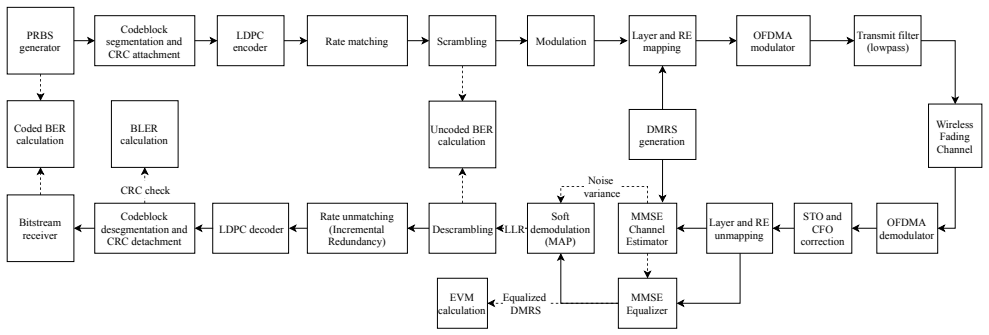
The load-bearing object is the simplified LDPC encoder specialized to 5G NR's quasi-cyclic parity-check matrices. The paper partitions the parity-check matrix $H$ into the six blocks $C,D,E,A,B,T$ and uses the structural facts $E=0$, $T=I$, and $g=4Z_c$, with $D$ non-singular, to reduce encoding to the two equations $p_1^T = D^{-1} C s^T$ and $p_2^T = A s^T + B p_1^T$. This identity carries the transmitter's correctness and its low complexity. The receiver chain is carried by DMRS-based LS estimation followed by MMSE channel estimation, MMSE MIMO equalization, MAP soft demodulation with Euclidean-distance LLR approximation, and Sum-Product LDPC decoding with a two-piece linear approximation of the Boxplus operator.
What would settle it
Compute $E$, $T$, and $g$ directly from the standard's tables for every supported base graph and lifting size, or encode a random information block with the two equations and test whether the result satisfies $H d = 0$; any failure would overturn the encoder's universality claim.
Extended reading notes
Core claim
The central discovery is that the complete 5G NR PUSCH physical-layer chain can be implemented with standard, well-tested DSP components and still reach considerable BLER performance. On the encoding side, the paper shows that the general partitioned LDPC encoder simplifies dramatically for 5G NR: with the parity-check matrix $H$ written in the six blocks $C,D,E,A,B,T$, the two base graphs satisfy $E=0$ (zero matrix), $T=I$ (identity), and $g=4Z_c$ (the gap size is four times the lifting size), so the parity bits are generated by $p_1^T = D^{-1} C s^T$ and $p_2^T = A s^T + B p_1^T$, where $D^{-1}C$ can be precomputed for each configuration. On the receiver side, LS-to-MMSE channel estimation, MMSE MIMO equalization, and Sum-Product decoding with an approximated Boxplus operator yield BLER curves that fall steeply below an SNR threshold for every tested modulation and coding scheme, under both AWGN and Rayleigh fading with mobility.
Load-bearing premise
Everything about the transmitter's encoder rests on the structural conditions $E=0$, $T=I$, and $g=4Z_c$ holding for every supported 5G NR base graph and lifting size; if even one supported configuration violates them, the two-equation encoder produces invalid codewords for that configuration.
Editorial extensions
If this is right
- If the encoder simplification holds for all supported BG1 and BG2 configurations, LDPC encoding in the transmitter reduces to two matrix multiplications per codeblock, with $D^{-1}C$ precomputed once per configuration.
- The receiver chain demonstrates that LTE-era algorithms such as MMSE estimation, MAP demodulation, and belief propagation are sufficient for 5G NR PUSCH, lowering implementation risk for future systems.
- The circular-buffer rate matching with LLR soft-combining supports incremental-redundancy HARQ, so retransmission gains can be obtained without changing the decoder design.
- The BLER waterfall behavior under AWGN and Rayleigh fading provides a reference baseline for comparing other 5G NR physical-layer implementations.
- The tutorial treatment of synchronization, channel estimation, equalization, and LDPC decoding ties standard algorithms directly to the corresponding 3GPP procedures.
Reading between the lines
- If the structural conditions $E=0$, $T=I$, and $g=4Z_c$ hold for every 5G NR base graph and lifting size, the same two-equation encoder would apply to any quasi-cyclic LDPC code family sharing that parity-check shape, not just 5G NR.
- The shallower BLER slopes at higher modulation orders under Rayleigh fading suggest that uncompensated Doppler-induced inter-carrier interference, rather than the decoder, is the limiting factor; adding ICI-aware equalization would be a natural next experiment.
- Because the numerical model is distributed with the paper, one could directly test alternative DMRS densities, numerologies, or MIMO configurations and check whether the measured waterfall threshold shifts as the standard's flexible frame structure predicts.
- The same receiver chain, with the pilot tracking enabled, could be extended to millimeter-wave phase-noise conditions, where PTRS-based correction would likely restore the steep waterfall seen in the sub-6 GHz results.
Signed reviews
Editorial analysis
A structured set of objections, weighed in public.
Referee Report
Summary. The paper describes a complete software transceiver for the 5G New Radio Physical Uplink Shared Channel (PUSCH), implemented in MATLAB/Octave and released as open source. The transmitter chain covers LDPC encoding, rate matching, scrambling, modulation, DMRS generation, OFDM modulation, and transmit filtering; the receiver chain covers synchronization, channel estimation, MMSE equalization, soft demodulation, rate unmatching, and LDPC decoding. The authors present BLER, BER, and EVM curves for five MCS configurations under AWGN and Rayleigh fading channels, and include a tutorial review of the relevant 5G NR physical-layer procedures.
Significance. If the implementation is correct, the open-source code is a useful reference for researchers and educators working on 5G NR physical-layer simulation. The simplification of the Richardson-Urbanke LDPC encoder to equations (2)-(3) is a practical contribution, provided the stated structural assumptions are justified. The main limitations are the lack of statistical rigor in the performance evaluation and the absence of a proof or citation for the LDPC encoder assumptions, both of which are addressable in revision.
major comments (3)
- [Section IV, Figs. 4 and 5] The BLER curves are presented without any statistical characterization: no number of transmitted code blocks per SNR point, no confidence intervals, and no error bars. With only single curves, the reader cannot assess whether the reported "considerable BLER performance" in Section V is statistically meaningful or whether the differences between MCS configurations are significant. Please state the Monte Carlo methodology, report trial counts, provide confidence intervals (e.g., 95% Clopper-Pearson intervals for binomial proportions), and add reference baselines such as the AWGN capacity limit or an ideal-channel receiver to contextualize the absolute performance.
- [Section III.A, Eq. (2) and (3)] The derivation of the simplified LDPC encoder relies on the assumptions g = 4*Zc, E = 0, T = I, and D non-singular for both BG1 and BG2, but these are asserted without proof or reference to the specific clauses in 3GPP TS 38.212. Since the validity of the entire transmitter depends on these properties holding for every supported lifting size and base graph, the authors should either prove them from the base graph tables or cite the relevant standard subsections and describe how the structure guarantees these conditions for all configurations.
- [Section IV and Appendix A] The paper does not describe any validation of the implemented chain against 3GPP test vectors or an independent reference decoder. Without such a check, it is difficult to confirm that the implementation is standard-compliant and that the reported curves reflect the actual 5G NR PUSCH behavior rather than an implementation-specific deviation. A short validation subsection, e.g., verifying CRC pass rates for a known transport block or comparing decoded bits to the transmitted payload for a noise-free channel, would substantially strengthen the trust in the results.
minor comments (6)
- [Table I] The reported slot duration for Δf = 60 kHz is 17.84 µs, which is the duration of one OFDM symbol (including cyclic prefix), not the 14-symbol slot duration; the correct value is approximately 250 µs.
- [Eq. (6)] Equation (6) is typeset in a garbled manner: the fraction inside the parentheses is not legible as printed. Please re-typeset the SNR estimator formula clearly.
- [Eq. (5)] The expression in Eq. (5) is a matched-filter operation, not an LS estimate in the usual sense, unless the pilot symbols are unit-amplitude and normalized. If that is the case, please state the normalization explicitly.
- [Eq. (15)] Equation (15) is missing a closing parenthesis on the right-hand side after the repeated Boxplus operations; please correct the typographical error.
- [Abstract and Section V] The phrase "considerable BLER performance" is vague. It would be helpful to give quantitative SNR values corresponding to a target BLER (e.g., BLER = 0.1) for each simulated MCS, and to correct the typo "A WGN" in the abstract.
- [Section II and III] The phrase "State-of-Art" in the abstract should be "state-of-the-art"; also, Eq. (8) uses subscripts with mixed Greek and Latin letters that may be unclear in the printed version, so please verify the notation.
Circularity Check
No circularity: LDPC encoder follows Richardson-Urbanke with assumptions from the 3GPP standard; BLER curves are simulation outputs, not fitted predictions.
full rationale
The paper's central technical derivation is the Richardson-Urbanke based LDPC encoder simplification in Section III.A. The encoder equations (2)-(3) are derived from a partition of the parity-check matrix under stated structural assumptions (E = 0, T = I, g = 4*Zc, D non-singular). These are properties of the 5G NR base graphs defined in the external 3GPP TS 38.212 standard, not quantities fitted from the paper's own outputs. No parameter is calibrated to simulation data and then renamed a prediction; the BLER/BER/EVM curves are direct simulation results from the public MATLAB implementation. The paper contains no load-bearing self-citations: references are to standards, textbook algorithms, and unrelated prior work, and the authors' own prior work is not invoked to justify any conclusion. The unquantified phrase 'considerable BLER performance' is a reporting gap rather than circularity, because the curves show standard waterfall behavior and the source code is public. Overall, the derivation is self-contained and no circular step can be exhibited.
Assumptions & free parameters
assumptions (2)
- domain assumption The 5G NR LDPC parity-check matrices for both BG1 and BG2 satisfy E=0, T=I, and g=4Zc for all configurations.
- domain assumption The channel autocovariance matrix Rhh for MMSE channel estimation is known to the receiver.
Cite this review
Pith. "Pith review of Prototyping Software Transceiver for the 5G New Radio Physical Uplink Shared Channel." pith.science (2026). https://pith.science/paper/PAXYTVG7
@misc{pith2026190804376,
  author       = {Pith},
  title        = {Pith review of: Prototyping Software Transceiver for the 5G New Radio Physical Uplink Shared Channel},
  year         = {2026},
  howpublished = {\url{https://pith.science/paper/PAXYTVG7}},
  note         = {Machine review of arXiv:1908.04376}
}
read the original abstract
5G New Radio (NR) is an emerging radio access technology, which is planned to succeed 4G Long Term Evolution (LTE) as global standard of cellular communications in the upcoming years. This paper considers a digital signal processing model and a software implementation of a complete transceiver chain of the Physical Uplink Shared Channel (PUSCH) defined by the version 15 of the 3GPP standard, consisting of both baseband transmitter and receiver chains on a physical layer level. The BLER performance of the prototype system implementation under AWGN and Rayleigh fading channel conditions is evaluated. Moreover, the source code of high-level numerical model was made available online on a public repository by the authors. In the paper's tutorial part, the aspects of the 5G NR standard are reviewed and their impact on different functional building blocks of the system is discussed, including synchronization, channel estimation, equalization, soft-bit demodulation and LDPC encoding/decoding. A review of State-of-Art algorithms that can be utilized to increase the performance of the system is provided together with a guidelines for practical implementations.
Figures

Figures from the paper (2 more)


Reference graph
Works this paper leans on
-
[28]
Design and Implementation of a 5G NR System Based on LDPC in Open Source SDR,
W. Ji et. al. , "Design and Implementation of a 5G NR System Based on LDPC in Open Source SDR," in IEEE Globecom Workshops (GC Wkshps), Dec. 2018
work page 2018
-
[1]
Test and Performance Analysis of PUSCH Channel of LTE System,
N. Hou et. al. , "Test and Performance Analysis of PUSCH Channel of LTE System," in 5th IEEE Int. Symp. on Microwave, Antenna, Propagation and EMC Technol. for Wireless Commun. , Oct. 2013
work page 2013
-
[2]
5G New Radio Uplink Performance: Noise, Interfer- ence and Emission Constraints,
T. Levanen et. al. , "5G New Radio Uplink Performance: Noise, Interfer- ence and Emission Constraints," in IEEE Wireless Commun. and Netw. Conf. (WCNC) , April 2018
work page 2018
-
[3]
F. Di Stasio, M. Mondin and F. Daneshgaran, "Multirate 5G Downlink Performance Comparison for f-OFDM and w-OFDM Schemes with Dif- ferent Numerologies," in Int. Symp. on Netw., Computers and Commun. (ISNCC), June 2018
work page 2018
-
[4]
Design of Low-Density Parity Check Codes for 5G New Radio,
T. Richardson and S. Kudekar, "Design of Low-Density Parity Check Codes for 5G New Radio," IEEE Commun. Mag. , vol. 56, no. 3, pp. 28-34, March 2018
work page 2018
-
[5]
Survey of Turbo, LDPC and Polar Decoder ASIC Implementations,
S. Shao et. al. , "Survey of Turbo, LDPC and Polar Decoder ASIC Implementations," IEEE Commun. Surveys Tuts., Early Access, Jan. 2019
work page 2019
-
[6]
NR; Physical Channels and Modulation,
3GPP TS 38.211, "NR; Physical Channels and Modulation," version 15.0.0, December 2017
work page 2017
-
[7]
NR; Multiplexing and Channel Coding,
3GPP TS 38.212, "NR; Multiplexing and Channel Coding," version 15.0.0, December 2017
work page 2017
Show all 30 references
-
[8]
OFDM Numerology Design for 5G New Radio to Support IoT, eMBB, and MBSFN,
A. Zaidi et. al. , "OFDM Numerology Design for 5G New Radio to Support IoT, eMBB, and MBSFN," IEEE Commun. Standards Mag. , vol. 2, no. 2, pp. 78 - 83, June 2018
2018
-
[9]
DMRS Design and Evaluation for 3GPP 5G New Radio in a High Speed Train Scenario,
G. Noh et. al. , "DMRS Design and Evaluation for 3GPP 5G New Radio in a High Speed Train Scenario," in IEEE Global Commun. Conf. (GlobeCom), Dec. 2017
2017
-
[10]
On the Phase Tracking Reference Signal (PT-RS) Design for 5G New Radio (NR),
Y . Qi et. al. , "On the Phase Tracking Reference Signal (PT-RS) Design for 5G New Radio (NR)," in IEEE 88th V eh. Technol. Conf. (VTC-Fall) , Aug. 2018
2018
-
[11]
Design of an OFDMA Baseband Receiver for 3GPP Long-Term Evolution,
C. Chu, C. Lee and Y . Huang, "Design of an OFDMA Baseband Receiver for 3GPP Long-Term Evolution," in IEEE Int. Symp. VLSI Design, Automation and Test (VLSI-DAT) , April 2008
2008
-
[12]
Analysis of 5G LDPC Codes Rate-Matching Design,
F. Hamidi-Sepehr, A. Nimbalker and G. Ermolaev, "Analysis of 5G LDPC Codes Rate-Matching Design," in IEEE 87th V eh. Technol. Conf. (VTC-Spring), June 2018
2018
-
[13]
Efficient Encoding of Low-Density Parity-Check Codes,
T. Richardson and R. Urbanke, "Efficient Encoding of Low-Density Parity-Check Codes," IEEE Trans. Inf. Theory , vol. 47, no. 2, pp. 638- 656, Feb. 2001
2001
-
[14]
The Effect of Filtering on the Performance of OFDM Systems,
M. Faulkner, "The Effect of Filtering on the Performance of OFDM Systems," IEEE Trans. V eh. Technol., vol. 49, no. 5, pp. 1877-1884, Sept. 2000
2000
-
[15]
Optimum Receiver Design for Wireless Broad-Band Systems Using OFDM—Part I,
M. Speth et. al. , "Optimum Receiver Design for Wireless Broad-Band Systems Using OFDM—Part I," IEEE Trans. Commun. , vol. 47, no. 1, pp. 1668-1677, Nov. 1999
1999
-
[16]
Synchronization Procedure in 5G NR Systems,
A. Omri et. al. , "Synchronization Procedure in 5G NR Systems," IEEE Access, vol. 7, pp. 41286-41295, March 2019
2019
-
[17]
Carrier Frequency Offset Compensation for Uplink of OFDM-FDMA Systems
J. Choi et. al. , "Carrier Frequency Offset Compensation for Uplink of OFDM-FDMA Systems", IEEE Commun. Let. , vol. 4, no. 12, Dec. 2000
2000
-
[18]
OFDM Channel Estimation with Timing Offset for Satellite plus Terrestrial Multipath Channels,
Y . Kang, D. Ahn and H. Lee, "OFDM Channel Estimation with Timing Offset for Satellite plus Terrestrial Multipath Channels," in IEEE 63rd V eh. Technol. Conf., May 2006
2006
-
[19]
Effective SNR Estimation in OFDM System Simulation,
S. He and M. Torkelson, "Effective SNR Estimation in OFDM System Simulation," in IEEE Global Commun. Conf. (GLOBECOM) , Nov. 1998
1998
-
[20]
Subspace-Based Noise Variance and SNR Estimation for OFDM Systems,
X. Xu, Y . Jing and X. Yu, "Subspace-Based Noise Variance and SNR Estimation for OFDM Systems," in IEEE Wireless Commun. Netw. Conf. , March 2005
2005
-
[21]
OFDM Channel Estimation by Singular Value Decomposition,
O. Edfors et. al. , "OFDM Channel Estimation by Singular Value Decomposition," IEEE Trans. Commun., vol. 46, no. 7, pp. 931-939, July 1998
1998
-
[22]
Diversity of MMSE MIMO Receivers,
A. Mehana and A. Nosratinia, "Diversity of MMSE MIMO Receivers," IEEE Trans. Inf. Theory , vol. 58, no. 11, pp. 6788-6805, Nov. 2012
2012
-
[23]
An Intuitive Justification and a Simplified Implementation of the MAP Decoder for Convolutional Codes,
A. Viterbi, "An Intuitive Justification and a Simplified Implementation of the MAP Decoder for Convolutional Codes," IEEE J. Sel. Areas Commun., vol. 16, no. 2, pp. 260-264, Feb. 1998
1998
-
[24]
Efficient Implementations of the Sum-Product Algorithm for Decoding LDPC Codes
X. Hu et. al., "Efficient Implementations of the Sum-Product Algorithm for Decoding LDPC Codes" in IEEE Global Commun. Conf. (GLOBE- COM), Nov. 2001
2001
-
[25]
Approximated Box-Plus Decoding of LDPC Codes,
S. Papaharalabos and F. Lazarakis, "Approximated Box-Plus Decoding of LDPC Codes," IEEE Commun. Lett. , vol. 19, no. 12, pp. 2074-2077, Dec. 2015
2015
-
[26]
Optimization of a Reduced-complexity Decoding Algorithm for LDPC Codes by Density Evolution,
G. Richter et. al. , “Optimization of a Reduced-complexity Decoding Algorithm for LDPC Codes by Density Evolution,” in IEEE Int. Conf. Commun., May 2005
2005
-
[27]
Numerical Issues Affecting LDPC Error Floors,
B. Butler and P. Siegel, "Numerical Issues Affecting LDPC Error Floors," in IEEE Global Commun. Conf. (GLOBECOM) , Dec. 2012
2012
-
[29]
NR; Base Station (BS) Radio Transmission and Reception,
3GPP TS 38.104, "NR; Base Station (BS) Radio Transmission and Reception," version 15.4.0, Dec. 2018
2018
-
[30]
Improved Models for the Generation of Multiple Uncorrelated Rayleigh Fading Waveforms,
Y . Zheng and C. Xiao, "Improved Models for the Generation of Multiple Uncorrelated Rayleigh Fading Waveforms," IEEE Commun. Lett. , vol. 6, no. 6, pp. 256–258, June 2002
2002
Reviewed August 14, 2026 · model on record in the stance chip above.
Discussion (0). Continue with ORCID to comment.