REVIEW 21 references
Connectivity at Infinity for the Braid Group of a Complete Bipartite Graph
T0 review · reviewed 2026-08-14 · deepseek-v4-flash
Pith's one-line read For r robots on a complete bipartite graph K_{n,N}, the universal cover of the configuration space is (ℓ-2)-connected at infinity but not (ℓ-1)-connected at infinity, where ℓ is an explicit function of the four parameters.
The pith
A machine-rendered reading of the paper's core claim, the machinery that carries it, and where it could break.
The reading
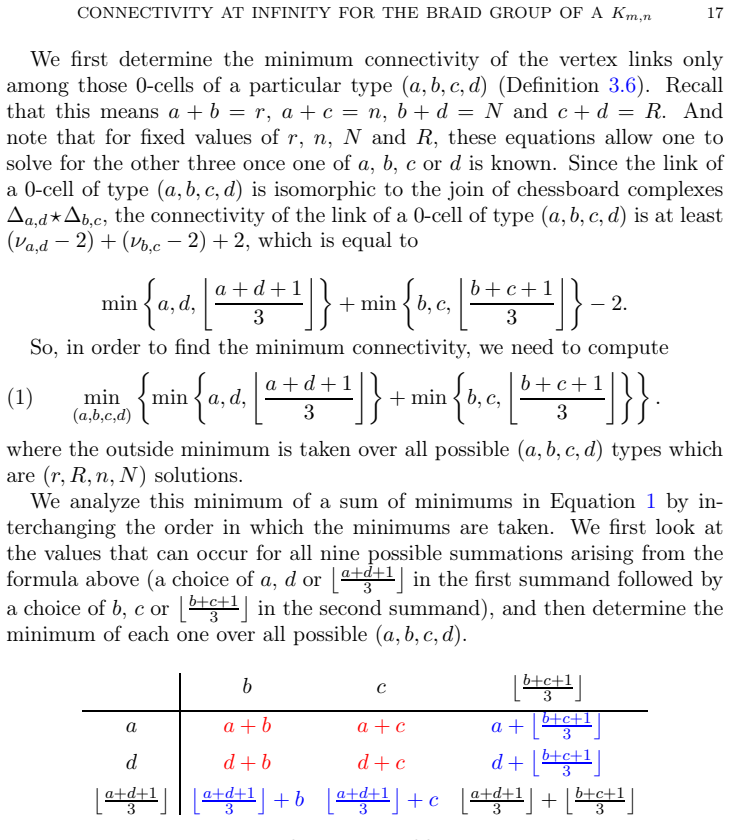
The paper proves the answer is governed by one number, ℓ, built from the number of robots r, the two side sizes n and N, and the number of empty vertices R. The space is (ℓ-2)-connected at infinity but not (ℓ-1)-connected at infinity. The proof examines the local view at each configuration ('vertex links') and shows each such view is a chessboard complex, a well-studied object whose connectivity is known exactly. The least connected link then controls the topology at infinity.
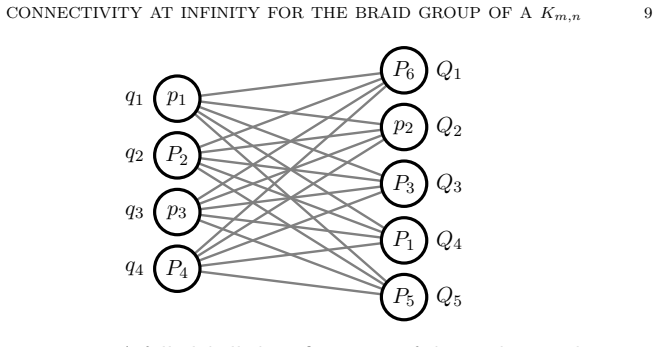
A key ingredient is a hidden symmetry: by imagining every empty vertex as occupied by a 'ghost' and transposing a matrix that records which robot or ghost sits where, the authors show eight different configuration spaces share the same universal cover. This lets them assume the parameters appear in a convenient order, and then a short list of cases completes the calculation.
Extended reading notes
Core claim
The Main Theorem states that for r robots on a complete bipartite graph K_{n,N}, with R=n+N-r open vertices and all four parameters at least 2, the universal cover of the configuration space is (ℓ-2)-connected at infinity but not (ℓ-1)-connected at infinity, where ℓ = min{min{r,R,n,N}, floor((min{r,R}+min{n,N}+1)/3), floor((n+N)/3)}. If the paper is correct, this exact two-sided bound is the connectivity at infinity for every such graph braid group.
Load-bearing premise
The sharpness half of the Main Theorem depends on the exact non-connectivity of chessboard complexes imported as Theorem 4.7 from BLVZ94, Zie94, Wac03, Ath04, SW07. In the proof of Theorem 5.1, the authors assert that a vertex link that is a single chessboard complex 'is not (ℓ-1)-connected by Theorem 4.7'. If that exactness statement were false, the conclusion that the space is not (ℓ-1)-connected at infinity would not follow, and only the lower bound (ℓ-2)-connected would remain.
Signed reviews
Editorial analysis
A structured set of objections, weighed in public.
Assumptions & free parameters
assumptions (5)
- standard math Theorem 1.2 (vertex links and connectivity at infinity), from Brady-Meier (2001) and Brady-McCammond-Meier (2003)
- standard math The configuration space Conf_r(n,N) is a finite, locally CAT(0) cube complex and a K(G,1) (Theorem 2.6, after Abrams 2002 and Bridson-Haefliger 1999)
- standard math Exact connectivity of chessboard complexes: Δ_{m,n} is (ν_{m,n}-2)-connected but not (ν_{m,n}-1)-connected, with ν_{m,n} = min{m,n,floor((m+n+1)/3)} (Theorem 4.7, from BLVZ94, Zie94, Wac03, Ath04, SW07)
- standard math Vertex decomposability of chessboard complexes and its preservation under joins, ensuring punctured links have the same connectivity (Theorem 4.9 after MZ13, Corollary 4.10 after Jon08)
- standard math Connectivity of joins: X⋆Y is (p+q+2)-connected when X is p-connected and Y is q-connected (Lemma 4.8, after Hatcher)
Cite this review
Pith. "Pith review of Connectivity at Infinity for the Braid Group of a Complete Bipartite Graph." pith.science (2026). https://pith.science/paper/PAYXEMH2
@misc{pith2026190800394,
  author       = {Pith},
  title        = {Pith review of: Connectivity at Infinity for the Braid Group of a Complete Bipartite Graph},
  year         = {2026},
  howpublished = {\url{https://pith.science/paper/PAYXEMH2}},
  note         = {Machine review of arXiv:1908.00394}
}
read the original abstract
The graph braid group of a complete bipartite graph is the fundamental group of a configuration space of points on the graph, which is a CAT(0) cube complex. We combine an analysis of the topology of links of vertices in this complex, the description of a hidden symmetry among the parameters, and known results from the literature to explicitly compute the exact degree to which these complexes and groups are connected at infinity.
Figures


Figures from the paper (3 more)


Reference graph
Works this paper leans on
-
[1]
Configuration spaces of colored graphs
Aaron Abrams. Configuration spaces of colored graphs. Geom. Dedicata , 92:185--194, 2002. Dedicated to John Stallings on the occasion of his 65th birthday
work page 2002
-
[2]
Finding topology in a factory: configuration spaces
Aaron Abrams and Robert Ghrist. Finding topology in a factory: configuration spaces. Amer. Math. Monthly , 109(2):140--150, 2002
work page 2002
-
[3]
Christos A. Athanasiadis. Decompositions and connectivity of matching and chessboard complexes. Discrete Comput. Geom. , 31(3):395--403, 2004
work page 2004
-
[4]
Martin R. Bridson and Andr\'e Haefliger. Metric spaces of non-positive curvature , volume 319 of Grundlehren der Mathematischen Wissenschaften [Fundamental Principles of Mathematical Sciences] . Springer-Verlag, Berlin, 1999
work page 1999
-
[5]
A. Bj \"o rner, L. Lov \'a sz, S. T. Vre \'c ica, and R. T. Z ivaljevi \'c . Chessboard complexes and matching complexes. J. London Math. Soc. (2) , 49(1):25--39, 1994
work page 1994
-
[6]
Connectivity at infinity for right angled A rtin groups
Noel Brady and John Meier. Connectivity at infinity for right angled A rtin groups. Trans. Amer. Math. Soc. , 353(1):117--132, 2001
work page 2001
-
[7]
Local-to-asymptotic topology for cocompact CAT(0) complexes
Noel Brady, Jon McCammond, and John Meier. Local-to-asymptotic topology for cocompact CAT(0) complexes. Topology Appl. , 131(2):177--188, 2003
work page 2003
-
[8]
Kenneth S. Brown. Cohomology of groups , volume 87 of Graduate Texts in Mathematics . Springer-Verlag, New York, 1994. Corrected reprint of the 1982 original
1994
Show all 21 references
-
[9]
Homology of tree braid groups
Daniel Farley. Homology of tree braid groups. In Topological and asymptotic aspects of group theory , volume 394 of Contemp. Math. , pages 101--112. Amer. Math. Soc., Providence, RI, 2006
2006
-
[10]
Presentations for the cohomology rings of tree braid groups
Daniel Farley. Presentations for the cohomology rings of tree braid groups. In Topology and robotics , volume 438 of Contemp. Math. , pages 145--172. Amer. Math. Soc., Providence, RI, 2007
2007
-
[11]
Discrete M orse theory and graph braid groups
Daniel Farley and Lucas Sabalka. Discrete M orse theory and graph braid groups. Algebr. Geom. Topol. , 5:1075--1109, 2005
2005
-
[12]
Topological methods in group theory , volume 243 of Graduate Texts in Mathematics
Ross Geoghegan. Topological methods in group theory , volume 243 of Graduate Texts in Mathematics . Springer, New York, 2008
2008
-
[13]
Algebraic topology
Allen Hatcher. Algebraic topology . Cambridge University Press, Cambridge, 2002
2002
-
[14]
Simplicial complexes of graphs , volume 1928 of Lecture Notes in Mathematics
Jakob Jonsson. Simplicial complexes of graphs , volume 1928 of Lecture Notes in Mathematics . Springer-Verlag, Berlin, 2008
1928
-
[15]
Characteristics of graph braid groups
Ki Hyoung Ko and Hyo Won Park. Characteristics of graph braid groups. Discrete Comput. Geom. , 48(4):915--963, 2012
2012
-
[16]
Connectivity at infinity for braid groups on complete graphs
John Meier and Liang Zhang. Connectivity at infinity for braid groups on complete graphs. Homology Homotopy Appl. , 15(1):303--311, 2013
2013
-
[17]
Stability phenomena in the homology of tree braid groups
Eric Ramos. Stability phenomena in the homology of tree braid groups. Algebr. Geom. Topol. , 18(4):2305--2337, 2018
2018
-
[18]
Topological complexity of n points on a tree
Steven Scheirer. Topological complexity of n points on a tree. Algebr. Geom. Topol. , 18(2):839--876, 2018
2018
-
[19]
John Shareshian and Michelle L. Wachs. Torsion in the matching complex and chessboard complex. Adv. Math. , 212(2):525--570, 2007
2007
-
[20]
Michelle L. Wachs. Topology of matching, chessboard, and general bounded degree graph complexes. Algebra Universalis , 49(4):345--385, 2003. Dedicated to the memory of Gian-Carlo Rota
2003
-
[21]
G \"u nter M. Ziegler. Shellability of chessboard complexes. Israel J. Math. , 87(1-3):97--110, 1994
1994
Reviewed August 14, 2026 · model on record in the stance chip above.
Discussion (0). Continue with ORCID to comment.