JiRAIYA: A Reputation-Based Hierarchical Federated Learning Framework on Web3
Pith reviewed 2026-06-27 05:58 UTC · model grok-4.3
The pith
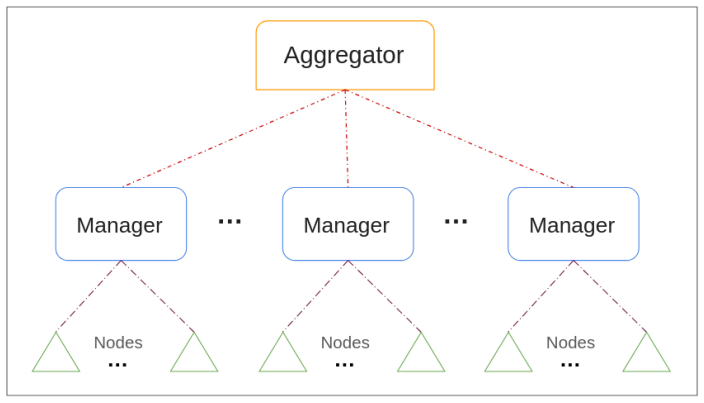
A Web3 hierarchy lets delegated managers reach consensus on encoded model updates to keep federated learning transparent and resistant to poisoning.
A machine-rendered reading of the paper's core claim, the machinery that carries it, and where it could break.
Core claim
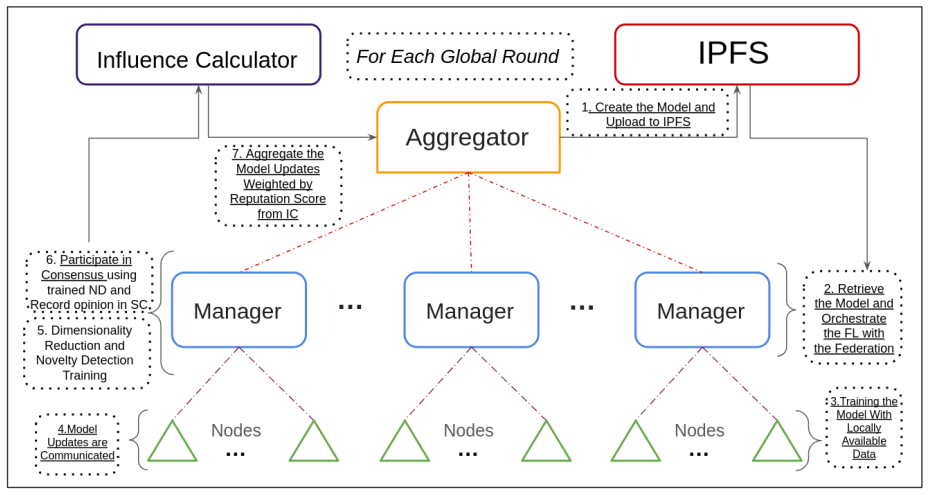
Model updates are encoded and broadcast to all managers, who independently evaluate their validity using novelty detection; updates approved by consensus are incorporated into the global model, while a reputation score mechanism provides backup to ensure continued model generation.
What carries the argument
Hierarchical architecture of delegated managers that broadcast encoded updates for independent consensus evaluation combined with novelty detection and reputation-based backup.
If this is right
- Every accepted model update becomes visible and auditable by all managers in the hierarchy.
- Training can continue without external validators because managers handle evaluation internally.
- Reputation scores allow the system to fall back to reliable participants when others drop out.
- The framework supports FL participation beyond closed enterprise networks by leveraging Web3 transparency.
Where Pith is reading between the lines
- The same broadcast-and-consensus pattern could be extended to record an immutable training log on a blockchain for post-hoc audits.
- Open participant pools might grow larger than in traditional FL because evaluation is distributed rather than centralized.
- If novelty detection parameters are tuned per federation, the approach could adapt to domain-specific data distributions without global retraining.
Load-bearing premise
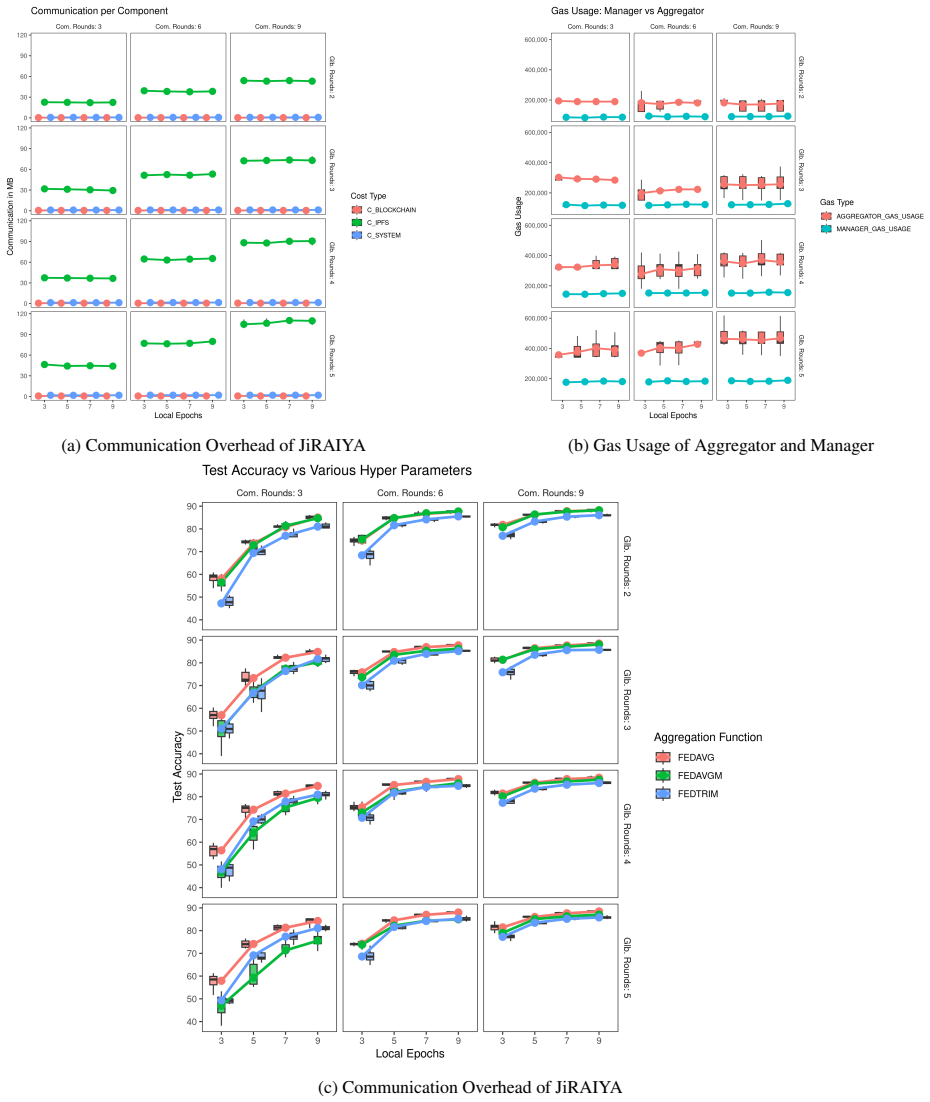
Broadcasting updates to multiple managers for consensus evaluation plus novelty detection can filter out bad updates effectively while keeping communication costs low.
What would settle it
An experiment in which a poisoning attack succeeds in altering the global model even after the consensus and novelty checks, or where the measured communication volume exceeds that of validator-based alternatives.
Figures
read the original abstract
Federated Learning(FL) is predominantly deployed in enterprise environments, where limited transparency and restricted auditability hinder broader adoption. Existing FL systems often suffer from opaque aggregation processes, making it unclear which model updates are accepted or discarded. Current mitigation strategies typically rely on external validators introducing additional computational and communication overhead. In this paper, we propose a novel FL framework that leverages existing Web3 technologies to enhance transparency, trust and auditability throughout the training process. The framework adopts a hierarchical architecture in which delegated managers orchestrate the FL training process within their respective federations. To mitigate adversarial and poisoning attacks, a combination of novelty detection and consensus mechanisms were employed. Model updates are encoded and broad casted to all managers, who independently evaluate their validity and those model updates that are approved by the consensus are incorporated into the global model. Additionally, a reputation score based backup mechanism is employed to ensure model generation. Extensive experiments conducted under real world scenarios demonstrate the effectiveness, resilience of the proposed framework, highlighting its potential to enable transparent FL beyond traditional enterprise setting.
Editorial analysis
A structured set of objections, weighed in public.
Referee Report
Summary. The paper proposes JiRAIYA, a hierarchical federated learning framework that uses Web3 technologies (including blockchain for transparency) to address opacity in traditional FL aggregation. Delegated managers orchestrate training within federations; model updates are encoded and broadcast to all managers, who apply novelty detection and reach consensus to accept or reject updates before incorporation into the global model. A reputation-score-based backup mechanism ensures continuity. The authors claim that extensive experiments under real-world scenarios demonstrate the framework's effectiveness and resilience against adversarial and poisoning attacks, enabling transparent FL beyond enterprise settings.
Significance. If the central claims on attack mitigation and real-world performance hold, the work would offer a concrete path to auditable, decentralized FL by repurposing existing Web3 primitives rather than introducing new external validators. The hierarchical manager design and reputation backup are pragmatic engineering choices that could reduce single points of failure, but the absence of quantitative attack evaluations limits the immediate impact on the FL security literature.
major comments (2)
- [Section 3] Section 3 (framework description): the consensus-plus-novelty-detection mechanism is presented at a high level without a formal threat model (e.g., Byzantine fraction among managers, model-replacement or backdoor attack definitions, or assumptions on manager collusion). This is load-bearing because the central claim that broadcasting updates plus independent evaluation reliably filters poisoning attacks rests on unstated security assumptions.
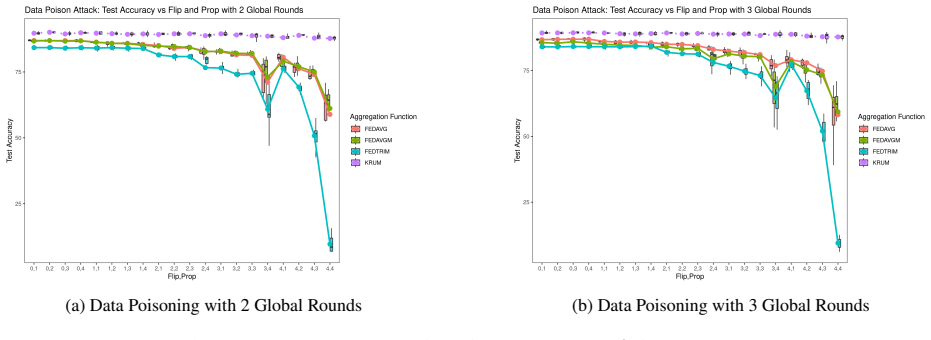
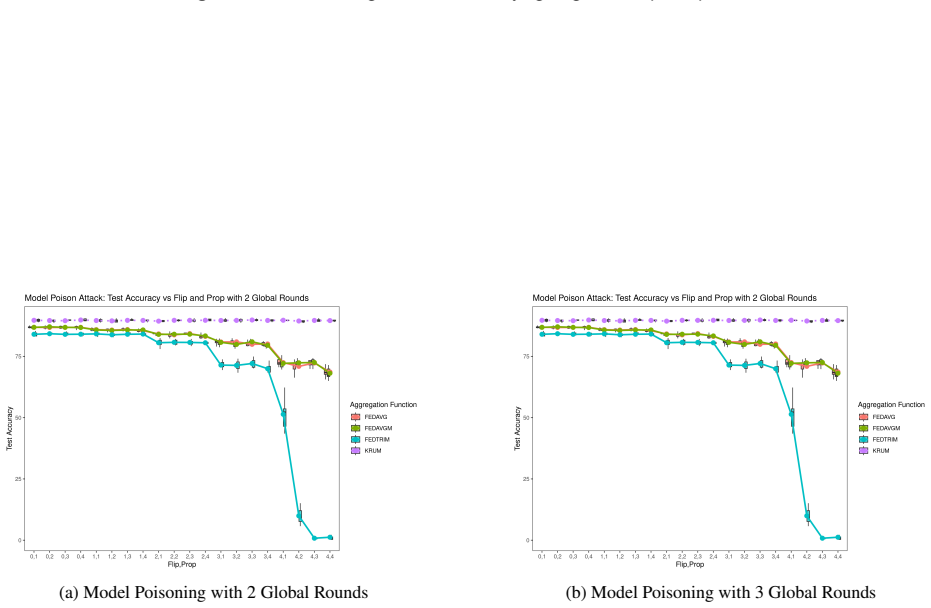
- [Experiments section] Experiments section (and abstract): the manuscript asserts 'extensive experiments conducted under real world scenarios' demonstrate resilience, yet reports only aggregate effectiveness metrics. No attack success rates, false-positive rates on benign updates, ablation on the novelty detector, or comparison against baselines under explicit poisoning are provided. This undermines the resilience claim that is central to the contribution.
minor comments (2)
- [Abstract] Abstract: 'broad casted' should be 'broadcast'; 'the effectiveness, resilience' is missing 'and'.
- Notation for reputation scores and consensus thresholds is introduced without a clear table or equation reference, making it difficult to reproduce the exact validation logic.
Simulated Author's Rebuttal
We thank the referee for the constructive feedback. We address the two major comments point by point below and commit to revisions that directly strengthen the security analysis and experimental evidence.
read point-by-point responses
-
Referee: [Section 3] Section 3 (framework description): the consensus-plus-novelty-detection mechanism is presented at a high level without a formal threat model (e.g., Byzantine fraction among managers, model-replacement or backdoor attack definitions, or assumptions on manager collusion). This is load-bearing because the central claim that broadcasting updates plus independent evaluation reliably filters poisoning attacks rests on unstated security assumptions.
Authors: We agree that a formal threat model is necessary to rigorously ground the security claims. In the revised manuscript we will insert a dedicated threat-model subsection in Section 3 that explicitly states (i) the assumed Byzantine fraction among managers, (ii) definitions of model-replacement and backdoor attacks, and (iii) collusion assumptions. This will clarify how the broadcast-plus-consensus design is intended to filter poisoning under those assumptions. revision: yes
-
Referee: [Experiments section] Experiments section (and abstract): the manuscript asserts 'extensive experiments conducted under real world scenarios' demonstrate resilience, yet reports only aggregate effectiveness metrics. No attack success rates, false-positive rates on benign updates, ablation on the novelty detector, or comparison against baselines under explicit poisoning are provided. This undermines the resilience claim that is central to the contribution.
Authors: We accept that the current experimental presentation does not supply the quantitative attack metrics needed to substantiate the resilience claims. In the revision we will augment the experiments section with (i) attack success rates under poisoning and backdoor scenarios, (ii) false-positive rates on benign updates, (iii) ablation results isolating the novelty detector, and (iv) direct comparisons against standard FL baselines under the same attack models. These additions will be reported alongside the existing aggregate metrics. revision: yes
Circularity Check
No circularity: framework proposal relies on external Web3 primitives, not self-derived inputs.
full rationale
The manuscript describes a hierarchical FL architecture using delegated managers, novelty detection, consensus on encoded updates, and reputation-based backup. No equations, fitted parameters, or derivations are presented that reduce to the paper's own inputs by construction. No self-citations are invoked as load-bearing uniqueness theorems or ansatzes. The central claims rest on the proposed mechanisms and claimed experiments rather than any self-definitional or fitted-input reduction. This matches the expected non-circular outcome for a systems-proposal paper.
Axiom & Free-Parameter Ledger
invented entities (1)
-
reputation score based backup mechanism
no independent evidence
Reference graph
Works this paper leans on
-
[1]
Accessed: 2026-01-16
Foundry.https://getfoundry.sh/. Accessed: 2026-01-16. Bai,L.,Hu,H.,Ye,Q.,Li,H.,Wang,L.,Xu,J.,2024. Membershipinferenceattacksanddefensesinfederatedlearning:Asurvey. ACMComputing Surveys 57, 1–35. Benet, J.,
2026
-
[2]
arXiv preprint arXiv:1407.3561
Ipfs-content addressed, versioned, p2p file system. arXiv preprint arXiv:1407.3561 . Beutel,D.J.,Topal,T.,Mathur,A.,Qiu,X.,Fernandez-Marques,J.,Gao,Y.,Sani,L.,Li,K.H.,Parcollet,T.,DeGusmão,P.P.B.,etal.,2020. Flower: A friendly federated learning research framework. arXiv preprint arXiv:2007.14390 . Blanchard, P., Mhamdi, E.M.E., Guerraoui, R., Stainer, J.,
Pith/arXiv arXiv 2020
-
[3]
arXiv preprint arXiv:1703.02757
Byzantine-tolerant machine learning. arXiv preprint arXiv:1703.02757 . Breunig,M.M.,Kriegel,H.P.,Ng,R.T.,Sander,J.,2000. Lof:identifyingdensity-basedlocaloutliers,in:Proceedingsofthe2000ACMSIGMOD international conference on Management of data, pp. 93–104. Buterin, V., et al.,
Pith/arXiv arXiv 2000
-
[4]
GitHub repository 1, 5–7
Ethereum white paper. GitHub repository 1, 5–7. Cao,X.,Gong,N.Z.,2022. Mpaf:Modelpoisoningattackstofederatedlearningbasedonfakeclients,in:ProceedingsoftheIEEE/CVFconference on computer vision and pattern recognition, pp. 3396–3404. Desai, H.B., Ozdayi, M.S., Kantarcioglu, M.,
2022
-
[5]
Accessed: 2026-01-16
Web3.py: Python library for ethereum.https://web3py.readthedocs.io/. Accessed: 2026-01-16. Grinberg, M.,
2026
-
[6]
Accessed: 2026-01-16
Python socket.io.https://python-socketio.readthedocs.io/. Accessed: 2026-01-16. Haber, S., Stornetta, W.S.,
2026
-
[7]
arXiv preprint arXiv:1909.06335
Measuring the effects of non-identical data distribution for federated visual classification. arXiv preprint arXiv:1909.06335 . Huang, R., Chen, J., Wang, Y., Bi, T., Nie, L., Zheng, Z.,
Pith/arXiv arXiv 1909
-
[8]
Blockchain: Research and Applications 5, 100173
An overview of web3 technology: Infrastructure, applications, and popularity. Blockchain: Research and Applications 5, 100173. Karimireddy,S.P.,Kale,S.,Mohri,M.,Reddi,S.,Stich,S.,Suresh,A.T.,2020. Scaffold:Stochasticcontrolledaveragingforfederatedlearning,in: International conference on machine learning, PMLR. pp. 5132–5143. Konečn`y, J., McMahan, H.B., Y...
2020
-
[9]
arXiv preprint arXiv:1610.05492
Federated learning: Strategies for improving communication efficiency. arXiv preprint arXiv:1610.05492 . Li, T., Sahu, A.K., Zaheer, M., Sanjabi, M., Talwalkar, A., Smith, V.,
-
[10]
IEEE Internet of Things Journal 12, 20393–20405
Similarity and diversity: Pca-based contribution evaluation in federated learning. IEEE Internet of Things Journal 12, 20393–20405. doi:10.1109/JIOT.2025.3546679. Maymounkov, P., Mazieres, D.,
-
[11]
Scikit-learn:Machinelearninginpython.https://scikit-learn
Pedregosa,F.,Varoquaux,G.,Gramfort,A.,Michel,V.,Thirion,B.,Grisel,O.,Blondel,M.,Prettenhofer,P.,Weiss,R.,Dubourg,V.,Vanderplas,J., Passos,A.,Cournapeau,D.,Brucher,M.,Perrot,M.,Duchesnay,E.,2026. Scikit-learn:Machinelearninginpython.https://scikit-learn. org/. Accessed: 2026-01-16. Pimentel, M.A., Clifton, D.A., Clifton, L., Tarassenko, L.,
2026
-
[12]
A review of novelty detection. Signal processing 99, 215–249. Rocket,T.,Yin,M.,Sekniqi,K.,vanRenesse,R.,Sirer,E.G.,2019. Scalableandprobabilisticleaderlessbftconsensusthroughmetastability. arXiv preprint arXiv:1906.08936 . Schölkopf,B.,Platt,J.C.,Shawe-Taylor,J.,Smola,A.J.,Williamson,R.C.,2001. Estimatingthesupportofahigh-dimensionaldistribution. Neural c...
arXiv 2019
-
[13]
Federated learning of gboard language models with differential privacy, in: Proceedings of the 61st Annual Meeting of the Association for Computational Linguistics (Volume 5: Industry Track), pp. 629–639. Yazdinejad,A.,Dehghantanha,A.,Karimipour,H.,Srivastava,G.,Parizi,R.M.,2024. Arobustprivacy-preservingfederatedlearningmodelagainst model poisoning attac...
2024
-
[14]
Incentive mechanism for horizontal federated learning based on reputation and reverse auction, in: Proceedings of the Web Conference 2021, pp. 947–956. :Preprint submitted to Elsevier Page 17 of 18 Zheng, G., Ivanov, D., Brintrup, A.,
2021
discussion (0)
Sign in with ORCID, Apple, or X to comment. Anyone can read and Pith papers without signing in.