On-farm management strategies for reducing H5N1 transmission in dairy cattle
Pith reviewed 2026-06-26 02:15 UTC · model grok-4.3
The pith
Dividing dairy cattle into fixed-order milking cohorts sharply reduces H5N1 outbreak risk irrespective of the main transmission route.
A machine-rendered reading of the paper's core claim, the machinery that carries it, and where it could break.
Core claim
Mathematical models of H5N1 transmission dynamics on dairy farms, considering multiple possible transmission pathways, demonstrate that dividing cattle into milking cohorts kept in separate pens or paddocks and milked in the same order every day would be highly effective at mitigating outbreaks irrespective of the dominant transmission pathway. The strategy performs best when applied before an outbreak occurs and when newly introduced cattle are assigned to the final milking cohort. Frequent bulk milk sample testing enables rapid detection and timely scaling of interventions.
What carries the argument
Transmission models that test the milking-cohort intervention across uncertain pathway weights, with milking-stall contamination as one explicit route.
If this is right
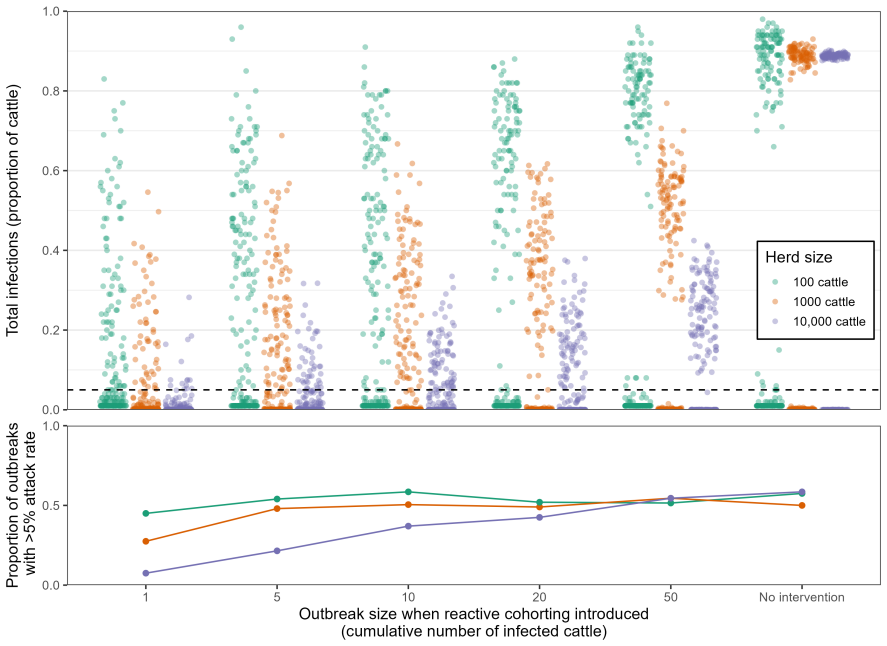
- Pre-emptive cohorting lowers risk more effectively than measures started after infection is already present.
- Assigning new cattle to the final cohort minimizes the chance of early spread from introductions.
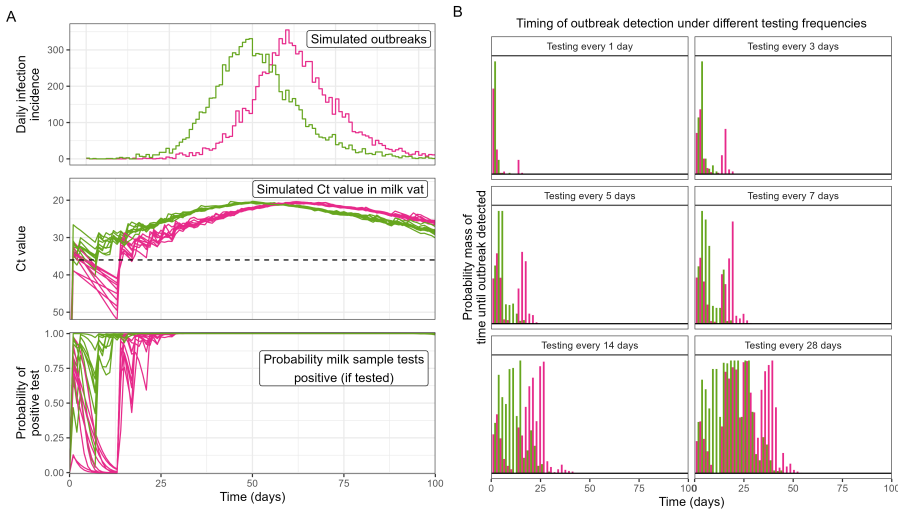
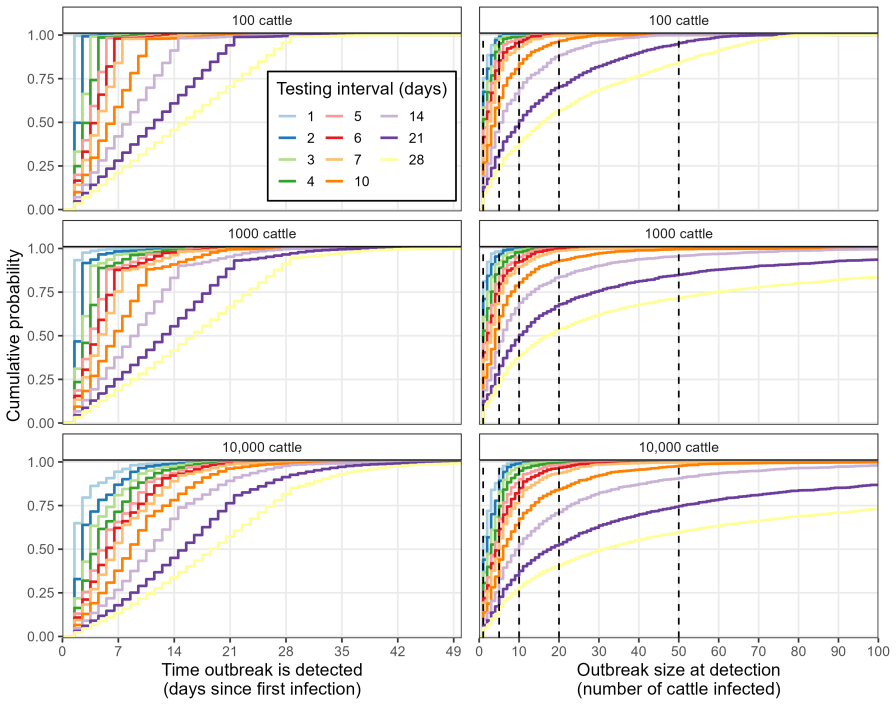
- Weekly bulk milk testing allows outbreaks to be caught early enough for reactive adjustments.
- The same cohort structure remains useful even if the relative importance of different routes changes.
Where Pith is reading between the lines
- The approach could be adapted to other farm pathogens that spread during milking or handling sequences.
- Combining cohorts with targeted testing might produce additive reductions not examined in the models.
- Real-farm implementation would need to account for labor constraints and pen layout that the models treat as feasible.
- Extending the models to include vaccination or culling thresholds could show how cohorting interacts with those tools.
Load-bearing premise
The models capture the uncertain relative contributions of different transmission pathways accurately enough to rank interventions reliably.
What would settle it
A controlled comparison of outbreak sizes or durations on farms that do versus do not use fixed-order milking cohorts would directly test the predicted reduction in spread.
Figures
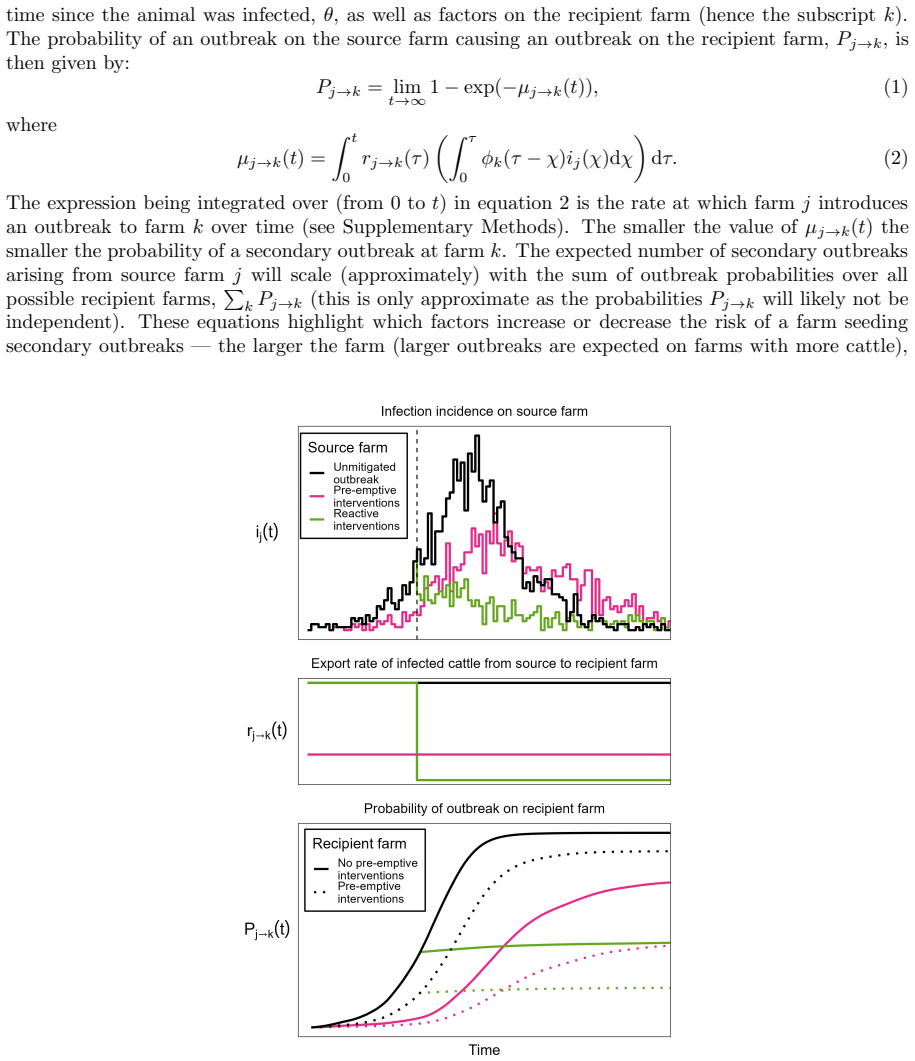
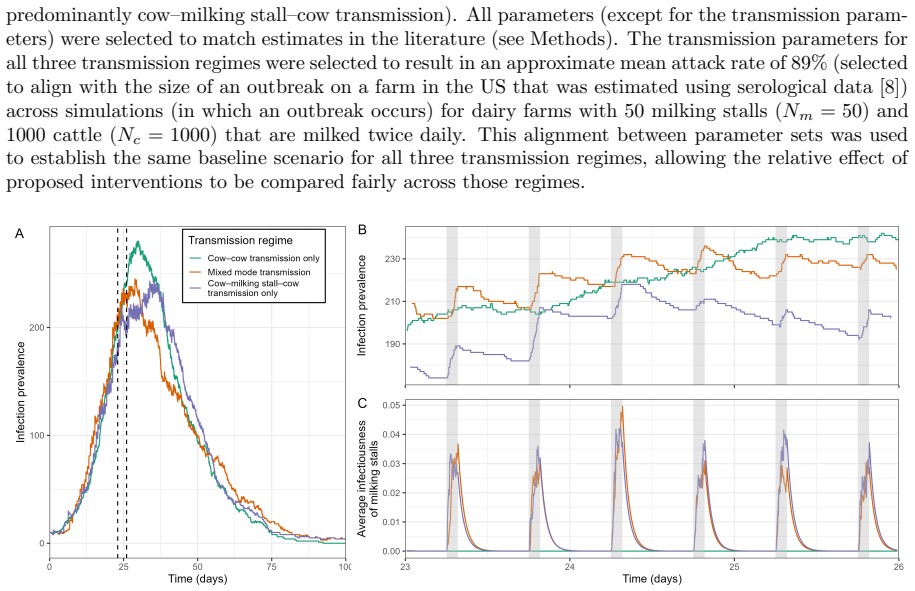
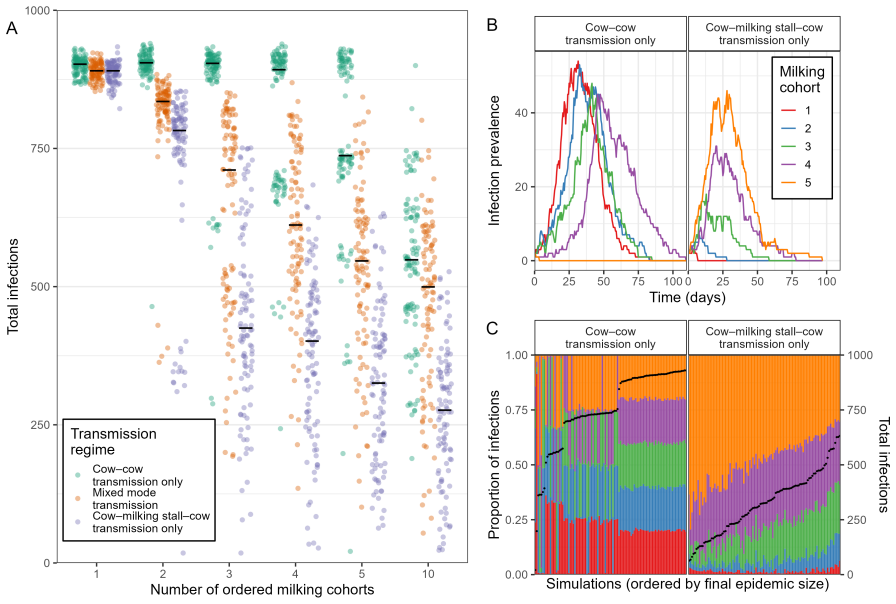
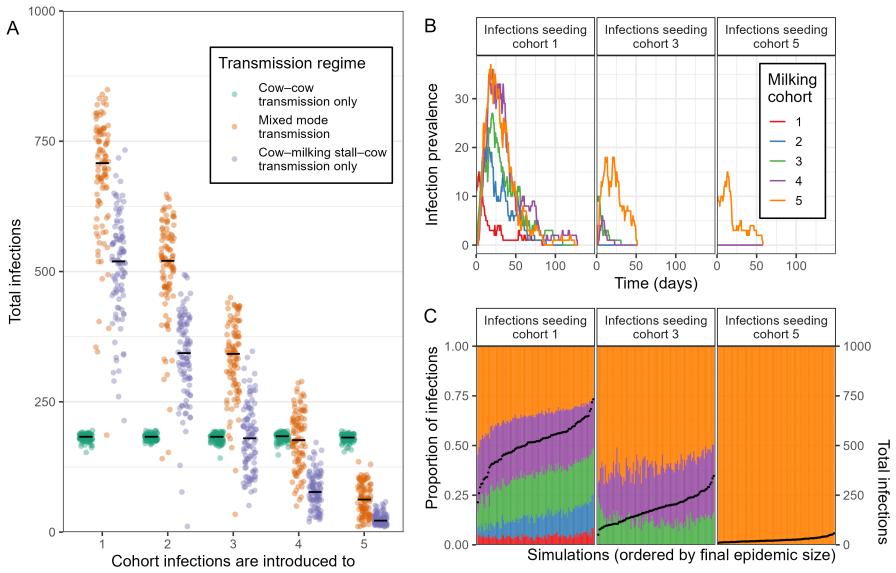
read the original abstract
Introductions of H5N1 clade 2.3.4.4b into dairy cattle have resulted in outbreaks on dairy farms across the United States since early-2024. Outbreaks have significant consequences for animal health, result in economic losses for the dairy industry, and pose a threat to human health. Though the relative contributions of different on-farm transmission pathways remain a key uncertainty, a major route is considered to be through repeated contamination of milking stalls (i.e. the equipment and area where an individual cow is milked) due to the milking of infected animals. Here we develop mathematical models of H5N1 transmission dynamics on dairy farms, considering multiple possible transmission pathways, and identify factors that contribute to outbreak risk and on-farm interventions for mitigating risk. In particular, we demonstrate that dividing cattle into 'milking cohorts', with cohorts kept in separate pens or paddocks and milked in the same order every day, would be highly effective at mitigating outbreaks irrespective of the dominant transmission pathway. Cohorting cattle is most effective when implemented pre-emptively (i.e. before an outbreak) and when newly introduced cattle are kept in the final milking cohort. Additionally, we demonstrate that frequent bulk milk sample testing (e.g. weekly) would enable the rapid detection of outbreaks and implementation of reactive interventions (or scaling up of existing interventions). Our findings can support the development of management guidelines for effectively responding to H5N1 outbreaks in dairy cattle.
Editorial analysis
A structured set of objections, weighed in public.
Referee Report
Summary. The paper develops mathematical models of H5N1 transmission on dairy farms that incorporate multiple pathways, with emphasis on milking-stall contamination. It identifies milking cohorting—dividing cattle into groups kept in separate pens and milked in fixed daily order—as highly effective at reducing outbreak size irrespective of which pathway dominates. Additional results address pre-emptive versus reactive implementation, placement of new cattle in the final cohort, and the value of frequent bulk-milk testing for early detection.
Significance. If the modeling framework and parameter choices are shown to be robust, the work supplies concrete, low-cost management recommendations that could limit within-farm spread, economic losses, and zoonotic risk during H5N1 outbreaks in U.S. dairy herds. The reported invariance of the cohorting benefit across pathways is a potentially useful result for guideline development.
minor comments (3)
- The abstract and introduction state that the cohorting intervention is effective 'irrespective of the dominant transmission pathway,' but the manuscript should explicitly list the pathways included in the model equations and the ranges over which their relative transmission rates were varied in the sensitivity analyses.
- Parameter sources and fitting procedures for transmission rates, latency periods, and recovery times are not described in sufficient detail in the methods; a table or supplementary section listing all numerical values and their origins would improve reproducibility.
- Figure legends should state the number of stochastic realizations used to generate each plotted curve and the criterion used to declare an outbreak.
Simulated Author's Rebuttal
We thank the referee for their supportive summary, recognition of the work's potential significance for on-farm management guidelines, and recommendation of minor revision. No specific major comments were provided in the report.
Circularity Check
No significant circularity detected
full rationale
The paper develops mathematical models of H5N1 transmission incorporating multiple pathways and evaluates interventions such as milking cohorting via forward simulation. No load-bearing step reduces by construction to fitted parameters or self-citations; the reported effectiveness of cohorting across pathways is an output of the simulation structure rather than a redefinition or renaming of inputs. The abstract and modeling description present the results as simulation-derived without internal reduction to the paper's own equations or prior self-citations as the sole justification. This is the expected non-finding for a forward-modeling study whose central claims remain falsifiable against external data.
Axiom & Free-Parameter Ledger
Reference graph
Works this paper leans on
-
[1]
The global H5N1 influenza panzootic in mammals
Peacock T, Moncla L, Dudas G, VanInsberghe D, Sukhova K, Lloyd-Smith JO, et al. The global H5N1 influenza panzootic in mammals. Nature. 2024; p. 1–2
2024
-
[2]
Evolution, spread and impact of highly pathogenic H5 avian influenza A viruses
Bellido-Mart´ ın B, Rijnink WF, Iervolino M, Kuiken T, Richard M, Fouchier RAM. Evolution, spread and impact of highly pathogenic H5 avian influenza A viruses. Nat Rev Microbiol. 2025; p. 1–16
2025
-
[3]
Emergence and interstate spread of highly pathogenic avian influenza A(H5N1) in dairy cattle in the United States
Nguyen TQ, Hutter CR, Markin A, Thomas M, Lantz K, Killian ML, et al. Emergence and interstate spread of highly pathogenic avian influenza A(H5N1) in dairy cattle in the United States. Science. 2025;388(6745):eadq0900
2025
-
[4]
Spillover of highly pathogenic avian influenza H5N1 virus to dairy cattle
Caserta LC, Frye EA, Butt SL, Laverack M, Nooruzzaman M, Covaleda LM, et al. Spillover of highly pathogenic avian influenza H5N1 virus to dairy cattle. Nature. 2024;634(8034):669–676
2024
-
[5]
Dairy cows develop protective immunity against reinfection with bovine H5N1 influenza virus
Facciuolo A, Aubrey L, Barron-Castillo U, Berube N, Norleen C, McCreary S, et al. Dairy cows develop protective immunity against reinfection with bovine H5N1 influenza virus. Nat Microbiol. 2025;10(6):1366–1377
2025
-
[6]
H5N1 clade 2.3.4.4b dynamics in experimentally infected calves and cows
Halwe NJ, Cool K, Breithaupt A, Sch¨ on J, Trujillo JD, Nooruzzaman M, et al. H5N1 clade 2.3.4.4b dynamics in experimentally infected calves and cows. Nature. 2024; p. 1–3
2024
-
[7]
The impact of H5N1 on US domestic and international dairy markets
Morel G, Pham A, Morgenstern C, Hicks J, Rawson T, Fan V, et al. The impact of H5N1 on US domestic and international dairy markets. Social Science Research Network. 2025
2025
-
[8]
The impact of highly pathogenic avian influenza H5N1 virus infection on dairy cows
Pe˜ na-Mosca F, Frye EA, MacLachlan MJ, Rebelo AR, de Oliveira PSB, Nooruzzaman M, et al. The impact of highly pathogenic avian influenza H5N1 virus infection on dairy cows. Nat Commun. 2025;16(1):6520
2025
-
[9]
A human isolate of bovine H5N1 is transmissible and lethal in animal models
Gu C, Maemura T, Guan L, Eisfeld AJ, Biswas A, Kiso M, et al. A human isolate of bovine H5N1 is transmissible and lethal in animal models. Nature. 2024;636(8043):711–718
2024
-
[10]
Avian influenza A(H5N1) isolated from dairy farm worker, Michigan
Brock N, Pulit-Penaloza JA, Belser JA, Pappas C, Sun X, Kieran TJ, et al. Avian influenza A(H5N1) isolated from dairy farm worker, Michigan. Emerg Infect Dis. 2025;31(6):1253
2025
-
[11]
Highly pathogenic avian influenza H5N1 in the United States: recent incursions and spillover to cattle
Mostafa A, Nogales A, Martinez-Sobrido L. Highly pathogenic avian influenza H5N1 in the United States: recent incursions and spillover to cattle. Npj Viruses. 2025;3(1):54
2025
-
[12]
Emergence of D1.1 reassortant H5N1 avian influenza viruses in North America
Crespo-Bellido A, Trov˜ ao NS, Puryear W, Maksiaev A, Pekar JE, Baele G, et al. Emergence of D1.1 reassortant H5N1 avian influenza viruses in North America. bioRxivorg. 2026; p. 2025.12.19.695329. 20
2026
-
[13]
APHIS Identifies Third HPAI Spillover in Dairy Cattle. U.S. Derpartment of Agriculture: Animal and Plant Health Inspection Service
-
[14]
APHIS Confirms D1.1 Genotype in Dairy Cattle in Nevada. U.S. Derpartment of Agriculture: Animal and Plant Health Inspection Service
-
[15]
Federal Or- ders;.https://www.aphis.usda.gov/livestock-poultry-disease/avian/avian-influenza/ hpai-detections/livestock/federal-order
United Stated Department of Agriculture: Animal and Plant Health Inspection Service. Federal Or- ders;.https://www.aphis.usda.gov/livestock-poultry-disease/avian/avian-influenza/ hpai-detections/livestock/federal-order
-
[16]
A mathematical model of H5N1 influenza transmission in US dairy cattle
Rawson T, Morgenstern C, Knock ES, Hicks J, Pham A, Morel G, et al. A mathematical model of H5N1 influenza transmission in US dairy cattle. Nat Commun. 2025;16(1):4308
2025
-
[17]
Dairy Herd Status Program;.https://www.aphis.usda.gov/livestock-poultry-disease/ avian/avian-influenza/hpai-detections/livestock/dairy-herd-status-program
-
[18]
United States Department of Agriculture: National Agricultural Statistics Service; 2026
USDA Milk Production Report. United States Department of Agriculture: National Agricultural Statistics Service; 2026
2026
-
[19]
Modeling U.S
Sellman S, Beck-Johnson LM, Hallman C, Miller RS, Bonner KAO, Portacci K, et al. Modeling U.S. cattle movements until the cows come home: Who ships to whom and how many? Comput Electron Agric. 2022;203(107483):107483
2022
-
[20]
The distribution of the time taken for an epidemic to spread between two communities
Yan AWC, Black AJ, McCaw JM, Rebuli N, Ross JV, Swan AJ, et al. The distribution of the time taken for an epidemic to spread between two communities. Math Biosci. 2018;303:139–147
2018
-
[21]
Persistence of influenza H5N1 and H1N1 viruses in unpasteurized milk on milking unit surfaces
Le Sage V, Campbell AJ, Reed DS, Duprex WP, Lakdawala SS. Persistence of influenza H5N1 and H1N1 viruses in unpasteurized milk on milking unit surfaces. Emerg Infect Dis. 2024;30(8):1721– 1723
2024
-
[22]
Highly pathogenic avian influenza A(H5N1) virus stability in irradiated raw milk and wastewater and on surfaces, United States
Kaiser F, Cardenas S, Yinda KC, Mukesh RK, Ochwoto M, Gallogly S, et al. Highly pathogenic avian influenza A(H5N1) virus stability in irradiated raw milk and wastewater and on surfaces, United States. Emerg Infect Dis. 2025;31(4):833–837
2025
-
[23]
Surveillance on California dairy farms reveals multiple possible sources of H5N1 influenza virus transmission
Campbell AJ, Shephard M, Paulos AP, Pauly MD, Vu MN, Stenkamp-Strahm C, et al. Surveillance on California dairy farms reveals multiple possible sources of H5N1 influenza virus transmission. PLoS Biol. 2026;24(5):e3003761
2026
-
[24]
Extinction thresholds in deterministic and stochastic epidemic models
Allen LJS, Lahodny GE Jr. Extinction thresholds in deterministic and stochastic epidemic models. J Biol Dyn. 2012;6(2):590–611
2012
-
[25]
Invited review: reduced milking frequency: milk production and management implications
Stelwagen K, Phyn CVC, Davis SR, Guinard-Flament J, Pomi` es D, Roche JR, et al. Invited review: reduced milking frequency: milk production and management implications. J Dairy Sci. 2013;96(6):3401–3413
2013
-
[26]
Modeling of H5N1 influenza virus kinetics during dairy cattle infection suggests the timing of infectiousness
Eales O, McCaw JM, Shearer FM. Modeling of H5N1 influenza virus kinetics during dairy cattle infection suggests the timing of infectiousness. PLoS Biol. 2026;24(1):e3003586
2026
-
[27]
Farm guidelines for mastitis control
Dairy Australia. Farm guidelines for mastitis control. Dairy Australia; 2020
2020
-
[28]
Milking machines and milking parlors
Reinemann DJ. Milking machines and milking parlors. In: Handbook of Farm, Dairy and Food Machinery Engineering. Elsevier; 2013. p. 177–197
2013
-
[29]
Dairy cows infected with influenza A(H5N1) reveals low infectious dose and transmission barriers
Lee C, Tarbuck NN, Cochran HJ, Foreman BM, Boley P, Khatiwada S, et al. Dairy cows infected with influenza A(H5N1) reveals low infectious dose and transmission barriers. Research Square. 2025
2025
-
[30]
United States 2022 Census of Agriculture
United States Department of Agriculture: National Agricultural Statistics Service. United States 2022 Census of Agriculture. Table 11. Cattle and Calves - Inventory and Sales: 2022 and 2017 (ac- cessed 09 December 2024);.https://www.nass.usda.gov/Publications/AgCensus/2022/Full\ _Report/Volume\_1,\_Chapter\_2\_US\_State\_Level/st99\_2\_011\_011.pdf
2022
-
[31]
Spatial and network analysis of U.S
Cabezas AH, Sanderson MW, Lockhart CY, Riley KA, Hanthorn CJ. Spatial and network analysis of U.S. livestock movements based on Interstate Certificates of Veterinary Inspection. Prev Vet Med. 2021;193(105391):105391. 21 Supplementary figures 22 Figure S1: Graphical representation of the potential impact of pre-emptive interventions on the probability an i...
2021
-
[32]
For all scenarios the median outbreak size across 100 simulations is also shown (black line)
= 10) seeded evenly across five cohorts (two in each cohort), for two transmission regimes (panels), different effectiveness of cleaning milking stalls (colour) and with cleaning done once between a different pair of milking cohorts (x-axis). For all scenarios the median outbreak size across 100 simulations is also shown (black line). Note that cleaning b...
discussion (0)
Sign in with ORCID, Apple, or X to comment. Anyone can read and Pith papers without signing in.