REVIEW 4 major objections 5 minor 28 references
A Combinatorial Approach to Novel Boundary Design in Deterministic Lateral Displacement
T0 review · 4 major / 5 minor · reviewed 2026-08-07 · deepseek-v4-flash
Pith's one-line read A two-parameter sidewall profile holds DLD critical-diameter error to 1–11%, down from 60–70%.
desk verdict A useful design-and-screen pipeline for DLD sidewalls with real experiments and CFD; the headline 1–11% vs 60–70% generalization claim rests on an untested transferability assumption. read the letter →
The pith
A machine-rendered reading of the paper's core claim, the machinery that carries it, and where it could break.
The reading
What carries the argument
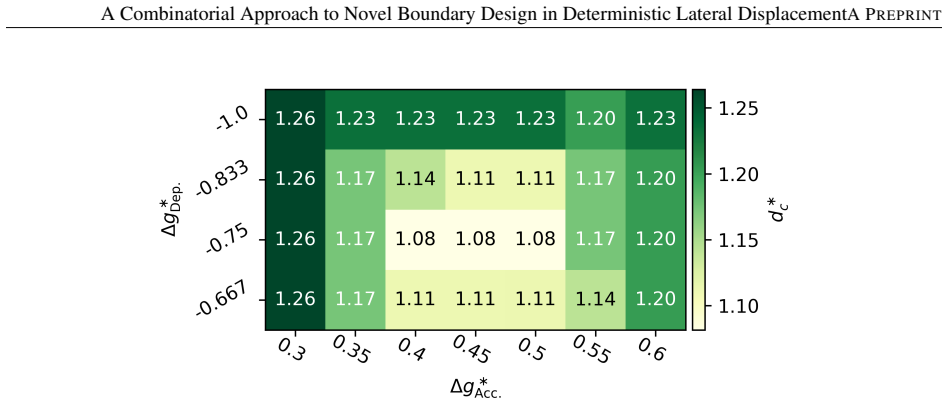
The central object is the parameterized boundary-profile family: at each full DLD unit, the depletion-sidewall gap and the accumulation-sidewall gap vary linearly along the channel axis, with the values at the upstreammost row set by the dimensionless parameters $\Delta g^*_{\mathrm{Dep}} \equiv \Delta g_d / g_w$ and $\Delta g^*_{\mathrm{Acc}} \equiv \Delta g_a / g_w$, where $g_w$ is the bulk gap. These two numbers fully determine the boundary geometry, so a combinatorial sweep over a coarse grid (37 designs in the experimental chip) plus a finer numerical grid amounts to optimizing a two-parameter family. Performance is scored in experiments by the width of the large-particle-laden stream downstream of the channel, and in simulations by the maximum local critical diameter across all lanes, normalized by an ideal Poiseuille-based reference value. The optimal pair is then checked for transferability across periodicity levels by particle tracking in solved 2D steady Navier-Stokes fields.
What would settle it
Simulate or fabricate a DLD array using the optimal boundary profile ($\Delta g^*_{\mathrm{Dep}}\approx -0.75$, $\Delta g^*_{\mathrm{Acc}}\approx 0.45$) with a different gap-to-pitch ratio (e.g., $g_w/\lambda_w = 0.3$ instead of $0.5$) or a non-circular pillar shape, and measure the maximum local critical diameter across lanes; if its deviation from the Poiseuille-reference value exceeds roughly 11%—or if the optimal parameter pair shifts—the claimed transferability of the design rule fails.
Extended reading notes
Core claim
The central discovery is that a linearly parameterized family of sidewall gap profiles—defined by the relative shrink of the depletion-sidewall gap and the relative widening of the accumulation-sidewall gap at the upstream row of each full unit—contains a stable optimum that nearly restores ideal flow behavior near boundaries. The pair $\Delta g^*_{\mathrm{Dep}}\approx -0.75$, $\Delta g^*_{\mathrm{Acc}}\approx 0.45$ was first located experimentally by testing 37 designs on a single chip and then sharpened by two-dimensional finite-volume simulations with particle tracking. On this basis, the authors claim that the maximum deviation of local critical diameter from the Poiseuille-reference value stays between roughly 1% and 11% for DLD periodicity $N_p = 8$ through $50$, in contrast to deviations of about 60–70% at large $N_p$ for the established flux-based boundary models. The paper presents this as the first boundary-design approach that deliberately replaces simplified analytical flux models with an empirically and numerically optimized parameterized profile.
Load-bearing premise
The load-bearing premise is that the optimal dimensionless boundary parameters measured and refined at one DLD geometry—periodicity 22, eight lanes, 14 µm pitch, circular pillars—transfer unchanged to every other DLD configuration; the paper's generalization test varies only the periodicity $N_p$ and keeps all other geometric parameters fixed.
Editorial extensions
If this is right
- A single boundary-profile rule, $\Delta g^*_{\mathrm{Dep}}\approx -0.75$ and $\Delta g^*_{\mathrm{Acc}}\approx 0.45$, can be applied directly to DLD channels of any periodicity between $N_p=8$ and $N_p=50$, keeping sidewall-induced critical-diameter deviations below about 11%.
- Prior flux-based boundary models (gap-squared, gap-cubed, and fitted-correlation) can leave deviations as high as 60–70% at large periodicity, so the parameterized family supersedes them for high-periodicity, narrow-channel devices.
- Because the experimental sweep found the optimal accumulation parameter near $\Delta g^*_{\mathrm{Acc}}\approx 0.4$, where the large-particle-laden stream narrows by roughly 19–28%, the design rule translates directly into higher downstream purity and concentration enhancement.
- The boundary design is integrated into an automated mask-layout generation code, so a complete DLD channel for a desired critical diameter and periodicity can be produced with a single command.
Reading between the lines
- The optimization was performed at one gap-to-pitch ratio and lane count; a systematic scan of $g_w/\lambda_w$ and lane number would reveal whether the dimensionless optimum is truly universal or merely local to the tested geometry.
- The numerical refinement includes a pressure-balance treatment near the accumulation sidewall that the experiments did not isolate, so the optimal parameter pair likely absorbs that effect; separating the two would show which mechanism the boundary profile is actually compensating for.
- If the same combinatorial framework is applied to multi-lane boundary profiles or nonlinear gap variations, the achievable critical-diameter deviation may drop below the 1–11% band reported here—a next step the authors themselves note.
- The experimental and numerical geometries differ (experiments used $N_p=27$, 10 µm pitch; simulations $N_p=22$, 14 µm pitch), so a direct head-to-head on identical geometry would test whether the 1–11% bound holds experimentally as well as numerically.
Editorial analysis
A structured set of objections, weighed in public.
Referee Report
Summary. The paper proposes a combinatorial design framework for sidewall boundary profiles in deterministic lateral displacement (DLD) arrays. Instead of using analytical or semi-empirical models, the authors parameterize the depletion- and accumulation-sidewall gap deviations at the upstreammost row by dimensionless parameters Δg*_Dep and Δg*_Acc, vary them in a parallel microfluidic chip containing 37 designs, and measure the downstream width of the large-particle-laden stream. They then use 2D CFD and particle tracking at a different geometry (Np=22, Nw=8, gaps 7 µm, pitch 14 µm) to refine the optimum to approximately Δg*_Dep=−0.75 and Δg*_Acc=0.45. In the generalization study (Section 2.2.2), they apply this optimum to periodicities Np=8–50 and report that the maximum critical diameter deviates from a Poiseuille-based reference by 1%–11%, whereas the methods of Ebadi et al. and Inglis et al. deviate by up to 60%–70%. The central claim is that the parameterized boundary design performs substantially better than existing approaches and generalizes across DLD periodicities.
Significance. If the central claim holds, the paper offers a practically useful engineering framework: it reduces sidewall-induced critical-diameter nonuniformity, integrates many designs on a single chip for efficient combinatorial testing, and provides open-source tools (mnFlow/DDA and particle-tracking code) that make the workflow reproducible. The agreement between experiments and CFD on a favorable parameter subspace is a genuine strength, as is the attempt to compare against established boundary-design methods. However, the significance is contingent on the transferability of the optimum to other DLD geometries and on a fair baseline comparison; these are precisely the points that currently need additional work.
major comments (4)
- [Section 2.2.2 (Generalization Evaluation), Figure 5] The generalization study varies only the periodicity Np; the optimal dimensionless parameters Δg*_Dep=−0.75 and Δg*_Acc=0.45 are transferred from a single base geometry (Np=22, Nw=8, gw=ga=7 µm, λw=λa=14 µm, circular pillars, 2D flow) to arrays with the same gap-to-pitch ratio, lane count, pillar shape, and depth. Since the optimum was found by a simulation-driven search at one geometry, the paper does not establish that these parameters remain optimal for other gap-to-pitch ratios, lane counts, pillar shapes, or finite channel depths. The conclusion that the boundary design 'generalizes effectively across a wide range of DLD periodicity values' is therefore supported only along the Np axis; the broader transferability assumption that underlies the abstract and conclusion remains untested.
- [Section 2.2.1 and Section 2.2.2] The optimization in Section 2.2.1 employs a pressure-balance scheme from Inglis et al. [21] in addition to the boundary profile, and the text states that this scheme mitigates disturbances 'irrespective of the boundary gap distribution utilized.' However, Section 2.2.2 does not state whether the same pressure-balance scheme was applied to the Ebadi et al. [20] and Inglis et al. [21] baseline designs. If it was not, the reported 60%–70% deviations for those baselines conflate the choice of boundary profile with an orthogonal pressure-balance enhancement, and the 1%–11% figure for the proposed design is not an apples-to-apples comparison. The authors should specify exactly what was simulated for each baseline and, ideally, rerun the baselines with the same pressure-balance treatment.
- [Section 2.1, Figure 3] The experimental performance metric is the mean width of the large-particle-laden stream downstream, not the maximum critical diameter dmax_c used in the numerical optimization. In addition, the experimental geometry (Np=27, Nw=22, gw≈4.3–4.6 µm, λ=10 µm) differs from the simulation geometry (Np=22, Nw=8, gw=ga=7 µm, λ=14 µm), and the experimental parameter grid is coarse (increments of 0.1 in Δg*_Acc). The experiments therefore identify a broad favorable subspace but do not independently verify the precise optimum (−0.75, 0.45) at the simulation geometry. Figure 3 also reports mean values without error bars or replicate statistics, so the ranking in Figure 3b gives no indication of whether Design #20 is significantly better than its near neighbors.
- [Section 2.2.2, metric Δd*_c,max] The headline numerical result is expressed as the deviation of dmax_c from a Poiseuille-based reference dref_c, which is a proxy for flow uniformity rather than a direct measurement of separation efficiency. The paper does not report an experimental measurement of dmax_c for the Np=8–50 range or for the optimized design at the experimental geometry. The abstract and conclusion phrase the 1%–11% result without this caveat, which could be read as experimental validation. The authors should state explicitly that the claimed superiority in the generalization study is a numerical result on this proxy metric.
minor comments (5)
- [Figure 5] The label 'P ow' appears to be a typographical artifact; it should read 'Pow' for consistency with the text.
- [Section 2.3, Listing 1] Listing 1 is described as a 'single-command' example, but it contains four lines; consider clarifying that one function call with keyword arguments is meant.
- [Section 4 (Numerical Simulations)] The tracer-count uncertainty estimate (±13.7 nm for first stream width, ±27.4 nm for critical diameter) is helpful, but no analogous uncertainty quantification is provided for the experimental stream-width measurements in Section 2.1; adding replicate counts or error bars to Figure 3 would strengthen the experimental ranking.
- [Conclusion] The statement that the gap size is 'presently assumed to vary linearly along the channel axis' is a useful limitation, but it appears only in the Conclusion; stating it when the design family is introduced in Section 2.1 would help readers interpret the parameter space.
- [Table 1] The caption entry 'Design #4 (~Pow3)' may confuse readers because Design #4 is also listed as a member of the new parameterized family; clarify that it is a linearized version of the gap-cubed boundary profile.
Circularity Check
No circular derivation: the optimal boundary parameters are fitted at one geometry and then validated at other periodicities, so the 1–11% generalization claim is an out-of-sample check rather than a tautology.
full rationale
The load-bearing result is an optimization followed by an out-of-sample evaluation. In Sec. 2.2.1, the dimensionless boundary parameters Δg*_Dep and Δg*_Acc are varied at a fixed geometry (Np=22, Nw=8, gw=ga=7 µm, λw=λa=14 µm) and the maximum of the local critical diameter, normalized by a Poiseuille-based reference, is minimized; this only fits two parameters at one operating point. In Sec. 2.2.2, those same fitted values are applied to DLD channels with Np from 8 to 50, i.e., geometries not used in the fit, and the same metric is evaluated against the external baselines of Ebadi et al. and Inglis et al. The reported 1–11% deviation is therefore a predictive check, not an identity: nothing in the definition of Δg*_Dep or Δg*_Acc forces the optimum found at Np=22 to also minimize the metric at Np=50. The self-citations (DDA/mnFlow tool, tracking code, and the prior pressure-balance study) support methodology and a secondary design choice, but the central claim is not derived from them, and the comparison baselines are external. No equation is shown to reduce to its own input, no fitted parameter is renamed as a prediction, and no uniqueness theorem is imported. The main vulnerability is transferability across gap-to-pitch ratios, pillar shapes, and lane counts, which is a scope limitation rather than circularity.
Assumptions & free parameters
free parameters (2)
- Δg*_Dep (dimensionless depletion-sidewall gap at upstreammost row) =
-0.75 (optimal); swept over -0.667, -0.833, -1.0 experimentally
- Δg*_Acc (dimensionless accumulation-sidewall gap at upstreammost row) =
0.45 (optimal); experimental optimum near 0.4
assumptions (6)
- domain assumption Flow is predominantly 2D because the normalized depth h*≈8 exceeds ~2.5, so 2D Navier-Stokes simulations represent the experiment.
- domain assumption Local critical diameter can be estimated as dc≈2β, where β is the first stream width obtained from point-tracer tracking in 2D flow.
- domain assumption The pressure balance scheme near the accumulation sidewall from reference [21] further mitigates disturbances, and its benefit is assumed to hold for all parameterized profiles.
- domain assumption The ideal reference critical diameter from a Poiseuille flow model [15] is an appropriate normalization target for measuring design quality.
- ad hoc to paper Optimal dimensionless parameters (-0.75, 0.45) found at one geometry transfer to other DLD configurations.
- ad hoc to paper Linear variation of the boundary gap along the channel axis is a sufficient design family for near-optimal performance.
Cite this review
Pith. "Pith review of A Combinatorial Approach to Novel Boundary Design in Deterministic Lateral Displacement." pith.science (2026). https://pith.science/paper/PCA5NCTY
@misc{pith2026250606936,
  author       = {Pith},
  title        = {Pith review of: A Combinatorial Approach to Novel Boundary Design in Deterministic Lateral Displacement},
  year         = {2026},
  howpublished = {\url{https://pith.science/paper/PCA5NCTY}},
  note         = {Machine review of arXiv:2506.06936}
}
read the original abstract
Deterministic lateral displacement (DLD) is a high-resolution separation technique used in various fields. A fundamental challenge in DLD is ensuring uniform flow characteristics across channel, particularly near sidewalls where pillar matrix inevitably loses its lateral periodicity. Despite attempts in the literature to improve boundary design, significant variations in critical diameter persist near sidewalls, adversely affecting the separation performance. We propose a combinatorial framework to develop an optimal design aimed at minimizing flow disturbances. We employ a set of parameterized boundary profiles, integrating multiple DLD channels, each with distinct design parameters, into a single microfluidic chip in parallel. Fluorescent beads are introduced into the chip via through-wafer via, flowing through inlet buses and DLD channels. The width of large-particle-laden stream downstream of channels is determined using fluorescence microscopy and image processing. The experimental results suggest an optimal range of design parameters for depletion and accumulation sidewalls. We conduct numerical simulations to further explore the experimental findings and refine the optimization. Comparison of results with existing design methodologies in the literature demonstrates the superior performance of the proposed framework. This work paves the way for design of DLD systems with enhanced performance, particularly for applications requiring high recovery rates and purity simultaneously.
Figures


Figures from the paper (3 more)


Reference graph
Works this paper leans on
-
[21]
D. Inglis, R. Vernekar, T. Kr¨uger, and S. Feng, “The fluidic resistance of an array of obstacles and a method for improving boundaries in deterministic lateral displacement arrays,” Microfluidics and Nanofluidics 24 no. 3, (Feb., 2020) 18. https://doi.org/10.1007/s10404-020-2323-x
-
[20]
Efficient paradigm to enhance particle separation in deterministic lateral displacement arrays,
A. Ebadi, M. J. Farshchi Heydari, R. Toutouni, B. Chaichypour, M. Fathipour, and K. Jafari, “Efficient paradigm to enhance particle separation in deterministic lateral displacement arrays,” SN Applied Sciences 1 no. 10, (Sept., 2019) 1184. https://doi.org/10.1007/s42452-019-1064-5
-
[1]
Continuous Particle Separation Through Deterministic Lateral Displacement,
L. R. Huang, E. C. Cox, R. H. Austin, and J. C. Sturm, “Continuous Particle Separation Through Deterministic Lateral Displacement,” Science 304 no. 5673, (May, 2004) 987–990. https://www.science.org/doi/10.1126/science.1094567
-
[2]
Gel-on-a-chip: Continuous, velocity-dependent DNA separation using nanoscale lateral displacement,
B. H. Wunsch, S.-C. Kim, S. M. Gifford, Y . Astier, C. Wang, R. L. Bruce, J. V . Patel, E. A. Duch, S. Dawes, G. Stolovitzky, and J. T. Smith, “Gel-on-a-chip: Continuous, velocity-dependent DNA separation using nanoscale lateral displacement,” Lab on a Chip 19 no. 9, (Apr., 2019) 1567–1578. https://pubs.rsc.org/en/content/articlelanding/2019/lc/c8lc01408f
work page 2019
-
[3]
Nanoscale lateral displacement arrays for the separation of exosomes and colloids down to 20 nm,
B. H. Wunsch, J. T. Smith, S. M. Gifford, C. Wang, M. Brink, R. L. Bruce, R. H. Austin, G. Stolovitzky, and Y . Astier, “Nanoscale lateral displacement arrays for the separation of exosomes and colloids down to 20 nm,” 11 A Combinatorial Approach to Novel Boundary Design in Deterministic Lateral DisplacementA PREPRINT Nature Nanotechnology 11 no. 11, (Nov...
work page 2016
-
[4]
J. T. Smith, B. H. Wunsch, N. Dogra, M. E. Ahsen, K. Lee, K. K. Yadav, R. Weil, M. A. Pereira, J. V . Patel, E. A. Duch, J. M. Papalia, M. F. Lofaro, M. Gupta, A. K. Tewari, C. Cordon-Cardo, G. Stolovitzky, and S. M. Gifford, “Integrated nanoscale deterministic lateral displacement arrays for separation of extracellular vesicles from clinically-relevant v...
work page 2018
-
[5]
N. Tottori, T. Hatsuzawa, and T. Nisisako, “Separation of main and satellite droplets in a deterministic lateral displacement microfluidic device,” RSC Advances 7 no. 56, (July, 2017) 35516–35524. https://pubs.rsc.org/en/content/articlelanding/2017/ra/c7ra05852g
work page 2017
-
[6]
Deterministic hydrodynamics: Taking blood apart,
J. A. Davis, D. W. Inglis, K. J. Morton, D. A. Lawrence, L. R. Huang, S. Y . Chou, J. C. Sturm, and R. H. Austin, “Deterministic hydrodynamics: Taking blood apart,” Proceedings of the National Academy of Sciences 103 no. 40, (Oct., 2006) 14779–14784. https://www-pnas-org.ezproxy.lib.utexas.edu/doi/full/10.1073/pnas.0605967103
Show all 28 references
-
[7]
Label-Free Biophysical Markers from Whole Blood Microfluidic Immune Profiling Reveal Severe Immune Response Signatures,
K. K. Zeming, R. Vernekar, M. T. Chua, K. Y . Quek, G. Sutton, T. Kr¨uger, W. S. Kuan, and J. Han, “Label-Free Biophysical Markers from Whole Blood Microfluidic Immune Profiling Reveal Severe Immune Response Signatures,” Small 17 no. 12, (2021) 2006123. https://onlinelibrary.w...
2021 doi
-
[8]
DLD pillar shape design for efficient separation of spherical and non-spherical bioparticles,
S. Ranjan, K. K. Zeming, R. Jureen, D. Fisher, and Y . Zhang, “DLD pillar shape design for efficient separation of spherical and non-spherical bioparticles,” Lab on a Chip 14 no. 21, (Sept., 2014) 4250–4262. https://pubs.rsc.org/en/content/articlelanding/2014/lc/c4lc00578c
2014
-
[9]
Asymmetrical Deterministic Lateral Displacement Gaps for Dual Functions of Enhanced Separation and Throughput of Red Blood Cells,
K. K. Zeming, T. Salafi, C.-H. Chen, and Y . Zhang, “Asymmetrical Deterministic Lateral Displacement Gaps for Dual Functions of Enhanced Separation and Throughput of Red Blood Cells,” Scientific Reports 6 no. 1, (Mar., 2016) 22934. https://www.nature.com/articles/srep22934
2016
-
[10]
Highly Sensitive Minimal Residual Disease Detection by Biomimetic Multivalent Aptamer Nanoclimber Functionalized Microfluidic Chip,
Y . Liu, H. Zhang, Y . Du, Z. Zhu, M. Zhang, Z. Lv, L. Wu, Y . Yang, A. Li, L. Yang, Y . Song, S. Wang, and C. Yang, “Highly Sensitive Minimal Residual Disease Detection by Biomimetic Multivalent Aptamer Nanoclimber Functionalized Microfluidic Chip,” Small 16 no. 20, (2020) 20...
2020 doi
-
[11]
Portable platform for leukocyte extraction from blood using sheath-free microfluidic DLD,
O. G. Chavez-Pineda, R. Rodriguez-Moncayo, A. M. Gonzalez-Suarez, P. E. Guevara-Pantoja, J. L. Maravillas-Montero, and J. L. Garcia-Cordero, “Portable platform for leukocyte extraction from blood using sheath-free microfluidic DLD,” Lab on a Chip 24 no. 9, (Apr., 2024) 2575–25...
2024
-
[12]
Precise Size-Based Cell Separation via the Coupling of Inertial Microfluidics and Deterministic Lateral Displacement,
N. Xiang, J. Wang, Q. Li, Y . Han, D. Huang, and Z. Ni, “Precise Size-Based Cell Separation via the Coupling of Inertial Microfluidics and Deterministic Lateral Displacement,” Analytical Chemistry 91 no. 15, (Aug., 2019) 10328–10334. https://doi.org/10.1021/acs.analchem.9b02863
2019 doi
-
[13]
Cascaded filter deterministic lateral displacement microchips for isolation and molecular analysis of circulating tumor cells and fusion cells,
Z. Liu, Y . Huang, W. Liang, J. Bai, H. Feng, Z. Fang, G. Tian, Y . Zhu, H. Zhang, Y . Wang, A. Liu, and Y . Chen, “Cascaded filter deterministic lateral displacement microchips for isolation and molecular analysis of circulating tumor cells and fusion cells,” Lab on a Chip 21...
2021
-
[14]
Maximizing particle concentration in deterministic lateral displacement arrays,
S. Feng, A. M. Skelley, A. G. Anwer, G. Liu, and D. W. Inglis, “Maximizing particle concentration in deterministic lateral displacement arrays,” Biomicrofluidics 11 no. 2, (Mar., 2017) 024121. https://aip.scitation.org/doi/10.1063/1.4981014
2017 doi
-
[15]
Critical particle size for fractionation by deterministic lateral displacement,
D. W. Inglis, J. A. Davis, R. H. Austin, and J. C. Sturm, “Critical particle size for fractionation by deterministic lateral displacement,” Lab on a Chip 6 no. 5, (May, 2006) 655–658. https://pubs.rsc.org/en/content/articlelanding/2006/lc/b515371a
2006
-
[16]
A Review on Deterministic Lateral Displacement for Particle Separation and Detection,
T. Salafi, Y . Zhang, and Y . Zhang, “A Review on Deterministic Lateral Displacement for Particle Separation and Detection,” Nano-Micro Letters 11 no. 1, (Sept., 2019) 77. https://doi.org/10.1007/s40820-019-0308-7
2019 doi
-
[17]
Broken flow symmetry explains the dynamics of small particles in deterministic lateral displacement arrays,
S.-C. Kim, B. H. Wunsch, H. Hu, J. T. Smith, R. H. Austin, and G. Stolovitzky, “Broken flow symmetry explains the dynamics of small particles in deterministic lateral displacement arrays,” Proceedings of the National Academy of Sciences 114 no. 26, (June, 2017) E5034–E5041. ht...
2017 doi
-
[18]
Pariset, C
E. Pariset, C. Pudda, F. Boizot, N. Verplanck, J. Berthier, A. Thuaire, and V . Agache, “Anticipating Cutoff Diameters in Deterministic Lateral Displacement (DLD) Microfluidic Devices for an Optimized Particle 12 A Combinatorial Approach to Novel Boundary Design in Determinist...
2017 doi
-
[19]
Efficient microfluidic particle separation arrays,
D. W. Inglis, “Efficient microfluidic particle separation arrays,” Applied Physics Letters 94 no. 1, (Jan., 2009) 013510. https://doi.org/10.1063/1.3068750
2009 doi
-
[22]
Investigation of pressure balance in proximity of sidewalls in deterministic lateral displacement,
A. Mehboudi, S. Singhal, and S. V . Sreenivasan, “Investigation of pressure balance in proximity of sidewalls in deterministic lateral displacement,” Biomicrofluidics 19 no. 3, (May, 2025) 034102. https://doi.org/10.1063/5.0272397
2025 doi
-
[23]
A universal framework for design and manufacture of deterministic lateral displacement chips,
A. Mehboudi, S. Singhal, and S. V . Sreenivasan, “A universal framework for design and manufacture of deterministic lateral displacement chips,” Lab on a Chip 25 no. 6, (Mar., 2025) 1521–1536. https://pubs.rsc.org/en/content/articlelanding/2025/lc/d4lc00838c
2025
-
[24]
mnFlow: A package for micro/nanoflow,
A. Mehboudi, “mnFlow: A package for micro/nanoflow,” Dec., 2024. https://zenodo.org/doi/10.5281/zenodo.14357811
2024 doi
-
[25]
J. A. Davis, Microfluidic Separation of Blood Components through Deterministic Lateral Displacement. PhD thesis, Princeton University, 2008. https://swh.princeton.edu/~sturmlab/theses/Davis-Thesis.pdf
2008
-
[26]
Tlambert03/nd2,
T. Lambert, “Tlambert03/nd2,” Jan., 2025. https://github.com/tlambert03/nd2
2025
-
[27]
Opencv/opencv-python
“Opencv/opencv-python.” Opencv, Jan., 2025. https://github.com/opencv/opencv-python
2025
-
[28]
A tracking algorithm for finite-size particles,
A. Mehboudi, S. Singhal, and S. V . Sreenivasan, “A tracking algorithm for finite-size particles,” Biomicrofluidics 19 no. 3, (May, 2025) 034103. https://doi.org/10.1063/5.0271539. 13
2025 doi
Reviewed August 7, 2026 · model on record in the stance chip above.
Discussion (0). Sign in to comment.