REVIEW 3 major objections 5 minor 56 references
Novel universality class for the ferromagnetic transition in the low carrier concentration systems UTeS and USeS exhibiting large negative magnetoresistance
T0 review · 3 major / 5 minor · reviewed 2026-08-14 · deepseek-v4-flash
Pith's one-line read The paper claims that the ferromagnetic transitions in UTeS and USeS have critical exponents $\beta \approx 0.30$, $\gamma \approx 1.00$, and $\delta \approx 4.2$–$4.3$, a set that matches neither the 3D Ising model nor mean-field theory…
desk verdict Careful exponent measurements on two new uranium compounds, but the 'novel universality class' framing outruns what the fit-window analysis can support. read the letter →
The pith
A machine-rendered reading of the paper's core claim, the machinery that carries it, and where it could break.
The reading
What carries the argument
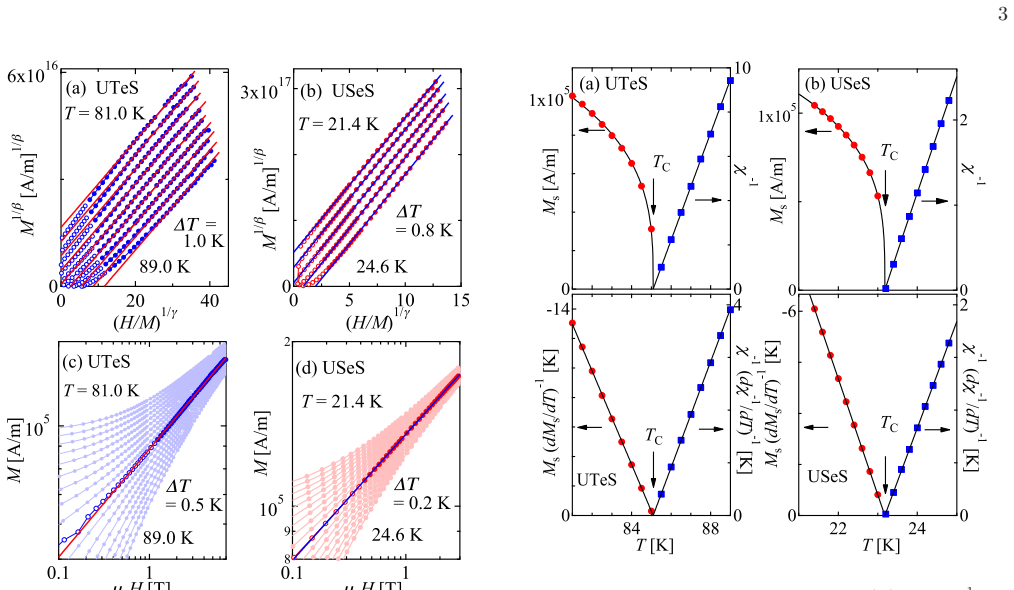
The load-bearing tool is the modified Arrott plot, built from the Arrott-Noakes equation of state $(H/M)^{1/\gamma} = (T - T_C)/T_1 + (M/M_1)^{1/\beta}$, which makes magnetic isotherms straight lines when the correct $\beta$ and $\gamma$ are chosen. The paper cross-checks the resulting values with the Kouvel-Fisher method and with a scaling analysis of the renormalized magnetization $m \equiv |t|^{-\beta}M$ against the renormalized field $h \equiv \mu_0H|t|^{-(\beta+\gamma)}$, and it obtains $\delta$ both from critical isotherm fits and from the relation $\delta = 1 + \gamma/\beta$. The convergence of these independent methods is what carries the identification of a common universality class.
What would settle it
Measure the magnetic correlation length and the specific-heat jump for UTeS and USeS, and compute the Ginzburg width $\Delta T_G$; if $\Delta T_G$ is comparable to or larger than the fitted windows (about 8 K for UTeS and 3.2 K for USeS), the reported $\beta$, $\gamma$, and $\delta$ are effective exponents rather than asymptotic ones. Alternatively, remeasure magnetization in a narrower window closer to $T_C$: if the exponents shift toward 3D Ising values, the proposed universality class is not confirmed.
Extended reading notes
Core claim
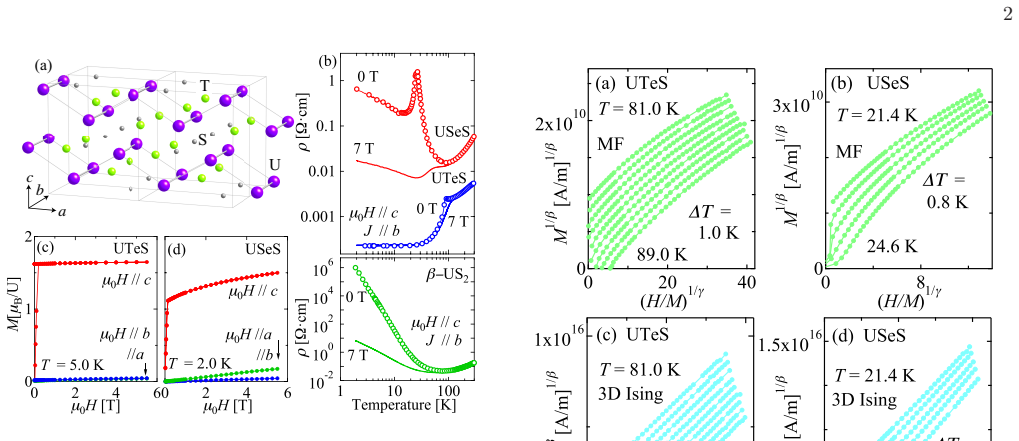
The central claim is that the ferromagnetic transitions in UTeS and USeS follow a common, unconventional set of critical exponents: spontaneous magnetization exponent $\beta \approx 0.30$ (Ising-like), susceptibility exponent $\gamma \approx 1.00$ and isotherm exponent $\delta \approx 4.2$–$4.3$ (mean-field-like), consistent with the scaling relation $\delta = 1 + \gamma/\beta$. The transitions are strongly uniaxial, yet the data reject the short-range 3D Ising class ($\beta = 0.325$, $\gamma = 1.241$, $\delta = 4.82$) and the mean-field class ($\beta = 0.5$, $\gamma = 1.0$, $\delta = 3.0$). The same exponent sets appear in UGe$_2$, URhGe, URhSi, UIr, and U(Co$_{0.98}$Os$_{0.02}$)Al, and the paper proposes that all these compounds belong to a single universality class that is now observed in materials with localized $5f$ electrons (UTeS, USeS) as well as itinerant ones.
Load-bearing premise
The result stands only if the fitted temperature and field windows really lie inside the narrow universal scaling region around each transition; the paper cannot independently verify this because no magnetic correlation length has been reported for either compound.
Editorial extensions
If this is right
- UTeS and USeS enlarge the proposed universality class from itinerant uranium intermetallics to localized-$5f$, low-carrier-density compounds.
- The failure of mean-field and 3D Ising descriptions is symmetric below and above $T_C$: the same exponents describe both sides, ruling out a crossover across $T_C$.
- The exponents obey the scaling relation $\delta = 1 + \gamma/\beta$, so the three measured exponents are thermodynamically consistent within each compound.
- If the class is genuine, the large negative magnetoresistance of UTeS and USeS and the superconductivity of UGe$_2$ and URhGe both occur adjacent to magnetism characterized by the same critical behavior.
- The class cannot be explained by short-range exchange, dipole interactions, the ANNNI model, or standard spin-fluctuation theory in the present comparison, narrowing the theoretical options.
Reading between the lines
- A testable extension: measure $\beta$-US$_2$ under pressure, where a ferromagnetic state is induced; if the universality class is generic among uranium dichalcogenides, its exponents should match $\beta \approx 0.30$ and $\gamma \approx 1.00$.
- The same exponents in a semiconductor (USeS) and a semimetal (UTeS) suggest that carrier density is not the organizing variable; the class may be controlled by the local geometry of the uranium moments and their coupling to a small number of conduction states.
- Specific-heat or neutron-scattering measurements close to $T_C$ should reveal a specific-heat exponent consistent with the reported exponents via standard scaling relations; seeing that consistency would stiffen the claim that this is a true universality class.
- A nonlocal or magnetoelastic Ginzburg-Landau description, previously applied to UGe$_2$ and URhGe, may be the natural language for the whole family and could be tested through uniaxial-pressure experiments.
Signed reviews
Editorial analysis
A structured set of objections, weighed in public.
Referee Report
Summary. The paper reports magnetization critical exponents for the ferromagnetic transitions in the low-carrier uranium dichalcogenides UTeS and USeS. Using modified Arrott plots, Kouvel-Fisher analysis, and scaling-collapse analysis on data in restricted temperature and field windows, the authors extract β ≈ 0.30, γ ≈ 1.00, and δ ≈ 4.21–4.34, with values from the Widom relation δ = 1 + γ/β in good agreement. They show that the exponents differ from the 3D Ising model with short-range exchange and are similar to those previously reported for UGe2, URhGe, URhSi, UIr, and U(Co0.98Os0.02)Al. They conclude that the transitions may belong to a novel universality class common to these uranium ferromagnets, appearing also in compounds with localized 5f electrons.
Significance. If the extracted exponents are true asymptotic critical exponents, the paper identifies a distinct and reproducible universality class in uranium ferromagnets, with an Ising-like β but mean-field-like γ and δ. This would be significant for theories of ferromagnetic quantum criticality, ferromagnetic superconductivity, and the dual localized/itinerant nature of 5f electrons. The manuscript has notable strengths: the three analysis methods are standard and properly applied; the Widom-relation check is nontrivial; the comparison compounds were measured in earlier, independent studies, so the comparison is not circular; and the authors explicitly acknowledge that the Ginzburg criterion cannot currently be evaluated for UTeS and USeS. The main weakness is that the asymptotic critical region is not independently established, so the central claim remains conditional on a fitting-window assumption.
major comments (3)
- [Section IV, Discussion] The load-bearing assumption is that the selected temperature and field windows lie inside the asymptotic critical region. The authors state that it is 'impossible to estimate ΔT_G for UTeS and USeS since the magnetic correlation length ξ has not been reported so far,' and they justify the windows by noting that data up to 7 T in USeS do not linearize the MAP and that different methods agree. These are internal-consistency checks performed on the same truncated data, not independent tests of the H→0, T→T_C fixed point. Since the MAP, Kouvel-Fisher, and scaling analyses all use essentially the same windows, agreement among them does not establish asymptoticity. The extracted exponents could be effective exponents from a high-field crossover region. Please provide a window-stability analysis (exponents as the temperature and field cutoffs are varied), an attempt to include the lower-field data with a quantified demagnetization correction, or a quantitative estimate or upper bound on ξ0 and hence ΔT_G.
- [Section III, Eq. (4) and Fig. 3] The MAP fits exclude the low-field data that deviate from straight lines, with the deviations attributed to domain-wall movement, sample inhomogeneities, or an inaccurate demagnetization factor. The asymptotic scaling laws in Eqs. (1)–(3) are defined for weak fields, and the critical isotherm is taken at H→0, so systematically excluding the low-field region and fitting only the high-field linear portion can bias γ and δ toward mean-field-like values (γ≈1, δ≈4.2). This is especially relevant because the reported γ is close to unity. The authors should quantify the sensitivity of the exponents to the demagnetization factor, which is quoted as D = 0.50 and 0.46 without uncertainty, and report the fitted exponents as the lower field cutoff is changed.
- [Title and abstract] The title asserts a 'novel universality class,' while the abstract and summary only state that the transitions 'may belong to the same one.' Given that the asymptotic-window assumption is not independently verified, the stronger title claim is not yet supported. Either temper the claim or add an independent test, such as the specific-heat exponent α or a scaling collapse that includes the previously excluded low-field region, which would test universality without relying solely on the same truncated windows.
minor comments (5)
- [Section III, figure references] The text refers to Figs. 4(c) and 4(d) for the critical isotherms used to determine δ, but those isotherms are shown in Figs. 3(c) and 3(d); similarly, the Kouvel-Fisher fits appear to be the lower panels of Figs. 4(a) and 4(b), not Figs. 4(e) and 4(f). Please correct the cross-references.
- [Table I] For U(Co0.98Os0.02)Al, the table lists β = 0.33, γ = 1.0, and δ = 4.18 without uncertainties, whereas other compounds have quoted errors; please provide the uncertainties from the source or state that they are unavailable.
- [Section IV, item (5)] The sentence about the nonlocal Ginzburg-Landau model ends with 'It is hoped that the almost mean-field behavior of χ is completely reproduced,' which is vague; specify which aspect of the Singh-Dutta-Nandy calculation is incomplete.
- [General] The manuscript does not report fit quality measures such as χ² or R² for the MAP, Kouvel-Fisher, and scaling fits; reporting these would help the reader judge the choice of fitting windows.
- [Introduction and title] The title emphasizes large negative magnetoresistance, but the paper only uses magnetoresistance as context and does not analyze its critical behavior; consider clarifying in the introduction that magnetoresistance is motivation rather than part of the exponent analysis.
Circularity Check
No significant circularity: critical exponents are fit outputs from magnetization data, and the comparison to other uranium compounds uses independent prior measurements.
full rationale
The paper's central quantities (β, γ, γ′, δ, and T_C) are determined by least-squares fits to magnetization isotherms through the Arrott-Noakes equation of state, Kouvel-Fisher analysis, critical-isotherm fits, and scaling collapse. None of these quantities is pre-assigned and then 'predicted' from itself; each is an output of the data. The claim that UTeS and USeS may share a universality class with UGe₂, URhGe, URhSi, UIr, and U(Co₀.₉₈Os₀.₀₂)Al rests on comparison with critical exponents reported in earlier papers [16, 24], which are independent measurements on different compounds and are not used as inputs to the fits in the present work. The scaling plot in Fig. 5 and the Widom relation check δ = 1 + γ/β are self-consistency checks, not derivations of the exponents from the claimed universality class. The paper's explicit admission that ΔT_G cannot be estimated for UTeS and USeS because the magnetic correlation length has not been reported is a limitation on whether the fitted exponents are truly asymptotic, but it is a validity concern, not circularity: the conclusion that the data are inside the critical region is not fed back into the fits as a parameter or constraint. No equation is defined in terms of the quantity it is said to derive, and no fitted parameter is renamed as a prediction. Therefore no circular step can be exhibited.
Assumptions & free parameters
free parameters (5)
- beta (spontaneous magnetization exponent) =
UTeS: 0.309 +/- 0.003 (MAP), 0.315 +/- 0.003 (KF), 0.318 +/- 0.002 (scaling); USeS: 0.300 +/- 0.003 (MAP), 0.293 +/…
- gamma (susceptibility exponent) =
UTeS: 0.998 +/- 0.003 (MAP), 0.996 +/- 0.003 (KF), 1.04 +/- 0.02 (scaling); USeS: 1.00 +/- 0.02 (MAP), 0.989 +/- 0.003…
- delta (critical isotherm exponent) =
UTeS: 4.21 +/- 0.04; USeS: 4.34 +/- 0.04
- Demagnetization factor D =
0.50 (UTeS), 0.46 (USeS)
- Fit windows (T and H ranges) =
UTeS: 81.0-89.0 K, 1.2-7.0 T; USeS: 21.4-24.6 K, 0.4-3.0 T
assumptions (4)
- standard math Magnetization near TC follows the scaling laws of Eqs. (1)-(3) and the Arrott-Noakes equation of state, Eq. (4).
- domain assumption Low-field deviations from the Arrott-Noakes straight lines are caused by domain-wall motion and sample inhomogeneities, not by a breakdown of the equation of state.
- ad hoc to paper The chosen temperature and field windows lie inside the asymptotic critical region even though the Ginzburg criterion cannot be computed because the correlation length is unmeasured.
- domain assumption The 5f electrons in UTeS and USeS are localized, based on soft X-ray photoemission (ref 50, unpublished).
Cite this review
Pith. "Pith review of Novel universality class for the ferromagnetic transition in the low carrier concentration systems UTeS and USeS exhibiting large negative magnetoresistance." pith.science (2026). https://pith.science/paper/PCRAXCP7
@misc{pith2026190807652,
  author       = {Pith},
  title        = {Pith review of: Novel universality class for the ferromagnetic transition in the low carrier concentration systems UTeS and USeS exhibiting large negative magnetoresistance},
  year         = {2026},
  howpublished = {\url{https://pith.science/paper/PCRAXCP7}},
  note         = {Machine review of arXiv:1908.07652}
}
read the original abstract
We report the novel critical behavior of magnetization in low carrier concentration systems UTeS and USeS that exhibit the large negative magnetoresistance around the ferromagnetic transition temperatures T_C ~ 85 and 23 K, respectively. UTeS and USeS crystallize in the same orthorhombic TiNiSi-type crystal structure as those of uranium ferromagnetic superconductors URhGe and UCoGe. We determine the critical exponents, beta for the spontaneous magnetization M_s, gamma for the magnetic susceptibility chi, and delta for the magnetization isotherm at T_C with several methods. The ferromagnetic states in UTeS and USeS have strong uniaxial magnetic anisotropy. However, the critical exponents in the two compounds are different from those in the three-dimensional Ising model with short-range magnetic exchange interactions. Similar sets of the critical exponents have been reported for the uranium ferromagnetic superconductors UGe_2 and URhGe, and uranium intermetallic ferromagnets URhSi, UIr and U(Co_0.98Os_0.02)Al. The universality class of the ferromagnetic transitions in UTeS and USeS may belong to the same one for the uranium compounds. The novel critical phenomenon associated with the ferromagnetic transition is observed not only in the uranium intermetallic ferromagnets with the itinerant 5f electrons but also in the low carrier concentration systems UTeS and USeS with the localized 5f electrons. The large negative magnetoresistance in UTeS and USeS, and the superconductivity in UGe_2 and URhGe share the similarity of their closeness to the ferromagnetism characterized by the novel critical exponents.
Figures

Figures from the paper (1 more)

Reference graph
Works this paper leans on
-
[1]
J. A. Mydosh and P. M. Oppeneer, Rev. Mod. Phys. 83, 1301 (2011)
work page 2011
-
[2]
Pfleiderer, Rev
C. Pfleiderer, Rev. Mod. Phys. 81, 1551 (2009)
2009
-
[3]
G. R. Stewart, Advances in Physics 66, 75 (2017)
work page 2017
-
[4]
A. D. Huxley, Physica C 514, 368 (2015)
work page 2015
- [5]
-
[6]
S. Ran, C. Eckberg, Q-P. Ding, Y. Furukawa, T. Metz, S. R. Saha, I-L. Liu, M. Zic, H. Kim, J. Paglione, and N. P. Butch, Science 365, 684 (2019)
work page 2019
- [7]
- [8]
Show all 56 references
-
[9]
Tro´ c, D
R. Tro´ c, D. Kaczorowski, L. Shlyk, M. Potel, and H. No¨ el, J. Phys. Chem. Solids. 55, 815 (1994)
1994
-
[10]
Ikeda, H
S. Ikeda, H. Sakai, T. D. Matsuda, D. Aoki, Y. Homma, E. Yamamoto, A. Nakamura, Y. Shiokawa, Y. Haga, and Y. ¯Onuki, J. Phys. Soc. Jpn. 75, 124706 (2006)
2006
-
[11]
Ikeda, H
S. Ikeda, H. Sakai, D. Aoki, Y. Homma, E. Yamamoto, A. Nakamura, Y. Shiokawa, Y. Haga, and Y. ¯Onuki, J. Phys. Soc. Jpn. 78, 114704 (2009)
2009
-
[12]
Hutanu, H
V. Hutanu, H. Deng, S. Ran, W. T. Fuhrman, H. Thoma, and N. P. Butch, arXiv:1905.04377
1905 arXiv
-
[13]
Y. Haga, E. Yamamoto, and S. Ikeda, unpublished
-
[14]
M. B. Salamon, Rev. Mod. Phys. 73, 583 (2001)
2001
-
[15]
Tateiwa, Y
N. Tateiwa, Y. Haga, E. Yamamoto, and Z. Fisk, JPS Conf. Proc. 3, 011086 (2014)
2014
-
[16]
Tateiwa, Y
N. Tateiwa, Y. Haga, T. D. Matsuda, E. Yamamoto, and Z. Fisk, Phys. Rev. B 89, 064420 (2014)
2014
-
[17]
Privman, P
V. Privman, P. C. Hohenberg, and A. Aharony, in Phase Transitions and Critical Phenomena , edited by C. Domb and J. L. Lebowitz (Academic, New York, 1991), p. 1
1991
-
[18]
Arrott and J
A. Arrott and J. E. Noakes, Phys. Rev. Lett. 19, 786 (1967)
1967
-
[19]
Seeger and H
M. Seeger and H. Kronm¨ uller, J. Magn. Magn. Mater. 78, 393 (1989)
1989
-
[20]
Widom, J
B. Widom, J. Chem. Phys. 43, 3892 (1965)
1965
-
[21]
J. S. Kouvel and M. E. Fisher, Phys. Rev. 136, A1626 (1964)
1964
-
[22]
M. E. Fisher, Rev. Mod. Phys. 46, 597 (1974)
1974
-
[23]
J. C. Le Guillou and J. Zinn-Justin, Phys. Rev. B 21, 3976 (1980)
1980
-
[24]
Tateiwa, Y
N. Tateiwa, Y. Haga, and E. Yamamoto, Phys. Rev. B 99, 094417 (2019)
2019
-
[25]
Knafo, C
W. Knafo, C. Meingast, S. Sakarya, N. H. v. Dijk, Y. Huang, H. Rakoto, J-M. Broto, and H. v. L¨ ohneysen, J. Phys. Soc. Jpn. 78, 043707 (2009)
2009
-
[26]
Sakarya, N
S. Sakarya, N. H. van Dijk, A. de Visser, E. Br¨ uk, Y. Huang, J. A. A. J. Perenboom, H. Rakoto, and J. -M. Brot, J. Magn. Magn. Mater. 310, 1564 (2007)
2007
-
[27]
Maeda, A
M. Maeda, A. V. Andreev, K. Shirasaki, T. Yamamura, and N. Kimura, J. Phys. Soc. Jpn. 87, 094713 (2019)
2019
-
[28]
A. V. Andreev, K. Shirasaki, J. ˇSebek, J. Vejpravov´ a, D. I. Gorbunov. L. Havela, S. Daniˇ s, and T. Yamamura, J. Alloys Compd. 681, 275 (2016)
2016
-
[29]
N. T. Huy, A. Gasparini, D. E. de Nijs, Y. Huang, J. C. P. Klaasse, T. Gortenmulder, A. de Visser, A. Hamann, T. G¨ orlach, and H. v. L¨ ohneysen, Phys. Rev. Lett. 99, 067006 (2007)
2007
-
[30]
V. L. Ginzburg, Sov. Phys. Solid State 2, 1824 (1961)
1961
-
[31]
P. M. Chaikin and T. C. Lubensky, Principles of Con- densed Matter Physics (Cambridge University Press, Cambridge, 1995)
1995
-
[32]
E. A. Yelland, S. J. C. Yates, O. Taylor, A. Griffiths, S. M. Haydem, and A. Carrington, Phys. Rev. B 72, 184436 (2005)
2005
-
[33]
Stock, D
C. Stock, D. A. Sokolov, P. Bourges, P. H. Tobash, K. Gofryk, F. Ronning, E. D. Bauer, K. C. Rule, and A. D. Huxley, Phys. Rev. Lett. 107, 187202 (2011)
2011
-
[34]
M. E. Fisher, S-k. Ma, and B. G. Nickel, Phys. Rev. Lett. 29, 917 (1972)
1972
-
[35]
Srinath, S
S. Srinath, S. N. Kaul, and H. Kronm¨ uller, Phys. Rev. B 59, 1145 (1999)
1999
-
[36]
M. E. Fisher and A. Aharony, Phys. Rev. Lett. 30, 559 (1973)
1973
-
[37]
Frey and F
E. Frey and F. Schwabl, Phys. Rev. B 43, 833 (1991)
1991
-
[38]
Frey and F
E. Frey and F. Schwabl, Phys. Rev. B 42, 8261 (1990)
1990
-
[39]
M. A. Yurishchev, Phys. Rev. B 50, 13533 (1994)
1994
-
[40]
A. K. Murtazev and Zh. G. Ibaev, J. Exp. Theor. Phys. 113, 106 (2011)
2011
-
[41]
Moriya, Spin Fluctuations in Itinerant Electron Mag- netism (Springer-Verlag, New York, 1985)
T. Moriya, Spin Fluctuations in Itinerant Electron Mag- netism (Springer-Verlag, New York, 1985)
1985
-
[42]
Takahashi, Spin Fluctuations Theory of Itinerant Electron Magnetism (Springer-Verlag, New York, 2013)
Y. Takahashi, Spin Fluctuations Theory of Itinerant Electron Magnetism (Springer-Verlag, New York, 2013)
2013
-
[43]
Singh, K
R. Singh, K. Dutta, and M. K. Nandy, Phys. Rev. E 95, 012133 (2017)
2017
-
[44]
Tateiwa, J
N. Tateiwa, J. Posp ´ ıˇ sil, Y. Haga, H. Sakai, T. D. Mat- suda, and E. Yamamoto, Phys. Rev. B 96, 035125 (2017)
2017
-
[45]
Yaouanc, P
A. Yaouanc, P. Dalmas de R´ eotier, P. C. M. Gubbens, C. T. Kaiser, A. A. Menovsky, M. Mihalik, and S. P. Cottrell, Phys. Rev. Lett. 89, 147001 (2002)
2002
-
[46]
Sakarya, P
S. Sakarya, P. C. M. Gubbens, A. Yaouanc, P. Dalmas de R´ eotier, D. Andreica, A. Amato, U. Zimmermann, N. H. van Dijk, E. Br¨ uck, Y. Huang, and T. Gortenmulder, Phys. Rev. B 81, 024429 (2010)
2010
-
[47]
Tro´ c, Z
R. Tro´ c, Z. Gajek, and A. Pikul, Phys. Rev. B 86, 224403 (2012)
2012
-
[48]
Hattori and H
K. Hattori and H. Tsunetsugu, Phys. Rev. B 87, 064501 (2013)
2013
-
[49]
Thalmeier, Eur
P. Thalmeier, Eur. Phys. J. B 27, 29 (2002)
2002
-
[50]
Takeda, T
Y. Takeda, T. Okane, T. Okochi, M. Kobayashi, S. Fuji- mori, Y. Saito, H. Yamagami, A. Fujimori, S. Ikeda, H. Sakai, and Y. Haga, unpublished
-
[51]
Braithwaite, J-P
D. Braithwaite, J-P. Brison, J. Flouquet, G. Knebel, A. Nakamura, and A. Pourret, Phys. Rev. Lett. 120, 037001 (2018)
2018
-
[52]
V. P. Mineev, Phys. Rev. B 96, 104501 (2017). 8
2017
-
[53]
T. R. Kirkpatrick and D. Belitz, Phys. Rev. B 91, 214407 (2015)
2015
-
[54]
Sundar, S
S. Sundar, S. Gheidi, K. Akintola, A. M. Cˆ ot´ e, S. R. Dunsiger, S. Ran, N. P. Butch, S. R. Saha, J. Paglione, and J. E. Sonier, arXiv:1905.06901
1905 arXiv
-
[55]
Ran, I-L
S. Ran, I-L. Liu, Y. S. Eo, D. J. Campbell, P. Neves, W. T. Fuhrman, S. R. Saha, C. Eckberg, H. Kim, J. Paglione, D. Graf, J. Singleton, and N. P. Butch, arXiv:1905.04343
1905 arXiv
-
[56]
T. Metz, S. Bae, S. Ran, I-L. Liu, Y. S. Eo, W. T. Fuhrman, D. F. Agterberg, S. Anlage, N. P. Butch, and J. Paglione, arXiv:1908.01069
1908 arXiv
Reviewed August 14, 2026 · model on record in the stance chip above.
Discussion (0). Continue with ORCID to comment.