A Stochastic Epidemiological Model of Latent Tuberculosis in a Radiation Exposed Mars Colony
Pith reviewed 2026-06-25 19:09 UTC · model grok-4.3
The pith
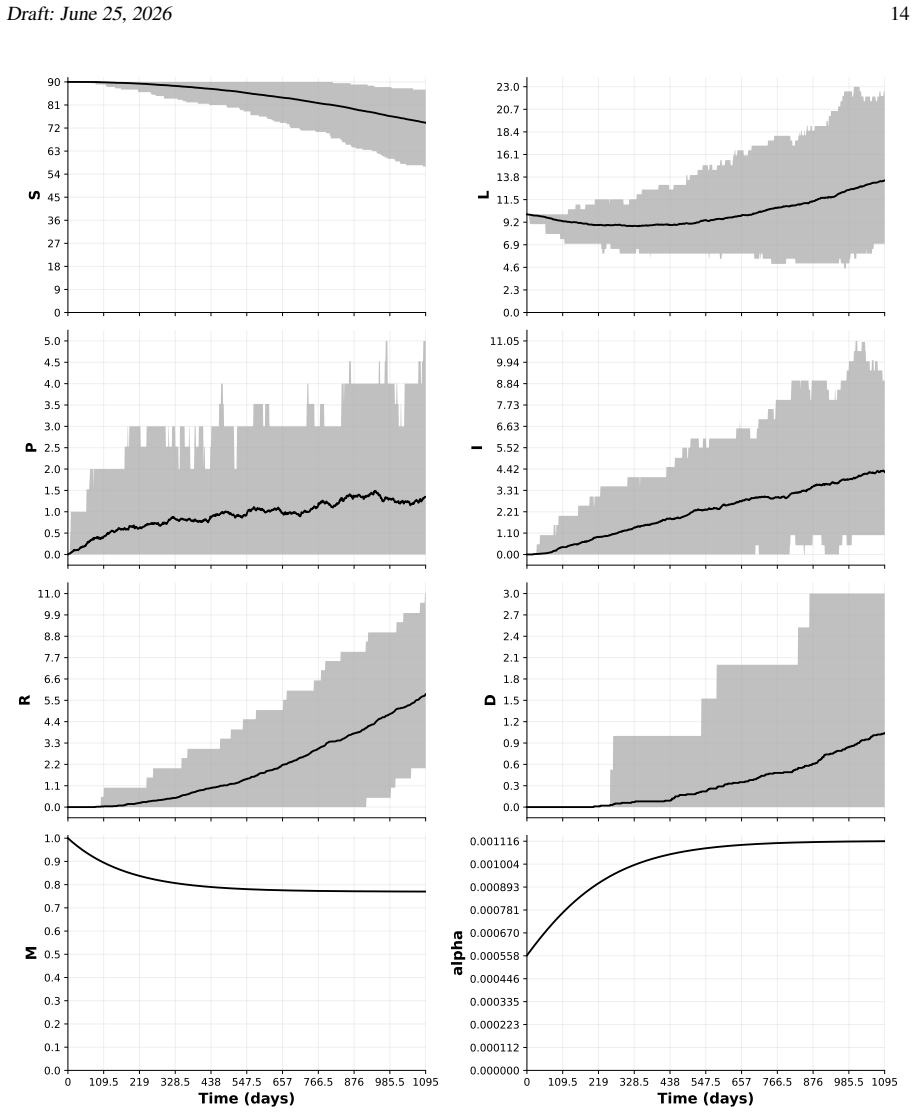
A stochastic model shows latent tuberculosis can reactivate endogenously in a Mars colony due to radiation effects on immunity, even without initial infectious cases.
A machine-rendered reading of the paper's core claim, the machinery that carries it, and where it could break.
Core claim
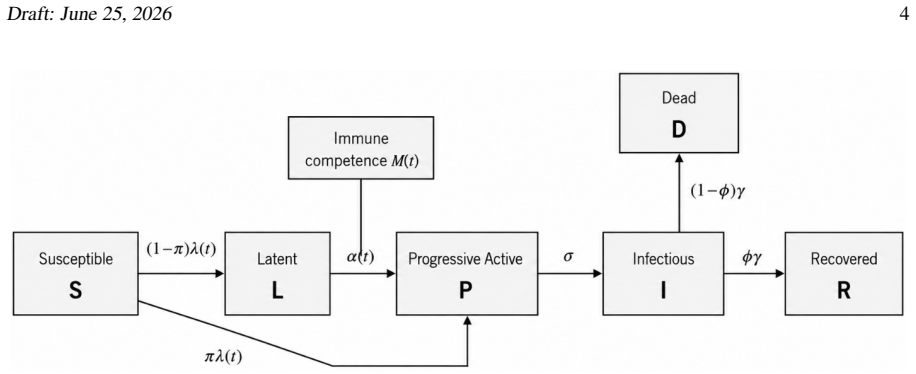
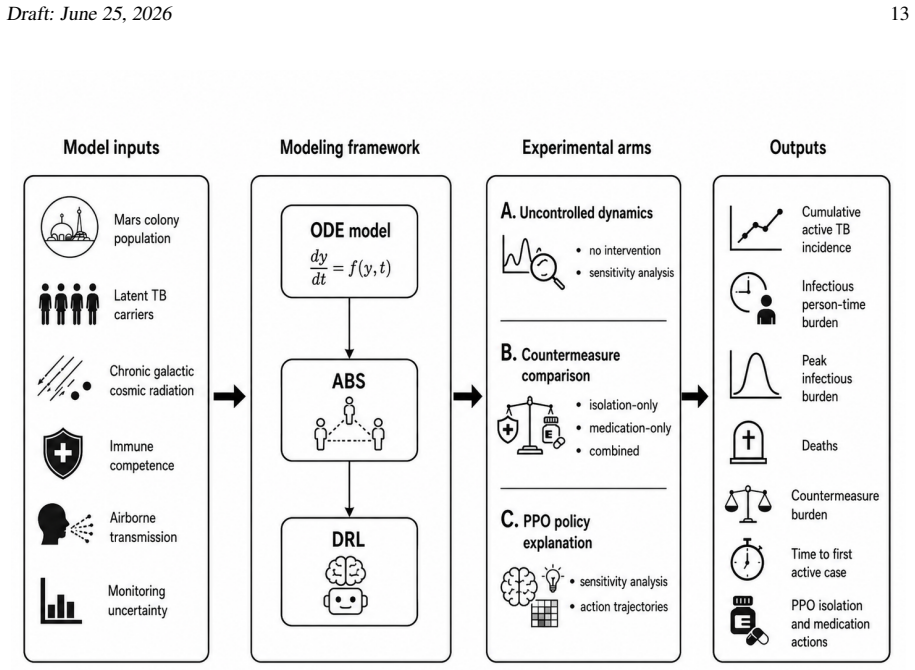
We develop a stochastic host-radiation-pathogen-habitat model of latent tuberculosis reactivation in a Mars colony. The model links galactic cosmic radiation to immune competence, immune competence to latent-tuberculosis reactivation, and reactivation to airborne transmission in a closed habitat. We also formulate countermeasure allocation as a partially observable sequential decision problem in which isolation and medication are selected by fixed baselines or by a proximal policy optimization policy trained on an agent-based simulator. Our simulations show that active tuberculosis can emerge endogenously despite no initial infectious cases, and that risk is most sensitive to latent reservoi
What carries the argument
Stochastic epidemiological model that couples galactic cosmic radiation dose to immune competence and then to latent TB reactivation probability, embedded in an agent-based simulator with a proximal policy optimization agent for adaptive isolation and treatment decisions.
If this is right
- Active tuberculosis can appear endogenously from a latent reservoir even when no individuals start infectious.
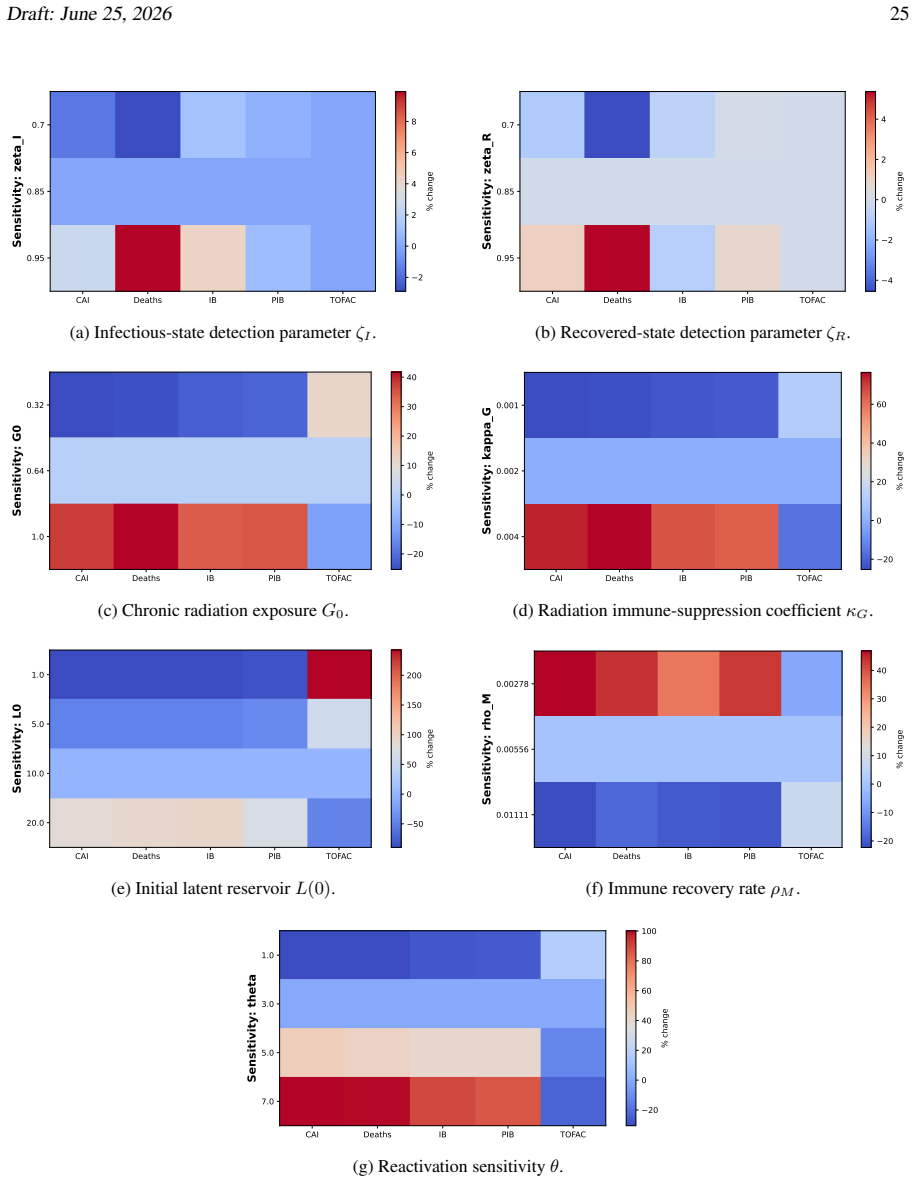
- Outbreak probability is most sensitive to the size of the latent TB reservoir, the radiation-immune coupling strength, and reactivation sensitivity.
- Adaptive policies for isolation and medication outperform fixed baselines by lowering infectious burden and mortality with fewer interventions.
- The framework permits pre-launch stress testing of screening, monitoring, shielding, and treatment strategies under Mars-specific conditions.
Where Pith is reading between the lines
- Pre-mission treatment to shrink the latent TB reservoir could materially lower in-mission outbreak risk.
- Analogous models could be applied to other latent infections or radiation-sensitive conditions in long-duration spaceflight.
- Terrestrial validation of the radiation-to-reactivation relationships would increase confidence in mission planning use.
- The adaptive control approach could extend to other scarce-resource medical decisions in isolated habitats.
Load-bearing premise
The specific functional relationships that convert radiation dose into reduced immune competence and then into higher latent TB reactivation rates are taken as given without independent calibration or validation data.
What would settle it
Direct empirical measurements of TB reactivation rates in humans or animal models under chronic radiation exposure levels matching Mars transit and surface conditions would test the accuracy of the modeled couplings.
Figures
read the original abstract
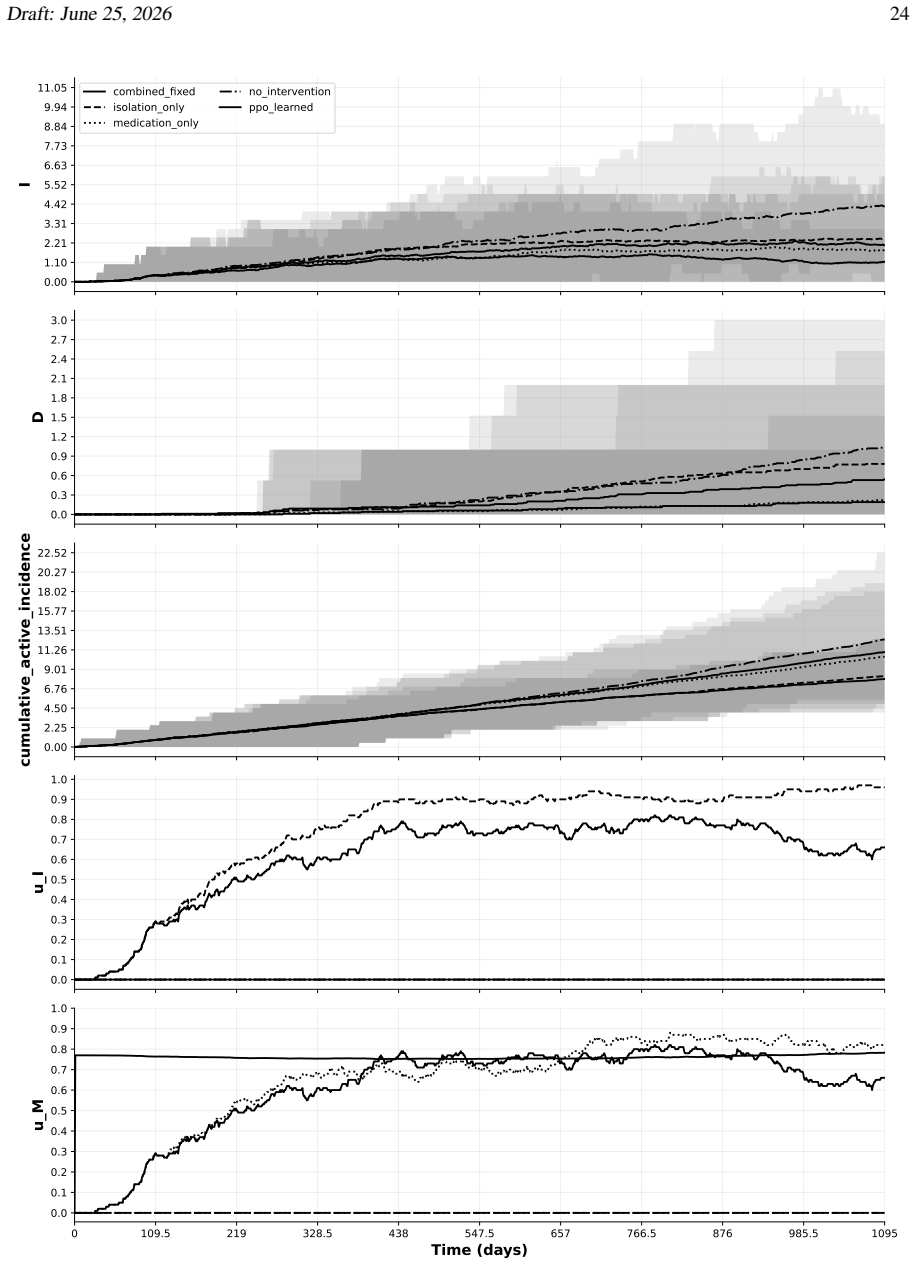
Plans to establish a sustained human presence on Mars have moved from speculative ambition toward concrete engineering programmes, making the biological consequences of settlement an increasingly practical question. A Mars colony would place a small, closed population in an environment combining chronic radiation, altered immunity, constrained medical autonomy, and engineered indoor air. Latent infections are especially important because clinically silent carriers may become sources of transmissible disease when host control deteriorates. In this study, we develop a stochastic host-radiation-pathogen-habitat model of latent tuberculosis reactivation in a Mars colony. The model links galactic cosmic radiation to immune competence, immune competence to latent-tuberculosis reactivation, and reactivation to airborne transmission in a closed habitat. We also formulate countermeasure allocation as a partially observable sequential decision problem in which isolation and medication are selected by fixed baselines or by a proximal policy optimization policy trained on an agent-based simulator. Our simulations show that active tuberculosis can emerge endogenously despite no initial infectious cases, and that risk is most sensitive to latent reservoir size, radiation-immune coupling and reactivation sensitivity. Adaptive control reduced infectious burden and mortality while limiting unnecessary intervention. This framework supports mission-specific stress testing of screening, monitoring, shielding and treatment strategies before launch.
Editorial analysis
A structured set of objections, weighed in public.
Referee Report
Summary. The manuscript develops a stochastic host-radiation-pathogen-habitat model coupling galactic cosmic radiation to immune competence, immune competence to latent TB reactivation probability, and reactivation to airborne transmission within a closed Mars colony. Agent-based simulations are used to show endogenous emergence of active TB from latent reservoirs with no initial infectious cases, to rank sensitivities to latent reservoir size, radiation-immune coupling strength, and reactivation sensitivity, and to demonstrate that a proximal policy optimization controller trained on the simulator reduces infectious burden and mortality relative to fixed baselines while limiting unnecessary interventions.
Significance. If the core functional mappings can be independently justified, the framework offers a concrete tool for pre-mission stress-testing of screening, shielding, and treatment policies under combined radiation and epidemiological stress. The integration of stochastic simulation with partially observable sequential decision-making via reinforcement learning is a constructive methodological step for closed-environment biosecurity problems.
major comments (3)
- [Model Formulation] Model description (implicit in abstract and methods): the functional forms that map galactic cosmic radiation dose to reduced immune competence and then to elevated latent-TB reactivation probability are introduced as given without derivation from empirical radiation-immunology data, TB reactivation studies, or cross-validation against known terrestrial or analog conditions. Because the reported sensitivity rankings and the endogenous-emergence result are driven by these mappings, any mismatch with actual biology would invalidate the central claims.
- [Simulation Results] Simulation results section: no parameter sources, ranges, or sensitivity-analysis protocol (e.g., partial-rank correlation coefficients, Sobol indices) are supplied, nor is any validation against real TB incidence or radiation-immune datasets described. Consequently the statement that risk is “most sensitive to latent reservoir size, radiation-immune coupling and reactivation sensitivity” cannot be verified from the supplied text.
- [Adaptive Control Experiments] Adaptive-control experiments: the claim that the PPO policy outperforms fixed baselines rests on the same uncalibrated couplings; without a robustness check that varies the radiation-immune and reactivation functions, it is unclear whether the reported reduction in burden and mortality generalizes beyond the specific assumed forms.
minor comments (2)
- [Abstract] The abstract would be strengthened by a single sentence stating the mathematical form of the radiation-immune and reactivation mappings or by citing the supplementary equations that define them.
- [Model Formulation] Notation for immune competence and reactivation probability should be introduced once with explicit symbols rather than repeated descriptive phrases.
Simulated Author's Rebuttal
We thank the referee for the constructive critique. The comments correctly identify gaps in justification, documentation, and robustness testing that must be addressed for the claims to be verifiable. We outline point-by-point revisions below.
read point-by-point responses
-
Referee: [Model Formulation] Model description (implicit in abstract and methods): the functional forms that map galactic cosmic radiation dose to reduced immune competence and then to elevated latent-TB reactivation probability are introduced as given without derivation from empirical radiation-immunology data, TB reactivation studies, or cross-validation against known terrestrial or analog conditions. Because the reported sensitivity rankings and the endogenous-emergence result are driven by these mappings, any mismatch with actual biology would invalidate the central claims.
Authors: We agree the functional forms require explicit derivation. The revised manuscript will add a dedicated subsection in Methods that cites specific radiation-immunology and TB latency studies, states the exact functional forms chosen, and discusses the terrestrial-to-Mars extrapolations and their uncertainties. revision: yes
-
Referee: [Simulation Results] Simulation results section: no parameter sources, ranges, or sensitivity-analysis protocol (e.g., partial-rank correlation coefficients, Sobol indices) are supplied, nor is any validation against real TB incidence or radiation-immune datasets described. Consequently the statement that risk is “most sensitive to latent reservoir size, radiation-immune coupling and reactivation sensitivity” cannot be verified from the supplied text.
Authors: We accept that parameter provenance and sensitivity protocol are absent. The revision will include a table of all parameter sources and ranges, a global sensitivity analysis using Sobol indices, and direct comparisons of model outputs against published terrestrial TB incidence and radiation-immune datasets. revision: yes
-
Referee: [Adaptive Control Experiments] Adaptive-control experiments: the claim that the PPO policy outperforms fixed baselines rests on the same uncalibrated couplings; without a robustness check that varies the radiation-immune and reactivation functions, it is unclear whether the reported reduction in burden and mortality generalizes beyond the specific assumed forms.
Authors: We agree that robustness to the assumed couplings must be shown. The revised experiments section will add a sensitivity sweep over the radiation-immune and reactivation parameters and report PPO performance statistics across those variations. revision: yes
Circularity Check
No circularity detected; model is simulation-based with explicit assumptions
full rationale
The paper constructs a stochastic epidemiological model by specifying functional links from galactic cosmic radiation to immune competence and from immune competence to latent-TB reactivation probability. These mappings are introduced as model components rather than derived via equations or self-citations that reduce the outputs to the inputs by construction. Simulations then generate endogenous emergence, sensitivity rankings, and control outcomes from the defined model. No quoted step shows a fitted parameter renamed as a prediction, a self-definitional loop, or a load-bearing self-citation chain. The derivation chain is the forward simulation itself and remains independent of the reported results.
Axiom & Free-Parameter Ledger
Reference graph
Works this paper leans on
-
[1]
Scott, Matthew J
Ebrahim Afshinnekoo, Ryan T. Scott, Matthew J. MacKay, Eloise Pariset, Egle Cekanaviciute, Richard Barker, Simon Gilroy, Duane Hassane, Scott M. Smith, Sara R. Zwart, et al. Fundamental biological features of spaceflight: Advancing the field to enable deep-space exploration.Cell, 183(5):1162–1184.e1, 2020
2020
-
[2]
Wiley Online Library, 2022
V olker Hessel, Jana Stoudemire, Hideaki Miyamoto, and ID Fisk.In-Space Manufacturing and Resources. Wiley Online Library, 2022
2022
-
[3]
Towards sustainable horizons: A comprehensive blueprint for mars colonization.Heliyon, 10(4), 2024
Florian Neukart. Towards sustainable horizons: A comprehensive blueprint for mars colonization.Heliyon, 10(4), 2024. Draft: June 25, 2026 19
2024
-
[4]
Infections in long-duration space missions.The Lancet Microbe, 5(9), 2024
Daniel Cowen, Rulan Zhang, and Matthieu Komorowski. Infections in long-duration space missions.The Lancet Microbe, 5(9), 2024
2024
-
[5]
Infectious diseases and the use of antimicrobials on space missions.Space: Science & Technology, 4:0205, 2024
Alice RC e Castro-Costa, Rodrigo Siqueira-Batista, Fab ´ıola A Alcˆantara, Tha´ıs Russomano, Marlise A San- tos, Isadora de C e Silva, and Oswaldo M Del Cima. Infectious diseases and the use of antimicrobials on space missions.Space: Science & Technology, 4:0205, 2024
2024
-
[6]
Evidence supporting the management of medical conditions during long-duration spaceflight: Protocol for a scoping review.JMIR Research Protocols, 10(3):e24323, 2021
Kim-Anh Tran, Neal William Pollock, Caroline Rh ´eaume, Payal Sonya Razdan, F´elix-Antoine Fortier, Lara Dutil-Fafard, Camille Morin, David Pierre-Marie Monnot, Maxime Huot-Lavoie, Philippe Simard-Sauriol, et al. Evidence supporting the management of medical conditions during long-duration spaceflight: Protocol for a scoping review.JMIR Research Protocols...
2021
-
[7]
Effects of simulated martian environmental stressors on specific human pathogen–immune system interactions.Mbio, 16(9):e01099–25, 2025
Tommaso Zaccaria, ¨Ozlem Bulut, Anaisa V Ferreira, Margo Dona, Jeroen D Langereis, Rob J Mesman, Joppe Wesseling, Laura van Niftrik, Mihai G Netea, Petra Rettberg, et al. Effects of simulated martian environmental stressors on specific human pathogen–immune system interactions.Mbio, 16(9):e01099–25, 2025
2025
-
[8]
From earth to mars: a perspective on exploiting biomineralization for martian construction.Frontiers in Microbiology, 16:1645014, 2025
Shiva Khoshtinat, Jared Long-Fox, and Seyed Mohammad Javad Hosseini. From earth to mars: a perspective on exploiting biomineralization for martian construction.Frontiers in Microbiology, 16:1645014, 2025
2025
-
[9]
Perras, Gregor Gorkiewicz, Gabriele Berg, and Christine Moissl-Eichinger
Maximilian Mora, Alexander Mahnert, Karin Koskinen, Michelle-Ruth Pausan, Lisa Oberauner-Wappis, Regina Krause, Alexandra K. Perras, Gregor Gorkiewicz, Gabriele Berg, and Christine Moissl-Eichinger. Microorganisms in confined habitats: Microbial monitoring and control of intensive care units, operating rooms, cleanrooms and the international space station...
2016
-
[10]
High resolution spatio-temporal model for room-level airborne pandemic spread.Mathematics, 11(2):426, 2023
Teddy Lazebnik and Ariel Alexi. High resolution spatio-temporal model for room-level airborne pandemic spread.Mathematics, 11(2):426, 2023
2023
-
[11]
The trade-off between airborne pandemic control and energy consumption using air ventilation solutions.Sensors, 22(22):8594, 2022
Ariel Alexi, Ariel Rosenfeld, and Teddy Lazebnik. The trade-off between airborne pandemic control and energy consumption using air ventilation solutions.Sensors, 22(22):8594, 2022
2022
-
[12]
Slaba, Charles M
Tony C. Slaba, Charles M. Werneth, Cary Zeitlin, et al. Validated space radiation exposure predictions from earth to mars during artemis-i.npj Microgravity, 11:6, 2025
2025
-
[13]
L. W. Townsend, J. H. Adams, S. R. Blattnig, M. S. Clowdsley, D. J. Fry, I. Jun, C. D. McLeod, J. I. Minow, D. F. Moore, J. W. Norbury, R. B. Norman, D. V . Reames, N. A. Schwadron, E. J. Semones, R. C. Singleterry, T. C. Slaba, C. M. Werneth, and M. A. Xapsos. Solar particle event storm shelter requirements for missions beyond low earth orbit.Life Scienc...
2018
-
[14]
Hassler, Cary Zeitlin, Robert F
Donald M. Hassler, Cary Zeitlin, Robert F. Wimmer-Schweingruber, Bent Ehresmann, Scot Rafkin, Jen- nifer L. Eigenbrode, David E. Brinza, G ¨unther Weigle, Stephan B ¨ottcher, Eckart B ¨ohm, et al. Mars’ surface radiation environment measured with the mars science laboratory’s curiosity rover.Science, 343(6169):1244797, 2014
2014
-
[15]
Ann R. Kennedy. Biological effects of space radiation and development of effective countermeasures.Life Sciences in Space Research, 1:10–43, 2014
2014
-
[16]
Hassler, Francis A
Cary Zeitlin, Donald M. Hassler, Francis A. Cucinotta, Bent Ehresmann, Robert F. Wimmer-Schweingruber, David E. Brinza, Sang Y . Kang, G¨unther Weigle, Stephan B ¨ottcher, Eckart B ¨ohm, et al. Measurements of energetic particle radiation in transit to mars on the mars science laboratory.Science, 340(6136):1080–1084, 2013
2013
-
[17]
Winer, Hongying Du, JangKeun Kim, et al
Daniel A. Winer, Hongying Du, JangKeun Kim, et al. Astroimmunology: The effects of spaceflight and its associated stressors on the immune system.Nature Reviews Immunology, 26:189–212, 2026
2026
-
[18]
NASA-STD-3001 Technical Brief: Microbiology in Space Overview
NASA Office of the Chief Health and Medical Officer. NASA-STD-3001 Technical Brief: Microbiology in Space Overview. Technical brief, 2024. Draft: June 25, 2026 20
2024
-
[19]
Spaceflight-induced immune system dysregulation and microgravity- associated alterations in microbial virulence – infectious disease risk for astronauts
NASA Human Research Program. Spaceflight-induced immune system dysregulation and microgravity- associated alterations in microbial virulence – infectious disease risk for astronauts. Human Research Roadmap task page, 2026
2026
-
[20]
Blue, Robert A
Rebecca S. Blue, Robert A. Mulcahy, Amy J. Kreykes, Robert Haddon, James M. Pattarini, Benjamin D. Johansen, and Rahul Suresh. Infectious disease outcomes of nasa’s health stabilization program.npj Micro- gravity, 2026
2026
-
[21]
Antonsen, Jerry G
Erik L. Antonsen, Jerry G. Myers, Lynn Boley, John Arellano, Eric Kerstman, Binaifer Kadwa, Daniel M. Buckland, and Mary Van Baalen. Estimating medical risk in human spaceflight.npj Microgravity, 8(1), 2022
2022
-
[22]
Prelich, Clara M
Matthew T. Prelich, Clara M. Gasiewski, Lauren McIntyre, Binaifer Kadwa, John Arellano, and Jerry G. Myers. Assessment of model outcomes between the integrated medical model (imm) and the medical ex- tensible dynamic probabilistic risk assessment tool (medprat). Technical Report NASA/TM-20240012058, National Aeronautics and Space Administration, 2024
2024
-
[23]
Menzies, Emory Wolf, David Connors, Meghan Bellerose, Alyssa N
Nicolas A. Menzies, Emory Wolf, David Connors, Meghan Bellerose, Alyssa N. Sbarra, Ted Cohen, An- drew N. Hill, Reza Yaesoubi, Kara Galer, Peter J. White, Ibrahim Abubakar, and Joshua A. Salomon. Pro- gression from latent infection to active disease in dynamic tuberculosis transmission models: A systematic review of the validity of modelling assumptions.T...
2018
-
[24]
Stepanov, Quyen Tran, Jason M
Aleksandra Checinska Sielaff, Camilla Urbaniak, Ganesh Babu Malli Mohan, Victor G. Stepanov, Quyen Tran, Jason M. Wood, Jeremiah Minich, Daniel McDonald, Tasha Mayer, Rob Knight, et al. Characteriza- tion of the total and viable bacterial and fungal communities associated with the international space station surfaces.Microbiome, 7:50, 2019
2019
-
[25]
V oorhies, C
Alexander A. V oorhies, C. Mark Ott, Satish Mehta, Duane L. Pierson, Brian E. Crucian, Alan Feiveson, Cherie M. Oubre, Manolito Torralba, Kevin Moncera, Yi Zhang, et al. Study of the impact of long-duration space missions at the international space station on the astronaut microbiome.Scientific Reports, 9:9911, 2019
2019
-
[26]
Mehta, Brian E
Satish K. Mehta, Brian E. Crucian, Raymond P. Stowe, Richard J. Simpson, C. Mark Ott, Clarence F. Sams, and Duane L. Pierson. Latent virus reactivation in astronauts on the international space station.npj Micro- gravity, 3:11, 2017
2017
-
[27]
Rooney, Brian E
Bridgette V . Rooney, Brian E. Crucian, Duane L. Pierson, Mark L. Laudenslager, and Satish K. Mehta. Her- pes virus reactivation in astronauts during spaceflight and its application on earth.Frontiers in Microbiology, 10:16, 2019
2019
-
[28]
Latent tuberculosis infection: Updated and consolidated guidelines for program- matic management, 2018
World Health Organization. Latent tuberculosis infection: Updated and consolidated guidelines for program- matic management, 2018
2018
-
[29]
Clinical overview of latent tuberculosis infection
Centers for Disease Control and Prevention. Clinical overview of latent tuberculosis infection. Web page, 2024
2024
-
[30]
Tuberculosis: Causes and how it spreads
Centers for Disease Control and Prevention. Tuberculosis: Causes and how it spreads. Web page, 2025
2025
-
[31]
Behr, David Dowdy, Keertan Dheda, Maziar Divangahi, Catharina C
Madhukar Pai, Marcel A. Behr, David Dowdy, Keertan Dheda, Maziar Divangahi, Catharina C. Boehme, Ann Ginsberg, Soumya Swaminathan, Melvin Spigelman, Haileyesus Getahun, Dick Menzies, and Mario Raviglione. Tuberculosis.Nature Reviews Disease Primers, 2:16076, 2016
2016
-
[32]
Behr, Paul H
Marcel A. Behr, Paul H. Edelstein, and Lalita Ramakrishnan. Quantifying the rates of late reactivation tuberculosis: A systematic review.The Lancet Infectious Diseases, 2021. Draft: June 25, 2026 21
2021
-
[33]
Rangaka, Katherine A
Molebogeng X. Rangaka, Katherine A. Wilkinson, Judith R. Glynn, Dena Ling, Dick Menzies, Judith Mwansa-Kambafwile, Katherine Fielding, Robert J. Wilkinson, and Madhukar Pai. Predictive value of interferon-γrelease assays for incident active tuberculosis: A systematic review and meta-analysis.The Lancet Infectious Diseases, 12(1):45–55, 2012
2012
-
[34]
Garrett-Bakelman, Manjula Darshi, Stefan J
Francine E. Garrett-Bakelman, Manjula Darshi, Stefan J. Green, Ruben C. Gur, Ling Lin, Brandon R. Ma- cias, Miles J. McKenna, Cem Meydan, Tejaswini Mishra, Jad Nasrini, et al. The nasa twins study: A multidimensional analysis of a year-long human spaceflight.Science, 364(6436):eaau8650, 2019
2019
-
[35]
Tierney, Eliah G
Braden T. Tierney, Eliah G. Overbey, et al. Longitudinal multi-omics analysis of host microbiome architec- ture and immune responses during short-term spaceflight.Nature Microbiology, 2024
2024
-
[36]
Tierney, Eliah G
JangKeun Kim, Braden T. Tierney, Eliah G. Overbey, Ezequiel Dantas, Matias Fuentealba, Jiwoon Park, S. Anand Narayanan, Fei Wu, Deena Najjar, Christopher R. Chin, et al. Single-cell multi-ome and immune profiles of the inspiration4 crew reveal conserved, cell-type, and sex-specific responses to spaceflight.Nature Communications, 2024
2024
-
[37]
Salido, Haoqi Nina Zhao, Daniel McDonald, Helena Mannochio-Russo, Simone Zuffa, Re- nee E
Rodolfo A. Salido, Haoqi Nina Zhao, Daniel McDonald, Helena Mannochio-Russo, Simone Zuffa, Re- nee E. Oles, Allegra T. Aron, Yasin El Abiead, Sawyer Farmer, Antonio Gonz ´alez, et al. The international space station has a unique and extreme microbial and chemical environment driven by use patterns.Cell, 188(7):2022–2041.e23, 2025
2022
-
[38]
Singh et al
Nitin K. Singh et al. Genomic, functional, and metabolic enhancements in multidrug-resistantEnterobacter bugandensisfacilitating its persistence and succession in the international space station.Microbiome, 2024
2024
-
[39]
Broddrick
Iris Irby and Jared T. Broddrick. Microbial adaptation to spaceflight is correlated with bacteriophage-encoded functions.Nature Communications, 15(1), 2024
2024
-
[40]
Hardy, Corey A
John G. Hardy, Corey A. Theriot, Thomas Oswald, and Gilles Cl ´ement. Spaceflight standard measures is a multidisciplinary study that systematically monitors risks to astronaut health and performance.npj Microgravity, 2025
2025
-
[41]
Spaceflight and medical microbiology: Possible implications for standard infection diag- nostics and therapy.Life, 15(11):1757, 2025
Alessa Lalinka Boschert, Stefan Leuko, Carolin Luisa Kr ¨amer, Katharina Siems, Yen-Tran Ly-Sauerbrey, and Franca Arndt. Spaceflight and medical microbiology: Possible implications for standard infection diag- nostics and therapy.Life, 15(11):1757, 2025
2025
-
[42]
Kermack and Anderson G
William O. Kermack and Anderson G. McKendrick. A contribution to the mathematical theory of epidemics. Proceedings of the Royal Society of London. Series A, 115(772):700–721, 1927
1927
-
[43]
Computational applications of extended SIR models: A review focused on airborne pan- demics.Ecological Modelling, 483:110422, 2023
Teddy Lazebnik. Computational applications of extended SIR models: A review focused on airborne pan- demics.Ecological Modelling, 483:110422, 2023
2023
-
[44]
Hethcote
Herbert W. Hethcote. The mathematics of infectious diseases.SIAM Review, 42(4):599–653, 2000
2000
-
[45]
Springer, New York, 2019
Fred Brauer, Carlos Castillo-Chavez, and Zhilan Feng.Mathematical Models in Epidemiology. Springer, New York, 2019
2019
-
[46]
Pandemic management by a spatio- temporal mathematical model.International Journal of Nonlinear Sciences and Numerical Simulation, 24(6):2307–2324, 2023
Teddy Lazebnik, Svetlana Bunimovich-Mendrazitsky, and Labib Shami. Pandemic management by a spatio- temporal mathematical model.International Journal of Nonlinear Sciences and Numerical Simulation, 24(6):2307–2324, 2023
2023
-
[47]
Sanzari, X
Jenine K. Sanzari, X. Steven Wan, Amy Muehlmatt, Liyong Lin, and Ann R. Kennedy. Comparison of changes over time in leukocyte counts in yucatan minipigs irradiated with simulated solar particle event-like radiation.Life Sciences in Space Research, 4:11–16, 2015
2015
-
[48]
David R. Cox. Regression models and life-tables.Journal of the Royal Statistical Society: Series B, 34(2):187–202, 1972. Draft: June 25, 2026 22
1972
-
[49]
Tuberculosis infection control
Centers for Disease Control and Prevention. Tuberculosis infection control. Web page, 2023
2023
-
[50]
Who consolidated guidelines on tuberculosis: Module 4: Treatment and care, 2025
World Health Organization. Who consolidated guidelines on tuberculosis: Module 4: Treatment and care, 2025
2025
-
[51]
Spatio-temporal influence of non- pharmaceutical interventions policies on pandemic dynamics and the economy: the case of COVID-19
Teddy Lazebnik, Labib Shami, and Svetlana Bunimovich-Mendrazitsky. Spatio-temporal influence of non- pharmaceutical interventions policies on pandemic dynamics and the economy: the case of COVID-19. Economic Research-Ekonomska Istrazivanja, 35(1):1833–1861, 2022
2022
-
[52]
A hybrid mathematical model for an optimal border closure policy during a pandemic.International Journal of Applied Mathematics and Computer Science, 33(4):583–601, 2023
Teddy Lazebnik, Labib Shami, and Svetlana Bunimovich-Mendrazitsky. A hybrid mathematical model for an optimal border closure policy during a pandemic.International Journal of Applied Mathematics and Computer Science, 33(4):583–601, 2023
2023
-
[53]
Teddy Lazebnik. Data-driven hospitals staff and resources allocation using agent-based simulation and deep reinforcement learning.Engineering Applications of Artificial Intelligence, 126:106783, 2023
2023
-
[54]
Keeling and Pejman Rohani.Modeling Infectious Diseases in Humans and Animals
Matthew J. Keeling and Pejman Rohani.Modeling Infectious Diseases in Humans and Animals. Princeton University Press, Princeton, NJ, 2008
2008
-
[55]
Optimal control in epidemiology.Annals of Operations Research, 251(1–2):55–71, 2017
Oluwaseun Sharomi and Tufail Malik. Optimal control in epidemiology.Annals of Operations Research, 251(1–2):55–71, 2017
2017
-
[56]
Workman.Optimal Control Applied to Biological Models
Suzanne Lenhart and John T. Workman.Optimal Control Applied to Biological Models. Chapman and Hall/CRC, Boca Raton, FL, 2007
2007
-
[57]
Odo Diekmann, J. A. P. Heesterbeek, and M. G. Roberts. The construction of next-generation matrices for compartmental epidemic models.Journal of the Royal Society Interface, 7(47):873–885, 2010
2010
-
[58]
Adi Shuchami and Teddy Lazebnik. Spatio-temporal SIR model of pandemic spread during warfare with optimal dual-use health care system administration using deep reinforcement learning.Disaster Medicine and Public Health Preparedness, 19:e197, 2025
2025
-
[59]
Agent-based modeling: Methods and techniques for simulating human systems.Proceedings of the National Academy of Sciences, 99:7280–7287, 2002
Eric Bonabeau. Agent-based modeling: Methods and techniques for simulating human systems.Proceedings of the National Academy of Sciences, 99:7280–7287, 2002
2002
-
[60]
Littman, and Anthony R
Leslie Pack Kaelbling, Michael L. Littman, and Anthony R. Cassandra. Planning and acting in partially observable stochastic domains.Artificial Intelligence, 101(1–2):99–134, 1998
1998
-
[61]
Sutton and Andrew G
Richard S. Sutton and Andrew G. Barto.Reinforcement Learning: An Introduction. MIT Press, 2 edition, 2018
2018
-
[62]
Proximal policy optimiza- tion algorithms.arXiv preprint arXiv:1707.06347, 2017
John Schulman, Filip Wolski, Prafulla Dhariwal, Alec Radford, and Oleg Klimov. Proximal policy optimiza- tion algorithms.arXiv preprint arXiv:1707.06347, 2017
Pith/arXiv arXiv 2017
-
[63]
A security games inspired approach for distributed control of pandemic spread.Advanced Theory and Simulations, 6(2):2200631, 2023
Ariel Alexi, Ariel Rosenfeld, and Teddy Lazebnik. A security games inspired approach for distributed control of pandemic spread.Advanced Theory and Simulations, 6(2):2200631, 2023
2023
-
[64]
Y . Ma, C. R. Horsburgh, L. F. White, and H. E. Jenkins. Quantifying tb transmission: A systematic re- view of reproduction number and serial interval estimates for tuberculosis.Epidemiology and Infection, 146(12):1478–1494, 2018
2018
-
[65]
Treatment for drug-susceptible tuberculosis disease
Centers for Disease Control and Prevention. Treatment for drug-susceptible tuberculosis disease. Web page, 2025
2025
-
[66]
Global tuberculosis report 2024, 2024
World Health Organization. Global tuberculosis report 2024, 2024
2024
-
[67]
Linda J. S. Allen. A primer on stochastic epidemic models: Formulation, numerical simulation, and analysis. Infectious Disease Modelling, 2(2):128–142, 2017. Draft: June 25, 2026 23
2017
-
[68]
Stable-baselines3: Reliable reinforcement learning implementations.Journal of Machine Learning Re- search, 22(268):1–8, 2021
Antonin Raffin, Ashley Hill, Adam Gleave, Anssi Kanervisto, Maximilian Ernestus, and Noah Dormann. Stable-baselines3: Reliable reinforcement learning implementations.Journal of Machine Learning Re- search, 22(268):1–8, 2021
2021
-
[69]
Lloyd-Smith, Sebastian J
James O. Lloyd-Smith, Sebastian J. Schreiber, P. Ekkehard Kopp, and Wayne M. Getz. Superspreading and the effect of individual variation on disease emergence.Nature, 438(7066):355–359, 2005
2005
-
[70]
Challenges of real-world reinforcement learn- ing: Definitions, benchmarks and analysis.Machine Learning, 110:2419–2468, 2021
Gabriel Dulac-Arnold, Daniel Mankowitz, and Todd Hester. Challenges of real-world reinforcement learn- ing: Definitions, benchmarks and analysis.Machine Learning, 110:2419–2468, 2021
2021
-
[71]
Crucian, Alexander Chouk `er, Richard J
Brian E. Crucian, Alexander Chouk `er, Richard J. Simpson, Satish Mehta, Gail Marshall, Scott M. Smith, Sara R. Zwart, Martina Heer, Sergey Ponomarev, Alexandra Whitmire, Jean-Pol Frippiat, Grace L. Dou- glas, Hernan Lorenzi, Judith-Irina Buchheim, Georgios Makedonas, Geoffrey S. Ginsburg, and C. Mark Ott. Immune system dysregulation during spaceflight: P...
2018
-
[72]
Edward A. Nardell. Transmission and institutional infection control of tuberculosis.Cold Spring Harbor Perspectives in Medicine, 6(2):a018192, 2016
2016
-
[73]
A. K. Deol, N. Shaikh, K. Middelkoop, M. Mohlamonyane, R. G. White, and N. McCreesh. Importance of ventilation and occupancy to Mycobacterium tuberculosis transmission rates in congregate settings.BMC Public Health, 22:1772, 2022
2022
-
[74]
The effects of reward misspecification: Mapping and mitigating misaligned models
Alexander Pan, Kush Bhatia, and Jacob Steinhardt. The effects of reward misspecification: Mapping and mitigating misaligned models. InInternational Conference on Learning Representations, 2022
2022
-
[75]
Reinforcement learning for policymaking in epidemic con- trol: A scoping review.PLOS One, 21(6):e0351176, 2026
Oleksandr Bolshov and Dmytro Chumachenko. Reinforcement learning for policymaking in epidemic con- trol: A scoping review.PLOS One, 21(6):e0351176, 2026
2026
-
[76]
Module 4: treatment – drug- resistant tuberculosis treatment, 2022 update
World Health Organization.WHO consolidated guidelines on tuberculosis. Module 4: treatment – drug- resistant tuberculosis treatment, 2022 update. World Health Organization, Geneva, 2022. Draft: June 25, 2026 24 0.00 1.10 2.21 3.31 4.42 5.52 6.63 7.73 8.84 9.94 11.05I combined_fixed isolation_only medication_only no_intervention ppo_learned 0.0 0.3 0.6 0.9...
2022
discussion (0)
Sign in with ORCID, Apple, or X to comment. Anyone can read and Pith papers without signing in.