Distributed Gaussian Mean Testing under Communication Constraints: messages, samples, and coins
Pith reviewed 2026-06-29 00:39 UTC · model grok-4.3
The pith
Distributed Gaussian mean testing extends to limited shared randomness, varying sample counts per user, and varying bits sent per user.
A machine-rendered reading of the paper's core claim, the machinery that carries it, and where it could break.
Core claim
The Gaussian mean testing problem remains well-posed and admits solutions when the users share only a small number s of random bits, when the per-user sample counts m_k are allowed to differ, and when the per-user communication budgets ℓ_k are allowed to differ, with the decision rule depending only on the received messages under these constraints.
What carries the argument
The generalized model parameterized by total shared randomness s, heterogeneous sample counts m_k, and heterogeneous message lengths ℓ_k, for testing ||μ||_2 = 0 versus ||μ||_2 ≥ ε under the spherical Gaussian G(μ, I_d).
If this is right
- Testing remains possible even when the total shared randomness is reduced to a small constant s.
- The overall communication requirement is determined by the individual ℓ_k values rather than a uniform ℓ.
- The total number of samples needed depends on the spread of the m_k values across users.
- Lower bounds from the uniform case lift to the heterogeneous case by appropriate reduction arguments.
Where Pith is reading between the lines
- Real-world sensor networks with uneven data volumes can perform mean testing without first balancing the loads.
- The same modeling approach could be applied to other distributed hypothesis-testing tasks such as identity testing or goodness-of-fit.
- Implementations could be tested by fixing small s and measuring how the error rate scales with heterogeneity in m_k.
Load-bearing premise
Each user's observations are i.i.d. draws from the same spherical Gaussian and the referee's decision uses only the messages sent under the stated limits on shared bits and per-user communication.
What would settle it
A concrete protocol that distinguishes the zero-mean case from the large-mean case with high probability while using strictly fewer total bits than the lower bound derived for the model with given s, {m_k}, and {ℓ_k}.
Figures
read the original abstract
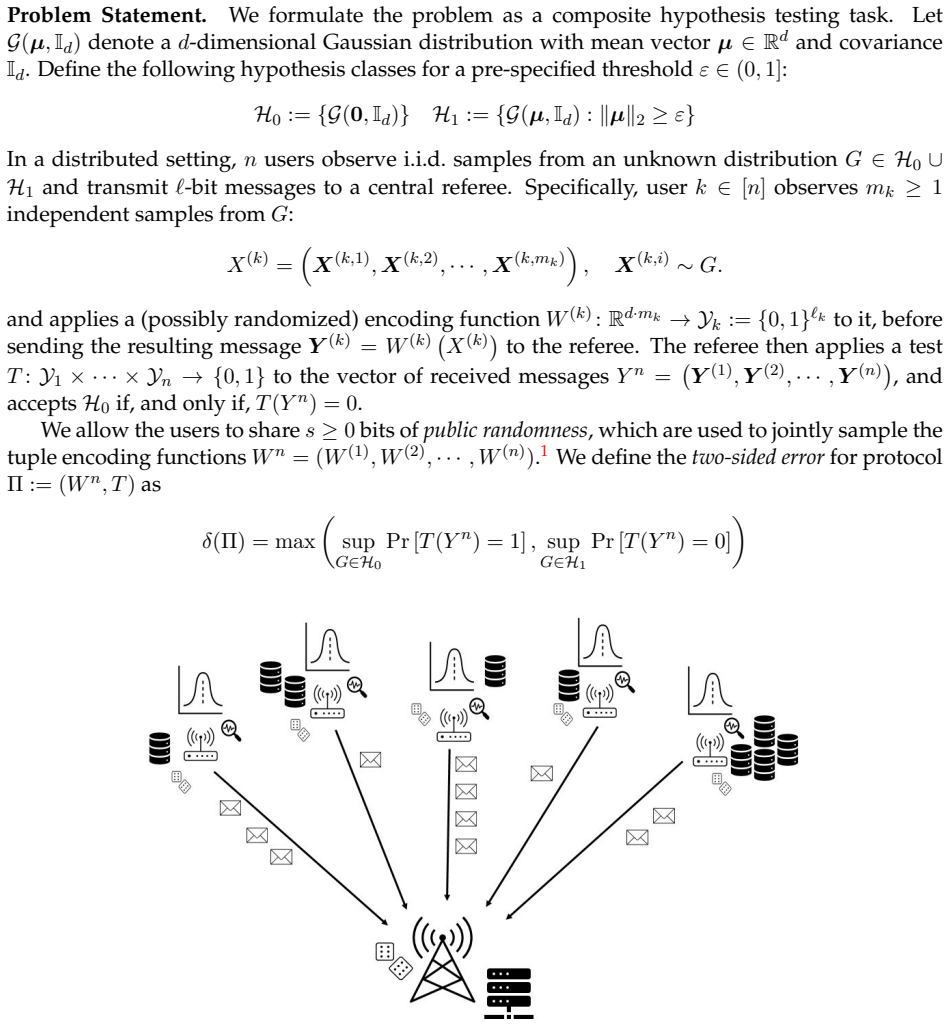
We revisit the problem of Gaussian mean testing in a distributed, communication constrained setting, where each of $n$ users independently observes samples from an unknown $d$-dimensional spherical Gaussian distribution $\mathcal{G}(\mu,\mathbb{I}_d)$, and can communicate up to $\ell$ bits to a central referee. The referee's goal is then to distinguish between cases (i) $\|\mu\|_2 = 0$ versus (ii) $\|\mu\|_2\ge \varepsilon$. This problem has been considered in the private- and public-coin settings, when each user holds exactly one sample, or more generally when each holds exactly $m$ samples. In this work, we significantly generalize the question in three directions: when the users only share a small number $s$ of random bits, when each user holds a different number of samples $m_k$, and when each user can send a different number of bits $\ell_k$ to the referee.
Editorial analysis
A structured set of objections, weighed in public.
Referee Report
Summary. The manuscript generalizes the distributed Gaussian mean testing problem (distinguish ||μ||_2=0 vs. ||μ||_2≥ε for spherical Gaussians G(μ,I_d)) from the homogeneous private/public-coin, fixed-m, fixed-ℓ setting to three heterogeneous axes: users share only s random bits, each user k holds m_k samples, and each user k sends ℓ_k bits. The referee decides based solely on the received messages.
Significance. The three-axis generalization models realistic distributed systems with non-uniform resources and limited shared randomness. If the communication-sample trade-offs are characterized tightly (matching or extending the homogeneous-case bounds), the work would be a useful reference for communication-constrained inference.
minor comments (2)
- [Abstract] The abstract states the modeling assumptions (i.i.d. spherical Gaussians, message-only referee) but does not preview the main theorems or whether the bounds remain tight under heterogeneity; adding one sentence on the achieved rates would improve readability.
- [§1] Notation for the heterogeneous parameters (s, {m_k}, {ℓ_k}) is introduced only in the abstract; a dedicated notation paragraph or table in §1 would help readers track the three extensions.
Simulated Author's Rebuttal
We thank the referee for the positive summary and recommendation of minor revision. The manuscript indeed extends the homogeneous setting to heterogeneous m_k, ℓ_k, and limited shared randomness s, and we agree this models more realistic distributed systems. No specific major comments were raised in the report.
Circularity Check
No significant circularity in derivation chain
full rationale
The paper extends the standard distributed Gaussian mean testing setup (i.i.d. spherical Gaussians, message-only referee) to heterogeneous per-user sample counts m_k, communication budgets ℓ_k, and shared randomness s bits. These are direct modeling generalizations of the homogeneous case already studied in prior work; the abstract and description introduce no self-definitional equations, fitted parameters renamed as predictions, load-bearing self-citations, uniqueness theorems imported from the authors' prior work, or ansatzes smuggled via citation. The derivation chain remains self-contained against external benchmarks and does not reduce any claimed result to its own inputs by construction.
Axiom & Free-Parameter Ledger
axioms (1)
- domain assumption Observations are i.i.d. samples from spherical Gaussian G(mu, I_d)
Reference graph
Works this paper leans on
-
[1]
Canonne, Yanjun Han, Ziteng Sun, and Himanshu Tyagi
Jayadev Acharya, Cl \' e ment L. Canonne, Yanjun Han, Ziteng Sun, and Himanshu Tyagi. Domain compression and its application to randomness-optimal distributed goodness-of-fit. In COLT , Proceedings of Machine Learning Research, pages 3--40. PMLR , 2020
2020
-
[2]
Canonne, Ziteng Sun, and Himanshu Tyagi
Jayadev Acharya, Cl \' e ment L. Canonne, Ziteng Sun, and Himanshu Tyagi. Unified lower bounds for interactive high-dimensional estimation under information constraints. In NeurIPS , 2023
2023
-
[3]
Canonne, and Himanshu Tyagi
Jayadev Acharya, Cl \' e ment L. Canonne, and Himanshu Tyagi. Distributed signal detection under communication constraints. In COLT , Proceedings of Machine Learning Research, pages 41--63. PMLR , 2020
2020
-
[4]
Canonne, and Himanshu Tyagi
Jayadev Acharya, Cl \' e ment L. Canonne, and Himanshu Tyagi. Inference under information constraints II: communication constraints and shared randomness. IEEE Transactions on Information Theory , 66(12):7856--7877, 2020
2020
-
[5]
Cl \' e ment L. Canonne. Topics and techniques in distribution testing: A biased but representative sample. Found. Trends Commun. Inf. Theory , 19(6):1032--1198, 2022
2022
-
[6]
Canonne, Abigail Gentle, and Vikrant Singhal
Cl \' e ment L. Canonne, Abigail Gentle, and Vikrant Singhal. Uniformity testing under user-level local privacy. In ITCS , LIPIcs, pages 33:1--33:24. Schloss Dagstuhl - Leibniz-Zentrum f \" u r Informatik, 2026
2026
-
[7]
Canonne, Themis Gouleakis, Yuhao Wang, and Joy Qiping Yang
Cl \' e ment L. Canonne, Themis Gouleakis, Yuhao Wang, and Joy Qiping Yang. Gaussian mean testing under truncation. In AISTATS , Proceedings of Machine Learning Research, pages 4879--4887. PMLR , 2025
2025
-
[8]
Random Restrictions of High Dimensional Distributions and Uniformity Testing with Subcube Conditioning , pages 321--336
Clément Canonne, Gautam Kamath, Amit Levi, and Erik Waingarten. Random Restrictions of High Dimensional Distributions and Uniformity Testing with Subcube Conditioning , pages 321--336. 01 2021
2021
-
[9]
Kane, and Ankit Pensia
Ilias Diakonikolas, Daniel M. Kane, and Ankit Pensia. Gaussian mean testing made simple. In SOSA , pages 348--352. SIAM , 2023
2023
-
[10]
Optimal distributed composite testing in high-dimensional gaussian models with 1-bit communication
Botond Szab \' o , Lasse Vuursteen, and Harry van Zanten. Optimal distributed composite testing in high-dimensional gaussian models with 1-bit communication. IEEE Trans. Inf. Theory , 68(6):4070--4084, 2022
2022
-
[11]
Optimal high-dimensional and nonparametric distributed testing under communication constraints
Botond Szab\' o , Lasse Vuursteen, and Harry van Zanten. Optimal high-dimensional and nonparametric distributed testing under communication constraints. Ann. Statist. , 51(3):909--934, 2023
2023
-
[12]
Salil P. Vadhan. Pseudorandomness. Found. Trends Theor. Comput. Sci. , 7(1-3):1--336, 2012
2012
discussion (0)
Sign in with ORCID, Apple, or X to comment. Anyone can read and Pith papers without signing in.