TRUST: Item-Calibrated Interval Evidence for Temporal Session-Based Recommendation
Pith reviewed 2026-06-26 02:04 UTC · model grok-4.3
The pith
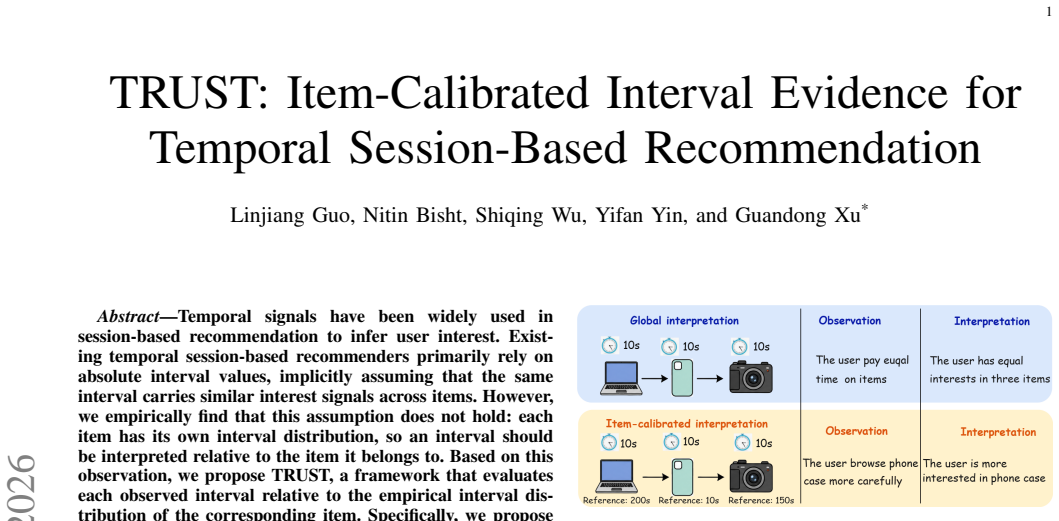
Each item has its own interval distribution, so temporal signals in session recommendations should be calibrated relative to the item rather than treated as absolute values.
A machine-rendered reading of the paper's core claim, the machinery that carries it, and where it could break.
Core claim
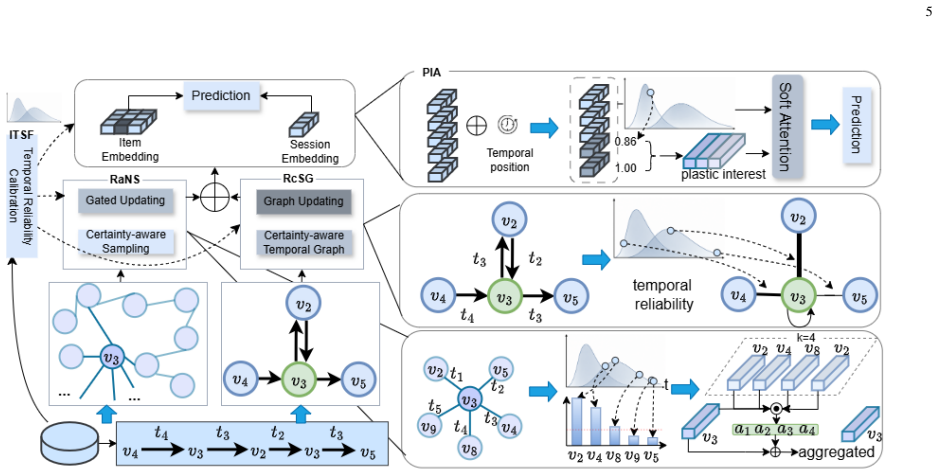
TRUST evaluates each observed interval relative to the empirical interval distribution of the corresponding item. A score function derived from this comparison guides global neighbor sampling, session graph encoding, and final interest aggregation. This yields consistent gains over representative temporal and non-temporal baselines, and the scoring function also improves other temporal session recommenders when inserted as a model-agnostic plug-in.
What carries the argument
The item-calibrated score function, which measures an observed interval against the item's own empirical distribution and is injected into neighbor sampling, graph encoding, and interest aggregation.
If this is right
- Calibrating intervals per item improves global neighbor sampling by selecting more relevant sessions.
- Session graph encoding captures item relationships more accurately when temporal evidence is item-relative.
- Interest aggregation produces better user profiles when the score replaces absolute intervals.
- The same scoring function raises performance when added to other temporal session recommenders without model changes.
- Retaining the calibrated temporal modules outperforms simply removing them from the pipeline.
Where Pith is reading between the lines
- The same per-item calibration logic could apply to other variable signals such as dwell time if those also differ systematically across items.
- In settings where item interaction rates change over time, the distributions would need periodic recomputation to stay useful.
- The approach might transfer to non-session recommendation tasks where timing patterns are known to be item-dependent.
Load-bearing premise
The empirical interval distribution of each item remains stable enough to serve as a reliable reference for scoring new intervals and can be plugged into existing modules without creating new biases.
What would settle it
A dataset in which all items exhibit statistically identical interval distributions and the calibrated model shows no accuracy gain over the uncalibrated version would falsify the central claim.
Figures


read the original abstract
Temporal signals have been widely used in session-based recommendation to infer user interest. Existing temporal session-based recommenders primarily rely on absolute interval values, implicitly assuming that the same interval carries similar interest signals across items. However, we empirically find that this assumption does not hold: each item has its own interval distribution, so an interval should be interpreted relative to the item it belongs to. Based on this observation, we propose TRUST, a framework that evaluates each observed interval relative to the empirical interval distribution of the corresponding item. Specifically, we propose a score function to guide global neighbor sampling, session graph encoding, and final interest aggregation. Experiments on public datasets show that TRUST consistently improves over representative temporal and non-temporal baselines, and plug-in experiments further show that the proposed scoring function can improve existing temporal session recommenders as a model-agnostic method. Component-wise ablations further show that calibrating the temporal signals within each module, rather than removing the module itself, consistently improves neighbor sampling, session graph encoding, and interest aggregation.
Editorial analysis
A structured set of objections, weighed in public.
Referee Report
Summary. The manuscript proposes TRUST, a framework for temporal session-based recommendation that calibrates observed intervals relative to each item's empirical interval distribution rather than using absolute values. It introduces a score function derived from these per-item distributions and applies it to guide global neighbor sampling, session graph encoding, and interest aggregation. The authors report consistent improvements over temporal and non-temporal baselines on public datasets, demonstrate that the scoring function acts as a model-agnostic plug-in for existing recommenders, and provide component ablations showing benefits from calibration within each module.
Significance. If the central claims hold after validation, the work would be significant for highlighting item heterogeneity in temporal signals and offering a practical, integrable calibration approach. The model-agnostic plug-in experiments and module-specific ablations are explicit strengths that increase the result's utility and falsifiability.
major comments (2)
- [Experiments] Experimental section: No frequency-stratified ablations, variance analysis, or results broken down by item frequency are presented. This is load-bearing for the central claim because the score function depends on stable per-item empirical distributions, yet recommendation datasets are heavy-tailed and many items have few observations; without such analysis the assumption that calibration improves rather than distorts signals for low-frequency items remains untested.
- [Method] Method section describing score function integration: The assertion that the same score function can be plugged into neighbor sampling, graph encoding, and aggregation without introducing new biases lacks supporting checks such as distribution comparisons or per-module bias metrics before and after calibration.
minor comments (2)
- [Abstract] Abstract and results summary: Quantitative details, error bars, dataset statistics, and exact improvement magnitudes are absent, making it difficult to assess the scale of gains.
- Notation for the score function: The mapping from empirical CDF to the final score is described at a high level but would benefit from an explicit equation or pseudocode for reproducibility.
Simulated Author's Rebuttal
We thank the referee for the constructive feedback and for recognizing the potential significance of item-calibrated temporal modeling. We address each major comment below and outline planned revisions.
read point-by-point responses
-
Referee: [Experiments] Experimental section: No frequency-stratified ablations, variance analysis, or results broken down by item frequency are presented. This is load-bearing for the central claim because the score function depends on stable per-item empirical distributions, yet recommendation datasets are heavy-tailed and many items have few observations; without such analysis the assumption that calibration improves rather than distorts signals for low-frequency items remains untested.
Authors: We agree this analysis is important given the heavy-tailed distributions and the dependence on per-item empirical interval statistics. While the reported component ablations and model-agnostic plug-in results already demonstrate consistent gains from calibration, they do not isolate effects by item frequency. In the revised manuscript we will add frequency-stratified performance breakdowns (head/torso/tail items), variance analysis across runs, and explicit checks on low-frequency items to test whether calibration improves or distorts signals. revision: yes
-
Referee: [Method] Method section describing score function integration: The assertion that the same score function can be plugged into neighbor sampling, graph encoding, and aggregation without introducing new biases lacks supporting checks such as distribution comparisons or per-module bias metrics before and after calibration.
Authors: The referee is correct that we did not provide explicit pre/post-calibration distribution comparisons or per-module bias metrics. The existing module ablations show that replacing absolute intervals with the calibrated score improves each component individually, which indirectly supports the absence of harmful bias. To strengthen the claim, the revision will include score-distribution comparisons and any relevant per-module bias metrics (e.g., shift in neighbor selection statistics or aggregation weights) before and after calibration. revision: yes
Circularity Check
No circularity: derivation uses empirical per-item distributions as direct input without reduction to self-definition or fitted predictions.
full rationale
The paper's central step computes a score function from each item's observed interval distribution in the training data and plugs the resulting values into neighbor sampling, graph encoding, and aggregation. This is a direct data-driven calibration rather than a self-definitional loop, a fitted parameter renamed as prediction, or a load-bearing self-citation. No equations or claims in the abstract reduce the output to the input by construction, and the method is presented as model-agnostic without invoking uniqueness theorems or prior author work as justification. The derivation chain remains self-contained against external benchmarks.
Axiom & Free-Parameter Ledger
Reference graph
Works this paper leans on
-
[1]
Graph and sequential neural networks in session-based recommendation: A survey,
Z. Li, C. Yang, Y . Chen, X. Wang, H. Chen, G. Xu, L. Yao, and M. Sheng, “Graph and sequential neural networks in session-based recommendation: A survey,”ACM Computing Surveys, vol. 57, no. 2, pp. 1–37, 2024
2024
-
[2]
Linear item-item models with neural knowledge for session-based recommendation,
M. Choi, S. Lee, S. Park, and J. Lee, “Linear item-item models with neural knowledge for session-based recommendation,” inProceed- ings of the 48th International ACM SIGIR Conference on Research and Development in Information Retrieval, 2025, pp. 1666–1675
2025
-
[3]
Rethink- ing contrastive learning in session-based recommendation,
X. Zhang, B. Xu, F. Ma, Z. Wang, L. Yang, and H. Lin, “Rethink- ing contrastive learning in session-based recommendation,”Pattern Recognition, vol. 169, p. 111924, 2026
2026
-
[4]
Beyond clicks: dwell time for personalization,
X. Yi, L. Hong, E. Zhong, N. N. Liu, and S. Rajan, “Beyond clicks: dwell time for personalization,” inProceedings of the 8th ACM Conference on Recommender systems, 2014, pp. 113–120
2014
-
[5]
Incorporating dwell time in session- based recommendations with recurrent neural networks
V . Bogina and T. Kuflik, “Incorporating dwell time in session- based recommendations with recurrent neural networks.”RecTemp@ RecSys, vol. 1922, pp. 57–59, 2017
1922
-
[6]
Time interval aware graph neural networks for session- based recommendation,
Z. Xu, X. Li, Z. Yin, X. Liu, J. Zhuo, S. Xu, X. Zhang, and B. Li, “Time interval aware graph neural networks for session- based recommendation,” inPacific-Asia Conference on Knowledge Discovery and Data Mining. Springer, 2025, pp. 53–65
2025
-
[7]
Dual-channel time- aware graph attention network for session-based recommendation,
L. Guo, S. Wu, D. Lu, L. Gao, and G. Xu, “Dual-channel time- aware graph attention network for session-based recommendation,” Information Sciences, p. 123289, 2026
2026
-
[8]
Silence is also evidence: interpreting dwell time for recommendation from psychological perspective,
P. Yin, P. Luo, W.-C. Lee, and M. Wang, “Silence is also evidence: interpreting dwell time for recommendation from psychological perspective,” inProceedings of the 19th ACM SIGKDD international conference on Knowledge discovery and data mining, 2013, pp. 989–997
2013
-
[9]
Positive, negative and neutral: Model- ing implicit feedback in session-based news recommendation,
S. Gong and K. Q. Zhu, “Positive, negative and neutral: Model- ing implicit feedback in session-based news recommendation,” in Proceedings of the 45th international ACM SIGIR conference on research and development in information retrieval, 2022, pp. 1185– 1195
2022
-
[10]
Reweighting clicks with dwell time in recommendation,
R. Xie, L. Ma, S. Zhang, F. Xia, and L. Lin, “Reweighting clicks with dwell time in recommendation,” inCompanion Proceedings of the ACM Web Conference 2023, 2023, pp. 341–345
2023
-
[11]
A survey on user behavior modeling in recommender systems,
Z. He, W. Liu, W. Guo, J. Qin, Y . Zhang, Y . Hu, and R. Tang, “A survey on user behavior modeling in recommender systems,” in Proceedings of the Thirty-Second International Joint Conference on Artificial Intelligence, 2023, pp. 6656–6664
2023
-
[12]
Feedrec: News feed recommendation with various user feedbacks,
C. Wu, F. Wu, T. Qi, Q. Liu, X. Tian, J. Li, W. He, Y . Huang, and X. Xie, “Feedrec: News feed recommendation with various user feedbacks,” inProceedings of the ACM Web Conference 2022, 2022, pp. 2088–2097
2022
-
[13]
Modeling dwell time to predict click-level satisfaction,
Y . Kim, A. Hassan, R. W. White, and I. Zitouni, “Modeling dwell time to predict click-level satisfaction,” inProceedings of the 7th ACM international conference on Web search and data mining, 2014, pp. 193–202
2014
-
[14]
Understanding web browsing behaviors through weibull analysis of dwell time,
C. Liu, R. W. White, and S. Dumais, “Understanding web browsing behaviors through weibull analysis of dwell time,” inProceedings of the 33rd international ACM SIGIR conference on Research and development in information retrieval, 2010, pp. 379–386
2010
-
[15]
Analysis of user dwell time by category in news application,
Y . Seki and M. Yoshida, “Analysis of user dwell time by category in news application,” in2018 IEEE/WIC/ACM International Con- ference on Web Intelligence (WI). IEEE, 2018, pp. 732–735
2018
-
[16]
Matrix factorization techniques for recommender systems,
Y . Koren, R. Bell, and C. V olinsky, “Matrix factorization techniques for recommender systems,”Computer, vol. 42, no. 8, pp. 30–37, 2009
2009
-
[17]
Bpr: Bayesian personalized ranking from implicit feedback,
S. Rendle, C. Freudenthaler, Z. Gantner, and L. Schmidt-Thieme, “Bpr: Bayesian personalized ranking from implicit feedback,” in Proceedings of the Twenty-Fifth Conference on Uncertainty in Artificial Intelligence, 2009, pp. 452–461
2009
-
[18]
Session-based recommendations with recurrent neural networks,
B. Hidasi, “Session-based recommendations with recurrent neural networks,” inThe International Conference on Learning Represen- tations (ICLR), 2016. 10
2016
-
[19]
Neural attentive session-based recommendation,
J. Li, P. Ren, Z. Chen, Z. Ren, T. Lian, and J. Ma, “Neural attentive session-based recommendation,” inProceedings of the 2017 ACM on Conference on Information and Knowledge Management, 2017, pp. 1419–1428
2017
-
[20]
Category-aware dual channel graph neural networks for session-based recommendation: R. wang et al
R. Wang, X. Rui, and Z. Wang, “Category-aware dual channel graph neural networks for session-based recommendation: R. wang et al.” Knowledge and Information Systems, vol. 68, no. 1, p. 3, 2026
2026
-
[21]
Session-based recommendation with graph neural networks,
S. Wu, Y . Tang, Y . Zhu, L. Wang, X. Xie, and T. Tan, “Session-based recommendation with graph neural networks,” inProceedings of the AAAI conference on artificial intelligence, vol. 33, no. 01, 2019, pp. 346–353
2019
-
[22]
Tagnn: Target attentive graph neural networks for session-based recommendation,
F. Yu, Y . Zhu, Q. Liu, S. Wu, L. Wang, and T. Tan, “Tagnn: Target attentive graph neural networks for session-based recommendation,” inProceedings of the 43rd international ACM SIGIR conference on research and development in information retrieval, 2020, pp. 1921– 1924
2020
-
[23]
Collaborative filtering with temporal dynamics,
Y . Koren, “Collaborative filtering with temporal dynamics,” in Proceedings of the 15th ACM SIGKDD international conference on Knowledge discovery and data mining, 2009, pp. 447–456
2009
-
[24]
Time matters: Sequential recommendation with complex temporal in- formation,
W. Ye, S. Wang, X. Chen, X. Wang, Z. Qin, and D. Yin, “Time matters: Sequential recommendation with complex temporal in- formation,” inProceedings of the 43rd international ACM SIGIR conference on research and development in information retrieval, 2020, pp. 1459–1468
2020
-
[25]
A survey on side information-driven session-based recommendation: From a data-centric perspective,
X. Zhang, B. Xu, C. Li, B. He, H. Lin, C. Ma, and F. Ma, “A survey on side information-driven session-based recommendation: From a data-centric perspective,”IEEE Transactions on Knowledge and Data Engineering, 2025
2025
-
[26]
Continuous-time sequential recommendation with temporal graph collaborative transformer,
Z. Fan, Z. Liu, J. Zhang, Y . Xiong, L. Zheng, and P. S. Yu, “Continuous-time sequential recommendation with temporal graph collaborative transformer,” inProceedings of the 30th ACM interna- tional conference on information & knowledge management, 2021, pp. 433–442
2021
-
[27]
Attention mixtures for time-aware sequential recommendation,
V . A. Tran, G. Salha-Galvan, B. Sguerra, and R. Hennequin, “Attention mixtures for time-aware sequential recommendation,” in Proceedings of the 46th international ACM SIGIR conference on research and development in information retrieval, 2023, pp. 1821– 1826
2023
-
[28]
Enhancing time awareness in generative recommendation,
S. Lee, S. Park, J. Kim, M. Yoon, and J. Lee, “Enhancing time awareness in generative recommendation,” inFindings of the As- sociation for Computational Linguistics: EMNLP 2025, 2025, pp. 23 917–23 933
2025
-
[29]
Temporal- contextual recommendation in real-time,
Y . Ma, B. Narayanaswamy, H. Lin, and H. Ding, “Temporal- contextual recommendation in real-time,” inProceedings of the 26th ACM SIGKDD international conference on knowledge discovery & data mining, 2020, pp. 2291–2299
2020
-
[30]
Time interval aware self-attention for sequential recommendation,
J. Li, Y . Wang, and J. McAuley, “Time interval aware self-attention for sequential recommendation,” inProceedings of the 13th inter- national conference on web search and data mining, 2020, pp. 322– 330
2020
-
[31]
Time-aware adaptive side information fusion for sequential recommendation,
J. Luo, W. Zhang, X. Zhang, and Y . Fang, “Time-aware adaptive side information fusion for sequential recommendation,” inProceedings of the Nineteenth ACM International Conference on Web Search and Data Mining, 2026, pp. 469–478
2026
-
[32]
Spatio-temporal contrastive learning-enhanced gnns for session-based recommendation,
Z. Wan, X. Liu, B. Wang, J. Qiu, B. Li, T. Guo, G. Chen, and Y . Wang, “Spatio-temporal contrastive learning-enhanced gnns for session-based recommendation,”ACM Transactions on Information Systems, vol. 42, no. 2, pp. 1–26, 2023
2023
-
[33]
Time-aware hyperbolic graph attention network for session-based recommendation,
X. Li, Y . Liu, Z. Liu, and P. S. Yu, “Time-aware hyperbolic graph attention network for session-based recommendation,” in2022 IEEE international conference on big data (Big Data). IEEE, 2022, pp. 626–635
2022
-
[34]
Trust decay-based temporal learning for dynamic recommender systems with concept drift adaptation,
L. Heryawan, R. Pulunganet al., “Trust decay-based temporal learning for dynamic recommender systems with concept drift adaptation,”IEEE Access, 2025
2025
-
[35]
Modeling online behavior in rec- ommender systems: The importance of temporal context,
M. Filipovic, B. Mitrevski, D. M. Antognini, E. Lejal Glaude, B. Faltings, and C.-C. Musat, “Modeling online behavior in rec- ommender systems: The importance of temporal context,” inPer- spectives 2021-Proceedings of the Perspectives on the Evaluation of Recommender Systems Workshop 2021, co-located with the 15th ACM Conference on Recommender Systems, Re...
2021
-
[36]
Knowledge-enhanced session-based recommendation with temporal transformer,
R. Zhang, Y . Gu, X. Shen, and H. Su, “Knowledge-enhanced session-based recommendation with temporal transformer,”arXiv preprint arXiv:2112.08745, 2021
-
[37]
Multi-behavior sequential rec- ommendation with temporal graph transformer,
L. Xia, C. Huang, Y . Xu, and J. Pei, “Multi-behavior sequential rec- ommendation with temporal graph transformer,”IEEE Transactions on Knowledge and Data Engineering, vol. 35, no. 6, pp. 6099–6112, 2022
2022
-
[38]
Temporal aug- mented graph neural networks for session-based recommendations,
H. Zhou, Q. Tan, X. Huang, K. Zhou, and X. Wang, “Temporal aug- mented graph neural networks for session-based recommendations,” inProceedings of the 44th International ACM SIGIR conference on research and development in information retrieval, 2021, pp. 1798– 1802
2021
-
[39]
Time-period-aware embedding regeneration for session-based recommendation,
C. Guo, R. Xue, and J. Zhang, “Time-period-aware embedding regeneration for session-based recommendation,” inProceedings of the 34th ACM International Conference on Information and Knowledge Management, 2025, pp. 4738–4742
2025
-
[40]
Time enhanced graph neural networks for session-based recommendation,
G. Tang, X. Zhu, J. Guo, and S. Dietze, “Time enhanced graph neural networks for session-based recommendation,”Knowledge- Based Systems, vol. 251, p. 109204, 2022
2022
-
[41]
Spatiotemporal-aware session-based recommendation with graph neural networks,
Y . Li, C. Gao, X. Du, H. Wei, H. Luo, D. Jin, and Y . Li, “Spatiotemporal-aware session-based recommendation with graph neural networks,” inProceedings of the 31st acm international conference on information & knowledge management, 2022, pp. 1209–1218
2022
-
[42]
Combine temporal information in session-based recommendation with graph neural networks,
Q. Chen, F. Jiang, X. Guo, J. Chen, K. Sha, and Y . Wang, “Combine temporal information in session-based recommendation with graph neural networks,”Expert Systems with Applications, vol. 238, p. 121969, 2024
2024
-
[43]
Interval-enhanced graph transformer solution for session-based recommendation,
H. Wang, Y . Zeng, J. Chen, N. Han, and H. Chen, “Interval-enhanced graph transformer solution for session-based recommendation,”Ex- pert Systems with Applications, vol. 213, p. 118970, 2023
2023
-
[44]
Time highlighted multi-interest network for session-based news recommendation,
Z. Zuo, J. Lu, L. Tan, Q. Hu, B. Wang, and F. Liu, “Time highlighted multi-interest network for session-based news recommendation,” Intelligent Data Analysis, p. 1088467X261426714, 2026
2026
-
[45]
Time-aware multi-interest capsule network for sequential recommendation,
Z. Wang and Y . Shen, “Time-aware multi-interest capsule network for sequential recommendation,” inProceedings of the 2022 SIAM International Conference on Data Mining (SDM). SIAM, 2022, pp. 558–566
2022
-
[46]
Temporal aware multi-interest graph neural network for session-based recommenda- tion,
Q. Shen, S. Zhu, Y . Pang, Y . Zhang, and Z. Wei, “Temporal aware multi-interest graph neural network for session-based recommenda- tion,” inAsian conference on machine learning. PMLR, 2023
2023
-
[47]
A user-oriented webpage ranking algorithm based on user attention time
S. Xu, Y . Zhu, H. Jiang, and F. C. Lau, “A user-oriented webpage ranking algorithm based on user attention time.” inAAAI, vol. 8, 2008, pp. 1255–1260
2008
-
[48]
Mining user dwell time for per- sonalized web search re-ranking,
S. Xu, H. Jiang, and F. C.-M. Lau, “Mining user dwell time for per- sonalized web search re-ranking,” inInternational Joint Conference on Artificial Intelligence (IJCAI 2011). AAAI Press/International Joint Conferences on Artificial Intelligence., 2011
2011
-
[49]
Agresti,Categorical data analysis
A. Agresti,Categorical data analysis. John Wiley & Sons, 2013
2013
-
[50]
The asa statement on p-values: context, process, and purpose,
R. L. Wasserstein and N. A. Lazar, “The asa statement on p-values: context, process, and purpose,” pp. 129–133, 2016
2016
-
[51]
Accurate uncertainties for deep learning using calibrated regression,
V . Kuleshov, N. Fenner, and S. Ermon, “Accurate uncertainties for deep learning using calibrated regression,” inInternational conference on machine learning. PMLR, 2018, pp. 2796–2804
2018
-
[52]
Addressing cold start in product search via empirical bayes,
C. Han, P. Castells, P. Gupta, X. Xu, and V . Salaka, “Addressing cold start in product search via empirical bayes,” inProceedings of the 31st ACM International Conference on Information & Knowledge Management, 2022, pp. 3141–3151
2022
-
[53]
G 3 sr: Global graph guided session-based recommendation,
Z.-H. Deng, C.-D. Wang, L. Huang, J.-H. Lai, and S. Y . Philip, “G 3 sr: Global graph guided session-based recommendation,”IEEE transactions on neural networks and learning systems, vol. 34, no. 12, pp. 9671–9684, 2022
2022
-
[54]
Ls-tgnn: long and short-term temporal graph neural network for session- based recommendation,
Z. Ou, X. Zhang, Y . Zhu, S. Lyu, J. Liu, and T. Ao, “Ls-tgnn: long and short-term temporal graph neural network for session- based recommendation,” inProceedings of the AAAI Conference on Artificial Intelligence, vol. 39, no. 12, 2025, pp. 12 426–12 434
2025
-
[55]
E-commerce recom- mendation with personalized promotion,
Q. Zhao, Y . Zhang, D. Friedman, and F. Tan, “E-commerce recom- mendation with personalized promotion,” inProceedings of the 9th ACM Conference on Recommender Systems, 2015, pp. 219–226
2015
-
[56]
A survey on session-based recommender systems,
S. Wang, L. Cao, Y . Wang, Q. Z. Sheng, M. A. Orgun, and D. Lian, “A survey on session-based recommender systems,”ACM Computing Surveys (CSUR), vol. 54, no. 7, pp. 1–38, 2021
2021
-
[57]
Evaluation of session-based recom- mendation algorithms: M. ludewig, d. jannach,
M. Ludewig and D. Jannach, “Evaluation of session-based recom- mendation algorithms: M. ludewig, d. jannach,”User Modeling and User-Adapted Interaction, vol. 28, no. 4, pp. 331–390, 2018
2018
-
[58]
Star graph neural networks for session-based recommendation,
Z. Pan, F. Cai, W. Chen, H. Chen, and M. De Rijke, “Star graph neural networks for session-based recommendation,” inProceedings of the 29th ACM international conference on information & knowl- edge management, 2020, pp. 1195–1204
2020
-
[59]
Causality-guided graph learning for session-based recommendation,
D. Yu, Q. Li, H. Yin, and G. Xu, “Causality-guided graph learning for session-based recommendation,” inProceedings of the 32nd ACM international conference on information and knowledge man- agement, 2023, pp. 3083–3093
2023
-
[60]
Rethinking the item order in session-based recommendation with graph neural networks,
R. Qiu, J. Li, Z. Huang, and H. Yin, “Rethinking the item order in session-based recommendation with graph neural networks,” inPro- ceedings of the 28th ACM international conference on information and knowledge management, 2019, pp. 579–588
2019
-
[61]
Global context enhanced graph neural networks for session-based recommendation,
Z. Wang, W. Wei, G. Cong, X.-L. Li, X.-L. Mao, and M. Qiu, “Global context enhanced graph neural networks for session-based recommendation,” inProceedings of the 43rd international ACM 11 SIGIR conference on research and development in information retrieval, 2020, pp. 169–178
2020
-
[62]
Self- supervised hypergraph convolutional networks for session-based rec- ommendation,
X. Xia, H. Yin, J. Yu, Q. Wang, L. Cui, and X. Zhang, “Self- supervised hypergraph convolutional networks for session-based rec- ommendation,” inProceedings of the AAAI conference on artificial intelligence, vol. 35, no. 5, 2021, pp. 4503–4511
2021
-
[63]
Bi-channel multiple sparse graph attention networks for session-based rec- ommendation,
S. Qiao, W. Zhou, J. Wen, H. Zhang, and M. Gao, “Bi-channel multiple sparse graph attention networks for session-based rec- ommendation,” inProceedings of the 32nd ACM International Conference on Information and Knowledge Management, 2023, pp. 2075–2084
2023
-
[64]
Dynamic multi-interest graph neural network for session-based recommendation,
M. Lv, X. Liu, and Y . Xu, “Dynamic multi-interest graph neural network for session-based recommendation,” inProceedings of the AAAI conference on artificial intelligence, vol. 39, no. 12, 2025, pp. 12 328–12 336
2025
-
[65]
Sequence and time aware neighborhood for session-based recommendations: Stan,
D. Garg, P. Gupta, P. Malhotra, L. Vig, and G. Shroff, “Sequence and time aware neighborhood for session-based recommendations: Stan,” inProceedings of the 42nd international ACM SIGIR confer- ence on research and development in information retrieval, 2019, pp. 1069–1072. APPENDIXA BASELINEDESCRIPTIONS GRU4Rec[18] introduces recurrent neural networks into...
2019
discussion (0)
Sign in with ORCID, Apple, or X to comment. Anyone can read and Pith papers without signing in.