REVIEW 3 major objections 5 minor 46 references
Exploring the Potential of LLMs for Serendipity Evaluation in Recommender Systems
T0 review · 3 major / 5 minor · reviewed 2026-08-06 · deepseek-v4-flash
Pith's one-line read Plain prompted LLMs match or beat proxy metrics for judging recommendation serendipity.
desk verdict Useful systematic benchmark of LLM serendipity evaluators, but the headline 21.5% is test-set selection and the movie gold standard is an unexpectedness proxy. read the letter →
The pith
A machine-rendered reading of the paper's core claim, the machinery that carries it, and where it could break.
The reading
What carries the argument
The central object is SerenEva, a meta-evaluation framework that measures how well any candidate evaluator aligns with user-study ground truth. SerenEva feeds a constrained prompt—user behavior history, item information, and a 5-point Likert question about serendipity—to an LLM, then compares the LLM's numeric ratings with real user ratings using Pearson correlation, MAE, and RMSE; proxy metrics are first rescaled to the same 5-point Likert format. The framework also varies the auxiliary data injected into the prompt (user demographics and psychology, item popularity and similarity, interaction length and type) and supports multi-LLM ensembles that average scores across models. The load-bearing comparisons are the four proxy metrics (SOG, PURS, DESR, SNPR) and the two user-study datasets treated as gold standard.
What would settle it
Run the same SerenEva evaluation on a dataset where users directly rate serendipity, or where the gold standard is independently validated by a second user study; if LLM correlations against that direct gold standard fall below the proxy metrics, or below the 21.5% reported here, the paper's central claim fails. A simpler check is to recompute the Serendipity-2018 gold standard from all eight original survey statements instead of the three unexpectedness variables and see whether the LLM-versus-proxy ranking survives.
Extended reading notes
Core claim
On the paper's own terms, the discovery is that serendipity evaluation can be performed by LLMs with no task-specific training. In a meta-evaluation across an e-commerce dataset (Taobao) and a movie dataset (Serendipity-2018), the authors find that a zero-shot GPT-4 or Qwen2.5-72B prompt reaches Pearson correlations of roughly 10.5–10.9% against user-study ratings, about double the 4.6–5.7% of the strongest proxy metric (SOG). Few-shot prompting improves most models further, and combining auxiliary data with a score-averaging ensemble of Qwen2.5-14B, Qwen2.5-72B, and GPT-4 yields Pearson correlations of 20.23% (Taobao) and 21.51% (Serendipity-2018), with correspondingly lower MAE and RMSE. The paper interprets these results as evidence that LLMs can combine the accuracy of user studies with the efficiency of proxy metrics.
Load-bearing premise
The load-bearing premise is that the user-study ratings used as gold standard genuinely measure serendipity; in the Taobao dataset that means a single 'pleasant surprise' Likert response, and in Serendipity-2018 an average of three unexpectedness-related survey variables rather than a direct serendipity rating.
Editorial extensions
If this is right
- Zero-shot or few-shot LLM prompts can serve as a drop-in replacement for proxy metrics when user studies are infeasible, giving similar or better alignment with human judgments.
- Including a small amount of user-study data as few-shot examples lets smaller models like Qwen2.5-7B approach the accuracy of much larger models, lowering cost.
- Auxiliary data helps only when matched to the domain: curiosity data matters for e-commerce, item popularity and long-term profiles matter for movies, and indiscriminate additions can hurt.
- Multi-LLM ensembles with simple score averaging improve alignment with human ratings, so evaluation systems can trade API cost for accuracy by selecting diverse models.
- LLM-based serendipity evaluation could make serendipity research more reproducible, since prompts and models are fixed and rerunnable, unlike one-off user studies.
Reading between the lines
- The reported correlations are modest in absolute terms (around 0.2), so the practical claim is not that LLMs capture serendipity fully, but that they capture it as well as any existing cheap proxy; a reader should interpret 'match or surpass' relative to weak baselines.
- Because the gold standard itself contains noise—the Taobao label is a single 'pleasant surprise' item and Serendipity-2018 averages three unexpectedness variables—the true human-alignment ceiling may be higher or lower than 21.5%; a direct serendipity-rating study would be needed to know.
- The same SerenEva protocol could be applied to other subjective evaluation targets—novelty, diversity, trust, explanation quality—where proxy metrics are known to diverge from user perception.
- The finding that multi-LLM averaging helps suggests that ensemble diversity, not raw model size, drives alignment; future work could test whether a small set of deliberately diverse open-weight models matches the GPT-4-inclusive ensemble.
Editorial analysis
A structured set of objections, weighed in public.
Referee Report
Summary. This paper proposes SerenEva, a meta-evaluation framework for assessing whether large language models (LLMs) can serve as serendipity evaluators in recommender systems. The authors compare zero-shot and few-shot LLM ratings against two user-study-derived gold standards (Taobao e-commerce and MovieLens/Serendipity-2018), benchmark them against four conventional proxy metrics (SOG, SNPR, PURS, DESR), investigate the effect of auxiliary user, item, and interaction data, and evaluate multi-LLM ensembles with score averaging. The main reported findings are that even basic zero-shot LLMs match or surpass proxy metrics, that auxiliary data improve performance in a domain-dependent manner, and that the best multi-LLM configuration reaches Pearson correlations of 20.23% (Taobao) and 21.51% (Serendipity-2018) with the user-study ground truth. The paper provides its code and uses publicly available models.
Significance. The study addresses a timely and practical question: whether LLMs can be inexpensive, reproducible evaluators of a subjective quantity like serendipity. The strengths of the manuscript are its clear meta-evaluation protocol, the use of real user-study data, the inclusion of several LLM families and sizes, and the public release of code. The zero-shot parity claim is supported by the results in Table 2, and the analysis of auxiliary data is a useful mapping of when such data help. However, the headline 'optimal' result is based on test-set selection, and the movie-domain gold standard is an unexpectedness composite rather than direct serendipity; both issues temper the strength of the central claims as currently presented.
major comments (3)
- [Section 5, Table 5] The reported headline Pearson correlations (20.23% and 21.51%) are the maximum over a grid search of auxiliary data types and multi-LLM ensemble compositions evaluated on the same test set used to compute the correlations. No held-out validation or multiple-testing correction is described; this makes the optimal performance estimate optimistically biased. Please separate configuration selection from final evaluation (e.g., with a validation split) and temper the abstract and conclusions accordingly.
- [Section 2.2] The Serendipity-2018 gold standard is not a direct user serendipity rating; the paper states that the dataset 'lacks direct user ratings on serendipity' and that the score was computed by averaging three unexpectedness-related variables. Since the LLM prompt asks for 'pleasant surprise', the correlations on this dataset measure alignment with an unexpectedness composite, which is a construct mismatch. Please justify this operationalization, discuss its validity, or provide sensitivity analyses with alternative gold-standard definitions.
- [Section 2.5] The paper reports only results that are statistically significant at p < 0.05 in a two-sided t-test, without any correction for the many models, prompts, auxiliary-data conditions, and ensemble configurations tested. Selective reporting of significant results inflates effect sizes and false-positive rates. Please report the full result matrix or apply a multiple-comparison correction, and distinguish exploratory from confirmatory findings.
minor comments (5)
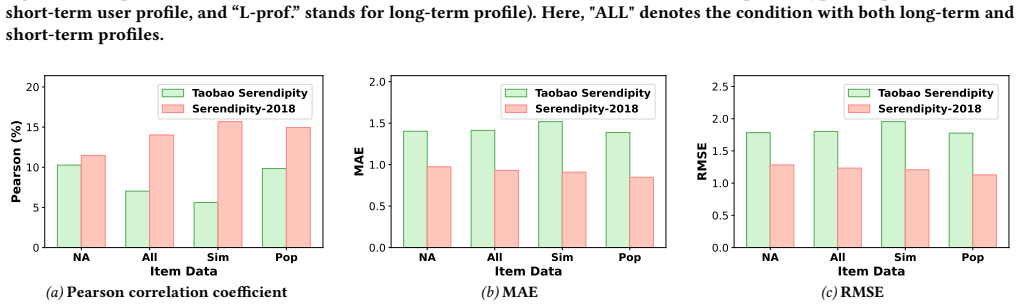
- [Figure 5 caption] The third panel caption contains a typo: 'Nummber' should be 'Number'.
- [Section 2.2] The sentence 'Because user studies provide real user feedback, making them the closest approximation to actual user perceptions. Therefore, we regard these results as the gold standard' is a fused sentence; consider splitting or rephrasing.
- [Section 2.5, Eq. (6)] The min-max normalization uses the distribution of outputs over the full evaluation set; this is acceptable for correlation but should be clarified for MAE/RMSE, since the normalized scores depend on the test set's min and max.
- [Section 4.1] The paper states that Big-Five traits, age, and gender 'did not help enhance performance and even reduced it'; providing the actual numbers (even in an appendix) would strengthen this negative result.
- [Section 5] The claim that 'multi-LLM techniques show performance improvements as the number of LLMs increases' is based on a limited set of ensembles; a direct comparison of ensemble sizes with error bars would clarify the trend.
Circularity Check
No circular derivation: LLM ratings are genuine model outputs compared against external user-study gold standards; minor self-citation overlap and grid-search selection are caveats, not circularity.
full rationale
The claimed derivation chain is not circular. The LLM evaluator outputs are real model predictions obtained from prompts (Section 2.4); no model parameter or prompt is fitted to the gold-standard serendipity labels. The meta-evaluation in Eq. (5) and the Likert rescaling in Eq. (6) are standard comparison operations, not identities that define the LLM scores in terms of the user-study scores. The proxy metrics are independently defined in Section 2.3 and then transformed for comparison. The Taobao and Serendipity-2018 gold standards come from external user studies, and the paper transparently states that Serendipity-2018 lacks direct serendipity ratings and uses an unexpectedness composite 'as validated in [31]'. Because [31] and [5] share author Li Chen, there is a legitimate independence caveat, and the composite may measure unexpectedness rather than serendipity, but this is a construct-validity limitation of the input data, not a reduction of the paper's conclusions to its own assumptions. Similarly, the headline 21.5% Pearson value is the best result of a grid search over multi-LLM and auxiliary-data combinations (Section 5), so it is a selected maximum rather than a held-out prediction; this is post-selection optimism, not circularity. The central comparative finding—that zero-shot/few-shot LLMs match or beat conventional proxy metrics—is evaluated against the same external labels for both sides and therefore has independent content.
Assumptions & free parameters
free parameters (4)
- Auxiliary data configuration =
Taobao: curiosity; Serendipity-2018: popularity
- Multi-LLM ensemble composition =
Qwen2.5-14B, Qwen2.5-72B, GPT-4
- Few-shot example count =
5
- Interaction history length =
10, with 20 for the Taobao interaction-type experiment
assumptions (5)
- domain assumption User-study serendipity ratings in Taobao and Serendipity-2018 are valid ground truth for serendipity.
- domain assumption Pearson correlation, MAE, and RMSE between predicted and reported ratings are appropriate measures of evaluator quality.
- domain assumption Min-max normalization of proxy metric outputs to a 5-point scale (Eq. 6) yields a fair comparison with LLM ratings.
- domain assumption LLM ratings generated by constrained prompts are meaningful psychometric responses, not artifacts of prompt wording or output format.
- domain assumption The two datasets, e-commerce and movies, are representative enough to support general conclusions about LLM serendipity evaluation.
Cite this review
Pith. "Pith review of Exploring the Potential of LLMs for Serendipity Evaluation in Recommender Systems." pith.science (2026). https://pith.science/paper/PG73P64T
@misc{pith2026250717290,
  author       = {Pith},
  title        = {Pith review of: Exploring the Potential of LLMs for Serendipity Evaluation in Recommender Systems},
  year         = {2026},
  howpublished = {\url{https://pith.science/paper/PG73P64T}},
  note         = {Machine review of arXiv:2507.17290}
}
read the original abstract
Serendipity plays a pivotal role in enhancing user satisfaction within recommender systems, yet its evaluation poses significant challenges due to its inherently subjective nature and conceptual ambiguity. Current algorithmic approaches predominantly rely on proxy metrics for indirect assessment, often failing to align with real user perceptions, thus creating a gap. With large language models (LLMs) increasingly revolutionizing evaluation methodologies across various human annotation tasks, we are inspired to explore a core research proposition: Can LLMs effectively simulate human users for serendipity evaluation? To address this question, we conduct a meta-evaluation on two datasets derived from real user studies in the e-commerce and movie domains, focusing on three key aspects: the accuracy of LLMs compared to conventional proxy metrics, the influence of auxiliary data on LLM comprehension, and the efficacy of recently popular multi-LLM techniques. Our findings indicate that even the simplest zero-shot LLMs achieve parity with, or surpass, the performance of conventional metrics. Furthermore, multi-LLM techniques and the incorporation of auxiliary data further enhance alignment with human perspectives. Based on our findings, the optimal evaluation by LLMs yields a Pearson correlation coefficient of 21.5\% when compared to the results of the user study. This research implies that LLMs may serve as potentially accurate and cost-effective evaluators, introducing a new paradigm for serendipity evaluation in recommender systems.
Figures


Figures from the paper (3 more)


Reference graph
Works this paper leans on
-
[1]
Josh Achiam, Steven Adler, et al. 2023. GPT-4 Technical Report. arXiv (2023)
work page 2023
-
[2]
Zahra Ashktorab, Michael Desmond, Qian Pan, James M Johnson, Martin Santillan Cooper, Elizabeth M Daly, Rahul Nair, Tejaswini Pedapati, Swapnaja Achintalwar, and Werner Geyer. 2024. Aligning Human and LLM Judgments: Insights from EvalAssist on Task-Specific Evaluations and AI-assisted Assessment Strategy Preferences. arXiv preprint arXiv:2410.00873 (2024)
arXiv 2024
-
[3]
Anna Bavaresco, Raffaella Bernardi, Leonardo Bertolazzi, Desmond Elliott, Raquel Fernández, Albert Gatt, Esam Ghaleb, Mario Giulianelli, Michael Hanna, Alexan- der Koller, et al. 2024. LLMs Instead of Human Judges? A Large-Scale Empirical Study Across 20 NLP Evaluation Tasks. arXiv preprint arXiv:2406.18403 (2024)
arXiv 2024
-
[4]
Brett Binst. 2024. How to Evaluate Serendipity in Recommender Systems: the Need for a Serendiptionnaire. In RecSys. 1335–1341
work page 2024
-
[5]
Li Chen, Yonghua Yang, Ningxia Wang, Keping Yang, and Quan Yuan. 2019. How Serendipity Improves User Satisfaction with Recommendations? A Large-Scale User Evaluation. In WWW. 240–250
work page 2019
-
[6]
Zhe Fu and Xi Niu. 2023. Modeling Users’ Curiosity in Recommender Systems. TKDD 18, 1 (2023), 1–23
work page 2023
-
[7]
Zhe Fu and Xi Niu. 2024. The Art of Asking: Prompting Large Language Models for Serendipity Recommendations. In ICTIR. 157–166
work page 2024
-
[8]
Zhe Fu, Xi Niu, and Mary Lou Maher. 2023. Deep Learning Models for Serendipity Recommendations: A Survey and New Perspectives. Comput. Surveys 56, 1 (2023), 1–26
work page 2023
Show all 46 references
-
[9]
Zhe Fu, Xi Niu, Xiangcheng Wu, and Ruhani Rahman. 2025. A Deep Learning Model for Cross-Domain Serendipity Recommendations. TORS 3, 3 (2025), 1–21
2025
-
[10]
Zhe Fu, Xi Niu, and Li Yu. 2023. Wisdom of Crowds and Fine-grained Learning for Serendipity Recommendations. In SIGIR. 739–748
2023
-
[11]
Samuel D Gosling, Peter J Rentfrow, and William B Swann Jr. 2003. A Very Brief Measure of the Big-Five Personality Domains. Journal of Research in personality 37, 6 (2003), 504–528
2003
-
[12]
Tonmoy Hasan and Razvan Bunescu. 2023. Topic-Level Bayesian Surprise and Serendipity for Recommender Systems. In RecSys. 933–939
2023
-
[13]
Todd B Kashdan, Matthew W Gallagher, Paul J Silvia, Beate P Winterstein, William E Breen, Daniel Terhar, and Michael F Steger. 2009. The Curiosity And Exploration Inventory-II: Development, Factor Structure, And Psychometrics. Journal of research in personality 43, 6 (2009), 987–998
2009
-
[14]
Denis Kotkov, Joseph A Konstan, Qian Zhao, and Jari Veijalainen. 2018. Investi- gating Serendipity in Recommender Systems Based on Real User Feedback. In SAC. 1341–1350
2018
-
[15]
Denis Kotkov, Alan Medlar, and Dorota Glowacka. 2023. Rethinking Serendipity in Recommender Systems. In CHIIR. 383–387
2023
-
[16]
Denis Kotkov, Alan Medlar, Triin Kask, and Dorota Glowacka. 2024. The dark matter of serendipity in recommender systems. In CHIIR. 108–118
2024
-
[17]
Denis Kotkov, Jari Veijalainen, and Shuaiqiang Wang. 2020. How Does Serendip- ity Affect Diversity in Recommender Systems? A Serendipity-Oriented Greedy Algorithm. Computing 102 (2020), 393–411
2020
-
[18]
Haitao Li, Qian Dong, Junjie Chen, Huixue Su, Yujia Zhou, Qingyao Ai, Ziyi Ye, and Yiqun Liu. 2024. LLMs-as-Judges: A Comprehensive Survey on LLM-Based Evaluation Methods. arXiv preprint arXiv:2412.05579 (2024)
2024 arXiv
-
[19]
Jiaqi Li, Mengmeng Wang, Zilong Zheng, and Muhan Zhang. 2023. LooGLE: Can Long-Context Language Models Understand Long Contexts? arXiv preprint arXiv:2311.04939 (2023)
2023 arXiv
-
[20]
Pan Li, Maofei Que, Zhichao Jiang, Yao Hu, and Alexander Tuzhilin. 2020. PURS: Personalized Unexpected Recommender System for Improving User Satisfaction. In RecSys. 279–288
2020
-
[21]
Xueqi Li, Wenjun Jiang, Weiguang Chen, Jie Wu, Guojun Wang, and Kenli Li. 2020. Directional and Explainable Serendipity Recommendation. In WWW. 122–132
2020
-
[22]
Xiang Liu, Peijie Dong, Xuming Hu, and Xiaowen Chu. 2024. Longgenbench: Long-context Generation Benchmark. arXiv preprint arXiv:2410.04199 (2024)
2024 arXiv
-
[23]
Gaurav Pandey, Denis Kotkov, and Alexander Semenov. 2018. Recommending Serendipitous Items Using Transfer Learning. In CIKM. 1771–1774
2018
-
[24]
Bhrij Patel, Souradip Chakraborty, Wesley A Suttle, Mengdi Wang, Amrit Singh Bedi, and Dinesh Manocha. 2024. AIME: AI System Optimization via Multiple LLM Evaluators. arXiv preprint arXiv:2410.03131 (2024)
2024
-
[25]
Pearl Pu, Li Chen, and Rong Hu. 2011. A User-Centric Evaluation Framework for Recommender Systems. In Proceedings of the fifth ACM conference on Recom- mender systems. 157–164
2011
-
[26]
Yu Tokutake and Kazushi Okamoto. 2024. Can Large Language Models Assess Serendipity in Recommender Systems? JACIII 28, 6 (2024), 1263–1272
2024
-
[27]
Hugo Touvron, Louis Martin, Kevin Stone, Peter Albert, Amjad Almahairi, Yas- mine Babaei, Nikolay Bashlykov, Soumya Batra, Prajjwal Bhargava, Shruti Bhos- ale, et al. 2023. Llama 2: Open Foundation and Fine-Tuned Chat Models. arXiv preprint arXiv:2307.09288 (2023)
2023 arXiv
-
[28]
Yu-Min Tseng, Wei-Lin Chen, Chung-Chi Chen, and Hsin-Hsi Chen. 2024. Are Expert-Level Language Models Expert-Level Annotators? arXiv preprint arXiv:2410.03254 (2024)
2024 arXiv
-
[29]
Jianling Wang, Haokai Lu, Yifan Liu, He Ma, Yueqi Wang, Yang Gu, Shuzhou Zhang, Ningren Han, Shuchao Bi, Lexi Baugher, et al. 2024. LLMs for User Interest Exploration in Large-Scale Recommendation Systems. In RecSys. 872–877
2024
-
[30]
Lei Wang, Jingsen Zhang, Hao Yang, Zhi-Yuan Chen, Jiakai Tang, Zeyu Zhang, Xu Chen, Yankai Lin, Hao Sun, Ruihua Song, et al. 2025. User Behavior Simulation with Large Language Model-Based Agents. TOIS 43, 2 (2025), 1–37
2025
-
[31]
Ningxia Wang and Li Chen. 2023. How Do Item Features and User Characteristics Affect Users’ Perceptions of Recommendation Serendipity? A Cross-Domain Analysis. UMUAI 33, 3 (2023), 727–765
2023
-
[32]
Ningxia Wang, Li Chen, et al . 2020. The Impacts of Item Features and User Characteristics on Users’ Perceived Serendipity of Recommendations. In UMAP
2020
-
[33]
Chris Wendler, Veniamin Veselovsky, Giovanni Monea, and Robert West. 2024. Do Llamas Work in English? On the Latent Language of Multilingual Transformers. In ACL. 15366–15394
2024
-
[34]
Yunjia Xi, Muyan Weng, Wen Chen, Chao Yi, Dian Chen, Gaoyang Guo, Mao Zhang, Jian Wu, Yuning Jiang, Qingwen Liu, et al. 2025. Bursting Filter Bubble: Enhancing Serendipity Recommendations with Aligned Large Language Models. arXiv preprint arXiv:2502.13539 (2025)
2025 arXiv
-
[35]
An Yang, Baosong Yang, Beichen Zhang, Binyuan Hui, Bo Zheng, Bowen Yu, Chengyuan Li, Dayiheng Liu, Fei Huang, Haoran Wei, et al . 2024. Qwen2.5 Technical Report. arXiv preprint arXiv:2412.15115 (2024)
2024 arXiv
-
[36]
Mingwei Zhang, Yang Yang, Rizwan Abbas, Ke Deng, Jianxin Li, and Bin Zhang
-
[37]
Xiaoyu Zhang, Yishan Li, Jiayin Wang, Bowen Sun, Weizhi Ma, Peijie Sun, and Min Zhang. 2024. Large Language Models as Evaluators for Recommendation Explanations. In RecSys. 33–42
2024
-
[38]
Jun Zhao, Zhihao Zhang, Luhui Gao, Qi Zhang, Tao Gui, and Xuanjing Huang
-
[39]
Pengfei Zhao and Dik Lun Lee. 2016. How Much Novelty Is Relevant? It Depends on Your Curiosity. In SIGIR. 315–324
2016
-
[40]
Yuhan Zhao, Rui Chen, Li Chen, Shuang Zhang, Qilong Han, and Hongtao Song
-
[41]
Yuhan Zhao, Rui Chen, Qilong Han, Hongtao Song, and Li Chen. 2024. Unlocking the Hidden Treasures: Enhancing Recommendations with Unlabeled Data. In RecSys. 247–256
2024
-
[42]
Lixi Zhu, Xiaowen Huang, and Jitao Sang. 2024. How Reliable Is Your Simu- lator? Analysis on the Limitations of Current LLM-Based User Simulators for Conversational Recommendation. In WWW. 1726–1732
2024
-
[43]
Reza Jafari Ziarani and Reza Ravanmehr. 2021. Serendipity in Recommender Systems: A Systematic Literature Review. Journal of Computer Science and Technology 36 (2021), 375–396
2021
-
[2021]
SNPR: A Serendipity-Oriented Next POI Recommendation Model. In CIKM. 2568–2577
-
[2024]
arXiv preprint arXiv:2401.01055 (2024)
Llama Beyond English: An Empirical Study on Language Capability Trans- fer. arXiv preprint arXiv:2401.01055 (2024)
2024 arXiv
-
[2025]
In AAAI, Vol
From Pairwise to Ranking: Climbing the Ladder to Ideal Collaborative Filtering with Pseudo-Ranking. In AAAI, Vol. 39. 13392–13400
Reviewed August 6, 2026 · model on record in the stance chip above.
Discussion (0). Sign in to comment.